The Wellington Connection – Attempted Assassination


Fitzroy Somerset, later Lord Raglan

 From The Letters of George Canning:

A letter written by Lt.-Col. Lord FitzRoy Somerset to Wellesley Pole dated Thursday, February 12, 1818.

My Dear Mr. Pole,

You have so often expressed apprehensions for the Duke’s safety, that you will be more shocked, than surprised to learn, that he was shot at, the night before last, just as his carriage was entering the Porte Cochere of his house (The Duke’s house was in the Rue Champs Elyses. It was from this house that the first shot was fired by Le Grange in the Revolution of 1848. It was subsequently pulled down by order of Napoleon III).  Fortunately the shot missed entirely; but however one may exult at his escape on this occasion, the fact that it is intended to take away his life is so clear, that one cannot but dread that another attempt may be more effectual.
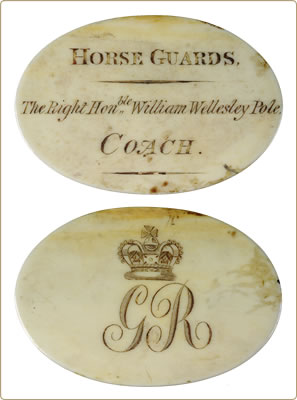

Ivory coach pass belonging to
William Wellesley Pole, Master of the
Royal Mint 1814-1823


It appears by the evidence of the coachman and footman, that as the carriage passed by the Hotel  d’Abrantes, which you may recollect is at the entrance of the Rue des Champs Elysees, they observed a man standing opposite to it, who, on the approach of the carriage moved on and kept pace with it till he reached the nearest sentry box at the Duke’s door, when he stopped and as the carriage was in the act of turning into the gateway the villain fired his pistol. Upon hearing the shot, the horses rather quickened their pace, which the coachman had checked to go more easily over the gutter, and the Duke arrived without accident at the house, totally unaware that he had been fired at, till the footman opened the door and said ‘J’espere, Monseigneur, que votre Excellence n’est pas blesse’.’ He had conceived that one of the sentries’ muskets had gone off by accident. Upon ascertaining how the fact stood, the Duke ordered the assassin to be pursued, but as no step had been taken till he gave the directions to that effect, the scoundrel of course made his retreat good. If however, the sentries had been as indeed they ought to have been outside the Porte Cochere, instead of being in it, or if the footman (a Frenchman) had had his wits about him, and upon seeing the man fire, had immediately jumped down and run after him, or had even cried out he must have been taken; for two of the Duke’s English servants were at the moment coming down the street, and heard the report of the pistol, and whilst they were debating upon what was the cause of the shot at such an hour (it was after midnight) they met the man running: and as one of them had said that the shot might have been fired at the Duke’s carriage they had a great mind to stop him, but hearing no alarm they thought it most prudent to let him go by without molestation.

Shortly after, some of the guard detached from the Duke’s came up to them and asked them if they had seen anybody, to which they replied in the affirmative, and immediately joined with the soldiers in the pursuit. One of the servants ran so fast, that he thinks he saw the same man go into a house in the Rue de la Madeleine, and stay at the door till he came up, when it was slammed in his face. This house was afterwards examined some hours after, I believe, and it appears that the only lodger is a laquais-de-place now in the service of an Englishman. The soldiers and servants continued their researches but ineffectually. The whole of yesterday was occupied by the police in the examination of everybody who could throw any light upon the affair, and in the evening a man came forth who had formerly lived as servant to Burgh, who acknowledged himself the author of an anonymous letter he had addressed Sir Ulysses about a month ago, who had communicated it to the Duke stating that he had been offered a sum of money to assassinate him. He now said that he had no personal acquaintance with the man who had made the proposition to him, but that he should know him if he were to see him, and that he was apprehensive that his own life was in danger in consequence of his refusal to undertake the murder. This laquais had been in the army and had afterwards lived with General Exelmans where he was probably remarked by the villain who wanted to induce him to perpetrate the crime. Nothing else has transpired which may tend to the discovery of the assassin, with the exception of a letter from Lord Kinnaird to Sir George Murray which you will receive through Sir Charles Stuart.


Charles, 8th Lord Kinnaird of Inchture (1780-1826)

In this it is stated that a man had asked Lord Kinnaird if he thought the Duke of Wellington could be prevailed upon to exert his influence with M. De Cazes to grant permission for the return to Paris of three French exiles. Lord Kinnaird replied in the negative, upon which the Frenchman enquired if the Duke would be induced to facilitate their return, on condition of his disclosing a plot, which had been some time in agitation against his life. The rest of the letter contains Kinnaird’s answer to this proposition and the steps which the other considers necessary, if it should be admitted. Murray by the Duke’s desire has written to K. to say that before any other step is taken, he must disclose the name of his informer, and as the attempt to assassinate has since been made, Kinnaird’s letter will be sent to Lord Clancarty (Ambassador to the Netherlands) who will act upon it as he thinks proper. It is impossible so immediately after the event to judge of the effect whi
ch the commission of such an outrage will make in Paris. The only people whom I have yet seen are connected with the Court and they as may naturally be supposed, express in strong terms their abhorrence of it, but the French in general are, as Lord Stanhope truly says, so unprincipled, and they carry their detestation of the Duke and of the English to such an extreme, that I do not believe many of them will really feel shocked that such an attempt should have been made, more particularly as they consider the Duke to be the author of their present degradation.


Duke of Wellington

Much as I have been accustomed to the unostentatious courage and strength of mind so peculiar to the Duke, I acknowledge that he has on this occasion displayed a firmness and a tranquillity which has astonished me, while at the same time he has evinced a disposition to take every precaution in his power to preserve his valuable life. He is aware that if a man is determined to destroy him at the certain sacrifice of his own existence, he cannot prevent him; but he thinks, and I am inclined to entertain the same opinion, that as nobody can have any private pique against him, the person who would undertake to assassinate him, would not venture to do so except on an occasion when he might have a good chance of effecting his escape. Self predominates in the minds of every individual in this nation, and I hope that feeling may be the cause of the preservation of the Duke.

Measures are taken to guard the Duke’s house and to watch the streets immediately leading to it, and he will have an Aide-de-camp always in the house, and he will have a person armed though not in uniform with his carriage. He has promised also never to go about alone and will not make use of his own carriage which is so well known.

Should I hear anything further before the messenger is dispatched I will communicate to you.

Yours most affectionately,

FitzRoy Somerset.

P.S.—Since writing the above, the Duke has shown me his letter to Lord Bathurst which is a very good one; you will observe that at the end of it he expresses a hope, that if it should be thought advisable to publish any part of his letter, care will be taken not to make known that part of it which relates to the channels which may lead to the discovery of the assassin, or to the precautions which he may think it proper to adopt. I have heard nothing further, except that an Officer of the Landers de la Garde was close to the carriage at the time, whose first impulse was to rush upon the villain, but upon second thoughts he judged it best not to attempt to seize him lest he should fail and being seen to run should be suspected of being the assassin. He therefore contented himself with enquiring if the Duke was hurt.

Hand Made Tales: Women and Domestic Crafts

Drawing on the current resurgence in sewing, gardening and cooking and the historical roots of the domestic arts within the home, this exhibition at The Women’s Library in London runs until April 1 and explores the ways in which household crafts have traditionally been the domain of women, their role as sources of knowledge and self-expression shared between generations and communities, and as cultural experiences nurturing the creative spirit is celebrated in the displays. Curated by Carol Tulloch, this timely exhibition will allow visitors to explore and learn the stories of crafts and the women involved in them through personal tales and fun interactive projects.

The Women’s Library is a cultural centre housing the most extensive collection of women’s history in the UK. We run exhibitions and events in addition to the Reading Room Service. The Women’s Library has an extensive Printed collections cataloguesearch online. (books, pamphlets, periodicals and videos). Most of the Library’s books, pamphlets, periodicals and videos are catalogued and available to use. The collections cover a variety of topics, such as women’s rights, suffrage, sexuality, health, education, employment, reproductive rights, the family, and the home. The emphasis is primarily on women in Britain, but some international material is included.

The Library houses over 500 archives (arranged in 11 strands) that document women’s lives and the issues that have concerned and interested them. They date primarily from the mid-nineteenth century to the present day and extend in size from one file to hundreds of boxes. Included are the personal papers of a wide variety of individuals, ranging from the papers of the famous suffragette Emily Wilding Davison to the papers of 2nd wave feminist Sheila Rowbotham. The records of societies and associations are also covered, including female emigration societies, women’s suffrage associations, societies for the abolition of the state regulation of prostitution, societies for the suppression of traffic in persons, women’s employment organisations and a myriad of other pressure groups and campaigning organisations on issues as varied as peace, single parenthood, women clergy and home economics. The records of research and oral history projects are also collected.

An online catalogue is available for searching the archives.

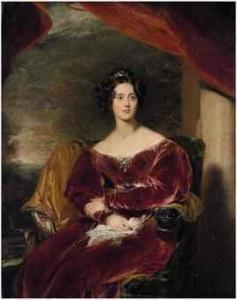
Thos. Lawrence's Countess of Wilton Fetches £1,777,250

In light of the recent posts on this blog by Jo Manning and others regarding Sir Thomas Lawrence, we thought we’d let you know that Lawrence’s portrait of Mary, Countess of Wilton (1801-1858), above, recently sold for £1,777,250 at Christie’s in London.

Of special note is the fact that the Countess of Wilton was the daughter of Edward Stanley, 12th Earl of Derby, and his second wife, the celebrated Irish beauty and actress Elizabeth Farren (1759-1829), whom Lawrence painted early in his career and whose full length portrait won Lawrence name recognition and kudos when it was exhibited at the Royal Academy in 1790. You can read my prior post about the Farren portrait and the Regency Power and Brilliance Exhibition at the National Portrait Gallery in London here.


Elizabeth Farren, later Countess of Derby

Elizabeth (the daughter) married Thomas Egerton, 2nd Earl of Wilton, the second son of Robert Grosvenor, 1st Marquess of Westminster. The Countess of Wilton sat for her portrait in 1829, the year before Lawrence’s death. On the Countess’s death, we have the following:

“At Egerton-lodge. Melton Mowbray, the Countess of Wilton. The deceased lady had been for some time a little indisposed, but fatal results were not anticipated until shortly before her death. The late Countess was very highly esteemed at Melton, both in aristic circles and among the poor, to whom she was endeared by her active charity. The deceased lady was the youngest (and onlv survivor) of the three children of Edward, 12th Earl of Derby, by his second countess (Miss Eliza Farren, the celebrated actress). Her Ladyship was born on the 23rd of March, 1801, so that she was in the 58th year of her age. She was married to the Earl of Wilton on the 29th of November, 1821, and her ladyship leaves two sons and three daughters. The present Earl of Derby (the 14th Earl) stands in the relation of half-nephew to her ladyship, and (being born on the 29th of March, 1799) is two years older than his half-aunt.” —Manchester Guardian.

For full notes and provenance on the Countess’s portrait, visit the Christie’s site here.

On The Shelf – Discovering New Authors – Part One

Occasionally, life treats us to rare gifts: a perfect summer’s day, a hug when you’re needing it most, an excellent pinot noir. If you’re like me, perhaps one of life’s greatest treats is the discovery of a new author. I’m always looking for them and recently I found a blog called My Porch, which I’ve added to the “Amusing Blogs” section found in the righthand sidebar of this blog. Written by a young man named Thomas who lives in Washington, D.C., it is a testament to his reading stamina, which beats my own with a very big stick. I enjoy his `voice’ and his book reviews, but My Porch also boasts a long list of links to yet more book sites, many with a British bent. One can troll them for hours. Which one did until, finally, it dawned on me that Victoria and I might do a post on favorite authors, with healthy backlists, that could then be our gift to you. So here goes. One disclaimer before we continue – you won’t find any romantic fiction here, not because we don’t read it but because many of its authors are friends and once one begins naming friends one inevitably leaves someone out and then one finds oneself in the soup, so to speak. So. . . here are a few of my favorites, in no particular order, beginning with a category of books I term gentle reads. Victoria’s picks in the same category will follow in Part Two. We sincerely hope you find a new author or two amongst them.

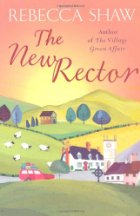
Rebecca Shaw has written two cozy village series, the Barleybridge novels and the Turnham Malpas books. The Barleybridge series consists of three titles that deal with the lives and clients in a rural veterinary clinic. More prolific, the Turnham Malpas books, which number 15 titles, are set in a small village and opens with The New Rector. Here’s the blurb: When Peter Harris arrives in Turnham Malpas as the new rector, he finds the village people welcoming but set in their ways. Yet despite his own weaknesses and the sadness of his childless wife, he comforts and advises his new parishioners, growing more and more involved with the rural way of life. Then the whole village is rocked by a spiteful trick that goes terribly wrong, and a gruesome murder that points to a killer in its midst. Now, more than ever, Peter’s pastoral role is crucial – and yet he is wrestling with his own private hell that may still wreck his own life. Don’t be turned off by the fact that the central character, at least in this title, is a member of the clergy. Shaw’s books are rather like an adult version of the Miss Read books, more on which later. Peter’s arrival in the village sets the stage for our introduction to a cast of quirky and mostly

loveable characters who reappear in succeeding novels. Most storylines do not deal with the church, but do include forays into middle aged love, greed, scandals, char women, shop owners, the gentry, the downtrodden and a few chuckles. Here’s the blurb for another title in the series, Village Matters: Times are changing in Turnham Malpas …Brash Craddock Fitch up at the Big House seems determined to make his mark on the village – and the village is determined to put him in his place. Sir Ralph is having trouble adjusting to his more modest status and timid Muriel to her exalted one while a change of fortune surprises Jimmy Glover too. It’s all Jimbo Charter-Plackett, fount of all gossip, can do to keep up. But these concerns are eclipsed by tragedy when Flick, Jimbo’s daughter, is knocked down by the unpopular barman Alan. And before the shock of the accident has passed, a bitter dispute springs up that could affect the entire village …  Enough drama and 21st century situations happen in each title to keep them from being overtly quaint, while Shaw’s characters and the dilemmas they find themselves in are firmly rooted in village life. You’ll find her website here.
 

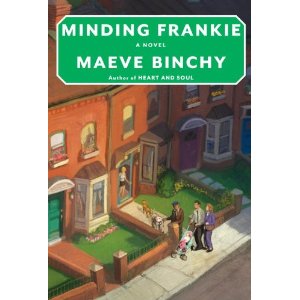
What can one say about Maeve Binchy except “read her?” Binchy is a master at characterization and story telling and each new title is, indeed, a long anticipated treat. Speaking of which, her latest, Minding Frankie, is due out on March 1. Here’s the blurb: Maeve Binchy is back with a tale of joy, heartbreak and hope, about a motherless girl collectively raised by a close-knit Dublin community. When Noel learns that his terminally ill former flame is pregnant with his child, he agrees to take guardianship of the baby girl once she’s born. But as a single father battling demons of his own, Noel can’t do it alone.

Fortunately, he has a competent, caring network of friends, family and neighbors: Lisa, his unlucky-in-love classmate, who moves in with him to help him care for little Frankie around the clock; his American cousin, Emily, always there with a pep talk; the newly retired Dr. Hat, with more time on his hands than he knows what to do with; Dr. Declan and Fiona and their baby son, Frankie’s first friend; and many eager babysitters, including old friends Signora and Aidan and Frankie’s doting grandparents, Josie and Charles. But not everyone is pleased with the unconventional arrangement, especially a nosy social worker, Moira, who is convinced that Frankie would be better off in a foster home. Now it’s up to Noel to persuade her that everyone in town has something special to offer when it comes to minding Frankie. I’ve already pre-ordered this title on my Nook.

Author Marion Chesney is now busy churning out tiles in both the Agatha Raisin and Hamish MacBeth series. If you’ve never read them, by all means do. You’ll find all the titles, and everything you need to know about them, on her website. Both are a series of cozy village mysteries, one set in the Cotswolds, the other in the Highlands of Scotland. Recurring characters and subplots, the standard cozy mystery fare, are both to be found. What isn’t to be found, from one who has read them all, is anyth
ing new. After about the 15th book in each series, one gets to feel that they are simply reading the same book over and over again. And Hamish and Agatha’s character flaws seriously begin to grind on one’s nerves. Still, if you haven’t read them before, you’re in for a treat. What I really wish is that M.C. Beaton would give these books a rest and go back to what she does (did) best and that’s writing Regency comedies as Marion Chesney. Yes, technically her books can be considered Regency romances, but I loved them for their plot lines and humour. And they were written in various series, so that you could settle in with a particular family and get to know all the members. These included  the House for the Seasons, Travelling Matchmaker and Poor Relation series. You’ll find a complete bibliography here. Marion, I know you’re raking in the cash with Agatha and Hamish, but please consider returning to the 19th century.

Beverley Nichols was the sort of man once euphamistically known as a “perennial bachelor.” He was also a writer who managed to write between bouts of gardening, house renovations, visits from instrusive neighbors and caring for cats. Many of his books are about gardening and/or cats, neither subject known for its excitement value. There are no car chases, sexual adventures or titillation of any sort, but what these books do contain is Nichols’s voice, which is at times fond, ironic, exasperated, plaintive or just plain pleased with itself. His first gardening book, Down the Garden Path, was illustrated — as were many of his books — by Rex Whistler. It was a bestseller running to 32 editions and has been in print almost continuously since 1932. It was also the first of his trilogy about Allways, his Tudor thatched cottage in Glatton, Cambridgeshire. A later trilogy written between 1951 and 1956 documents his travails renovating Merry Hall (Meadowstream), a Georgian manor house in Agates Lane, Ashtead, Surrey, where Nichols lived from 1946 to 1956. These books often feature his gifted but laconic gardener “Oldfield”. Nichols’s final trilogy is referred to as “The Sudbrook Trilogy” (1963–1969) and concerns his late 18th-century attached cottage at Ham, (near Richmond), Surrey. Sometimes Nichols waxes poetical about his endeavors – “To dig one’s own spade into one’s own earth! Has life anything better to offer than this?” At other times, he’s just plain funny – “I was brought up surrounded by junk. It was no fault of my mother’s, who had an exquisite, natural taste; it was merely a question of money. We had a large house, a quantity of hideous inherited furniture, and an abundance of positively frightening pictures. We had to put up with them.” Here’s a link to his website, where you’ll find more excerpts from his books and you’ll find blurbs and more about Nichols’s titles here.

Barbara Pym is known for her novels that include village vignettes and snaps of social satire. In a book review, The Times said:  “In Jane and Prudence, one character ironically compares herself to Austen’s matchmaking heroine Emma Woodhouse – and turns out to be no better at finding a husband for her protégée than Emma was. This is Jane Cleveland, a vicar’s wife, now in her forties, who hopes to see her best friend Prudence Bates – a sophisticated bachelor girl with a tendency to fall for unsuitable men – happily settled like herself. So she invites her to the village where her husband Nicholas is vicar, and introduces her to Fabian Driver, a handsome and eligible widower. But Prudence has an unlikely rival for Fabian’s affections in mousy-looking Jessie Morrow, a lady’s companion determined to escape her role as a spinster.” For an article on Pym’s writing, click here. You’ll find the site for the U.S. Pym Society here. There’s also a (hard to find) Barbara Pym Cookbook, featuring recipes mentioned throughout her books.

Born in 1913, Dora Jesse Saint began writing under the name Miss Read in 1955 and has charmed us ever since with her books set in both the fictional Fairacre and Thrush Green. The blurb for the first Thrush Green, titled the same, runs – “It’s the May Day holiday, and a fair has come to the village of Thrush Green. The residents of Thrush Green all have their own views about the fair. For young Paul, just recovered from an illness, it is a joy to be allowed out to play at the fair; for Ruth, who returned to the soothing tranquillity of Thrush Green nursing a broken heart, the fair is a welcome distraction from her own problems. And for Dr Lovell, the fair brings an unexpected new patient. Then there is Mrs Curdle, the long-standing matriarch of the fair. For her, this year’s visit to Thrush Green awakens mixed feelings, and a difficulty she doesn’t want to face… Full of Miss Read’s inimitable charm and humour, Thrush Green is a wonderful introduction to this bestselling series.” While written in the 1950’s, 60’s and 70’s, Miss Read’s books read as though they hark back an even earlier time when life was simpler and time ticked by more slowly. The crisis encountered by the villagers in Thrush Green are more personal than global and are often solved by their being shared. Still, Miss Read uses insight to draw simple but richly felt characters with whom we instantly identify and for whom we care immensely. As we do for those characters who live in Fairacre “. . .  a village of cottages, a church and the school – and at the heart of the school, its head mistress, Miss Read. Through her discerning eye, we meet the villagers of Fairacre and see their trials and tribulations, from the irascible school cleaner Mrs Pringle, to the young school children, with their scraped knees, hopeful faces and inevitable mischief. Miss Read takes us through the school year, beginning with the Christmas term, when the bitterly cold weather challenges the school’s ancient heating system, right through to the hot summer day when school is over for another year. Full of Miss Read’s unique, acerbic wit, and wry observations.” These are books to savor and to read, and re-read, whenever the world we currently
live in seems a bit too complicated for our liking. Miss Read retired from writing in 1996 and was made a Member of the Order of the British Empire in 1998. As far as I can make out, she is still alive. Hurrah! Why, I wonder, is there no Miss Read Society? You can find a complete bibliography of her books here.

There is an Angela Thirkell Society and you can find them here. In fact, our very own Victoria is a card carrying member and did a post on the Society that you’ll find here. Barsetshire is a fictional county created by Anthony Trollope, which is featured in the series of novels known as the “Chronicles of Barsetshire” and where the county town and cathedral town is Barchester. Trollope’s books have been made into various mini-series, namely The Way We Live Now and The Pallisers. I’ve just downloaded the first book in the Barsetshire series, The Warden, and will then move on to The Barsetshire Chronicles, also made into a mini-series.  Barsetshire was also used as the setting for a series of 29 novels by Angela Thirkell, written from 1930 to 1961. Thirkell’s stories blend social satire with romance. In Part Two, Victoria will tell you about Thirkell’s books – and more.

Part Two Coming Soon!

The Wellington Connection – The Tower of London

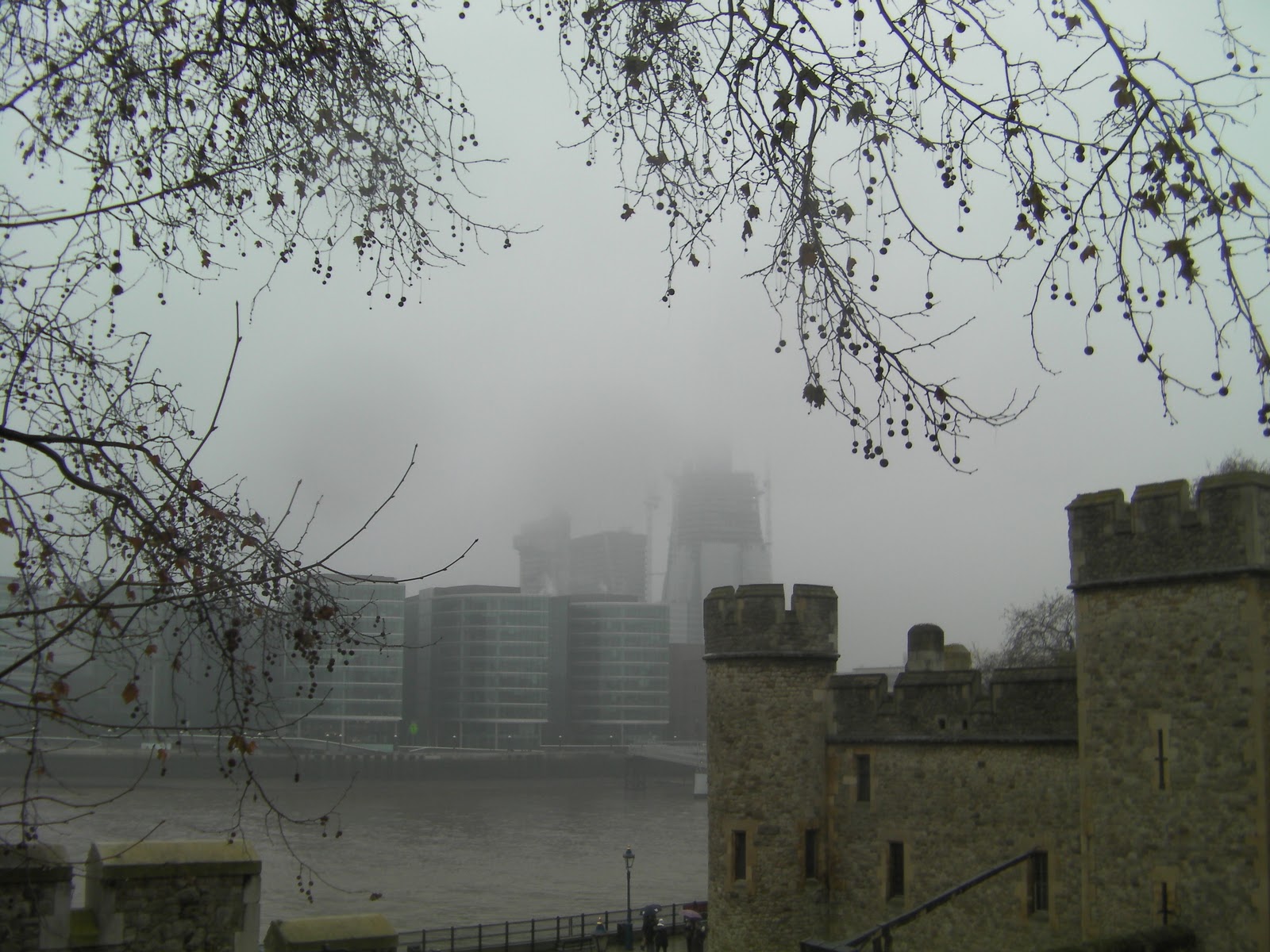
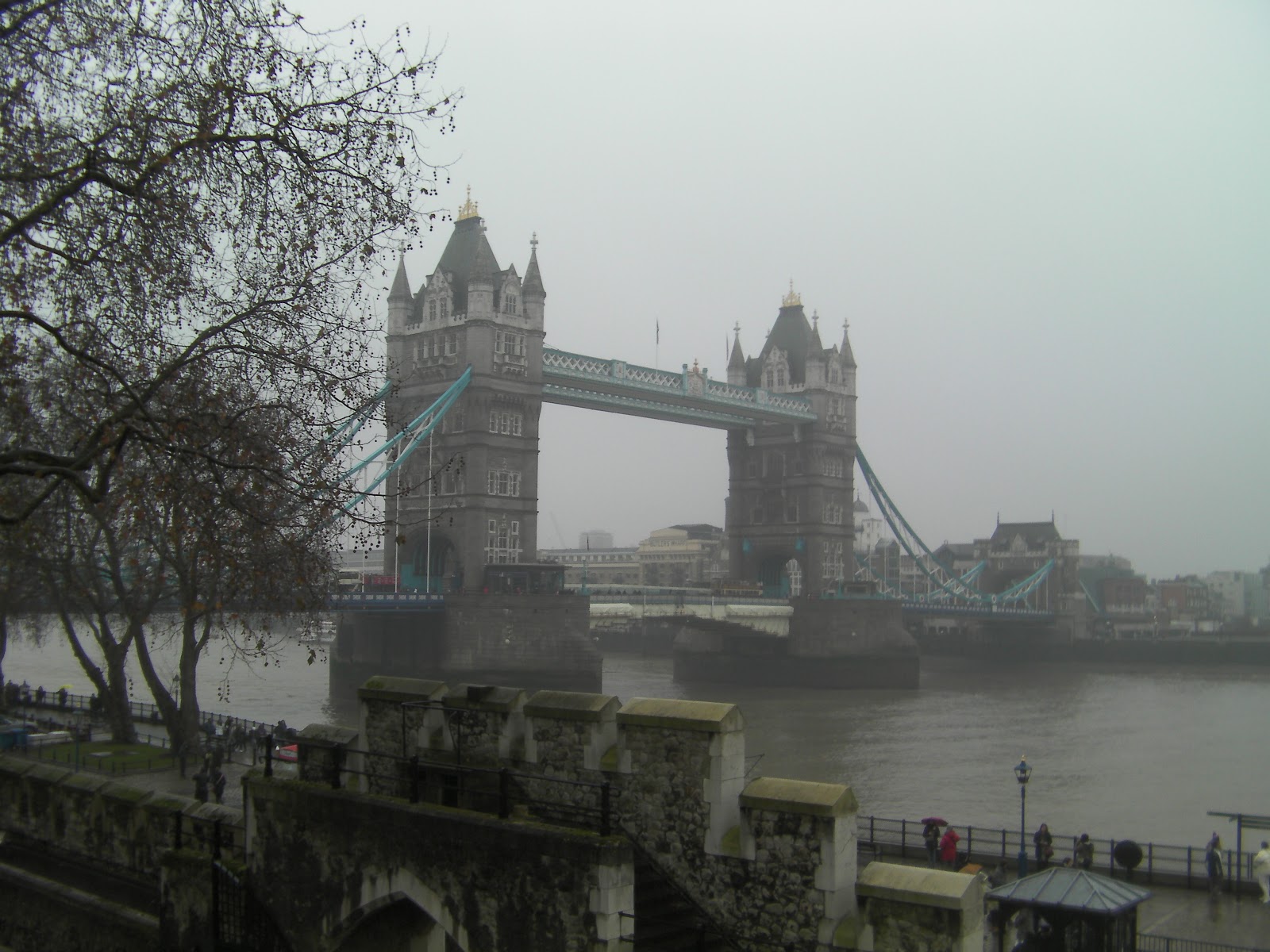
It was a cold, wet, foggy day when we visited the Tower of London – a day chock full of atmosphere and history.

Of course, the Tower is a must see for any first time visitor to London and that’s why it was on our agenda, so that Greg could take it all in. Not surprisingly, the Duke of Wellington made an appearance here, as well, having served as Constable of the Tower for 26 years. As I said to Greg, “You’ve got to give it to Artie, he had his fingers in so many pies.”

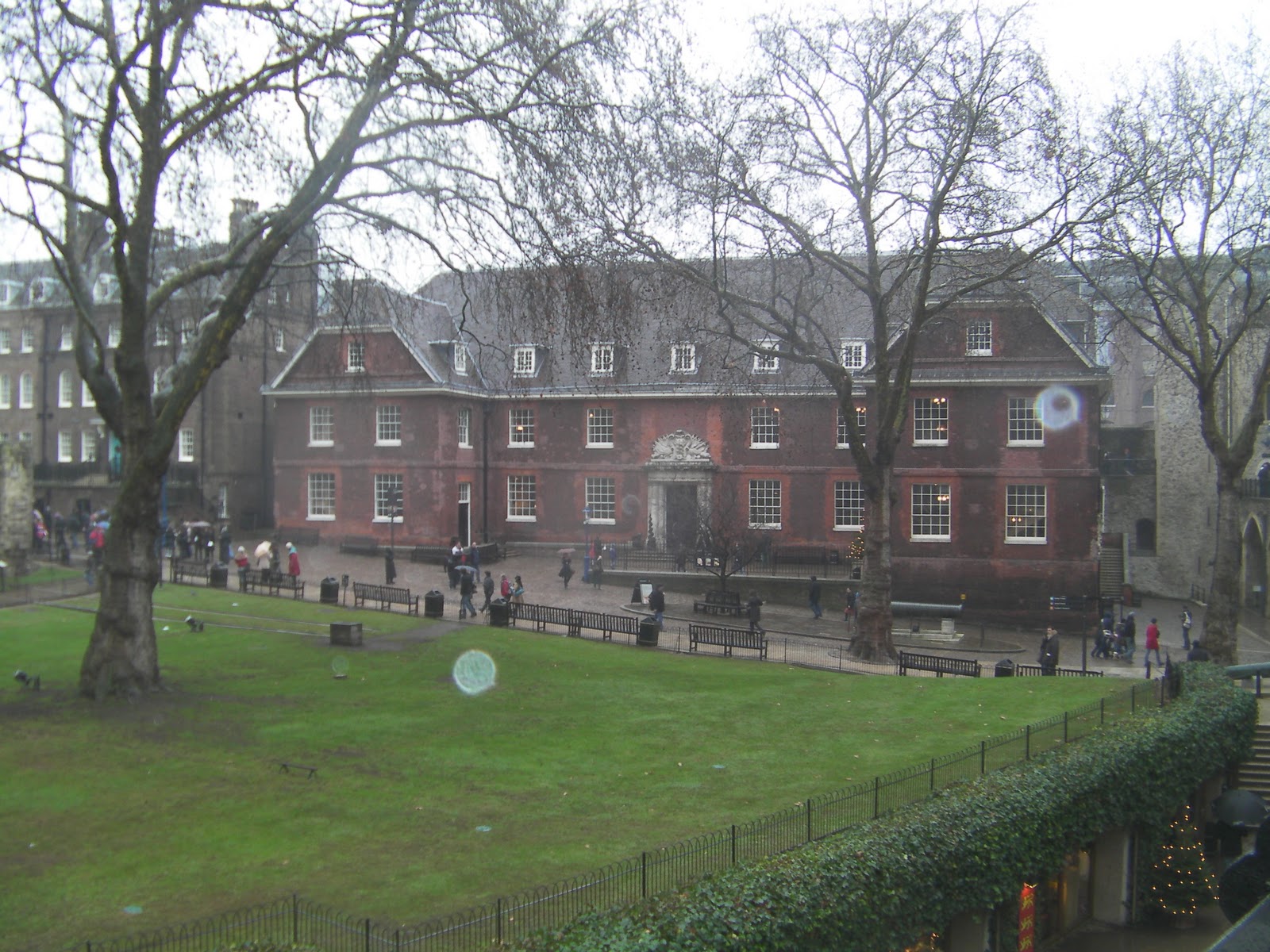
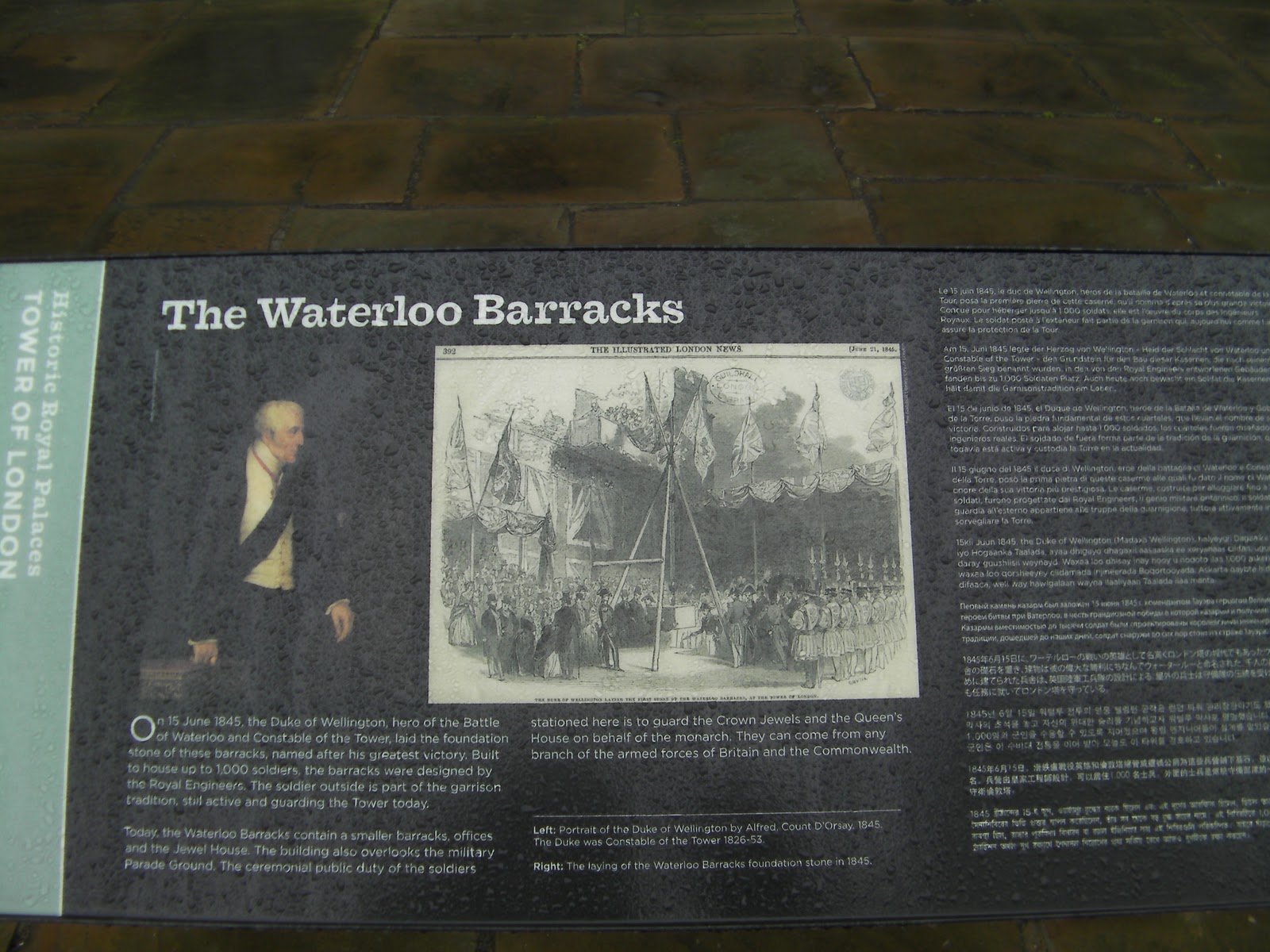
The Waterloo Barracks

The Waterloo Barracks at the Tower were built while Wellington was Constable and named after his famous victory over Napoleon. The building replaced the Grand Storehouse which was destroyed by fire in 1841 and the foundation stone, laid by the Duke of Wellington in 1845, can be seen at the north-east end of the building.  The fire, which had taken place on October 30, 1841, at 10:30 p.m. was caused by an  overheated flue in the Bowyer Tower. Thirty minutes later, the Bowyer Tower was almost completely destroyed, and the fire had spread to the armories and storehouse to the east of the Chapel of St. Peter ad Vincula. By midnight the armories were burning so furiously that the heat caused the lead pipes to melt on the walls of the Great Tower. The Brick Tower then caught fire, and flames threaten to burn Martin Tower where the Crown Jewels of England were kept. The Keeper of the Jewel House only had the key to the outer room (the Lord Chamberlain had the other keys). Water was sprayed on the walls of Martin Tower as firemen tried to keep the walls cooled down until the Crown Jewels could be removed. One firemen was killed when he was hit by a piece of falling stone. Using crowbars, policemen bent back the bars from in front of the Crown Jewels. A brave policeman handed out the Crown Jewels piece by piece. He did not leave, even though his uniform was charred from the heat, until everything, except a silver font which would not fit through the bars, had been saved. The fire was finally under control at 3:15 a.m., but the two armories, storehouse, Bowyer Tower, and the Brick Tower were destroyed, and both the Chapel of St. Peter ad Vincula and the Great Tower (White Tower) were badly damaged. The Duke of Wellington was Tower Constable at the time of the fire (he was appointed in 1826), and with the help of Prince Albert, Wellington spearheaded a campaign to get government funds to restore and rebuild the Tower of London. This massive project lasted throughout the rest of the 19th century.

At the time Wellington became Constable in 1826, the post of Yeoman Warder could be bought for 250 guineas, or even inherited within families. The Duke brought these practices to an end, making appointments based on distinguished military service. He also made improvements to the Tower itself. By 1841, in the words of the Surgeon-Major, the moat was ‘impregnated with putrid animal and excrementitious matter…and emitting a most obnoxious smell.’ Several men from the garrison died and 80 were in hospital due to the poor water supply. Local cholera outbreaks were blamed on the moat. The duke drained it and created the dry ditch, or fosse, that visitors see today.


Lion’s skull found in drained Tower moat

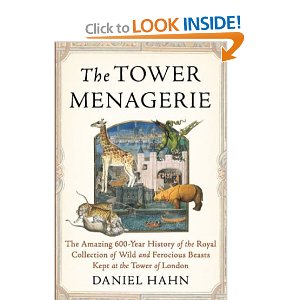
 The menagerie at the Tower was once filled with exotic animals and was a popular tourist attraction. It was established by King John, who reigned in England from 1199-1216, and is known to have held lions, elephants, leopards, camels, ostrich and bears. The menagerie was finally closed in 1835, on the orders of the Duke of Wellington, and the remaining animals were moved to the Zoological Society’s Gardens in Regent’s Park, now known as London Zoo.

A list of animals in the menagerie during the reign of George IV

To learn more about the history of the Tower menagerie, click on the book cover.

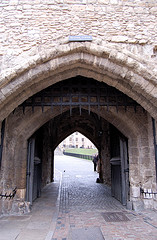
Finally, the Duke made some improvements to the portcullis at the Bloody Tower, above. Look closely and you’ll see spiked, black iron bars on either side of the doorway at about knee height. The Duke ordered these to be installed so that the guards would no longer be able to lounge against the wall and smoke whilst on duty – ha!