
Bridget Jones meets Pride and Prejudice. Click here to watch the video.

— The King and Queen arrived at the Pavilion at Brighton on Saturday afternoon in a travelling chariot, preceded by outriders. On their Majesties’ arrival a Royal salute was fired from the battery, and a peal was rung on the bells of St Nicholas’ tower. In the evening the town was enlivened with a brilliant display of fire-works, which was seen by their Majesties and suite from the windows of the Palace.
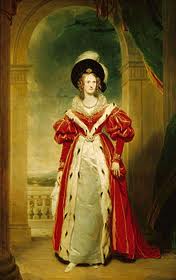 |
| Queen Adelaide |
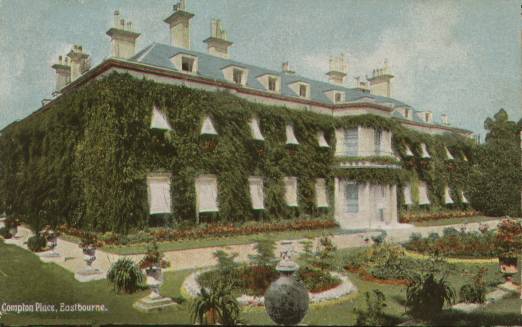 |
| Compton Place |
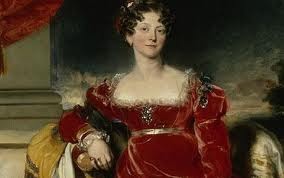 |
| Princess Sophia by Lawrence |
 |
| Haigh Hall |
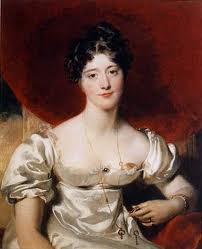 |
| Marchioness of Londonderry |
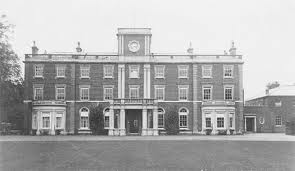 |
| Sudbourne Hall |
— Prince Esterhazy and his son have left Chandos House for Sudbourne Hall, the magnificent seat of the Marquis of Hertford, in Suffolk, which, since the departure of his Lordship for Italy, has been entitled ‘ Paradise Lost.’ The Prince from his long residence here is on the closest terms of intimacy with the Noble Marquis,who has accorded permission to his Highness and other persons of note to shoot over his preserves, which swarm with game from Sudbourne. The Prince proceeds to the Duke of Grafton’s, at Euston, for a week.
 |
| Hornby Castle |
— The Duke and Duchess of Leeds have been entertaining their relatives and friends at his Grace’s splendid establishment, Hornby Castle. Mr and Lady Charlotte Lane Pox have been staying during the last week at Gwydyr House, the magnificent mansion purchased by the Duke from Lord Willoughby d’Eresby. They return to Yorkshire in a few days.
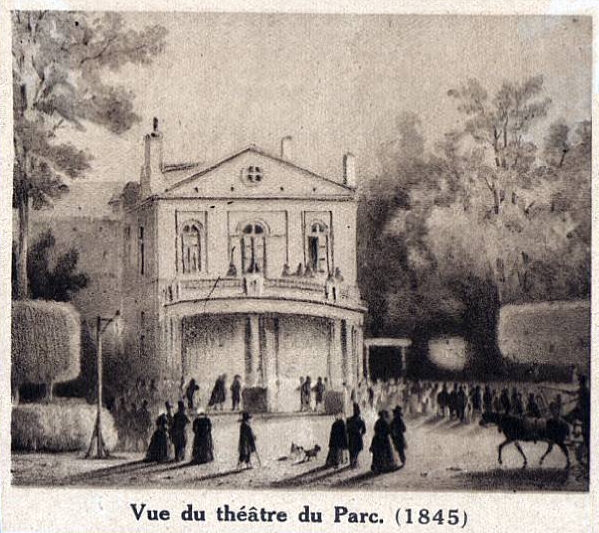 |
| copyright the Brussels Bronte Group |
From: Three Years With the Duke, or Wellington in Private Life (1853) by Lord William Pitt Lennox (younger son of the Duke of Richmond)
The theatre in the Park (in Brussels 1814) was opened, under the management of Mr. Penley, with a company of English players. The comedy of John Bull was the first performance, and attracted a most crowded and fashionable audience. Throughout the day, it had been hinted at the box-office, that the Duke of Wellington would probably attend the evening’s performance, and a private box had been kept back under this hope. The Duke’s avocations, however, prevented his making his appearance upon this occasion, as he had already informed the manager, when asked to patronise the play. This nearly led to a ludicrous mistake—a young officer and myself had been dining in company with the Duke, and, with that good-nature and consideration for which he was famed, he gave us permission to attend the theatre, telling us we might take his carriage after it had set him down. Upon reaching the Park, the carriage was recognised, and a crowd immediately followed it. As we gained the entrance of the theatre, the name of Wellington rent the air. This was communicated to the manager, who thrust his head out from behind the curtain, to give a signal to the leader of the band to play, “See the conquering hero comes!” The report spread like wildfire. The performances ceased—all eyes were anxiously fixed on the vacant box.
In the meantime, we had jumped out of the carriage, had tendered our money, and were surprised at the obsequiousness of the box-keeper, who, thinking we were the precursers of the Duke, begged us to walk into the lobby. The manager, or some official personage, had rushed into the private box to prepare the seats, and there awaited the welcome visiter. We now began to see the mistake that we had unwittingly caused; and, anxious to explain it, we approached the now open box-door. No sooner were our uniforms visible, than the band struck up the heart-stirring melody. In vain did we try to correct the error: the audience had risen, en masse; shouts re-echoed throughout the house; the curtain was drawn up, and the company came forward to sing the national song of “God save the King:” but no Duke of Wellington appeared.
For some minutes the cheers continued, when at length it was announced from the stage, that a slight mistake had occurred— that the avocations of the noble Duke had prevented his attendance; and, after the excitement had a little subsided, my young friend and myself sneaked quietly into the box, placing ourselves behind the curtain, fearful of calling the attention of the public to two mere urchins, who so unintentionally had nearly received the honours due to their chief.
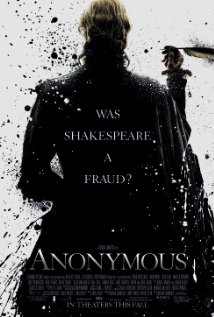
Anonymous, opening on October 28th, is a political thriller advancing the theory that it was in fact Edward De Vere, Earl of Oxford who penned Shakespeare’s plays; set against the backdrop of the succession of Queen Elizabeth I, and the Essex Rebellion against her. The film stars Rhys Ifans, Vanessa Redgrave and David Thewlis.
Shakespearean conspiracy theories have been around for centuries and the film does not seek to advance one or the other, but rather it presents the facts and leaves it to the viewer to make up their on mind on the subject. The sets are gorgeous, the acting isn’t half bad and the costumes are as authentic as costume designer lisy Christl could make them. Christl boiled, shrank, then dyed and painted the fabrics to transform them into director Roland Emmerich’s desired look for the authentic atmosphere of the political snake-pit of Elizabethan England and the movie’s picture style with low light that comes from candles and fireplaces.
“With the new developments in digital cinematography, we could really take advantage of candlelight and firelight,” says Director of Photography Anna Foerster. “For a period piece, using available light – candles, fireplaces, whatever comes in from outside – makes it real.” Together with Emmerich, she developed the look of the film from the paintings of Johannes Vermeer and Georges de La Tour. “Vermeer uses the soft, diffused daylight that comes in through windows; de La Tour would have a single source of light, a candle or a torch.”
 |
| Actress Joely Richardson in the role of Princess Elisabeth Tudor, later Queen Elizabeth I. |
Visit the film’s official site here, where you can watch a trailer, as well as design your own coat of arms. A review of the film can be found at here at ScreenCrave.

From The Creevey Papers
October 23rd. (1837) —Since August 30th, nearly two months, I have written not a line, for I have had nothing to record of public or general interest, and have felt an invincible repugnance to write about myself or my own proceedings. Having nothing else to talk of, however, I shall write my own history of the last seven weeks, which is very interesting to me inasmuch as it has been very profitable. Having asked George Bentinck to try my horse ‘Mango’ before Doncaster, we went down together one night to Winchester race-course and saw him tried. He won the trial and we resolved to back him. This we accomplished more successfully than we expected, and ten days after he won the St. Leger, and I won about 9,000Z. upon it, the first great piece of good fortune that ever happened to me. Since Doncaster, I have continued (up to this time) to win at Newmarket, so that my affairs are in a flourishing condition, but, notwithstanding these successes, I am dissatisfied and disquieted in my mind, and my life is spent in the alternations of excitement from the amusement and speculation of the turf and of remorse and shame at the pursuit itself. One day I resolve to extricate myself entirely from the whole concern, to sell all my horses, and pursue other occupations and objects of interest, and then these resolutions wax faint, and I again find myself buying fresh animals, entering into fresh speculations, and just as deeply engaged as ever. It is the force of habit, a still unconquered propensity to the sport, and a nervous apprehension that if I do give it up, I may find no subject of equal interest.