HAPPY 241st BIRTHDAY, JANE AUSTEN

HAPPY 241st BIRTHDAY, JANE AUSTEN

Here we are, almost entering the year 2017, two hundred years on July 18 since Jane Austen died at the terribly premature age of 41. Hard to believe the woman who wrote such celebrated literature lived only a smidgen above four decades. Her legacy will live forever.

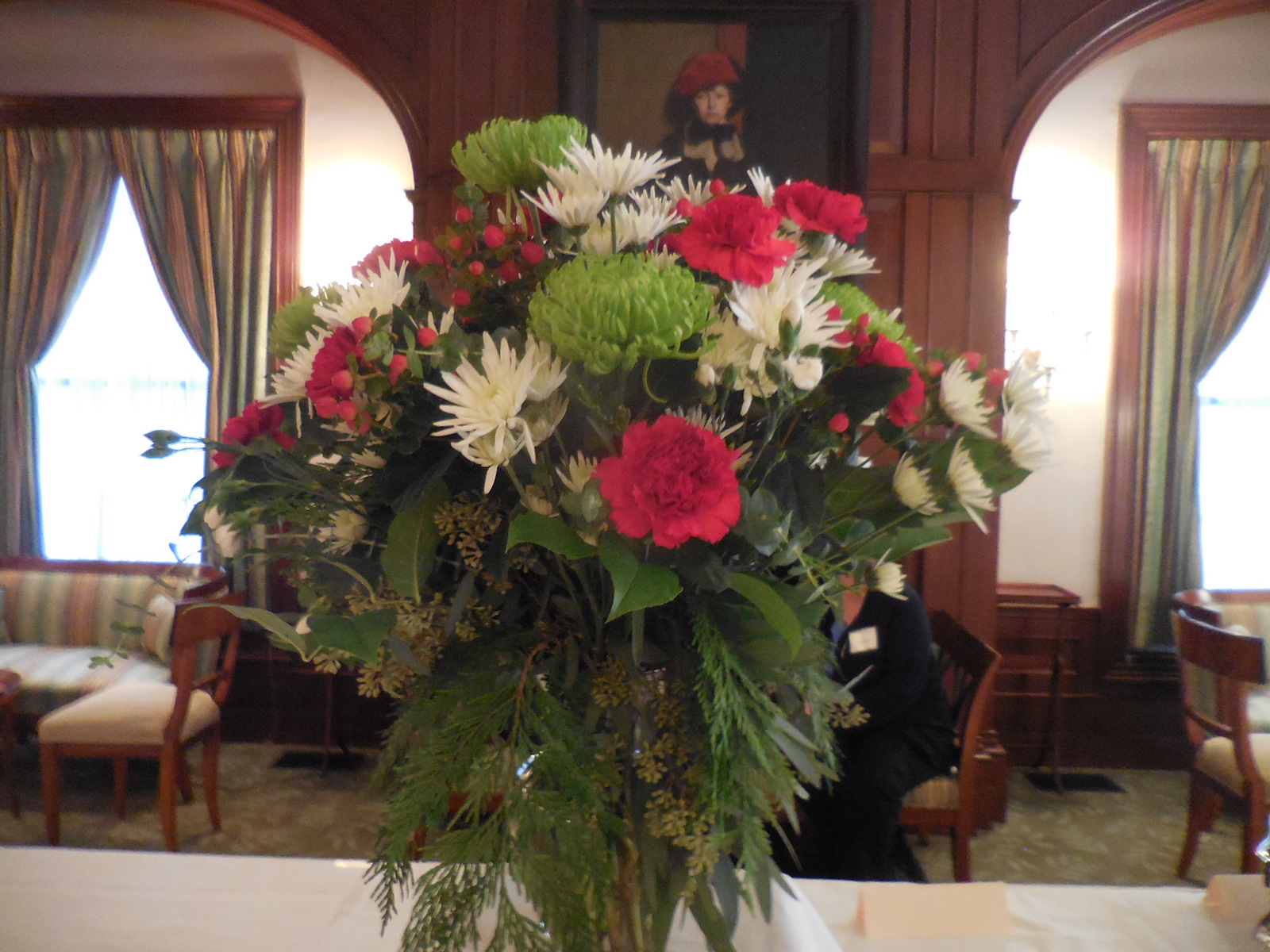
I am fortunate to attend two Jane Austen Society of North America Birthday events each year, one in Chicago and one in Milwaukee. Both are joyous occasions in beautiful venues with excellent programs, fine food, and rooms full of delightful companion Austen-lovers. Since JA’s birthday falls in mid-December, we always celebrate amidst seasonal decorations adding to the festivities.

The Great Chicago Region held our Birthday Tea on Saturday, December 3, at The Fortnightly, just north of the Magnificent Mile.

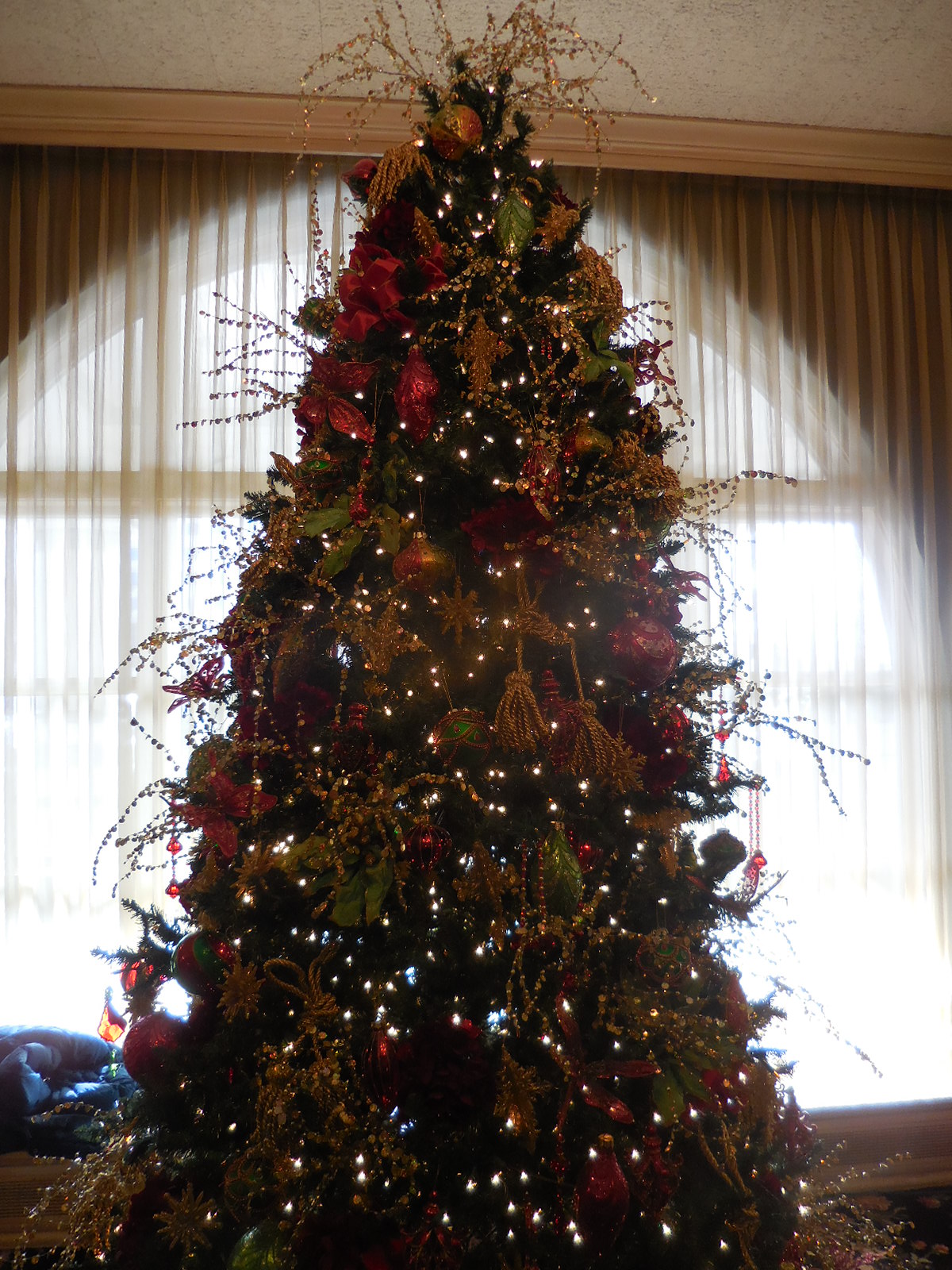
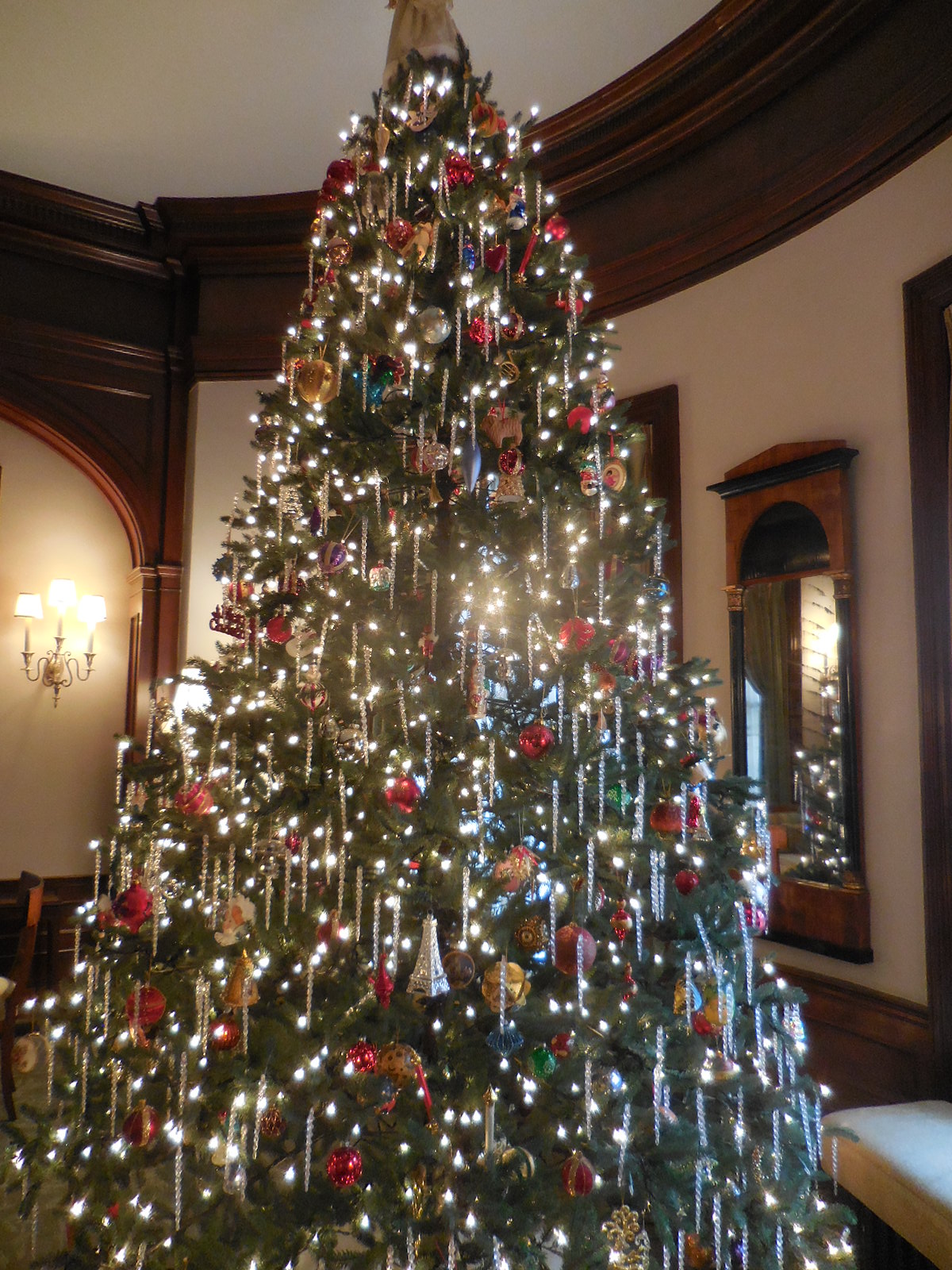
One of The Fortnightly’s many Christmas trees.

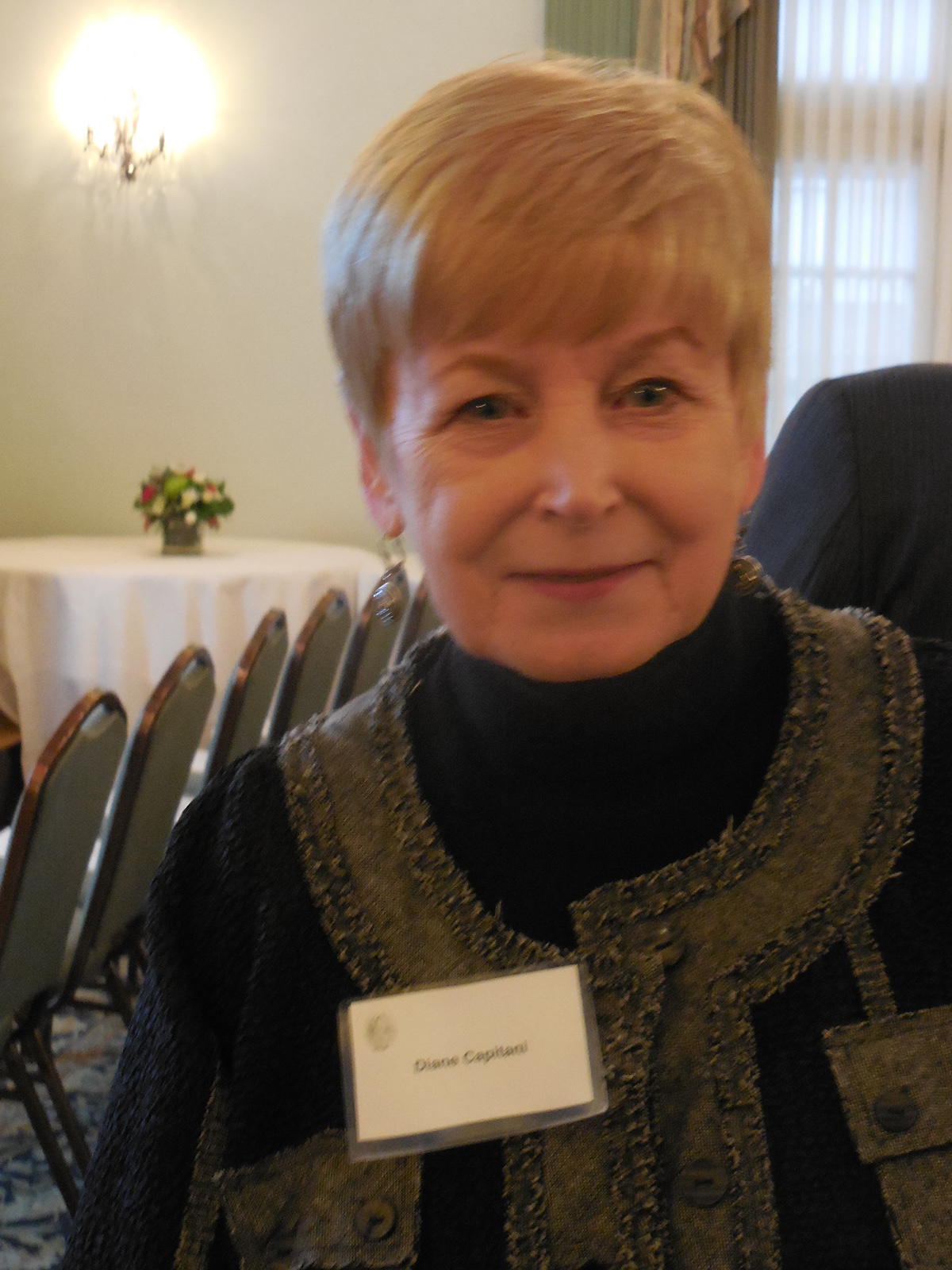
This year, Dr. Diane Capitani presented a talk on Emma and Motherhood, exploring the many aspects of maternal activity — or lack of it — in the last novel Austen published in her lifetime.  As always, Dr. Capitani drew us deep into her subject with provocative interpretations inspiring lively discussion. Four leading characters in the novel are “motherless” – Emma, Frank Churchill, Jane Fairfax, and Harriet Smith. Other characters give us a variety of potential (or actual) maternal behavior: Emma herself in regard to her father, Miss Taylor/Mrs. Weston, and the deliciously offensive Mrs. Elton, for example. The resulting conversation was only stopped by the temptations of The Fortnightly’s sumptuous tea.

Diane Capitani
Dr. Capitani is a professor at the Garrett Theological Seminary of Northwestern University, and the Education Outreach Director of JASNA-GCR.

On Saturday, December 10, the Wisconsin Club in Milwaukee was the scene of JASNA-WI’s Birthday luncheon. The bright sunlight outdoors almost stole the sparkle from their huge dining room tree.

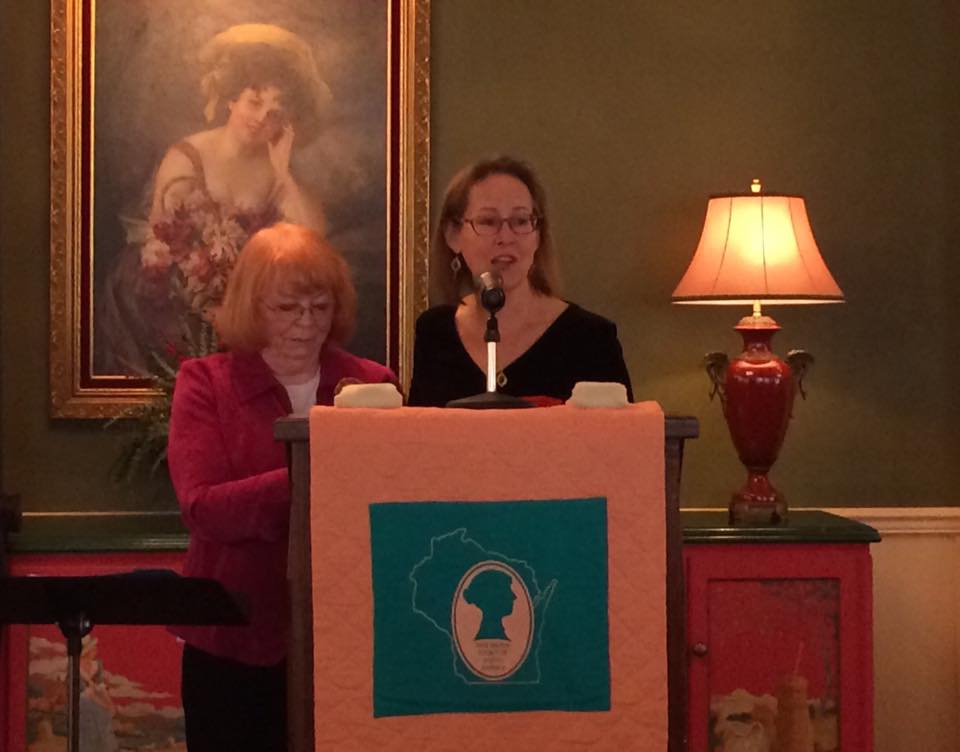
JASNA-WI Regional Coordinator Judith Beine (left) concluded her two terms as RC, turning the reins over to Kim Wilson (right) as the newly elected RC.

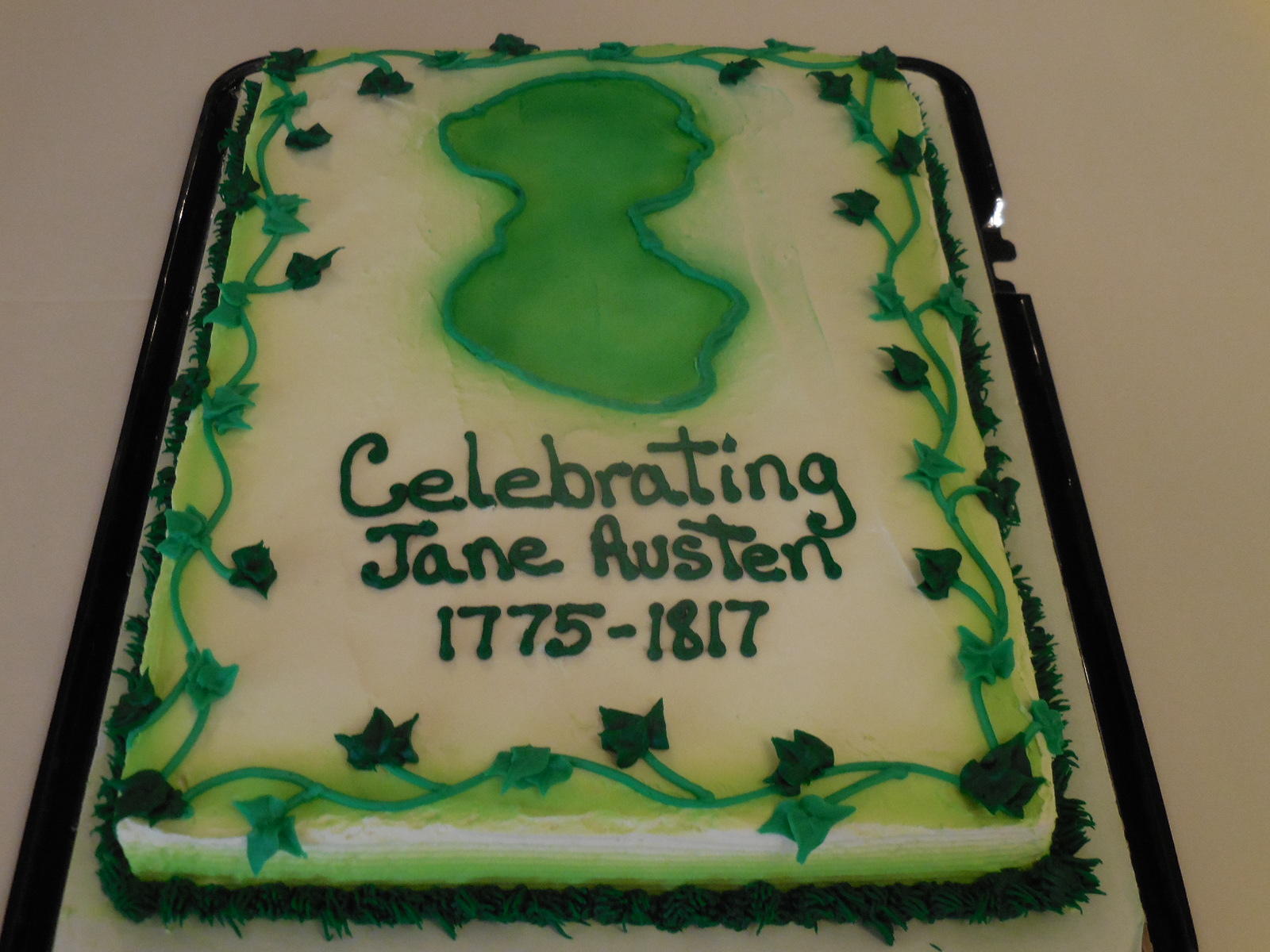
Following the delicious luncheon, we shared birthday cake, a timely reminder of the real source of our celebration.

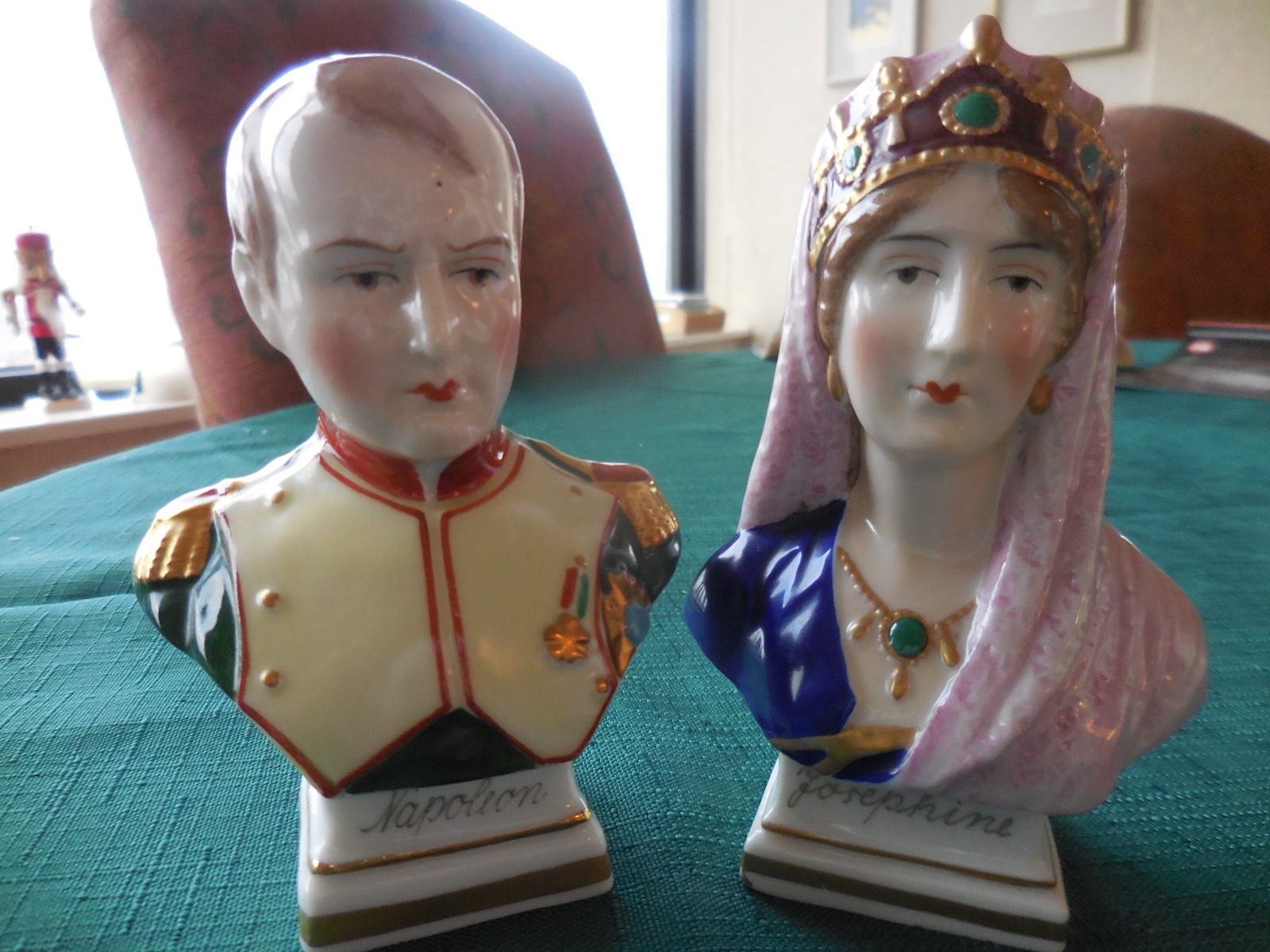
After quite a few years as JASNA-WI Recording Secretary, I was delighted to turn over my records to incoming RS, Sara Bowen,  Thanks Sara!  And many thanks also to Judy Beine for presenting me with these charming reminders of Wellington’s great victory in 1815’s Battle of Waterloo: antique statues of Napoleon and his Josephine.

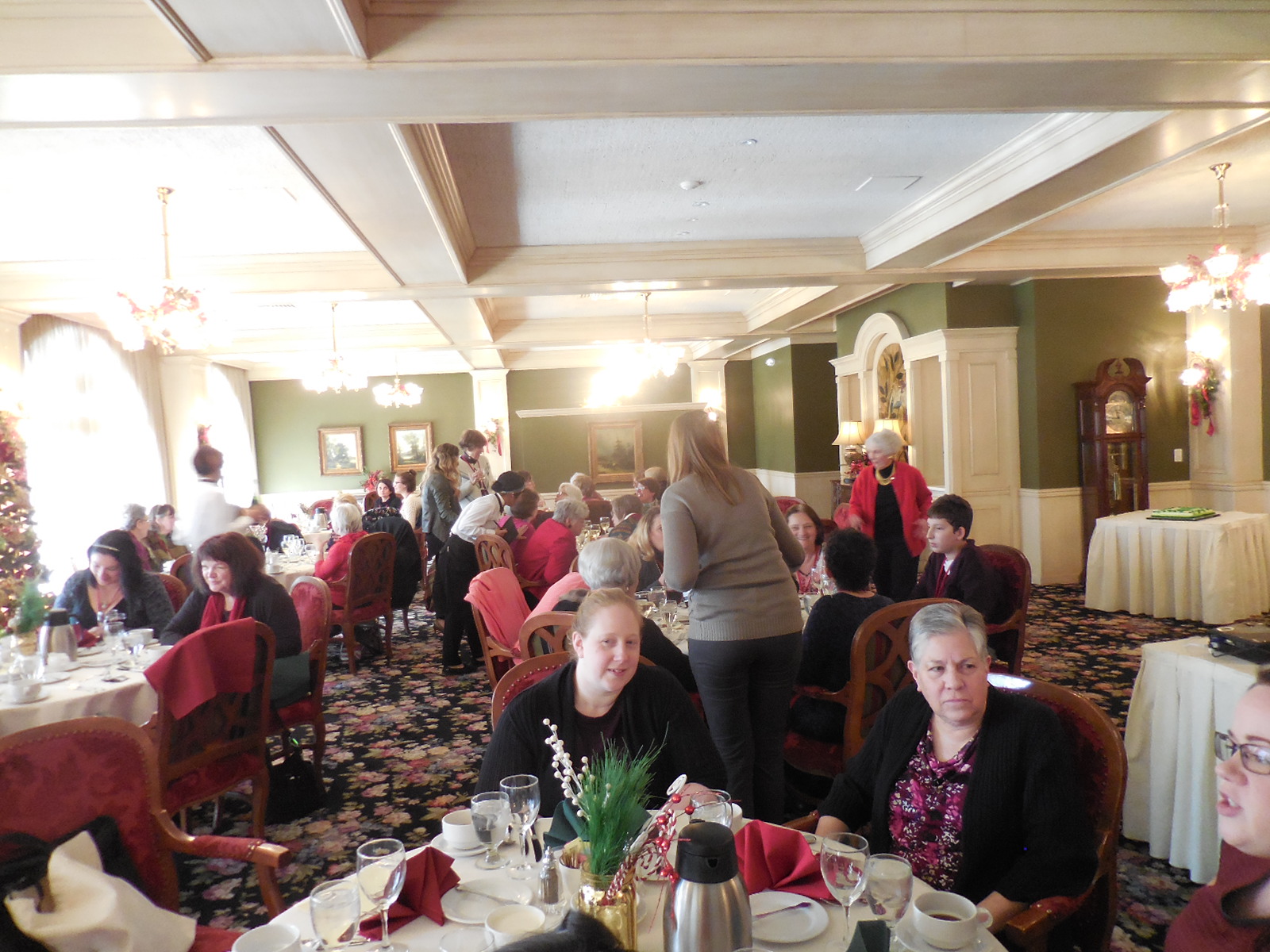
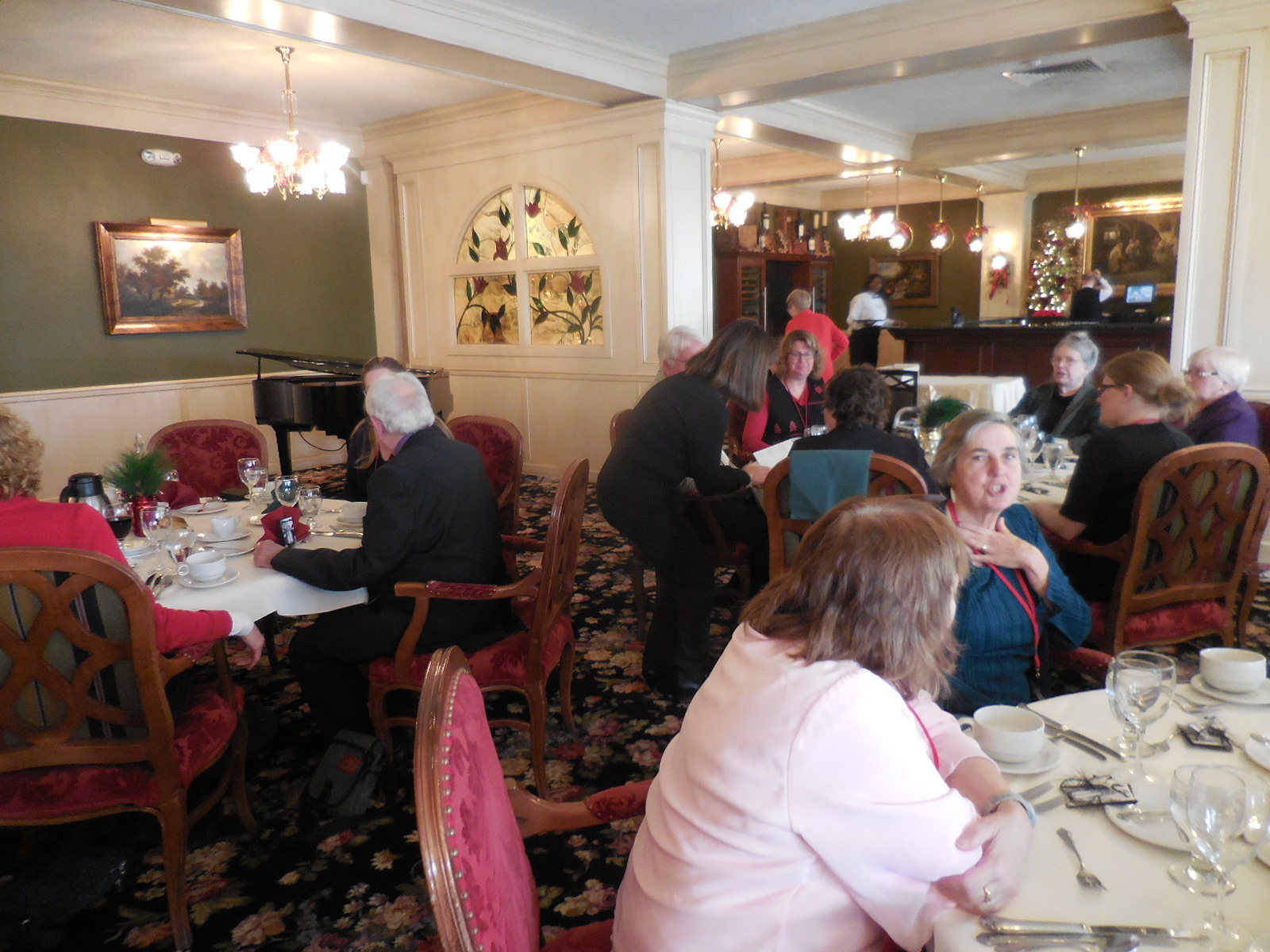
A large crowd enjoyed fellowship and the best of all events: a delightful presentation on Jane Austen’s life and times.

Speaker of the day was the always-popular Professor Jeffrey Nigro of the Art Institute of Chicago and Newberry Library, in addition to his recent terms as JASNA-GCR’s Regional Coordinator and presently as the Program Director.
Jeff Nigro
Jeff presented Divas in the Drawing Room, or Italian Opera Comes to Highbury.  The popularity of Italian Opera in the London Society of Jane Austen’s era, augmented by the well-publicized competitions among the prima donnas, was reflected in Austen’s Emma.  
Madame Catalani

 Emma admires the abilities of Jane Fairfax, her replacement as the leading performer in Highbury (it’s prima donna?), but Emma is also very envious.  Less important, but amusingly noted, are the continual claims of Mrs. Elton to performance excellence, even though she deftly deflects invitations to illustrate her ability.  Including some soaringly-lovely examples of Italian vocal technique , this lecture brought everyone a new appreciation of Emma — and of Jeffrey Nigro! 
 One reminder for the upcoming new year.  You need to order your 2017 Jane Austen Calendar!

BEHIND THE SCENES OF THE CROWN

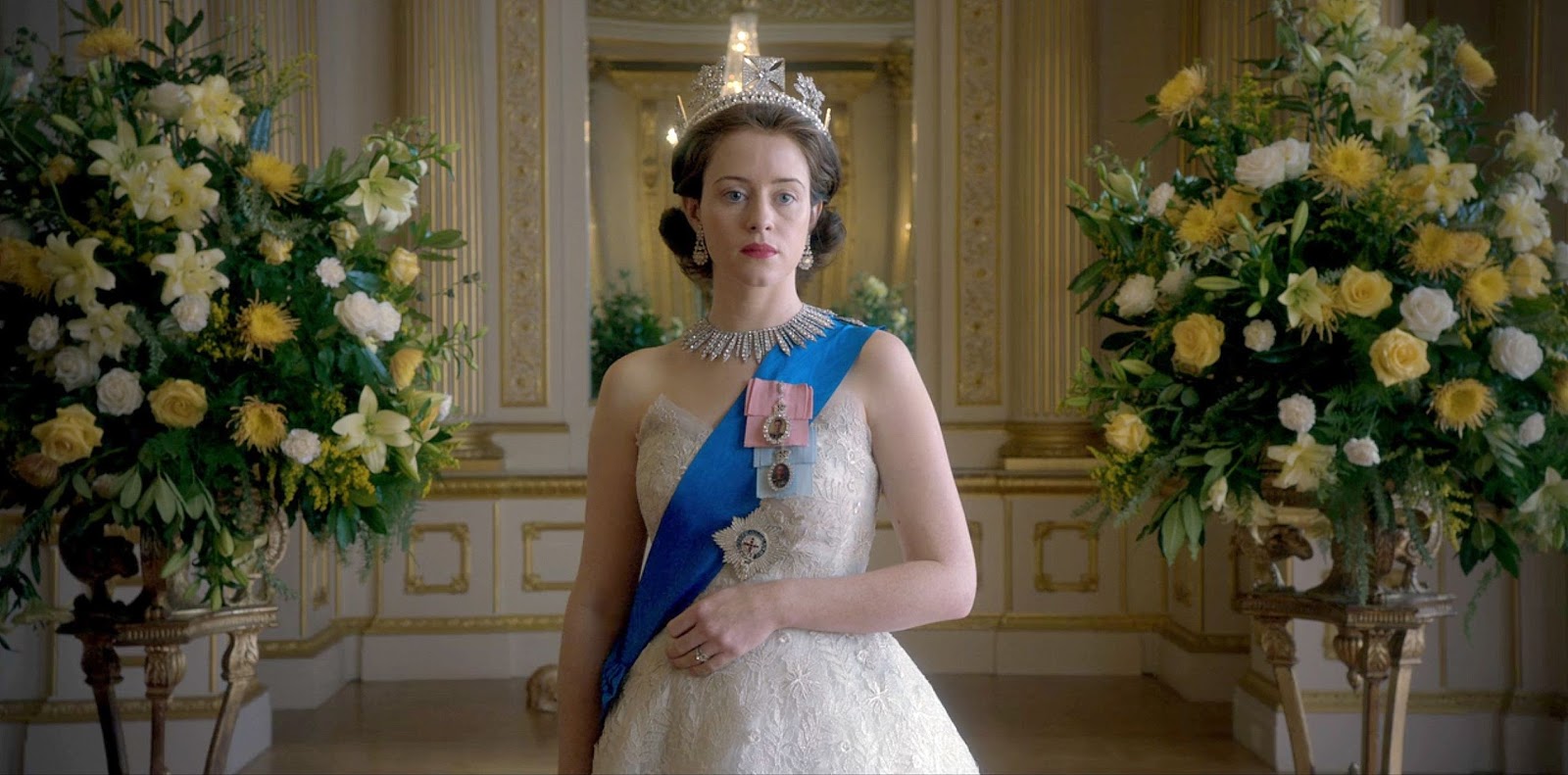
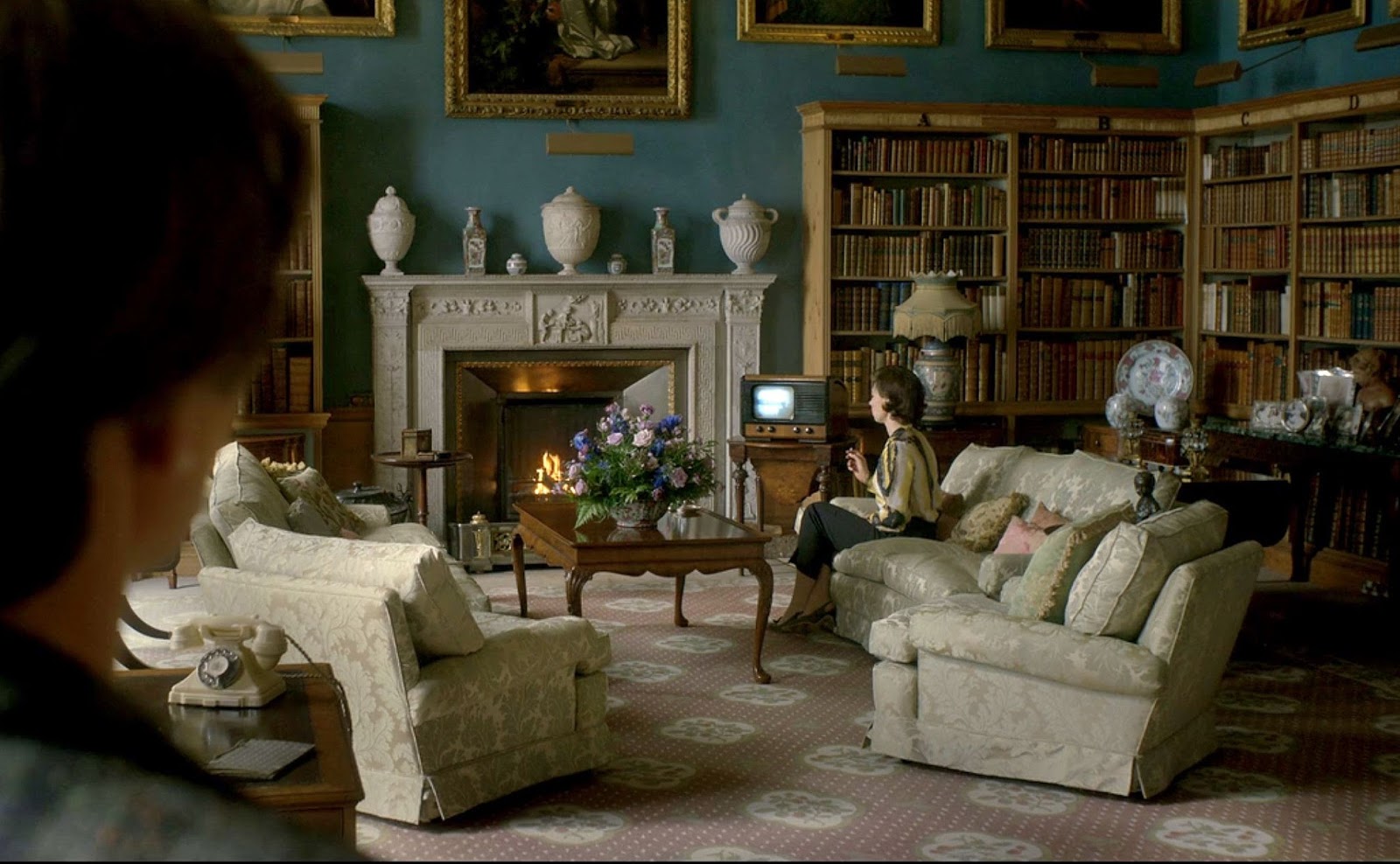
A few months ago, my pal Denise Costello led me to a fabulous blog called Cote de Texas, a lifestyle, decorating, design and all around wonderful site. Recently, Joni Webb, who writes and edits Cote de Texas, ran a really in-depth, well researched and visually stunning post on the sets used during the filming of The Crown, the Netflix series centered on Queen Elizabeth and the royal family that reached a staggering $100 million to produce, chiefly due to the fact that the production team were determined that the sets, costumes, jewels, cars and everything else connected with filming be historically correct.

For her recent post, Joni uncovers which historic locations stood in for Buckingham Palace and Clarence house, she looks into the attention to detail that is the hallmark of The Crown and also offers up some most amusing nuggets of behind-the-scenes on-dit.

Click here to read Behind the Sets of The Crown, which  appears to be just the first in a series of posts about The Crown, so don’t forget to follow the site while you’re there!

WINDSOR'S "CROOKED HOUSE" NOW THE JERSEY PEARL

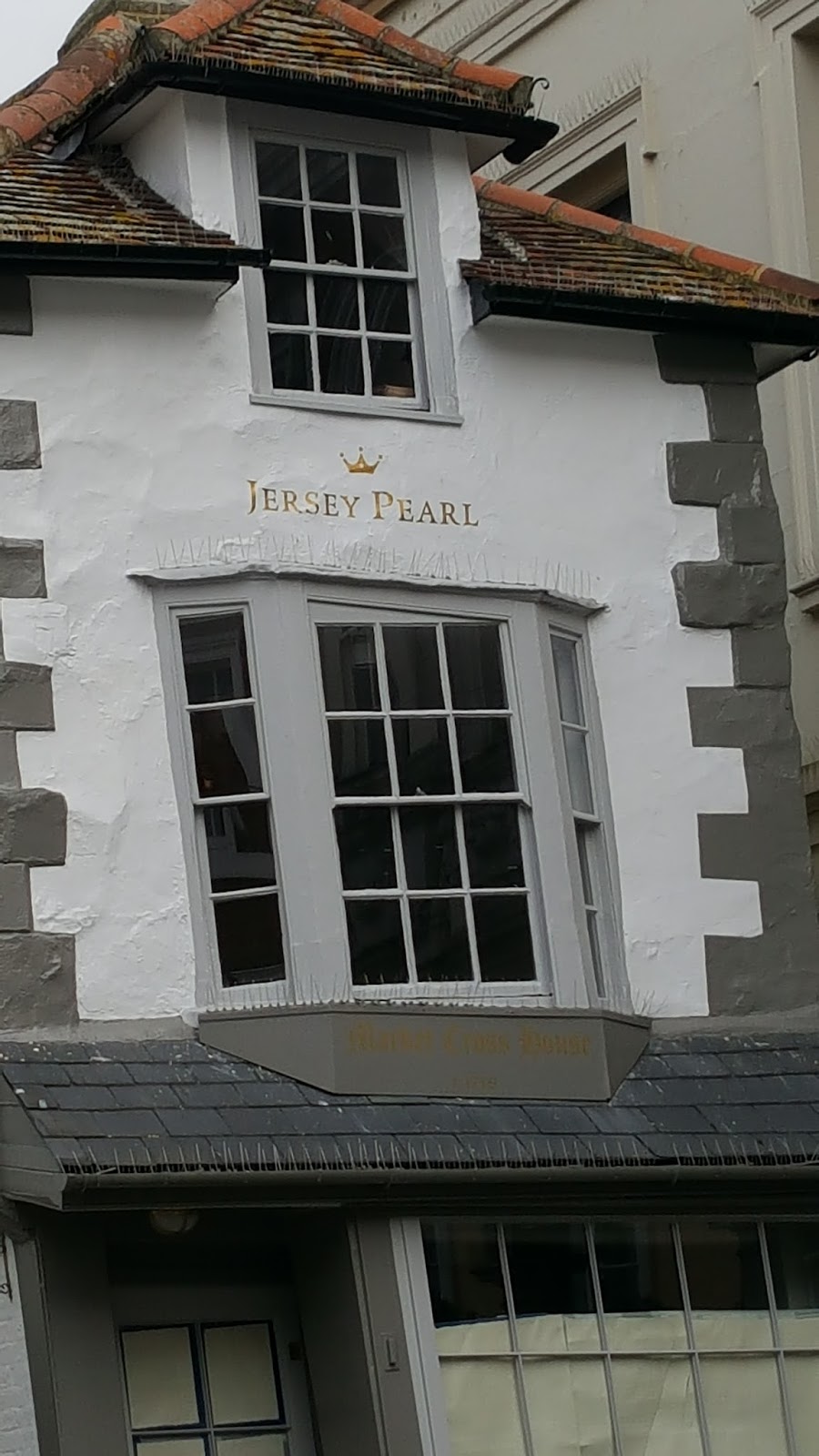
Windsor is one of my favourite places in England. It offers so much variety in things to see and do and the entire town is extremely walkable. I try to visit Windsor every time I’m over, as I did with Sue Ellen Welfonder a few months back. Of course, you can’t miss the Crooked House, a mainstay of the Windsor High Street for centuries. It was built in 1592 and originally known as Market Cross House, standing cheek by jowl with the Guildhall. It didn’t start to tilt until 1718, when renovations were carried out using green, unseasoned wood. I’ve personally seen it transform from one type of business to another several times, the latest tranistion being from gift shop to tea rooms. This time I visited, it was again being transformed, but the only clue we had to it’s future use was some gilt writing on the facade stating “Jersey Pearl.”
Soon after I returned home, someone mentioned the Crooked House in a Facebook post and a discussion was started regarding the House and it’s future purpose. Recently, I received an email from Windsor regarding exactly what the “Jersey Pearl” is and I share that news with you here. 
Mystery solved!

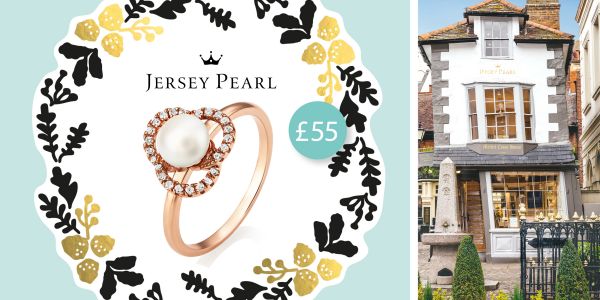
Windsor’s famous Crooked House is now the home of Jersey Pearl – and it’s a great place to visit.

Located in the heart of historic Windsor, Crooked House is one of the town’s most photographed buildings, instantly recognisable for its jaunty lean. But now, there’s a whole lot more to do and see inside – in fact, this amazing boutique is tipped as one of Windsor’s most enjoyable experiences.
There’s a huge range of exquisite pearl jewellery to suit all tastes and budgets. From classic necklaces to fun, contemporary and colourful ways to wear pearls, there’s plenty to explore and new looks to try.
For fans of royal history there are plenty of surprises. Fancy trying on a replica of Queen Elizabeth I’s necklace of 600 pearls? Or see what Queen Elizabeth II’s favourite pearl strands look like on? Come along and take a photo wearing them and then delight your friends with your new, royal look!
And while you’re at it, you can enjoy a spot of Christmas shopping; in fact, if you bring this newsletter to our boutique, you’ll receive £10 off your first purchase.
For more information, contact Debbie and the team in Windsor store.
Tel: 01753 868969

ONCE AGAIN WEDNESDAY: FASHIONS FOR 1815

Victoria here sharing a few of my fashion plates from magazines of 1815. At one time, I owned most of the 1815 and 1816 La Belle Assemblee volumes and plates, now residing in the Chawton House Library.  I have kept digital and printed copies for my own use, but they will reach a better audience there.  I still have a few from Ackermann’s, so herewith :

What you’d  be Wearing 200 years ago!

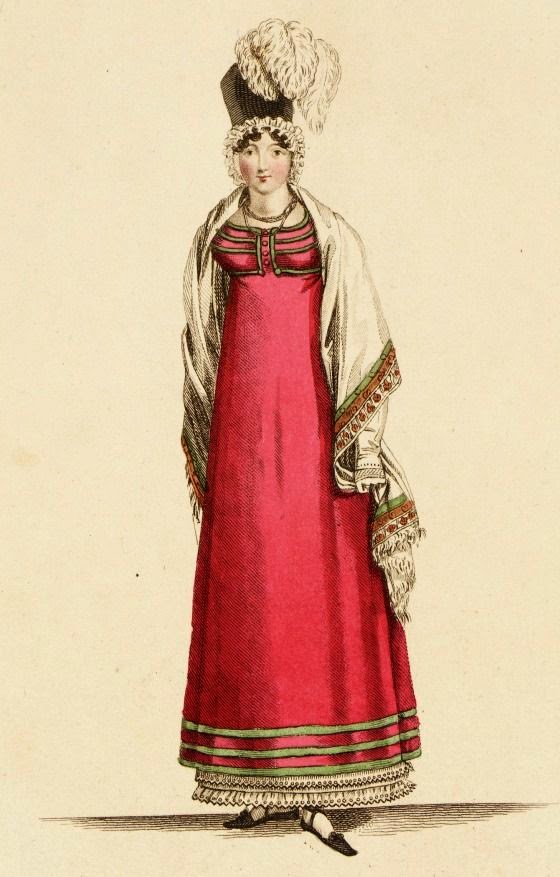
La Belle Assemblée, February, 1815
From the magazine: “Parisian Costume: A short round dress of the finest light ruby Merino cloth, trimmed with narrow blue velvet, is worn over a cambric petticoat, no part of which is seen by the double flounce of the finest Valenciennes edging with which it is ornamented at the bottom.  We refer our readers to the Print for the form of this dress.  An elegant little cap of black velvet is put on over one of white lace, the lace border is disposed round the face in a very novel and becoming style.  The hair is little seen on the forehead, and not at all on the neck, otherwise the fullness of lace would look much better; the cap is ornamented with a beautiful plume of white ostrich feathers, put on so as to fall over in front.  White silk scarf with a border of intermingled blue and ruby.  Black kid slippers, tied round the ancle (sic.) with a narrow black ribband; and white kid gloves.
                We have selected this dress because it is at present in the highest estimation amongst the Parisian elegantes; it is certainly original, and the materials are elegant, the scarf, in particular, is superb; its tout ensemble is truly French, and the admirers of Parisian fashions will, we think, agree with us, as to its being one of the most striking lately introduced in that tasteful metropolis. The dinner dress was invented by Mrs. Bell, Inventress of the Ladies Chapeau Bras and the Circassian Corsets, and of whom only it can be had, at her Magazin des Modes, No. 26, Charlotte-street, Bedford-square; of who also May be had the Parisian Costume as above described.
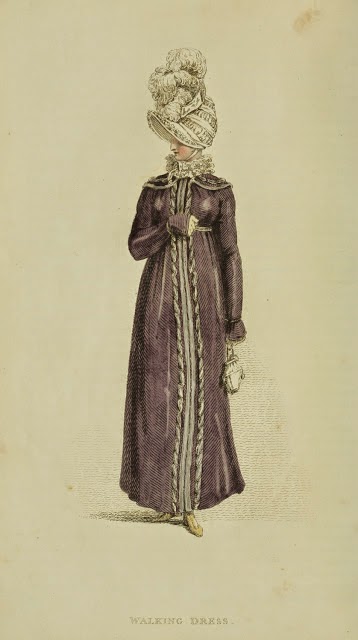
Ackermann’s, March 1815
This looks like just the ensemble for the chilly winds of March. But that hat would need a strong set of pins to keep it on her head.
Description from the magazine: “Walking Dress: Pelisse of short walking length, made of evening-primrose coloured velvet, ornamented down the front with satin trimming, round capes, trimmed to correspond, full lace ruff.  A French bonnet, composed of white velvet and satin in reversed plaitings, trimmed round the edge with a quilting of lace, full plume of ostrich feathers in the front. Half-boots of tan-coloured kid. Gloves, Limerick or York tan.”
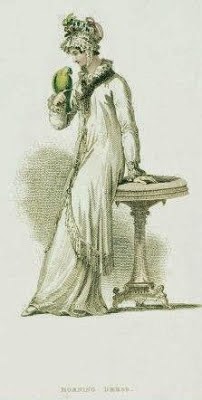
Ackermann’s, April 1815
I love the parrot or budgie on her hand. 
“Morning Dress: A loose robe of fine cambric or worked jaconot muslin, over a petticoat of the same, flounced with French trimming; long, full sleeve, confined at the wrist with treble drawings, and ornamented with corresponding trimming. The robe or neglige of demi-length, is confined at the top by a narrow collar or gathered into a Vandyke ruff, and is worn with coloured silk handkerchief, tied carelessly round the neck, and is fastened down the front with bows and tassels.  A mob cap, composed of net and Brussels lace, decorated with a cluster of flowers, and bows of satin ribbon. Hair curled in the neck. Slippers or sandals of pale tan-coloured kid. Gloves en suite.”
La Belle Assemblée, May, 1815
Originally published March, 2015
Angouleme Walking Dress
Angouleme is an area of southwestern France. In 1799, the Duke of Angouleme married Marie Thérèse 1778-1851), eldest child of  King Louis XVI of France and Queen Marie Antoinette. The Duke was the son of the eventual French King Charles X, who abdicated in 1830.  As the niece of Louis XVIII. the Duchess was part of his entourage when he became King in 1814, and she accompanied him when he fled at Napoleon’s return to Paris. Since I cannot locate the magazine’s description of this plate, alas, I assume the ensemble is named for the Duchess in some regard.
La Belle Assemblée July 1815
Waterloo Walking Dress:  After the Battle, the publishers of this maga
zine must have raced to find a suitable dress to commemorate the battle, something in the colors of mourning for the dead, yet expressive of the victorious celebration throughout the nation. Do you think they succeeded?
From the magazine: “Waterloo Walking Dress
This very beautiful dress, which answers the double purpose of walking or dinner dress, is composed of clear muslin and is made in a most original and tasteful style:  the petticoat, as our readers will perceive by the Print, is ornamented in an elegant and appropriate manner with a tasteful black trimming.  The body and sleeves, composed of an intermixture of black satin and clear muslin, are exquisitely fancied; they are made in a style of novelty, elegance, and simplicity which we never recollect being equalled in the mourning costume.  The Waterloo dress, when worn for dinner parties, has no shirt, but some ladies shade the neck a little by a narrow frill of white crape round the bosom.  In the walking costume it is worn with a shirt invented for the occasion, and trimmed in a very novel and appropriate style.  Of the hat worn with this dress we can only observe that it is the most elegant and striking headdress ever invented for mourning; it is an intermixture of white satin and black crape, most tastefully ornamented with either black or white feathers.  Black or white kid sandals and white kid gloves finish the dress, the effect of which altogether is much more elegant than our fair readers can conceive either from the Print or from our description.  The above dress was invented by Mrs. Bell, Inventress of the Ladies Chapeau Bras and the Circassian Corset, and of whom only they can be had, at her Magazin des Modes, No. 26, Charlotte Street, Bedford-Square.”
La Belle Assemblée  August 1815

The description below is particularly amusing, referring to ease of shedding the dress while in the bathing machine (see background drawing) ready to be ‘plunged.’

“Sea Side Bathing Dress: This very elegant dress is composed of the newly introduced Berlin silk. It is made in the form of a pelisse, and is so contrived that the stays, petticoat, and pelisse are all put on in a few moments. A flounce of green gauze, crape, or muslin, edged with an exceedingly pretty silk trimming, ornaments the dress; which, when on, is so finished and elegant that no one could suppose it was possible to adjust it in a few moments. A Leghorn hat ornamented with a plume of straw colour feathers, and green plaid leather boots, finish this dress, which we look upon as a chef d’oeuvre in its way, since, independent of the advantage which it is to a lady to be able to dress and undress so quickly, the most fastidious belle must confess that nothing can possibly be more becoming than this Sea Side Bathing Dress. The Wellington corset, with which it is worn, is admirably adapted to display in the most easy and graceful manner the natural proportions of the shape; and the tout ensemble of this elegant and useful habit is simple, tasteful and in the highest degree appropriate.”

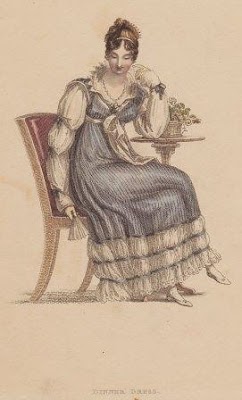
Ackermann’s, September 1815
“Dinner Dress: A white satin slip worn under a dress made in primrose-coloured French gauze, terminating at the feet with a full flounce  of blond lace, headed with a double border of the same, gathered in full, and confined with folds of satin, corresponding colours to the dress; handkerchief -front trimmed with white satin, and a falling collar of blond lace; long sleeve of white satin, the fulness upon the shoulder confined under an epaulet of the French gauze tried with white satin; the sleeve drawn alternately across the arm with the evening primrose coloured satin ribbon. Long white sash of white satin, tied in front.  The ends of the hind hair brought forward, to fall in ringlets over the temple, confined with a plain white satin ribbon, and ornamented with a tiara of pearl. Necklace to correspond. Gloves, French kid. Slippers, white satin.”
Want more of 1815? We’d love to have you join us on Number One London’s 1815: London to Waterloo Tour, when we’ll be exploring this exciting year in-depth. Full details on our website, at the link above.
LISTEN TO THE WATERLOO BUGLE BEING SOUNDED

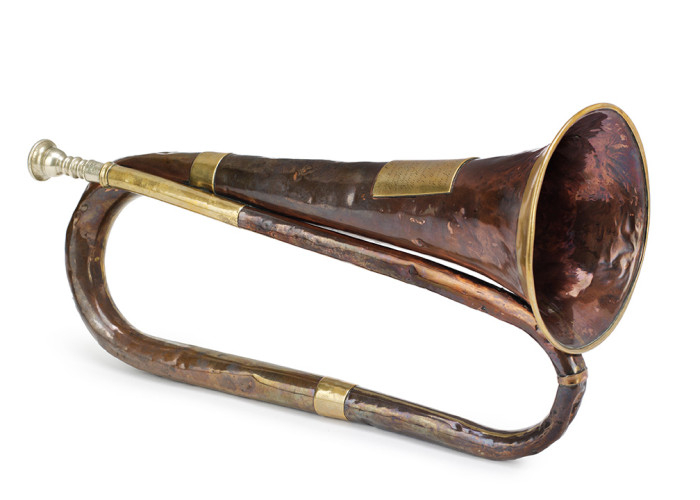
Copyright Waterloo 200/Household Cavalry Museum

It is impossible to imagine the field at the Battle of Waterloo without calling the senses into play. The sights: soldiers clashing swords, horses rearing, men forming squares, columns of smoke from cannon fire. The smells: wet earth, sweat, wet horse and wet leather, cordite and black powder. The sounds: musket fire, swords singing metal on metal, horses neighing, men shouting and, perhaps most identifiable to us in the present day, bugles and trumpets sounding the calls. Amazingly, a few of the instruments that were played on the field of Battle at Waterloo have been preserved and are occasionally still played, like the trumpet above in the collection of the Household Cavalry Museum, which was played by John Edwards on the battlefield.

From the Waterloo200 website:

This field bugle was blown by 16-year-old John Edwards, who was duty trumpeter of the day. It sounded the charge for the Household Brigade which comprised the 1st and 2nd Life Guards, the Royal Horse Guards (the Blues) and the 1st Dragoon Guards.
The other brigade, the Union Brigade, comprised the 1st (Royal) Dragoons, the Royal North British Dragoons (Scots Greys) and the 6th (Inniskilling) Dragoons. They charged a few minutes before the Household Brigade.
The Allied cavalry manoeuvred through the ranks of Allied infantry and charged D’Erlon’s Corps, with its supporting cuirassiers, causing immense damage. Then, rather than turn back having successfully completed their task, they charged on over the French gun batteries. They arrived without support and with exhausted horses deep into the French lines, where they in turn suffered heavy casualties.
Of the 2,500 cavalrymen involved, approximately half were killed or wounded. However, Napoleon had lost the initiative and failed to gain control of the battle. Two French Eagles (battalion colours) were taken.
Trumpet or bugle calls were a vital command system in battles at this time. Shouting and screaming men and horses, the explosions of guns, cannon shells and small arms made verbal communication impossible. The smoke from black powder meant visibility was down to that of a thick fog. The incredible danger from musket balls, sabres, cannon balls and kicking horses made full attention vital. Only the sound of the trumpet was able to communicate between cavalry squadrons, each of which had a trumpeter.
There were over 40 different bugle calls used in the field, all to command horses. Formations were controlled by calls known to the cavalrymen and made easier to remember by the addition of words in songbooks.
The trumpet was played again at the Household Cavalry Musem during preparations for the 200th Anniversary of the Battle of Waterloo in 2015 and you can watch the video and listen to the call being played here
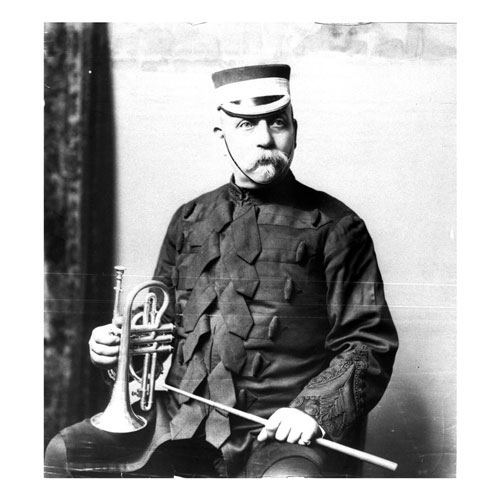
A far older sound recording of a Waterloo bugle was made in 1890 in London by trumpeter Landfried of the 17th Lancers, who is said to have played the charge at Balaclava using this Waterloo bugle. You can listen to that recording here

For more on Martin Lanfried, visit the Lives of the Light Brigade site.

Want more Waterloo? You’ll have the opportunity to walk the key sites connected to the Waterloo Battlefield with guide Ian Fletcher on Number One London’s 1815: London to Waterloo Tour in June, 2017. In addition to the headquarters of both Wellington and Napoleon, we’ll be visiting La Hay Sainte, Quatre Bras, Ligny, Hougoumont, the Lion’s Mound, the newly remodeled Visitor’s Centre and, of course, the Battlefield itself. At every stop, Ian will describe the events that took place there and explain their significance in the Allied victory. This is an opportunity you won’t want to miss.