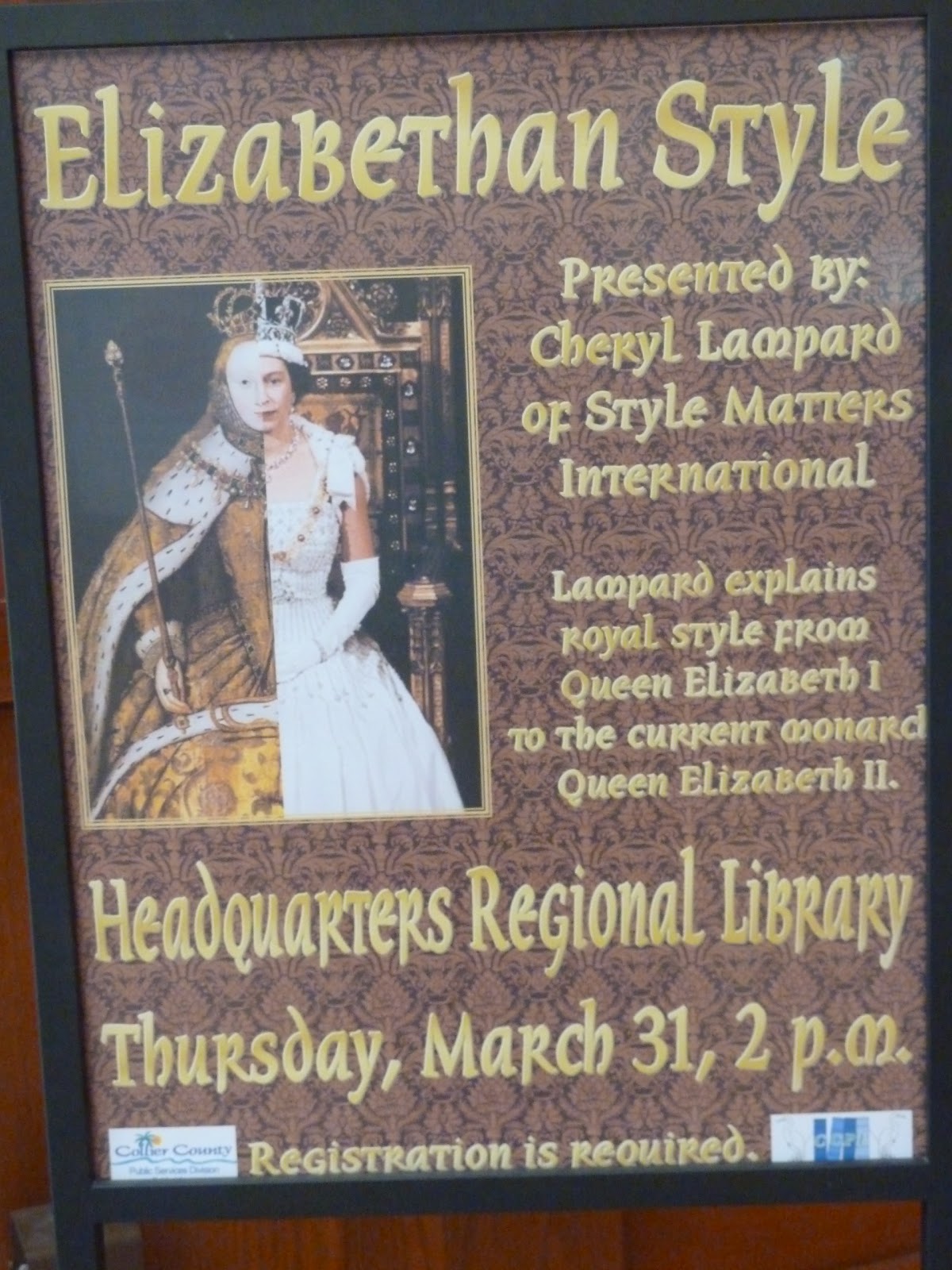
Style from Elizabeth I to Elizabeth II

Victoria here, reporting on a delightful presentation I attended in Naples, FL, at the public library. Presenter Cheryl Lampard, who is a consultant on fashion, make-up and image, spoke on royal style to an eager group of mostly females who peppered her with questions at the end of her talk — mostly about the upcoming royal wedding. What did she think the Queen would wear?  What about the royal limousine, THE dress and so forth.  I can reliably report that here in FL, the audience for the great event will be huge.

Cheryl Lampard’s business is Style Matters International, based in Naples. Click here for her website.


Ms. Lampard’s power point talk began with a discussion of “Dress for Success” Elizabethan style. Ms. Lampard says, “Your image is your brand” and that applies to royalty as well as to the rest of us.  Elizabeth I needed to project an image of power nobles to foreign diplomats to the great mass of her subjects.  The luxury and splendor of her clothing represented the powers and strength of the nation over which she ruled.

Elizabeth I inherited her father’s fine taste and flair for showmanship. The first Elizabethan  Era is celebrated for its achievements, particularly in the arts, e.g. Shakespeare.
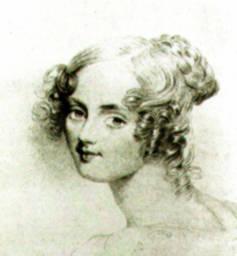
At left, Elizabeth I (1533-1603) as a girl, whose future was anything but assured. Nevertheless she outlasted her half-brother, Edward, and her half-sister Mary, to take the throne in 1558 at age 25. She ruled for 44 years, overcoming both internal threats (e.g. Protestants vs. Catholics) and external threats from continental powers.

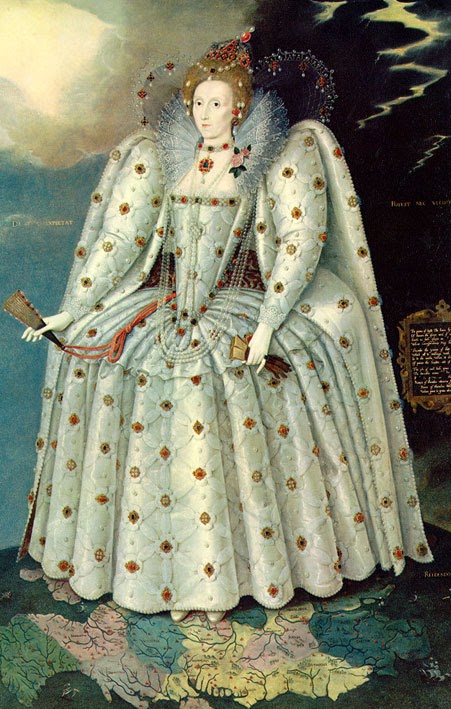
In the painting, Tudor style prevailed in dress, jewelry, hair and make-up. As Ms. Lampard pointed out, nothing is new when it comes to fashion; we see cycles of clothing and make-up styles throughout history.  A primary example: the wasp waist.  Clothing emphasized the narrowness of the waist in contrast to the wide skirts and sleeves. As time went on, Elizabeth I’s fashions exaggerated the small waist, as well as sumptuousness in fabric and decoration.


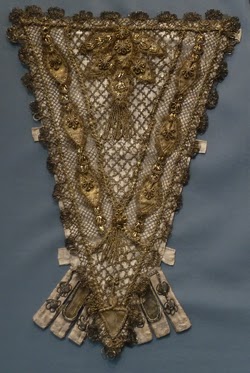
To emphasize the narrowness of the wasp waist, women wore a “stomacher,” in the shape of a triangle across the chest and pointing down at the waist.  Often richly decorated, the stomacher was a separate piece of clothing that was tied or otherwise fastened on and used with a variety of gowns.
A set of hoops called a farthingale spread out the skirt and widened the gown from hips to floor. Both the stomacher and farthingale were stiffened with wood, whalebone, ivory or mother-of-pearl.
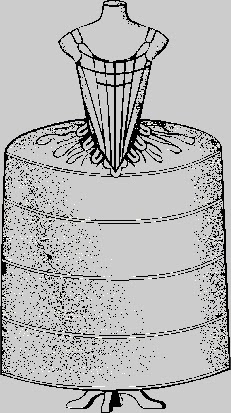
In order for the skirt to fall in graceful folds, often it was necessary to use a bumroll below the waist.

The effect was obviously to make the waist look small in comparison to the hips, carrying the hourglass figure to extremes.  Full sleeves and wide shoulders add to the illusion.

The Armada Portrait (at Woburn Abbey with other versions and/or copies elsewhere) shows Elizabeth I in a setting rich with important  and impressive symbolism. The gown of expensive satins and silks is crusted with jewels, emphasizing the prosperity and magnificence of the court. Her hand rests on the globe, to portray England’s dominance of the sea, and on either side of her head, two stages of the 1588 defeat of the Spanish Armada can be seen.

By late in Elizabeth I’s reign,  everything was exaggerated.  The skirts were  amazingly wide and heavy. The sleeves look like her arms would be nearly unmovable. The tall r
uffs would make turning her head uncomfortable.

 
The make-up, too, was dangerous.  Pale skin was admired, signifying that the person never had to work in the outdoors. In another recurring fashion trend, this white make-up was lead- based well into the 19th century, poisonous to the system and causing pockmarks on the face. Fashion can be foolish indeed.


Ms. Lampard described many more details about Elizabethan fashions, the sleeves, the  ruffs, (tall, starched, and probably scratchy), and the discomfort endured for the sake of image.  She jokingly compared these fashions with today’s exaggerated platform stiletto-heeled shoes. 


Moving to the Victorian period, she discussed the return of the wasp waist, the continued need for the monarch to project an image of stability and power, and the adoption (forever and ever) of Victoria’s white wedding gown as the standard for brides worldwide.  Formerly, she said, silver had been the usual color for royal brides.

Victoria became the mother of nine children, then endured a long period of mourning after her husband’s death. But she knew how to dress for the role of head of the empire.
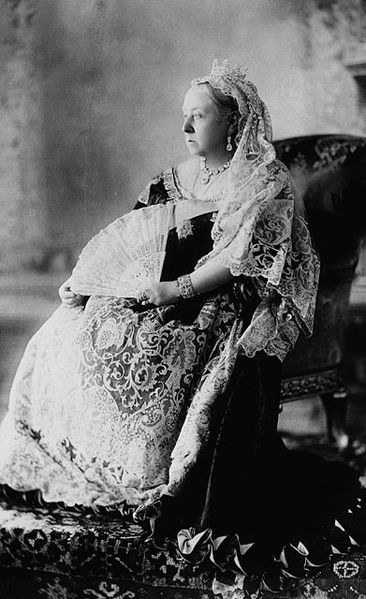
Even in the 1880’s Victoria kept up appearances. Below, a photograph of Queen Victoria
for her Diamond Jubilee in 1897.

Moving on to today’s era, the second Elizabethan Age, we see again in the young Princess Elizabeth, the recurrence of the wasp waist, for her 1947 wedding gown and a few years later for her coronation in 1953.

Wedding gown, 1947, by Norman Hartnell

Coronation gown, 1953, by Norman Hartnell

Although the current Queen Elizabeth has not been in the forefront of fashion trends, she too has recognized her obligation to represent her nation in a modern way.  For ceremonial events, of course, she is suitably gowned, crowned and bejeweled.  For her day-to-day activities, Ms. Lampard said, she can be particularly admired for her choice of hats.  Designing a hat that is flattering, attractive and capable of having the monarch’s face visible is not an easy job.
Here are a few views of the Queen’s headgear.
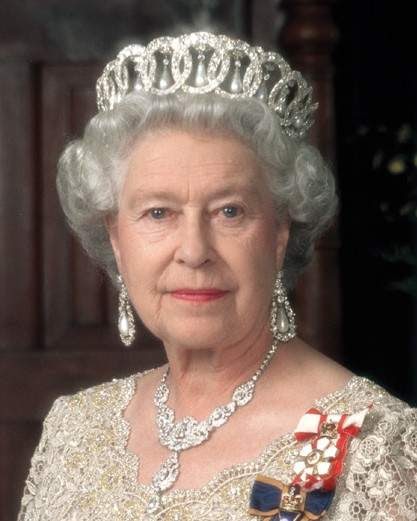
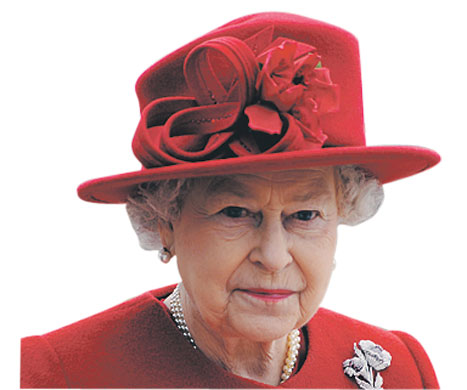
Here is a gallery from CBS News of Queen Elizabeth II’s hats.

All in all we had a wonderful time last week covering centuries of royal fashion and chatting about the wedding to come.  Many thanks, Cheryl Lampard of Style Matters International.

The Birthday of Jane Digby el Mezrab

Today, in the midst of turbulent international events, we have a great deal of  curiosity and concern about the middle east.  So did the British of the 19th century, dealing as they did with the Ottoman Empire and its 600-year rule over a large part of the world.  By the 19th century, its eventual disintegration was well underway…think of Byron fighting for Greek independence, for example. Though trade and commerce continued, the middle east was not an area familiar to most of 19th century Britain. The stories of intrepid women travelers who went there to live are particularly fascinating.   
Mary S. Lovell has written the story of our birthday girl’s adventurous life, published in 1998, and titled in the U.S. Rebel Heart.  
BBC Photo


Lovell is the author of many biographies: Bess of Hardwick, Beryl Markham, the Mitford Sisters, and Amelia Earhart. 
 Her book about the Churchills will be released this month in the UK and in May in the US.
For her website, click here.
Jane Elizabeth Digby, Lady Ellenborough (1807-1881), moved to Damascus in the early 1850’s,  following a path forged by Lady Hester Stanhope  (1776-1839) after the death of her uncle, Prime Minister William Pitt the Younger in 1805.  Lady Hester’s story will be forthcoming on this blog in the future.
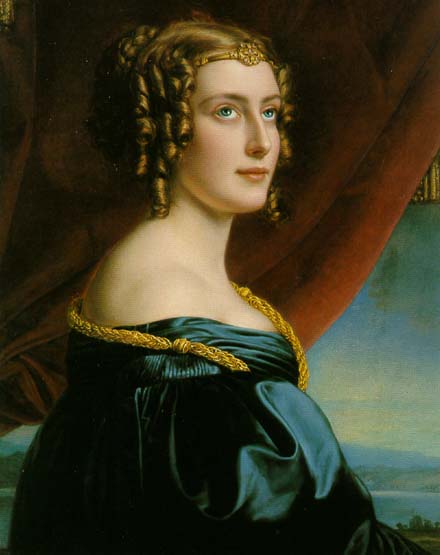
 Jane Digby was exceptionally beautiful but apparently unlucky at finding enduring  love for many years.  She was raised in the wealthy and aristocratic household of her father, Admiral Sir Henry Digby, and her mother  Mary Coke, daughter of the lst Earl of Leicester. Before she was 20 years old, Jane married Edward Law, second Baron Ellenborough, later the Earl of Ellenborough, who was Governor General of India 1842-44.  Jane was Ellenborough’s second  wife and bore him (supposedly) one son who lived only two years.  They were divorced in 1830, after undergoing the almost-impossible process of ending a marriage in those days, proving her adultery through several through several decisions of legal and ecclesiastical courts and culminating in an act of the House of Lords.
1831 Painting of Jane Digby, Lady Ellenborough
by Joseph Karl Stieler


Jane had many affairs, often with very prominent men, including (but not limited to) King Ludwig I of Bavaria, King Otto of Greece (son of Ludwig), Austrian statesman Prince Schwarzenberg, and her cousin, George Anson. In all she married four times and had several children, most of whom died very young. Her daughter by Schwarzenberg was raised by the Prince’s sister in Basel.

To follow the progress of her many affairs and marriages is like reading a scandalous travelogue She finally settled in Syria with her fourth husband, Sheikh Medjuel el Mezrab, who was two decades younger than she was. She wore Arab dress and spent part of each year living a nomadic life in the desert with her husband’s tribe. In Damascus, they lived in an elegant villa and entertained many Europeans, including the famous traveler, explorer and author Richard Burton and his wife.

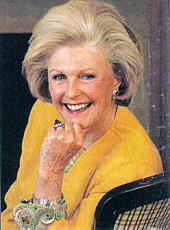
It is often noted in connection with Jane Digby that her great great grandniece was Pamela Churchill Harriman, nee Digby (1920-1997), U. S. Ambassador to France 1993-1997, whose life of romance with world statesmen could be considered a 20th century version of Jane’s own story. Her three husbands were Randolph Churchill, Leland Hayward, and Averill Harriman.

She was also linked in the popular press with many other prominent men, among them Edward R. Murrow, Prince Aly Khan, Baron Elie de Rothschild, William S. Paley, Gianni Agnelli, and Stavros Niarchos. 

Though we might, while wishing her happy birthday, call Jane Digby “one of a kind,” but she obviously left a legacy to her descendants.

Anecdotes of Sheridan from the Pen of Thomas Creevey


Richard Brinsley Sheridan

“. . . Sheridan entered into whatever fun was going on at the Pavilion as if he had been a boy, tho’ he was then 55 years of age. Upon one occasion he came into the drawing-room disguised as a police officer to take up the Dowager Lady Sefton for playing at some unlawful game; and at another time, when we had a phantasmagoria at the Pavilion, and were all shut up in perfect darkness, he continued to seat himself upon the lap of Madame Gerobtzoff [?], a haughty Russian dame, who made row enough for the whole town to hear her.
“The Prince, of course, was delighted with all this; but at last Sheridan made himself so ill with drinking, that he came to us soon after breakfast one day, saying he was in a perfect fever, desiring he might have some table beer, and declaring that he would spend that day with us, and send his excuses by Bloomfield for not dining at the Pavilion. I felt his pulse, and found it going tremendously, but instead of beer, we gave him some hot white wine, of which he drank a bottle, I remember, and his pulse subsided almost instantly. . . . After dinner that day he must have drunk at least a bottle and a half of wine. In the evening we were all going to the Pavilion, where there was to be a ball, and Sheridan said he would go home, i.e., to the Pavilion (where he slept) and would go quietly to bed. He desired me to tell the Prince, if he asked me after him, that he was far from well, and was gone to bed.
So when supper was served at the Pavilion about 12 o’clock, the Prince came up to me and said: “‘ What the devil have you done with Sheridan to-day, Creevey? I know he has been dining with you, and I have not seen him the whole day.’
“I said he was by no means well and had gone to bed; upon which the Prince laughed heartily, as if he thought it all fudge, and then, taking a bottle of claret and a glass, he put them both in my hands and said:
“‘ Now Creevey, go to his bedside and tell him I’ll drink a glass of wine with him, and if he refuses, I admit he must be damned bad indeed.’
“I would willingly have excused myself on the score of his being really ill, but the Prince would not believe a word of it, so go I must. When I entered Sheridan’s bedroom, he was in bed, and, his great fine eyes being instantly fixed upon me, he said :— “‘ Come, I see this is some joke of the Prince, and I am not in a state for it.’
“I excused myself as well as I could, and as he would not touch the wine, I returned without pressing it, and the Prince seemed satisfied he must be ill.
“About two o’clock, however, the supper having been long over, and everybody engaged in dancing, who should I see standing at the door but Sheridan, powdered as white as snow, as smartly dressed as ever he could be from top to toe. . . . I joined him and expressed my infinite surprise at this freak of his. He said:
“Will you go with me, my dear fellow, into the kitchen, and let me see if I can find a bit of supper.’


Kitchens at the Royal Pavilion, Brighton
“Having arrived there, he began to play off his cajolery upon the servants, saying if he was the Prince they should have much better accommodation, etc, etc, so that he was surrounded by supper of all kinds, every one waiting upon him. He ate away and drank a bottle of claret in a minute, returned to the ballroom, and when I left it between three and four he was dancing.

In the year 1810, Mrs. Creevey, her daughters and myself were spending our summer at Richmond. Sheridan and his wife (who was a relation and particular friend of Mrs. Creevey’s) came down to dine and stay all night with us. There being no other person present after dinner, when the ladies had left the room, Sheridan said : “‘A damned odd thing happened to me this morning, and Hester [Mrs. Sheridan] and I have agreed in coming down here to-day that no human being shall ever know of it as long as we live; so that nothing but my firm conviction that Hester is at this moment telling it to Mrs. Creevey could induce me to tell it to you.’
“Then he said that the money belonging to this office of his in the Duchy being always paid into Biddulph’s or Cox’s bank (I think it was) at Charing Cross, it was his habit to look in there. There was one particular clerk who seemed always so fond of him, and so proud of his acquaintance, that he every now and then cajoled him into advancing him £10 or £20 more than his account entitled him to. . . . That morning he thought his friend looked particularly smiling upon him, so he said:—
‘”I looked in to see if you could let me have ten pounds.’
“‘Ten pounds!’ replied the clerk; ‘to be ‘sure I can, Mr. Sheridan. You’ve got my letter, sir, have you not?’
“‘ No,’ said Sheridan, ‘what letter?’
“It is literally true that at this time and for many, many years Sheridan never got twopenny-post letters,* because there was no money to pay for them, and the postman would not leave them without payment.
“‘Why, don’t you know what has happened, sir?’ asked the clerk. ‘There is £1200 paid into your account. There has been a very great fine paid for one of the Duchy estates, and this £1200 is your percentage as auditor.’
“Sheridan was, of course, very much set up with this £1200, and, on the very next day upon leaving us, he took a house at Barnes Terrace, where he spent all his £1200. At the end of two or three months at most, the tradespeople would no longer supply hi
m without being paid, so he was obliged to remove. What made this folly the more striking was that Sheridan had occupied five or six different houses in this neighbourhood at different periods of his life, and on each occasion had been driven away literally by non-payment of his bills and consequent want of food for the house. Yet he was as full of his fun during these two months as ever he could be—gave dinners perpetually and was always on the road between lames and London, or Barnes and Oatlands (the Duke of York’s), in a large job coach upon which he would have his family arms painted.”
* The charge at this time for letters sent and delivered within the metropolitan district was only 2d., payable by the recipient; but country letters were charged from l0d. to 1s. 6d. and more, according to distance.

The Windsor Dioramas by Guest Blogger Hester Davenport

A few years ago in Sebastopol in the Crimea I walked around a compelling recreation of a moment in the siege of the city during the Crimean war where the closest figures are almost life-size. This kind of model is called a diorama. In Windsor Museum we have our own diorama of a siege but ours in on a small scale, as are the others which pinpoint moments in the town’s history. They’re like miniature theatres, in glass-fronted cases and lit from above, all of them lively and dramatic, where you almost expects the tiny figures to continue the actions they’ve just begun.


Part of a diorama showing the barons attacking Windsor Castle in 1216
© Windsor Museum

The Windsor dioramas were commissioned in the 1950s from two friends, Judith Ackland and Mary Stella Edwards. They had met when at Regent Street Polytechnic in 1919, where they studied art, and afterwards they set up a home and studio together in a cottage called The Cabin, on the beautiful North Devon coast.


The Cabin at Bucks Mills
appledorearts.org

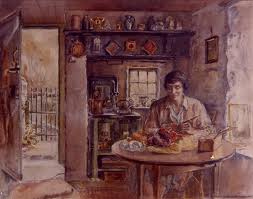
For many years they spent the summers travelling, painting landscapes and selling their art, but after the Second World War, perhaps feeling they were too old for gipsy living, they started a new career making dioramas. After meticulous research into their subjects Mary painted the backgrounds, while Judith made the figures. She developed her own way of modelling figures which she called ‘Jackanda,’ using wire and compressed cotton-wool. Remarkably she could not only position her figures in a life-like way, but even on a miniature scale – each figure measures around 10 cms – she could create expression and in the case of historical characters recognisable portraits.


Judith Ackland at work by Mary Stella Edwards
Bucksmillscabin.blogspot.com


The Windsor commissions came about after one of their dioramas was shown in the Guildhall as part of a Florence Nightingale centenary exhibition. The enlightened local council then asked the women to create a diorama for 1957, which would mark 350 years since John Norden’s map of Windsor in 1607.

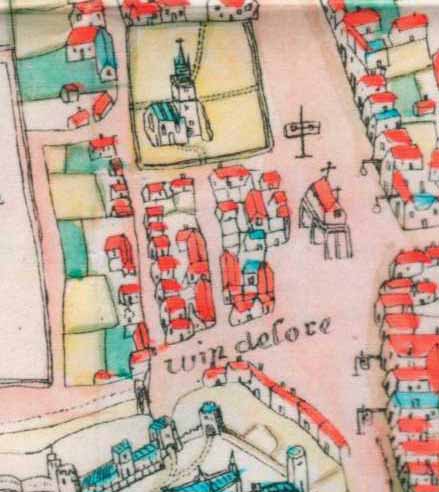
Detail of John Norden’s 1607 map of Windsor
It was the first map of the town and shows the recently-built Market Hall (1596), with the old parish church behind. You can also see the pillory where wrong-doers were punished by being forced to stand pinioned by their neck and wrists, enduring cat-calls and, if unlucky, well-aimed fruit and vegetables (our Museum has a model pillory for visitors to stick their heads in, and a basket of fruit and veg., luckily fluffy, for friends and relations to throw).

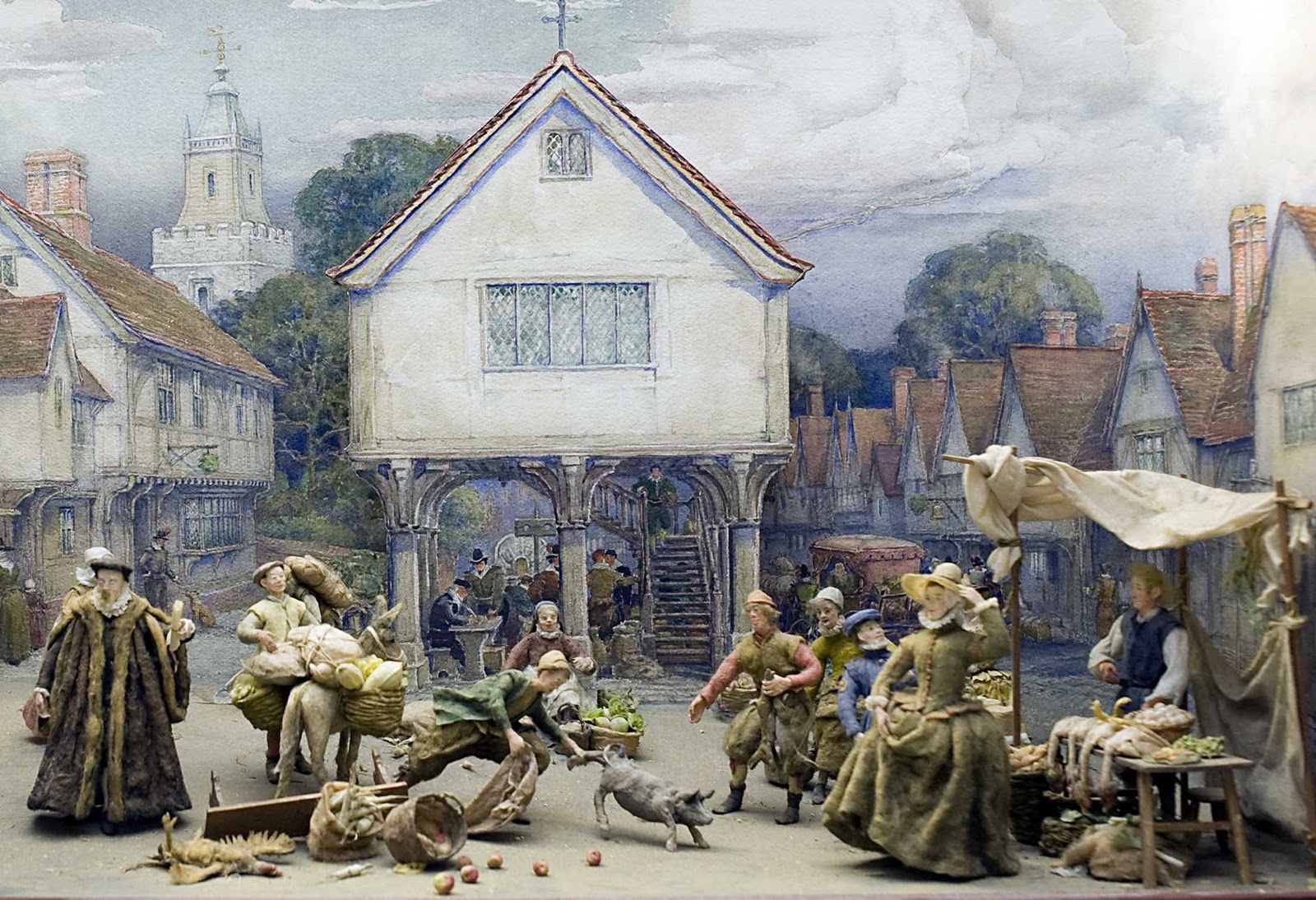
Windsor Market-place in 1607 © Windsor Museum

The women peopled their market scene with imagination: a pig has made a bid for freedom, overturning a stall. Vegetables cascade across the ground and a plucked chicken lies with its feet in the air. There are other stalls, a group of women churning butter and behind them a butcher’s shop. An elderly man in a fur-edged robe, oblivious to the mayhem, must be someone important, perhaps the Mayor. A well-dressed woman with her page pulls her skirts out of the way.

Every detail has been researched, even to the type of coach seen in the background. One of the clever aspects of these dioramas is the way three-dimensional modelling merges with two-dimensional figures and landscape without any sharp division.
So successful was this scene that the women were asked to make another, and the following year they produced Windsor Bridge in the year 1770, again carefully researched.

Windsor Bridge in 1770

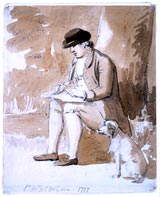
It’s a windy day, washing is blowing on a line and the women crossing the bridge have to hang on to their hats. An artist sitting at the corner
sketching is recognisably Paul Sandby, who painted many Windsor scenes including the bridge.

Paul Sandby sketching by Watkins William Winn
museumwales.ac.uk

The river is imagined running across the front of the diorama, and a boy is fishing in it. Masts of the barges which carried goods up and down the river can be seen, and bargees with their horses which hauled the boats along. Above looms the Castle, as it was in 1770, when the Round Tower was short and squat.

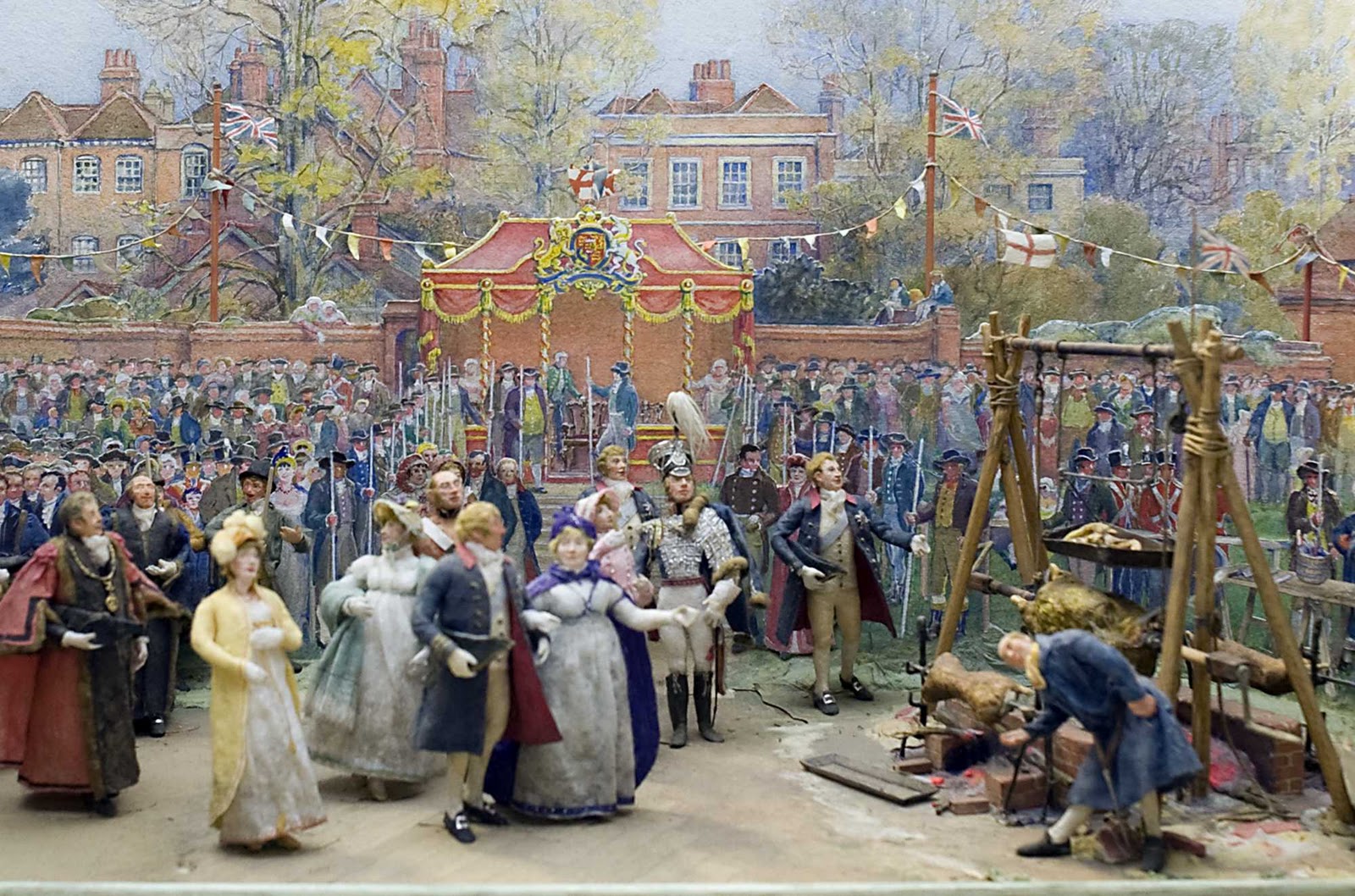
A year on and the women produced their most ambitious work: the Golden Jubilee celebrations of George III in Bachelors’ Acre in 1809, 150 years after the event.
On 25 October, when George III entered the 50th year of his reign, rejoicing was nationwide. In Windsor the so-called Bachelors of Windsor organised an ox-roast on the Acre – the name of this piece of open ground is thought to come from a time when butts were set up there for young men to practice their archery. Unfortunately the King, in his 71st year, lame, deaf and of poor sight, was too infirm to attend, but at one o’clock Queen Charlotte arrived on the arm of her second son, Frederick Duke of York, with most of her other children in tow (the Prince of Wales was also absent as he shunned public appearances because of his unpopularity over his treatment of his wife Caroline of Brunswick). The Mayor is in his robes, with the Corporation all dressed in blue with white wands of office. Even the cook had been given a blue smock and white silk stockings.
All the figures were researched from portraits in the Royal Collection. Princess Augusta is on the left in yellow, plump Princess Elizabeth is in blue, with the Duke of Kent, Queen Victoria’s father behind her, Princess Sophia is in pink with the really bad sheep of the family, the swaggering Ernest Duke of Cumberland at her side in uniform (he was believed to harbour incestuous thoughts about his sister Sophia and less than a year later suspected of killing his valet.) The Duke of Sussex is behind him. The royal party graciously partook of slices of the meat served on silver dishes, before retiring to the garden at the back for a ‘cold collation.’
Unfortunately because of its complexity and the illness of one of the women, the Jubilee diorama was late in delivery and over-budget. So for the next one, the Council laid down strict rules, and consequently it is the least detailed.

It shows the siege of Windsor Castle in 1216. After King John had failed to keep to the terms of Magna Carta (1215), the furious barons invited Prince Louis of France to take the English throne. Much of southern England fell into their hands, but Windsor Castle held out and after three months the attackers withdrew (they should have waited as King John died not long afterwards).

Once more, the Castle, the armour and weapons of war were meticulously researched. (It’s a pity you can’t see the horses behind the tents in the photo.) This is the diorama on show at the new Museum at the moment and the other three will take their turns. There are dressing-up clothes of the period for children, and one little boy was proud to have spotted the man who is collapsing with an arrow fired from the Castle walls in his neck.

Note the men lighting a bonfire against the Castle walls to weaken them.
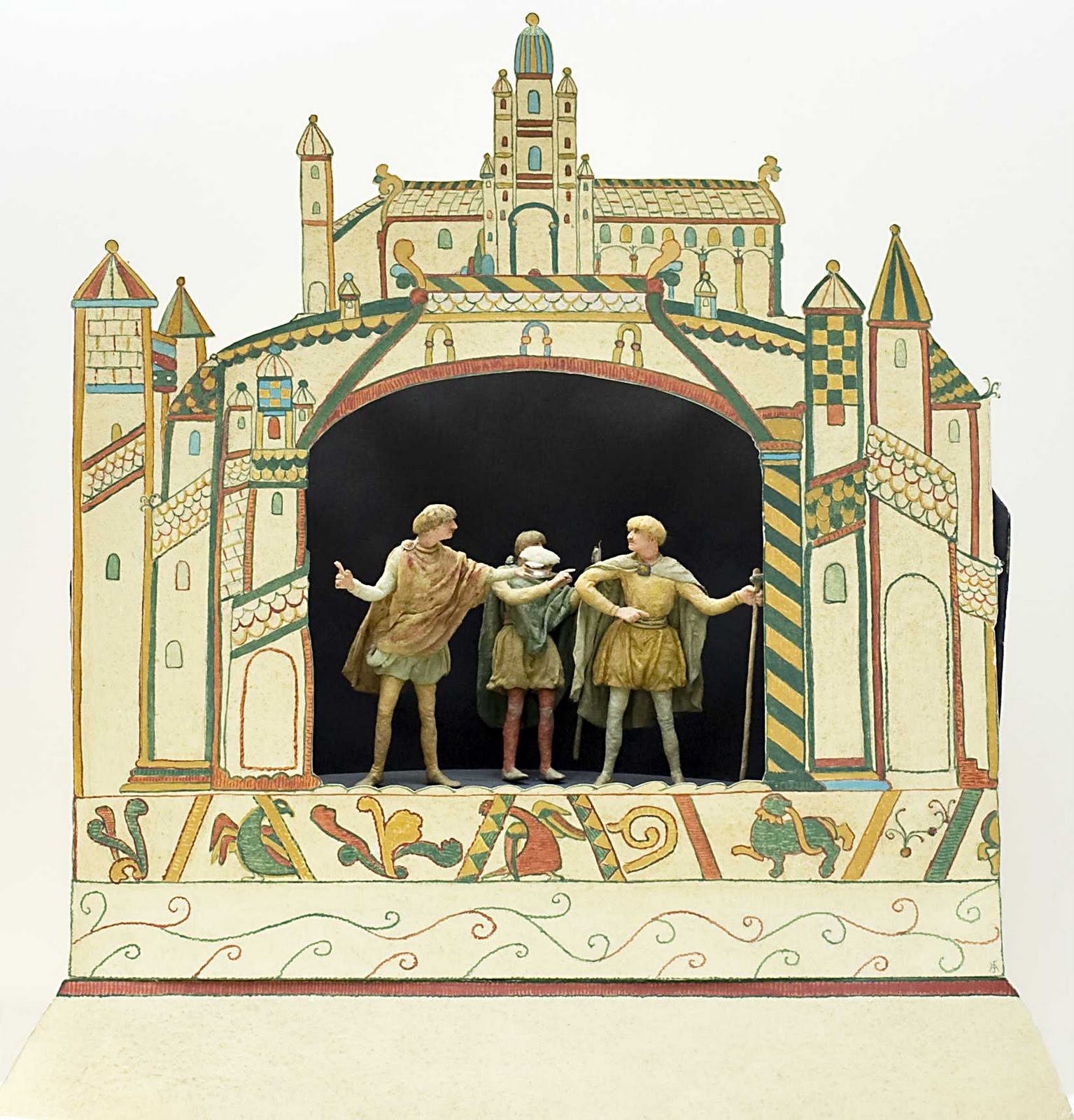
Judith and Mary made other dioramas for Windsor, though they are simpler in scope, including one not in a case and with only three figures, which celebrates the Bayeux Tapestry.

Judith Ackland died in Devon in 1971. Thereafter Mary Stella Edwards organised exhibitions of her friend’s work and moved to what had been her family home in Staines, not far from Windsor, where she died in 1989. (The Cabin was kept as it was, and is now part-owned by the National Trust.) It had been a remarkable partnership and one we are proud to display in our Museum.

Mary Stella Edwards by Judith Ackland

Mary Stella Edwards and Judith Ackland