Speaking of Bridget Jones

Tis the season for Bridget Jones what with Bridget Jones: The Musical set to hit the West End in 2012 and Christmas being right around the corner. Yes, Christmas. You know you’ll be watching Bridget Jones’s Diary during the holidays just to see those awful holiday sweaters again. Well, we can’t wait. You probably can’t wait, either, so here’s the movie trailer to get you into the spirit of things. Click here to watch.

Visiting Corsham Court with Victoria

Corsham Court is near Chippenham in Wiltshire.  The website is here.

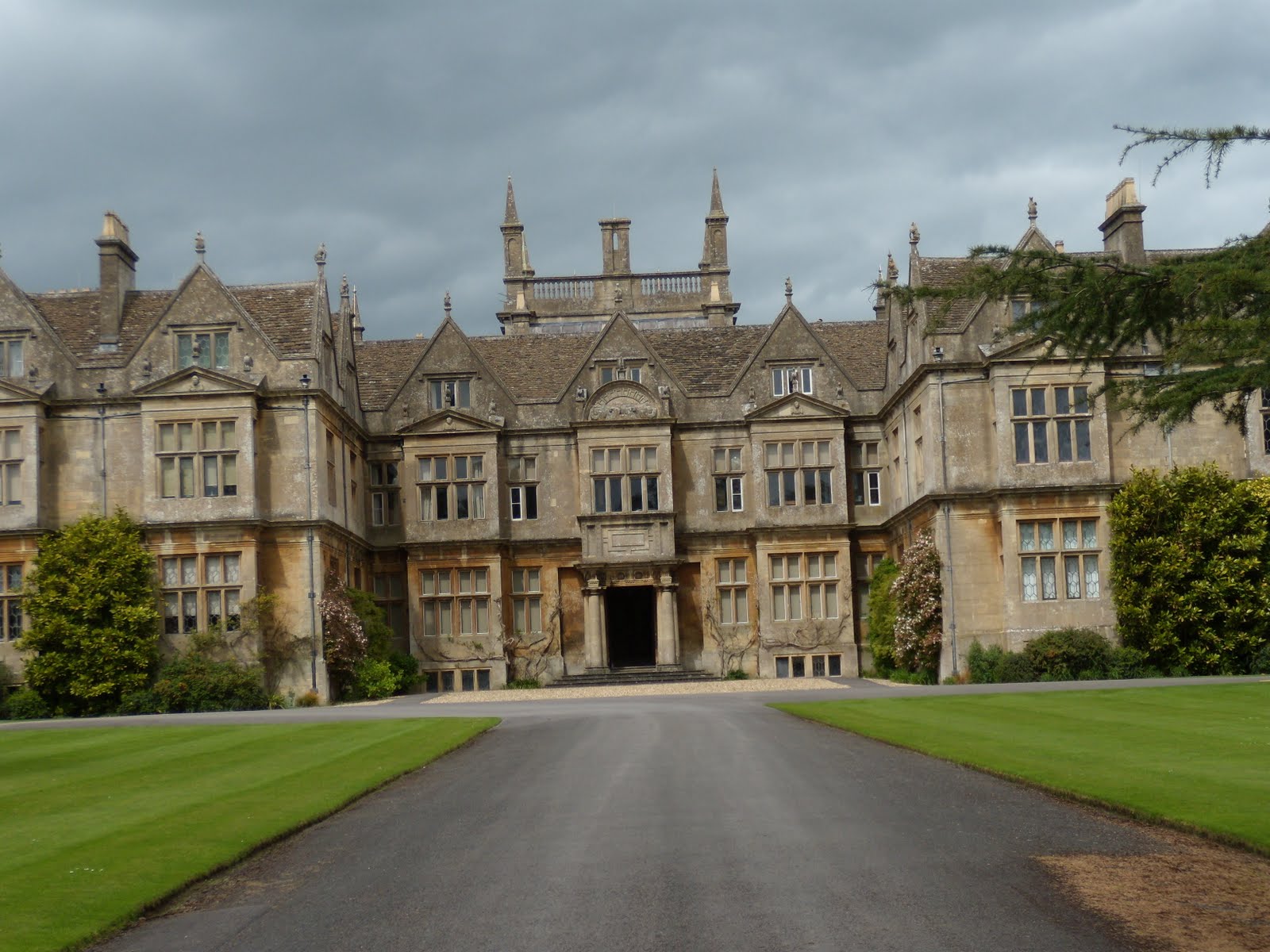
Corsham Court, which I photographed in 2009 on a visit to Hampshire and Wiltshire, was a Royal manor in the time of Saxon Kings. The core of the present house was built in the late 16th century by Thomas Smyth. In the 1740’s, the estate was purchased by a member of the Methuen family and eventually altered to house Sir Paul Methuen’s excellent collection of paintings.  Almost two centuries later, more fine pictures were added when the family inherited the collection of a relative who had resided in Italy where he acquired many old masters.  The initial impression of the house exterior reminded me of a previous visit to the Biltmore estate in Asheville, North Carolina.

Biltmore Estate, Asheville, North Carolina

Biltmore, the home of George Vanderbilt in North Carolina, opened in 1895, the creation of architect William Morris Hunt; he based his designs on the style of three 16th C French chateaux.

A closer look at the entrance of Corsham Court.

At Corsham Court, the Elizabethan house was altered significantly several times.  In 1798, architect John Nash followed in Capability Brown’s footsteps (see below) but could not keep up!  Sadly, Nash’s work was poorly executed and needed significant repair within a few decades.  So in the 1840’s, parts of the house  were rebuilt again, giving it the look it now has by architect Thomas Bellamy. I find both the Court and Biltmore rather forbidding in appearance.  However, the interior of Corsham Court could not be more different from Biltmore.  I felt Biltmore was dark, dreary, and altogether uninviting as a place to live (to visit, quite fascinating). 

An angled view of one wing. 

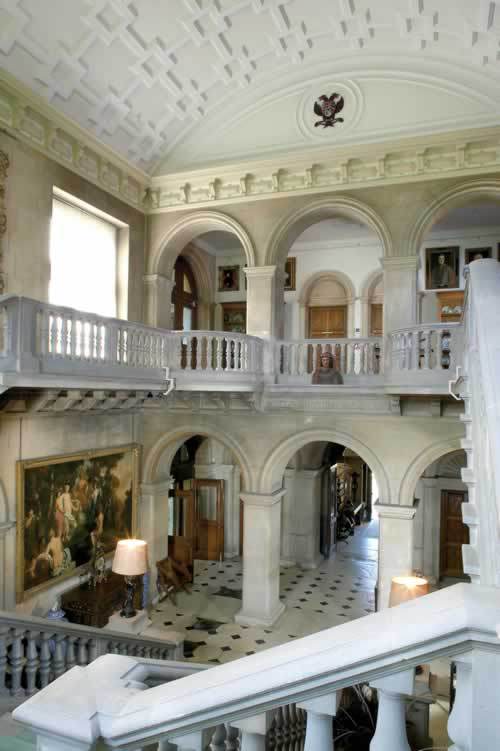
 Corsham Court is lovely, beginning with a handsome hall, that I would call a combination of neo-classic and baroque, as interpreted by Bellamy in the Victorian Age.

The Picture Gallery, a triple cube room, 72 feet long, was designed by Lancelot Capability Brown in the 1760’s.  Brown is renowned for his hundreds of landscape garden designs, but he is also responsible for a number of country houses, some fully, others remodeling projects.


Brilliant works by Van Dyke, Strozzi, Dolci, Reni, del Sarto, Rosa, and others fill the walls in the state rooms – an astonishing collection, mostly still owned by the Methuen family. According to the Blue Guide to English Country Houses, “The pictures themselves, still hung much as they were in the 18C, many of them in their original frames, offer an almost unparalleled insight into 18C artistic taste.” 
 From the house guide book, “In 1765 Morris & Young of Spitalfields supplied 700 yards at 13 s. 6d. a yard, and four years later a further 478 1/2 yards at 14 s. the latter amount for covering the furniture. As time went by, the damask on the chairs got worn, and so sections were cut from behind the paintings to patch them.”
Among the most renowned paintings in the collection is Van Dyke’s Betrayal of Christ, above, now actually owned by the City of Brisol Art Gallery.

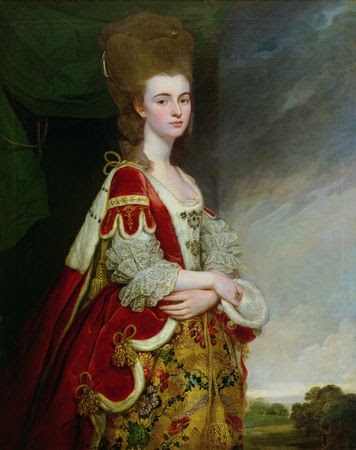
Lady Boston, nee Christiana Methuen by George Romney

I love to look at the family portraits as well as the Old Masters since knowing the stories of the families who lived in the great stately homes is a big part of the fun. Christian Methuen died in 1832.

The Cabinet Room
Almost as renowned as the art collections at Corsham Court are the gardens, some dating from the days of Capability Brown and others developed in the last decades.

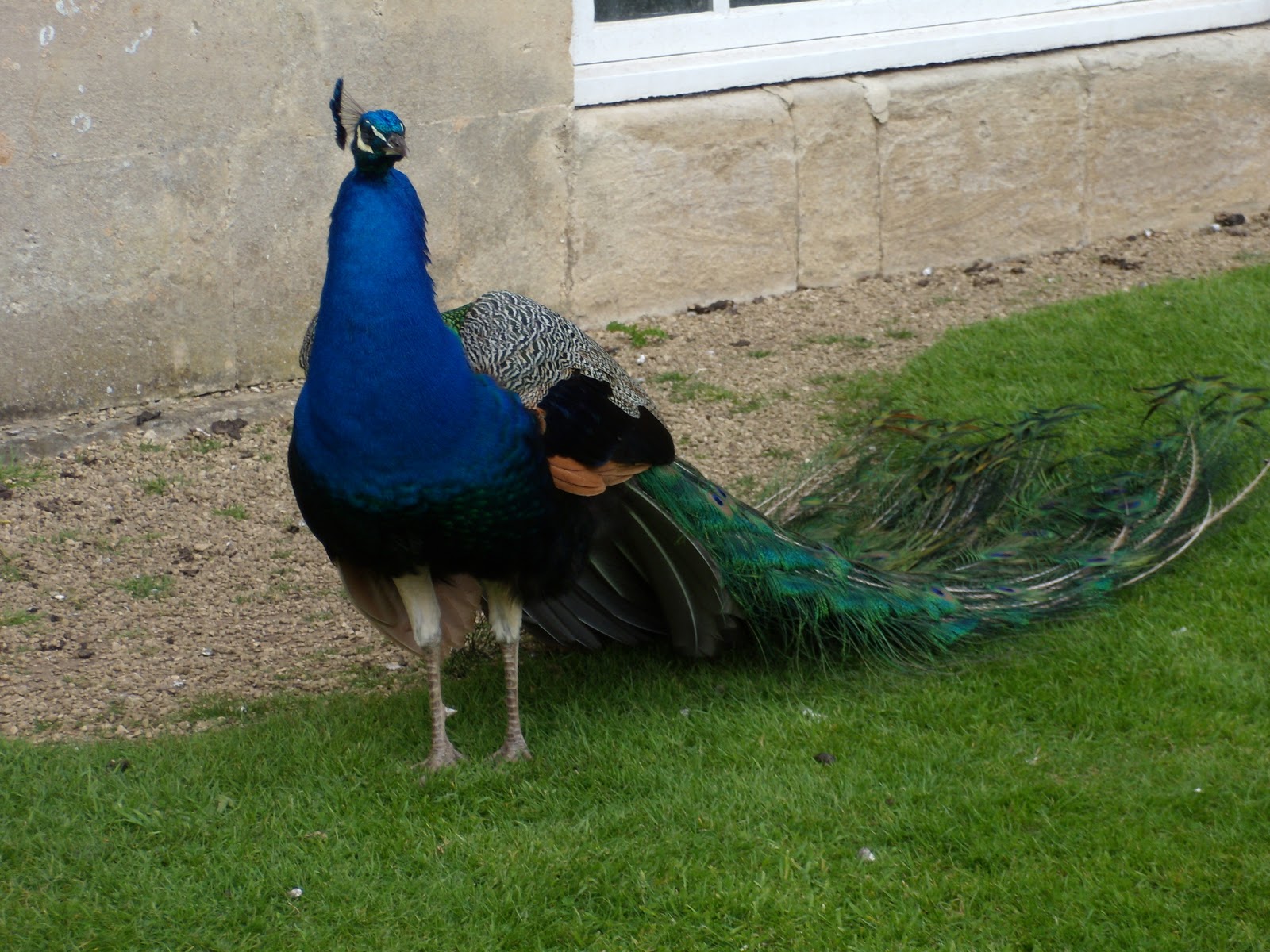
I had my usual luck with peacocks.  Despite my begging, they just weren’t interested in display!

In fact, this fellow just stalked away with a haughty expression. “Don’t bother me,” he seemed to say.

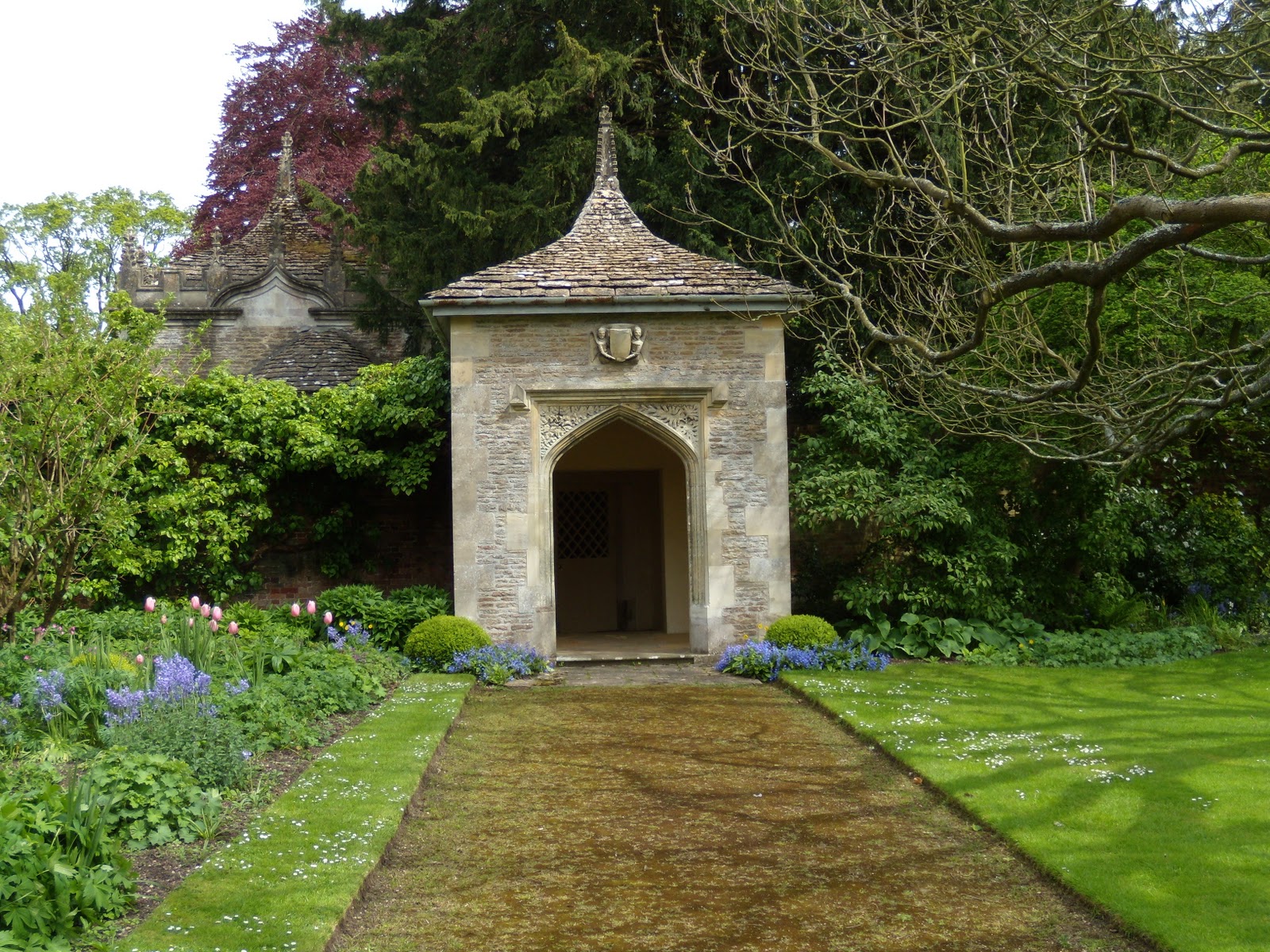
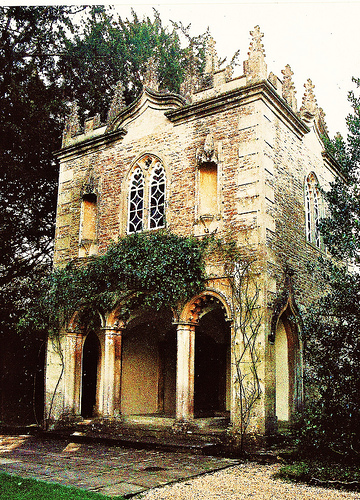
This charming structure leads to the bathhouse, originally designed by Brown but altered by others to its present neo-Gothic look.

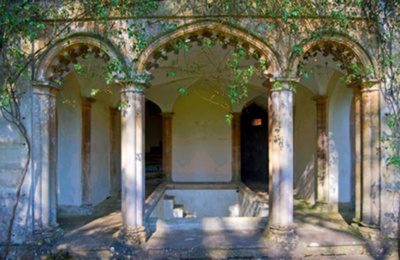
Below is another view which shows the now-empty plunge bath, once a popular feature of country houses — and probably useful too.

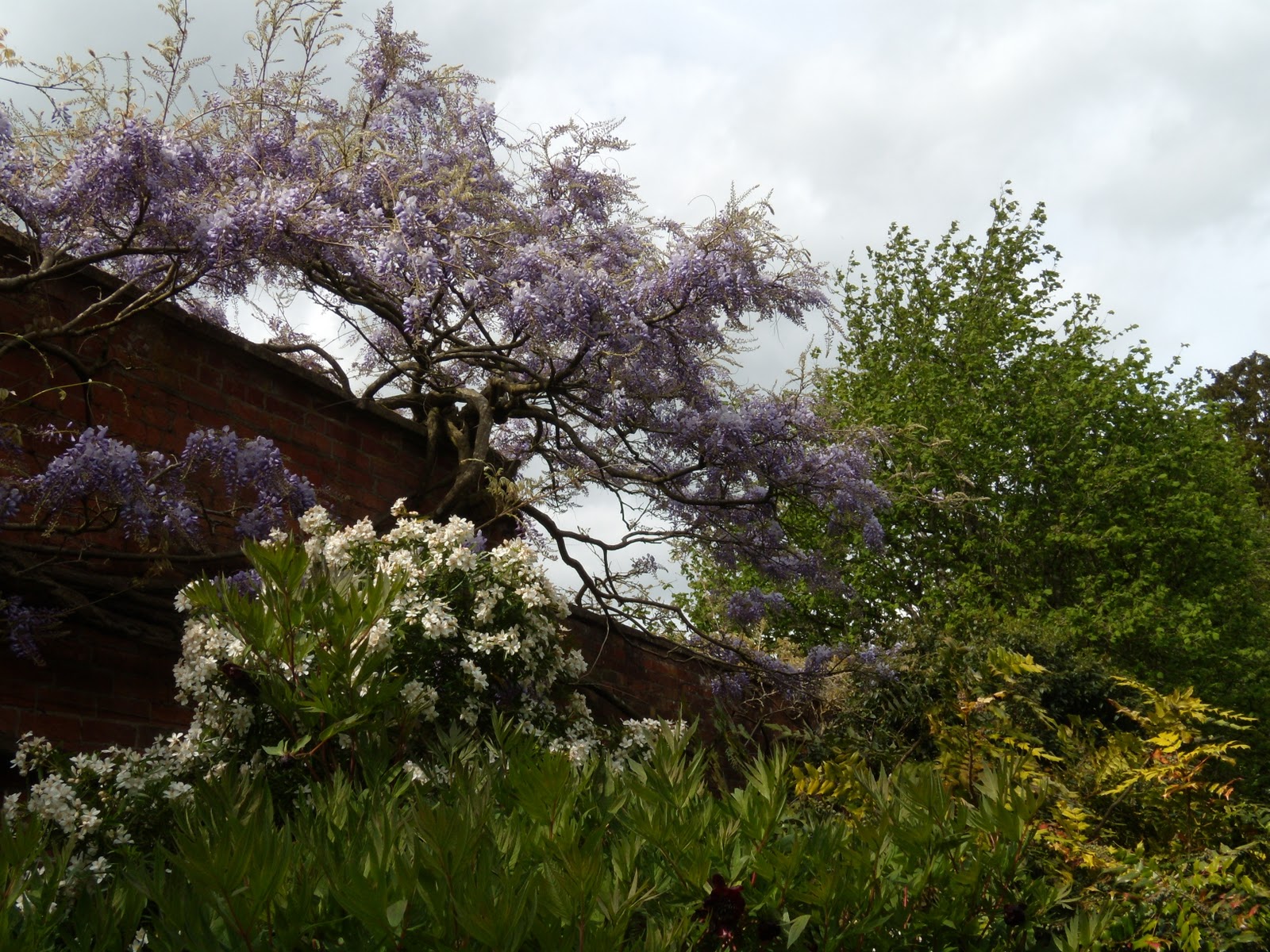
It must have been lovely on a warm day to soak in the bath and gaze out on the beautiful garden blooms.
Corsham Court is as great country house, well worth visiting.
For a detailed history of the house:
More information on the collections and reproductions of the paintings can be seen here:

For Sale: Bath, England

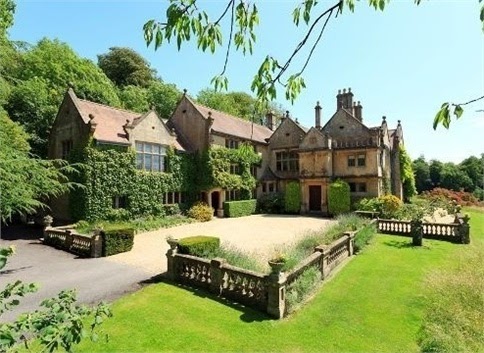
Well . . . I’ve been looking at property listings again. And I’ve found one that’s a right pip, and also offers fantastic views of the city of bath. As the property listing tells us:

Rainbow Wood House, which is unlisted, was specially designed and built in Jacobean revival style in 1897 for the Mallett family, who at the time owned most of the land around Rainbow Woods, including what is now the Bath Clinic and Rainbow Wood Farm. Rainbow Wood House, which is unlisted, is positioned in a spectacular hillside position that affords complete privacy being located a quarter of a mile from the nearest road, Widcombe Hill. Surrounded by mature trees and its own gardens, the house is so secluded that very few Bathonians know the property exists.
The Malletts were well known in Bath and London for their antique business and donated many of their properties and much of their land, including the farm which adjoins Rainbow Wood House, to the National Trust. The present owners acquired the property from the Mallett family in 1980 and are only the second family to reside at the Rainbow Wood estate.

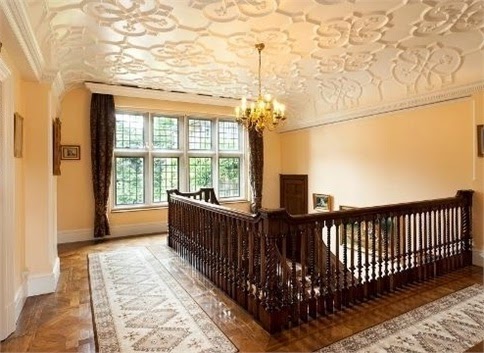
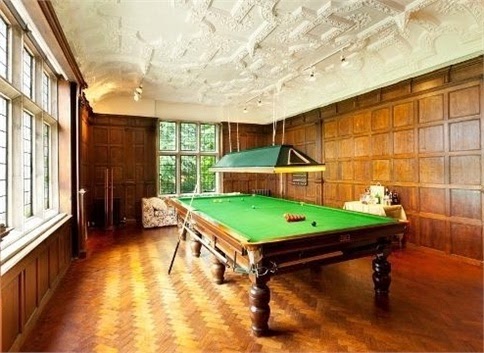
Rainbow Wood House is constructed of Bath stone under a tiled roof and has an array of splendid features from the stone mullions to the gables and bronze, iron and steel framed windows. The reception space is exceptionally impressive having many ornate features that adorn the walls and ceilings in many of the rooms. Of particular note are the half panelled reception hall, a magnificent Edwardian staircase, the fully panelled Oak Room and numerous hand carved doors and original fireplaces. Rainbow Wood House has an interconnected North Wing, which provides substantial additional self-contained accommodation that lends itself to becoming an integral part of the main house. This wing houses the magnificent oak panelled gallery, which is currently used as a snooker and games room.

The house has a gas fired central heating system throughout, with radiators in all rooms including the workshop and attic, modern electrics, a modern alarm system and outside security lights. All main services are connected.
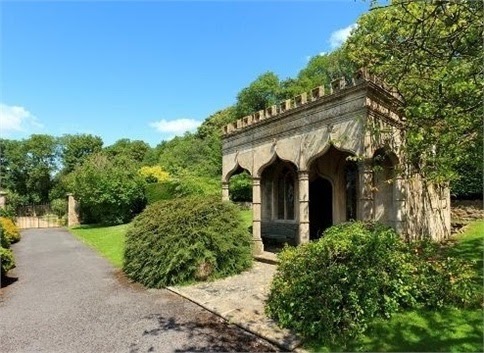
The estate gardens and grounds that encircle Rainbow Wood House are sensational. The extensive lawns are defined and embellished with carved stone features and balustrades and a range of herbaceous borders and mature trees. There are a number of ornamental ponds and a fountain, a central walk leading to the stone built Gothic Temple and a large, original stone walled garden having an abundance of fruit trees. On the top lawns there is a hard tennis court. There is also a two acre grass paddock with wrought iron ‘estate’ fencing..

Ancillary accommodation includes a three bedroom lodge built in the same style as the main house, and a two bedroom gardeners cottage.

The principal outlook is to the south and west overlooking its own gardens, National Trust fields and woodlands and there are far-reaching views over the city towards Bristol and the distant Welsh hills. Despite the seclusion of its position, the house is less than a 5 minute drive from the centre of Bath. In all, the estate has about 13 acres.

Guide price £5,500,000 – Freehold

For complete details, visit the Savills Bath website.

From the Pen of Horace Walpole

Horace Walpole

To John Chute, Esquire.

Paris, Oct. 3, 1765.
I don’t know where you are, nor when I am likely to hear of you. I write at random, and, as I talk, the first thing that comes into my pen. I am, as you certainly conclude, much more amused than pleased. At a certain time of life, sights and new objects may entertain one, but new people cannot find any place in one’s affection. New faces with some name or other belonging to them, catch my attention for a minute—I cannot say many preserve it. Five or six of the women that I have seen already are very sensible. The men are in general much inferior, and not even agreeable. They sent us their best, I believe, at first, the Due de Nivernois. Their authors, who by the way are everywhere, are worse than their own writings, which I don’t mean as a compliment to either. In general, the style of conversation is solemn, pedantic, and seldom animated, but by a dispute. I was expressing my aversion to disputes: Mr. Hume, who very gratefully admires the tone of Paris, having never known any other tone, said with great surprise, “Why, what do you like, if you hate both disputes and whisk?”
Palace of Versailles

What strikes me the most upon the whole is, the total difference of manners between them and us, from the greatest object to the least. There is not the smallest similitude in the twenty-four hours. It is obvious in every trifle. Servants carry their lady’s train, and put her into her coach with their hat on. They walk about the streets in the rain with umbrellas to avoid putting on their hats; driving themselves in open chaises in the country without hats, in the rain too, and yet often wear them in a chariot in Paris when it does not rain. The very footmen are powdered from the break of day, and yet wait behind their master, as I saw the Duc of Praslin’s do, with a red pocket-handkerchief about their necks. Versailles, like everything else, is a mixture of parade and poverty, and in every instance exhibits something most dissonant from our manners. In the colonnades, upon the staircases, nay in the antechambers of the royal family, there are people selling all sorts of wares. While we were waiting in the Dauphin’s sumptuous bedchamber, till his dressing-room door should be opened, two fellows were sweeping it, and dancing about in sabots to rub the floor.
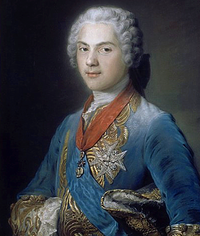
Louis, Dauphin of France

You perceive that I have been presented. The Queen took great notice of me; none of the rest said a syllable. You are let into the King’s bedchamber just as he has put on his shirt; he dresses and talks good-humouredly to a few, glares at strangers, goes to mass, to dinner, and a-hunting. The good old Queen, who is like Lady Primrose in the face, and Queen Caroline in the immensity of her cap, is at her dressing-table, attended by two or three old ladies, who are languishing to be in Abraham’s bosom, as the only man’s bosom to whom they can hope for admittance. Thence you go to the Dauphin, for all is done in an hour. He scarce stays a minute; indeed, poor creature, he is a ghost, and cannot possibly last three months. The Dauphiness is in her bedchamber, but dressed and standing; looks cross, is not civil, and has the true Westphalian grace and accents. The four Mesdames, who are clumsy plump old wenches, with a bad likeness to their father, stand in a bedchamber in a row, with black cloaks and knotting-bags, looking goodhumoured, not knowing what to say, and wriggling as if they wanted to make water. This ceremony too is very short; then you are carried to the Dauphin’s three boys, who you may be sure only bow and stare. The Duke of Berry looks weak and weak-eyed: the Count de Provence is a fine boy; the Count d’Artois  well enough. The whole concludes with seeing the Dauphin’s little girl dine, who is as round and as fat as a pudding.
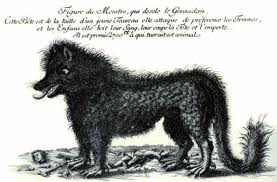
In the Queen’s antechamber we foreigners and the foreign ministers were shown the famous beast of the Gevaudan, just arrived, and covered with a cloth, which two chasseurs lifted up. It is an absolute wolf, but uncommonly large, and the expression of agony and fierceness remains strongly imprinted on its dead jaws.*

I dined at the Due of Praslin’s with four-and-twenty ambassadors and envoys, who never go but on Tuesdays to court. He does the honours sadly, and I believe nothing else well, looking important and empty. The Due de Choiseul’s face, which is quite the reverse of gravity, does not promise much more. His wife is gentle, pretty, and very agreeable. The Duchess of Praslin, jolly, red-faced, looking very vulgar, and being very attentive and civil. I saw the Due de Richelieu in waiting, who is pale, except his nose, which is red, much wrinkled, and exactly a remnant of that age which produced General Churchill, Wilks the player, the Duke of Argyll, &c. Adieu!

* More from Walpole on the Beast in a letter to the Hon. H.S. Conway, October 6, 1765: Yes, the wild beast, he of the Gevaudan. He is killed, and actually in the Queen’s antechamber, where he was exhibited to us with as much parade as if it was Mr. Pitt. It is an exceedingly large wolf, and, the connoisseurs say, has twelve teeth more than any wolf ever had since the days of Romulus’s wet-nurse. The critics deny it to be the true beast; and I find most people think the beast’s name is legion, for there are many. He was covered with a sheet, which two chasseurs lifted up for the foreign ministers and strangers.

Regency Reflections: Pitshanger Manor and Dulwich Picture Gallery

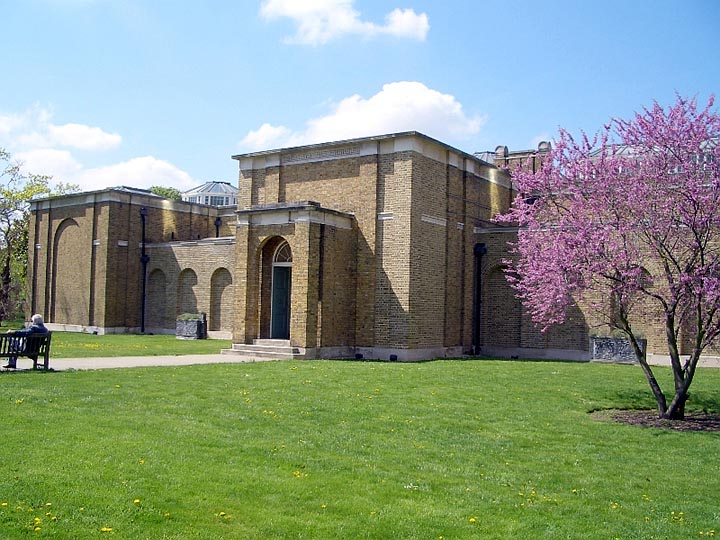
Sir John Soane (1784-1837) was a distinguished architect in Georgian England whose works have received at great deal of attention from 20th and 21st century architects. His work was unique for his time and appealing to the contemporary sensibility, both then and now. For information on his London home and museum, see the blog post of 9/24/11. This post will discuss two more of his buildings, Pitshanger Manor and the Dulwich Picture Gallery.

Pitshanger Manor, Ealing, Greater London
Soane had a well established practice and had completed most work on his own London home in Lincoln’s Inn Fields by 1800. He wanted a villa west of the city where he, his wife and two sons could enjoy country life. He purchased 28 acres for £ 4,500 including an existing house and outbuildings, known as Pitshanger Manor.  Eventually, he demolished most of the existing structures, saving only a wing designed by his mentor, architect George Dance, in the 1770’s for previous owners. Over the next few years, Soane and his students worked on the house. Almost all of the drawings  and receipts for the construction, decoration and furnishing of the house have been preserved in Sir John Soane’s Museum.
Library, Pitshanger Manor
London has spread out quite a bit and Pitshanger Manor is now in a park in the suburb of Ealing, reachable by the Underground, amidst an affluent bedroom community. In the early 20th century, the building had become the local library, with an addition for additional space. Since the mid-80’s, it has been opened to the public and carefully restored to the look of Soane’s day, except for the addition which is used for small art exhibitions.


Breakfast Room., Pitshanger Manor

The interiors are clearly neo-classic, but have a distinctly contemporary feel. One can easily see why post-modernists are attracted to Soane’s work. The breakfast room has walls with marbled effects, a popular technique used by today’s designers.  

Dulwich Picture Gallery
In another section of suburban London, the Dulwich Picture Gallery attracts many visitors to its collection of Old Masters.  It is Britain’s first purpose-built public picture gallery, and Soane’s design set the standard for every art museum since.  The Picture Gallery is located on the campus of Dulwich College, established in the early 17th century in the village of Dulwich, where it today serves about 1600 boys, ages 7 to 18. 
The Picture Gallery came about as a result of several coincidences  A London art dealer Noel Desenfans (1745-1807)  was asked by the King of Poland to assemble paintings for a national collection in 1790. However, within a few years, Poland had been divided up among Austria, Prussia and Russia. Desenfans tried to sell the collection but met with no success. Therefore he decided, with the help of his friend, Francis
Bourgeois, to set up a public gallery. After his death, Bourgeois willed the collection to Dulwich College. His friend Sir John Soane designed the building, which also includes a mausoleum for Mr. and Mrs. Desenfans and Bourgeois.

Soane’s design was unique, using extensive skylights to bring in natural light. Building began on October 12, 1811.  Originally there were five galleries on either side of the mausoleum and flanked by almshouses, which were later converted to additional galleries. Further additions have been kept in sympathy with the original designs.

Girl Leaning on a Window-sill, Rembrandt
The collection contains many gems, some dating from the establishment of the original college, many from the Desenfans collection, others from more recent acquisitions.  The Gallery’s website is here.
The Madonna of the Rosary: Murillo
Thomas Linley (1732-95) and his son, also Thomas (1756-98) were famous composers and musical performers in Georgian England, along with Elizabeth and Mary, the elder Thomas’s daughters. They were good friends of the renowned  portraitist Thomas Gainsborough (1727-1788) who painted all of them. Gainsborough’s portrait of the Linley Sisters, below, was part of a bequest of Linley family portraits to the

Gallery. Elizabeth Linley (in blue) was painted just before she eloped and eventually married Richard Brinsley Sheridan, playwright and politician.

  
The Linley Sisters by Gainsborough
Two hundred years after its establishment, the Dulwich Picture Gallery is thriving; it has won many awards for its extensive educational programs. It stands as a tribute to its founders and to the designer of its trail-blazing building, Sir John Soane.