London Calling…

The New York Times book Review of Sunday, November 13, 2011, carried a review of a new book I need to add to my library: London Under: The Secret History Beneath the Streets by Peter Ackroyd.
To read the review, click here.

The book begins with a warning to tread carefully in the streets of London, for one is walking over the remains of tens of thousands over many centuries. It is no surprise to think of cities buried beneath us; that is true of many cities. But for London junkies like Kristine and Victoria, all other locations pale in comparison.
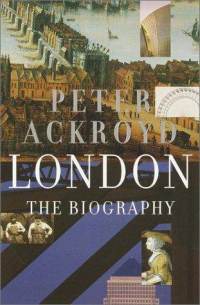
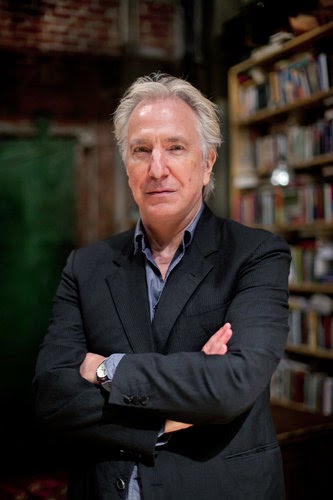
Author Peter Ackroyd (above, from The Guardian in 2008) has written dozens of books, many about London and its residents.  One of my favorites is London: The Biography, published in 2000. Beginning with pre-history, Ackroyd brings London’s story up to the Greater London of almost today, a metropolis that sprawls over a vast region. London Under tells about what is below, from the earliest races of human habitation along the river Thames to the constant expansion of the Underground, or as it is more affectionately known, the Tube. The chapter headings begin with “Darkness Visible” and run to “Deep Fantasies.”
Ackroyd’s biographies include such subjects as Chaucer, Shakespeare, William Blake, J.M.W. Turner, Charles Lamb, Charles Dickens, Oscar Wilde, T.S. Eliot, and Ezra Pound.  Don’t you wonder what he does in his spare time? 

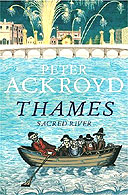
I seem to have missed Ackroyd’s 2007 book Thames: Sacred River, a situation I will have to remedy soon.  He has also written fiction, some sounding like fictional biography, a genre that has become increasingly popular lately.

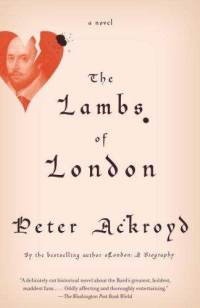
Above, the story of Charles Lamb, written as a novel, published in 2004.  From what little I recall about Charles and his sister Mary, the truth is actually stranger than fiction.  But the story of the pair no doubt makes for a dramatic account of interesting aspects of the regency era.

I guess I have set us up for a lot of reading in the near future.  But as long as the topic is London, it is a labor of love.  Thanks, Mr. Ackroyd!

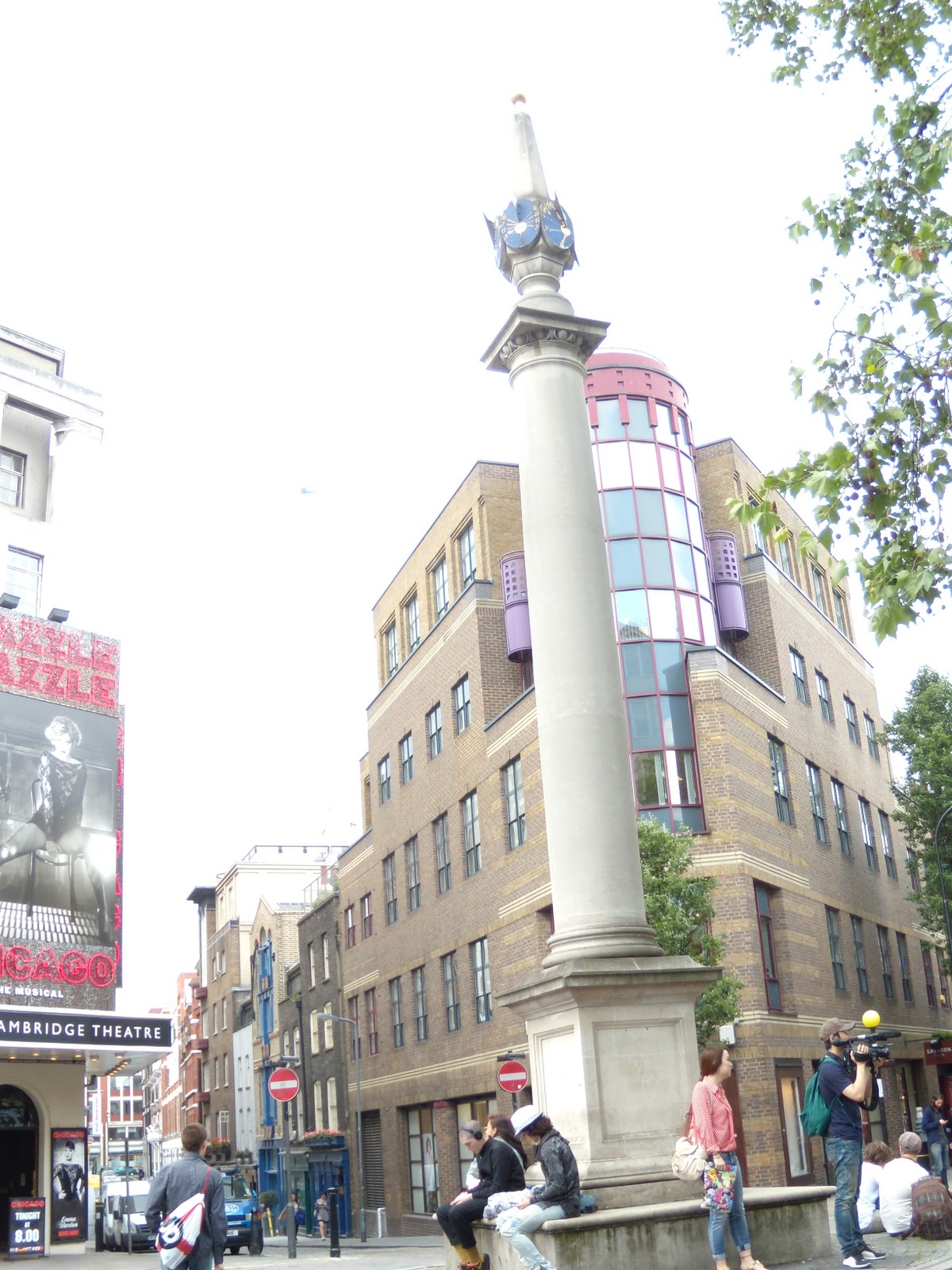
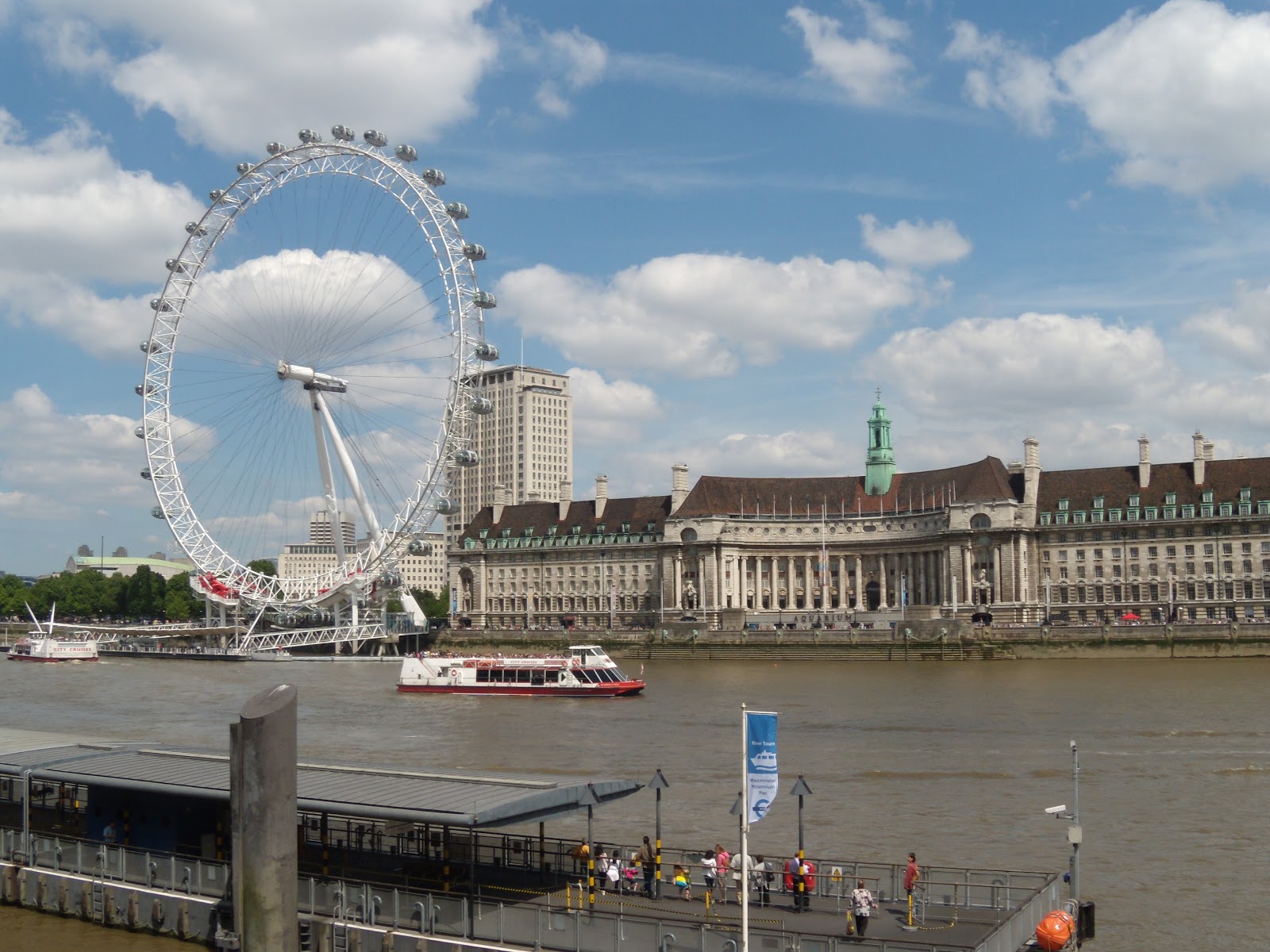
Above, my photos:  Seven Dials, 2010; The London Eye from Parliament, also 2010.

In Praise of Alan Rickman

Here in the US, Masterpiece on PBS recently presented The Song of Lunch  starring Alan Rickman and Emma Thompson.  A BBC dramatization of Christopher Reid’s poem, the program was unique, in my (Victoria, here) view.  Poetry.  On tv.  Brilliant acting. Emma.  And Alan. Sigh.

I consider myself a charter member of the Alan-Rickman-can-do-no-wrong Club. Though he has been cast in some unsavory roles, to me he is always a hero.  As “he” in The Song of Lunch, Rickman portrays a self-pitying character who meets a former lover (Thompson) in an unsuccessful encounter for which he had some unrealistic expectations.

By the way, Alan, I am available for lunch in Soho almost any time — just e-mail me right here. And figure in enough time for me to fly across the pond — and have my hair done.

Sad to say, I haven’t kept up with the character development of Severus Snape, the role that most young people will associate most with Rickman.  He was a villain early on, but I believe he evolved into a very good guy in Harry Potter’s world. 

Villain-wise, however, I choose the Sheriff of Nottingham in the 1991 film Robin Hood, Prince of Thieves.  There’s a dastardly fellow we can all love.  If we can stop laughing long enough.

And just about my favorite of Rickman’s many film roles is that of Col. Brandon in the 1996 version of Sense & Sensibility, a role that forever altered my view of Jane Austen’s first published novel. Until I saw — and heard — Rickman wooing Marianne and confessing to Elinor, I had felt only moderate interest in and compassion for Brandon.  But now I can never think of Brandon without seeing and hearing Alan Rickman.  Which makes Marianne’s obsession with the shallow Willoughby even more foolish — and her reluctance to immediately adore Brandon almost impossible to accept. That’s one of the drawbacks to watching filmed versdions of favorite novels, isn’t it?  Can anyone think of Darcy again without seeing Colin Firth?

I think I read that Rickman is bound for Broadway soon — so Alan, maybe we could have that luncheon in New York?  Just name that date!! 

I am expecting to have to arm-wrestle a few of our regular readers to win this encounter.  I’m ready!!

But wait, there’s  more!  Gambit will be coming out soon (?).  A remake of the 1966 Michael Caine/Shirley MacLaine caper film, this new version stars Alan Rickman, Colin Firth, Stanley Tucci and Cameron Diaz, among others.  The Coen Brothers are involved — but I couldn’t find a set release date. 2012 is all I found. Let’s hope it is as soon as possible!!

On The Shelf – High Rising

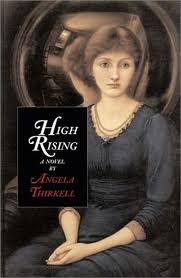
I’ve just re-read Angela Thirkell’s High Rising and realized that I’d made a huge mistake – I read it without having any more of the Barsetshire novels on hand to read next. I then spent a good hour online, ordering six more titles in the series. Honestly, these novels, and the characters therein, are pure joy. Another thing I only recently realized – penned in the 1930’s, these stories are now eighty years old, but they still read as funny and the characters are just as amusing as any 21st century counterparts. Like E.F. Benson and P.G. Wodehouse, Thirkell takes us back to an England where conversation is witty and entertaining, where plots are relatively simple (yet infinitely engaging) and where villians, if there are any, are really rather harmless, except to themselves. Everyone gets their comeuppance, everything comes right in the end and we, the readers, are thoroughly entertained throughout.

Oft compared to our own Jane Austen, Ms. Thirkell is a genius at setting place, crafting a plot and at writing sometimes over-the-top yet wholly believable dialogue. After reading any of the Barsetshire novels, who wouldn’t want to spend a few weeks in the English countryside?

From the Powell’s Books website: “In High Rising, Mrs. Morland, a widowed author, must attend to the deeper problems of country life while her son Tony drives everyone to distraction with his amazing combination of toy trains. Here Mrs. Thirkell demonstrates the characteristic style for which she is known and for which readers love her. This is fiction replete with gentle irony, grave absurdity, and urbane understatement. This novel introduces one of Angela Thirkell’s most beloved characters–Laura Morland, a novel-writing widow and mother of four who strongly resembles Thirkell herself. In High Rising, Laura receives a marriage proposal from her publisher, who really loves Sibyl, the daughter of Laura’s neighbor; Dr. Ford has feelings for Laura’s secretary, Anne; and attractive but neurotic Una is determined to marry her employer. And in Tony, Laura’s youngest son, Thirkell has created one of the most exasperating small boys in fiction. This is the first of the Barsetshire novels.”

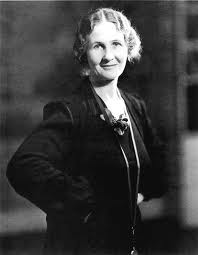
 If you haven’t yet read Thirkell (above), do. If you have, read them again. Oh, Barsetshire is sheer bliss. You can learn more about Angela Thirkell at the Thirkell Society’s website here.

Grosvenor Prints

Once again, Grosvenor Prints, London, has some eclectic and interesting new stock. Grosvenor Prints, in Seven Dials, is one stop I always make when in London. When there last, Vicky and I spent a few enjoyable hours pouring over their stock – she looking at fashion prints, whilst I combed through their Wellington files. Samples of their latest acquisitions for sale can be seen below. Click here to see all of their new listings.

Sketch of Bonaparte. As laid out on his Austerlitz Camp Bed, taken by Capt.n Marryatt R.N., 14 hours after his Decease, at the request of Sir Hudson Lowe, Governor of St Helena & with the permission of Count Montholon & General Bertrand. C. Hullmandel’s Lithography. London Published by S. & J. Fuller, 34 Rathbone Place, July 16 1821. Lithograph, fine, sheet Printed area 265 x 300mm, 10½ x 11¾”. Full uncut sheet bearing the embossed stamp for “S & J Fuller”.  Napoleon died, reportedly of stomach cancer, on 5 May 1821 after six years in exile on St Helena. His body was buried first in the grounds of Longwood, his St Helena residence, before being brought back to France in 1840 to be ceremoniously reburied in Les Invalides. Marryat was a naval officer, and later the author of ‘Peter Simple, Mr Midshipman Easy’, and other popular seafaring novels, and later children’s books. At the time of Napoleon’s death he commanded the sloop ‘Beaver’, guardship at St Helena. When the ex-emperor died he carried the dispatches announcing the death back to England. The fact that Marryat visited and sketched Napoleon so soon after his death illustrates the continued fascination and emotion Napoleon evoked back in Britain, even after six years in remote exile away from the public glare. See NMM: PAF3523. {f: 21864] £280.00                                                             

To the Viscountess Canning This Portrait of The Right Honble. George Canning, M.P.             Painted by Sir Thomas Lawrence, P.R.A. Principal Painter in Ordinary to His Majesty, Engraved by Charles Turner, A.R.A. Mezzotinto Engraver in Ordinary to His Majesty, Pall Mall East, London, Published April 9, 1829, by Messrs. Colnaghi Son & Co, Printsellers to the King. Mezzotint, final state, image 580 x 355mm. 22¾ x 14″. Some mould spots and foxing. Tatty and chipped margins.
Fine full-length portrait of statesman George Canning (1770 – 1827), Foreign Secretary, Prime Minister for 119 days, the shortest term ever. After Sir Thomas Lawrence (1769 – 1830).
Whitman 95, v of v.  [Ref: 21797] £280.00    

A Cockatoo – Henry Rayner [signed in plate and in pencil to margin.] [n.d., c.1940.] Drypoint etching printed in colours, 170 x 125mm. 6¾ x 5″. A fine impression. A cockatoo is any of the 20 bird species belonging to the family Cacatuidae. Along with the Psittacidae family (the true parrots), they make up the order Psittaciformes. Cockatoos have a much more restricted range than the true parrots, occurring naturally only in Australia and nearby islands. Eleven of the 21 species exist in the wild only in Australia, while seven species occur in Indonesia, New Guinea, and other south Pacific islands. Henry Hewitt Redstone Rayner (1902 – 1957). Australian-born, he worked in the Antipodes before studying at the Royal Academy. He was a friend of Sickert. [Ref: 22521] £75.00
Viscountess Duncannon. Painted by Sir J. Reynolds P.R.A. Engraved by J. Grozer. Wm. Austin excudit. Published as the Act directs March 31st 1786 by Wm Austin Drawing Master, Engraver & Print Merchant No.195 Piccadily near St Jamess Church London. Mezzotint, final state with altered publication line, 390 x 275mm. 15¼ x 7″. A fine impression with full margins. Portrait of Henrietta Frances (‘Harriet’) Ponsonby (née Spencer), Countess of Bessborough (1761 – 1821), an amateur etcher; standing in a landscape, looking to the right, with flowers attached to the front of her shawl. After Sir Joshua Reynolds (1723 – 1792). Hamilton p.96, III of III. CS: 8, iii/iii. [Ref: 22388] £280.00                                 
Mary Isabella, Duchess of Rutland. Painted by Sir Joshua Reynolds, & Engraved by the late J.K.Sherwin, Historical Engraver to his Majesty, & his royal highness the Prince of Wales, finish’d since his decease. London Published June 4th. 1791 by Robt. Wilkinson No. 58 Cornhill.

Engraving, very fine published state, 510 x 380mm. 20 x 15″ Mary Isabella Manners (née Somerset), Duchess of Rutland (1756 – 1831), politician and society hostess; seate
d to right with her head in profile, resting on her left hand, a book in her right; seascape through window behind. After Sir Joshua Reynolds (1723 – 1792).
Hamilton p.129. NPG D39956. [Ref: 21779] £320.00   
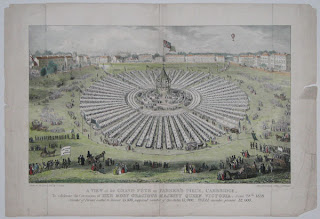
                                                   

A View of the Grand Fête on Parker’s Piece, Cambridge, To celebrate the Coronation of Her Most Gracious Majesty Queen Victoria, June 28th 1838. Number of Persons seated to Dinner 15,000, supposed number of Spectators 17,000, _ Total number present 32,000. [& Admission ticket] A Dinner Given to 12000 Persons on Parker’s Piece, Cambridge, June 28, 1838. In Commemoration of the Coronation of Her Most Gracious Majesty Victoria Queen. Drawn on the Spot & Lith.d by G Scharf. Metcalfe & Palmer, Lithog. Cambridge. [&] Rog. sculp.t. Cambridge. [n.d., c.1838.] Coloured lithograph. Printed area 185 x 270mm, 7¼ x 10½”. & engraved admission ticket on card very scarce, 115 x 150mm, 4½ x 6″. Binding folds, one split, tears in edges.

A formal dinner on Parker’s Piece, a 25-acre common near the centre of Cambridge, England, named after a college cook, Edward Parker, who obtained the rights to farm on it. [Ref: 22318] £160.00


For Sale: Ayton Castle

Castle, houses, lodges, cottages and fishing in the Scottish Borders

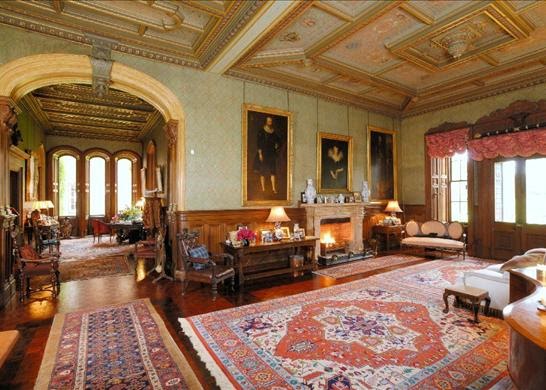
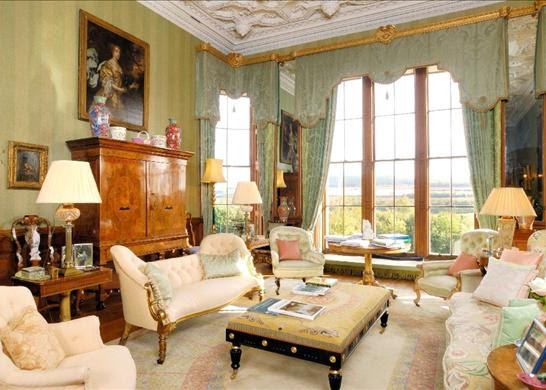
Yes, yes, I’ve been at it again – property browsing on a grand scale. But you must admit, the sale of Ayton Castle is the perfect opportunity for anyone with dreams of playing Monarch of the Glen to own their very own family pile.

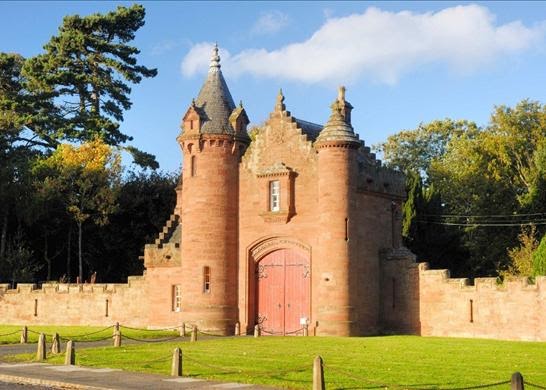
Ayton Castle comes complete with aself-contained flat and grounds extending to 159 acres, 4 houses/cottages, 2 lodges, stable yard with 2 flats and various outbuildings. Fishing on The Eye Water, private garden and extensive policies with good grazing.

As property agents Knight Frank tell us, Ayton Castle has 7 main reception rooms, 17 bedrooms, 9 bathrooms, kitchen/breakfast room, billiards room, extensive domestic offices and a self-contained house keeper’s flat. There are 2 lodges and 4 estate houses/cottages. There is a traditional stone-built stable yard with 2 flats.

Ayton Castle is widely regarded as one of Scotland’s finest baronial style buildings and was designed by James Gillespie Graham, Scotland’s leading Gothic revival architect of the early 19th century. The Castle is a magnificent example of a Scots baronial house, primarily over two storeys, with a five storey ‘Great Tower.’

There is an array of secondary accommodation at the lower ground floor and basement/courtyard levels including the former servants hall and various store rooms and adjacent accommodation arranged around the service courtyard. Approximately half the policies are grazing and half are woodland, all of which are in hand.

As the Berwickshire News reported on Sunday: “The Liddell-Grainger family has continued to own the castle throughout the 20th century, but with the death of David Liddell-Grainger in 2007, the estate and the family seem to have encountered turbulent times, resulting in the castle being put on the property market.

“The private life of David Liddell-Grainger has been colourful and an affair with Christine de la Rue, wife of Sir Eric de la Rue, resulted in him divorcing his wife in 1981 and Christine moving into the castle along with her elderly husband who by this time required nursing care. David Liddell Grainger and Christine de la Rue had two children together, one of whom died of cancer as a child.


“They married in 1996 and when he died 11 years later it is believed that David Liddell-Grainger left his 6000 acre estate to his son by Christine de la Rue rather than his eldest son by his first marriage.

“Last month a Private Rented Housing Panel issued an enforcement notice which ordered Henry Liddell-Grainger and Lady Christine de la Rue to carry out immediate repairs on two cottages on Ayton Castle estate. Tenants had complained of leaking roofs, damp and a two page catalogue of essential repairs that were needed to bring the properties up to a habitable standard.”

Tenant issues aside, Ayton Castle would make the perfect backdrop for a life of baronial splendour. Never mind the massive heating bills – that’s what fireplaces are for.

You can watch a video of the stunning Castle grounds here.

Offers Over £2,200,000 – Knight Frank