Preserved Kitchens from the Past

A few months ago, the Daily Mail reported on the discovery of a Victorian kitchen in the basement of a large home in Wales. The room, closed off for decades, will be preserved as an excellent example of how the servants once lived and worked.

Cefn Park, Wales

The entire article is here.  Imagine discovering such relics right down in the basement!

Which got us thinking about other historic  kitchens  we’ve visited in Britain.  There are many — send us your favorites!

The Hampton Court Palace kitchens are among the most popular parts of the oft-visited palace.  On many days, costumed works demonstrate Tudor cookery and prepare treats for the sightseers.  We remember imbibing chocolate drinks, far different than what we enjoy at Starbucks, but still delicious (when you get used to it!).

Above, the larder where the butcher received game and began to prepare the meat for feeding the hundreds of royal guests, court functionaries and palace staff.  Imagine keeping 600 people fed — 24/7.

The kitchen complex includes bakeries, breweries, larders, boiling and roasting rooms, pantries, confectories, spicery, and many more. Not to mention sculleries I suppose. For more on Henry VIII’s kitchens, click here.

Another wonderful kitchen that prepared royal meals is in the Brighton Pavilion, home of the Prince Regent, later George IV.  For a panoramic Tour, click here.  For more on the Brighton Pavilion, try this.

When it was constructed in the early 1800’s, it was the epitome of innovation with its high ceilings.  Our friend Ian Kelly wrote a book about Careme, the most famous chef who worked here, among other places. For details, click here.

 Below, the kitchens at Burghley House, home of Queen Elizabeth I’s trusted advisor William Cecil.

The kitchens at Burghley House are filled with copper pans (Kristine and Victoria and their companions almost swooned at the thought of keeping all of them so shiny!) On the right above, are the collected skulls of turtles, who were no doubt privileged to sacrifice their lives to the soup pot.  To see more on Burghley House, click here.
As a matter of fact, displays of gleaming copper pots are typical of the kitchens in stately homes.  Petworth has a wonderful collection.  Details on Petworth here.
 Petworth, National Trust
Harewood House, above, in Yorkshire also boasts shelf after shelf of bright copper utensils. This kitchen, too, is often the site of special events which include tasty treats.  Harewood’s excellent website is here.
Uppark, NT
 There’s a special twist to the downstairs facilities displayed at the National Trust’s Uppark House. The mother of the brilliant author H. G.Well
s (1866-1946) worked here as housekeeper in the 1880’s and the young Wells grew up in the servants quarters.  More on Uppark is here.
 The tunnels at Uppark were constructed to shield the delicate sensibilities of the owners from viewing the servants bustling about between the kitchens and the stables. But imagine how much fun it would be to play hide-and-seek here. Or chase the toads that often invade. Nevertheless, we should not try to romanticize the lives beneath the stairs — it was never easy and often brutal.

However, if you insist upon romanticizing the life of a servant, you can always try your hand at various below stairs tasks at the very interactive Lanhydrock House (above) in Cornwall, where they urge visitors to “have a go at napkin folding, laying a place setting and hat brushing on our touch and discover tables around the house.”

For an authentic look at the life of the country house staff, the National Trust has this and other volumes available at their bookstore, here
So what are you having for dinner?  I’m thinking carry-out!

More Reminiscences of Captain Gronow

To say that Captain Gronow is not politically correct by today’s standards would be an understatement indeed. However, his comments no doubt reflect the prevailing view of his readers, however offensive we find his prejudices today.

Here are Gronow’s observations on author Matthew Lewis (1775-1818), known as Monk after the name of his renowned Gothick novel.

Matthew “Monk” Lewis by Pickersgill, 1809
“MONK” LEWIS

One of the most agreeable men of the day was “Monk” Lewis.  As the author of the Monk and the Tales of Wonder, he not only found his way into the best circles, but had gained a high reputation in the literary world. His poetic talent was undoubted, and he was intimately connected with Walter Scott in his ballad researches.  His Alonzo the Brave and the Fair Imogene was recited at the theatres, and wherever he went he found a welcome reception.  His West Indian fortune and connections, and his seat in Parliament, gave him access to all the aristocratic circles; from which, however, he was banished upon the appearance of the fourth and last dialogue of the Pursuits of Literature.  Had a thunderbolt fallen upon him, he could not have been more astonished than he was by the onslaught of Mr. Matthias, which led to his ostracism from fashionable society.

 It is not for me to appreciate the value of this satirical poem, which created such an extraordinary sensation, not only in the fashionable, but in the political world; I, however, remember that whilst at Canning’s, at the Bishop of London’s, and at Gifford’s, it was pronounced the most classical and spirited production that had ever issued from the press, it was held up at Lord Holland’s, at the Marquis of Lansdowne’s, and at Brookes’s, as one of the most spiteful and ill-natured satires that had ever disgraced the literary world; and one which no talent or classic lore could ever redeem.  Certain it is, that Matthias fell foul of poor “Monk” Lewis for his romance: obscenity and blasphemy were the charges laid at his door; he was acknowledged to be a man of genius and fancy, but this added only to his crime, to which was superadded that of being a very young man.  The charges brought against him cooled his friends and heated his enemies; the young ladies were forbidden to speak to him, matrons even feared him, and from being one of the idols of the world, he became one of the objects of its disdain. Even his father was led to believe that his son had abandoned the paths of virtue, and was on the high road to ruin.

 “Monk” Lewis, unable to stand against the outcry thus raised against him, determined to try the effects of absence, and took his departure for the island in which his property was; but unfortunately for those who dissented from the ferocious judgment that was passed upon him, and for those who had discrimination enough to know that after all there was nothing very objectionable in his romance, and felt assured that posterity would do him justice, this amiable and kind-hearted man died on his passage out; leaving a blank in one variety of literature which has never been filled up.

 The denunciation was not followed by any other severe criticism; but editors have, in compliance with the insinuations of Matthias, omitted the passages which he pointed out as objectionable, so that the original text is seldom met with.

“Monk” Lewis had a black servant, affectionately attached to his master; but so ridiculously did this servant repeat his master’s expressions, that he became the laughing-stock of all his master’s friends: Brummell used often to raise a hearty laugh at Carlton House by repeating witticisms which he pretended to have heard from Lewis’s servant.  Some of these were very stale; yet they were considered so good as to be repeated at the clubs, greatly adding to the reputation of the Beau as a teller of good things.  “On one occasion,” said Brummell, “I called to inquire after a young lady who had sprained her ancle; Lewis, on being asked how she was, had said in the black’s presence, ‘The doctor has seen her, put her legs straight, and the poor chicken is doing well.’ The servant, therefore, told me, with a mysterious and knowing look, ‘Oh, sir, the doctor has been here; she has laid eggs, and she and the chickens are doing well.'”

 Such extravagances in those days were received as the essence of wit, and to such stories did the public give a willing ear, repeating them with unwearying zest.  Even Sheridan’s wit partook of this character, making him the delight of the Prince, who ruled over the fashionable world, and whose approbation was sufficient to give currency to anything, however ludicrous and absurd.

More excerpts from Captain Gronow's Reminiscences

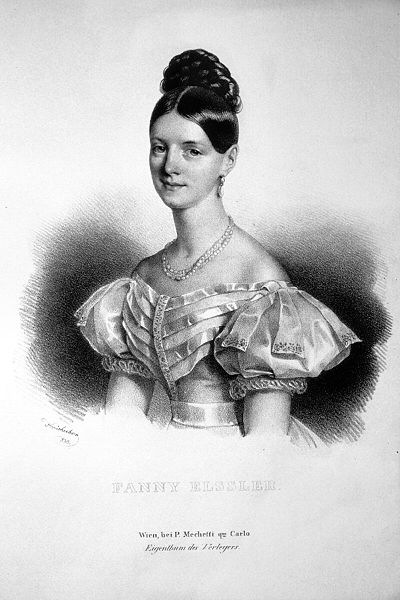
Captain Gronow knew and admired the Austrian dancer Fanny Elssler (1810-1884). Here, from his Reminiscences, is his commentary on her:

FANNY ELSSLER

In 1822 I saw this beautiful person for the first time.  She was originally one of the figurantes at the opera at Vienna, and was at this time about fourteen years of age, and of delicate and graceful proportions.  Her hair was auburn, her eyes blue and large, and her face wore an expression of great tenderness. Some years after the Duke of Reichstadt, the son of the great Napoleon, was captivated with her beauty; in a word, he became her acknowledged admirer, while her marvellous acting and dancing drew around her all the great men of the German court.  The year following she went to Naples, where a brother of the King fell desperately in love with her.  Mademoiselle Elssler went soon afterwards to Paris, where her wit electrified all the fashionable world, and her dancing and acting in the Diable Boiteux made the fortune of the entrepreneur. In London her success was not so striking; but her cachucha will long be remembered, as one of the most exquisite exhibitions of female grace and power ever seen at her Majesty’s Theatre, and in expressiveness, her pantomimic powers were unrivalled.
Fanny Elssler, 1836

The Wellington Connection: Waterloo Chairs

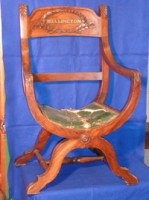
Discovered during a routine valuation morning at the Chipping Norton branch of Tayler and Fletcher, Auctioneer and Valuer Stephen Sheppard could not believe his eyes when a photograph of The Duke of Wellington Chair appeared before him.

This fine regency period elm cross frame chair proudly proclaimed the name ‘Wellington’ in bold brass lettering to the top rail and carried a metal plate inscribed with the following inscription ‘This chair is formed from a tree which grew on the plains of Waterloo, and under which the Duke of Wellington stood during a great portion of the day on which he achieved the most glorious of his many Victories. The wood was given to me by J G Children Esq., of The B. Museum, who purchased the entire tree of its proprietor E.V.U.’

Field Marshal Arthur Wellesley, 1st Duke of Wellington, KG, GCB, GCH, PC, FRS (1 May 1769 – 14 September 1852), was a British soldier and statesman, a native of Ireland, from the Anglo-Irish Ascendancy and one of the leading military and political figures of the nineteenth century. He is often referred to as the ‘Duke of Wellington,’ even after his death and there have been subsequent Dukes of Wellington.

Wellington rose to prominence as a general during the Peninsular campaign of the Napoleonic Wars, and was promoted to the rank of field marshal after leading the allied forces to victory against the French at the Battle of Victorian in 1813. Following Napoleon’s exile in 1814, he served as the ambassador to France and was granted a dukedom. During the Hundred Days war in 1815, he commanded the allied army which, with a Prussian army under Blücher, defeated Napoleon at the Battle of Waterloo. Wellesley’s battle record is exemplary, ultimately participating in some 60 battles throughout his military career; he was also twice prime minister under the Tory party and remained Commander-in-Chief of the British Army until his death.

Following further research, it was discovered that The Gentleman’s Magazine of 1836 carried a contemporary review of Dykes Tour in Belgium – Kay’s Caffraria, which states “As to accuracy of fact – Mr Dyke mentions that the elm tree on the plain of Waterloo, under which Lord Wellington stood, “was purchased of a farmer, by a mercenary Goth from England, who hacked and twisted it into tooth picks and snuff boxes”. Now the fact is, that this said mercenary Goth was John George Children, Esq. of the British Museum, the learned and scientific translator of Berzelius, who did not cut it into tooth picks or snuff boxes, but formed it into a massive and handsome chair, in which he reposes, and which he does not sell.” Could this be the very chair mentioned in the magazine article of 1836?  The Wellington Chair is estimated at £5,000-£8,000 and measures 97cm high x 61cm wide. Provenance: Purchased at a country house sale in Oxfordshire during the 1950’s thence by descent to the private vendor.

This fine piece of furniture is only one small part of a much larger auction sale that will include ceramics, glassware, metalware and bronzes, silverware, jewellery, clocks watches and barometers, collectables and bijouterie, paintings and pictures, mirrors and books, soft furnishings, textiles and hand knotted oriental rugs and carpets and viewing for this particular auction sale at the Pittville Pump Room, Cheltenham, is on Wednesday the 29th February from 8am-7pm and also on the morning of the sale from 7.30am until the start of sale at 10am. 01451 821666 www.taylerandfletcher.co.uk

Review of Eliza O'Neil at Covent Garden

Fom La Belle Assemblee, May, 1815

Covent Garden

A new afterpiece, entitled The Fortune of War, was on Wednesday, May 17, performed at this Theatre; it is, without question, one of the most humourous farces of the day. It is the production of Mr Kenny, to whose fertile and whimsical genius the public are indebted for several pieces of acknowledged merit.

Covent Garden, c. 1815
            The plot, which comprises a far greater number of ludicrous incidents and whimsical situations than we have recently seen in any effort of the same description is remarkable for its complexity.

Covent Garden, c. 1815

            The afterpiece met with almost unprecedented success. It was loudly applauded throughout, and was announced for repetition, amidst the exclamations of the audience.

            Miss O’Neil’s performance of the character of Euphrosia, in the Grecian Daughter, may be ranked amongst her most successful efforts. The play, in many senses, is heavy and declamatory, and wants that spirit and variety of action, without which tragedy never fails to be insipid. In some senses, however, the character of Euphrosia shines forth with great strength and dignity, and rescues this piece from that oblivion into which it would otherwise have fallen. Miss O’Neil was peculiarly successful in the scene with Evander; she threw a surprising pathos and an heroic affection into this scene which we never saw surpassed. In the scene in which she stabs Dionysius she was most eminently happy; she here rose to the highest energy and sublimity of tragic acting, and gave us a lively image of Mrs. Siddons in her best days. Young’s Evander was a chaste and powerful performance.

Today’s Royal Opera House, Covent Garden