by Louisa Cornell
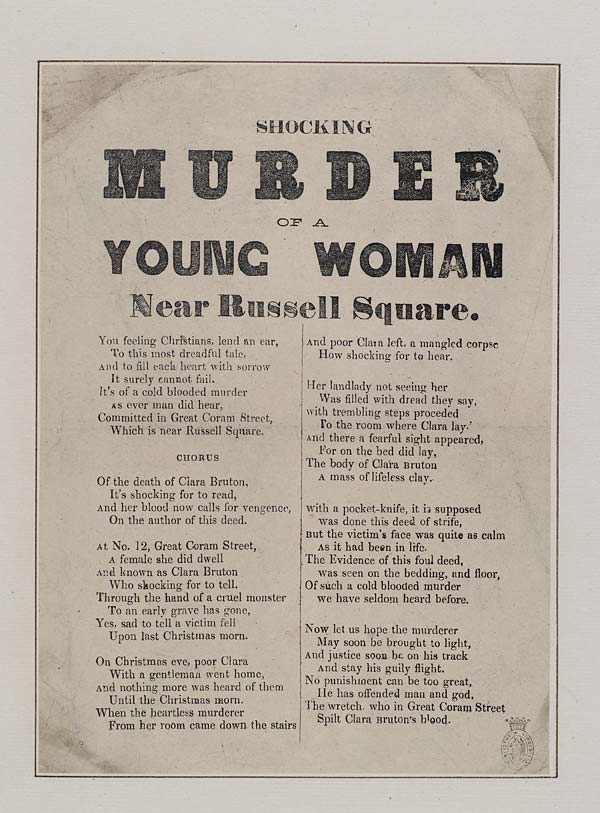
My study of the music of the Regency Era has covered a broad range of musical forms. One of the most typically English forms is that of the traditional ballad. It is a difficult field of study in one aspect as many of these songs have been passed down in varying forms long before they were written down. Their authors were often unknown and their words were interchangeable depending on the singer and the venue in which they were performed. In addition to word of mouth, during the Regency many of these songs came from the music hall in the form of parlour ballads, music hall comic operas and eventually in the form of commercial print literature and broadsheet publications.

A few of the commonalities they shared were formulaic diction, stock phrases and narrative motifs. One of the most fascinating of these is the stock phrase. Each of these phrases had a message or meaning the listener knew at once because it was such a standard in so many ballads. The best examples of these can be found in what was known as the “Child’s ballads” – songs of love, betrayal, murder, and mystery collected and published in the nineteenth century by Francis James Child in his The English and Scottish Popular Ballads. Here are a few of those stock phrases, some quite chilling when one learns their meaning!

Lily-white hand serves as a warning something dramatic is about to happen. When written as a man taking a lady’s hand it can denote either rape or seduction. And whilst the rape connotation always ends tragically (such as in Prince Heathen) the seduction connotation can go either way (in Katherine Jafray she is seduced and later rescued by her lover.) In addition to her lovely skin tone the phrase may also denote the lady’s virtue as well.
Playing at the ball – serves a rather eerie purpose as it usually forewarns a love affair, adultery or violent death (sometimes all three.) A group of ladies or boys are seen playing at a ball and one is singled out as the ‘fairest flower’ of them all. The word play can be used to mean a literal game, a symbol of fate or to signify manipulation and pursuit. In some ballads the game is followed by the immediate death of the game’s spectator.
Where will I get a bonny boy – This plea is generally met with a willing response from a boy to either carry a message or run an errand. His efforts can end well or ill. In Lord Lovel the lover receives a message from his lady, but when he returns it is too late, she has died of longing for his return. However, in Geordie the condemned husband is saved. The term bonny is used to denote health, strength, vigor, and physical beauty.
She dressed herself in silks so fine / rich attire / scarlet red – a ballad character who dresses in her finest is often about to embark on a journey. Some of its other uses include outfitting oneself for war. Most often this journey is to confront a lover who is about to marry another. As you can imagine, many of these ballads do not end well for any of the parties concerned. Sometimes the heroine is dressing to go to her execution. One does want to look nice for such an occasion.
O mother, mother make my bed – This one, unfortunately, never bodes well. It always signals the imminent death of the speaker. It usually refers to the grave. The best example can be found in Bonny Barbara Allen.
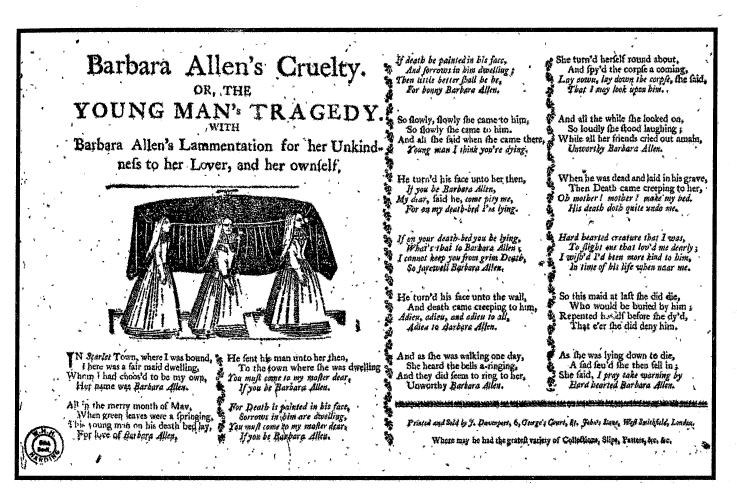
As many of the early singers of these ballads could not read or write and learned the words and melodies by heart, these phrases enabled them to compose their own songs or to add their own or local twists to a song familiar to their listeners. In later years it served to give a ‘traditional’ flavor to the songs used in the music halls and the broadsheet ballads. These phrases were familiar to the man on the street and to even the most discerning music listener of the era.
And interestingly enough, the use of phrases like this is nothing new. They can be found in the works of Homer and in the verses of many of the epic poems even before the middle ages.
A particularly maudlin form of the English ballad is the murder ballad. But that is a story for another post.