The Wellington Connection – Pubs

Today we’re taking a look at some of the many, many, many pubs named after the Hero of Waterloo.

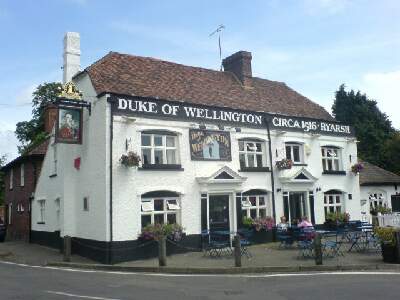
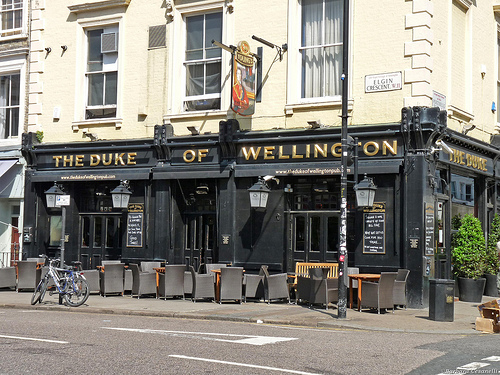
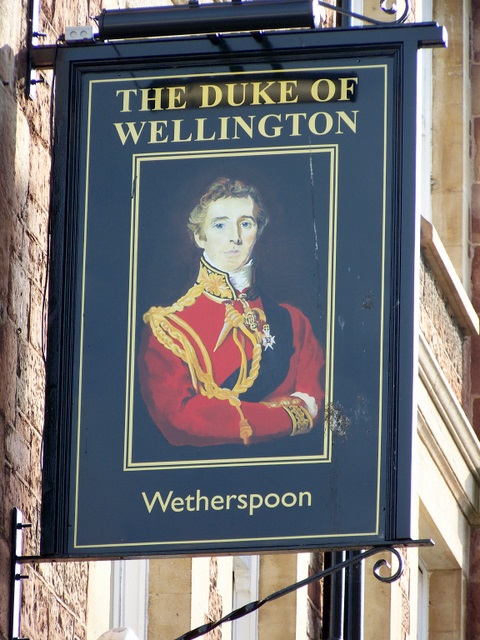
As far as I can make out, the Duke of Wellington was not widely known as a drinking man, so the large number of pubs named in his honour is amazing – almost as many as those named for the Duke of York who, I believe, was a drinking man. And the Marquess of Angelsey, who may not have been a lush, but was certainly a wife stealer – but that’s another story. When in London, I heard tell of a man who has taken up the mission of visiting as many of the Duke of Wellington pubs across England as he can. He’s going to be very old, and very drunk, by the time he’s done. One of the prettiest Duke of Wellingtons I’ve seen is this one, though I’ve not personally visited it. Yet.

They’re in Surrey – check out the website here.

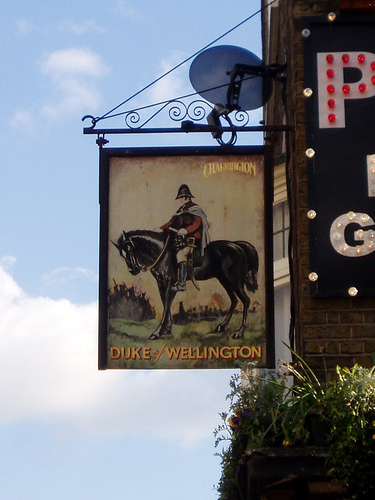
Whilst I haven’t made it my mission, I must admit that I’ve fallen upon, and entered, a few Wellington pubs myself, such as the one in Portobello Road that features this sign

And Brooke and I visited the Wellington at Waterloo south of the River in June, which you can read about in at prior post. If you’ve been following this blog, you’ll know that I fell upon yet another Wellington pub when in London recently, at the corner of Wellington Street and the Strand. Here’s a bit from that post to refresh your memory –

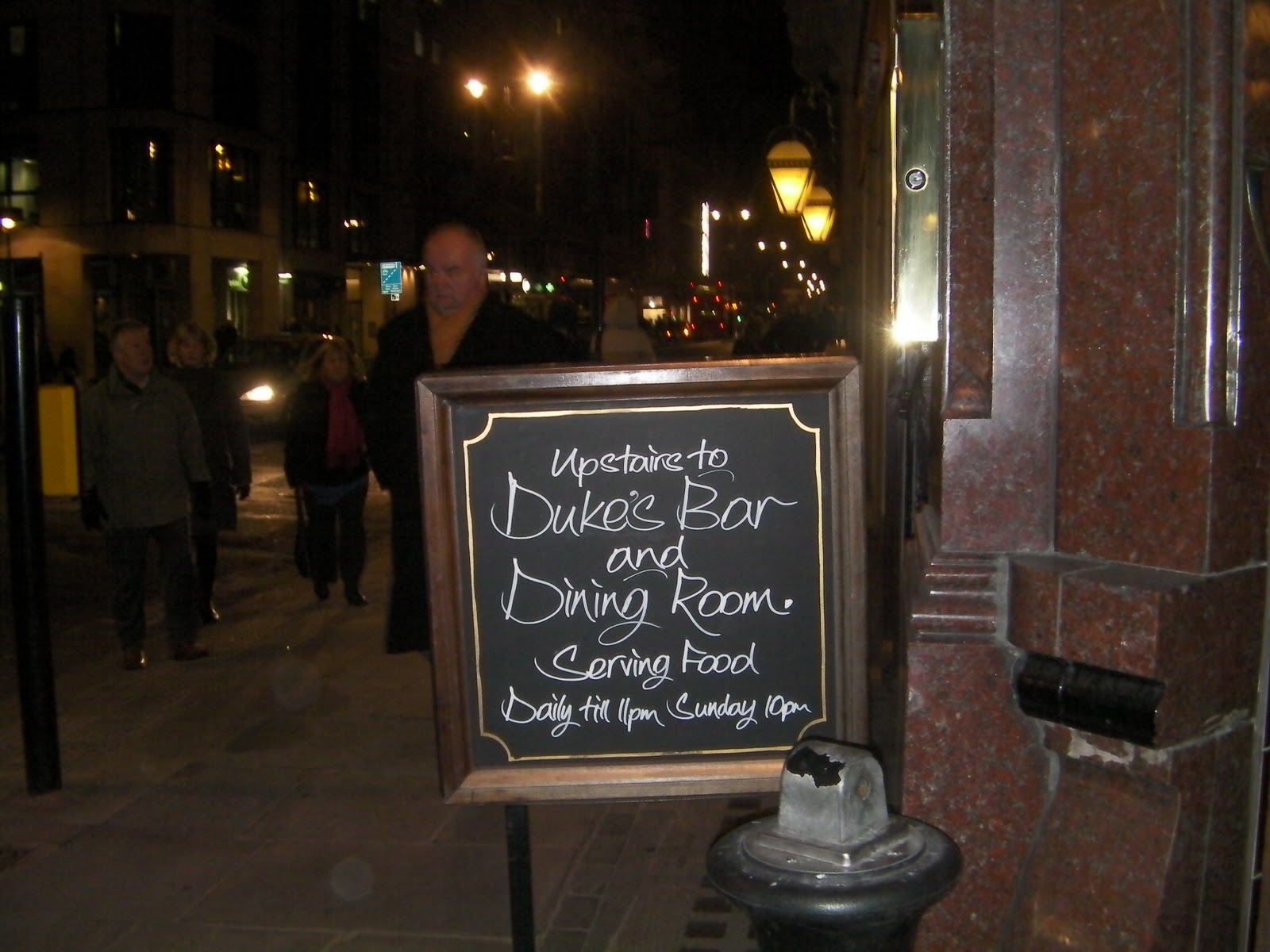
“took a boat cruise on the River Thames then went to Ye Olde Cheshire Cheese in Fleet Street for dinner. It was closed until the 29th – and the cab had left. Fleet Street after business hours is desolate, to say the least. What to do? Well, I thought, I’ll just carry on as if I know what the Hell I’m doing. “This way,” I told Greg as I walked purposefully towards the Strand. Please God, I prayed, let there be somewhere’s nice to eat. We passed The George pub – very old, very atmospheric, very closed. Xmas and the Bank Holiday are playing havoc with opening times. Right then, I told myself, keep marching. We fell upon Somerset House and went inside to watch the ice skaters. Then we walked another three blocks up the Strand when, off on the far right corner I saw something promising – lights were on, people were inside and it looked like a pub. It was a pub . . . The Duke of Wellington in Wellington Street. NO, I’m not kidding . . . saved by the Duke. Again. We had a pint in the bar and then went upstairs to the dining room, where we had a fantastic meal (lamb shank pie for me, steak for Greg) and warmed ourselves by the gas fire. The Duke of Wellington – I ask you, what were the odds!?”

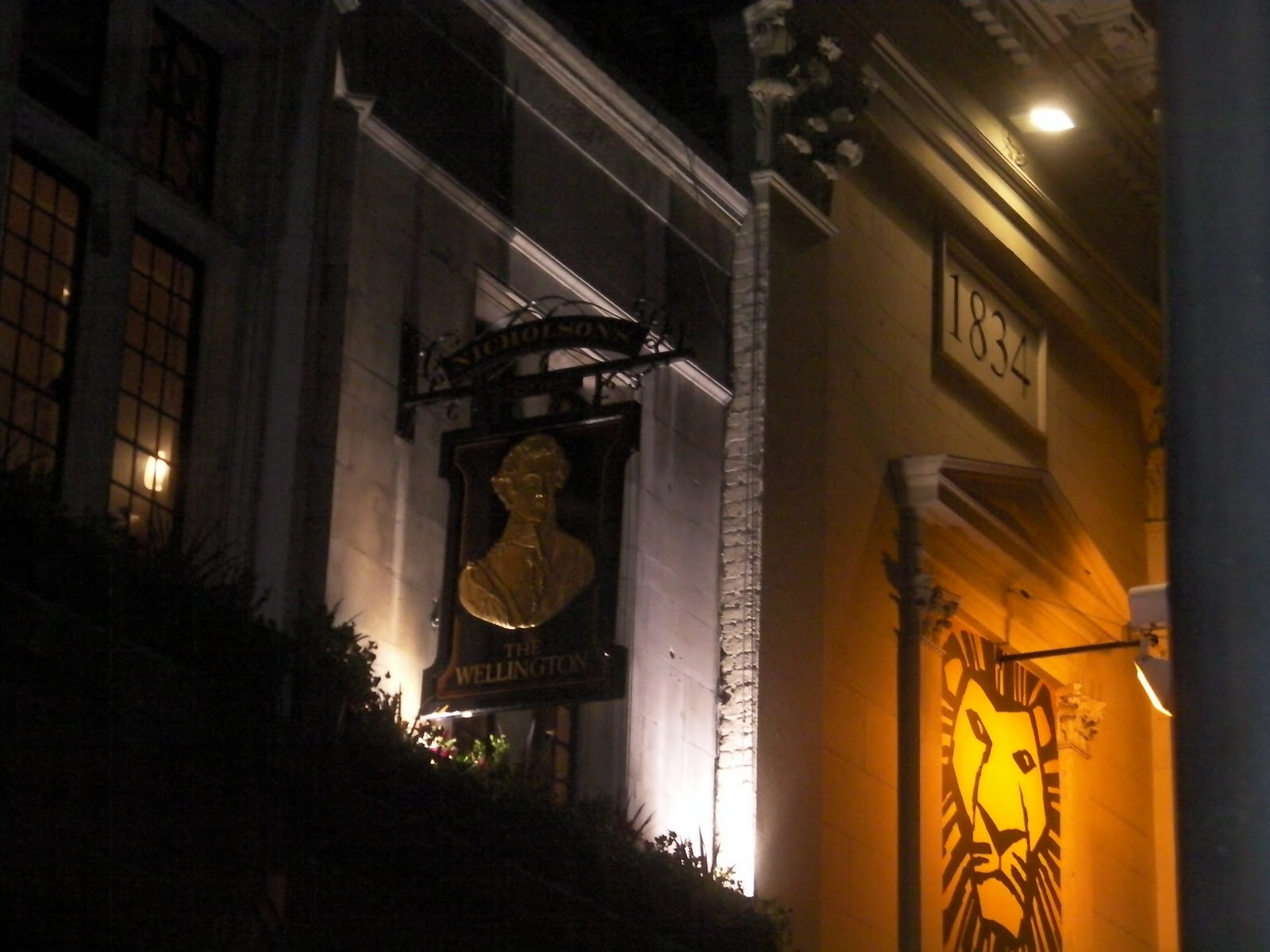
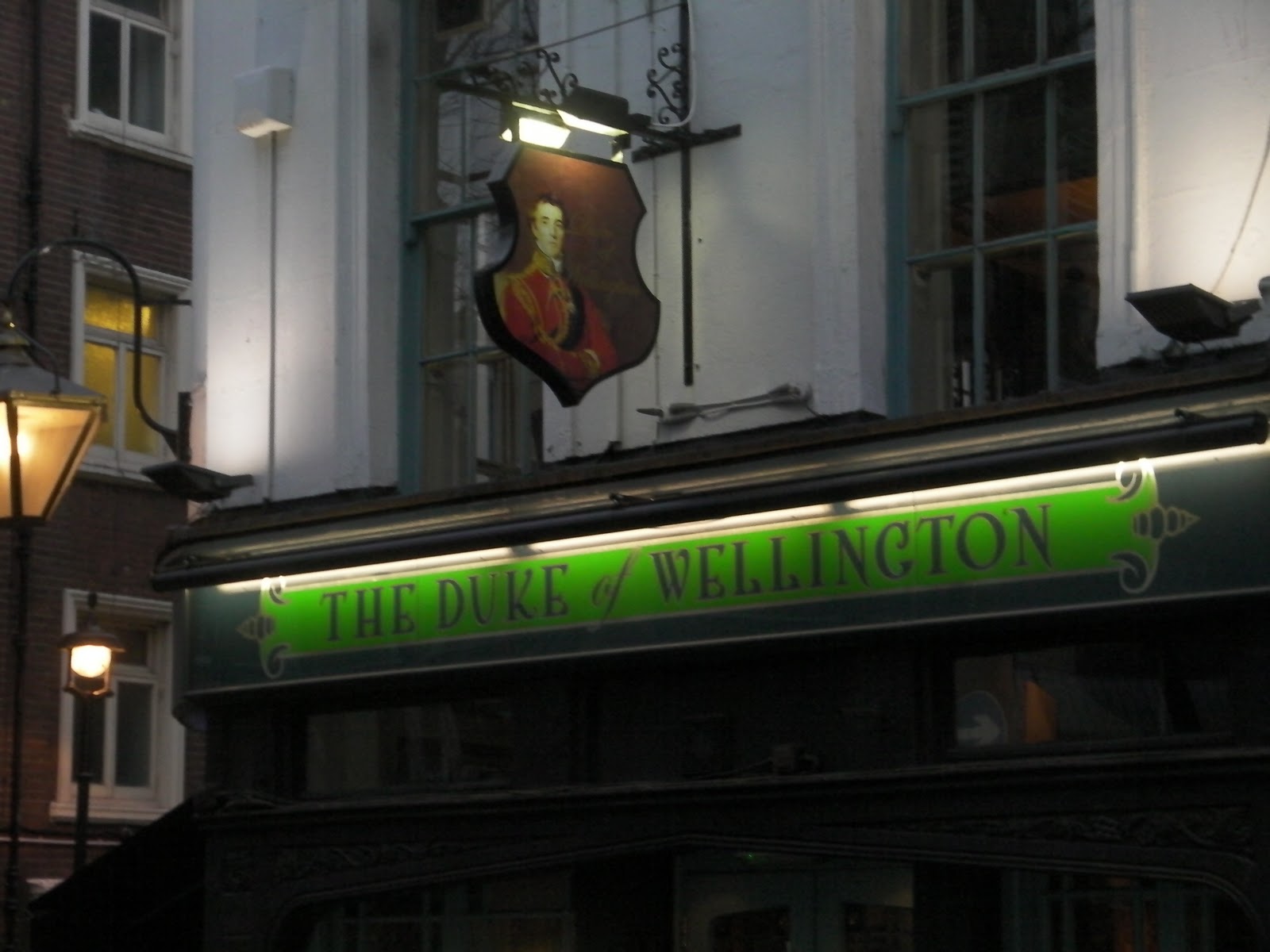
Here are my personal photos of the pub, which don’t measure up to those above, but you’ll excuse me under the circumstances.

That’s the logo for The Lion King just behind the Duke – the pub is next to the theatre where it’s playing.

You can read a review of the pub here. To prove the point that one can, and often does, literally fall upon pubs named for the Duke of Wellington,  I tripped over yet another whilst Greg and I were on a Rock and Roll walking tour.

As we had to keep up with the tour guide, I didn’t have the opportunity to peek inside.

Which may be just as well, as I’ve come to learn that it’s known for being a gay bar. The Duke of Wellington . . . . . I ask you . . . . couldn’t they have changed the name to something a bit more appropriate?

On Dits from Ramsgate


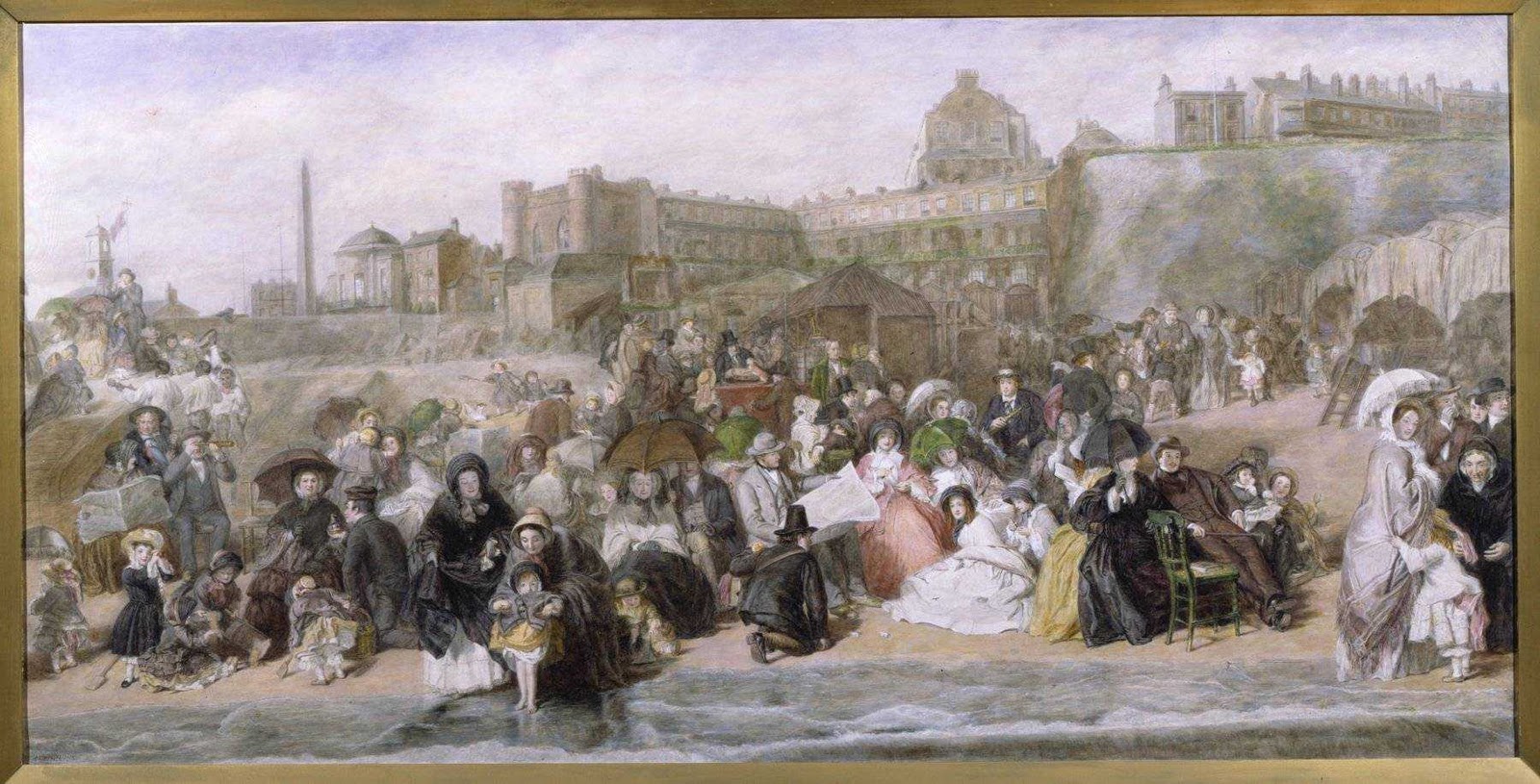
Ramsgate Sands by Frith 1864


From The Letter Bag Lady Elizabeth Stanhope
Whilst on a visit to Ramsgate, Mrs Stanhope and her party were contenting themselves with whatever gaieties the place afforded, and on May 31st, 1807, Marianne Stanhope sent her brother an interesting account of the conditions prevailing there at that date.

Nelson’s Crescent.

Just now I think you would be very miserable here, for the wind is very high and whistles at every corner, the sea is rough and everything looks blowing. The night before last was dreadfully tempestuous, and all yesterday morning was very stormy, but it cleared out, happily for us, in the evening, so that we were able to take a turn on the pier.

That famous pier! The only thing worth seeing, I think, either in or out of Ramsgate, for you must know I have now seen almost all the lions:—that miserable forlorn Mansion, East Cliff, ci-devant Lord Keith’s; the elegant little cake house of Mr Warne, who is going to Russia; the soi-disant cottage of Mr Yarrow, in the romantic vicinity of Pegwell Bay, celebrated, I am told for its fisheries; and last, though certainly not least, the splendid and deserted King’s Gate. The building is very classic and elegant, but surely Tully’s Villa must be a very different thing in the sweet Campagna of Italy, than placed on such a barren cliff. Poor fellow! Could he look out of the Elysian fields (for there, I suppose, we must place him) I think he would not admire the change of situation!

There is a regiment of Irish Dragoons here. The Colonel has just left them to take possession of a large fortune, and another officer has gone to Ireland to give a vote. Both the Irish and Germans have very good bands which often play before our windows etc. this is the only gaiety there is.

I am sure all the pleasure of this place must depend upon the company; when you have society that you like, what spot will not appear pleasant?

We are not too well off in that respect as you will think when I have described our acquaintance.

Our greatest intimate is Lady Jane Pery (1), Lord Limerick’s daughter, who has had so many complaints she is unable to move from her chair, though full of life and spirits. Lady Conyngham (2) is the great lady of the place, a nice, civil old woman. We were at a party at her house where we met all the natives. Her daughter, Miss Burton, is 6 ft. 4 in. in height and ugly in proportion, but very agreeable. To-morrow we are going to a party there where we are to meet everybody, for you must know that even in this small society there is an improper set. Lady Dunmore (3) and her daughters, Lady Virginia Murray, and the married one, Lady Susan Drew (4), sisters to the Duchess of Sussex (5) and Lord and Lady Edward Bentinck (6); their two daughters are visited by very few proper people, but both these houses are the rendez-vous of the officers. Lady Sarah Drew had a ball the other night.

At Lady Conyngham’s, we are to meet all these.

Miss Bentinck (7) is a great beauty; there has been a long affair between her and Hay Drummond, which is at last broke off by the lady. She had been sent to the Duke of Rutland’s to be out of his way. Drummond contrived to introduce himself to the servants as her maid’s beau, by which means he slept in the house and was able to walk with her before breakfast and late at night. At last her brother, who was shooting one morning early, and knew Drummond by sight well, found them out and gave the alarm. The Duke sent Miss Bentinck home directly, and they were to be married in September, but lo! she has changed her mind.

1 Cecil-Jane, sixth daughter of the 2nd Baron Glentworth, who was created Viscount and Earl of Limerick in 1803. She married, in 1828, Count John Leopold Ferdinand Casimir de la Feld, a Count of the Holy Roman Empire.

2 Francis Pierrepont-Burton, 2nd Baron Conyngham, who, on inheriting the titles and estates of his uncle, assumed the surname and arms of Conyngham, married, in 1750, the eldest daughter of the Right Hon. Nathaniel Clements, and sister of Robert, Earl of Leitrim. She died in 1814.

3 Lady Charlotte Stewart, daughter of Alexander, 6th Earl of Galloway, married, in 1759, John, 4th Earl of Dunmore.

4 Susan, third daughter of the 4th Earl of Dunmore, married, first, in 1788, Joseph Tharpe, Esq. of Chippenham, Cambridge; secondly, John Drew, Esq.; and thirdly, in 1809, the Rev. A. E. Douglas.

5 Augusta, second daughter of 4th Earl of Dunmore, married, at Rome, the 4th of April 1793, Prince Augustus Frederick, Duke of Sussex, and was re-married to H.R.H. the following December at St George’s Church, Hanover Square.

6 Edward Charles, second son of William, 2nd Duke of Portland, and Lady Margaret Cavendish Harley, only daughter and heir of Edward, 2nd Earl of Oxford. Lord Edward Bentinck married Elizabeth, eldest daughter of Richard Cumberland, Esq., and had one son and three daughters. He died in 1819.

7 The three Miss Bentincks were: Harriet, married, 1809, Sir William Mordaunt Sturt Milner, Bart.; Elizabeth, married, 1812, Captain Henry Wyndham; and Charlotte married Major Robert Garrett.

Victoria in England 2011

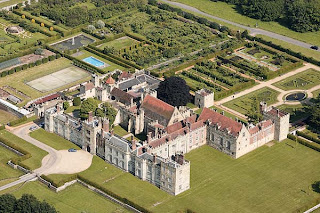
Penshurst Place, Kent

Yes, both Kristine and I confess we are unrepentant when it comes to spending our time and money on trips across the pond to England.  Many of you do the same.  We work hard to book ourselves into a variety of cities and London neighborhoods,  lots of museums and other historic attractions, gardens for wandering, evenings in the theatre or concert hall, and wonderful meals… and, believe it or not, time in libraries and archives.  My upcoming two weeks in England will be no different … castles, stately homes, gardens, museums, several different hotels…and archives at the University of Southampton and Hatfield House.
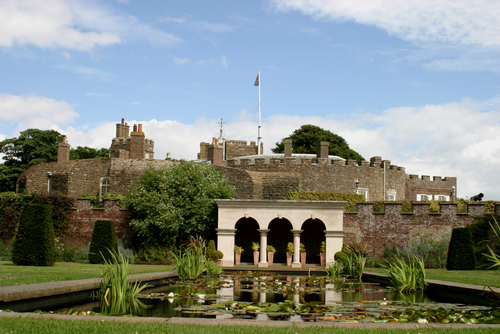
Upon our arrival in Dover, I hope we can visit Walmer Castle. We “did” Dover Castle a few years ago, and this time, I want to see the Duke of Wellington’s home when he was in residence as the Warden of the Cinque Ports, less than ten miles north along the Channel coast.

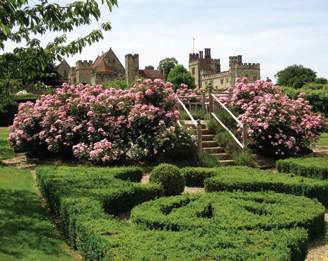
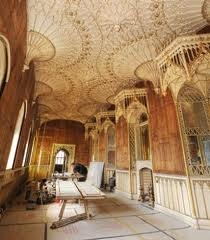
We have a stop planned at Penshurst Place, in which many centuries of British History are enveloped…as well as a great slice of architectural history. And stunning gardens, which I hope will be in full bloom in early June.

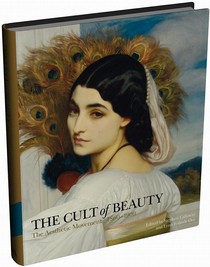
While we are in London, we want to re-visit the Victoria and Albert Museum, this year to see the Cult of Beauty exhibition, which comes highly recommended by Jo Manning and many others.
Last year, at the V and A, I enjoyed the Horace Walpole and Strawberry Hill exhibition, in which many of his treasures were reassembled and shown while the house itself was undergoing a thorough renovation.  This year, I intend to see the finished house, just a short train ride from London in Twickenham.

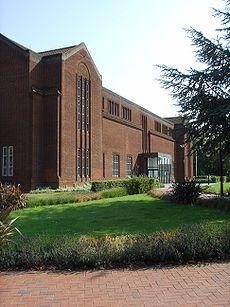
Next I head to Southampton to visit the Archives in Hartley Library at the University of Southampton.

And while I am in town, I will make time to see the sights, though I understand that the house in which Jane Austen once resided is long gone.  Parts of the city walls, however, still stand, and the famous port should be interesting to see. 

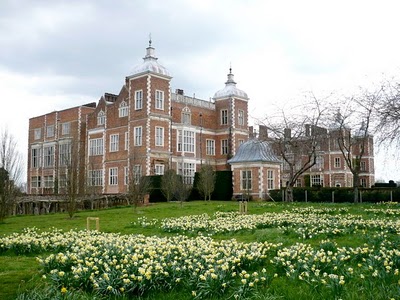
After a short stay in London again, I will go to Hatfield House in Hertfordshire, to study diaries in their Archive. Hatfield has an amazing history and renowned gardens. I wrote about a previous visit to Hatfield on this blog, August 13 2010.

My final stop will be in Windsor, where I will visit the brand new Museum of Windsor and, if the stars are in perfect alignment, visit with our friend Hester Davenport, author of biographies of Mary Robinson and Fanny Burney, and an expert on Windsor history, among other achievements.

Then it will be time to fly home. And start planning the next trip (anticipation is more than half the fun). I will report more fully after I return, and perhaps, along the way.

The Darker Side of London History – Captain Coram and the Foundling Hospital – Part Two

From Memoranda; or, Chronicles of the Foundling Hospital by John Brownlow (1847)
“. . . . the difficulty which presented itself paramount to all others, related to the manner in which so great a number of children was to be reared. In the first year of this indiscriminate admission, the number received was 3,296; in the second year, 4,085; in the third, 4,229; and during less than ten months of the fourth year (after which the system of indiscriminate reception was abolished), 3,324. Thus, in this short period, no less than 14,934 infants were cast on the compassionate protection of the public! It necessarily became a question how the lives of this army of infants could be best preserved; and the Governors, not being able to settle this point among themselves, addressed certain queries to the College of Physicians, which were promptly answered, by recommending a course of treatment consonant to nature and common sense! Children, deprived as these were of their natural aliment, required more than usual watchfulness; and although, on a small scale, the providing a given number of healthy wet-nurses, as substitutes for the mothers of infants, would have been an easy task, yet, when they arrived in numbers so considerable, the Governors found that the object they had in view must necessarily fail from its very magnitude.
“It has been truly said, that the frail tenure by which an infant holds its life, will not allow of a remitted attention even for a few hours: who, therefore, will be surprised, after hearing under what circumstances most of these poor children were left at the Hospital gate, that, instead of being a protection to the living, the institution became, as it were, a charnel-house for the dead! It is a notorious fact, that many of the infants received at the gate, did not live to be carried into the wards of the building; and from the impossibility of procuring a sufficient number of proper nurses, the emaciated and diseased state in which many of these children were brought to the Hospital, and the malconduct of some of those to whose care they were committed (notwithstanding these nurses were under the superintendence of certain ladies—sisters of charity), the deaths amongst them were so frequent, that of the 14,934 received, only 4,400 lived to be apprenticed out, being a mortality of more than seventy per cent.”


James II shilling copyright icollector.com


Charles Knight writes more on this theme in Knight’s Cyclopædia of London (1851) –
“Of 14,934 children received under the new system, only 4400 lived to be apprenticed! On the 8th of February, 1760, a resolution was passed in Parliament, declaring “That the indiscriminate admission of all children under a certain age into the Hospital had been attended with many evil consequences, and that it be discontinued.” From 1756 to 1771, the years of the Parliamentary connection, the national fuuds coutributed, it appears, no less a sum than 549,796. 16s. to the expenses of this illjudged experiment. Yet it was not till 1801 that the most objectionable practice of taking children without inquiry, on a payment of £100, was formally abolished.
Now Knight touches upon a theme that is relevant to the Foundling Museum’s current online exhibition, Threads of Feeling.
“Tokens.—It will be seen, that one of the regulations at the outset was, that persons leaving children should “affix on them some particular writing, or other distinguishing mark or token.” Forty years ago, the Governors being curiously inclined, appointed a committee to inspect these tokens, with the view of ascertaining their general nature, which committee, having examined a portion of them, reported the following to be specimens of the whole: viz.—
A half-crown, of the reign of Queen Anne, with hair.
An old silk purse.
A silver fourpence and an ivory fish.
A stone cross, set in silver.
A shilling, of the reign of James the Second.
A silver fourpence of William and Mary, and a silver penny of King James.
A silver fourpence.
A small gold locket.
A silver coin (foreign), of sixpence value.
“In 1757, a lottery ticket was given in with a child, but whether it turned up a prize or a blank is not recorded. The following lines were pinned to the clothes of one of the deserted infants :—

“Go, gentle babe, thy future life be spent
In virtuous purity and calm content;
Life’s sunshine bless thee, and no anxious care
Sit on thy brow, and draw the falling tear;
Thy country’s grateful servant may’st thou prove,
And all thy life be happiness and love.”
“Another child, received on the first day of admission, had the following doggrel lines affixed to its clothes:—
“Pray use me well, and you shall find
My father will not prove unkind
Unto that nurse who’s my protector,
Because he is a benefactor.”

copyright Needleprint
“At this period, the station in life of the parties availing themselves of the charity, could only be surmised by the quality of the garments in which the children were dressed, the particulars of which were faithfully recorded; the following being a sample, viz.—
“1741.—A male child, about two months old, with white dimity sleeves, lined with white, and tied with red ribbon.”
“A female child, aged about six weeks, with a blue figured ribbon, and purple and white printed linen sleeves, turned up with red and white.”
“A male child, about a fortnight old, very neatly dressed; a fine holland cap, with a cambric border, white corded dimity sleeves, the shirt ruffled with cambric.”
“A male child, a week old; a holland cap, with a plain border, edged biggin and forehead-cloth, diaper bib, striped and flowered dimity mantle, and another holland one; India dimity sleeves, turned up with stitched holland, damask waistcoat, holland ruffled shirt.”
As to the matter of naming such a large number of infants, Knight explains –
“It has been the practice of the Governors, from the earliest period of the Hospital to the present time, to name the children at their own will and pleasure, whether their parents should have been known or not.
At the baptism of the children first taken into the Hospital, which was on the 29th March, 1741, it is recorded, that “there was at the ceremony a fine appearance of persons of quality and distinction: his Grace the Duke of Bedford, our President, their Graces the Duke and Duchess of Richmond, the Countess of Pembroke, and several others, honouring the children with their names, and being their sponsors.
“Thus the register of this period presents the courtly names of Abercorn, Bedford, Bentinck, Montague, Marlborough, Newcastle, Norfolk, Pomfret, Pembroke, Richmond, Vernon, etc.. etc., as well as those of numerous other living individuals, great and small, who at that time took an interest in the establishment. When these names were exhausted, the authorities stole those of eminent deceased personages, their first attack being upon the church. Hence we have a Wickliffe, Huss, Ridley, Latimer, Laud, Sancroft, Tillotson, Tennison, Sherlock, etc., etc.  Then come the mighty dead of the poetical race, viz.—Geoffrey Chaucer, William Shakspeare, John Milton, etc. Of the philosophers, Francis Bacon stands pre-eminently conspicuous. As they proceeded, the Governors were more warlike in their notions, and brought from their graves Philip Sidney, Francis Drake, Oliver Cromwell, John Hampden, Admiral Benbow, and Cloudesley Shovel. A more peaceful list followed this, viz.—Peter Paul Rubens, Anthony Vandyke, Michael Angelo, and Godfrey Kneller; William Hogarth, and Jane, his wife, of course not being forgotten. Another class of names was borrowed from popular novels of the day, which accounts for Charles Allworthy, Tom Jones, Sophia Western, and Clarissa Harlowe. The gentle Isaac Walton stands alone.

“So long as the admission of children was confined within reasonable bounds, it was an easy matter to find names for them; but during the ” parliamentary era” of the Hospital, when its gates were thrown open to all comers, and each day brought its regiment of infantry to the establishment, the Governors were sometimes in difficulties; and when this was the case, they took a zoological view of the subject, and named them after the creeping things and beasts of the earth, or created a nomenclature from various handicrafts or trades. In 1801, the hero of the Nile and some of his friends honoured the establishment with a visit, and stood sponsors to several of the children. The names given on this occasion were Baltic Nelson, William and Emma Hamilton, Hyde Parker, etc.
“Up to a very late period the Governors were sometimes in the habit of naming the children after themselves or their friends; but it was found to be an inconvenient and objectionable course, inasmuch as when they grew to man and womanhood, they were apt to lay claim to some affinity of blood with their nomenclators. The present practice therefore is, for the Treasurer to prepare a list of ordinary names, by which the children are baptized.


© Coram Family in the care of the Foundling Museum

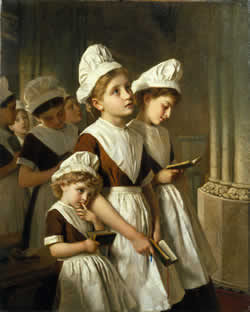
“The children are all disposed of by apprenticeship: the girls at the age of fifteen to domestic service, for a term of five years, and the boys at the age of fourteen as mechanics, &c. for a term of seven years. The trades to which the latter have been apprenticed during the last seven years are as follows, viz.:— tailors, sixteen; boot and shoe makers, sixteen; fishermen, seven; cabinet makers, four; linen drapers, three; confectioners, two; bakers, two; gold beaters, two; hair dressers, three; hair manufacturers, two; silver smith, one; opticians, two; tin plate worker and ironmonger, ‘one; general provision dealer, one; weaver, one; law writers, two; watch maker, one; pawnbrokers, three; soda water manufacturer, one; cooper, one; dyer, one; paper hanger, one; furnishing undertaker, one; brass, copper, and iron wire drawer, one; silk hat manufacturer, one; domestic service, four; in all eighty apprentices. A very satisfactory report was recently made of their conduct and destination, four only excepted. These have left their masters, owing to disagreements; but are believed to be leading reputable lives.
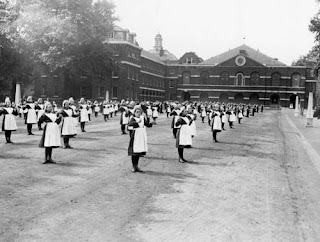


Girls exercising at the London Foundling Hospital
© Coram Family in the care of the Foundling Museum

With respect to the girls, it appeared by a recent investigation, that of all those apprenticed during the last five years, there was only one whose conduct had been faulty, and she was redeeming her character by subsequent good behaviou
r.
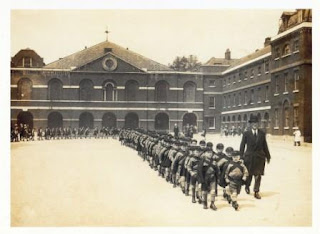


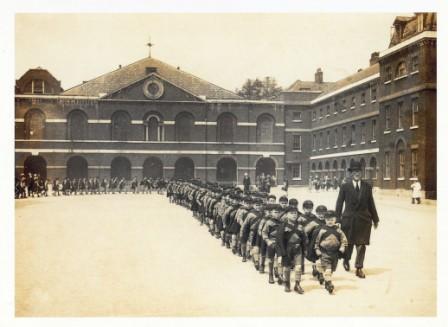
Boys marching out of the London Foundling Hospital for  the last time, 1926 © Coram in the care of the Foundling Museum


Whilst running a charity of such a size was not without its problems, some might say horrors, over the centuries, thousands of children’s lives were saved:  some 27,000 children, before the 1952 Children Act changed the way charities operated.  The Foundling Hospital finally closed its doors in 1954 and became the Thomas Coram Foundation for Children, which continues to benefit the children of London to this day.
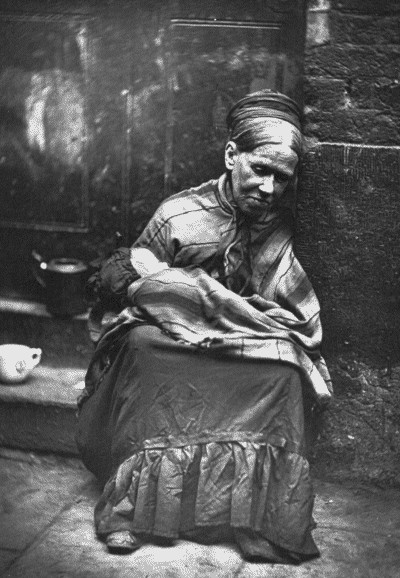
The Darker Side of London History – Captain Coram and the Foundling Hospital


copyright The Foundling Museum

Recently, Janet Mullany at Risky Regencies did a post on websites of interest, one of them being a link to the Threads of Feeling online exhibition mounted by the Foundling Museum in London, which allows you to view fabrics that illustrate the moment of parting as mothers left their babies at the original Foundling Hospital, which continues today as the children’s charity Coram.
From the Museum’s website – “In the cases of more than 4,000 babies left between 1741 and 1760, a small object or token, usually a piece of fabric, was kept as an identifying record. The fabric was either provided by the mother or cut from the child’s clothing by the hospital’s nurses. Attached to registration forms and bound up into ledgers, these pieces of fabric form the largest collection of everyday textiles surviving in Britain from the 18th Century.
“John Styles Research Professor in History at the University of Hertfordshire received funding from the Arts and Humanities Research Council to curate the exhibition. John comments: “The process of giving over a baby to the hospital was anonymous. It was a form of adoption, whereby the hospital became the infant’s parent and its previous identity was effaced. The mother’s name was not recorded, but many left personal notes or letters exhorting the hospital to care for their child. Occasionally children were reclaimed. The pieces of fabric in the ledgers were kept, with the expectation that they could be used to identify the child if it was returned to its mother.
The textiles are both beautiful and poignant, embedded in a rich social history. Each swatch reflects the life of a single infant child. But the textiles also tell us about the clothes their mothers wore, because baby clothes were usually made up from worn-out adult clothing. The fabrics reveal how working women struggled to be fashionable in the 18th Century.”


Captain Thomas Coram painted by William Hogarth 1740

The Foundling Hospital in London began as the mission of retired sea captain Thomas Coram, who was appalled at the number of abandoned babies in the City. It took Captain Coram 17 years to raise the necessary money to build The Foundling Hospital as “an hospital for exposed and deserted children” to which destitute mothers brought their babies. AThe artist William Hogarth joined the cause and attracted benefactors by hanging many of his valuable paintings in the building and thereby founding the first London Art Gallery; and Handel gave fundraising concerts in the Hospital Chapel, which included a special Foundling Anthem and the music of Messiah. Coram’s efforts were finally recognized by King George II who, in 1739, gave Coram a Royal Charter to create the Foundling Hospital.
No man could have undertaken a cause with a greater need, nor with such good intentions. Unfortunately, the sheer numbers of abandoned and unwanted children led to pitfalls the kind hearted Coram could not have forseen.
From Memoranda; or, Chronicles of the Foundling Hospital by John Brownlow (1847)
“When a Foundling Hospital was established in Paris, in the year 1640, its objects were limited to the children found exposed in that city, and its suburbs; and it was understood by those who furthered a similar design in this country, that its operation would, in the same manner, be confined to London and its environs. But benefits so tempting being irresistable to persons in country towns, they were determined to share with the good people of London, a privilege which they considered common to all. “There is set up in our Corporation ” (writes a correspondent from a town three hundred miles distant, in one of the chronicles of the day), ” a new and uncommon trade, namely, the conveying children to the Foundling Hospital. The person employed in this trade is a woman of notoriously bad character. She undertakes the carrying of these children at so much per head. She has, I am told, made one trip already; and is now set upon her journey with two of her daughters, each with a child on her back.” The writer then very properly suggests, that it ought to be ascertained “whether or not these poor infants do really arrive at their destination, or what becomes of them.” That such an inquiry was necessary, there is no doubt;—the sequel will prove it.
“At Monmouth, a person was tried for the murder of his child, which was found drowned with a stone about its neck! when the prisoner proved that he delivered it to a travelling tinker, who received a guinea from him to carry it to the Hospital. Nay, it was publicly asserted in the House of Commons, that one man who had the charge of five infants in baskets, happened in his journey to get intoxicated, and lay all night asleep on a common; and in the morning he found three of the five children he had in charge actually dead! Also, that of eight infants brought out of the country at one time in a waggon, seven died before it reached London: the surviving child owing its life to the solicitude of its mother; who rather than commit it alone to the carrier, followed the waggon on foot, occasionally affording her infant the nourishment it required.
“It was further stated, that a man on horseback, going to London with luggage in two panniers, was overtaken at Highgate, and being asked what he had in his panniers, answered, “I have two children in each: I brought them from Yorkshire for the Foundling Hospital, and used to have eight guineas a trip; but lately another man has set up against me, which has lowered my price.”


copyright This Butterfly Mind
In his Knight’s Cyclopædia of London (1851) Charles Knight explains more about this dark trade in children and how children were received at the Hospital:
“During the period from the establishment of the Hospital to about five years after the death of Coram the applications for admission were so constantly beyond the number that the funds would admit, that the Governors ultimately determined to petition Parliament for assistance. It received the application favourably, and on the 6th of April, 1756, granted the sum of .£10,000, on the condition that all children under a certain age (first two months, then six, and lastly, as at present, twelve) should be received. And now commenced a state of things that had well-nigh utterly destroyed the institution, and which for a time caused it to be looked on, and at unjustly, as the greatest curse in the shape of a blessing that well-meant charity had ever inflicted. To make the act of application as agreeable as possible, a basket was hung at the gate, and all the trouble imposed on parents was the ringing of a bell, as they deposited their little burdens, to inform the officers of the act. Prostitution was never before, in England at least, made so easy. The new system began on the 2nd of June, 1756, on which day 117 children were received, and before the close of the year the vast number of 1,783 were adopted by the institution. Far from being frightened at this army of infants so suddenly put under their care, the Govenors appear to have been apprehensive of being neglectful of the uses and capacites of the institution; for in the following June appeared advertisements in the chief public papers, and notices at the end of every street, informing all who were concerned how very widely open were the Hospital gates. Such attention was not ill bestowed; 3727 children were admitted that year, and in all, during the three years and ten months this precious system lusted, nearly 15,000 infants were received into The Foundling Hospital! And now for some of the consequences. “There is set up in our corporation (writes a correspondent from a town three hundred miles distant in one of the chronicles of the day) a new and uncommon trade, namely, the conveying children to the Foundling Hospital. The person employed in this trade is a woman of a notoriously bad character. She undertakes the carrying of these children at so much per head. She has, I am told, made one trip already, and is now set upon her journey with two of her daughters, each with a child on her back.” From another quarter we learn that the charge for bringing up children from Yorkshire, four in two panniers slung across a horse’s back, was for some time eight guineas a trip, but competition had in that, as in other pursuits, lowered the price. It was perhaps to make up for the reduction in the profits that certain carriers, before leaving the children, actually stripped the little creatures naked for the sake of the value of their clothing, and thus left them in the basket! The same authority also states that out of eight babes brought up from the country for the Foundling Hospital at one time in a waggon, seven died before it reached London.”
Here we return to Memoranda; or, Chronicles of the Foundling Hospital
“This practice of transporting children from remote towns was condemned by a distinct resolution of the House of Commons, and a Bill was ordered to be brought in to prevent it; but this Bill was never presented, so that parish officers and others still continued to carry on their illicit trade, by delivering children to vagrants, who, for a small sum of money, undertook the task of conveying them to the Hospital, although they were in no condition to take care of them, whereby numbers perished for want, or were otherwise destroyed; and even in cases where children were really left at the Hospital, the barbarous wretches who had the conveying of them, not content with the gratuity they received, stript the poor infants of their clothing into the bargain, leaving them naked in the basket at the Hospital gate.*
“A system so void of all order and discretion, must necessarily have occasioned many difficulties: for instance, it frequently happened, that persons who sent their children to the Hospital, having nothing to prove their reception, were suspected, or, if not suspected, were charged by their malevolent neighbours with destroying them, and were consequently cited before a magistrate of the district to shew to the contrary. This they could only do by procuring an examination of the Hospital registers; and the Governors were frequently called upon for certificates of the fact, before the party could be released. This inconvenience was, however, afterwards obviated, by the practice of giving a billet to each person who brought a child, acknowledging its reception.

“* The following is a strong instance of the vicissitudes of life :—A few years since, an aged Banker in the north of England, received into the Hospital at the above period, was desirous of becoming acquainted with his origin, when, all the information afforded by the books of the establishment was, that he was put into the basket at the gate naked.”

Part Two Tomorrow!