Travels with Victoria: Trooping the Colour 2011
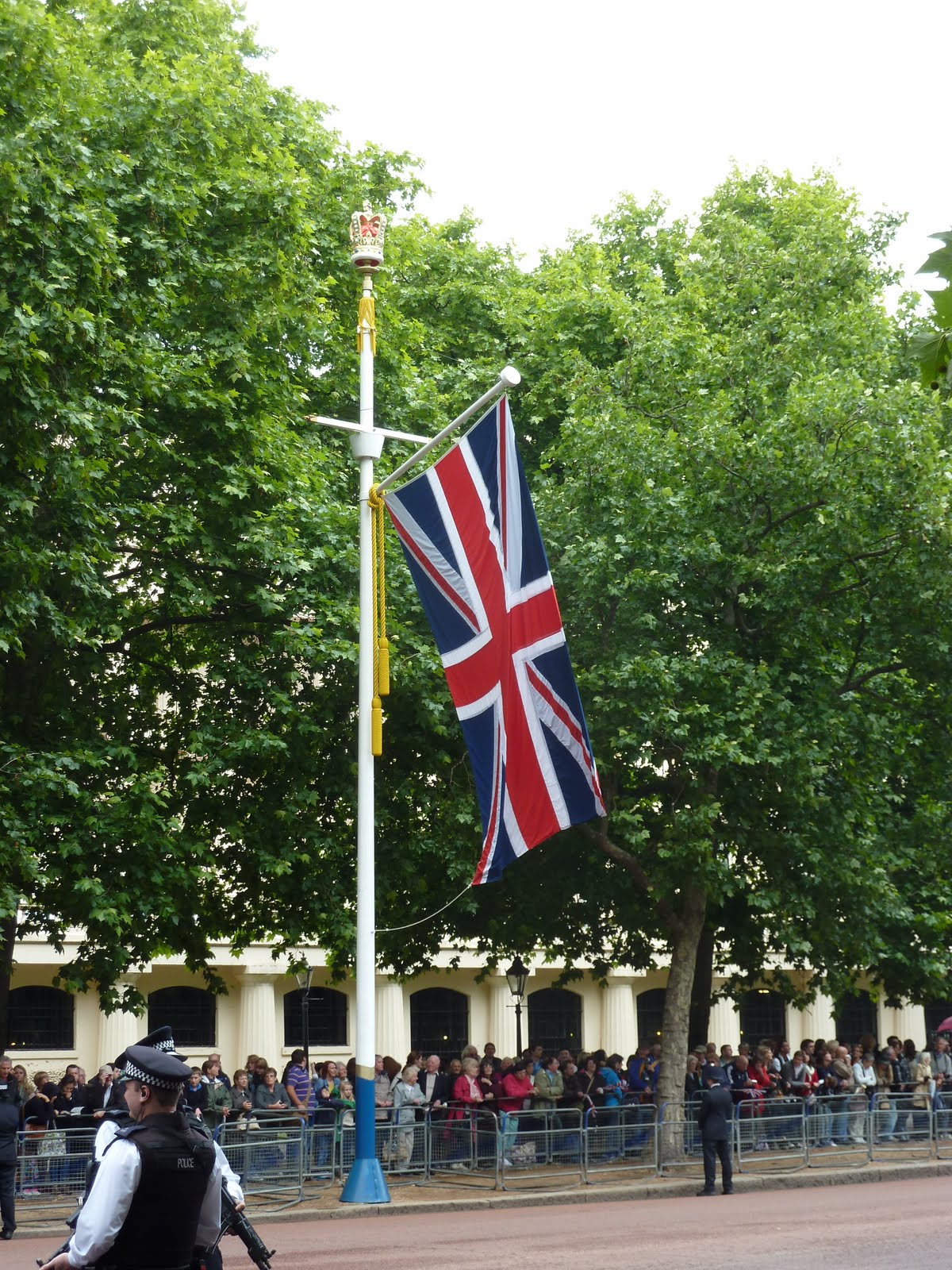
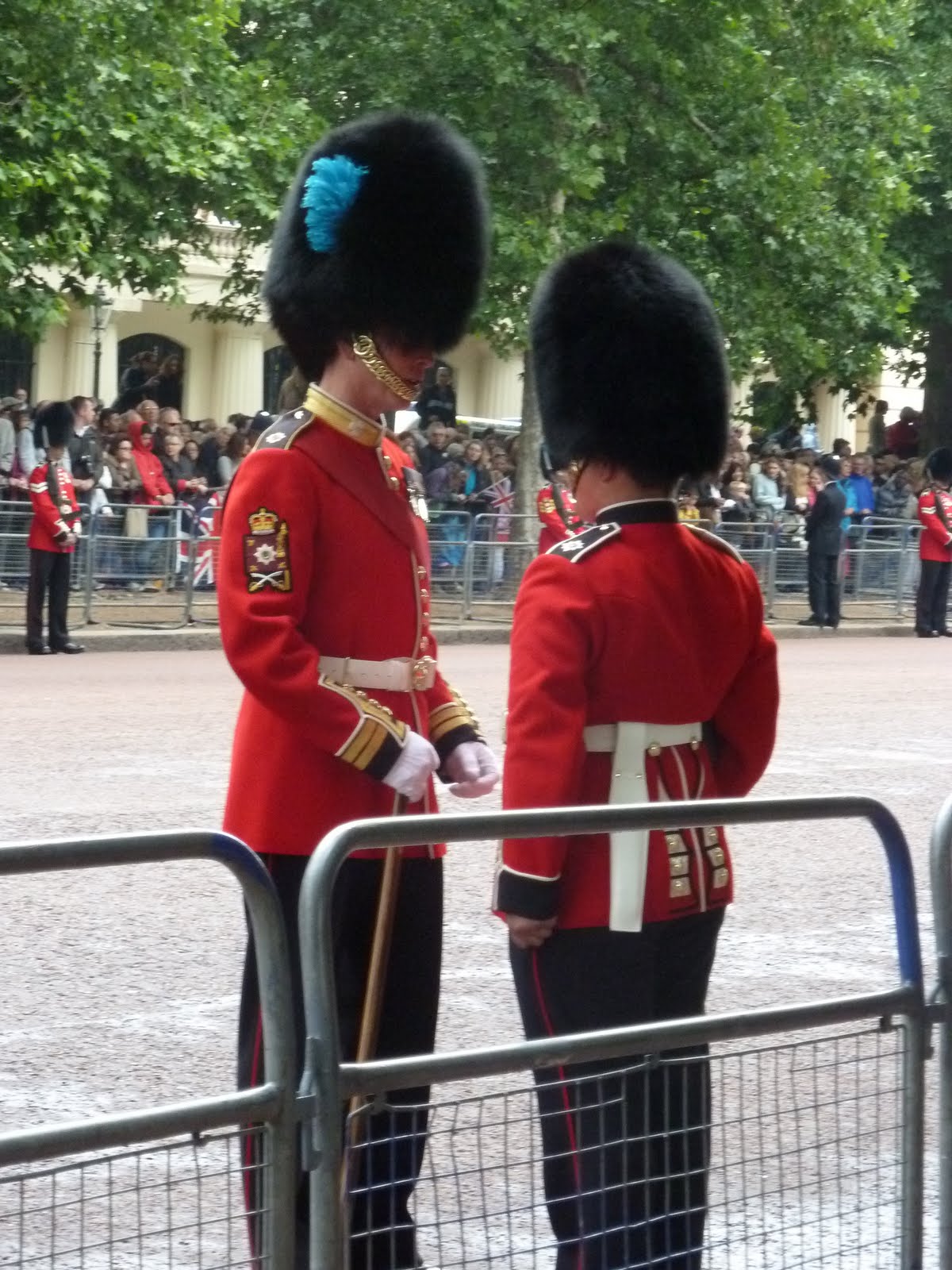
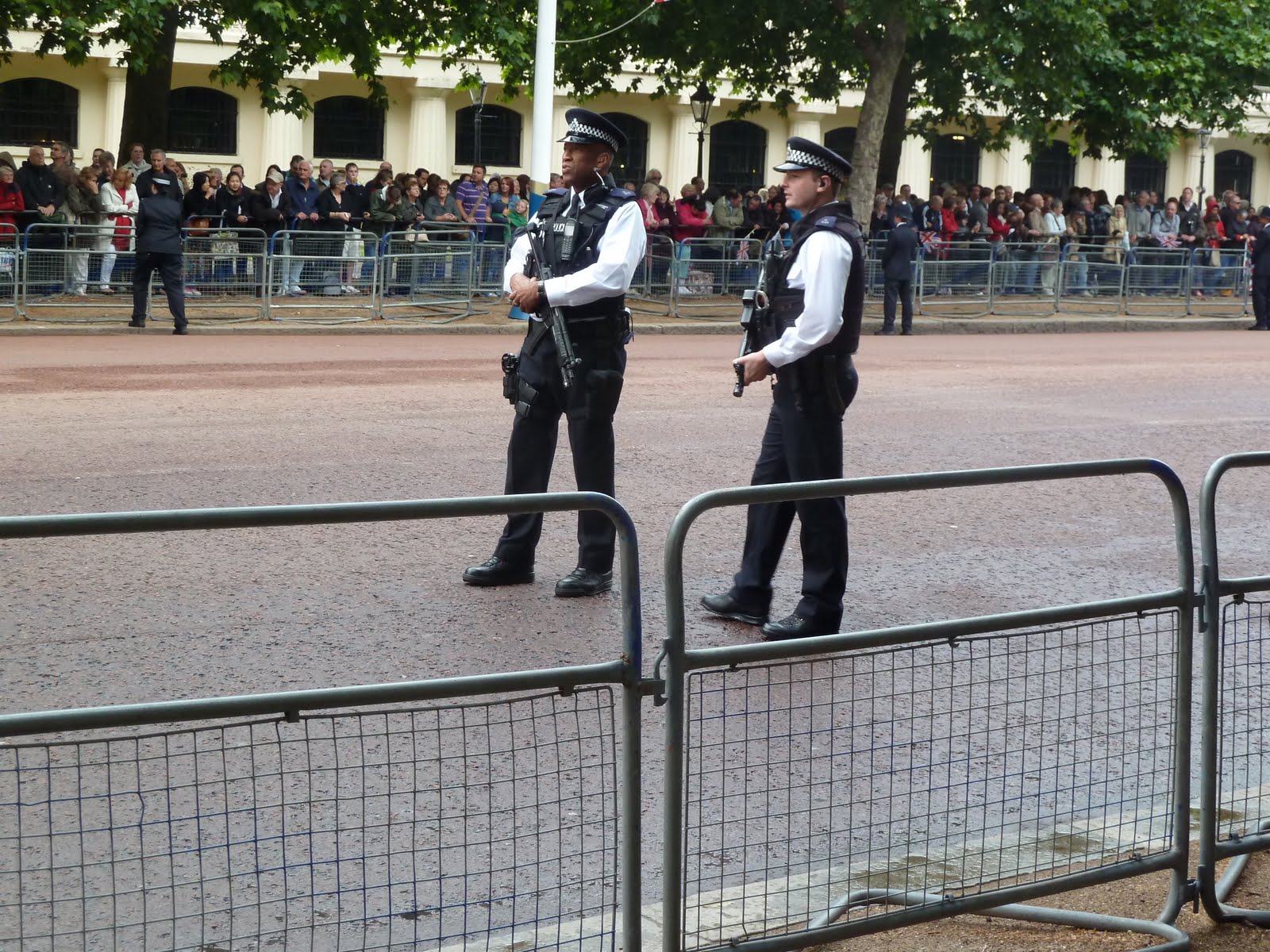
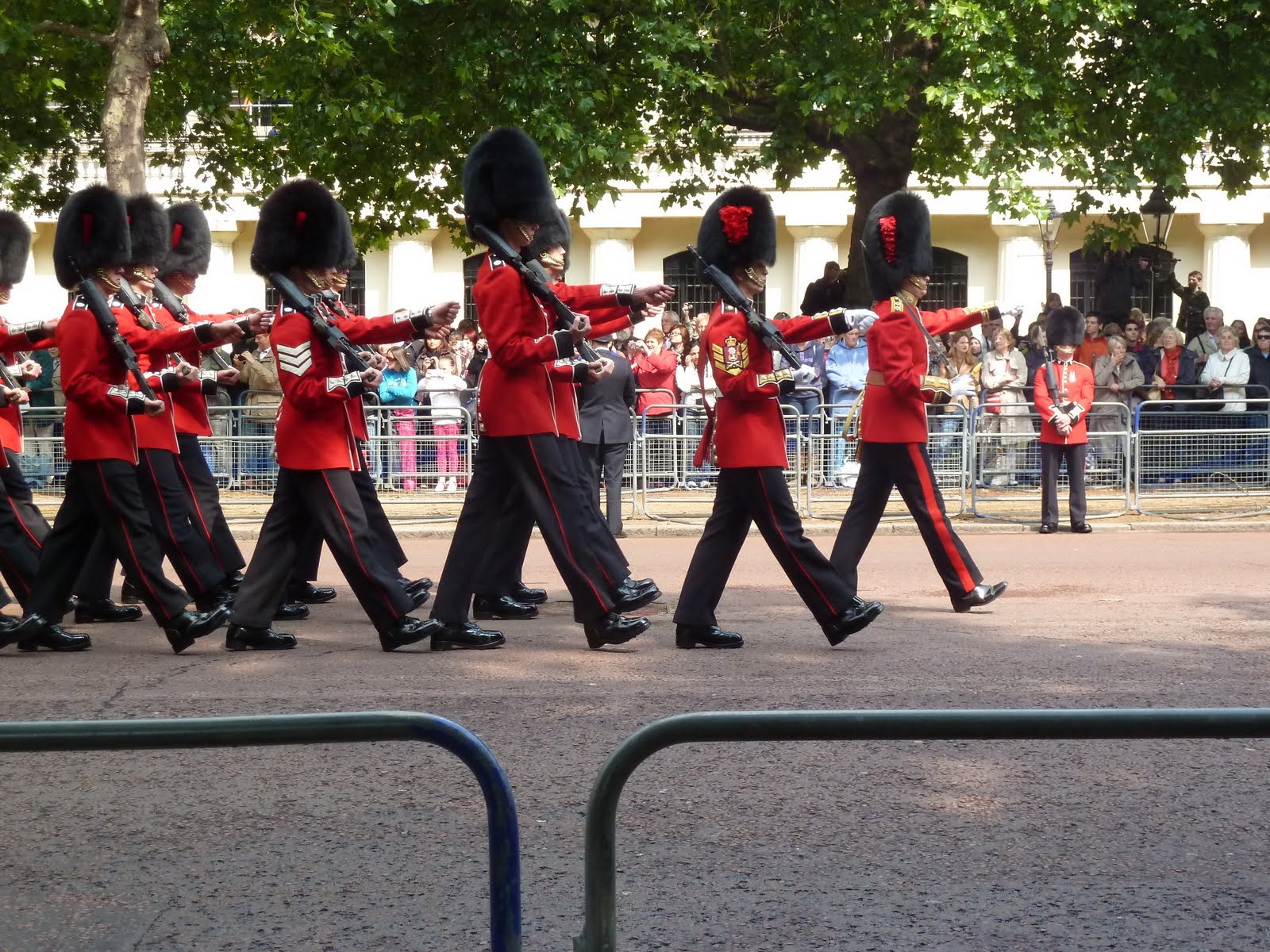
First to patrol the processional route were the police who stood every few yards with their automatic machine guns near the red-coated guards. The difference is that the soldiers, in their bearskin hats, had to remain at attention, or parade rest, while the police were far more casual.
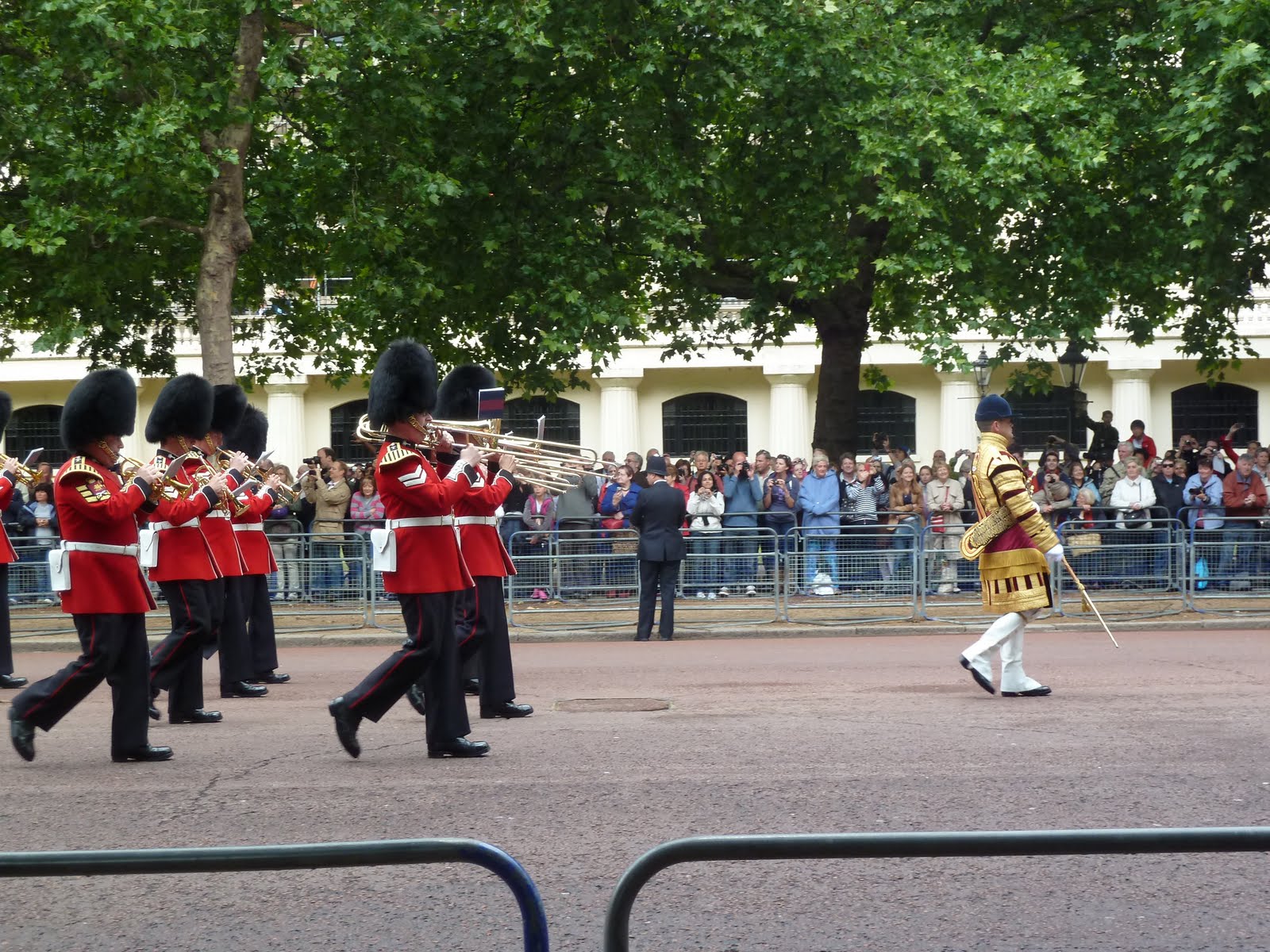
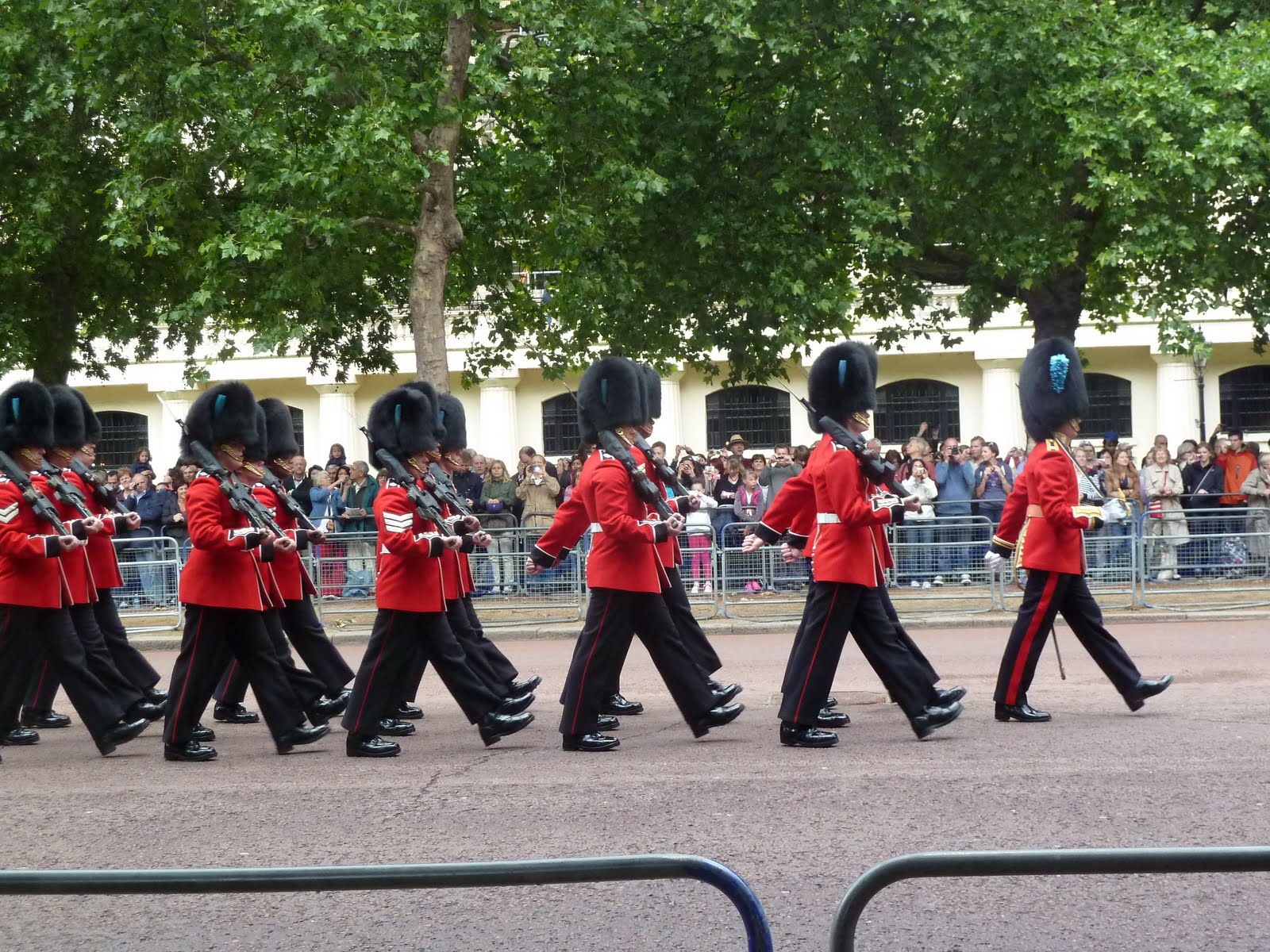
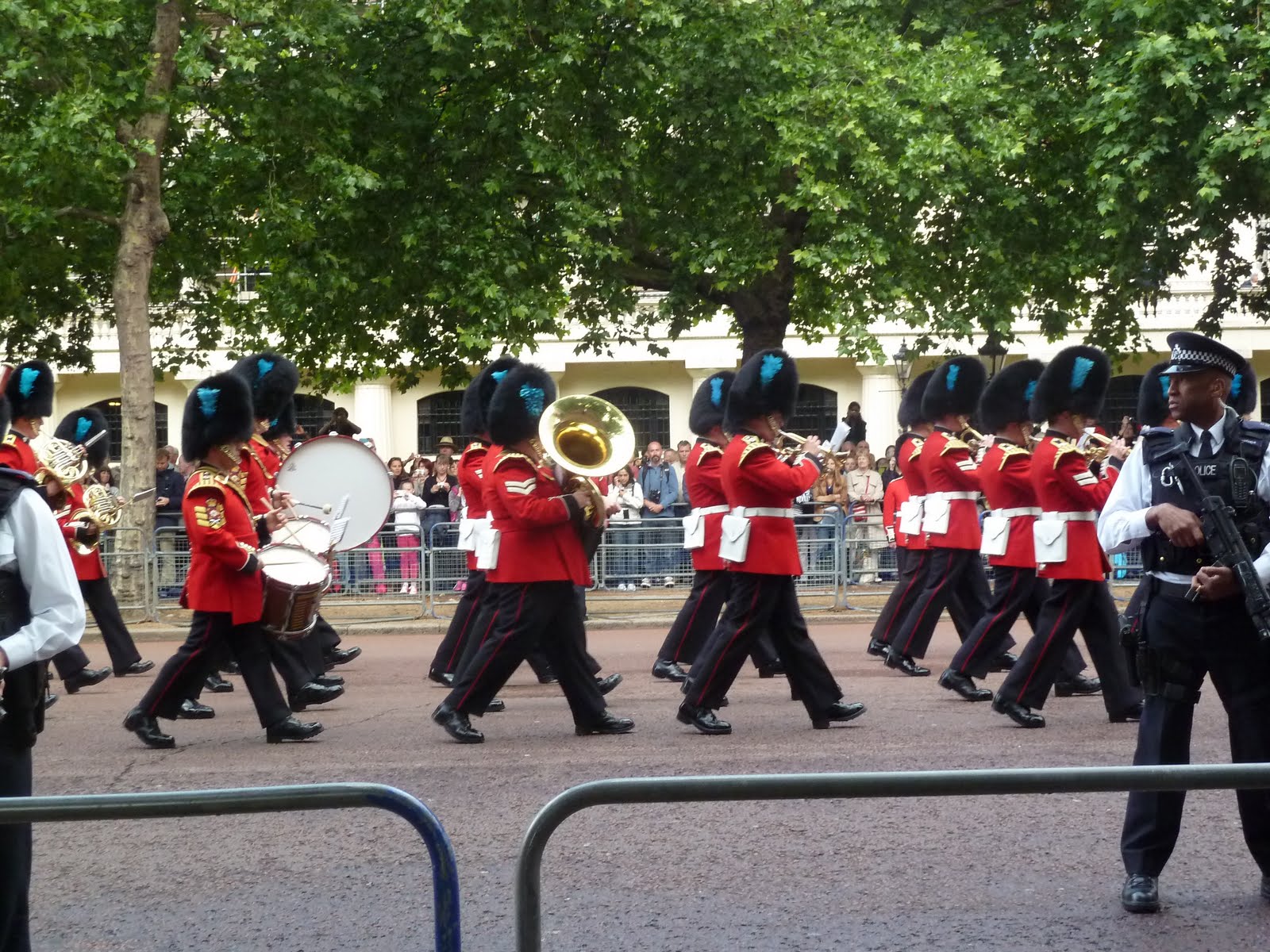
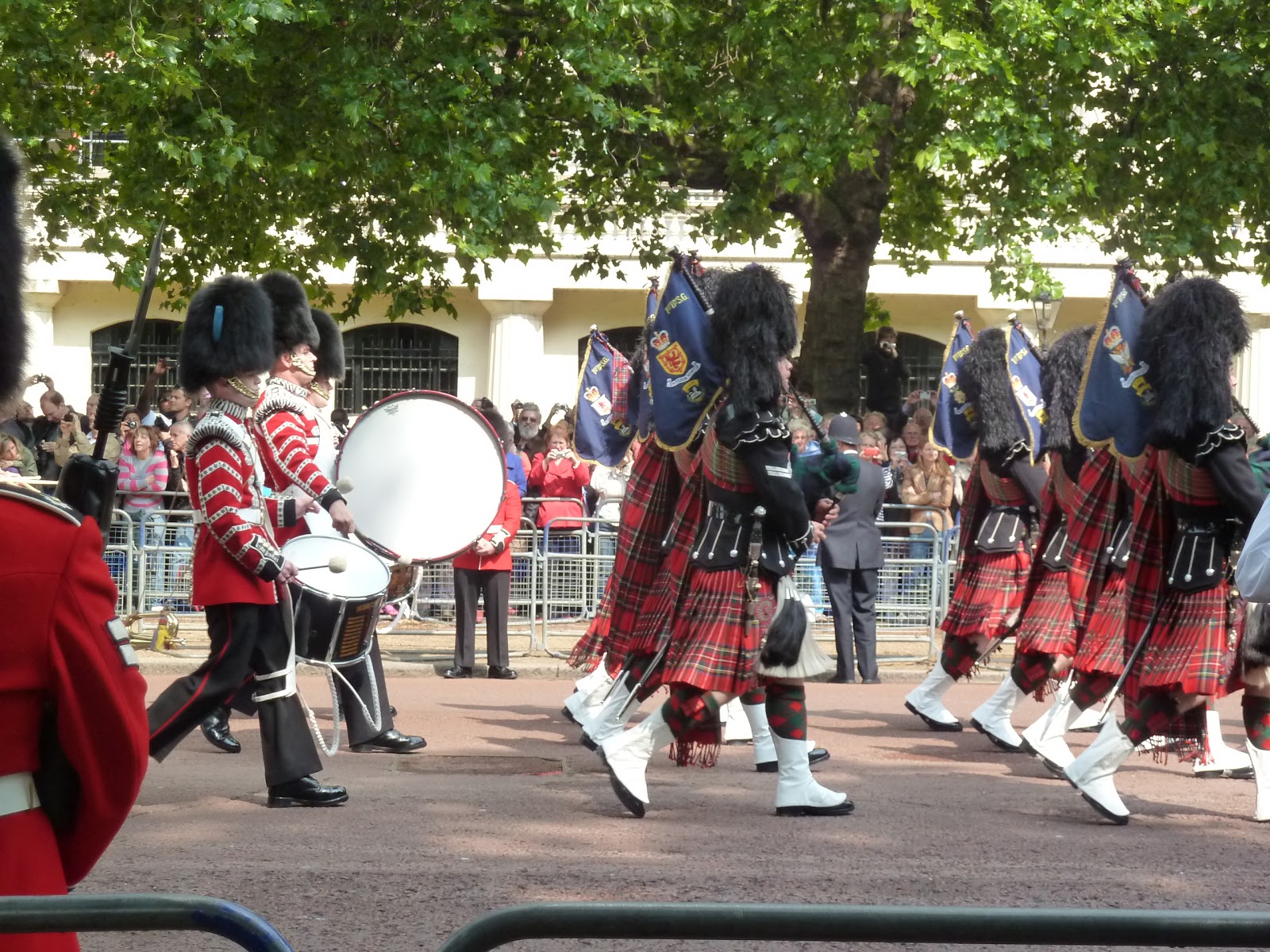
The Irish Guards can be identified by the blue plumes on their hats and by the arrangement of buttons on their tunics.
| Band of the Irish Guards |
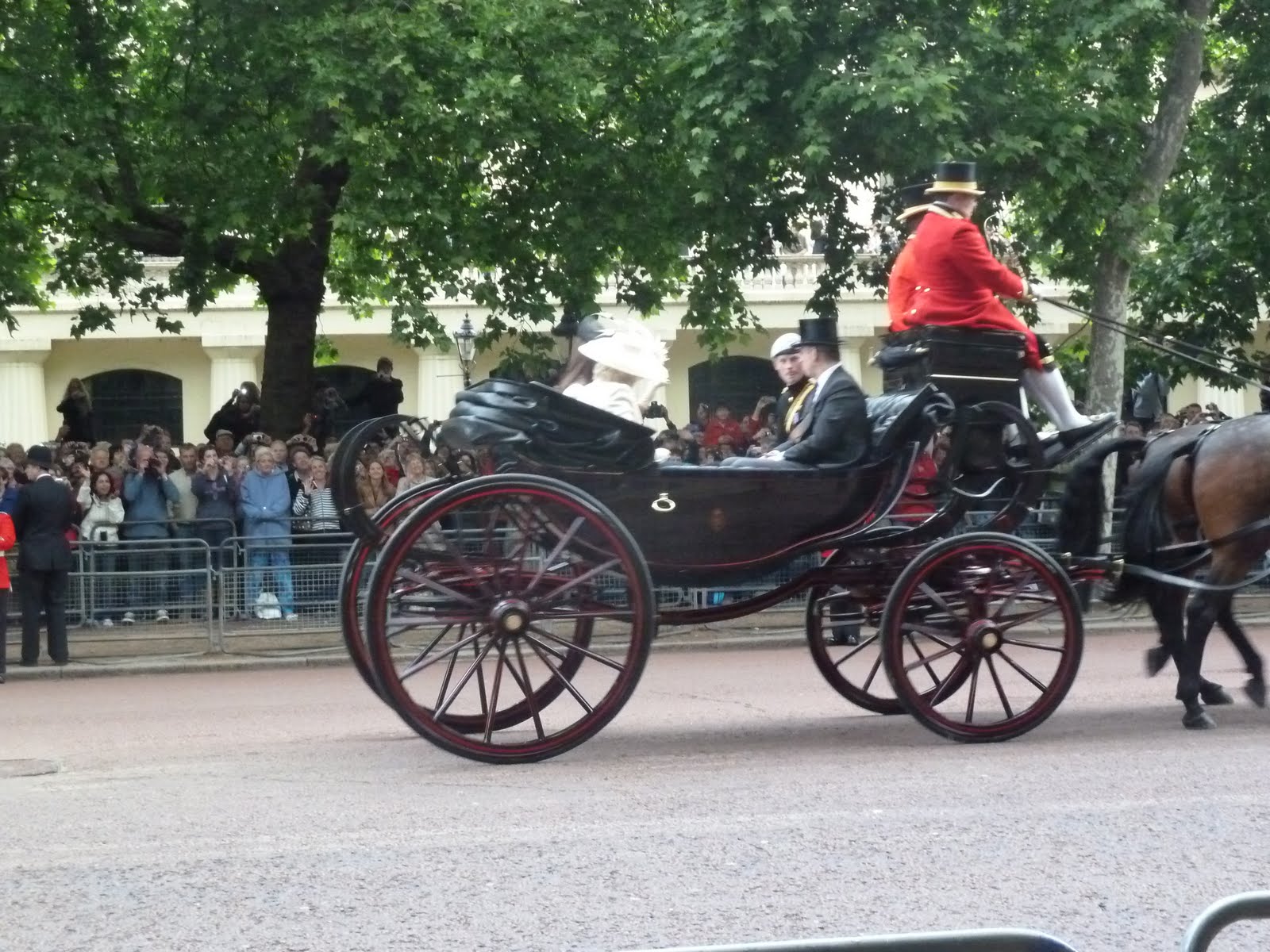
Duchess of Cambridge; across from them are Prince Harry, on the left and the Duke of York.
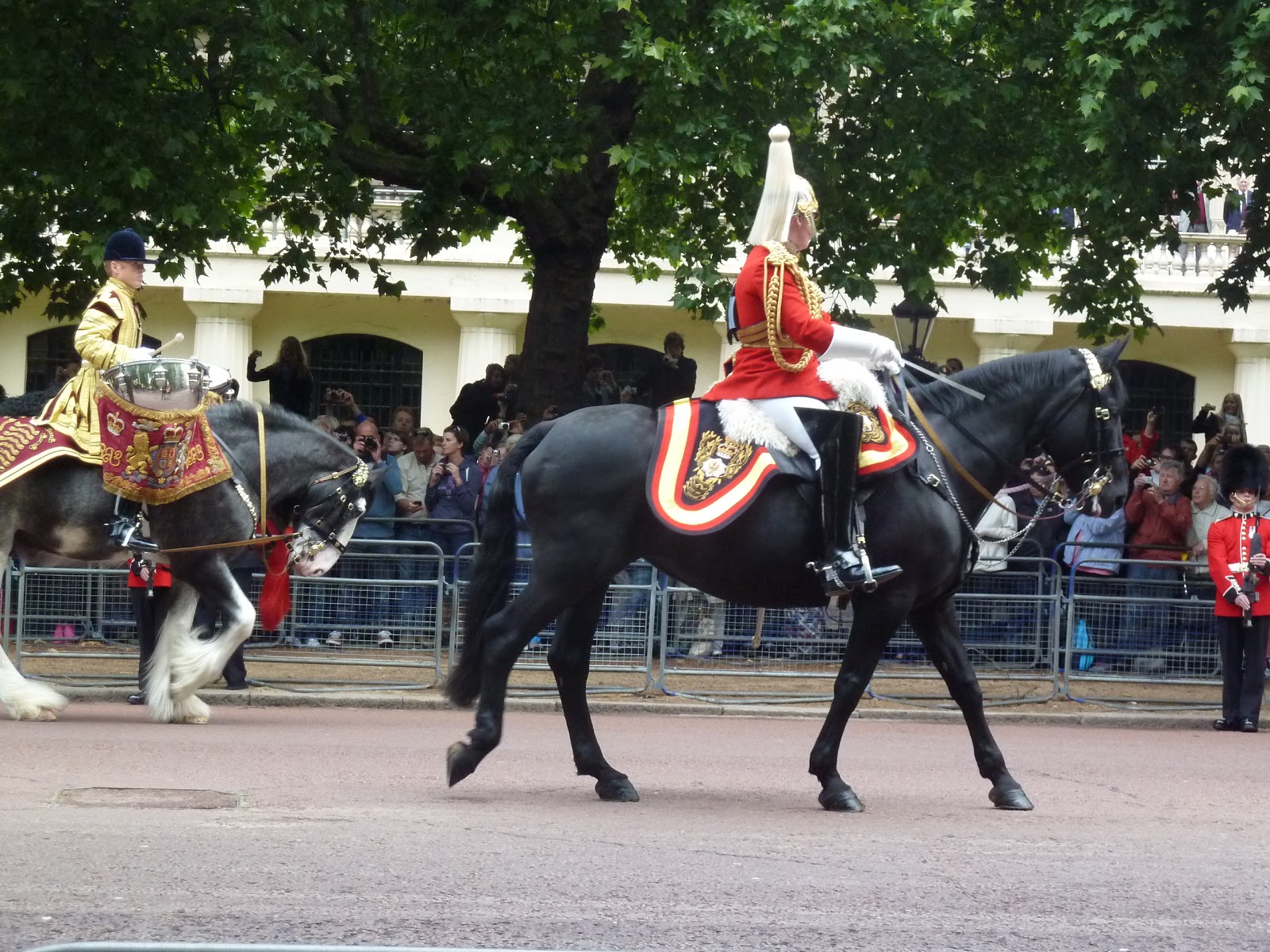
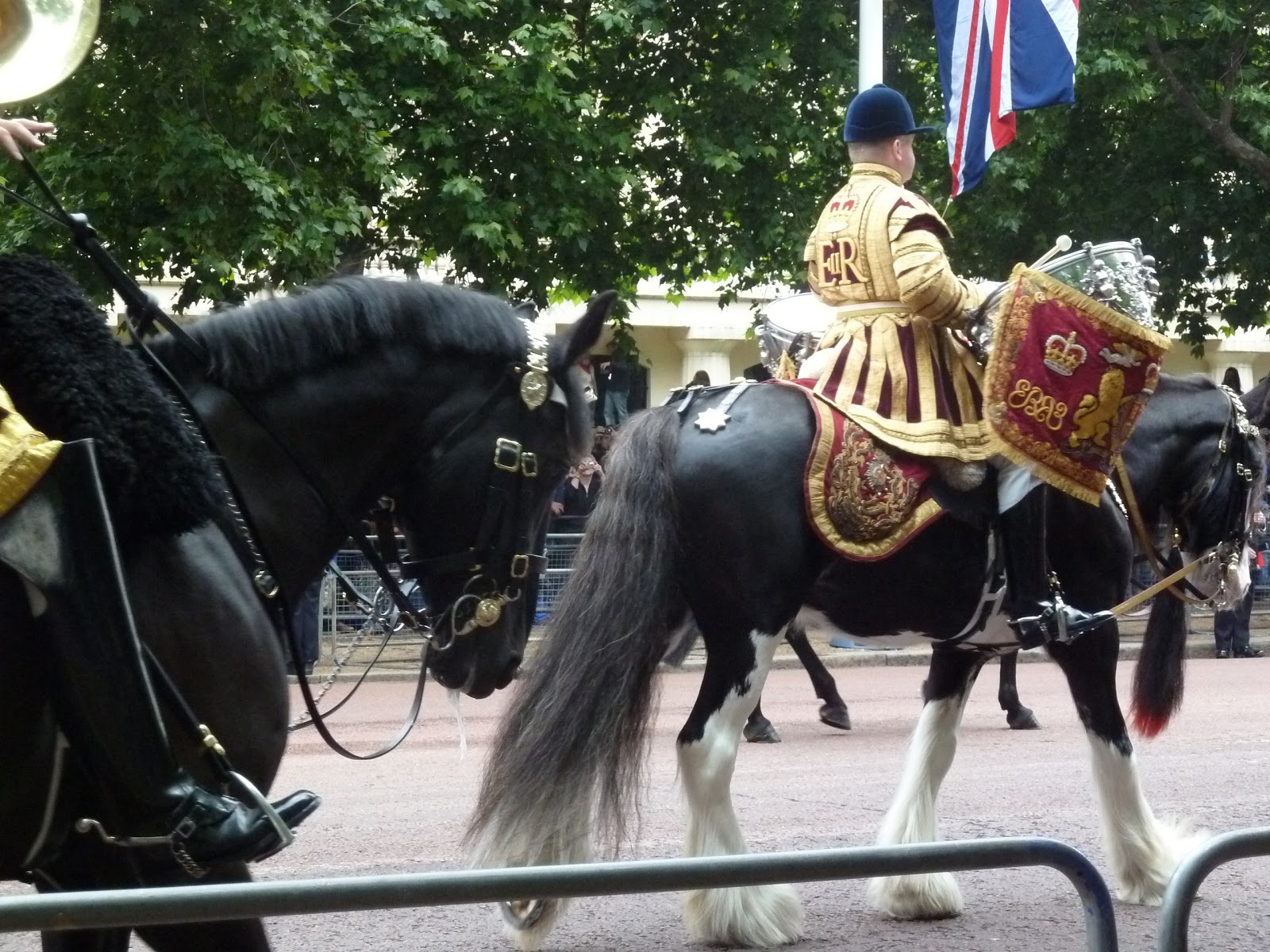
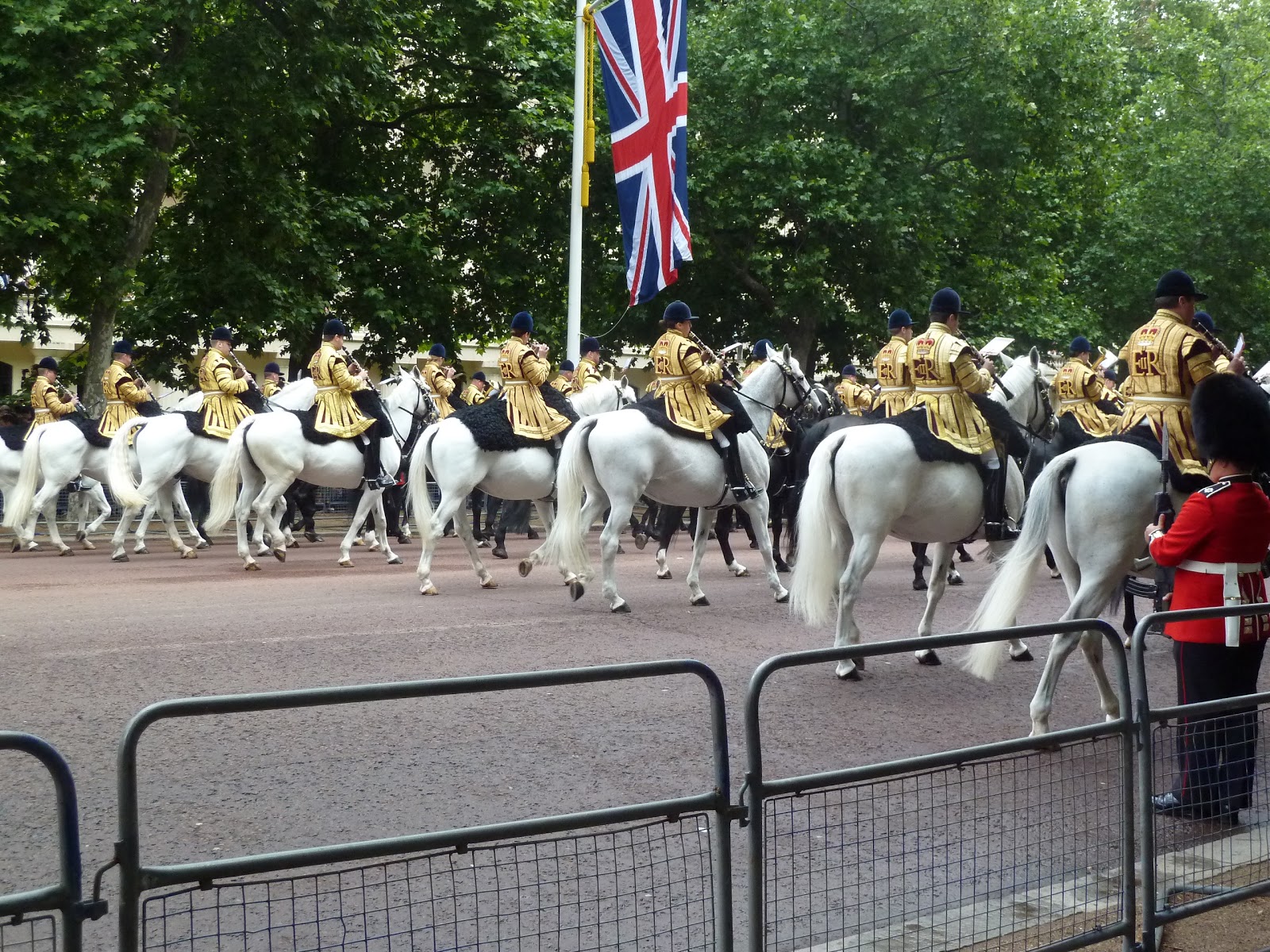
I love the drummers in the mounted bands; the horse’s reins are attached to the stirrups so the rider can beat the time. See also the photo below.
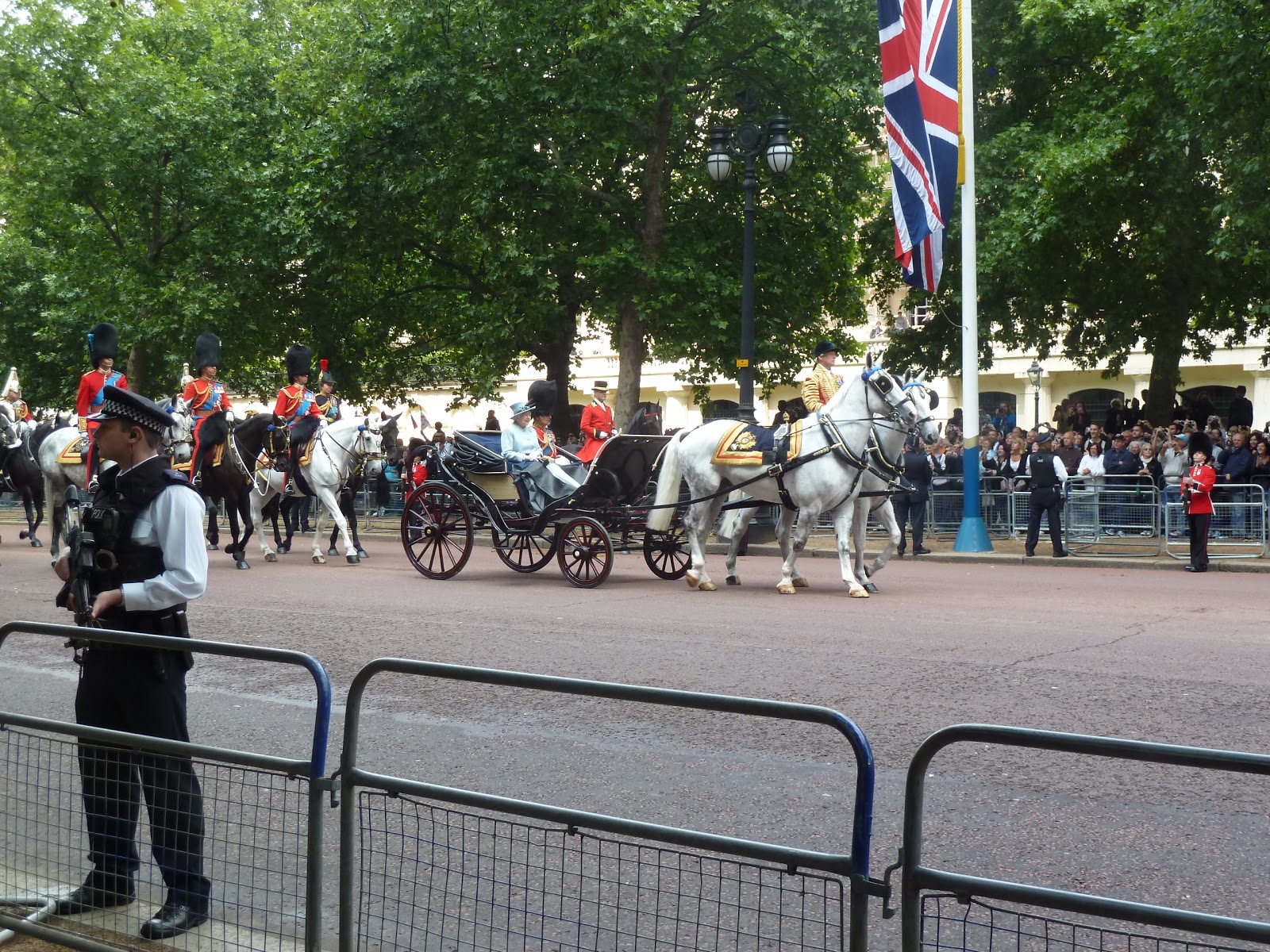
The Queen and Prince Philip, in his uniform as Colonel of the Grenadier Guards, ride in the carriage.
Behind the Queen’s Carriage are, l-r, Prince William, Duke of Cambridge, in the uniform of Colonel of the Irish Guards; Prince Charles, Colonel of the Welsh guards; the Duke of Kent, Colonel of the Scots Guards; and Anne, Princess Royal, Colonel of the Household Cavalry’s Blues and Royals.
Here’s a closer shot of the Queen’s escort from the Daily Mail.
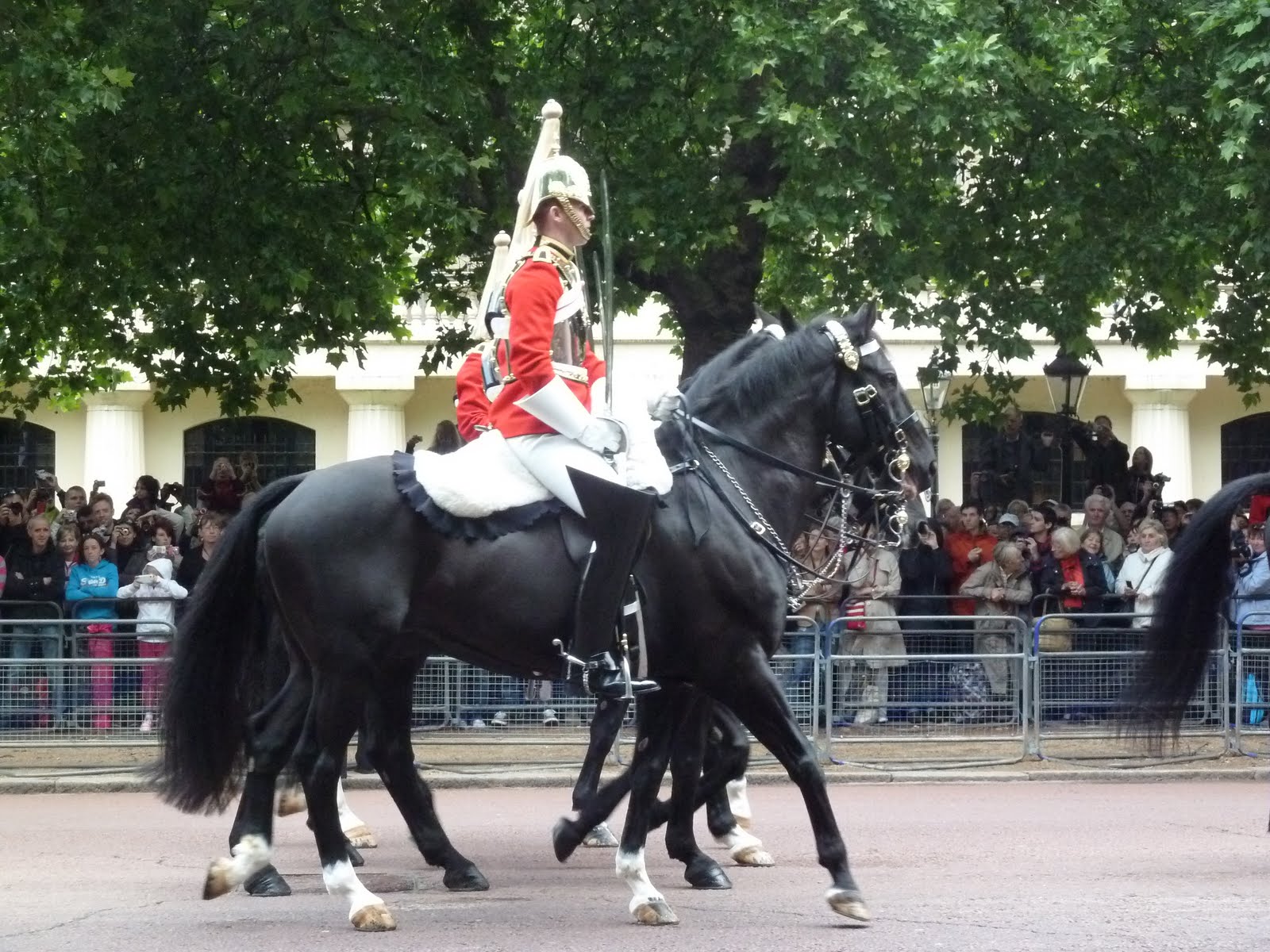
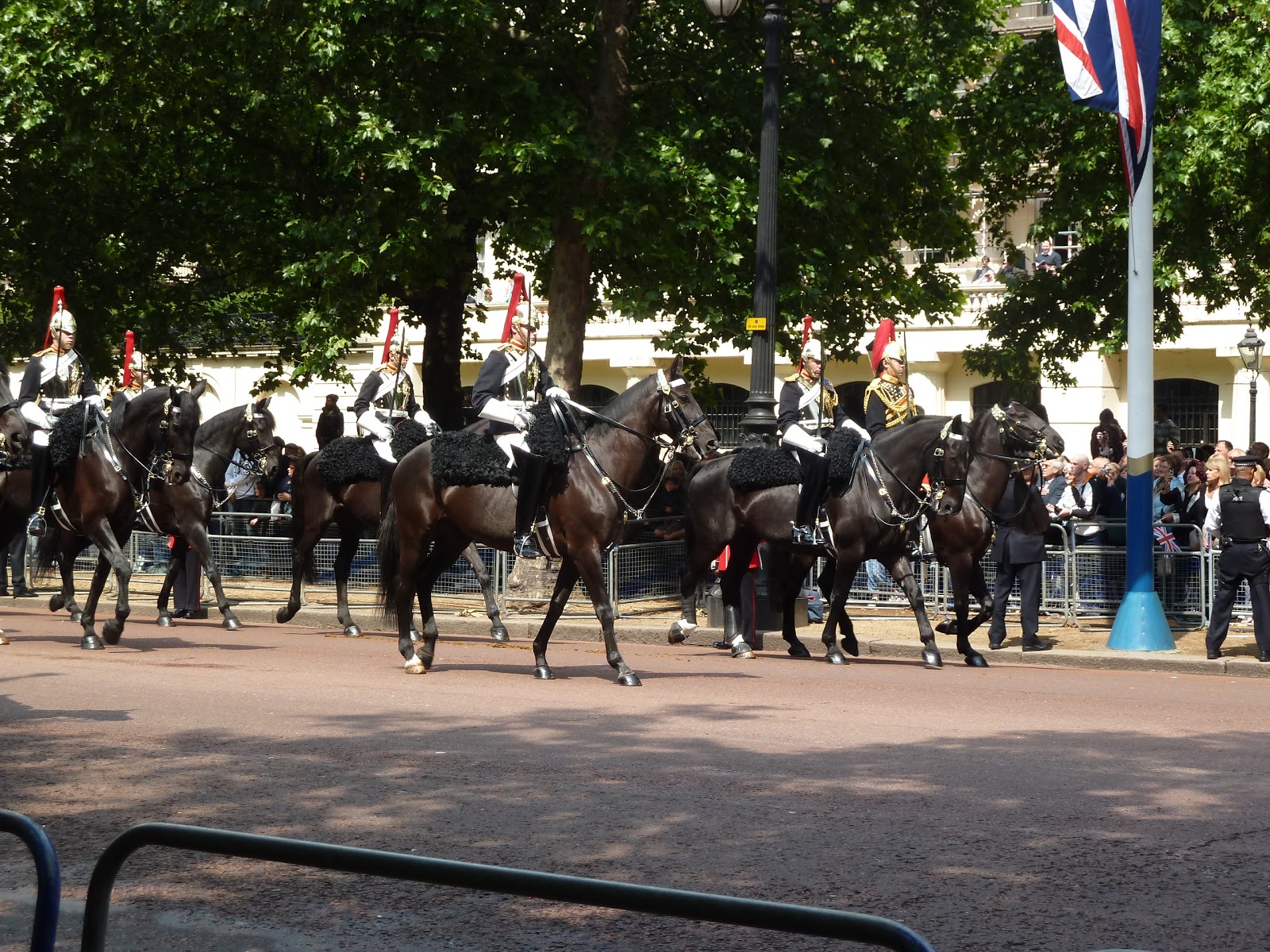
Finally, the Blues and Royals, in their blue tunics with red plumes, part of the Household Cavalry.
It was a magnificent parade; All the military and the Royals, along with hundreds of invited guests, were massed at Horse Guards Parade where the ceremony went on for just over an hour. While they were going through their paces, I left the crowd lining the Mall, most of whom were waiting for the return parade back to Buckingham Palace. But — not having a lot of Saturdays to spend in London — I decided not to wait but to explore further. Next, Marlborough House.
Trembleuse Cups and Saucers
![]() |
| Copyright Worthopedia |
Recently, I was watching the British version of Antiques Roadshow and saw an example of a Trembleuse cup and saucer being appraised. I had never heard of these items and it fascinated me. Which prompted me to think that they would, perhaps, fascinate you, too, so I decided to share a few of these gorgeous pieces.
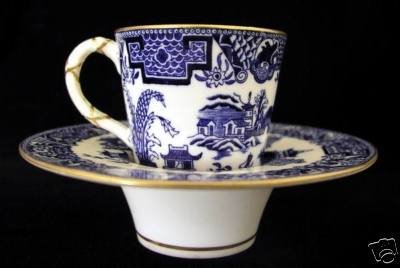
Trembleuse cups and saucers were specifically designed for a person who suffered from the trembles and were virtually “spillproof.” The example above was made by Royal Worcester and is marked with a date symbol for the year 1882. It is printed under the glaze in a beautiful rich blue and decorated with gold trim. The cup has a molded handle. Note both the deep inset of the saucer in which the cup firmly rests and the saucer’s very wide border, all of which was designed to avoid spilling of the hot liquid by a trembling hand.
![]() |
| Copyright J. Paul Getty Museum |
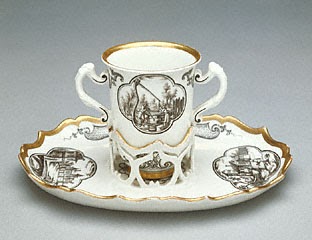
In the 1700s, this double-handled cup pictured above would probably have been used to serve coffee or hot chocolate. Following the Chinese and Japanese custom, Europeans in the 1700s usually drank tea from small handless bowls.
Cups made at the Du Paquier porcelain manufactory were tall, higher than they were wide, and could be unstable. For this reason, the factory developed a trembleuse (literally “trembling”) form, in which a raised ring or basket on the saucer held the cup in place and prevented spillage caused by a shaky hand.
Porcelain painters often imitated engravings with black enamel decoration known as schwarzlot; this decoration was typical of the Du Paquier factory.
![]() |
| Copyright the Victoria and Albert Collection |
![]() |
| Circa 1775 Copyright The Lessing Photo Archive |
![]() |
| Royal Worcester 1878 – Copyright Trocadero.com |
![]() |
| 19th century cranberry glass copyright Miller’s Antiques |
It seems to me that a Trembleuse is exactly what poor Liz needed whenever she went for coffee at her neighbor, Hyacinth Bucket’s house! (That’s Bouquet) By the bye, the pair of cups and saucers on Antiques Roadshow were valued at five thousand pounds.
Travels with Victoria: A Visit to Strawberry Hill
Horace Walpole (1717-1797) was the epitome of the 18th century man: author, collector, designer and architect, politician, diarist, raconteur — you know, the best of those “sees all, knows all, tells all” fellows. His Strawberry Hill gothic fantasy in Twickenham (website here) has received a major renovation and is open to the public; from central London, it’s a short train ride and brief walk.
Walpole acquired the house on this property in the 1740’s and set about remodeling and adapting it for the next several decades. He continued his collecting of artifacts to adorn the rooms and it became the object of many visitors to tour the premises, so many that he complained about their invasion of his privacy. But before the intrusions got so bad, he had another “invention” up his sleeve. In 1765 he published The Castle of Otrano, first in a continuing tradition of “Gothick” literature, popular even today in various forms.
Having no direct heirs, and being the last of the Earls of Orford, he left the house to his friend, sculptress and society leader Anne Damer. Later it fell into disrepair, was sold and the collections dispersed. For the last decades, it has been a part of St. Mary’s University College. The Strawberry Hill Trust secured £9 million for the restoration project, which opened in October, 2010.
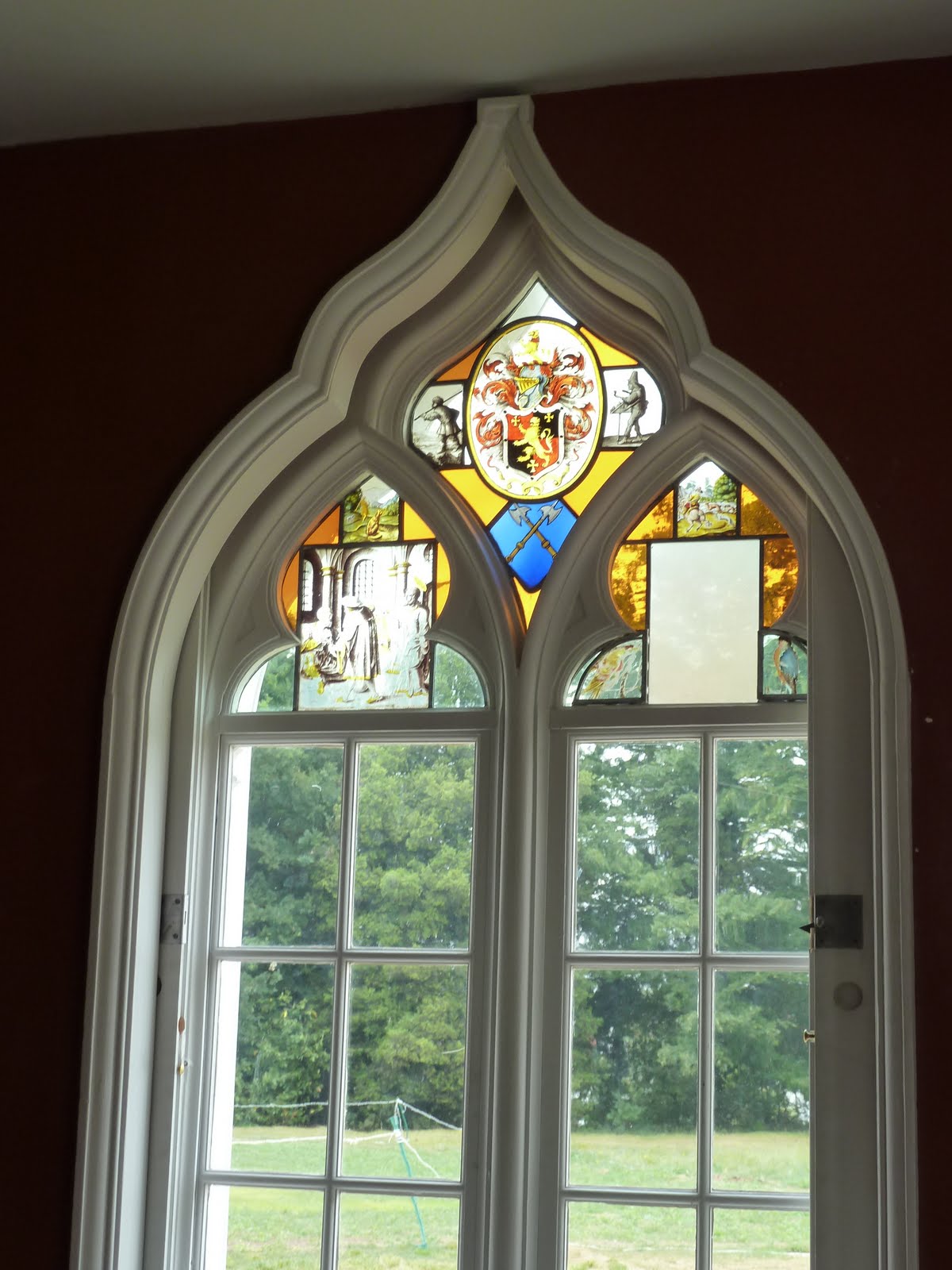
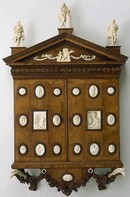
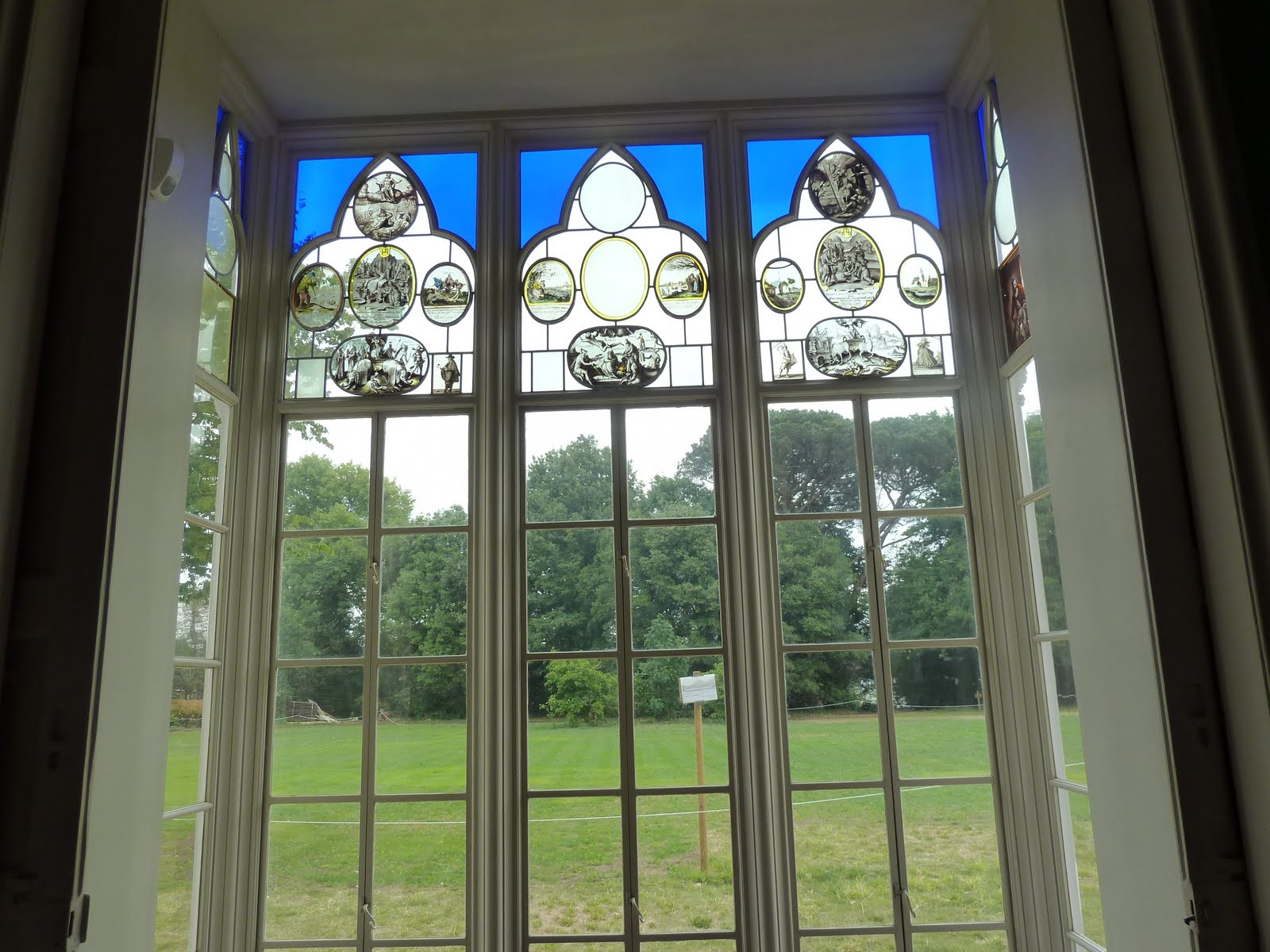
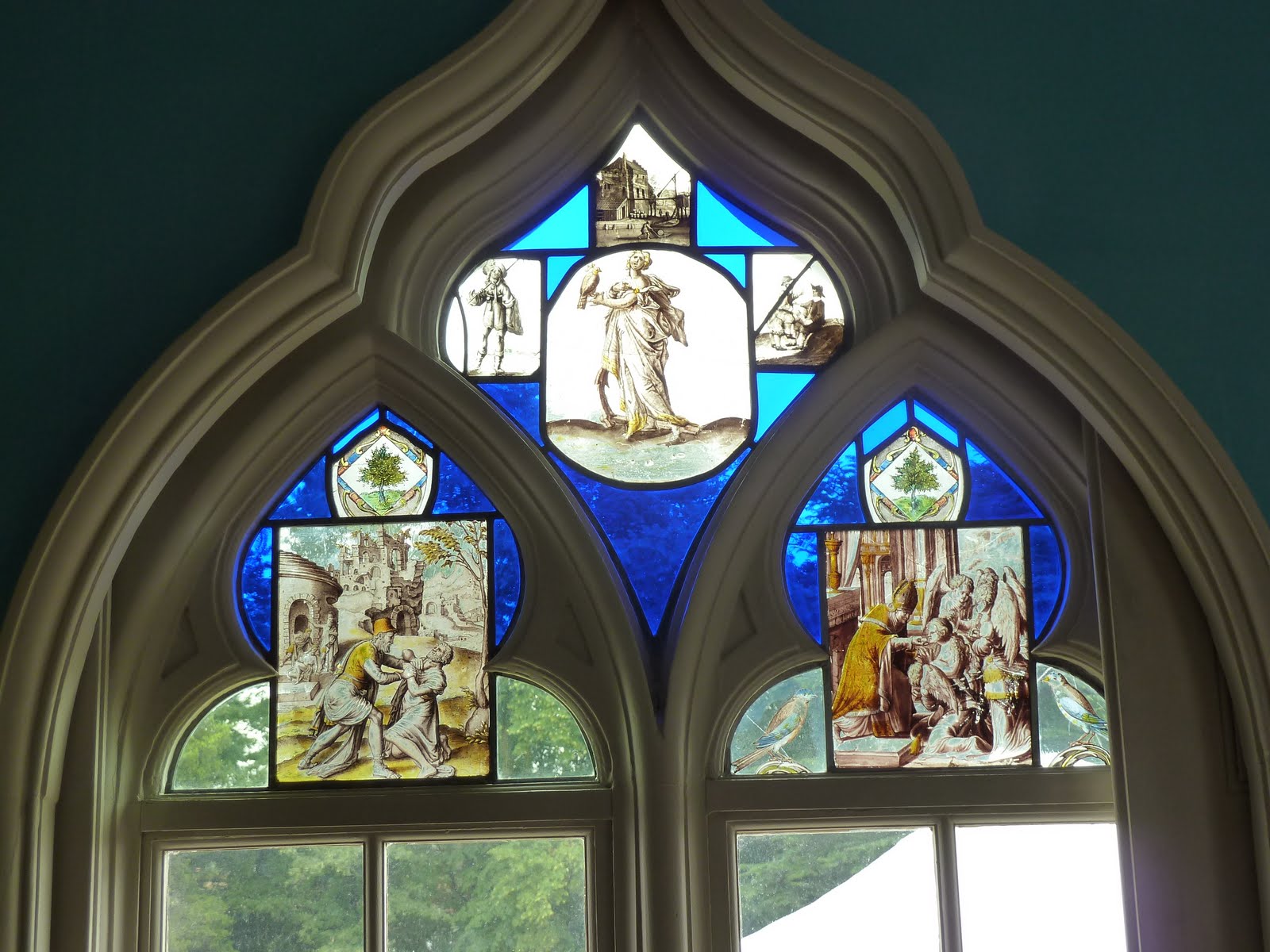
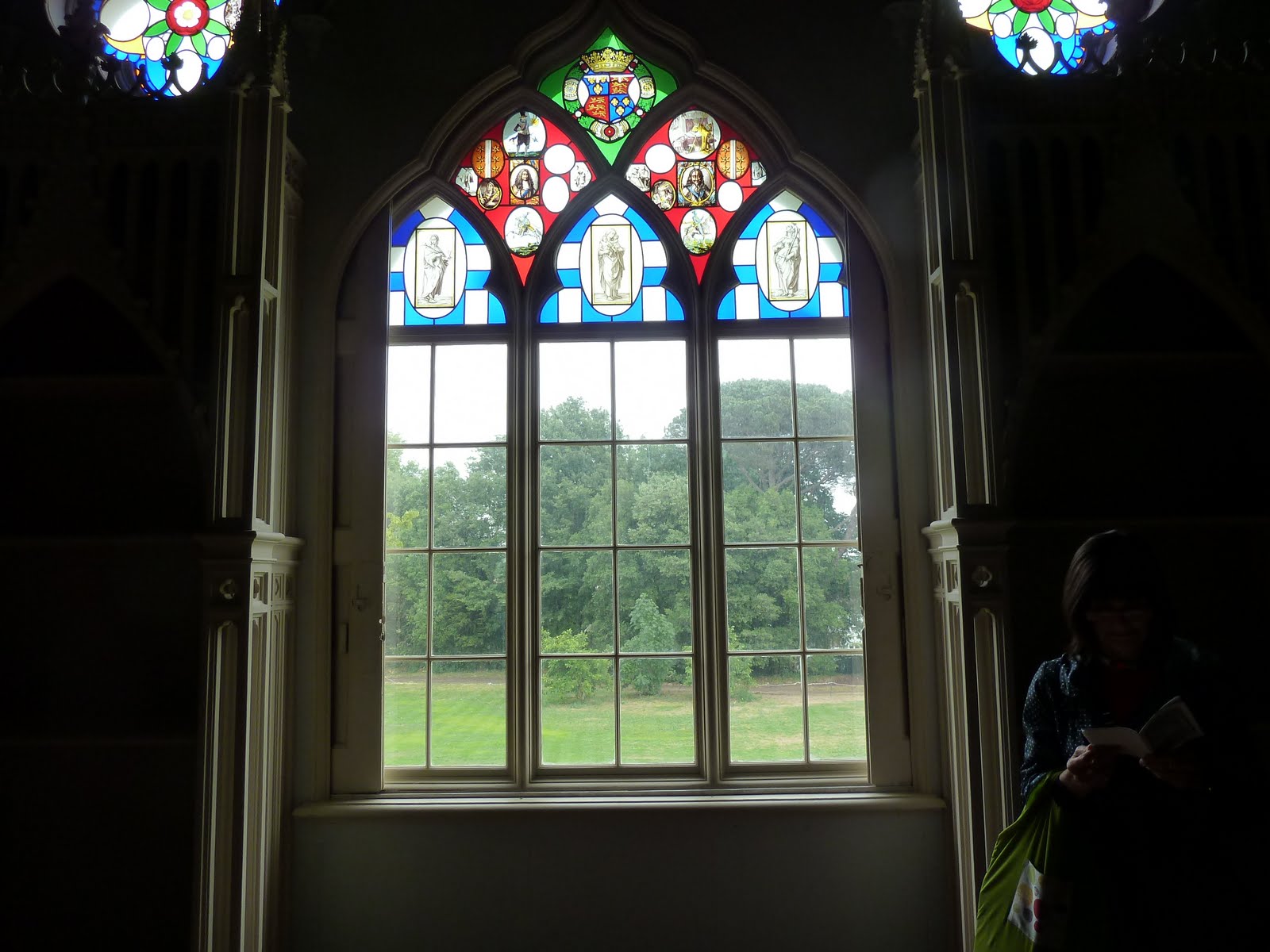
Above, a window, showing how Walpole incorporated his collection of Renaissance and older glass into his modern 18th century windows. Last year, in 2010, I was fortunate enough to visit the wonderful exhibition at the Victoria and Albert Museum in London: Horace Walpole and Strawberry Hill. The exhibition, also shown at the Yale Center for British Art, reassembled many of the objects Walpole have collected but which were dispersed in a multi-day sale in 1842. Below, a cabinet of miniatures and enamels made for Walpole and now owned by the V&A. Inside, it was full of his treasures.
Most of these objects and much of the interior furnishings remain in other collections, both private and in museums, but gradually the Trust hopes to secure some loans and gifts of the originals. For the time being, while the renovations continue, the rooms are empty.
There are, however, some amenities: the gift shop and the restaurant, both of which enjoyed our custom. Due to the nature of the building, it is necessary to book visits in advance or risk a long wait. In 1784,Walpole wrote a guide to Strawberry Hill. A reproduction of this guide is given to each visitor. Walpole wrote: “In truth, I did not mean to make my house so Gothic as to exclude convenience, and modern refinements in luxury…It was built to please my own taste, and in sole degree to realize my own vision.”
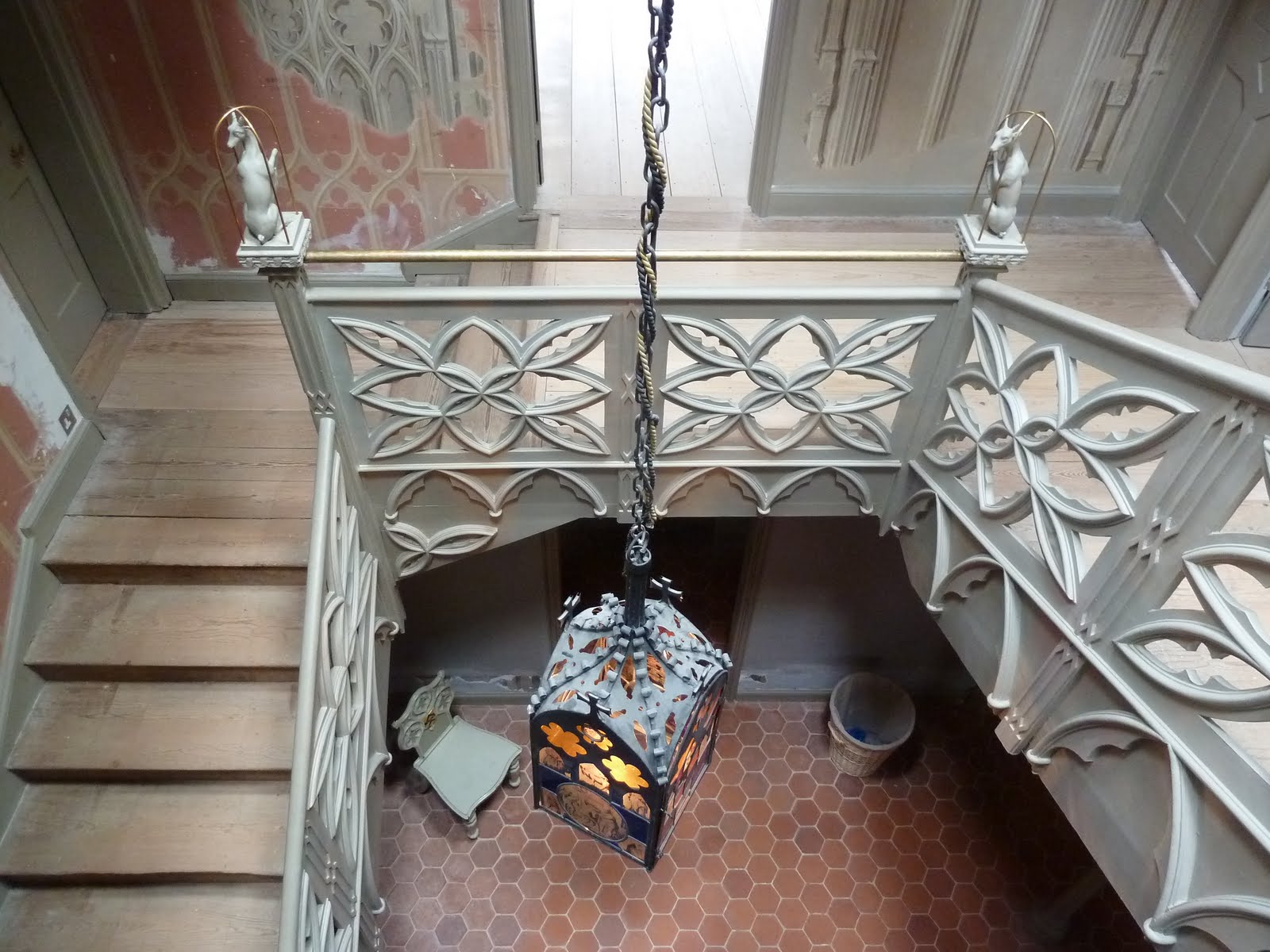
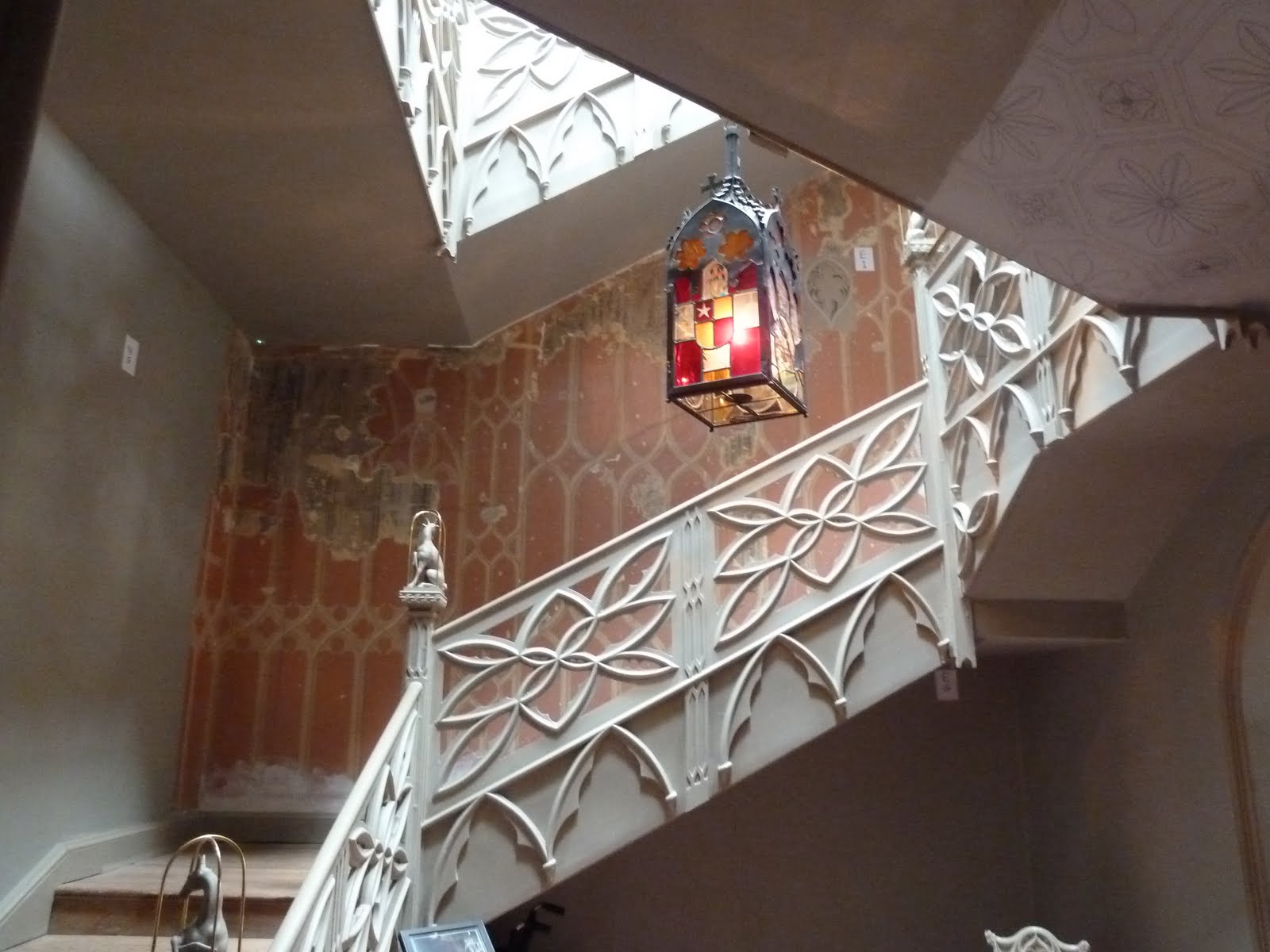
The staircase from below and from above. From Walpole’s 1784 guide: “In the well of the staircase, by a cord of black and yellow, hangs a Gothic lantern of tin japanned, designed by Mr. Bentley and filled with painted glass…”
Below, I have arranged my photos in groups of architectural features. If you’d rather see each room, one by one, click here. More of the windows, incorporating Walpole’s colorful collections of glass:
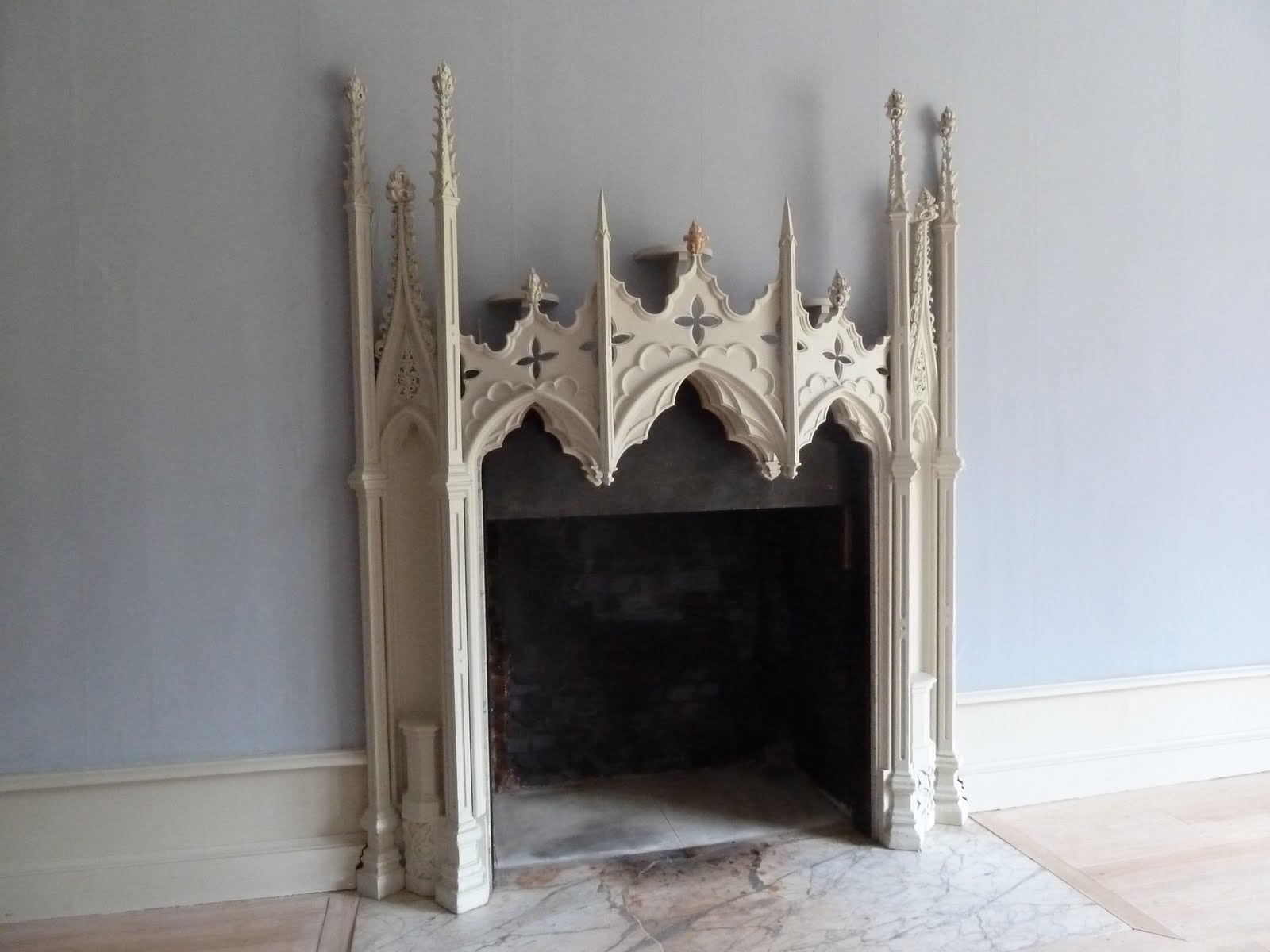
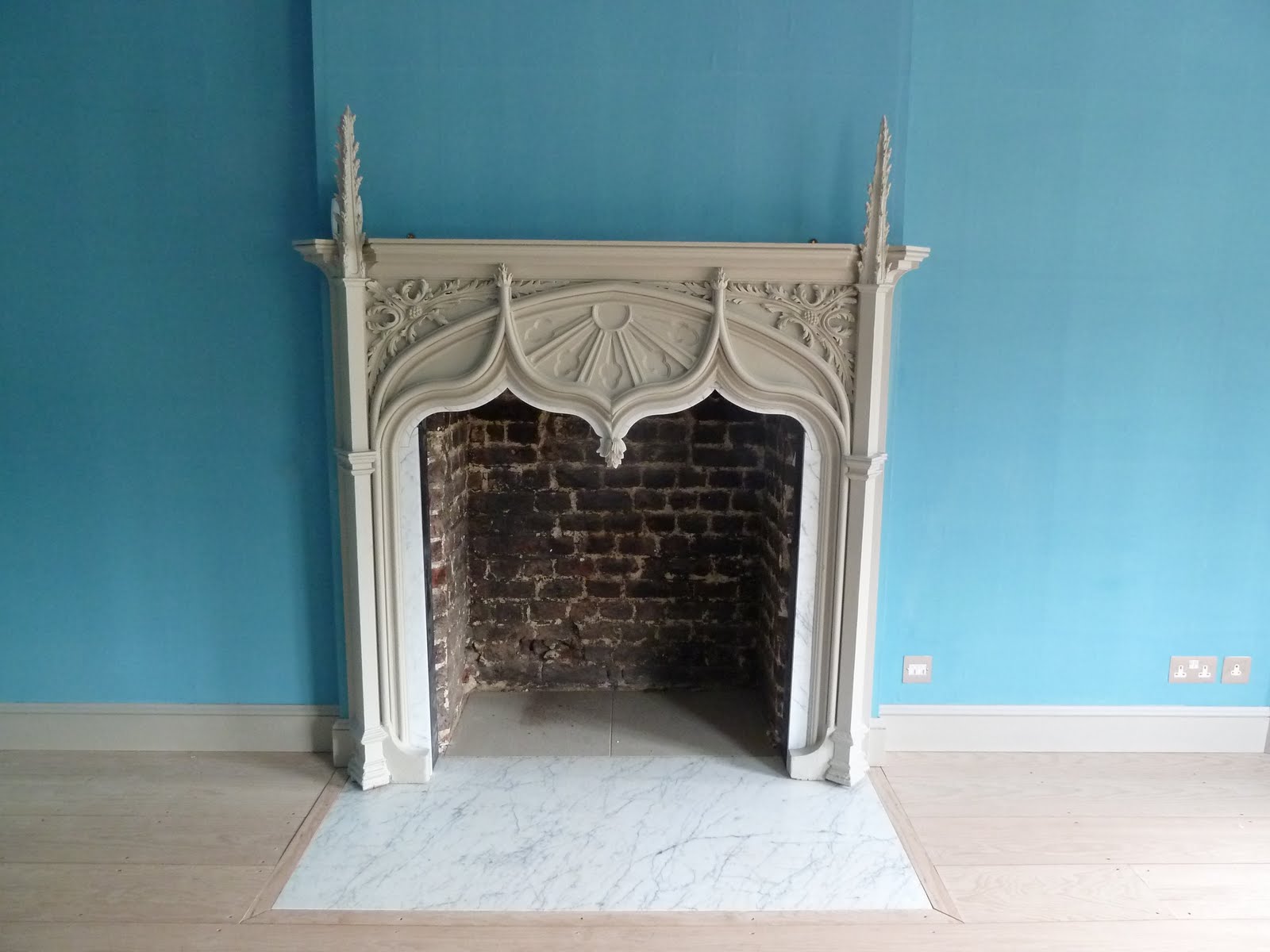
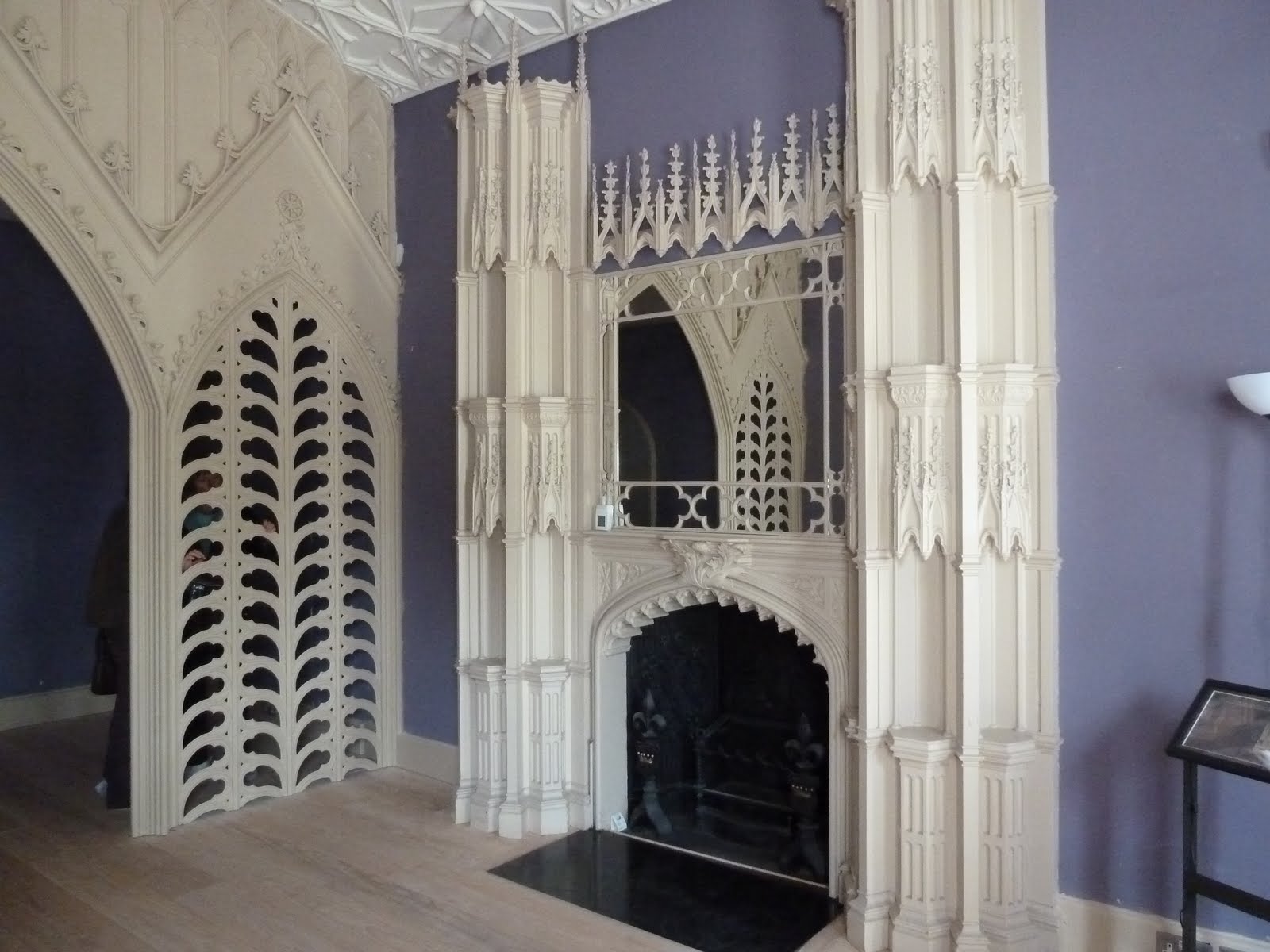
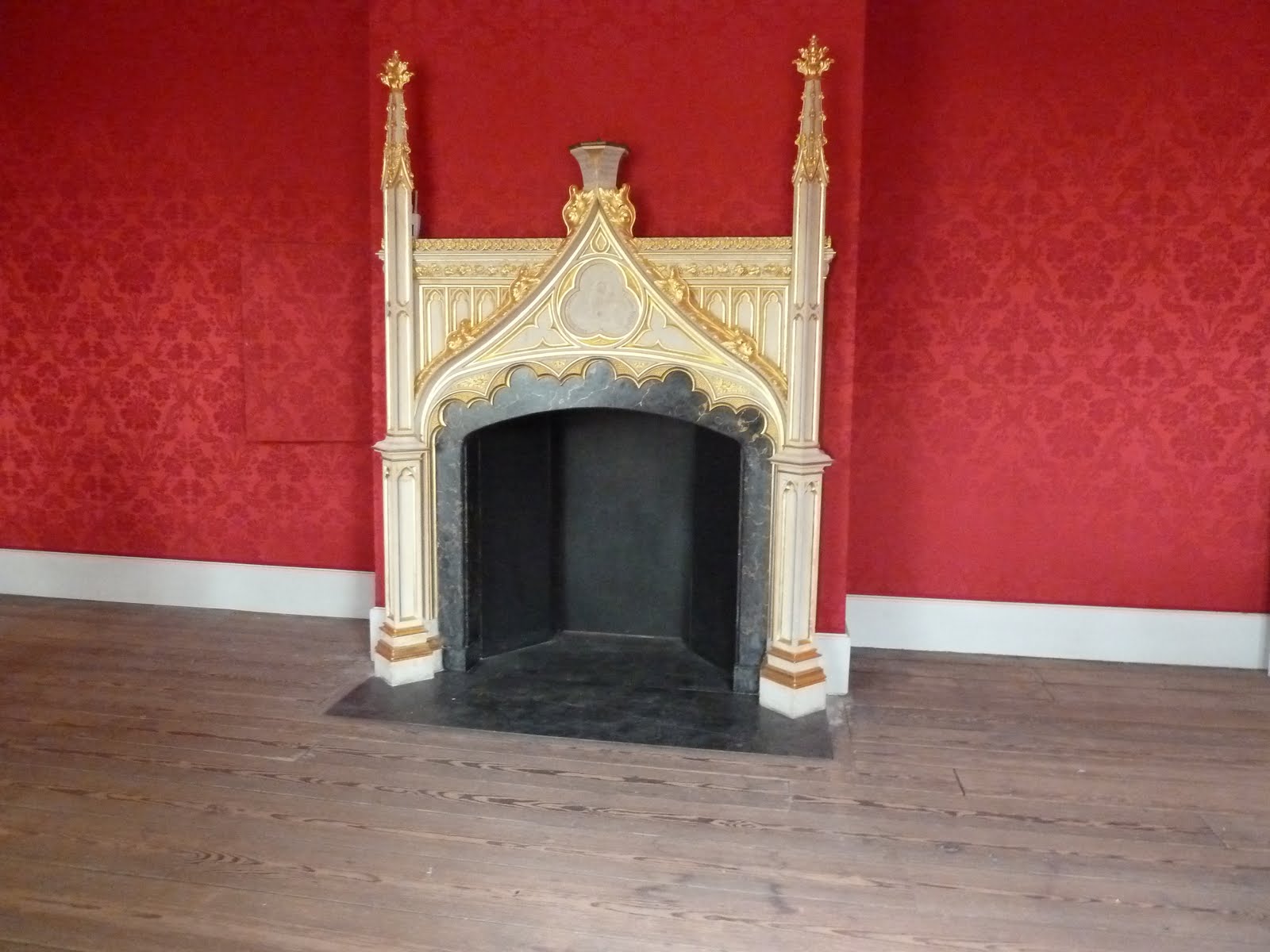
Also of note are the various designs for fireplaces.
| The Blue Bed Chamber |
| The Holbein Chamber |
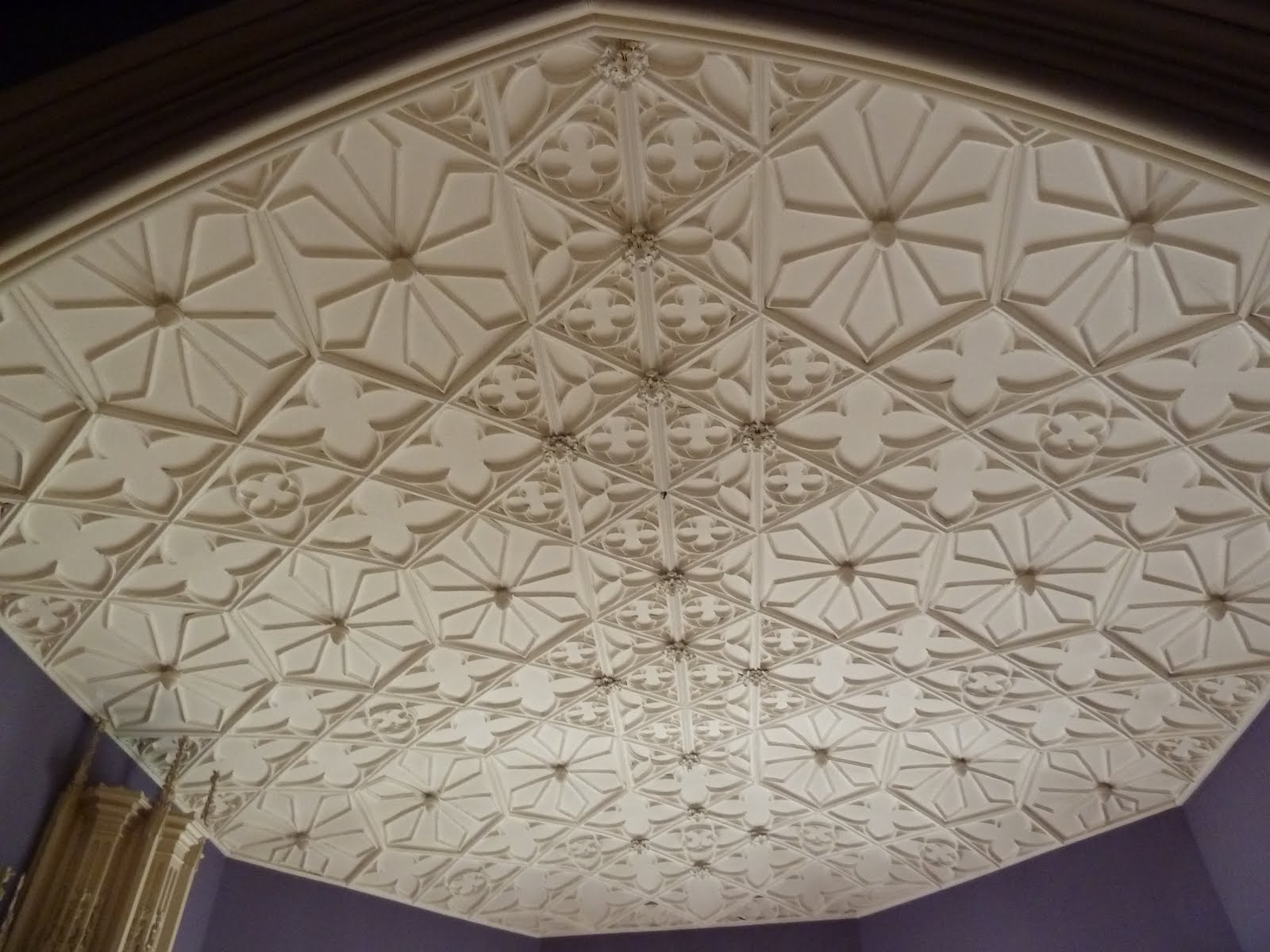
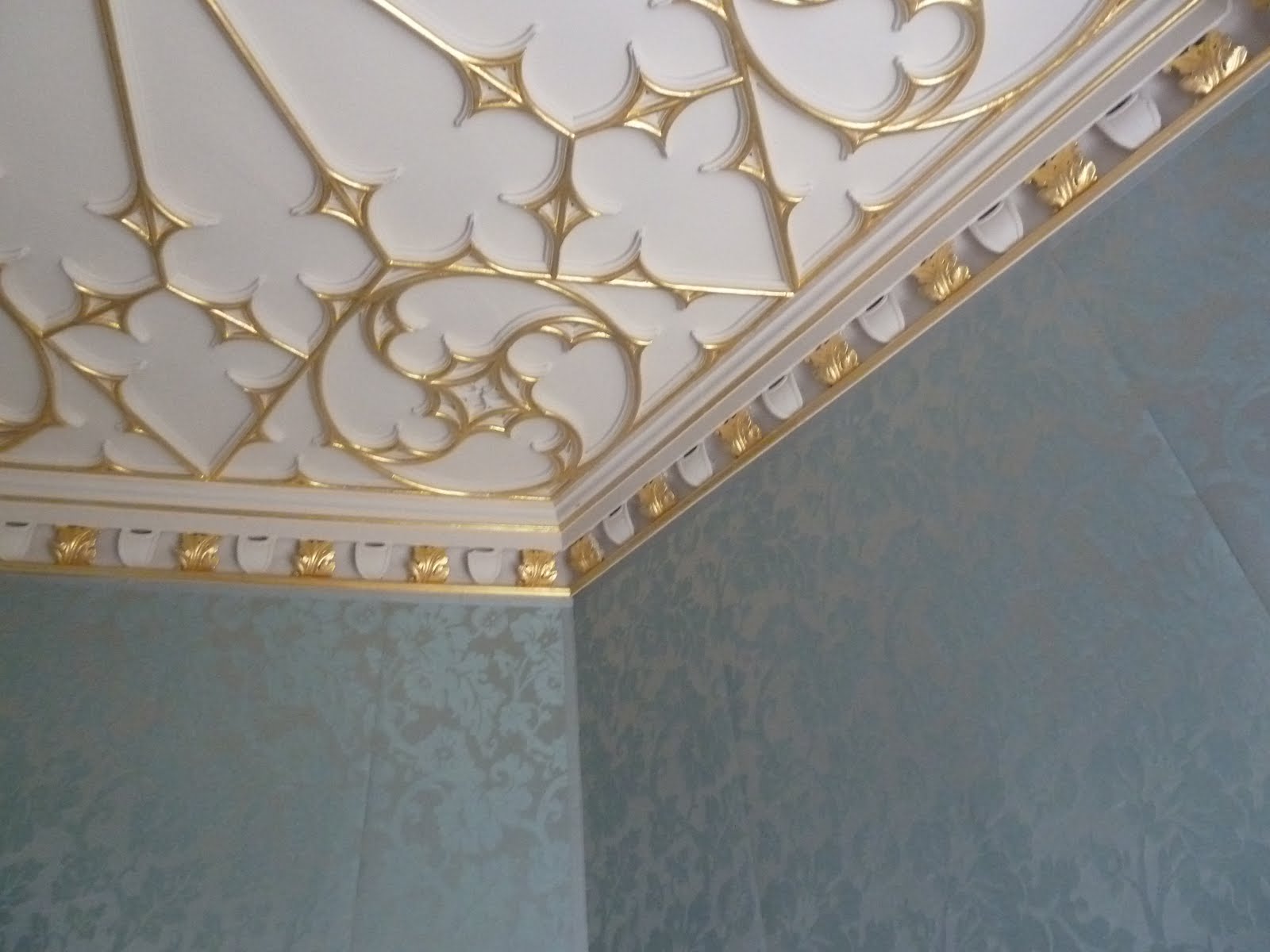
The ceilings were brilliantly executed – and restored.
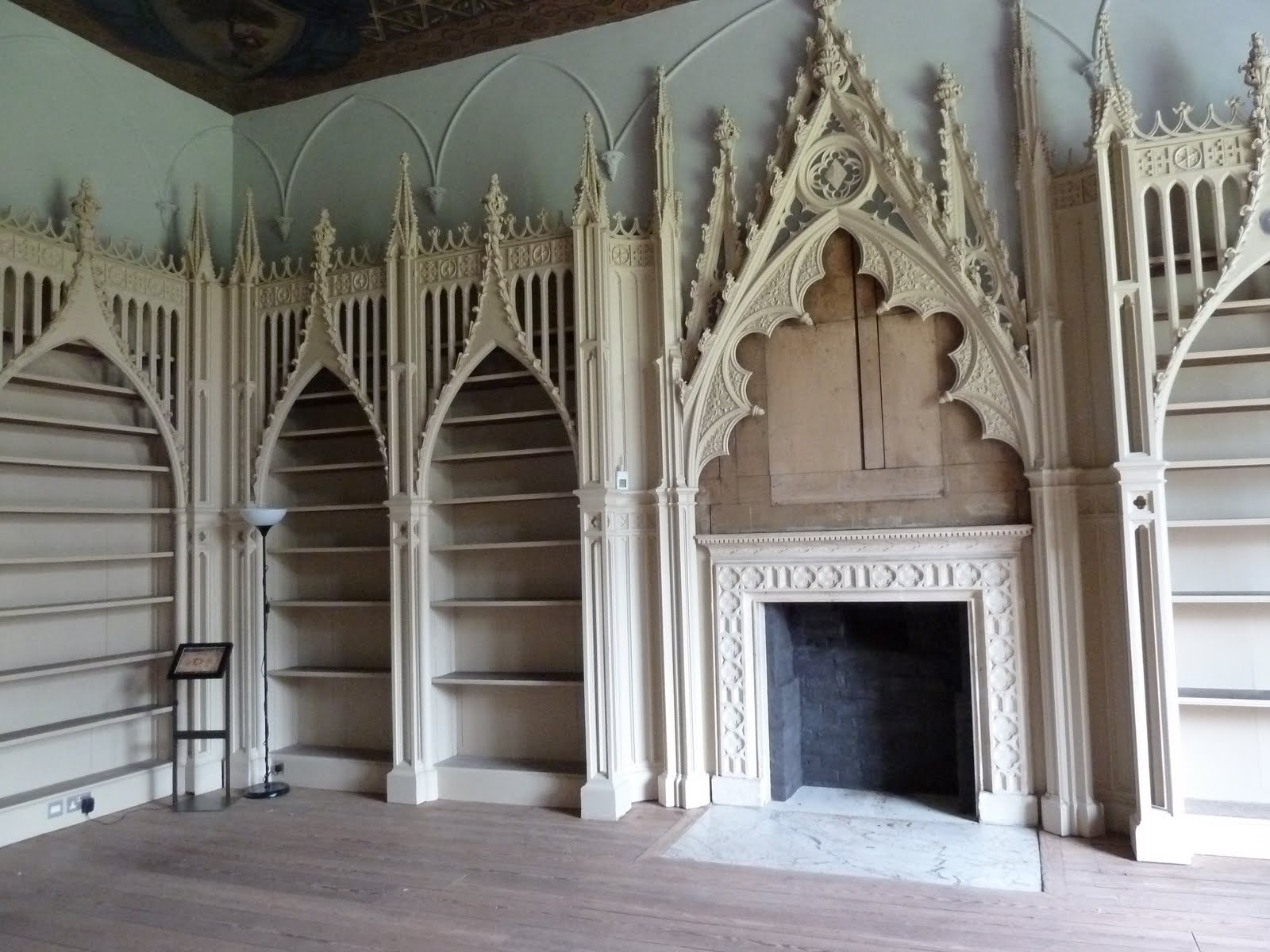
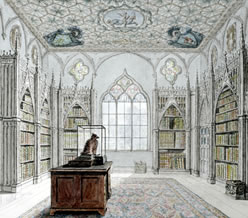
| The Library |
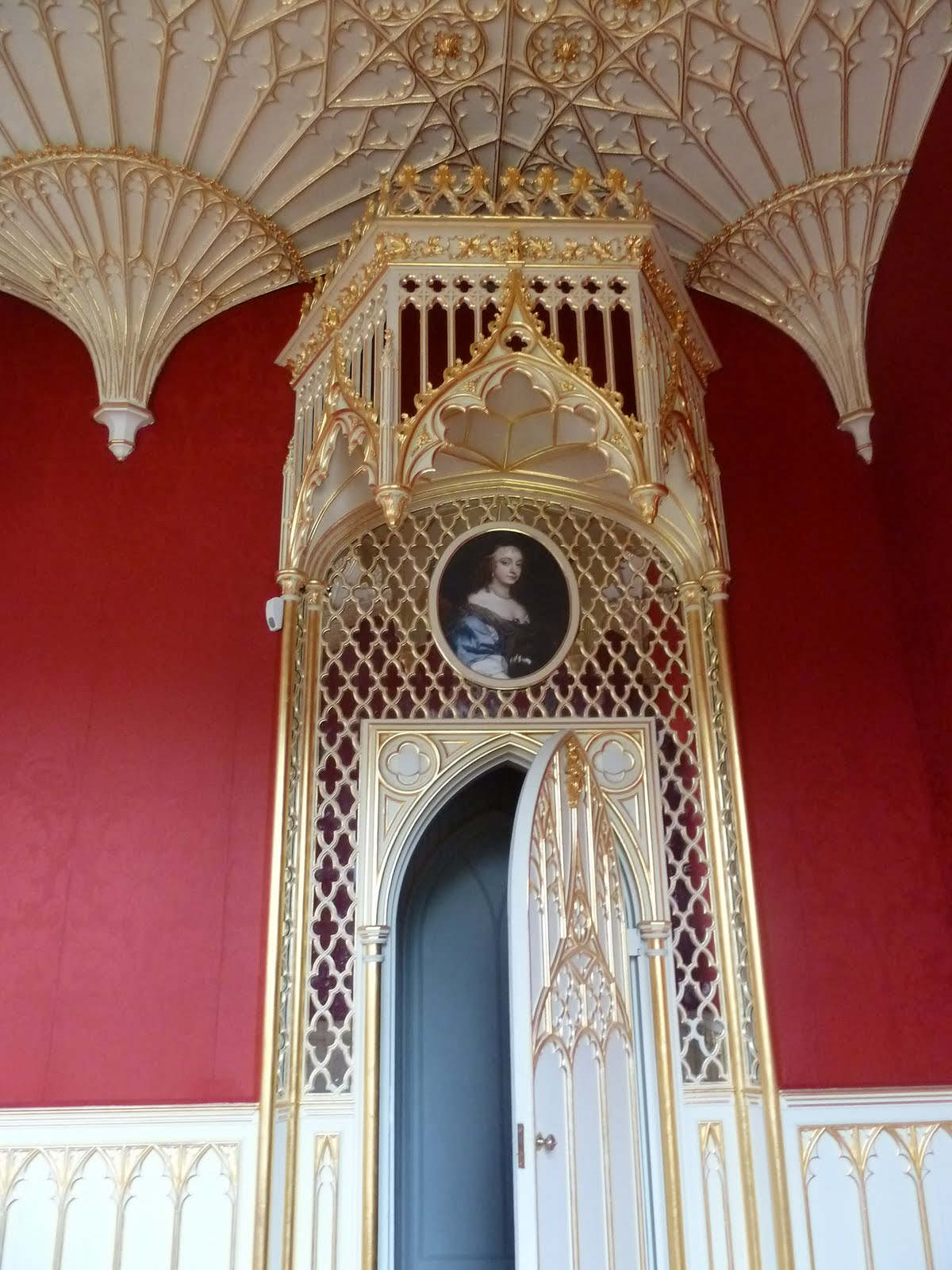
The Gallery, with a fan-vault ceiling inspired by Westminster Abbey’s King Henry VII chapel, is brilliant; in the restoration, the papier mache forms were refreshed and regilded.
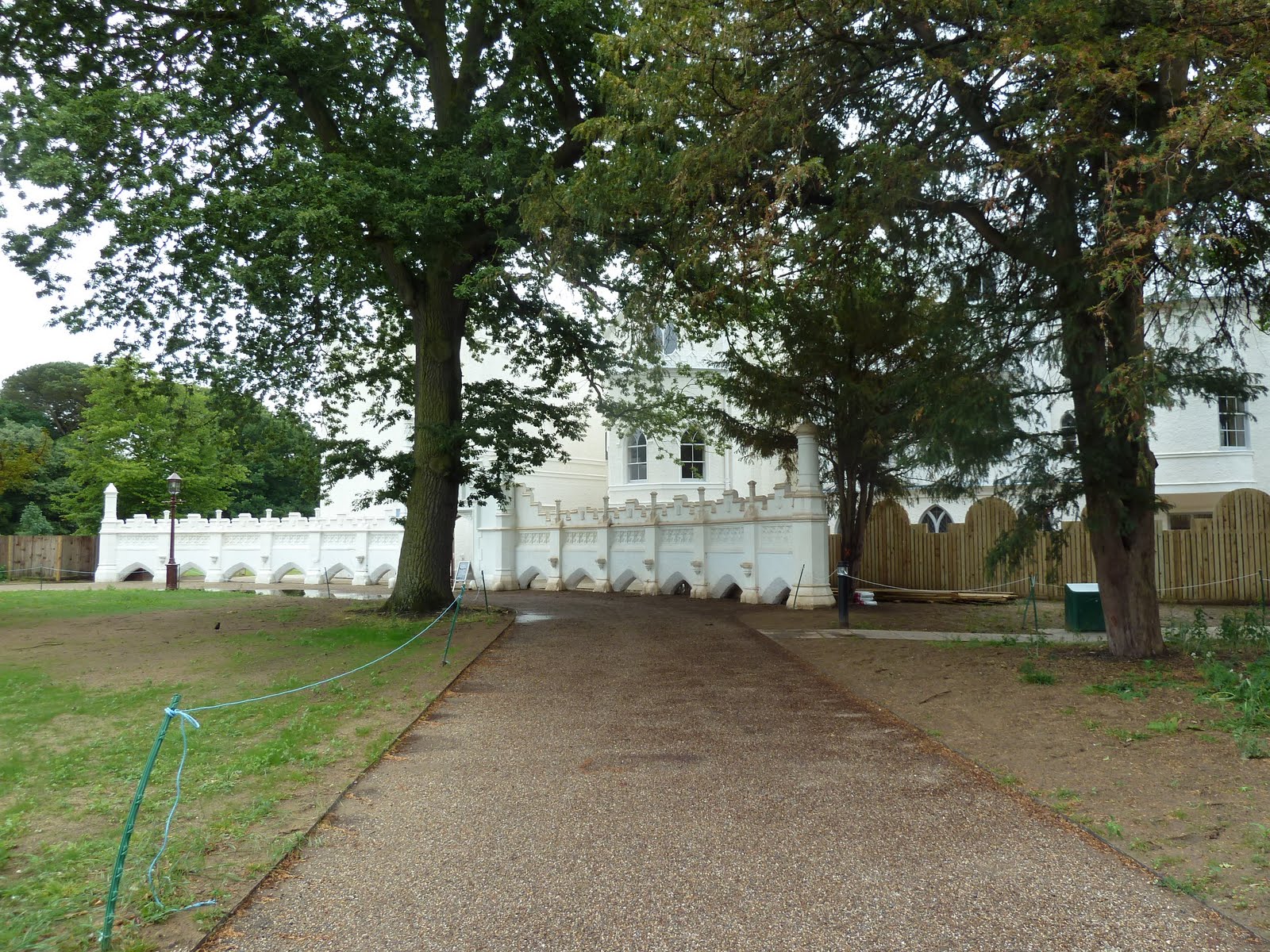
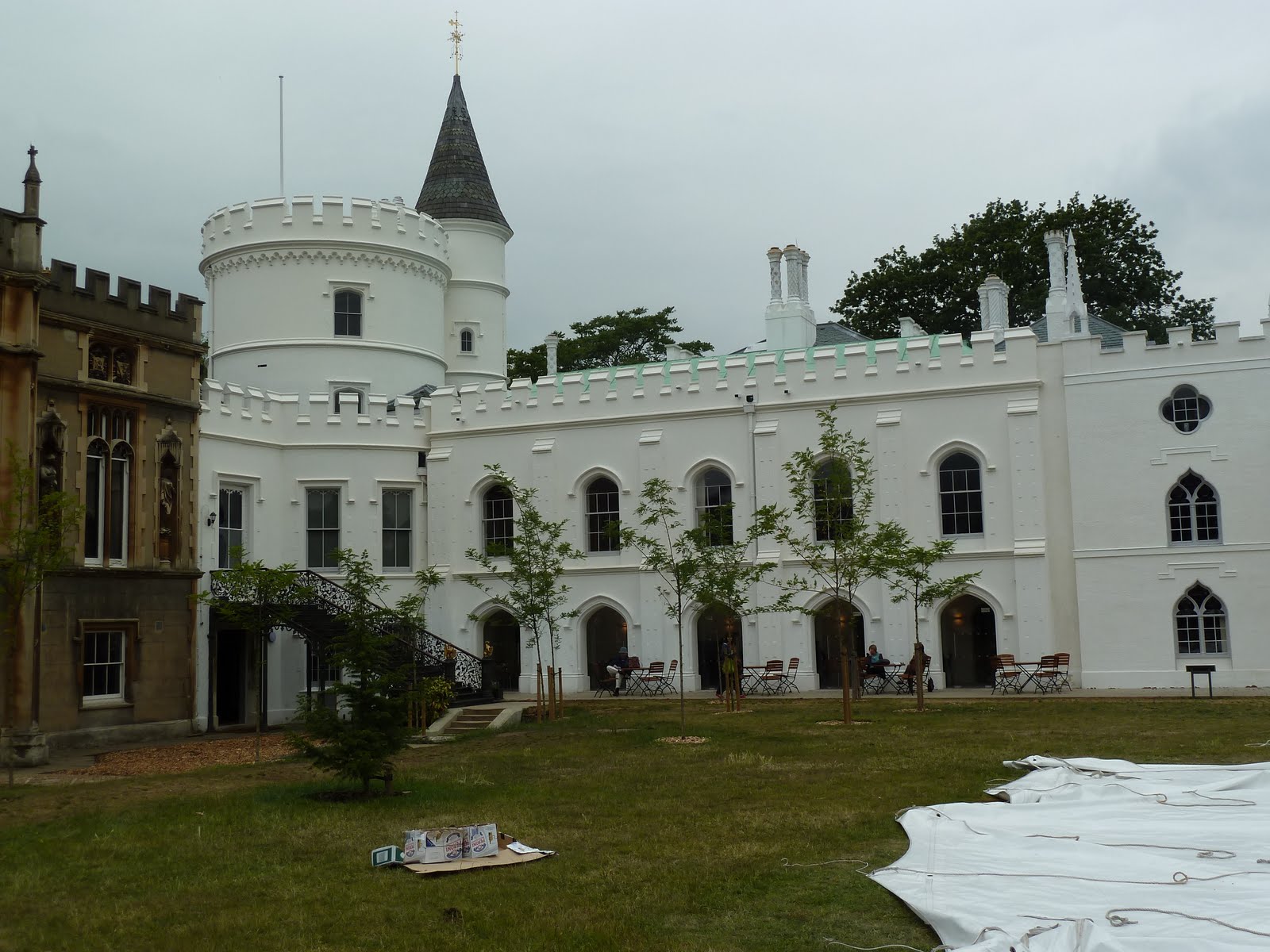
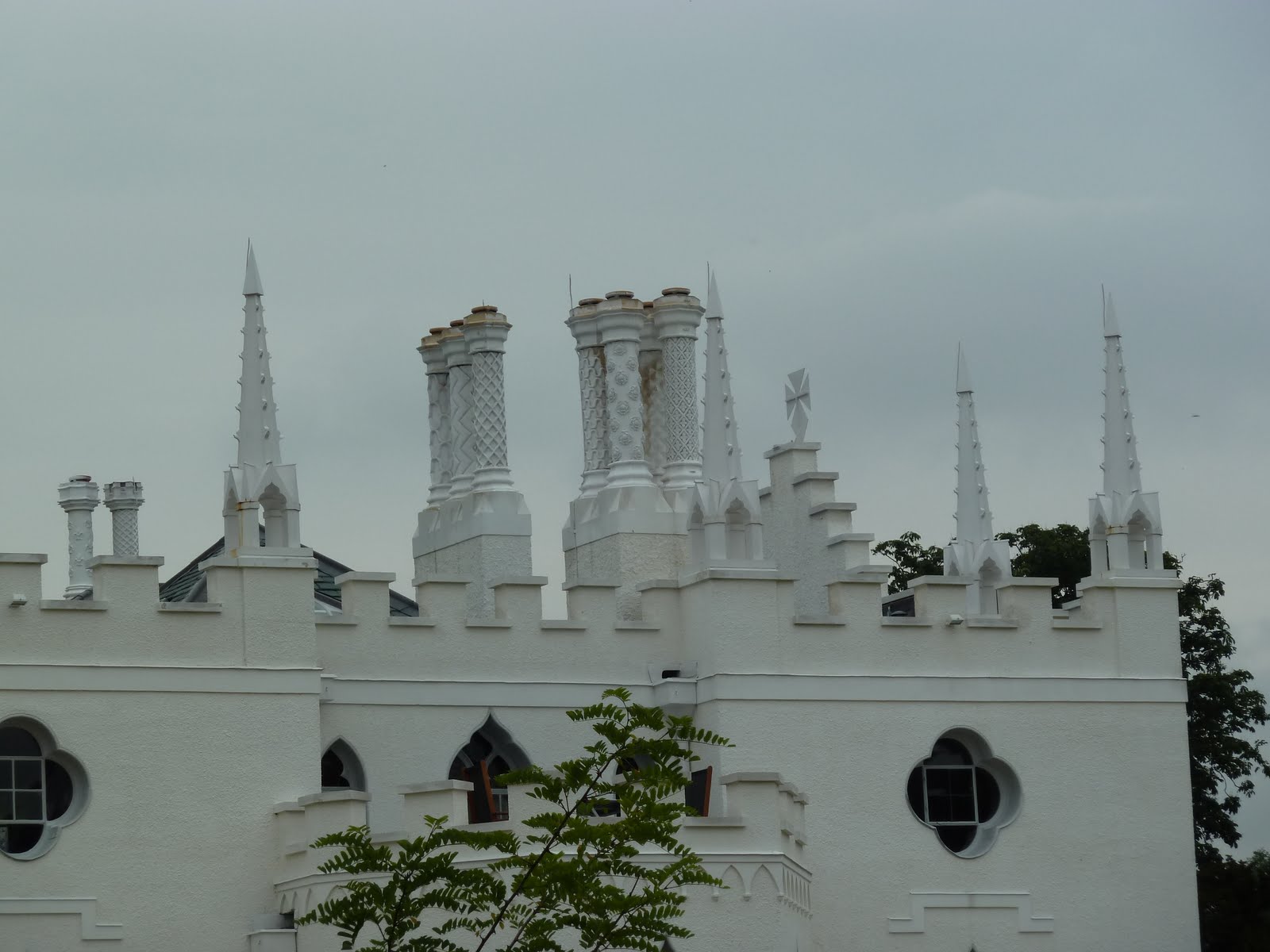
Finally, a few shots of the exterior. The garden is being re-developed, and it has a way to go. The white canvas at the lower right was part of a tent used for a party the previous evening and in the process of removal.
The roof.
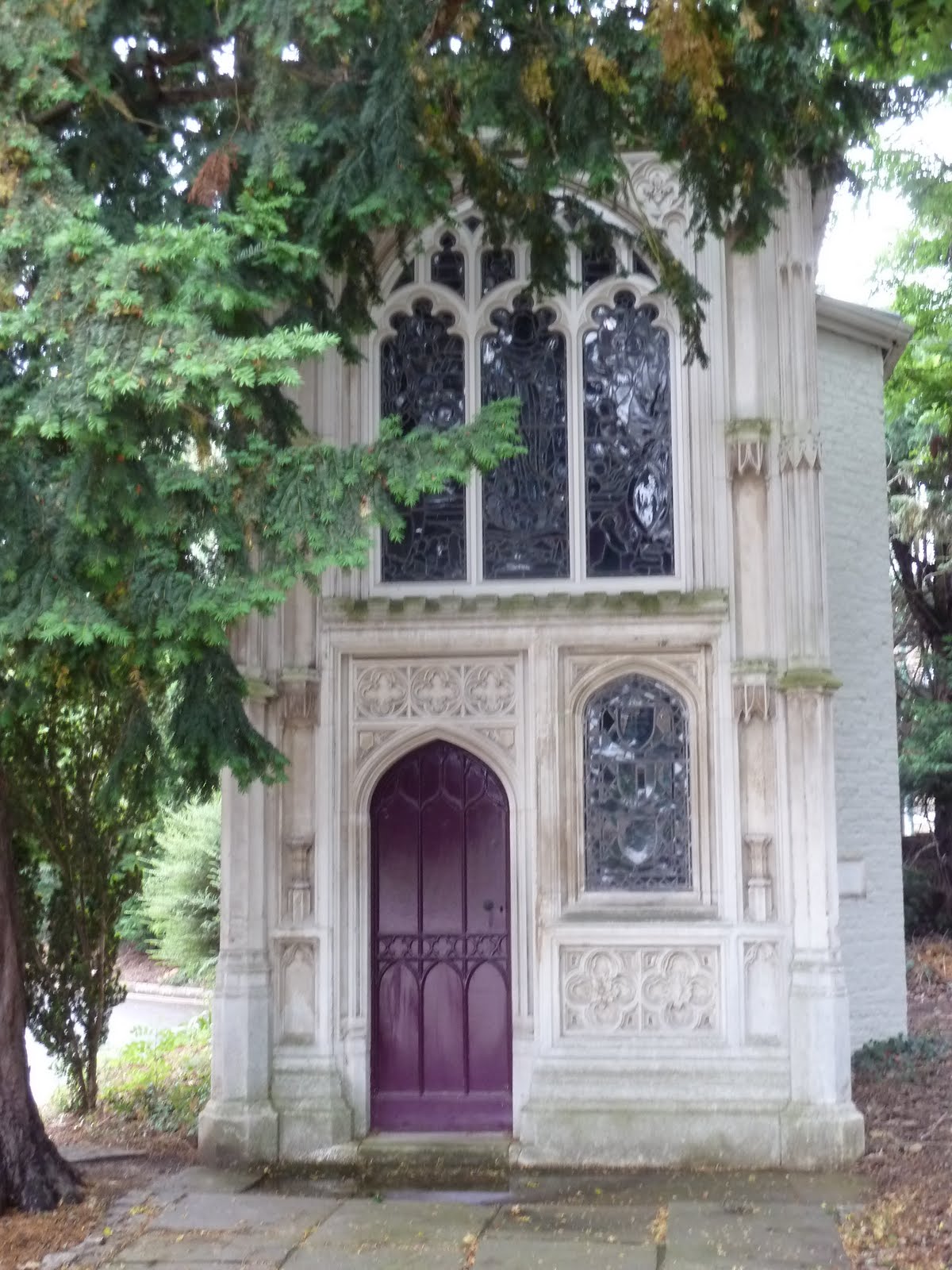
We searched for a while before a kind St. Mary’s faculty member directed us to the chapel, now hidden beyond a car park. The design is based on the tomb of Edmund Audley, bishop of Salisbury in the Cathedral there.
For more posts on Horace Walpole, see our blogs of 4/20/10, 4/7/11, 5/11/11, 5/28/11, 6/8/11, and 6/19/11.
For Sale: Period Perfection in Bath
It is time once again to share with you yet another period property of perfection. Read on and weep. I know I’m sobbing as I write this. Sigh.
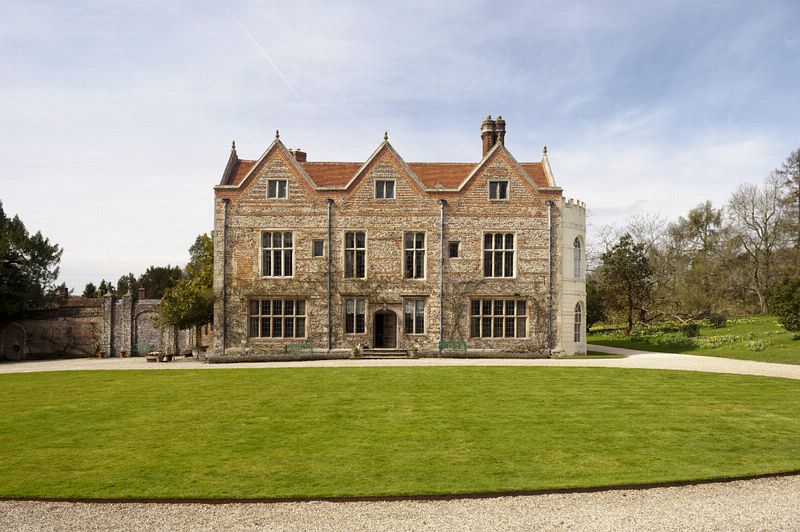
Set amid an idyllic valley just minutes from the heart of Bath, Widcombe Manor is an enchanting and historic residence. It is also a comfortable and peaceful family home. Constructed of Bath stone, it is a Grade I listed building, and regarded as one of the finest examples of Georgian architecture in the South West. The estate and house are immersed in history. Early records have it built on the site of a grange for the abbots of Bath. On the dissolution of the monasteries, the estate was owned by Richard Chapman, a rich clothier and Mayor of Bath. The original house was built in 1656, and was most likely to have been designed by Inigo Jones(sob). It was remodelled in 1727 for Chapman’s grandson, Philip Bennet, and the crest of the Bennet family still sits atop two pedestals at the magnificent entrance gates. Famous visitors include Henry Fielding, who wrote his classic novel Tom Jones while staying here, and, in more recent times, A-list celebrities and party-goers such as Cecil Beaton, Princess Margaret and Lord Snowdon. Today, it’s a comfortable retreat in a fascinating and historic city. (Aaarrgghhhh!)
Period Features
Widcombe Manor is the finest Georgian home in Bath, and the attention to detail is second to none. The Georgian facade, with its elaborate and highly decorative stonework, is a breathtaking sight and is complemented perfectly by a bronze 15th Century Venetian-style fountain. The interior has been sensitively refurbished in recent years and retains historical features, such as an Elizabethan mahogany staircase and ornate cornices (sniff, snuffle, sniff). Panelling, oak flooring and elegant statuary are featured through the house to create the feel of an elegant yet welcoming country home that is ideal for entertaining, as well as family life. Modern touches, such as an internal water garden, create a delightful design statement.
Spacious Living – The Ground Floor
This unique residence offers the flexibility to combine family life with business enterprise. The beautiful and spacious panelled hallway leads to a number of rooms including a library with leather flooring (be still my heart!) and a spacious study/office. The large, comfortable family sitting room has a bay window which offers superb views over the landscaped gardens and woodland of surrounding Lyncombe Vale. The kitchen and breakfast room are ideal for informal entertaining and large French windows open to the sun terrace and outdoor dining area. For more formal occasions, the dining room is an intimate and atmospheric space to welcome guests. The basement has been sensitively renovated to provide a large open games room as well as a wine cellar. A further play area overlooks a courtyard which was added by the current owners and built in Bath stone with an elegant fountain. There is parking for three cars in the garage, and a utility room and plant room complete the ground floor. A staff cottage is situated close to the house and has a living room, kitchen, bedroom and bathroom. (I’m completely out of Kleenex!)
Beautiful Views – The Upper Floors
Widcombe Manor has been designed so that owners can enjoy views of its exquisite grounds from all the main reception rooms. The views are particularly superb from the magnificent drawing room, situated on the first floor, which overlooks the lakes and cascade. Decorated in tones that echo the Georgian elegance of Bath’s Assembly Rooms, the room also features elegant touches such as gilt cornicing, bay windows and a painted ceiling. South-facing, it offers views over all nine acres of the estate and the vale beyond. It is the perfect place to enjoy the everchanging colours of the seasons in the surrounding mature woodland and formal terraces. Most of the main reception rooms are south-facing over the estate and the Bath stone is particularly beautiful when bathed in gentle sunlight at dawn and dusk. The panelled landing is an elegant feature and affords views over the Venetian fountain, as does the second floor office, which has a beautiful oval window. (Howl!)
Comfort and Style – The Bedroom Suites
Widcombe Manor is a home that represents the perfect marriage of grandeur and comfort, and nowhere is that more evident than in its three exquisite bedroom suites. These spacious and beautifully designed rooms are ideal for guests or family living. The master bedroom is a light, airy room which offers beautiful views over the woodland and gardens. This leads on to a dressing area and Grecian-themed marble bathroom. A further delightful guest suite overlooks the courtyard and fountain to the front of the house, and has a large en suite bathroom with roll-top bath. Decorated in subtle tones, with delightful dressings, furnishing and cream panelling, this is a relaxing retreat.
The manor has a further guest bedroom on the first floor which overlooks the gardens and has a stylish en suite bathroom. On the second floor there are three more bedrooms and two bathrooms, which are ideal family rooms. (You can all come to stay!). Tucked away in the eaves of the house, they are characterful and intimate, yet offer the spaciousness required for family living.
Modern Luxury – The Pavilion
Amid the Georgian splendour of this residence, the modernist garden Pavilion provides an exciting departure in terms of design, and was influenced by the Mies van der Rohe-designed Barcelona Pavilion. Situated to the east of the residence, it is a large, light-filled space with kitchen and dining area, and an informal living room. Its huge glass doors slide back to reveal breathtaking views of the woodland and lakes, creating a sense of being at one with the natural world. A large heated infinity pool reflects the tones of woodland surrounding the Pavilion and offers fabulous views over the vale and gardens. A grass ‘staircase’ leads down from this perfect suntrap to the terraces and more formal areas (stop! You’re killing me!). In perfect contrast is the Georgian Summerhouse, a delightful and spacious garden room built in Bath stone. Situated along a long walk, with wellstocked herbaceous borders, it provides a formal and elegant focal point amid the terraces close to the house. It is also spacious enough to be
the ideal place to serve tea on a hot, sunny day. (Can this pile posssibly be more appealing?!)
Exquisite landscapes – Garden and Grounds
Widcombe Manor’s nine-acre gardens are a central attraction in this enchanting retreat. Terraced and landscaped in the 18th Century they were developed into their current form in the 1930s, with some further redevelopment in the 1990s, and include lakes, a cascade (wanted: one hermit for live in position), formal gardens, a croquet lawn and tennis court. The Italianate gardens near the house provide a suitably formal and architectural extension of the Georgian splendour of the house. Elegant topiary, statues, fountains and immaculate lawns are complemented by architectural plants as well as well-established perennials. The formality gives way to a vale which leads down to the lakes and cascade. Mature woodland provides perfect privacy and an everchanging panoply of colour and interest throughout the seasons. A children’s play area and a bountiful cutting garden are other features that enhance the estate’s attraction, and a boules court is another delightful addition from the current owners.
The soothing sounds of natural, flowing water from the waterfall enhance the sense of rural tranquillity in a residence that is just minutes from the many cultural attractions of Bath. (Oh, the humanity!)
Offered for sale by Savills Bath – offers in excess of £10,000,000
Reader, I am spent.