From Famous Racing Men by Willmott-Dixon Thormanby (1882):
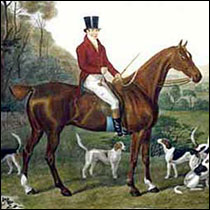
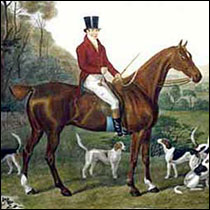
The incidents of Mytton’s romantic and eventful life have been narrated with tolerable fidelity but questionable taste by his friend, C. J. Apperley (the famous “Nimrod”) . . . . John Mytton was born on the 30th of September, 1796, at the family seat of Halston, in Shropshire, three miles from Oswestry, and was left fatherless at two years of age. His mother spoiled him, and by the time he was ten years of age the young heir was what is called a regular pickle. He was expelled from Westminster and Harrow in succession. At the former school he spent £800 a-year, exactly double his allowance, and wrote, when he was only fourteen years of age, to Lord Eldon, the then Lord Chancellor, requesting an increase of income, as he was going to be married. The Lord Chancellor replied—” Sir, if you cannot live on your income you may starve, and if you marry I will commit you to prison.” At the age of nineteen he entered, as a cornet, the 7th Hussars, and joined that regiment in France with the army of occupation. But as there was no more fighting, Cornet Mytton was at leisure to enter into all kinds of youthful mischief. One of his feats was borrowing £3,000 of a banker at St. Omer one day and losing half of it at an E. 0. table in Calais the next.
John Scott, 1st Lord Eldon
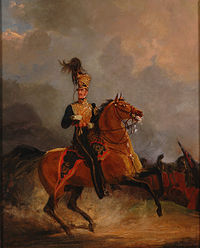
He also lost 16,000 napoleons to a certain captain at billiards, which sum he was unable to pay at the moment. But this score was wiped off in a more agreeable manner. The colonel of Mytton’s regiment, the then Earl of Uxbridge, forbade his paying the money, and the captain in question was afterwards implicated in a transaction which went far to prove that Lord Uxbridge was morally right. When Mytton came of age he found himself possessed of an estate of about £10,000 a-year and £60,000 of accumulated cash, but a large portion of the latter had to go towards liquidating his already numerous debts. Quitting the army, he married, at the age of twenty-three, Harriet, the eldest daughter of the then lately deceased Sir Tyrrwhitt Jones, Bart., of Stanley Hall, Shropshire. The bridegroom was attended by the Earl of Uxbridge and the Earl of Denbigh, K.G., and the wedding was one of the events of the season. The issue of their union was only one daughter. Mrs. Mytton died a few years after her marriage, and there can be no doubt that her death was accelerated, if not actually caused, by her husband’s insane conduct and cruel neglect.
Henry Paget, Lord Uxbridge
John Mytton was physically a fine animal: in height about 5ft. 9in., in weight 12st., with magnificent shoulders, a splendid chest, and an arm the biceps muscle of which was larger than that of Jackson’s, the celebrated pugilist, who was believed to be the most powerful man of his time in England. He was fond of displaying his strength, but it was perhaps fortunate that he steadily refused to learn boxing.
In dress Mytton was peculiar, not to say eccentric. He never wore any but the thinnest and finest silk stockings, with very thin boots or shoes, so that in winter he very rarely had dry feet. To flannel he was a stranger from the time he left off petticoats. Even his hunting-breeches were without lining; he wore one small waistcoat, always open in the front from the second of the lower buttons, and about home he was as often without a hat as with one. His winter shooting gear was a light jacket, white linen trousers without lining or drawers; and in frost and snow he waded through all water that came in his way. These, however, are not exceptional marks of hardihood, we know men of the present day who go as lightly clad through all the seasons. But Mytton went further than this. He would sometimes strip to his shirt to follow wildfowl in hard weather, and once actually laid himself down in the snow with absolutely not a stitch on him but his shirt to await the arrival of the ducks at dusk.
Curiously enough, extravagant though he was in other respects, Mr. Mytton made no great show in his establishment at Halston. There was every comfort but no display, and had he conducted all his affairs with the same regularity and simplicity as his menage at his ancestral seat he would never have run through upwards of half-amillion of money in less than fifteen years as he did. But it was not difficult to find where the screw was loose in his expenditure. His foxhounds were kept by himself and upon a very extensive scale, with the additional expenses of hunting two countries. His racing establishment was on a still larger scale, for he often had from fifteen to twenty horses in training at the same time, and seldom less than eight. His average number, indeed, of thoroughbred stock at home and from home, including brood mares and yearlings, was about thirty-six, which probably cost him something like £6,000 a-year. His game preserves, too, were a severe drain upon his income; for besides such items as £1,500 in one bill to a London dealer for pheasants and foxes alone, there was the formation of miles of plantations which this game went in part to stock, and which he employed a staff of fifty labourers to keep in order. He was a great friend, too, to the tailors, having frequently in his wardrobes as many as a hundred and fifty pairs of breeches and trousers, with a proportionate number of coats and waistcoats. In his cellars there were “hogsheads of ale, standing like soldiers in close column, and wine enough in wood and bottle for a Roman emperor.” He made his own malt, and “John Mytton, Licensed Maltster,” was painted in large letters over the malt house door. How much he spent on post horses it is impossible to guess; but almost every post boy in England knew “Squire Mytton” and lamented his fall. He never stayed at an inn without giving the waiter a guinea, and he would never pay a tradesman’s bill until he had received a writ. A strange unaccountable creature he was, who though always making a great pretence of
“enjoying life,” seems really never to have derived enjoyment from anything.
A summary of Mr. Mytton’s actual racing career may be comprised in a few words. He had too many horses in the first place, and too many of them not good enough to pay their way. It isevident he was anxious to have good ones from the prices he paid; but he bought several of that sort after their day had gone by; for example, Comte d’Artois, Banker, Longwaist, &c. He had, however, several good winners, old Euphrates at their head, and Whittington, Oswestry and Halston were esteemed very “smart” horses in the racing world. Indeed, it is believed that in some hands they would have proved trump cards. As for himself as a racing man he was too severe upon his horses: they rarely came out fresh after Chester and one or two other places. He seldom backed his horses to any serious amount, generally not at all. His stables were upon Delamere Forest, in Cheshire; his home-stud groom, Tinkler, was a careful nurser of young racing stock, but do what he would, Mr. Mytton was never able to breed a good racehorse.
It would be out of place to discuss here Mr. Mytton’s conduct towards his wives, of whom the second fared no better than the first. His brutality was inexcusable, and the most charitable supposition is that it was the result of a morbid insanity. For the last twelve years of his life it may safely be stated that he was never sober. His daily quantum of port wine was from four to six bottles; but even in spite of this excess he would probably have lived far longer than he did had he not in an evil hour discarded port for brandy. Even his adamantine constitution, “perhaps the hardiest ever bestowed upon man,” as ” Nimrod” says, was not proof against that. He went from bad to worse, till in the year 1830 the world heard without surprise that “it was all up with Jack Mytton.” Everything that could be sold was sold, and he retired to Calais with just a small pittance sufficient to keep body and soul together. There he completed the wreck of his magnificent physique by drinking brandy till he really was a raving lunatic. On partially recovering his senses, he came over to England, when he was arrested and thrown into the King’s Bench Prison, beyond the gates of which he was destined never to pass alive. For there he died in misery and squalor in the thirtyeighth year of his age. And so ended the mournfullest, the maddest, the most utterly wasted career of which the annals of the turf contain any record.
John `Mad Jack’ Mytton was born in 1796, the son of a Shropshire squire. Though he had a rather typical upbringing, John Mytton seems to have gone out of his way in order to earn the name “Mad Jack.” He drank several bottle of port each morning to “forestall the bad effect of the night air” and was also known to drink eau de cologne when nothing else was to hand. He drove his four horse gig recklessly, often stripped bare whilst fox hunting and arrived at one dinner party on a bear and dressed as a highwayman to hold up his guests as they left his house on their ways home. He is reputed to have kept 2,000 dogs and more than 60 finely-costumed cats, but Jack’s specialty seems to have been horses – A favourite horse ‘Baronet’ had full and free range inside Halston Hall, and would lie in front of the fire with Jack. And, he is said to have ridden his horse into the Bedford Hotel, up the grand staircase and onto the balcony, from which he jumped, still seated on his horse, over the diners in the restaurant below, and out through the window onto the Parade.
Once, he set fire to himself once in order to cure his hiccups. He survived, inherited Hallston Hall estate and a fortune worth about £500,000 a year by today’s standards, but ended his life at the age of thirty-seven in the King’s Bench debtor’s prison in Southwark.
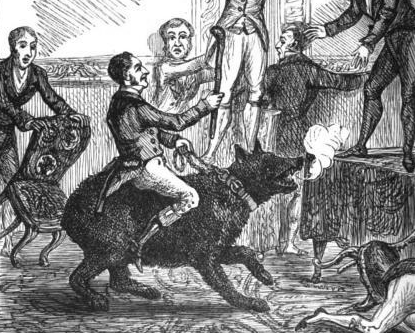
John ‘Mad Jack’ Mytton ‘invested’ £10,000 to become MP for Shrewsbury, handing out ten pound notes in order to buy votes, but spent less that half an hour in the House of Commons. Madcap pranks made Mytton a legend in his own lifetime. A drunken friend was put to bed with two bulldogs and a bear. Mytton went duck shooting by moonlight on Halston’s frozen lake, dressed in only his nightshirt. Disguised as a highwayman, complete with his blazing pistols, he ambushed departing guests on the Oswestry road. One biographer relates further details regarding the bear incident, adding that Mytton rode the bear into his drawing room in full hunting costume. “The bear carried him very quietly for a time; but on being pricked by the spur he bit his rider through the calf of his leg.” ‘Mad Jack’ lost his money, but not his friends. Three thousand people attended his funeral. He is buried in the Chapel at Halston.”
Buried at Halston he may be, but the Mytton & Mermaid Hotel at Atcham is not only named for Mad Jack, but claims to be home to his ghost, which is reputed to appear each year on September 30, Mad Jack’s birthday. His funeral procession stopped at the Mytton, then a coaching inn, on the way to Halston Chapel. Fittingly, the Jack Mytton Way was opened in 1993 and covers 100 miles of spectacular Shropshire countryside. It is one of the longest bridleways in the country and is used by horse riders, cyclists and walkers, none of whom, we presume, have a penchant for leaping from balconies.
More anecdotes of Mad Jack’s life from Famous Racing Men by Willmott-Dixon Thormanby coming soon.
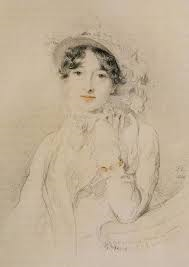
Catherine (Kitty) Pakenham married Arthur Wellesley on 10 April, 1806. To say that their marriage was not a happy one would be an understatement. For anyone who is unfamiliar with the story, you can read Kitty’s biography and gain some insight into the relationship between the Duke and Duchess on Wikipedia. Wellington moved in circles that were not unfamiliar to Kitty, yet she never fit in and, more importantly, never made the slightest effort to do so. None of Wellington’s friends became her friends, which is stranger still, as the Duke had several ladies in his circle who could have been an asset to Kitty, both personally and politically. In this post, we’ll be gaining insight into what Kitty’s contemporaries thought about her via their letters and diary journals.
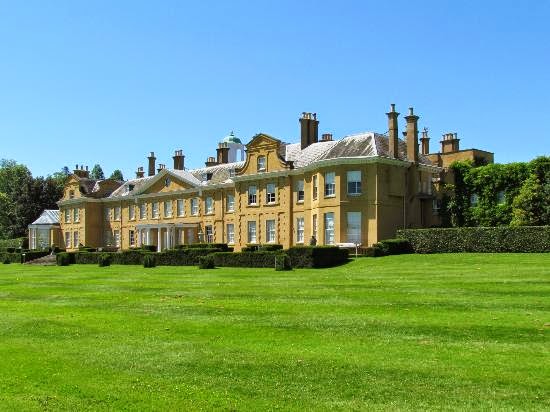
From Princess Lieven (below) to Metternich, March 1, 1820 – I have been obliged to promise the Duke of Wellington to visit him in the country (Stratfield Saye, above) tomorrow. You have no idea how much it bores me and puts me out. He has unfortunately taken it into his head that his house is the most comfortable in the world. Well, there are two very definite drawbacks to that comfort. It is always cold there, and his wife is stupid. What’s to be done?
Mrs. Arbuthnot, October 27, 1825 – . . . I think the Duke’s unfortunate marriage has pursued him even in his relations with his children. He dreads their inheriting her narrow mind and he says, instead of directing them to useful pursuits or uging them to read or to occupy their time, she is continually seeking out for them the most trivial and childish amusements. She certainly is the silliest woman I have ever met with, and I must own I think she now does not appear to have the slightest desire to please him. She does not comply with any of his fancies in the arrangement of his house, and in truth it is so bad a menage it is quite disagreeable to be in the house. It is hopeless, too; if she had good sense all would now be right, for what he now wants is a comfortable home, but she is totally unfit for her situation. She is like the housekeeper and dresses herself exactly like a shepherdess, with an old hat made by herself stuck at the back of her head, and a dirty basket under her arm. The Duke says he is sure she is mad.
Lady Shelley – The Duchess of Wellington “sat apart from her guests, dressed, even in winter, in white muslin, without any ornaments, when everyone else was in full dress . . . She seldom spoke, but looked through her eyeglass lovingly upon the Duke, who sat opposite to her.”
Mrs. Arbuthnot – February 16, 1830 . . . . . He (the Duke) is entirely occupied and engrossed with public matters, cannot look after his private affairs and there is no one who can do it for him, for his wife has not sense enough and rather encourages his servants and people to cheat him. Not that she is extravagant in herself for she is generally dressed like a beggar, but from mere folly.
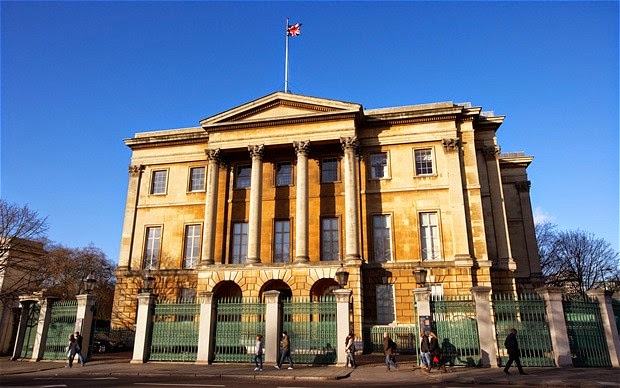
Kitty’s health began to fail and she became seriously ill in 1831, when she was confined to her bed at Apsley House (above), where the Duke of Wellington kept vigil at her bedside. At one point, Kitty ran a finger up his sleeve to find if he was still wearing an amulet she had once given him, “She found it, as she would have at any time these past twenty years, had she cared to look for it” remarked Wellington.
Kitty was visited by friends such as Maria Edgeworth and lingered for some time before passing away on 24 April. In a bittersweet twist, it appears that the Duke and Duchess of Wellington finally had a meeting of minds at the end, for Wellington afterwards remarked, “How strange it was that people could live together for half a lifetime and only understand each other at the end.”
Sadder still, within the Duke’s circle, Kitty’s death was merely mentioned as an afterthought:
Mrs. Arbuthnot – June 18, 1831 – . . . . I have omitted to mention the death of the Dss of Wellington, which happened on the 24th of April. She had been ill very long and without any hope of recovery, so that it was a relief at last. She died in London and was buried at Stratfield Saye.
Join us as we visit Apsley House on Number One London’s upcoming tours.
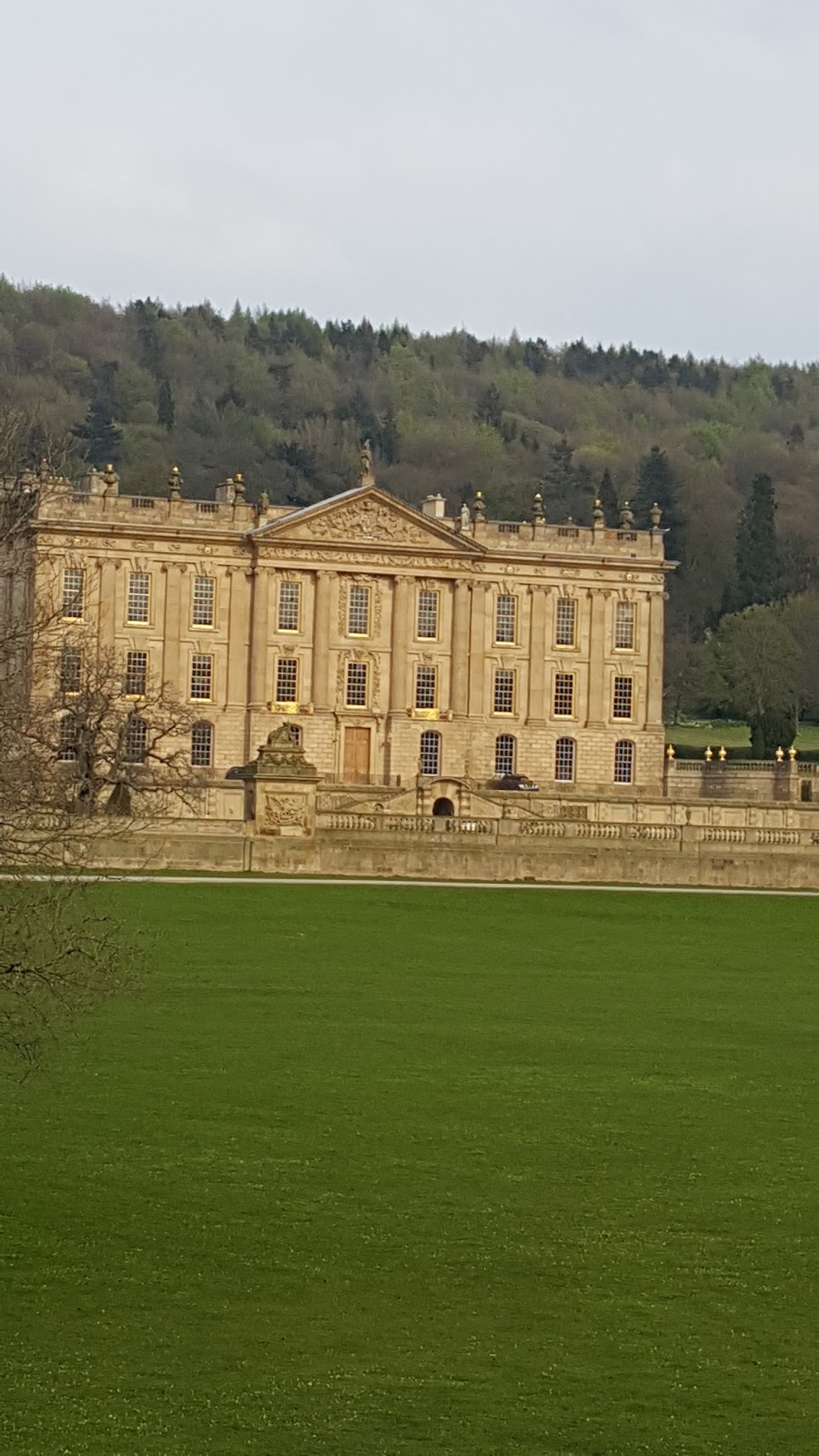
We’ll be returning to Chatsworth House and visiting five more of Britian’s finest stately homes on our May 2021 Country House Tour – we hope you’ll consider joining us!
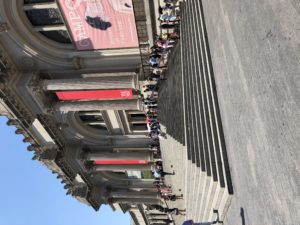
Just before closing for the covid 19 pandemic, New York City’s Metropolitan Museum of Art reopened the British Galleries after a total reinstallation. When was last in NYC, I was disappointed not to visit favorite spots such as the Lansdowne House Dining Room, removed from the London structure and brought to the Met many years ago. But now that room and many other treasures have been restored, reinstalled, and reinterpreted.
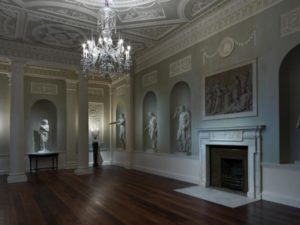
The Lansdowne House Dining Room
I have not visited the new Galleries (the Met is scheduled to reopen in late August), but they have received widespread comments from art and cultural sources, enough to give us a pretty good idea of the new approaches.
19th Century Gallery
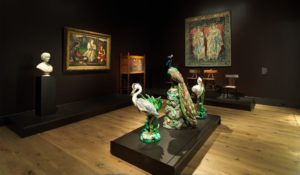
From the Met’s press release last March, 2020: ‘The Metropolitan Museum of Art’s $22m reinstallation of its British galleries opens to the public on Monday with a stirring narrative on the anxious commercial striving that shaped the British decorative arts from 1500 to 1900. Featuring nearly 700 works in 10 rooms spanning 11,000 sq. ft, the galleries tell a warts-and-all story of empire in which dark elements like the slave trade emerge and cataclysmic events like the Great Fire of London in 1666 serve as dramatic punctuation points. Nearly a third of the works on view have been newly acquired, with a preponderance of those recent purchases in the 19th-century section.’
19th Century Gallery
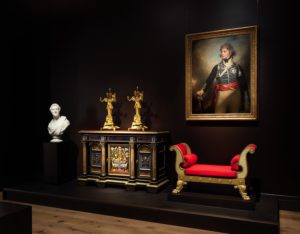
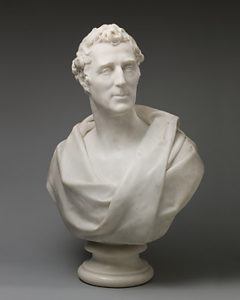
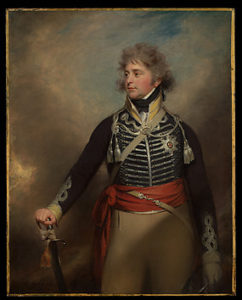
In the above picture, a bust by Sir Francis Chantrey (1781-1841) of Arthur Wellesley, lst Duke of Wellington (1769-1852), is at the left and below. At right and below is a portrait of George (1762-1830), Prince of Wales, later George IV, by Sir William Beechey (1753-1839). Beneath the portrait is a red bench by Thomas Hope (1769-1831), before 1807.
Duke of Wellington, marble, 1823George IV
Other than these familiar objects, the installation is very different than past representations of British Art. Again, quoting the Met’s press release: ‘The Met’s British collection is the largest of its kind in the US. The opening, part of the Met’s 150th anniversary celebrations, crowns a seven-year effort that began with the notion that “these galleries needed some attention and refreshment,” says Wolf Burchard, the Met’s associate curator of British furniture and decorative arts. “The previous galleries were all about the individual objects in historic interiors, and there was no thread that went through it,” he explains. “The new galleries are all about the cross section between creativity and entrepreneurialism.”’
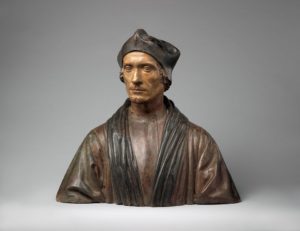
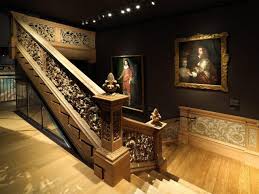
Pietro Torrigiano’s bust of Bishop John Fisher (1510-1515) Courtesy of Metropolitan Museum of ArtThe newly conserved pine and elm staircase from Cassiobury Park, Herfordshire (around 1677-80) in the Metropolitan Museum of Art ‘s new British galleries Photo by Joseph Coscia, February 2020/Courtesy of the Metropolitan Museum of Art
The Met continues: ‘The first gallery, clad in paneling made for the merchant trader William Crowe, opens from the museum’s medieval sculpture hall, vaulting the viewer into the 16th-century Renaissance era. A wall text emphasizes how the House of Tudor competed to match the artistic splendors of papal Rome, the French courts and the Germanic centers of Hapsburg power, and how a new class of professionals with luxury appetites arose under the stable reign of Elizabeth I amid an expansion of global trade. Surveying the gallery from its perch is a polychrome terra cotta bust that is thought to depict Bishop John Fisher, who was executed for opposing Henry VIII’s decision to lead the Church of England away from Roman Catholicism and papal authority. Leading to a mezzanine is another highlight, the magnificently ornamented and newly conserved pine and elm staircase from Cassiobury Park, Herfordshire (around 1677-80), with its naturalistic acanthus leaves, acorns, birds and snakes.’
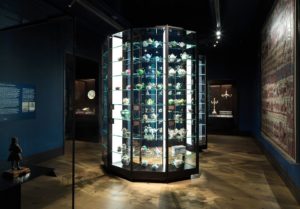
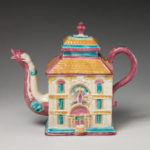
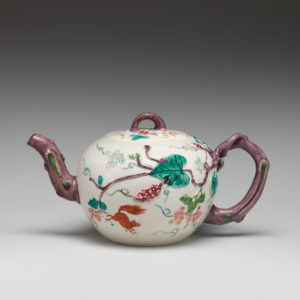
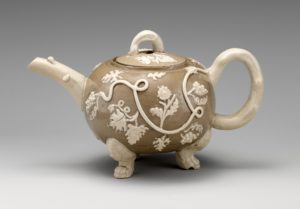
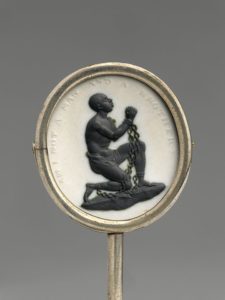
The Met continues: ‘A gallery titled “Tea, Trade and Empire” drives home how four commodities—tea, sugar, coffee, and cocoa—fuelled artistic innovation in Britain from the late 17th through the late 18th century. The museum has installed two towering semi-circular glass cases filled with a whimsical assortment of 100 teapots, underlining how that staple became a pivot point for social interaction in even modest British households and nurtured an enormous national ceramic industry. (The galleries are mindful not just of an aristocratic elite but of multiple layers of society.) At the same time, the 1789 title page of a slave’s memoir on the perimeter of the gallery alerts viewers to the exploitative nature of empire, with the trans-Atlantic slave trade rising in tandem with the spread of sugar plantations. “Much of the wealth of this period is built on the labor of enslaved Africans,” a wall text says simply.’
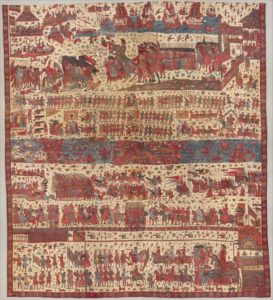
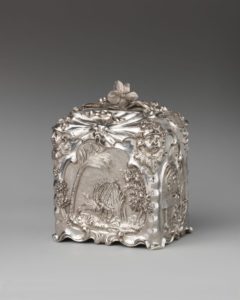
A gallery titled “Tea, Trade and Empire’ features two towering glass cases featuring 100 British teapots Photo by Joseph Coscia, February 2020/Courtesy of the Metropolitan Museum of Artteapot in the form of a house, ca. 1775; Salt-glazed stoneware with enamel decorationStaffordshire teapot, salt-glazed stoneware with enamel decoration, ca 1760Staffordshire Teapot, ca. 1750-60Hanging depicting a European conflict in South India, cotton, drawn & resist-dyedSugar Box, Silver, Ca. 1738, by Paul de LamerieJosiah Wedgwood, anti-slavery medallion, 1787
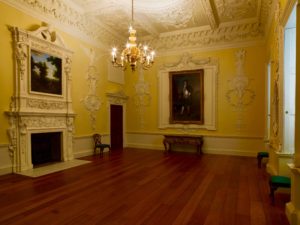
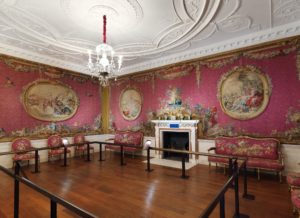
The Met continues: ‘Three galleries are devoted to the re-creation of striking 18th-century British interiors moved from Kirtlington Park (Oxfordshire), Croome Court (Worcestershire) and Lansdowne House (London). A wall text notes that the Lansdowne dining room, designed by Robert Adam and crowned by an intricately decorated ceiling, banished odor-absorbing textiles that would have retained “the smell of the victuals”.’
Kirtlington Park; photo by Richard LeeCroome Park room, after Robert Adam, 1763-71, photo by Joseph Coscia
Last year I was at the Met in July but I won’t make it this year. What a strange year 2020 is!
July, 2019, photo by Victoria HinshawView from the Met roof, July 2019, photo by VH