The Earl's Court Wheel

From Discoveries and Inventions of the 19th Century (1898) by Robert Routledge

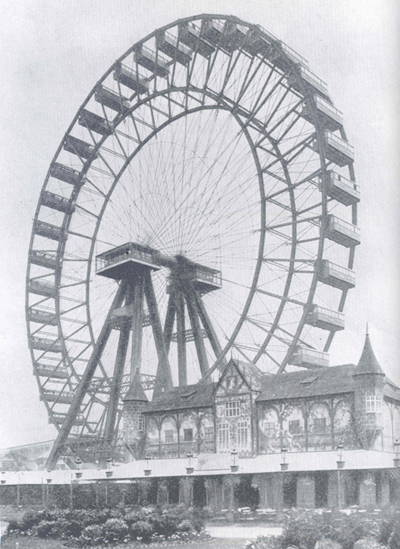
” . . . . . . amid the attractions of an International Exhibition, it was not lost upon the enterprising people of the States when the ” World’s Fair” at Chicago was in preparation in 1893. It was then that Mr. G. W. G. Ferris, the head of a firm of bridge constructors at Pittsburg, conceived the idea of applying his engineering skill to the erection of a huge wheel, revolving in a vertical plane, with cars for persons to sit in, constituting, in fact, an enormous “merry-go-round,” as the machine once so common at country fairs was called. The novelty of the Chicago erection was, therefore, not the general idea, but the magnitude of the scale, which, for that reason, involved the application of the highest engineering skill, and the solution of hitherto unattempted practical problems. Several thousand pounds were, in fact, expended on merely preliminary plans and designs. The great wheel at Chicago was 350 feet in diameter, and to its periphery were hung thirty-six carriages, each seating forty persons. At each revolution, therefore, 1,440 people would be raised in the air to the height of 250 feet, and from that elevation afforded a splendid prospect, besides an experience of the peculiar sensation like that of being in a balloon, when the spectator has no perception of his own motion, but the objects beneath appear to have the contrary movement, that is to say, they seem to be sinking when he is rising, and viceversd.

“This curious structure was not begun until March, 1893, yet it was set in motion three months afterwards, having cost about £62,500. The Company had to hand over to the Exhibition one half of the receipts after the big wheel had paid for its construction, but even then they realised a handsome profit, and at the close of the World’s Fair, they sold the machine for four-thirds of its cost, in order that it might be re-erected at Coney Island.

“No sooner had the great Ferris wheel at Chicago proved a financial success than an American gentleman, Lieutenant Graydon, secured a patent for a like machine in the Un1ted Kingdom; and as it has now become almost a matter of course that some iron or steel structure, surpassing everything before attempted, should form a part of each great exhibition, a Company was at once formed in London, under the title of “The Gigantic Wheel and Recreation Towers Co., Limited,” to construct and work at the Earl’s Court Oriental Exhibition of 1895, a great wheel, similar in general form to that of Chicago. But the design of the London wheel had some new features . . . and, moreover, having been planned of larger dimensions than its American prototype, presented additional engineering problems of no small complexity. After due deliberation the scheme of the work was entrusted to Mr. Walter B. Bassett, a talented young engineer, connected with the firm of Messrs. Maudslay, Sons, & Field, and already experienced in designing iron structures. Under this gentleman, with the assistance of Mr. J. J. Webster in carrying out some of the details, the work has been so successfully accomplished that the ” Great Wheel”- of 1895 may be cited as one of the crowning mechanical triumphs of the nineteenth century. . . .
“The wheel at Earl’s Court exceeds the Ferris wheel in diameter by 50 feet, being 300 feet across. It is supported on two towers, 175 feet high, each formed by four columns 4 feet square, built of steel plates with internal diaphragms, and surmounted by balconies that may be ascended in elevators raised by a weight of water, which, after having been discharged into a reservoir under the ground level, is again pumped up to the top of the towers. Between the balconies on each tower there is also a communication through the axle of the wheel, which, instead of being solid as at Chicago, is a tube of 7 feet diameter, and 35 feet long, made in sections, riveted together, of steel 1 inch thick, and weighing no less than 58 tons.”
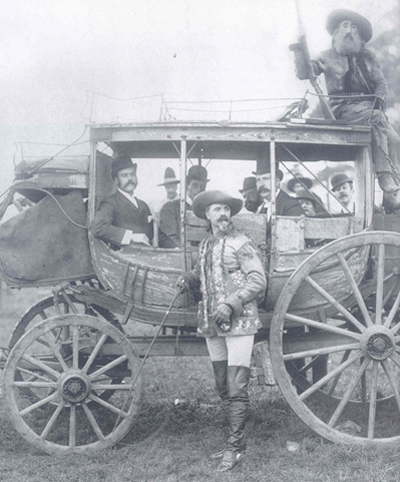
You can read much more about the history of Earl’s Court as an entertainment venue here. Other rides included a Water Chute and showman who appeared at the grounds included none other than Buffalo Bill, show below at Earl’s Court.

Sedan Chairs

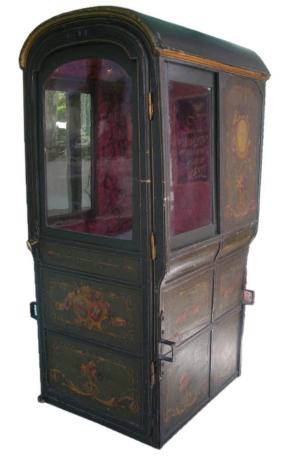
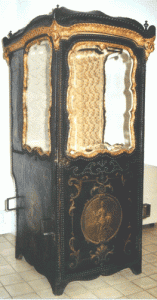
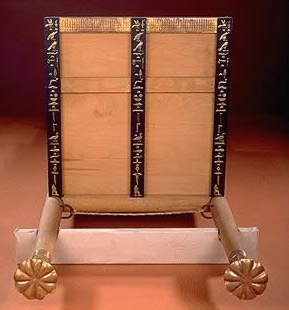
Sedan chairs, also called litters, are enclosed seats carried on poles that have been used for centuries, or at least as early as the Eyptian Empire. Sedan chairs were introduced to Britain from Spain – before leaving Madrid in 1623 to return to England, the Prince of Wales, later Charles I, was given a gift by the Prime Minister that included “three sedan chairs of curious workmanship.” He later gave two of these chairs to the Duke of Buckingham, who used them in the streets of London and prompted outrage for “reducing free born Englishmen to the condition of beasts of burden.”

Benjamin Franklin in his sedan chair
Sedan chair made for Queen Maria Luisa of Parma circa 1795

A late 18th century French sedan chair – click here to see the inside

By 1726 there were 400 sedan chairs registered in London. They were used in Edinburgh until the 1860’s.

Above is a modern day Chinese sedan chair, traditionally used to carry a bride to her wedding. There is also a foundation in Hong Kong that raises money through their Sedan Chair Charities Fund and annual sedan chair races. Come to that, there are even sedan chair races still going on in England.

You can see examples of sedan chairs in museums throughout Great Britain:


From the Ulster Folk and Transport Museum

From the Museum of Leathercraft

From the Victoria and Albert Museum

And coming full circle, the sedan chair of Queen Hetepheres from the Egyptian Museum, Cairo 

Captain Gronow on His School Friend Shelley

Rees Howell Gronow (1794-1865) wrote his Reminiscences late in his life.  He knew many leading figures of his era.  Below are his comments on Percy Bysshe Shelley (1792-1822), one of the most famous of the Romantic Era English Poets. 

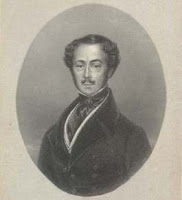
Rees Gronow
SHELLEY

Shelley, the poet, cut off at so early an age; just when his great poetical talents had been matured by study and reflection, and when he probably would have produced some great work, was my friend and associate at Eton. He was a boy of studious and meditative habits, averse to all games and sports, and a great reader of novels and romances.  He was a thin, slight lad, with remarkably lustrous eyes, fine hair, and a very peculiar shrill voice and laugh. His most intimate friend at Eton was a boy named Price, who was considered one of the best classical scholars amongst us.  At his tutor, Bethell’s, where he lodged, he attempted many mechanical and scientific experiments.  By the aid of a common tinker, he contrived to make something like a steam-engine, which, unfortunately, one day suddenly exploded; to the great consternation of the neighbourhood and to the imminent danger of a severe flogging from Dr. Reate.

Percy Byssche Shelley
Soon after leaving school, and about the year 1810, he came, in a state of great distress and difficulty, to Swansea, when we had an opportunity of rendering him a service; but we never could ascertain what had brought him to Wales, though we had reason to suppose it was some mysterious affaire du coeur.

 The last time I saw Shelley was at Genoa, in 1822, sitting on the sea-shore, and, when I came upon him, making a true poet’s meal of bread and fruit; He at once recognized me, jumped up, and appearing greatly delighted, exclaimed, “Here you see me at my old Eton habits; but instead of the green fields for a couch, I have here the shores of the Mediterranean. It is very grand, and very romantic.  I only wish I had some of the excellent brown bread and butter we used to get at Spiers’s: but I was never very fastidious in my diet.”  Then he continued, in a wild and eccentric manner: “Gronow, do you remember the beautiful Martha, the Hebe of Spiers’s?  She was the loveliest girl I

ever saw, and I loved her to distraction.”

 Shelley was looking careworn and ill; and, as usual, was very carelessly dressed.  He had on a large and wide straw hat, his long brown hair, already streaked with grey, flowing in large masses from under it, and presented a wild and strange appearance.

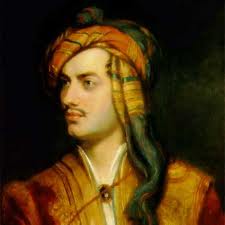
Lord Byron
During the time I sat by his side he asked many questions about myself and many of our schoolfellows; but on my questioning him in turn about himself, his way of life, and his future plans, he avoided entering into any explanation: indeed, he gave such short and evasive answers, that, thinking my inquisitiveness displeased him, I rose to take my leave.  I observed that I had not been lucky enough to see Lord Byron in any of my rambles, to which he replied, “Byron is living at his villa, surrounded by his court of sycophants; but I shall shortly see him at Leghorn.” We then shook hands.  I never saw him again; for he was drowned shortly afterwards, with his friend, Captain Williams, and his body was washed ashore near Via Reggio.  Every one is familiar with the romantic scene which took place on the sea-shore when the remains of my poor friend and Captain Williams were burnt, in the presence of Byron and Trelawney, in the Roman fashion. His ashes were gathered into an urn, and buried in the Protestant cemetery at Rome.  He was but twenty-nine years of age at his death.

The Funeral of Shelley

Notes from Victoria: This painting by Louis Edouard Fournier, completed in 1889 obviously long after the event, shows Edward Trelawney and Byron at the cremation of Shelley’s remains on the shore.  Also pictured are Mary Shelley, second wife of Percy, kneeling at the far left, and Leigh Hunt, though neither of them actually attended. One of several blue plaques honoring Shelley, the version below can be found at 15, Poland Street, WI, London, between Oxford Circus and Soho Square; Shelley resided here after he left Oxford.

A Look at The Look of Love

 A guest blog by Jo Manning

Jo Manning (with Lily)

The LOOK OF LOVE exhibit has opened in Birmingham, Alabama, at the Birmingham Museum of Art.  I was fortunate enough to be there for the opening and the first couple of days of the show, which runs until the end of June.  For museum information, click here.

Dr David  and Nan Skier
Before discussing this spectacular exhibit – the first of its kind in the world – and one that, with its accompanying catalog, sets the standard for research on this unique portrait miniature-cum-jewelry that has been, up until now, so little known in either the art or jewelry worlds, some backstory…
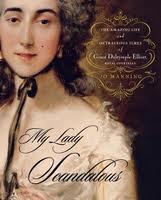
I often tell people that one never knows, after one’s book is published and sent out into the marketplace, who will see it, who will be affected by it, and what repercussions it will generate.  My biography of Grace Dalrymple Elliott, a notorious courtesan of the late 18th-early 19th centuries, was sold in bookstores and museum gift shops. 

At one of the latter, the Bass Museum of Art’s gift shop in Miami Beach, Florida, it was seen by Dr David Skier, an eye surgeon from Birmingham, who thought his wife would enjoy it. One of the things he noticed in the book was a sidebar on Lover’s Eyes — eye miniatures – with a photo of a ring in the “collection of the author”.

This was of great interest to Dr Skier because he and his wife Nan had quietly been collecting these beautiful objects for many years and had accumulated some 70+ of them. (They now own 100+ of these miniatures.)  Assuming that I had a collection of these objects, they wrote to my publisher Simon & Schuster, asking for my contact information.  The publisher referred them to my agent, Jenny Bent of the Bent Agency, and she contacted me.  I responded promptly with the news that, no, I owned just the one ring, and that I’d become interested in them after seeing the eye miniatures in the collection of my writing colleague Candice Hern, who owned several lovely brooches.  I was also entranced by the story of how they came about and their subsequent history.
 
The Skiers became friends, and when I was asked to contribute to the catalog for an exhibition of their collection called The Look of Love, I said I would be happy to do so, but that I did not in any way consider myself an expert on the subject.  No, they said, we’d like you to write some stories, vignettes, inspired by the eyes in their collection.  I thought this was a brilliant idea, frankly, because each of the eyes had a story – an unknown story for the most part, to be sure, as sitters and artists were mostly unidentified – and the eyes do speak to the viewer.  I gave my imagination full rein and wrote five stories for their consideration.  To my knowledge, this is another first; I know of no fiction in the catalogs of art shows. Essays on the art and history, yes, those are standard, but bits of fiction…nope!
 I have to confess that the stories came very easily, which does not always happen to a writer.  But the eyes drew me in, and I chose the most eloquent, in my opinion, and wrote away.  My goal was to illuminate how these objects of love and affection came about, what they meant in a society with mores quite unlike our own, who the artists might be and why they painted them, what the symbolism involved meant to people in that era, and, yes, the aura they held of clandestine love tokens was very appealing to me, as a writer of historical romance.
The stories are:  “Pippa and William”; “Ursula Engleheart Prepares Tea For Her Artist Husband George…”; “I Mourn Your Loss, My Beloved…”; “My Mother, Mariah Norcross”; and “The Grey Eye in Great-Aunt Lavinia’s Jewelry Box”.
 Pippa and William are star-crossed lovers (not to be confused with Pippa Middleton and Prince William J) who meet as children, fall in love, but cannot marry because of dynastic “rules” governing marriage; Ursula Engleheart is the story of a prolific painter of miniatures (an estimated 5,000 of them in his lifetime) who paints eyes for clandestine lovers but doesn’t sign them to avoid trouble with his patrons, their parents; I Mourn Your Loss tells a sad tale of two of the many young men who perished in the Napoleonic Wars and how all that remains of one of them is the lover’s eye he gave to his fiancée; My Mother, Mariah Norcross is another bereavement story that also illustrates the perils of epidemics in that Georgian era and its horrific costs to families; and, finally, the last story, of what was found in Great-Aunt Lavinia’s Jewelry Box by careless heirs, speculates on the possible unfortunate fate of many an eye miniature.
The exhibition, and the beautifully illustrated 208 page catalog – a proper coffee-table book! – have each garnered wonderful publicity.  The catalog will probably become a collector’s item as well as an important research source on the subject of eye miniatures; the essays by Dr. Graham Boettcher, the curator, and Elle Shushan, a dealer in portrait miniatures, are outstanding, detailed, and most readable.
Graham Boettcher
Elle Shushan
The exhibit is exquisite, mounted with extreme delicacy and care by the professionals at the Birmingham Museum of Art, and the oohs and ahhs of those visiting the jewel of a room in which it is housed brings joy to everyone who’s been involved in its creation and implementation, but most of all to Nan and Dr David Skier, who collected these gorgeous pieces that combine art/history/and jewelry in such a unique manner. Plans are underway to bring the exhibit to other cities; the catalog can be ordered through Amazon, where it has been Number One in its category – Art  and Antiques – for weeks. It can also be ordered from the English publisher
D Giles Ltd here.
Nan Skier talks about the collection here. Scroll down half a page for the presentation.

There are special events surrounding the Look of Love which can be found on the museum’s web site  here.

The coverage has been overwhelming: Take a look at the Vanity Fair web article, for example, here.
A beautiful article appears in Antiques & Fine Arts which requires an online FREE registration.  Here is the online site:  http://www.antiquesandfineart.com/
Many other articles area available on the internet and through the museum’s website.
A postscript:  One of the several delightful people I met – including dealers/art consultants/appraisers Reagan Upshaw, Michael Quick, and Sonja Weber (the book is dedicated to her late husband Barry Weber, who often appeared on Antiques Roadshow) — was Thomas Sully, a painter and direct descendant of the English-born American painter of the same name.

Tom Sully self-portrait miniature

Tom Sully paints portrait miniatures, amongst other painting genres and has lately begun to do eye miniatures. I asked him, “How do you do this? Isn’t elephant ivory  [which was used for most Georgian eye miniatures] endangered?”  He replied that the Russians are selling woolly mammoth – yes! woolly mammoth! – ivory and that is what he is using. Not endangered. Extinct. But not endangered.&
nbsp;
I saw some samples of his work and it is very fine, indeed.  Check him out   here.


And do consider commissioning a lover’s eye – or two – for yourself.

Best Exotic Marigold Hotel

Best Exotic Marigold Hotel, the movie, opens in the UK and Ireland 24 February. Those in the States will have to wait until summer to see the film, although the novel will be available in stores in March.

The movie, directed by John Madden, sees a group of retirement age Brits move to India to see out their elderly years in colorful Jaipur and take up residence in what they believe is a newly restored hotel. Less luxurious than its advertisements, the Marigold Hotel nevertheless slowly begins to charm in unexpected ways. Dev Patel, of “Slumdog Millionaire” fame, plays the guy who entices them to take the adventure and the film also features Dame Judi Dench, Dame Maggie Smith, Penelope Wilton and Bill Nighy.

Deborah Moggach is the author of sixteen successful novels, including the bestselling Tulip Fever, and two collections of stories. The book on which this film is based was originally titled These Foolish Things. Her screenplays include Pride and Prejudice, which was nominated for a BAFTA. She lives in North London.

You can watch the movie trailer here.