Swimming in August

Summer is ending for another year and soon Victoria will lament the closing of the Regency House swimming pool until next May. Sigh. Of course, I will be in Florida by mid January, ready for another pool — and the lovely beaches too. 

Sea Bathing became increasingly fashionable in the 18th century as doctors praised the beneficial effects of drinking sea water and bathing in the cold salt-water of the Channel, or the North or Irish Sea.

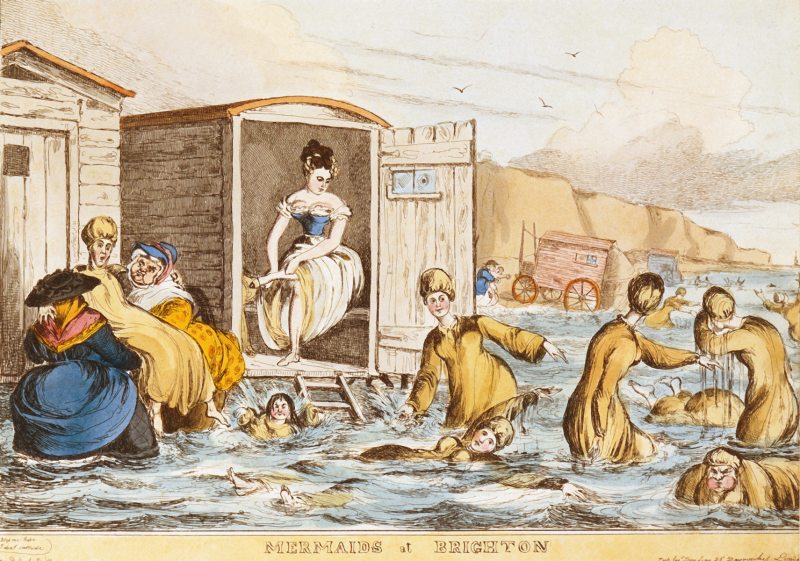
The print above, by William Heath (1795-1840), ca. 1829, depicts the Mermaids of Brighton near their bathing machines.  On the left two sturdy dippers, as the women who assisted the bathers were called, help a girl in a sort of loose garment like a shift (or a shroud???). Inside the wooden structure, another young lady begins to disrobe, while others cavort in the water.  How very different than the look below, the Italian swimming star in the London Olympics, Federica Pellegrini.

But apparently, not all sea bathers were clothed at all!  The caricature below by Thomas Rowlandson (1776-1827) is entitled Summer Amusement at Margate, or a Peep at the Mermaids and clearly shows a group of men oogling the nude bathers.

Even more revealing is Rowlandson’s Venus Bathing (Margate): A Fashionable Dip. Margate is in Kent.

And its companion engraving by Rowlandson, Sideway or any way, in which a crowd seems to have gathered at the top of the cliff to observe:

Most fashion plates from the early 19th century show ladies dressed quite properly indeed.  Below, From Ackermann’s Repository, 1809:

La Belle Assemblee chose this costume for sea bathing in 1815. Note the bathing machines in the background, lower right:

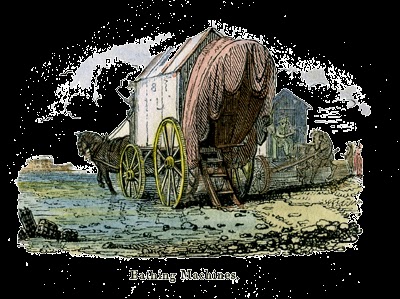
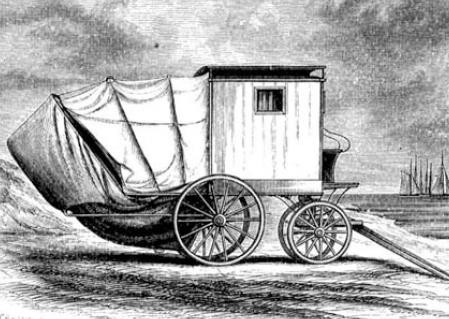
The Bathing Machines were built to various designs, but most had an enclosed room on high wheels in which one could dress and undress.  The vehicles were pulled out into the water by horses, donkeys or even humans.  Many had large canvas awnings which could be lowered for privacy.  The bather enters the water via steps and may be assisted by a helper, the dipper, as seen in the first engraving above.

Another Version
One of the dippers, Martha Gunn, became famous in Brighton, a favorite of the Prince of Wales, and became an advertisement for the resort itself.  Her portrayal below shows her importance as she wears the Prince’s three feathers on her hat.
Toby jug, Mrs. Gunn

In 1773, author Frances (Fanny) Burney (1753-1840) recorded her experience while sea bathing.

Fanny Burney by Edward Francis Burney, c. 1784
National Portrait Gallery, London

August 1773

“Ever since I went to Torbay, I have been tormented with a dreadful cold and very much advised to sea bathing in order to harden me…. I was terribly frightened, and really thought I should never have recovered from the plunge. I had not breath enough to speak for a minute or two, the shock was beyond expression; but after I got back to the [bathing] machine, I presently felt myself in a glow that was delightful – it is the finest feeling in the world, and will induce me to bathe as often as will be safe. “

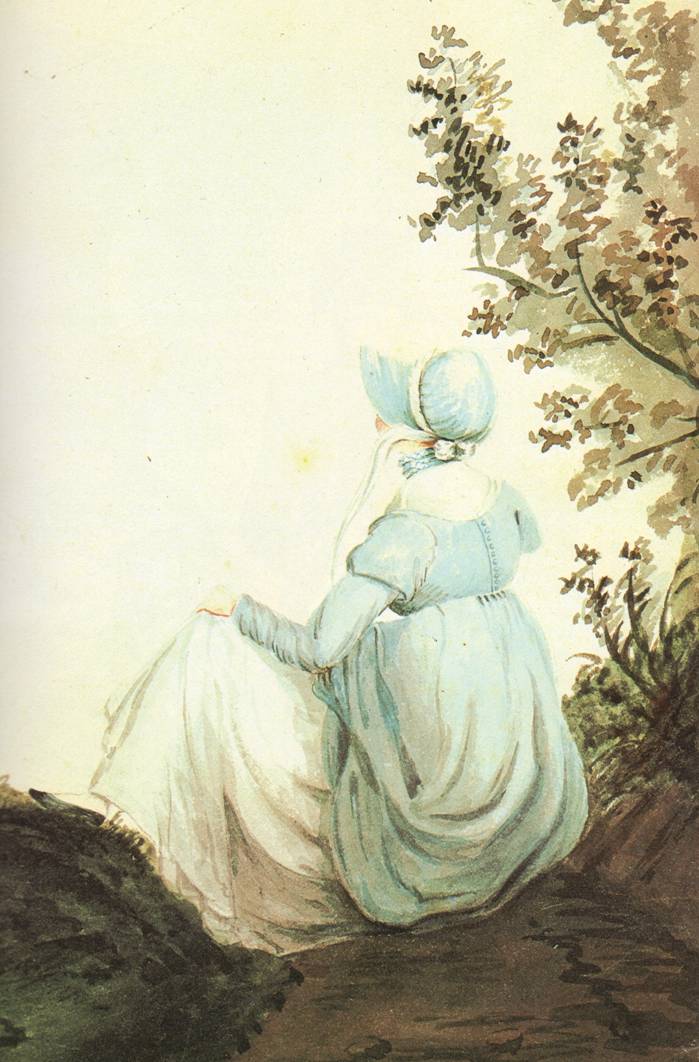
Jane Austen, watercolour by her sister Cassandra

Jane Austen too indulged in  sea bathing.  Her family often visited coastal resorts.  She wrote to Cassandra from Lyme:

Friday 14 September 1804
“…I continue quite well, in proof of which I have bathed again this morning.  It was absolutely necessary that I should have the little fever and indisposition, which I had;–it has been all the fashion this week in Lyme…”

That evening, she added, “…The Bathing was so delightful this morning and Molly so pressing with me to enjoy myself that I believe I staid in rather too long, as since the middle of the day I have felt unreasonably tired. I shall be more careful another time, and shall not bathe tomorrow, as I had before intended…

I think the former quote shows Jane Austen’s ironic wit, but her later remarks sound quite sincere!

I hope you have time, if you wish, for a few more dips in the sea or the pool this season.

The pool at Victoria’s Building
Dickens: Bicentenary of his birth

Charles Dickens (1812-1870), painted by Daniel Maclise (1806-1870)

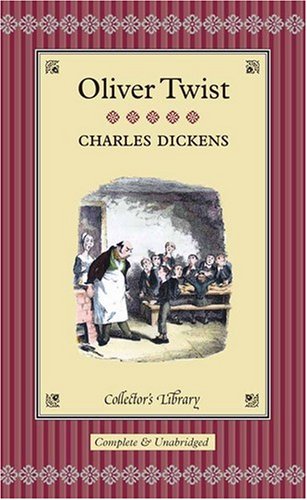
Victoria here, reporting on my latest encounters with a favorite author of mine, Charles Dickens.  My local PBS station is rerunning the presentation of Oliver Twist and Great Expectations they first showed last winter.  I hope you have a chance to see them too.

Oliver Twist, played by William Miller

The PBS website, here, has lots of details about the BBC-Masterpiece production of Oliver Twist, including a synopsis, cast information and a Dickens timeline.

You can buy this DVD, as well as many other classics here.

I have to admit I remember the story from several of the dozens of films and television series rather than from the book, which I probably read in high school.  There have been many stage versions as well, including the very popular London production of Oliver, the Musical in 1960.

The musical also ran on Broadway for a long time, and has been successfully revived in Britain and the U.S. several times.  The film version won the Academy Award for Best Picture in 1969.

I think the reason for the enduring popularity of the story is mainly attributable to the wonderful characters, the innocent young Oliver, the unforgettable Fagin, Artful Dodger, Nancy, and Bill Sikes — and the family that ultimately rescues Oliver and brings a happy ending.  As in all of Dickens, the details of the London scene are unmatched.

Personally, I prefer Oliver Twist to Great Expectations, probably because Miss Havisham meets such a tragic ending in the latter.  But nevertheless I will watch it. Again and again.  Like Oliver Twist’s, Pip’s story has been filmed many times, from silent movies to current miniseries, and has been adapted for stage as well.

One of the book groups I participate in is reading A Tale of Two Cities, another Dickens novel that has been often adapted. “It was the best of times; it was the worst of times” has to be one of the most famous opening lines in English literature. 

A Tale of Two Cities, published 1859
And to top off my Year of Dickens, I am reading Claire Tomalin’s biography Charles Dickens, published in 2011.  Like her previous biographies of Jane Austen, Samuel Pepys and others, this account is eminently readable.  She deals with complex personalities in a realistic and engaging way.

I hope you are having your own Dickens Year in 2012…if not, you still have time!

Rowland Hill's Hawkstone Hall For Sale

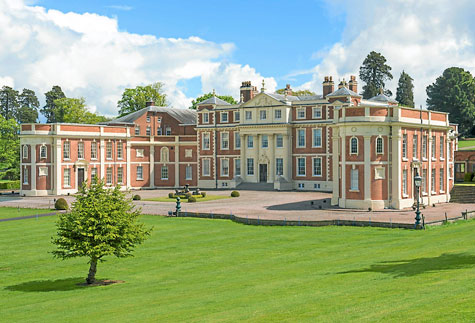
A historic mansion house in Shropshire has gone on the market for £5 million, and is looking for just its fourth new owner in more than 550 years. The 80-room Hawkstone Hall, in Marchamley, near Wem, is the former home of the Hill family – including Rowland Hill, who was the Duke of Wellington’s deputy at the Battle of Waterloo.
** Lord Rowland Hill was no relation to Sir Rowland Hill, inventor of the postage stamp.

Peter Duckers is the curator at the Shropshire Regimental Museum, based in Shrewsbury Castle. He is a great admirer of Lord Hill: “He was known as Daddy Hill to his men because he was one of the few generals who took a serious interest in the welfare of the men under him.”

At Waterloo, Lord Hill commanded the 2nd Army Corps which included the 2nd and 4th divisions: “There were some of the very finest of the British Army’s regiments in it, including veterans of the Peninsular War.

“He took part in the overall command of what was one of the greatest military victories in British history.”

In 1817, General Sir Rowland Hill (above) became Colonel of the 53rd Shropshire Regiment. He was also MP for Shrewsbury from 1812-1814. At the Battle of Waterloo Hill commanded the 2nd Corps. He led the famous charge of Sir Frederick Adam’s brigade against the Imperial Guard towards the end of the battle. For some time it was thought that he had fallen in the melee. He escaped, however, without a wound and continued with the army in France until its withdrawal in 1818.

On the 27 August 1815 the Dutch King William I made him a Commander of the exclusive Military Order of William. He succeeded the Duke of Wellington as Commander-in-Chief of the Forces in 1828 and served in this capacity until 1839.
He lived at Hardwick Grange at Hadnall and it was there that he died on December 10 1842, aged 71, just after he had been made a Viscount. He was buried at Hadnall Church.

For the last 85 years, Hawkstone Hall has been used as an educational institution and is now a retreat centre. The current owners, a Roman Catholic missionary congregation called The Redemptorists, have decided to sell.

Nigel Grugeon, from estate agent Reeves and Partners who are selling the property, said it would “attract international attention.”


“It is rare to deal with a property which has had so few owners down the centuries and it does bring us a sense of responsibility,” he said.

The Hawkstone estate was owned by the Hill family from 1556 to 1906. By the end of the 19th Century the family were bankrupt and the contents of the hall were sold. The Roman Catholic Redemptorists bought it for £10,000 in 1926 as a seminary to train priests. In the 1970s, the hall was turned into a pastoral centre and people come from across the world to attend a variety of courses and conferences.

Description:
The Original Hall
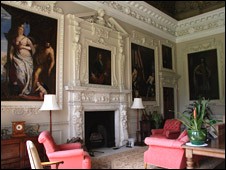
A Listed Georgian mansion dating from circa 1700 is built over three floors with a cellar beneath. The gross internal floor area (GIA) is approximately 20,500 sq ft (1,900 sq m) excluding the cellar. On the ground floor there is an impressive entrance hallway and six reception rooms including the magnificent ballroom and Venetian saloon with a wealth of architectural and artistic features including many inset wall paintings.
The north wing contains two offices and the library, with a small gymnasium in the basement whilst the south wing contains the ‘Winter Garden’, a TV room at a lower level and the immensely impressive ‘Academy’ above.
On the first floor there are four bedrooms, some with en suite facilities, a staff room with kitchenette and WC, an office, laundry room and ancillary facilities, with two further bedrooms and a seminar room on the first floor of the north wing. The second floor provides a further eight rooms, some used as bedrooms and some for study, with further bathrooms and WC facilities, and attic storage space above.
Historical Note
The Estate originally formed part of a Manor acquired by Sir Roland Hill MP in 1556 and remained the seat of the Hill family for almost 350 years. Hawkstone Hall is understood to date from circa 1700 with subsequent alterations between 1719 and 1725. There was then more substantial remodelling and enlargement in 1750.
The original Estate of the Hill family was broken up by 1906 when Hawkstone Hall was sold to the Liberal politician George Whiteley, later Lord Marchamley. He renovated the Hall and reduced the original wings in length. Following his death the property was acquired by the Roman Catholic Redemptorist Congregation of priests and brothers in 1926 and was originally occupied as a seminary. Since 1973/4 it has been run as an International Pastoral and Retreat Centre with associated conference facilities and residential accommodation.
The Residential Wing
Approximately 19,250 sq ft GIA (1,790 sq m) built in the 1960s and spread over three floors, there are circa 50 single bedrooms with extensive bathroom, WC and service accommodation.
The Estate
Extending to about 88 acres (35.6 Ha) in total, the Estate includes circa 63 acres (25.49 Ha) of agricultural land. The balance of about 25 acres (10.12 Ha) comprises the buildings with their adjoining landscaped gardens and woodland, and includes a former walled kitchen garden of approximately 2 acres (0.81 Ha) along with the two cottages and their gardens.
St Martin’s & St Clement’s Cottages
A pair of semi detached cottages adjoining the northern boundary of the Estate each with two reception rooms, a kitchen, three bedrooms and a bathroom. Separate sales particulars of the cottages are available on request.
The Chapel
Built in the mid 1930s in Romanesque style the Chapel is about 3,650 sq ft GIA (340 sq m) and has the capacity to seat approximately 150 people.

Interested parties should contact Reeves & Partners, Estate Agents.

Call For Papers!

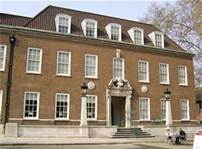
The 28th Annual Conference on Music in 18th-Century Britain will be taking place on Friday 30th November 2012 at the Foundling Museum, London.
  
Offers of contributions to the programme are invited. We encourage proposals for presentations focusing on all aspects of music in 18th-century Britain. As well as formal papers we can accommodate formats such as round tables, reports on work-in-progress, lecture-recitals and performance. Proposals should be approximately 250 words. The length of the paper or presentation is normally limited to 30 minutes, but longer or shorter formats will be considered. Collaborative or related topic papers are also welcomed.
Please submit your abstract by e-mail to c.sharpe@ram.ac.uk Be sure to include your name, address or institution, telephone, and email address in the body of the message. All submissions will be acknowledged by return email.
Closing date for submissions is Friday 28 September.

Jane Austen in London

Jane Austen arrived at her brother Henry’s new London residence in Hans Place on August 22, 1814.  Henry had moved from his previous house in Henrietta Street near Covent Garden to this recently developed area off Sloane Street.

The house now occupying the spot at #23 Hans Place is a Victorian reconstruction, very unlike the house in which Austen stayed.  Below, the blue plaque on the house, commemorating her stay on the premises.

Around the crescent from #23 Hans Place there is a Regency-era house which is probably what Henry’s house looked like in 1814.  Of course, any vehicle that might have been in the road in those days would not have resembled the one here.

The neighborhood around Hans Place was relatively new, developed just off Sloane Street as part of the Cadogan estate and opened out onto uninhabited fields to the west.  The Hans in the name honors to Sir Hans Sloane (1660-1753), president of the Royal Society and benefactor of the British Museum, for whom Sloane Square is named.

The general neighborhood has been much in the news lately because the Ecuadoran Embassy is located nearby, the place Julian Assange sought asylum.

A quick check of property values in the area shows that these tall Victorian houses, now mostly institutions or condominiums, are extremely pricey. 

Jane Austen described Henry’s house in a letter to Cassandra dated Tuesday 23-Wednesday 24 August, 1814. After sharing a few details of her journey to London, she wrote:  “It is a delightful place—more than answers my expectation. Having got rid of my unreasonable ideas, I find more space and comfort in the rooms than I had supposed and the Garden is quite a Love. I am in the front Attic, which is the Bedchamber to be preferred.  Henry wants you to see it all…”

From Ackermann’s Repository, April 1814

In early September, Jane Austen wrote from London to Martha Lloyd, who was staying in Pulteney Street, Bath.  She shares her impressions of London fashions: “I am amused by the present style of female dress; — the coloured petticoats with braces over the white Spencers and enormous Bonnets upon the full Stretch are quite entertaining…”

From Ackermann’s Repository, 1814

Miss Austen went on to make observations on a recent art exhibit:  “I have seen West’s famous painting and prefer it to anything of the kind I ever saw before. I do not know that it is reckoned superior to his Healing in the Temple, but it has gratified me much more and indeed is the first representation of our Saviour which ever at all contented me. ‘His Rejection by the Elders’, is the subject.–I want to have You and Cassandra see it.”

Benjamin West, Christ Rejected, 1814,
Pennsylvania Academy of Fine Arts, Philadelphia

Jane Austen wrote further of  her brother’s house (his wife, Eliza de Feuillide Austen had died in April 1813): “I am extremely pleased with this new House of Henry’s, it is everything that could be wished for him and I have only to hope he will continue to like it as well as he does now, and not be looking out for anything better.–He is in very comfortable health; — he has not been so well, he says for a twelvemonth.”

Henry Austen was his sister’s favorite brother, for his talents and charm.  He had several careers, first at Oxford, then in the military, and in various business ventures.  His bank failed in 1816 and he went into the church, as curate in the Chawton parish and later as rector in Steventon.  Henry assisted Jane in her publishing ventures, making deals for the sa
le and repurchase of her books.  He oversaw posthumous publication of   Jane Austen’s Northanger Abbey and Persuasion.

Today: Garden in Hans Place, London