Rembrandt, Van Dyck, Gainsborough: The Treasures of Kenwood House, London

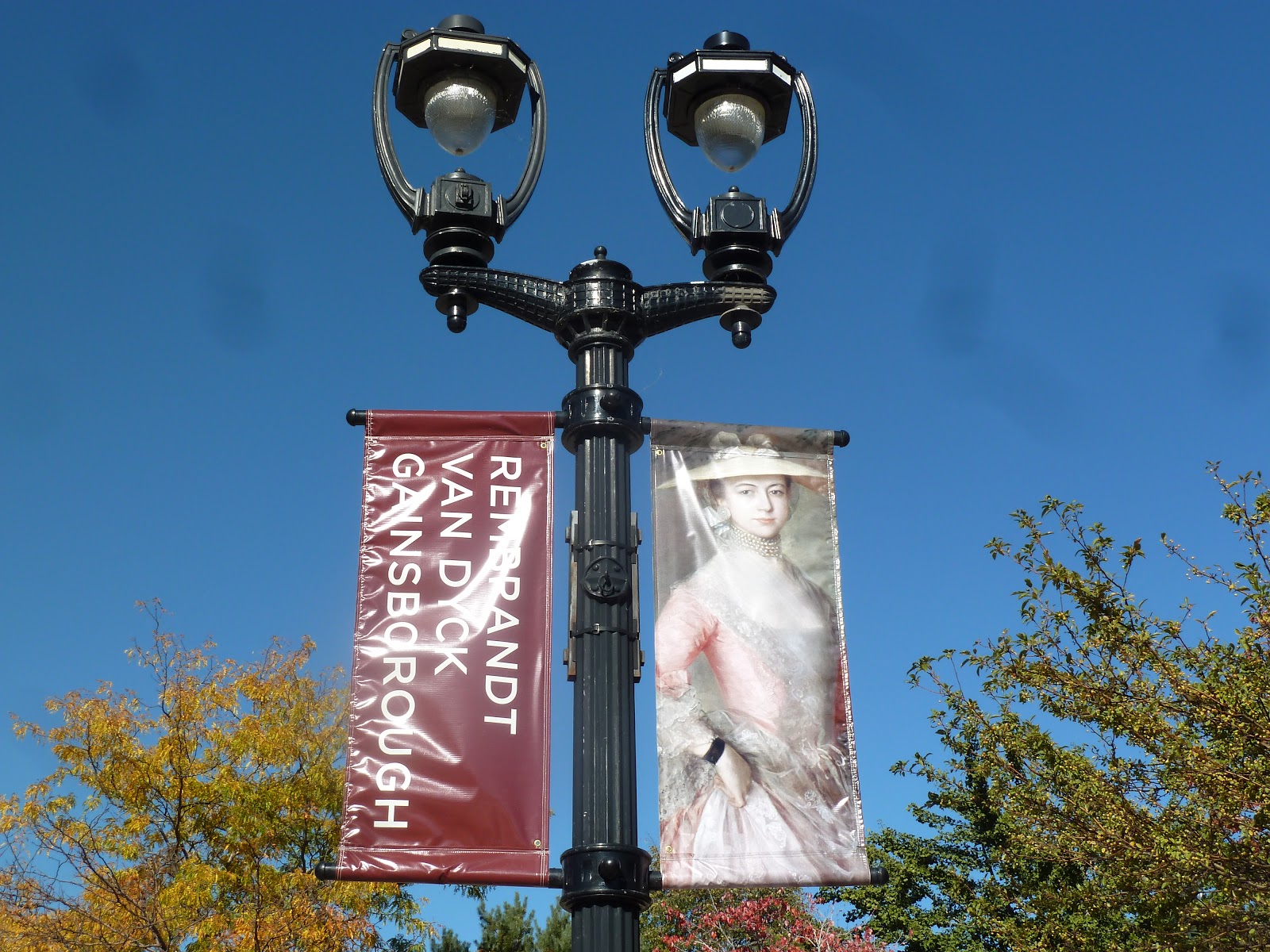
The Milwaukee Art Museum is showing Rembrandt, Van Dyck, Gainsborough: The Treasures of Kenwood House, London   through January 13, 2013.    Victoria here, reporting about my several visits to this outstanding exhibition.  I wrote about it previously  here.  And I have attended a number of programs associated with the exhibition.

Curator of the exhibition, Dr. Susan Jenkins, is a senior curator at Kenwood House for English Heritage, the British government’s agency administering hundreds of historical sites, from Stonehenge to Cold War nuclear missile sites. She trained at London’s Courtauld Institute and previously served as a curator at Apsley House, the Wellington Museum.
Susan Jenkins

Four particular interests of Lord Iveagh guided his choice of paintings and these four are used to arrange the paintings at the MAM. They are: Dutch and Flemish artworks, long valued by the British aristocracy; Portraits of Women, particularly by the great 18th century British portraitists; Portrayals of Children; and Landscapes and Maritime pictures.

Rembrandt van Rijn, Portrait of the Artist, ca. 1665

Foremost in the first group is, of course, Portrait of the Artist, 1665, by Rembrandt van Rijn, among many other outstanding works by Van Dyke, Hals, and others. 


Joshua Reynolds, The Angerstein Children, ca. 1782-85

Thomas Gainsborough, Two Shepherd Boys with Dogs Fighting, 1783

The children’s portraits vary widely from the skipping miss of Sir Thomas Lawrence to the dramatic candlelit image by Joseph Wright of Derby. 

Sir Thomas Lawrence, Miss Murray, 1824-26

Joseph Wright of Derby, Two Girls Dressing a Kitten by Candlelight, ca. 1768-70
Among the landscapes and maritime works is one of Joseph Mallord William Turner’s early seascapes which foreshadowed his later dramatic and unique techniques.
Joseph Mallord William Turner, A Coastal Scene with Fishermen Hauling a Boat Ashore
(“The Iveagh Sea-Piece”), ca. 1803-04
The erudite Christopher Lloyd spoke on “Contrasts in Royal Patronage: Sir Joshua Reynolds and Thomas Gainsborough.”  Mr. Lloyd is the former Surveyor of the Queen’s Pictures (the Royal Collection, www.royalcollection.org.uk) and served as Guest Curator for the MAM’s exhibition Impressionism: Masterworks on Paper, one year ago.

Mr. Lloyd characterized the personalities and gifts of Sir Joshua Reynolds (1723 – 1792) and Thomas Gainsborough (1727-1788), a study in contrasts. Though both came from modest beginnings in the country, their approaches to their work could hardly have been different. Though both excelled at portraiture, they held entirely different attitudes toward the theory and practice of painting. Reynolds, founding president of the Royal Society of Art, was the ultimate insider, friend and colleague of the greatest men in literature, government and society. He studied and followed traditional methodology and utilized classical ideals by which to organize his works. Mr. Lloyd recommended reading Reynolds’ collected lectures on the theory and practice of painting, Discourses on Art.

Joshua Reynolds, Mrs. Tollemarche as “Miranda”, 1773-74

Gainsborough, said Mr. Lloyd, was an outsider, on the edges of the art establishment, always (in today’s terminology) pushing the envelope when it came to poses, techniques and even subject matter, though his popular portraits financed his life. Where Joshua Reynolds was official portrait painter to King George III, Gainsborough was more likely to favor – and be favored by – the raffish circle of George, Prince of Wales, who disagreed with his father on everything: his behavior, his friends and his taste in art.

Thomas Gainsborough, Lady Brisco, ca. 1776

Reynolds and Gainsborough definitely were rivals though when the latter was nearing death, Reynolds reconciled with him and praised Gainsborough’s achievements. They were men of great, but very different, skills and temperaments. Mr. Lloyd suggested that visitors to the exhibition look for the great contrasts in the styles and techniques of the two artists; Six pictures by Gainsborough and nine by Reynolds are on display.

The exhibition Rembrandt, Van Dyck and Gainsborough: The Treasures from Kenwood House is organized by The American Federation of Art and English Heritage. After it closes in Milwaukee in January, 2013, it will travel to Seattle and Arkansas.
Milwaukee Art Museum

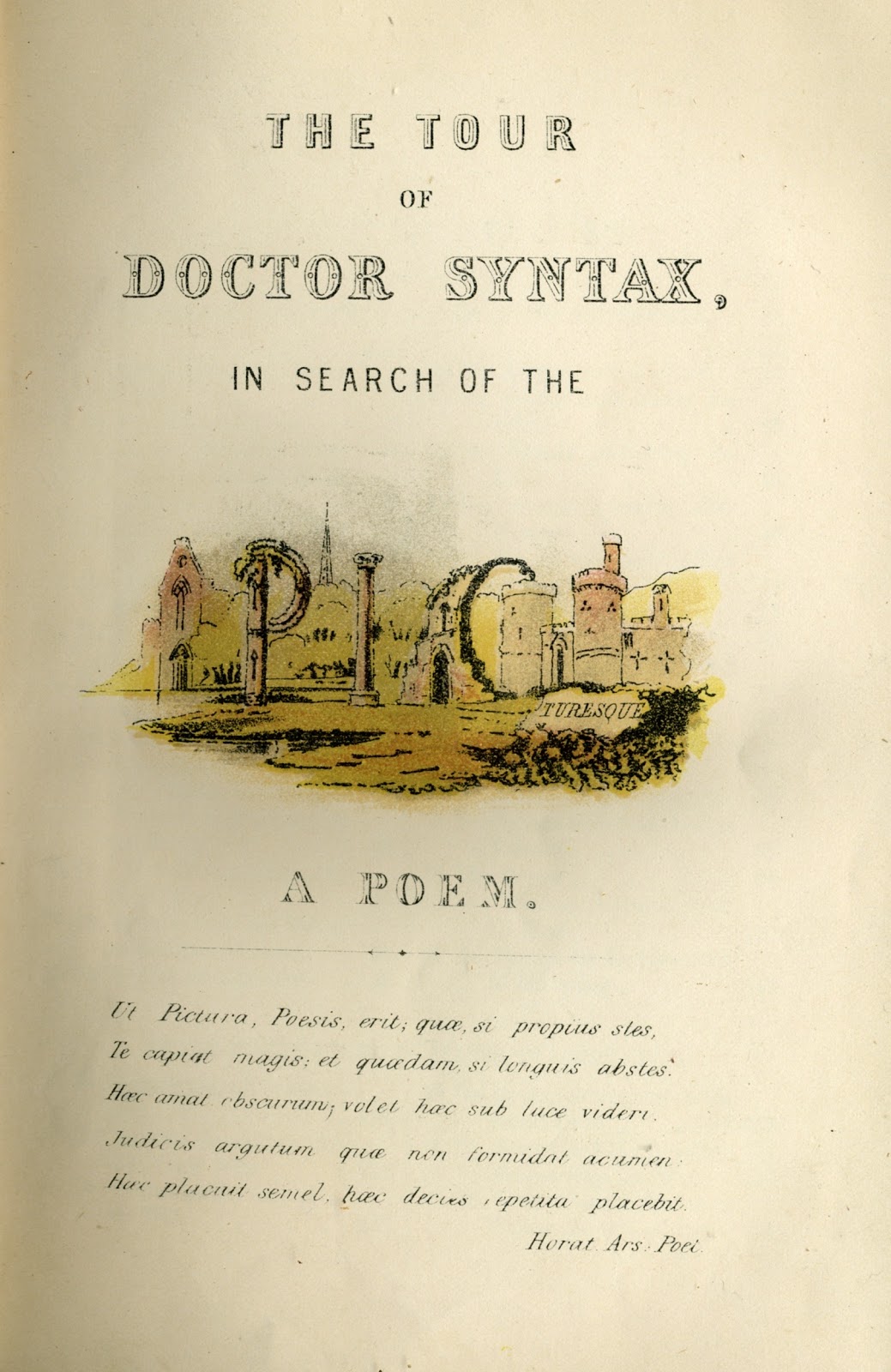
Dr. Syntax, Part Four (Cantos 4 and 5)

More from The Tour of Dr. Syntax in Search of the Picturesque

In Canto I, Syntax conceives his project and takes off on his quest on his mare Grizzle, leaving his wife behind. Canto II finds Syntax confronting, instead of a sublime scene of wild beauty, a pack of braying donkeys. As he mourns the scene, he is attacked by highwaymen who steal his purse and his mare, leaving the poor Syntax tied to a tree.

He is rescued in Canto Three and remembers his good wife had sewn some of his money into his clothes, so he is not without funds. He finds his way to an inn and Grizzle is found, though the poor horse has had her ears and tail docked.

Excerpts from Canto IV

He finds sleep in the inn refreshing:
…Thus wrapt in slumber Syntax lay —
Forgot the troubles of the day:
So sound his sleep, so sweet his rest.
By no disturbing dreams distrest;
That, all at ease, he lay entranced.
Till the fair morn was far advanc’d. …

After his morning ablutions and a hearty breakfast…

“…And when the well-fed meal was o’er,
Grizzle was order’d to the door;
Betty was also told to say.
The mighty sum there was to pay:
Betty, obedient to his will,
Her court’sy makes, and brings the bill.
Down the long page he cast his eye,
Then shook his head, and heav’d a sigh,
“What! am I doom’d, where’er I go.
In all I meet to find a foe?
Where’er I wander, to be cheated.
To be bamboozled and ill-treated!”
Thus, as he read each item o’er,
The hostess op’d the parlour door;
When Syntax ‘rose in solemn state.
And thus began the fierce debate:—
“Good woman; here, your bill retake,
And, prithee, some abatement make;
I could not such demands afford. …
Were I a bishop or a lord.”

Dr. Syntax Disputing his Bill with the Landlady

… Hostess: “The charges all are fairly made;
If you will eat, I must be paid.
My bills have never found reproaches
From lords and ladies, in their coaches…”

Finally Dr. Syntax makes an offer:

“I’m in haste to get away,
Though one pound three I will not pay:
So, if you’ll take one-half th’ amount,
We’ll quickly settle the account.
There is your money — do you see ?
And let us part in charity.”

The hostess agrees, and Canto IV ends with Dr. Syntax waiting for his mare, Grizzle..

Excerpts from Canto V:

Once on his way, Dr. Syntax reflects on his quest.

“It seems to be my luckless case.
At ev’ry point, in every place.
To meet with trouble and disgrace.
But yesterday I left my home.
In search of fancied wealth to roam;
And nought, I think, but ills betide me
Sure, some foul spirit runs beside me;
Some blasting demon from the east,
A deadly foe to man and beast.
That loves to riot in disaster,
And plague alike both horse and master.”

Dr. Syntax seeks out some help for his horse’s wounds, and once she is treated, goes on to stay at another inn. The next morning he goes down for breakfast.

“In spirits from his calm repose;
And while the maid prepar’d the tea,
He look’d around the room to see
What story did the walls disclose
Of human joys, of human woes.
The window quickly caught his eye,
On whose clear panes he could descry
The motley works of many a Muse:
There was enough to pick and choose;
And, “Faith!” said he, “to strive to hook
Some of these lines into my book:
For here there are both grave and witty,
And some, I see, are rather pretty.”
From a small pocket in his coat
He drew his tablets, — when he wrote
Whate’er the pregnant panes possess’d;
And these choice lays among the rest:
’If my fond breast were made of glass.
And you could see what there doth pass,
Kitty, my ever charming fair!
You’d see your own sweet image there.’” …

Dr. Syntax Copying the Wit of the Window

After copying down several more of these stories,

“…But as he copied, quite delighted,
All that the Muse had thus indited,
A hungry dog, and prone to steal.
Ban off with half his breakfast meal;
While Dolly, ent’ring with a kettle.
Was follow’d by a man of mettle.
Who swore he’d have the promis’d kiss;
And, as he seiz’d the melting bliss,
From the hot, ill-pois’d kettle’s spout,
The boiling stream came pouring out.
Which drove the Doctor from the Muse,
By quickly filling both his shoes.”

Canto V ends with poor Dr. Syntax suffering yet another affront: his shoes are steaming!

To be continued soon….


A Couple In England: Bound For Bath

As I write this, the news is filled with reports of floods, cold snaps and even snow in the UK. However, my heart is warmed by the thought of returning to Bath, one of my favourite cities. Bath stone, Georgian architecture and Regency reminders on virtually every street. As you may know, my Husband is a reluctant tourist. Our most recent discussion about the Bath portion of our trip went something like this:
Him – We don’t have to be doing something every minute of every day.
Me – Mmmmmmm.
Him – What’s there to do in Bath, anyway?
Me – Well . . . . there are the Roman baths and the Assembly Rooms and the Holburne Museum and the ice rink and the Royal Crescent. And, er, the Fashion Museum.
Him – (Groan, eye roll, deep sigh) Remember that I’m old and have a bad back, will ya? I can’t keep going and going every day like you.
Me – You’re not that old. You’re only four years older than me. 
Him – Yeah, but you’re actually interested in British history and you don’t have a bad back.
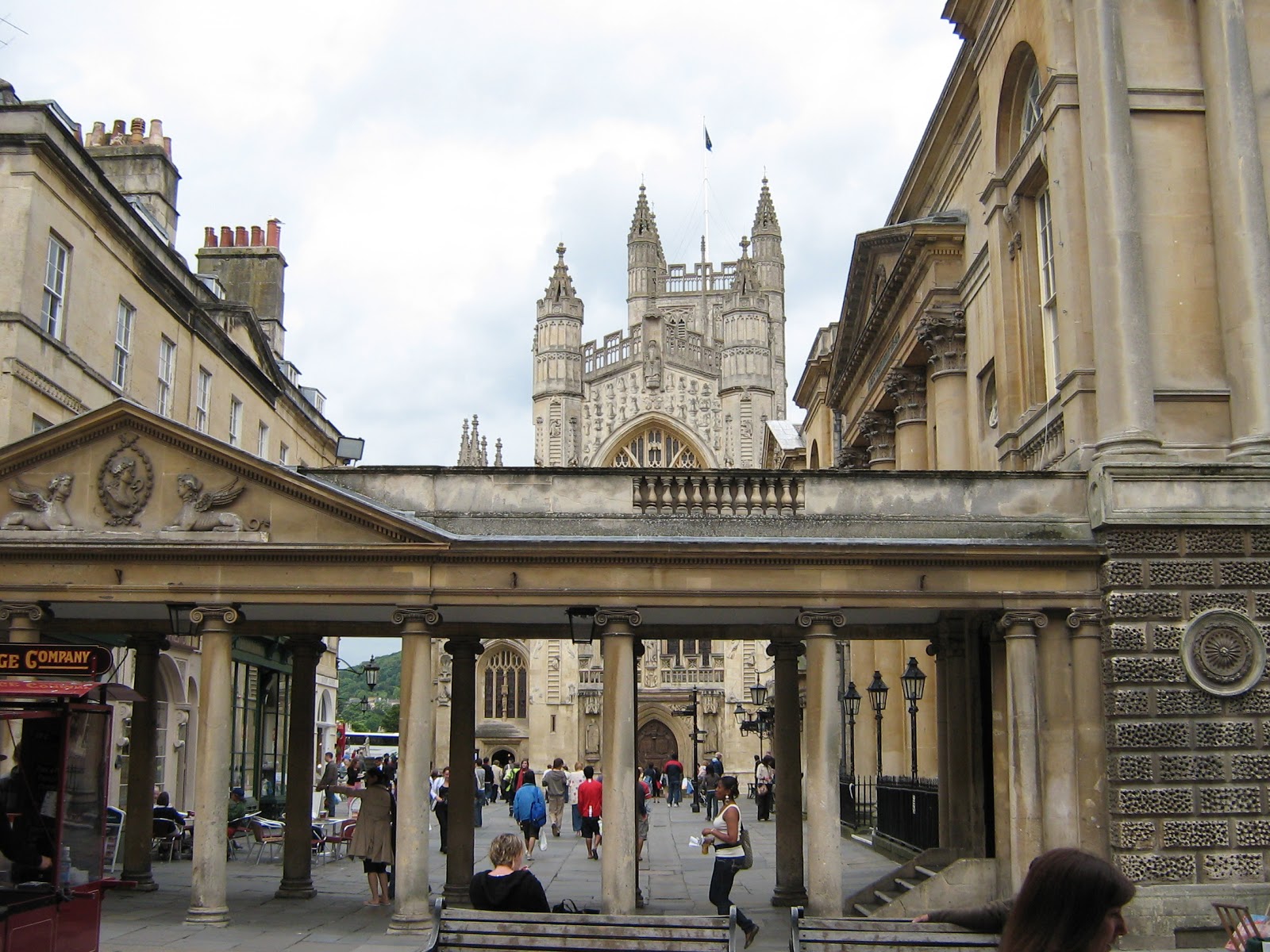
Point taken. But it’s Bath. Our hotel is in walking distance of Pulteney Bridge (above) and the Abbey and I must admit to having splurged on this portion of our trip – we are booked into the Wellington Suite for the duration – sitting room, bedroom and bathroom with a tub big enough for a right proper soaking. So far, in addition to those items listed above, our itinerary for the three days in Bath includes a bus tour of the City, a stroll of the streets of Bath, a trip to Longleat House for the Christmas extravaganza, some shopping, some pub hopping, a horse and carriage ride, New Year’s Eve dinner followed by fireworks over the Abbey and finally a New Year’s day trip to a nearby spa for two hours of couples pampering. I mean, one must spa when in a spa town, non?

The only dark spot on the Bath horizon (aside from a grumbling husband) is that the City won’t be filled with people dressed in period costume. Note to self: attend Jane Austen Festival one year soon. When I think of Bath, I think of Mrs. Delaney and Jane Austen, Beau Nash and liveried footmen. It’s a bit of shock to arrive to find the streets populated instead with 21st century people dressed in down jackets, button down shirts and jeans and not a single gleaming brass button in sight.
Upon taking a really good look at our itinerary, I admit it may seem a tad crowded. Ish. And Hubby might have cause to gripe at having to take the train, and then a taxi, to Longleat. And having been at Longleat all day long visiting the house, Christmas displays and perhaps even the safari park, Hubby might not be in the mood to return to the hotel, get all spruced up in order to go out for dinner and then stay up until midnight to watch the fireworks display. The phrase “going and going” comes to mind, but, hey, things could be worse for the Husband. At least I’m not expecting him to dress like Colin Firth.

Have Yourself a British Telly Christmas

If you’re a fan of British telly (and who isn’t. No question mark needed) you must check out Acorn TV. For a mere $29.99 per year, it allows you to stream a wide range of British television programs to your computer, with the schedule changing each month. For $79.99, you can bundle the package with a Roku player, which will allow you to watch the shows on your television. If you just don’t know what to ask for this Christmas, this is just the ticket. Heck, even if you’ve already asked for a whacking great number of items, tack this on, as well.

I couldn’t wait for Christmas and ordered it for myself and it arrived just in time for Thanksgiving, on which day I had my son hook it up for me. Turkey and telly – heaven. Here are just a few of the programs available – Prime Suspect, Poirot, The Last Detective, Pie In The Sky, Midsomer Murders, Poldark, Miss Marple, Rosemary & Thyme, Jennie: Lady Randolph Churchill, Fingersmith, Above Suspicion, Touching Evil, etc., etc. It’s fabulous to be able to watch all my favorite shows, whenever I want them. And the schedule rotates often enough that you’ll always have something new to watch. Currently, they’re running a Most Mysterious Christmas Specials marathon, featuring holiday episodes of all our favorite mysteries. So order the stream, light the fire, pour the sherry and enjoy. Merry Christmas, indeed.

Christmas Reading: Envious Casca

One of Georgette Heyer’s best mysteries — in fact, I believe her very best — is a Christmas-set story, entitled Envious Casca.  It’s a favorite of mine (Victoria’s) and a Christmas book I want to recommend.

Of course, since it is a murder mystery, don’t expect a great deal of yuletide cheer. In fact, as you might assume from its genre, most of the characters are rather unpleasant and Lexham Manor may not be the house you dream about occupying in the quiet countryside.

The title Envious Casca  comes from lines in Shakespeare’s play Julius Caesar:

If you have tears, prepare to shed them now.
You all do know this mantle: I remember
The first time ever Caesar put it on;
‘Twas on a summer’s evening, in his tent,
That day he overcame the Nervii:
Look, in this place ran Cassius’ dagger through:
See what a rent the envious Casca made:

Thus we knew from the start that stabbing was the method of murder, and there may be a clue to the perpetrator — a friend? a relative?

One might also consider this a typical country house mystery.  A dysfunctional family gets together for the holidays — various strains are evident from page one.  If you enjoy an intriguing whodunit, you might give this a try for those hours after a big dinner when you are reaching for slumber…

Unlike many of Heyer’s, it is not a historical but set in her own time period, the 1930’s, and you might compare it with similar works by English mystery mistresses such as Dorothy L. Sayers and Agatha Christie. The actual publishing date was 1941. The novel features one of Heyer’s continuing characters in her mysteries, Inspector Hemingway of Scotland Yard.

Georgette Heyer (1902-1974) wrote dozens of novels and short stories, some in collections, others in periodicals.  She has been the subject of several biographies, the latest of which by Jennifer Kloester, will be available in paperback from Sourcebooks in January, 2013. It was published in the UK in 2011. Also available as an e-book soon.