A Couple In England: Day 8 – Part Two
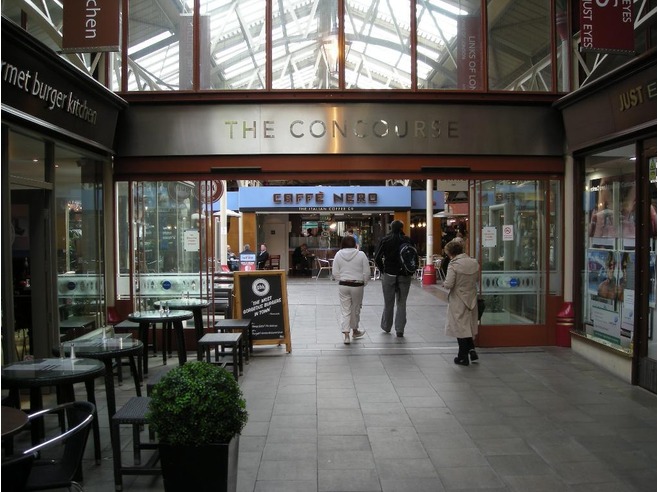
Exiting the train at Royal Windsor Station, one of the first things Hubby saw was a Caffe Nero.
“Caffe Nero, Hon! We can go tomorrow morning.”
“Absolutely.”
We entered the pedestrian only Peascod Street. “No cabs?”
“We don’t need one. We just need to get to the top of the street, make a right and the Castle Hotel is a block away on the right.”
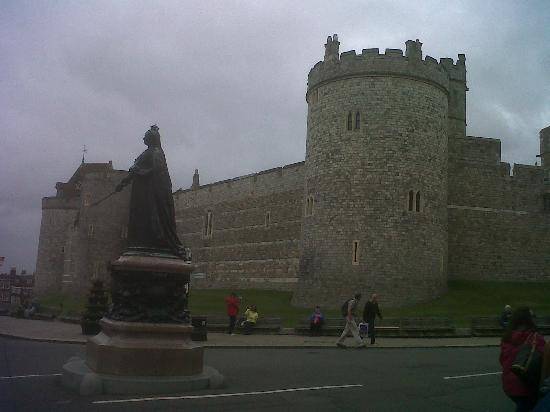
When we got to the top of the Street, I pointed at the statue. “Queen Victoria. It was erected for her Golden Jubilee in 1887.”
“What’s that? Is that a castle? It looks like that castle in London.”
“It’s Windsor Castle,” I told Hubby. “The castle in London is actually the Tower of London. It’s not a castle at all.”
“They look the same to me.”
Sigh.
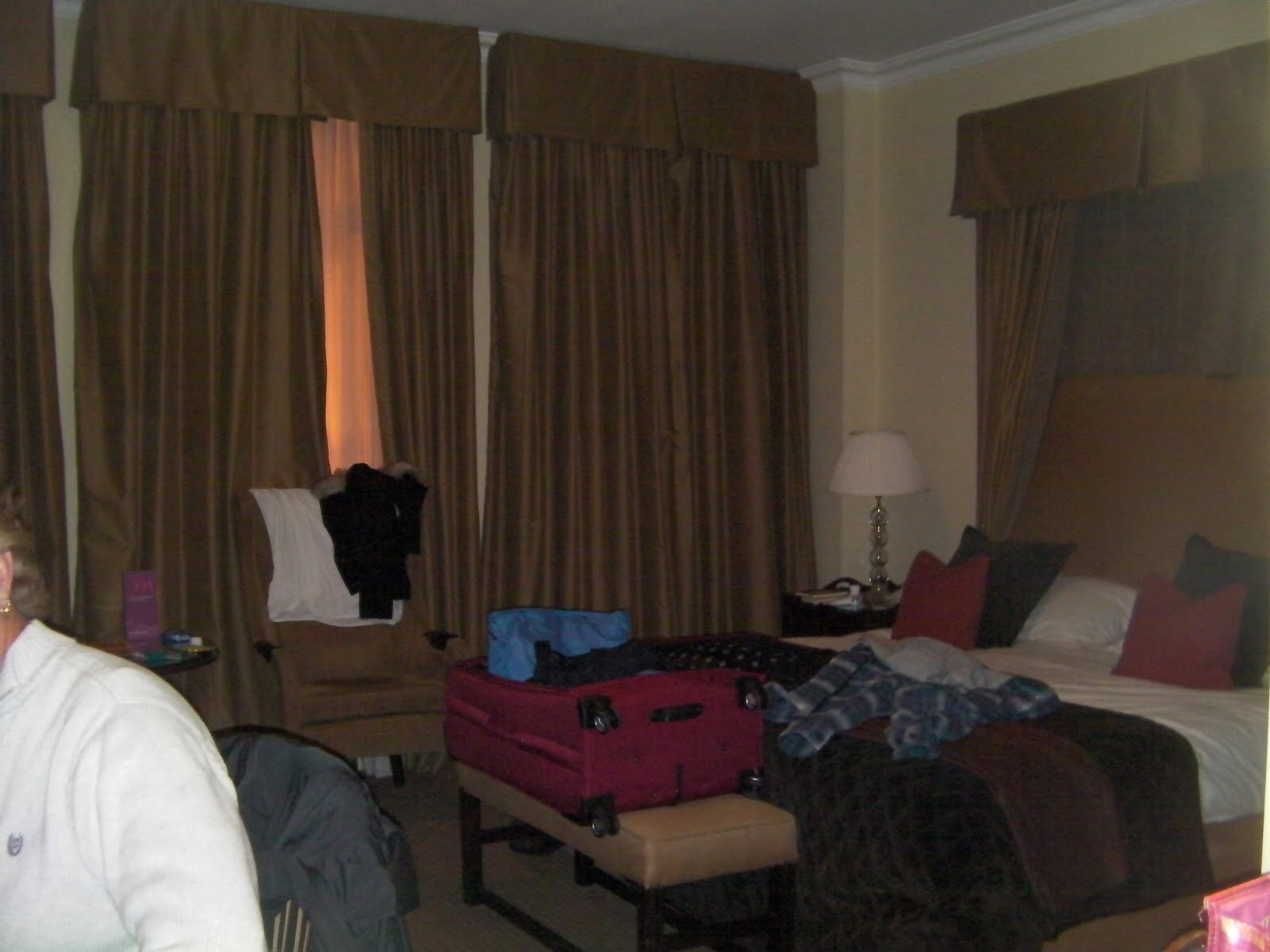
A few more steps brought us to the Castle Hotel, which is just lovely. We were given a very large room overlooking the High Street. I’m sorry I didn’t think to take a photo of the room before Hubby and I disgorged our belongings over every flat surface, but you get the idea.
Both the Crooked House and Guildhall were right outside our window.
“Isn’t your friend at the Guildhall?” Hubby asked.
“Yes, Hester told me to come over and meet her there when we got to Windsor.”
“Well go on then, go see her.”
“You sure?” I gave Hubby a quick once over, trying to assess his condition. He looked much better than he had this morning. Not one hundred percent, mind you, but no longer at death’s door.
“Okay. But I’ll be literally right across the street.”
“Go. If I need you, I’ll hang a pair of my boxers out the window.”
Regular readers of this blog will know the name Hester Davenport. Not only has Hester contributed guest posts to this blog, she is also the author of The Prince’s Mistress: A Life of Mary Robinson, among other works, and has graciously acted as our Windsor guide whenever Vicky, Jo Manning or myself are there. In fact, a visit with Hester is typically the high point of our trips across the Pond. In addition, Hester was a driving force in getting the Windsor and Royal Borough Museum, housed in the Guildhall, up and running. In fact, Hester acted as hostess to the Queen, who paid a visit to the Museum. You can see photos and read all about Hester’s meeting with the Queen last year here. On a past visit, Hester arranged for the issues of the Windsor newspaper dealing with the Battle of Waterloo to be pulled from the archives so that Vicky and I could see them up close and personal. Now that’s what you call a pal . . . . .
When I got to the Museum, Hester was busy speaking to a few people, but she saw me, did a double take and then gave me the “be with you in a minute” high sign. I sat on a nearby bench and was shortly joined by Hester, who took a good look at me and said, “Oh, dear. I knew you were sick by your emails but I’d no idea you were this sick.”
“Do I look that bad?”
“Oh, yes.” Good old Hester. She pulls no punches. “And Hubby? Is he as bad as you?”
“Worse. Don’t forget, I’m in the recovery phase now. You should have seen me a few days ago.”
“Oh, you poor thing. I had no idea.”
“Really? The fact that I wrote you that I had cholera and was near death didn’t clue you in?”
“Well, I thought you were exaggerating somewhat,” she said, “but now I see you weren’t. Oh, dear. Are you sure you’re going to want to go to Oatlands and Hampton Court tomorrow?”
“Was Wellington at Waterloo? Yes, I’m sure. I’m going to Oatlands if I have to crawl there. I’ve longed to see Oatlands for ages now, haven’t I? I’m determined to see Freddy’s house and the pet cemetery.”
A co-worker of Hester’s came by then and Hester introduced us. “This is my friend Kristine I was telling you about.”
“Ah, the one who’s been ill?” She took a good look at me and said, “Oh, dear.”
You’ll understand that I’ve developed an aversion to the British `Oh, dear’ during this trip. Oh dear, indeed. Why don’t the English just say what they really mean, which in this case is `Holy crap, should you be out of your sick bed?’ I couldn’t wait to see what Hester would say when she caught sight of Hubby tomorrow. Oh dear would hardly cover it.
Hester and her friend then questioned me about my illness and I gave them every sorry detail, from my not being able to get out of the cab when we arrived at Duke’s Hotel in Bath, to our missing New Year’s Eve entirely, to my not having eaten anything to speak of for a week, to my plight in Milsom Street on the way to the Fashion Museum.
When I was done – and they had both wiped the tears from their eyes and gotten their laughter under control – Hester said, “Oh, I am sorry to laugh, but that’s the funniest story. Isn’t funny?” she asked her f
riend.
“Quite,” she agreed.
“And today the pair of you had to take the train here to Windsor, what with you both feeling poorly. Now you go right back to your hotel and get some rest. I’m so glad Hubby felt he was improving and didn’t need the doctor after all, but an early night and rest will do you both a world of good. We’ve got a big day planned for tomorrow, after all.”
What good advice. I could have kissed Hester for suggesting an early night, but restrained myself as I didn’t want to pass on the cholera to her. After all, I needed her healthy and able to drive us to Oatlands and Hampton Court tomorrow. Not to mention that her husband, Tony, would be none too pleased with me if I landed Hester in the hospital.
We stood and gave each other a somewhat sanitized version of an embrace and I headed across the street to the Castle Hotel whilst wondering in what condition I would find Hubby upon my return.
Part Three Coming Soon!
Guest Post: A Farewell to Donald Hendricks
by Guest Blogger Jo Manning
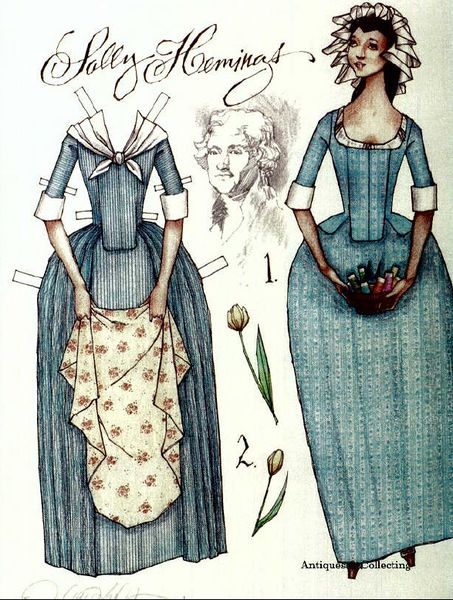
I first made his acquaintance after the publication of my biography of Grace Dalrymple Elliott, My Lady Scandalous. Donald was entranced by the life and beauty of Grace Elliott and inspired to do a paper doll set of her. He said that he hoped I “wouldn’t mind”. Wouldn’t mind?! I was delighted
Donald ran a paper doll business with a friend called Legacy Designs. They closed the business and took down the website a couple of years ago. Donald specialized in drawing paper dolls of celebrities, artists, authors, and literary figures. His work was exquisite! He did a number of paper doll sets of Jane Austen characters as well as the March sisters from Little Women, fashion icons, movie stars, et al.
![]() |
| Mr. Darcy, hero of Pride and Prejudice |
![]() |
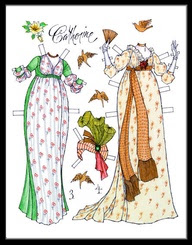
| Catherine Morland, a character in Jane Austen’s Northanger Abbey |
![]() |
| Playwright William Shakespeare |
Donald’s work was exhibited at the Tate Modern in London and the Smithsonian in Washington, D.C. His designs appeared with regularity in magazines, including, of course, The Paper Doll Review, and he was active wherever paper doll collectors met, a mainstay of the summer’s annual Paper Doll Society meetings in Los Angeles. (Where there will be a table honoring him and his career this year.
In 2008, he made a gift of some of his papers to the ONE National Gay and Lesbian Archives in Los Angeles, Collection # Coll2008-041. These are original drawings by Don illustrating Rechy’s 2003 book The Life and Adventures of Lyle Clemens, together with emails from the author to Don, and a set of paper dolls from his Icons and Lovers series.
My Lady Scandalous is about to go into ebook format and I had hoped to use one of the paper doll illustrations by Donald for its new cover. We had talked about this a month or so before he passed away and he was thrilled at the prospect. In his honor, I hope this can be accomplished. He was a very dear man, a talented artist, and a most cherished colleague.
Grace Elliott as a French revolutionary…though she was anything but! Grace was a staunch Royalist to the end of her days, but this is Don Hendricks having a little bit of fun.
Guest Post: My First Trip To London
by Guest Blogger M. Denise C.
Since I went to London on the cheap and had a kitchenette, I would eat oatmeal for breakfast, eat a decent meal out at lunch at a pub or a restaurant, and then I would eat light or at a takeout place (Pret-a-Manger) or bring something back to the hotel for dinner. One of the best meals I had was at Cafe in the Crypt located under St. Martin in the Fields church (the Queen’s church). It was only £10 and was very British (chicken with potatoes and root vegetables and a gravy and red cabbage).
The next day I went from the hotel to the Tube and went to Westminster Bridge and did one of the river cruises. When I came out of the Westminster Station, I looked up and there was Big Ben in all his glory! Beautiful. They were working on parts of the buildings the clock tower is attached to (Parliament buildings). So awesome to pop out of the station and look up and see such an iconic building.
The next day I went to tour the Duke’s home, Apsley House, which is a gem of a museum (as you probably know from reading this blog). The current Duke of Wellington (the 8th) still lives there with his family in private apartments that are not open to the public. Eight main rooms of the mansion are open to the public. The first Duke collected art and received art from the Spanish after his army captured Joseph Bonaparte’s carriage containing the loot at the battle of Vitoria. There were lots of Caravaggio’s and Murillo’s and Velasquez’s and some very interesting portraits of his military friends and himself. And there was this gorgeous china room that had china and swords and guns displayed. One of the cool things for me personally was a jeweled saber from the Tipu Sultan in India that the Duke somehow acquired. Wellington defeated the Tipu Sultan in a battle in India (I knew all about that from Sharpe’s Tiger–one of the prequel novels by Mr. Cornwell).
There was a large dining room and one of the things on the table was a huge (and I mean huge) table piece made all of silver that was very ornate and honored some of his major battles in Spain and Portugal. The house itself was restored to glory. Also, there exists a statue of a naked Napoleon that George IV gave to Wellington after Napoleon was exiled and his property dispersed. The sculptor was Canova. Apparently, Napoleon did not like this statue after completion. I love how it landed in the Duke’s house! It is so huge it is in the stairwell and the staircase winds around it. I wish I could have taken pictures of my own in the house, but they were not allowed.
I did get stuck in the elevator at Earl’s Court Station when I was heading back to the airport at the end of my visit. It was early and I was alone in the elevator, which kept going up and down, but the doors would not open. So I had no choice but to push the alarm button. The voice of a security guard came over the radio and before long they were opening the door for me. In hindsight, it was funny, but I’m still glad it was early and no one else was around.
I’ve been back to London once since that first trip and I hope to take a third trip soon. On both of my previous trips I discovered that there is just too much to do and see London and I only managed to just scratch the surface.
You can visit my own blog here.
Do you h
ave a travel story about a trip to England? If so, please consider sharing it here.
A Couple In England – Day 8
You can tell that I was feeling a bit better myself, as I actually took these photos myself from the platform. We had a few minutes to wait for the next train, so I got us a couple of coffees and brought them out to Hubby.
“No smoking,” he said, as he took the coffee from me.
“Huh?”
“The sign,” he said, pointing in its direction with his chin. “No smoking. We’re outside on the platform and we can’t smoke. You can’t smoke in England.”
“Well, let’s not worry about it until you can’t smoke in France. Or Greece. Or Turkey. Then we’ll worry about it.”
“How long is the train ride to Windsor?”
Uh, oh. Here we go. “It’s about two hours. We, uh, we have to change trains though.”
“Where?”
“At Reading. And Slough.”
“Two changes?”
I could feel his pain. It wasn’t that long ago that I was myself close to death on a train. Only we had been traveling in the opposite direction.
“Reading is close to Stratfield Saye,” I sighed. Stratfield Saye, whose opening times never seem to coincide with my trips to England.
“What’s that?”
“Artie’s house.”
“I thought Apsley House was Artie’s house.”
“It is. He bought Apsley House himself. The country bought Stratfield Saye as a sort of thank you gi
ft for his having defeated Napoleon at Waterloo.”
“What?”
“Yeah. Napoleon was seen as the Hitler of his day. A tyrant. He proclaimed himself as Emperor of France and then turned his eye on the rest of the world. He threatened democracies everywhere. And Wellington and his army and the allies defeated him at Waterloo. Napoleon’s army was notorious for looting and stealing whatever they needed, wherever the went. Napoleon’s troops were the ones who shot the nose off the Sphinx.”
“The Egyptian Sphinx?”
“Yes. Destruction wherever they went. On the other hand, Wellington went out of his way to make sure that people were compensated to some degree for whatever his troops requisitioned. Not that the British didn’t indulge in some looting and pillaging of their own, but still, Artie had a completely different mindset about it. Remember the story about the looted Spanish art I told you about at Apsley House?”
“Oh, yeah.”
“There was this guy called Congreve and he worked at the Royal Arsenal, trying to perfect rockets Wellington had first seen at Seringapatam.”
“Where?”
“In India. Congreve worked to perfect them, but it took several attempts. He demonstrated them to Wellington, hoping he’d use them during his campaigns. It turns out that the rockets were unreliable and their trajectory uncertain. And then they’d set things on fire instead of blowing them up. And the things set afire were not necessarily the things one was aiming at. Wellington said that when he entered a town it was most often in order to liberate it, rather than destroy it. Wellington refused to use them because of the wholesale damage they caused and the destruction they left behind. In his own words, he had a bad opinion of them.”
“So Congreve didn’t get the commission?”
“Not from Wellington, but Congreve had gotten in tight with Prinny, who was pushing for the use of the rockets.”
“Who?”
Sigh. “Prinny, the Prince Regent. King George the fourth. They kept pestering Wellington to use them. When Wellington was in Portugal in 1810, the matter was again raised in a letter from Vice Admiral Berkeley. Wellington said that they wouldn’t answer for his purposes on land, but he allowed that every thing deserved a fair chance. So it was that eventually the Royal Navy used them and fired them from the decks of their ships.”
“How’d that go?”
“You’ve heard of `the rockets red glare’?”
“The bombs bursting in air?”
“Exactly. Those were Congreve’s rockets. They put on a great show, but weren’t very effective.”
Our train arrived and I helped Hubby get ourselves and our luggage onboard. I must say that Hubby was a brick, changes and all, up until the last leg of the journey, when a guy got on the train with a pit bull.
Hubby elbowed me in the side. “He’s got a dog on the train. A pit bull.”
Now, as you know, I pride myself on reporting this trip exactly as it happened. There was a pit bull on the train. Which now allows me to segue neatly into this photo of our granddog, Coco, the pit bull. Who believes with all his heart that he’s a Yorkshire terrier and who is constantly trying to climb onto my lap. But I digress . . . . .
“You’re allowed to bring dogs on the train in England,” I told Hubby.
“You can’t smoke outside on the platform, but you can bring a dog into a crowded train?”
“Look!” I said as I pointed out the window.
“What? What is that? Is that a castle?”
Part Two Coming Soon!