Kristine here – By now, most of you know about my hobby of web shopping for real estate in England. Recently, I discovered a new residential development in the South Downs National Park and had to share it with you.

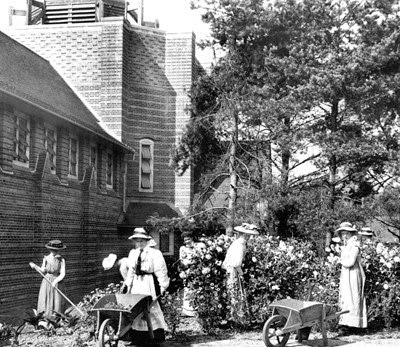
The gardens are an early 20th Century example of a therapeutic garden and are of considerable historic interest in their own right, which is recognised by their listing on the English Heritage Register of Parks and Gardens. They have further significance in the combination of the Percy Adams and Charles Holden designed Sanatorium and the Jekyll designed landscape, their unity encapsulating many of the aspirations of the Edwardian era.
The gardens are a nationally important heritage asset, and a unique example of Jekyll’s belief in the benevolence of plants and their benefits to patients, in their restored form they will continue to deliver these benefits for both residents and visitors. Detailed planting plans, based on the original drawings have been drawn up to restore the original intention of the planting which in many areas has become impoverished, and it is intended to restore some areas of the garden which have been ‘lost’ for decades below car parks and hospital out buildings.
and car parking, the gardens to the south of the hospital remain remarkably intact.
The gardens are a nationally important heritage asset, and a unique example of Jekyll’s belief in the benevolence of plants and their benefits to patients, in their restored form they will continue to deliver these benefits for both residents and visitors. Detailed planting plans, based on the original drawings have been drawn up to restore the original intention of the planting which in many areas has become impoverished, and it is intended to restore some areas of the garden which have been ‘lost’ for decades below car parks and hospital out buildings.
Until the 1950’s the building faired well, with the necessary extensions being designed in a sensitive manner. However, from the 1960’s onwards such sensitivity was put aside, with the practicalities of a hospital being the overriding influence. These unfortunate additions paid little regard to the historic architecture and landscape. Despite this much of the historic fabric and quality remains, and the upgrading to Grade II* listing in 2004 for the main building and chapel underline the importance of this collection of historic buildings.


.JPG)

.JPG)

.JPG)
.JPG)


.JPG)