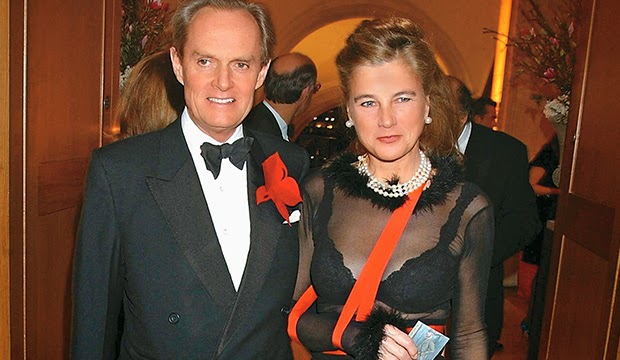
MEET THE DUKE AND DUCHESS OF WELLINGTON

Arthur Charles Valerian Wellesley, 9th Duke of WellingtonOBE DL (born 19 August 1945), is the present Duke of Wellington. He is the son of Valerian Wellesley, 8th Duke of Wellington, and his wife, Diana McConnel.

He married Princess Antonia of Prussia (who no longer uses her royal title) on 3 February 1977 at St. Paul’s ChurchKnightsbridge,LondonPrincess Antonia of Prussia, Duchess of Wellington, Duchess of Ciudad Rodrigo, OBE (born 28 April 1955), is a great-granddaughter of Wilhelm II, German Emperor and is descended from Queen Victoria through her daughter, Princess Victoria. Antonia Elizabeth Brigid Louise Mansfeld was born in London on 28 April 1955, the daughter of Prince Frederick of Prussia and Lady Brigid Katherine Rachel Guinness, daughter of Rupert Guinness, 2nd Earl of Iveagh. She is the twin sister of Prince Rupert Alexander Frederi
ck. She was educated at 
Cobham Hall School and King’s College London (BA, English). She was awarded the OBE in the 2008 Birthday Honours for services to social housing as President of the Guiness Trust.

The Duke and Duchess of Wellington have five children:


  • Arthur Gerald Wellesley, Marquess of Douro (above, born 31 January 1978); married as of 4 June 2005 to the former model Jemma Kidd, a fashion stylist and great-granddaughter of Lord Beaverbrook. They have twins and a younger son:
    • Lady Mae Madeleine (born 4 January 2010).
    • Arthur Darcy, Earl of Mornington (born 4 January 2010).
    • Lord Alfred (born 10 December 2014).[3]
  • Lady Honor Victoria Wellesley (born 25 October 1979); married (as his second wife) the Honourable Orlando Montagu, younger son of the Earl of Sandwich, and had issue:
    • Walter Montagu (born 3 December 2005); first grandchild of the Duke and the Duchess, then the Marquess and Marchioness of Douro.
    • Nancy Jemima Montagu (born January 2007).
  • Lady Mary Luise Wellesley (born 16 December 1986).[4]
  • Lady Charlotte Anne Wellesley (born 8 October 1990); attends Oxford University.
  • Lord Frederick Charles Wellesley (born 30 September 1992); attended Eton College.


BATTLE OF NEW ORLEANS, JANUARY 8, 1815

For a listing of commemorative events in New Orleans this week, click here.

As we have noted from time to time on this blog, the War of 1812 between the United States and Great Britain took place in the years 1812-1814, with the Treaty of Ghent, supposedly ending the hostilities, signed on December 24, 1814. In those days of very slow communication, neither army on US territory knew of the settlement when the Battle of New Orleans was fought on January 8, 1815.

General Jackson encourages his troops to repel the Highlanders
1920 Painting by Edward Moran, with incorrect uniforms (no kilts were worn here)
but trying to capture the spirit of the moment
The American commander was General Andrew Jackson, later the 7th President of the U.S.. The British were led by General Edward (Ned) Pakenham (1778-1815), younger brother of the Duchess of Wellington. Although the British Parliament had approved the treaty, and it had been signed by the Prince Regent on December 30, 1814, The U.S Senate did not ratify the treaty until February 18, 1815.
Death of Pakenham, 1860
by Felix O. C. Darley
Many British troops that fought in the Peninsula had been sent to fight in North America after the Peace of 1814. But since the War with Napoleon was over, there was no need to enforce trade restriction — or board U.S. flag vessels on the high seas to look for so-called British Navy deserters.

Andrew Jackson, 1819
by Charles Willson Peale

The battle was fought a few miles south of the New Orleans at Chalmette in a swampy area unfamiliar to the British troops, a fact which benefited the Americans. There had been some preliminary fights in previous weeks. The Americans had built some earthworks and as the British attacked, they were driven back. General Pakenham was killed along with many of his countrymen, totaling almost 300 dead and 1,300 wounded.  The America casualties were 13 dead and over 50 missing or wounded. Like that of Admiral Nelson after Trafalgar, Pakenham’s body was returned to England in a barrel of rum.

The Battle of New Orleans, 1839, by Eugene Louis Lami, 
 Louisiana State Museum

The British withdrew to the Royal Navy vessels.which attacked Fort St. Philips the next day. For over a week, they attempted to breach the fort’s defenses, but eventually withdrew on January 18, ending the final battle of the war.

Some of the British troops returned to Europe in time to participate in the Battle of Waterloo on June 18, 1815, but many did not get back across the Atlantic in time.

The Treaty of Ghent made few changes from the time before the war.  The declared causes of the U.S. complaints were no longer in effect; other causes, such as the desire to take land from Canada, had not been achieved. The losers were, as it seemed throughout North American history, were the Native Americans. Various attempts to establish an Indian state came to naught.

About the only lasting memories of the War of 1812, from the U.S. side, were the burning of Washington and the writing of the National Anthem the Star Spangled Banner. For this aspect of the war, click here.

The British really don’t remember the War of 1812 at all. But to our friends in Canada, it means a great deal.  And in New Orleans this week, the battle will be re-enacted and other festivities are planned to commemorate 200th anniversary.  For more information, click here.

Chalmette Memorial Battle Site

For more information on the National Park Service’s Chalmette Battlefield, click here.

LOOSE IN LONDON: HIGHGATE CEMETERY

After our morning at Kenwood, we still had a few particles of energy left…enough for a visit to Highgate Cemetery?  Well, we’d only know if we gave it a try.  So Kristine and Victoria climbed aboard a bus and trusted we’d remembered the right number — and voila!  Soon we were across the Heath and at the cemetery gates.  From here on, this is Victoria’s account. Kristine’s will come in her own inimitable style.

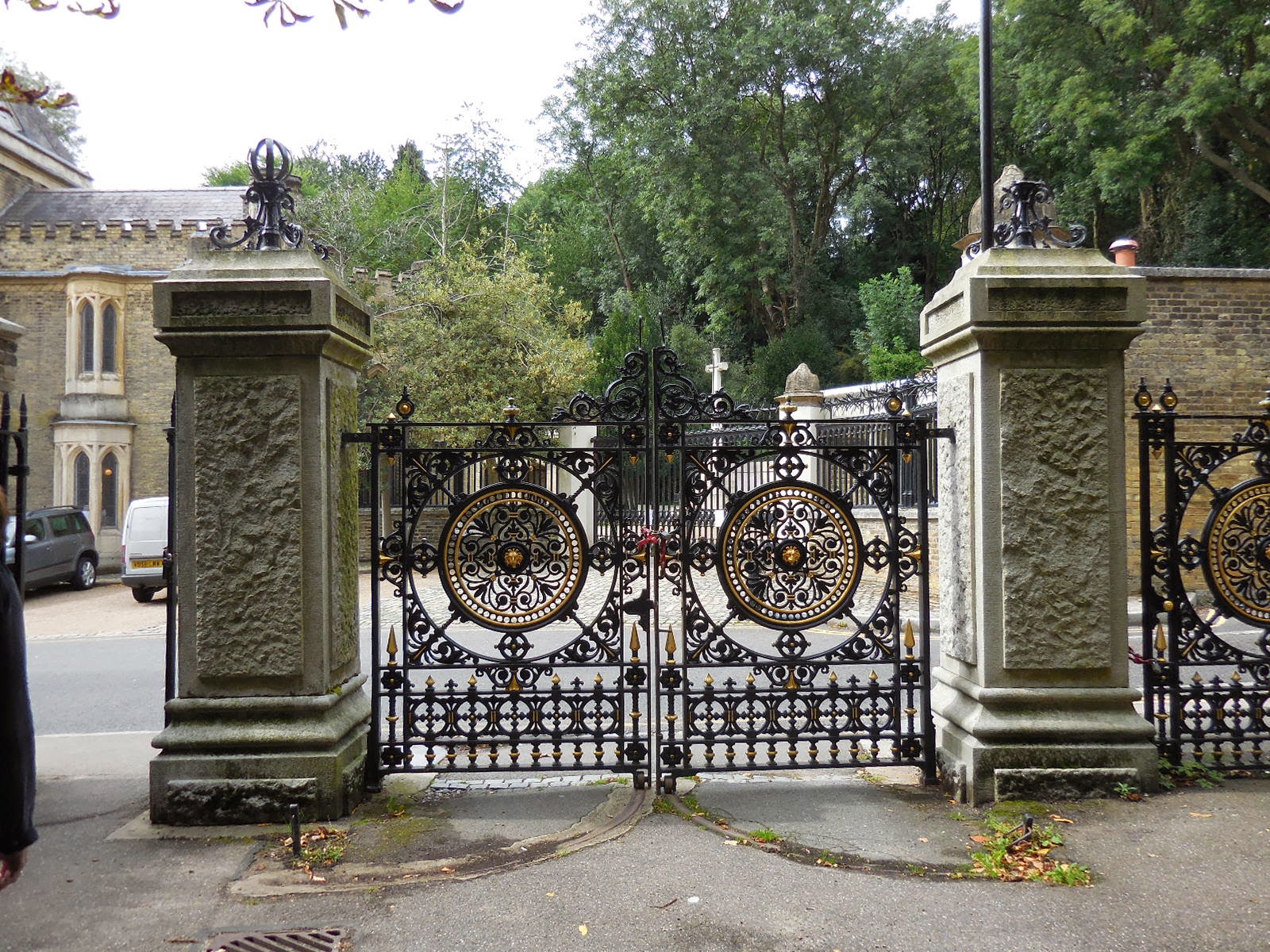
Entrance Gates in Swain’s Lane
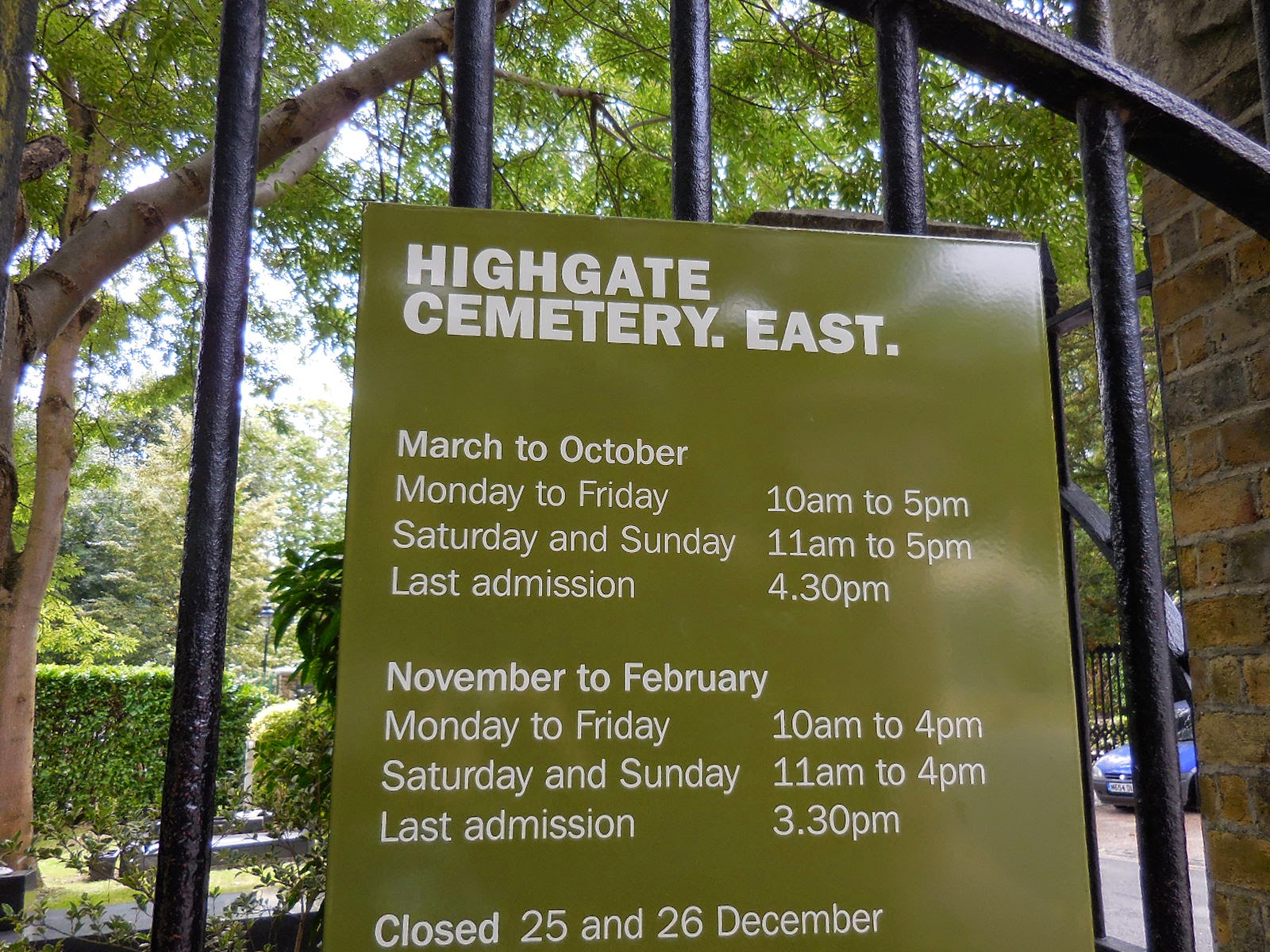
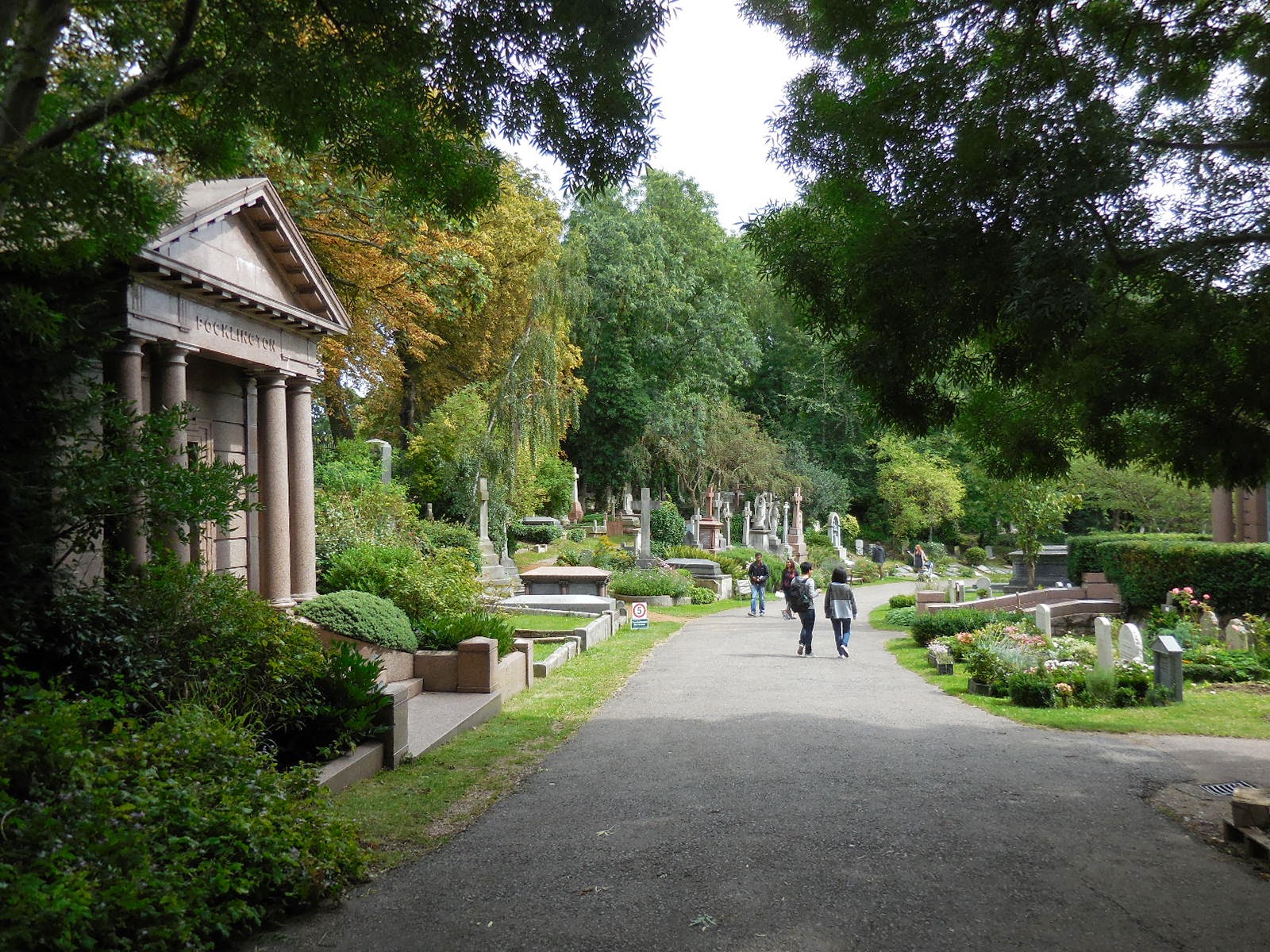
We started out wandering in the East part of the cemetery, where individual rambles are allowed.
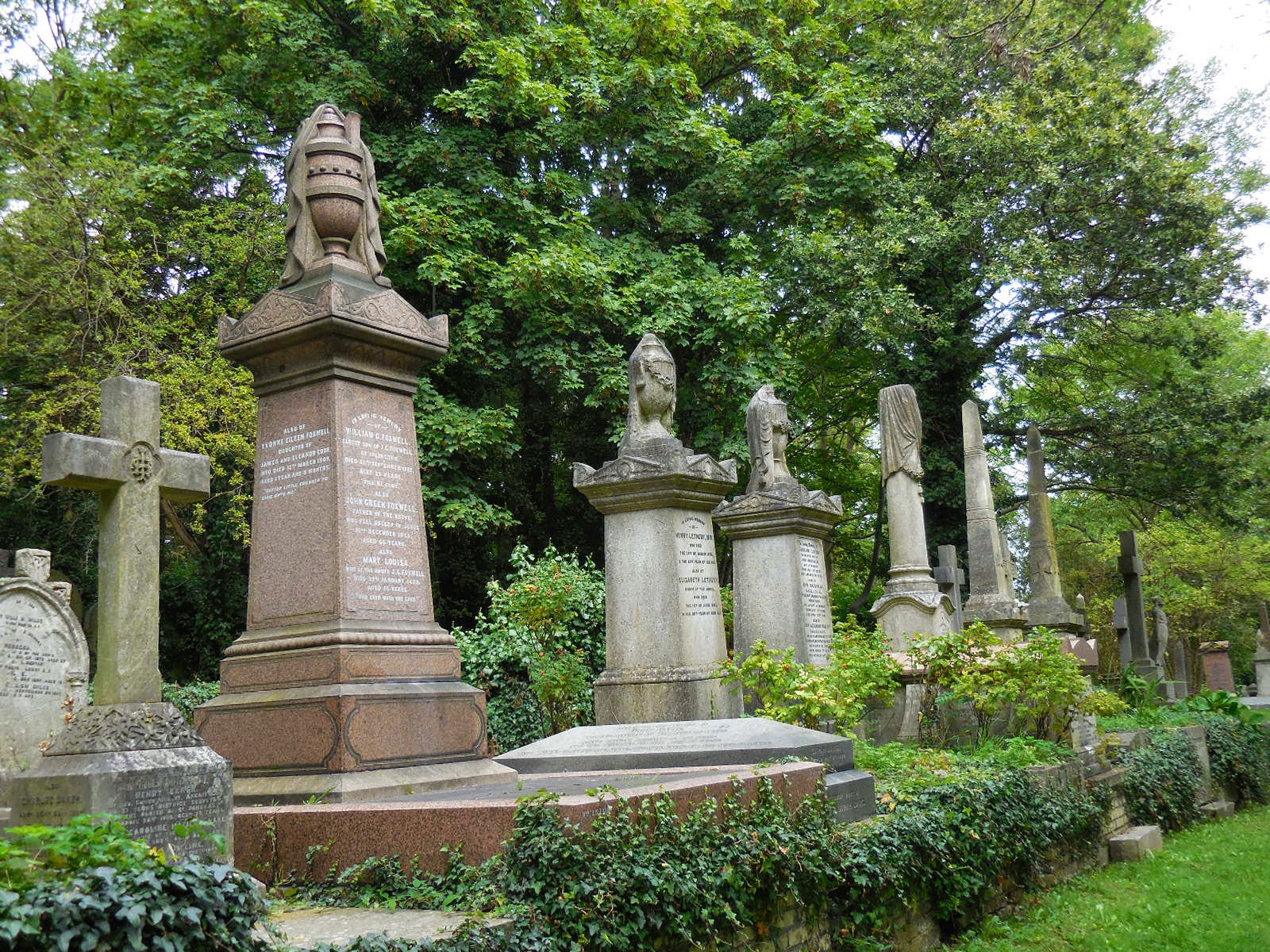
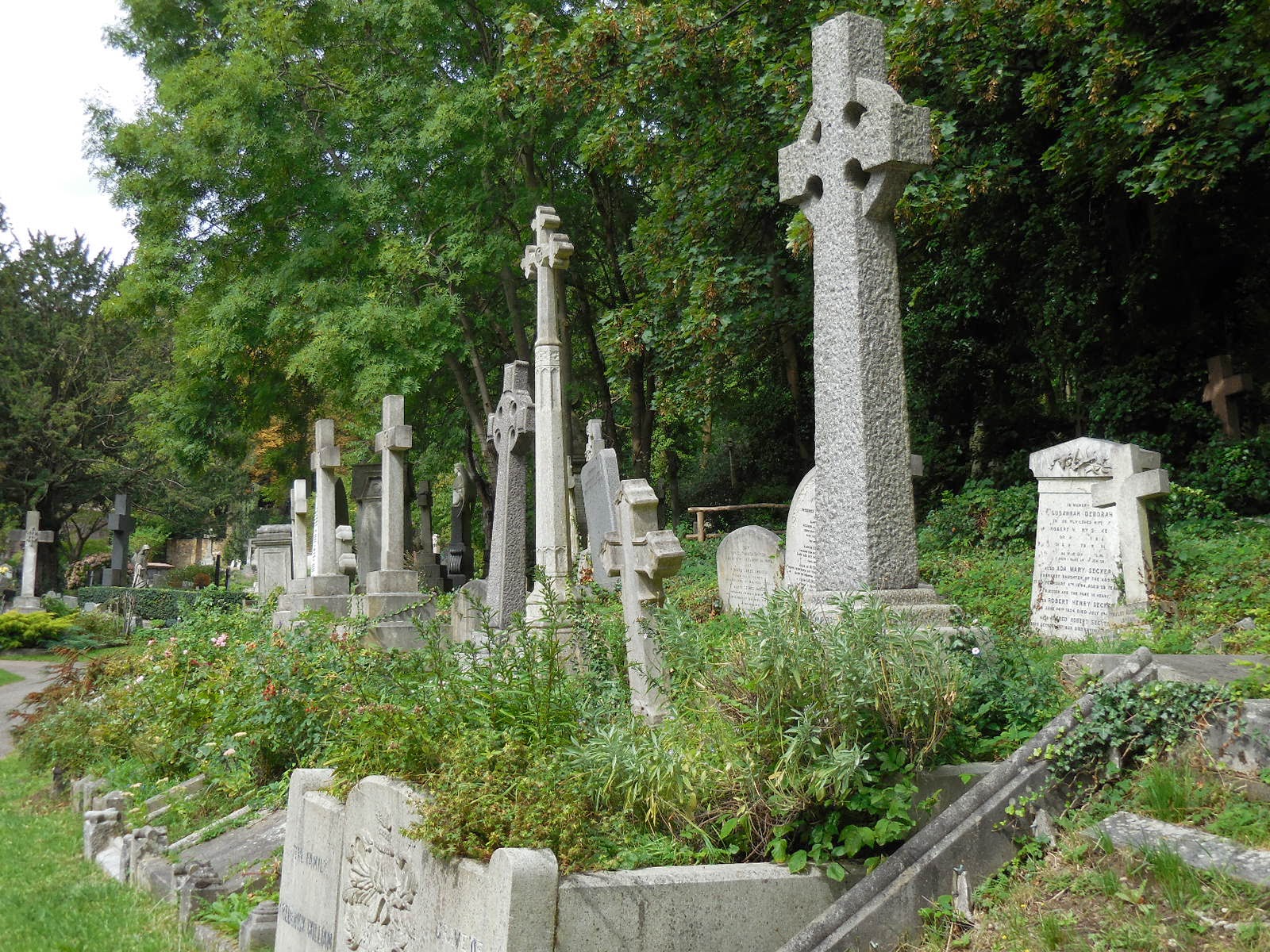
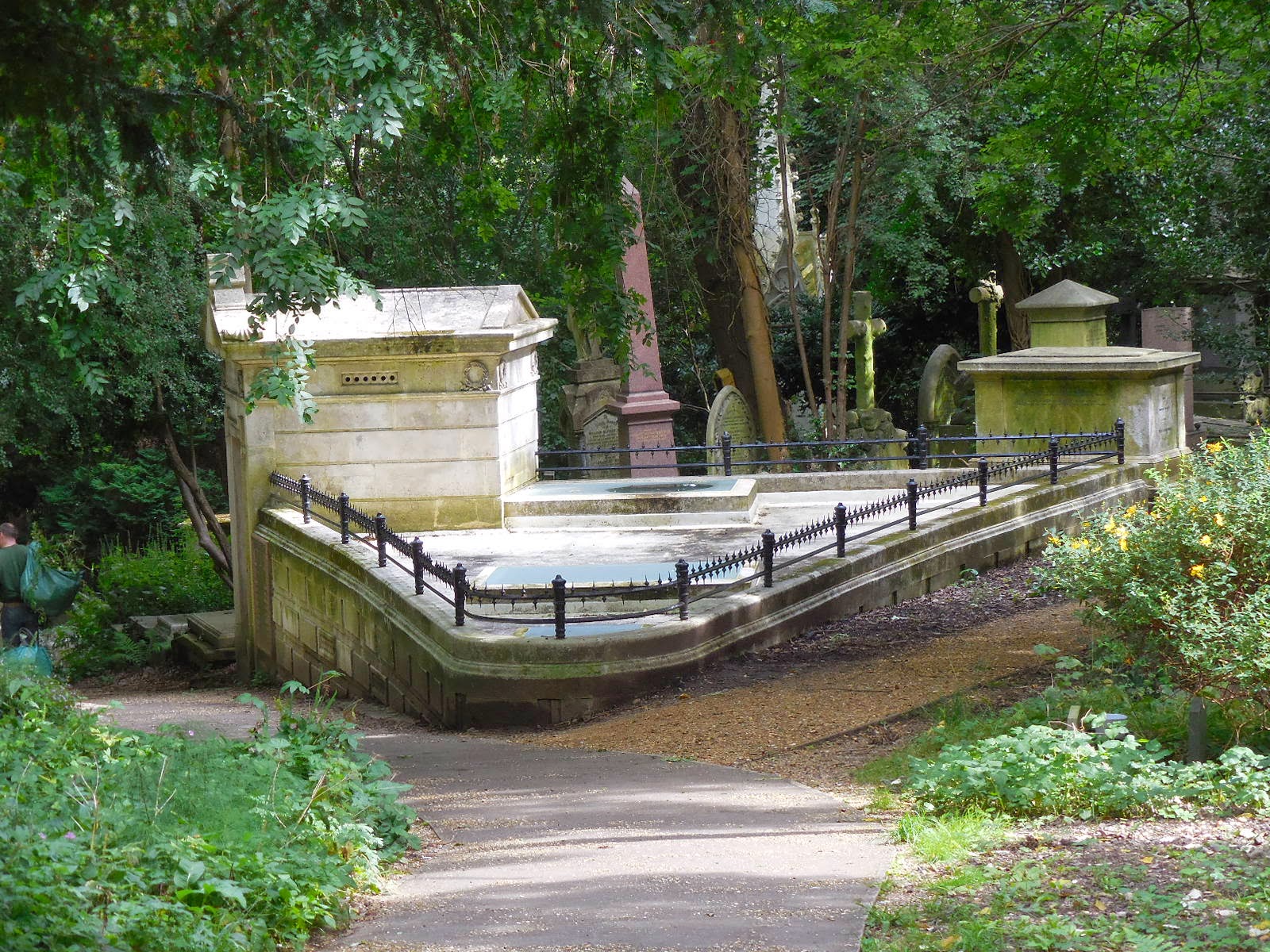
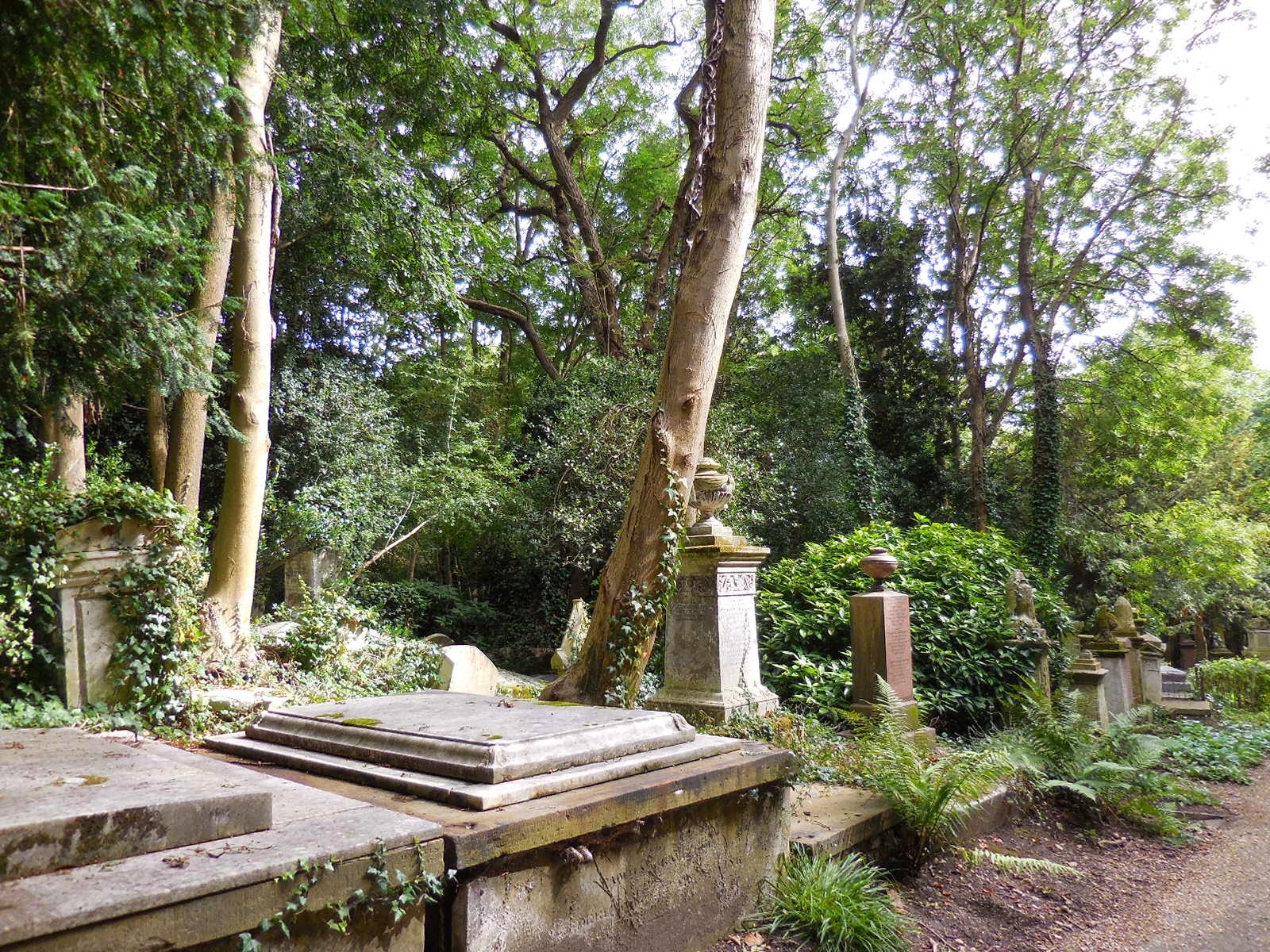
The paths are lined with memorials of all sizes and shapes.

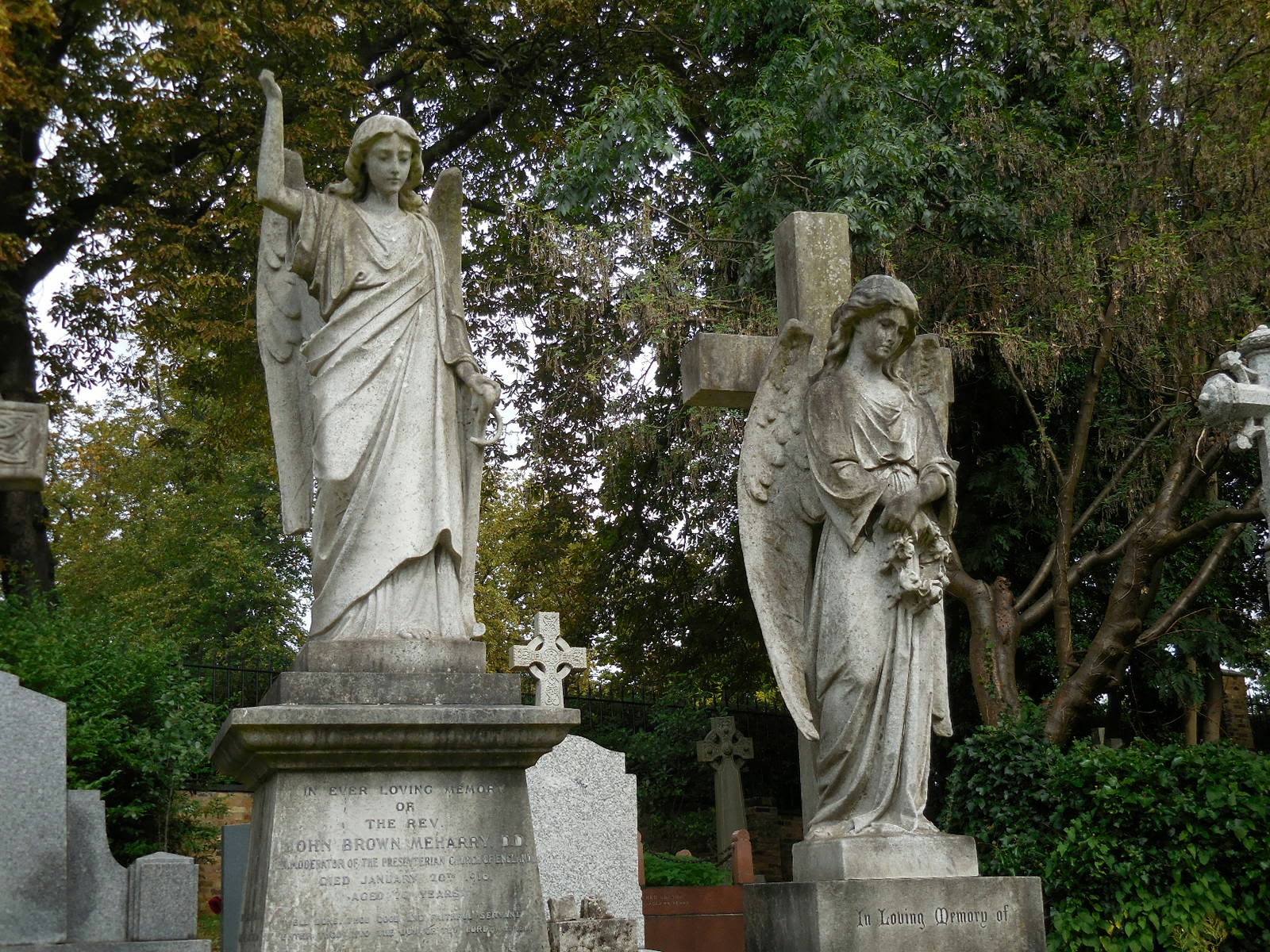
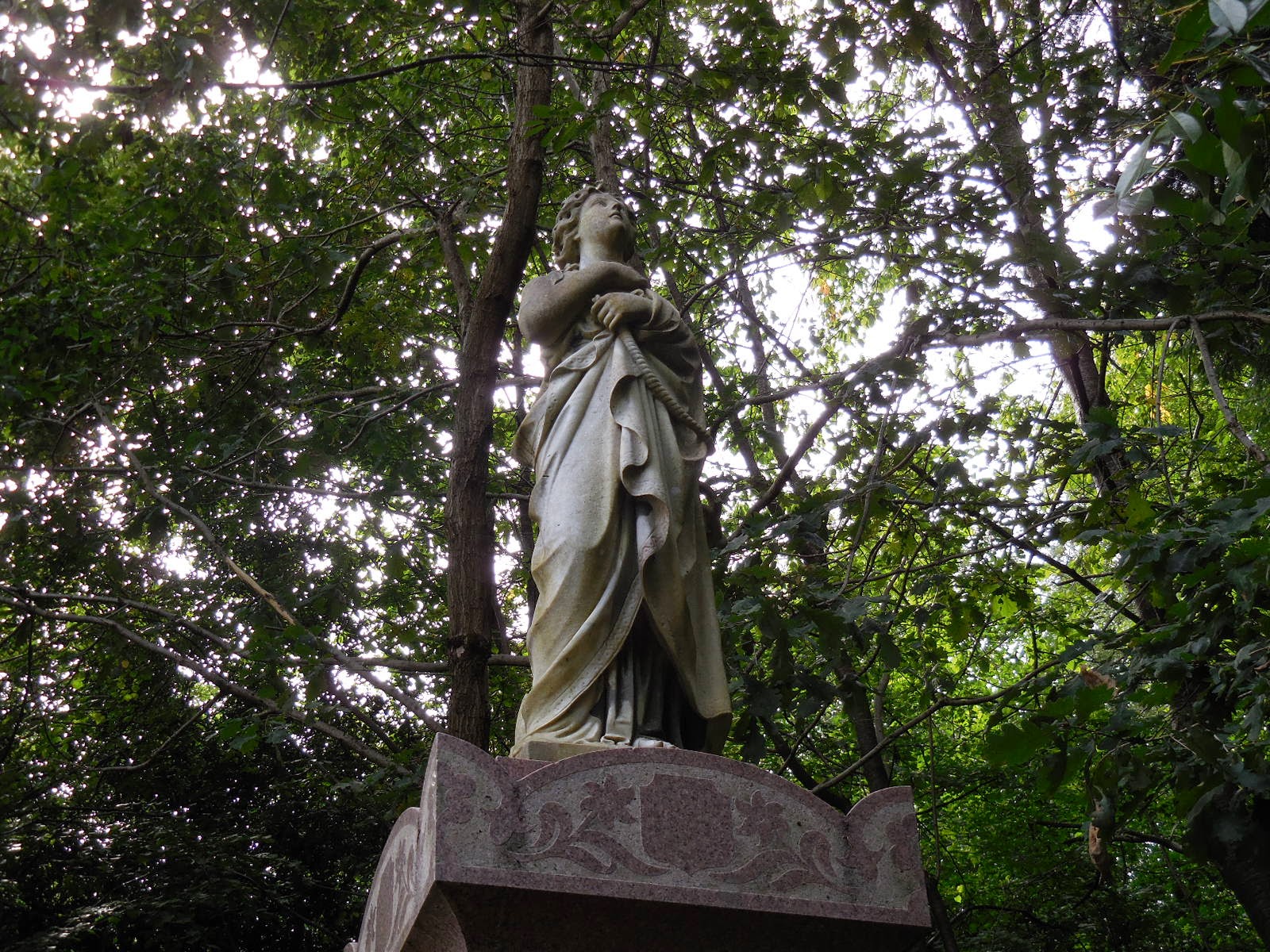
I wonder if anyone has ever counted all the angels watching over the departed?
As we will see even more below, Mother Nature rules the area.
The draped urns on so many markers represent the soul and the image of grief.

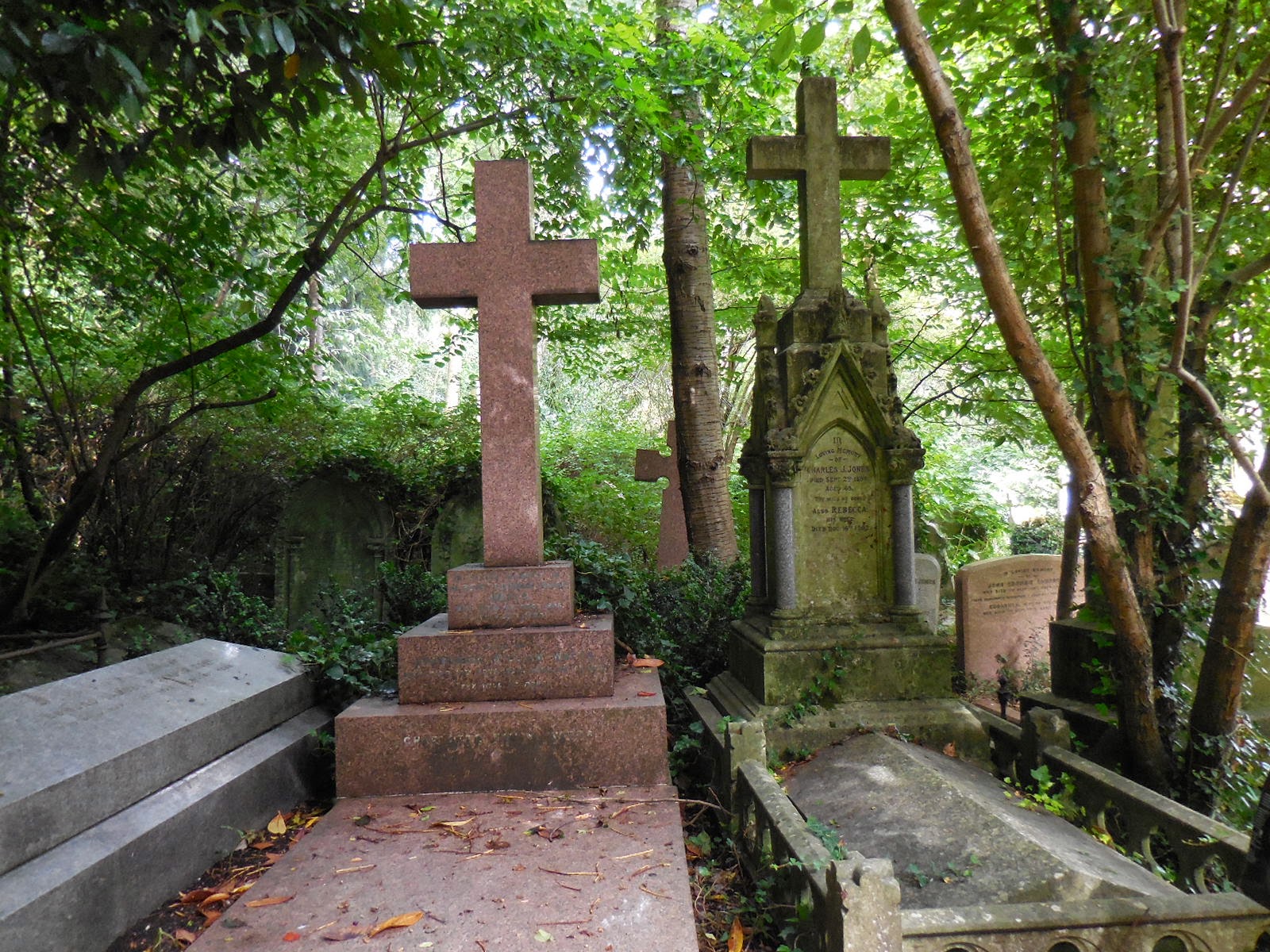
Many kinds of crosses 
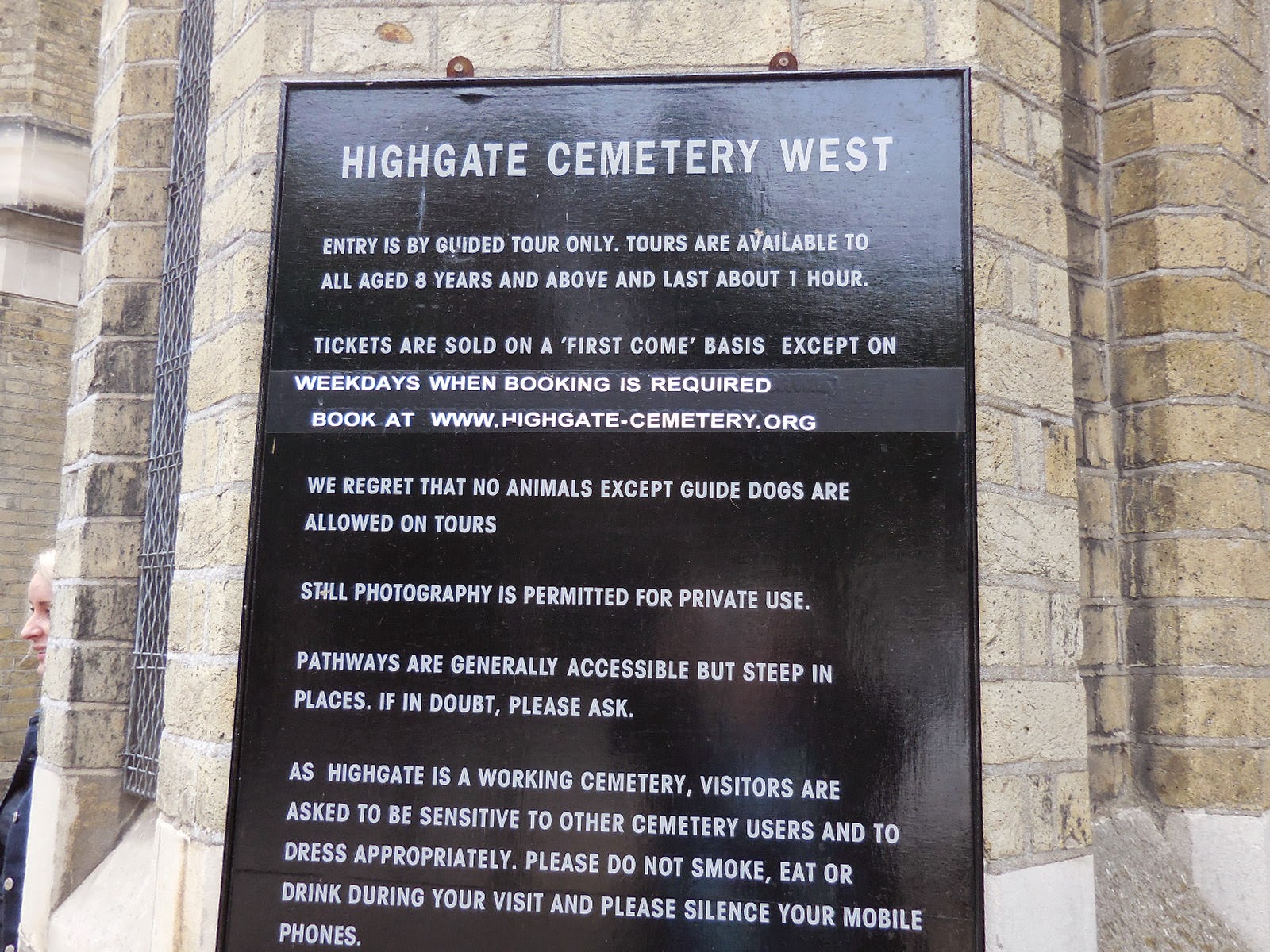
We moved slowly, fascinated by the sights, and soon we had to hurry back to the West part of the cemetery for our guided tour, beginning at the Chapel. As you will see below, there is a reason to require guides for this larger part of the cemetery. It would be very easy to get lost!
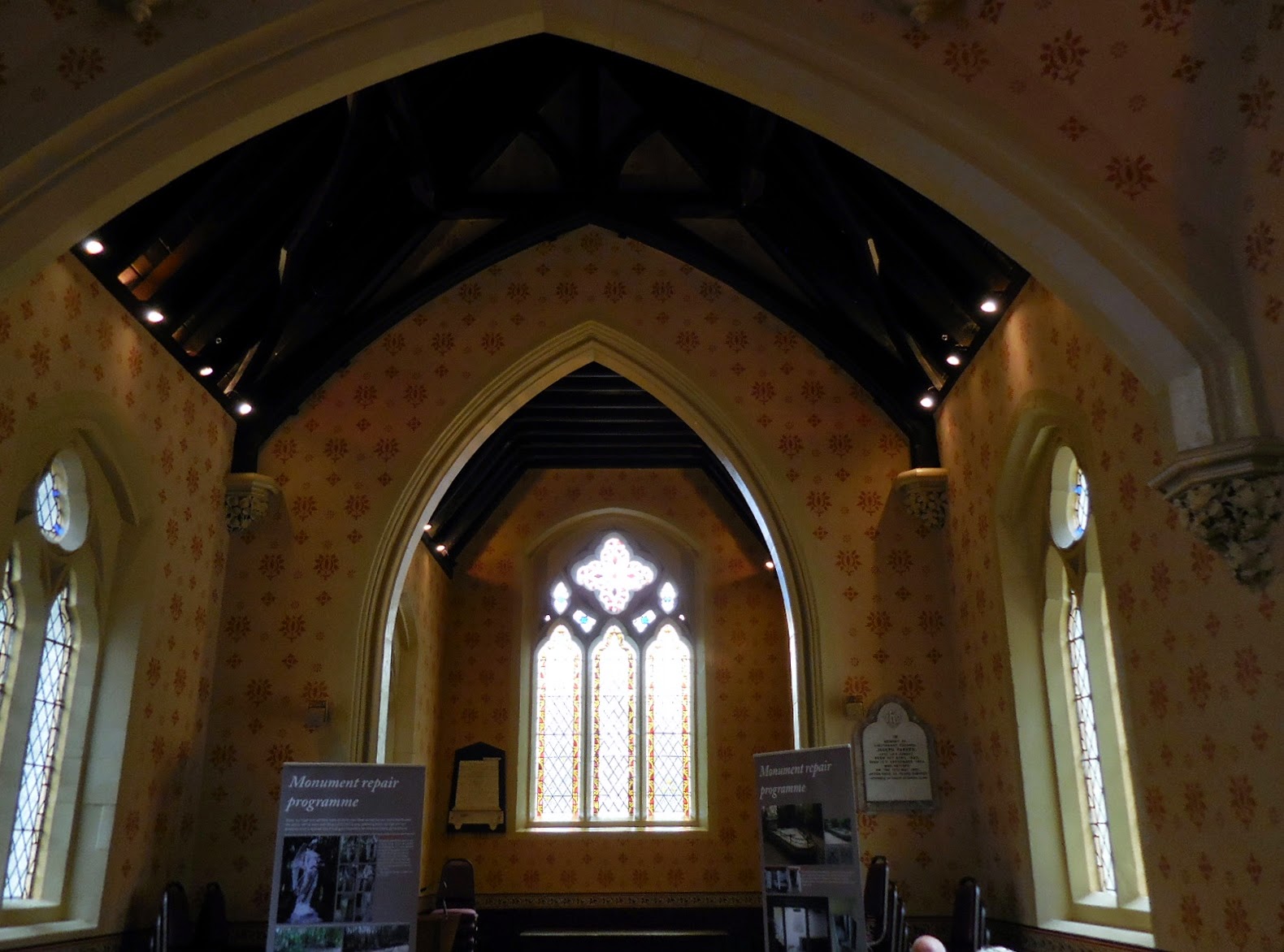
Victorian Stained Glass in the Chapel

Monuments of all varieties
Highgate Cemetery is maintained and managed by a Friends group which organized to preserve the grounds. Though some of the monuments and graves are maintained by families, many were abandoned long ago.  The Friends group keeps the natural growth under some control without trying to restore the appearance to that of the originals. It is also a wildlife refuge for all sorts of creatures, few of which ventured out while we humans were trudging around.
Areas on both sides of the cemetery are available for current burials, and among the Victorian monuments, you find recent graves here and there.  One of the most famous is below.
Alexander Litvinenko (1962-2006) is widely believed to have been poisoned by Russian agents in London.
Author Beryl Bainbridge, DBE, 1932-2010,
And many old ones…
The tomb of General Sir Loftus Otway, 1775-1854, hero of the Peninsular War
and family members
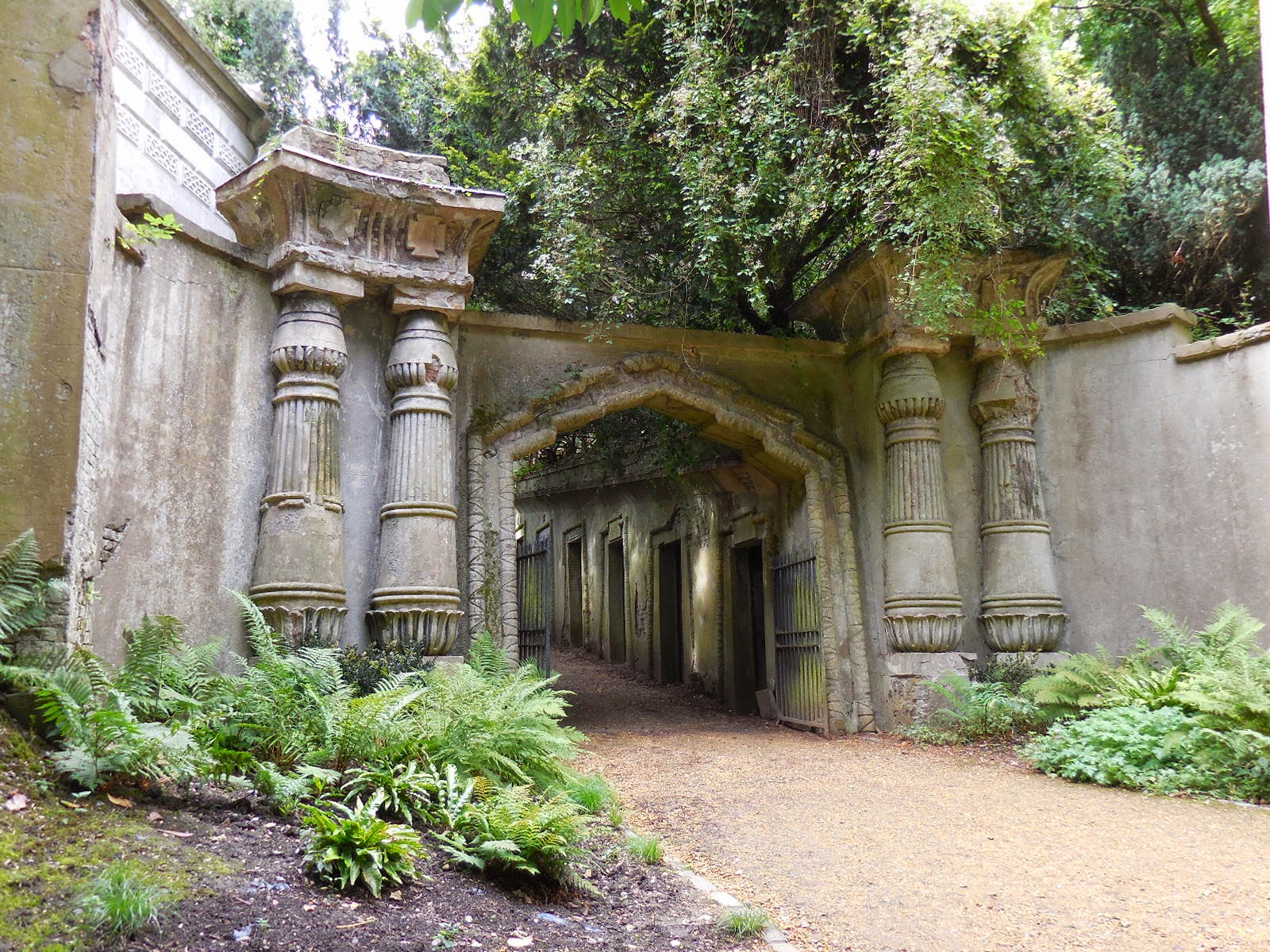
The Egyptian Avenue,
among the most exotic areas reflecting the Victorian imagination  of the cemetery creators.
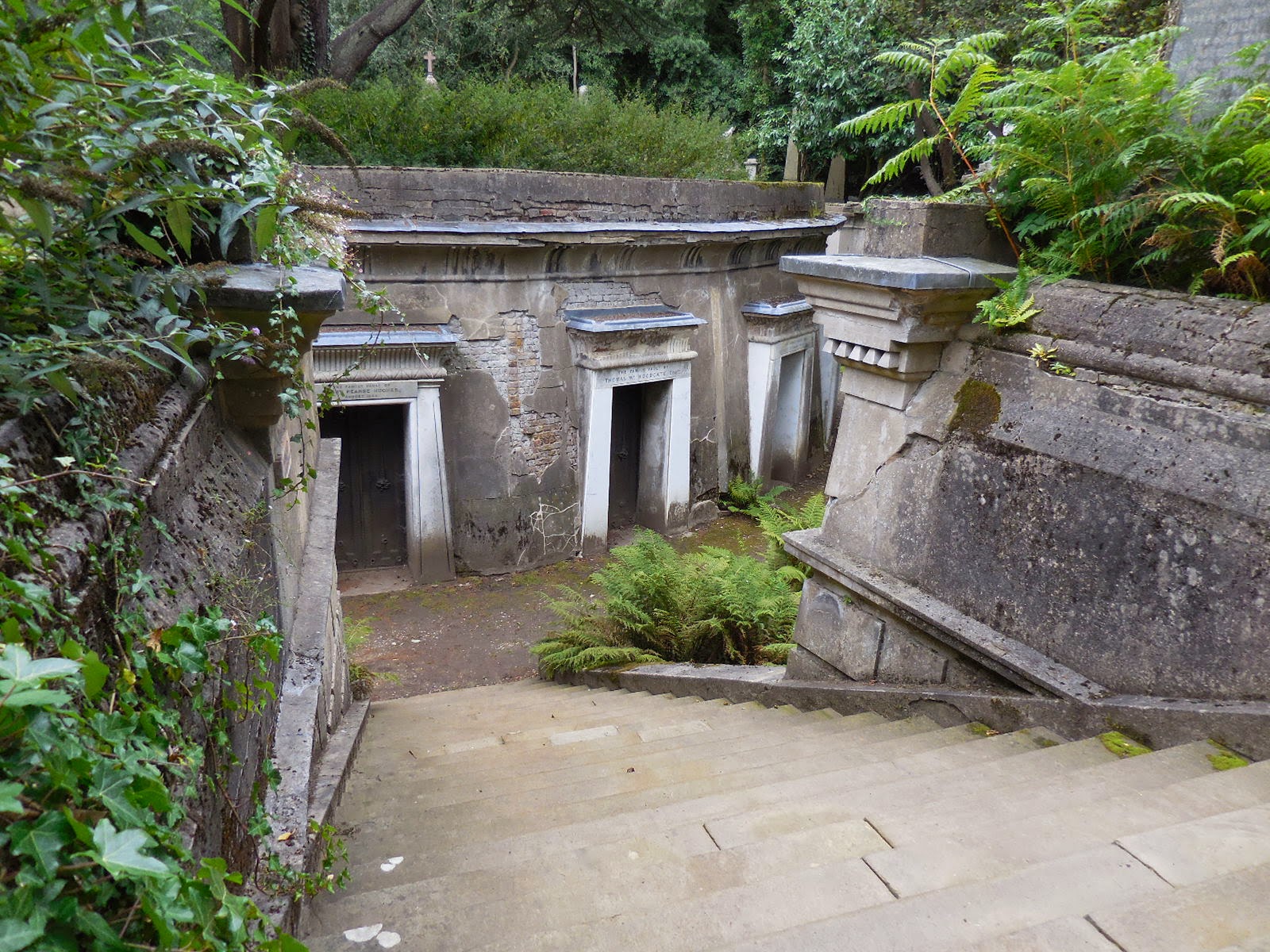
Circle of Lebanon
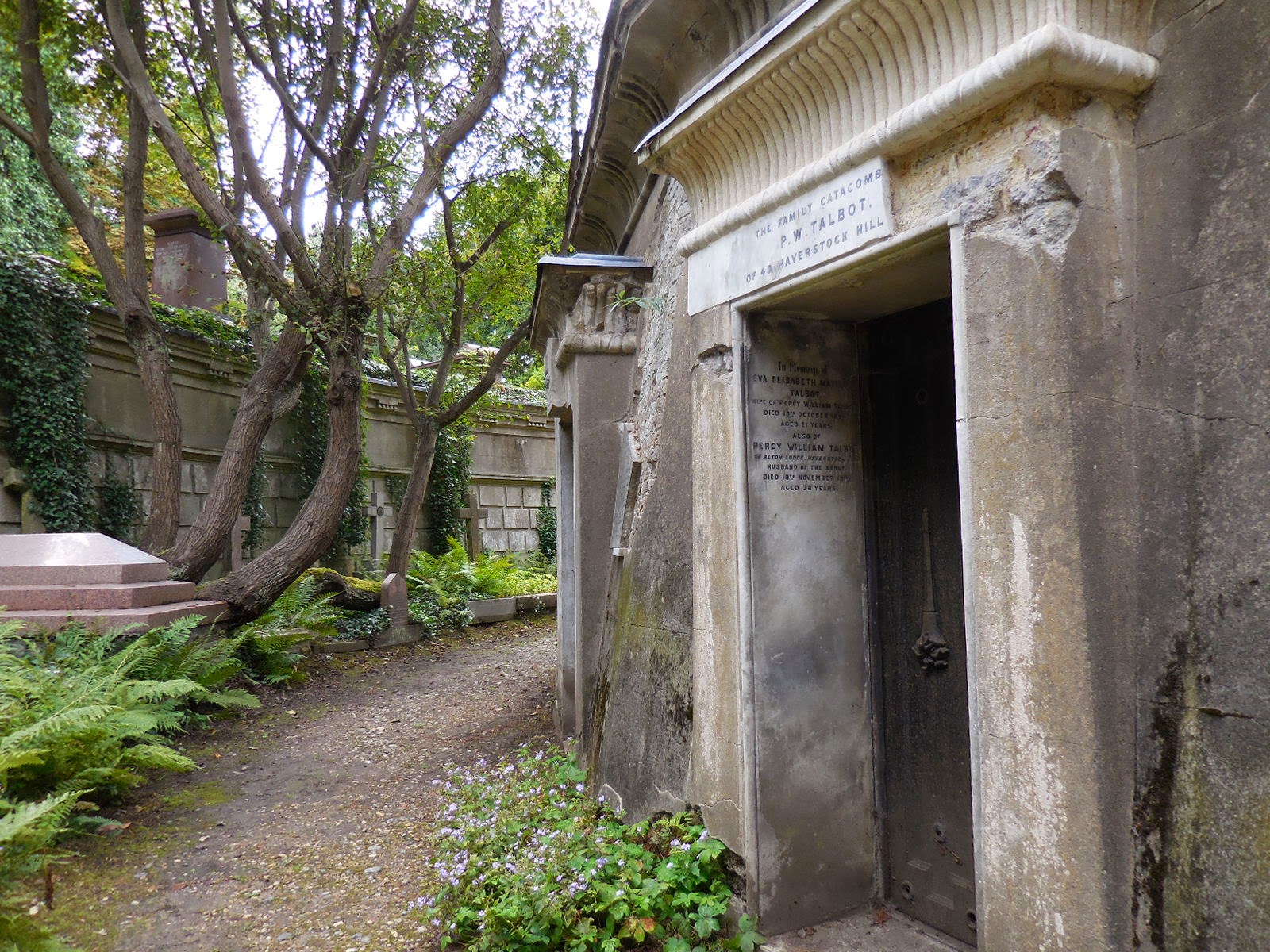
The Family Catacomb of P.W. Talbot of 439 Haverstock Hill
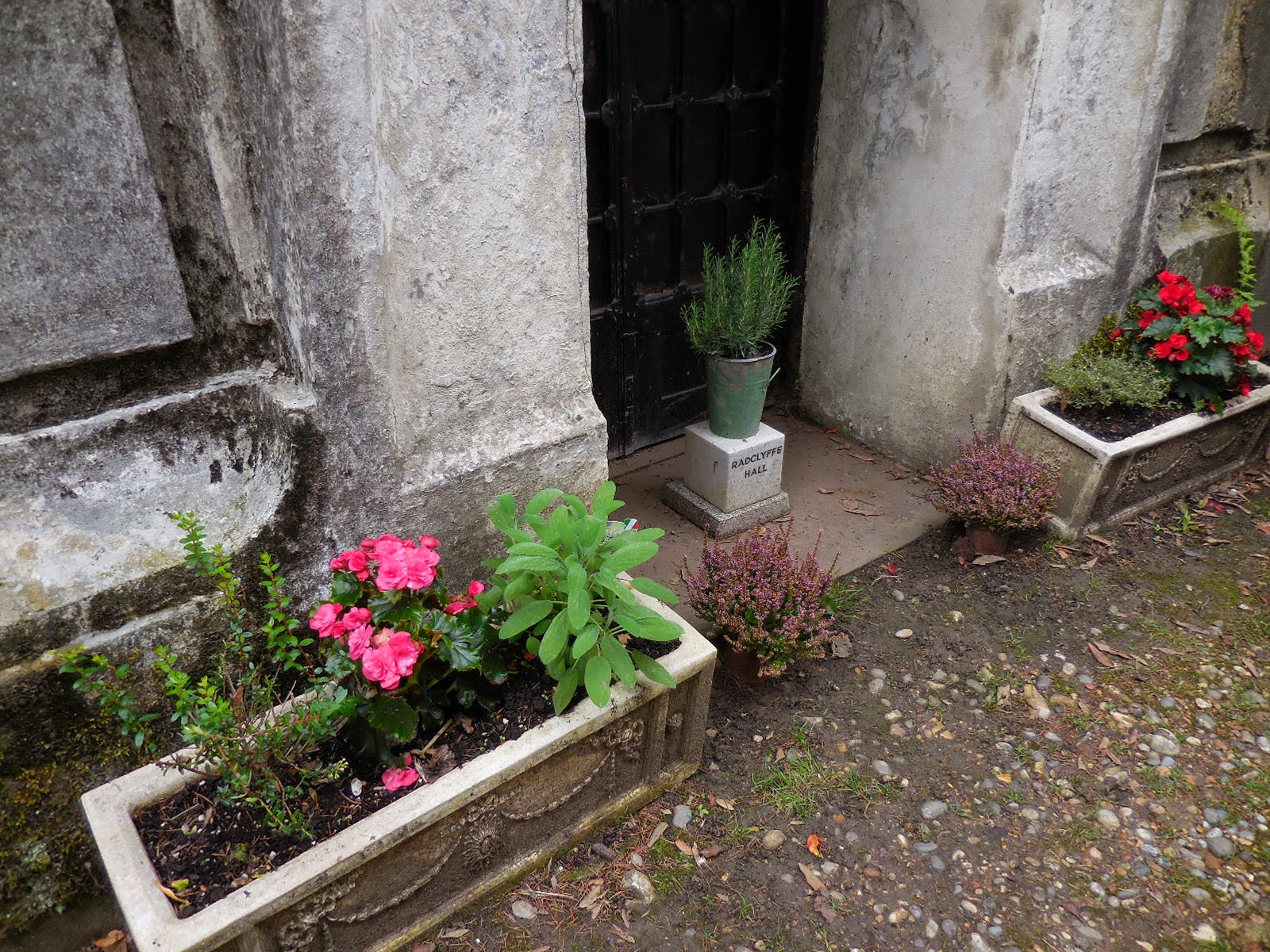
Vault of author Radclyffe Hall 1880-1943 and her partner Mabel Batten
Hall wrote The Well of Loneliness, 1928; admirers keep fresh flowers here always.
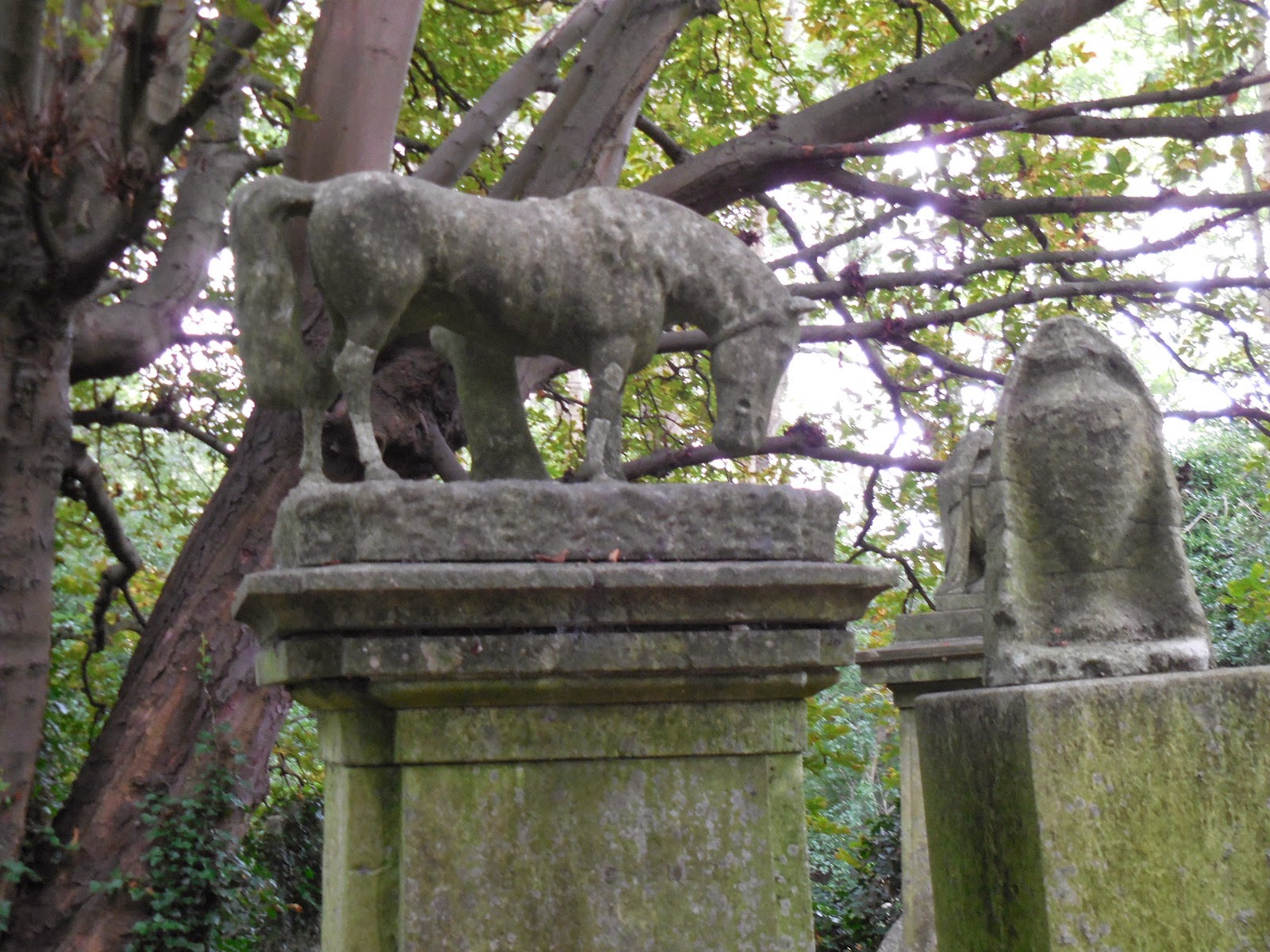
This horse is one of the numerous animals adorning gravesites.

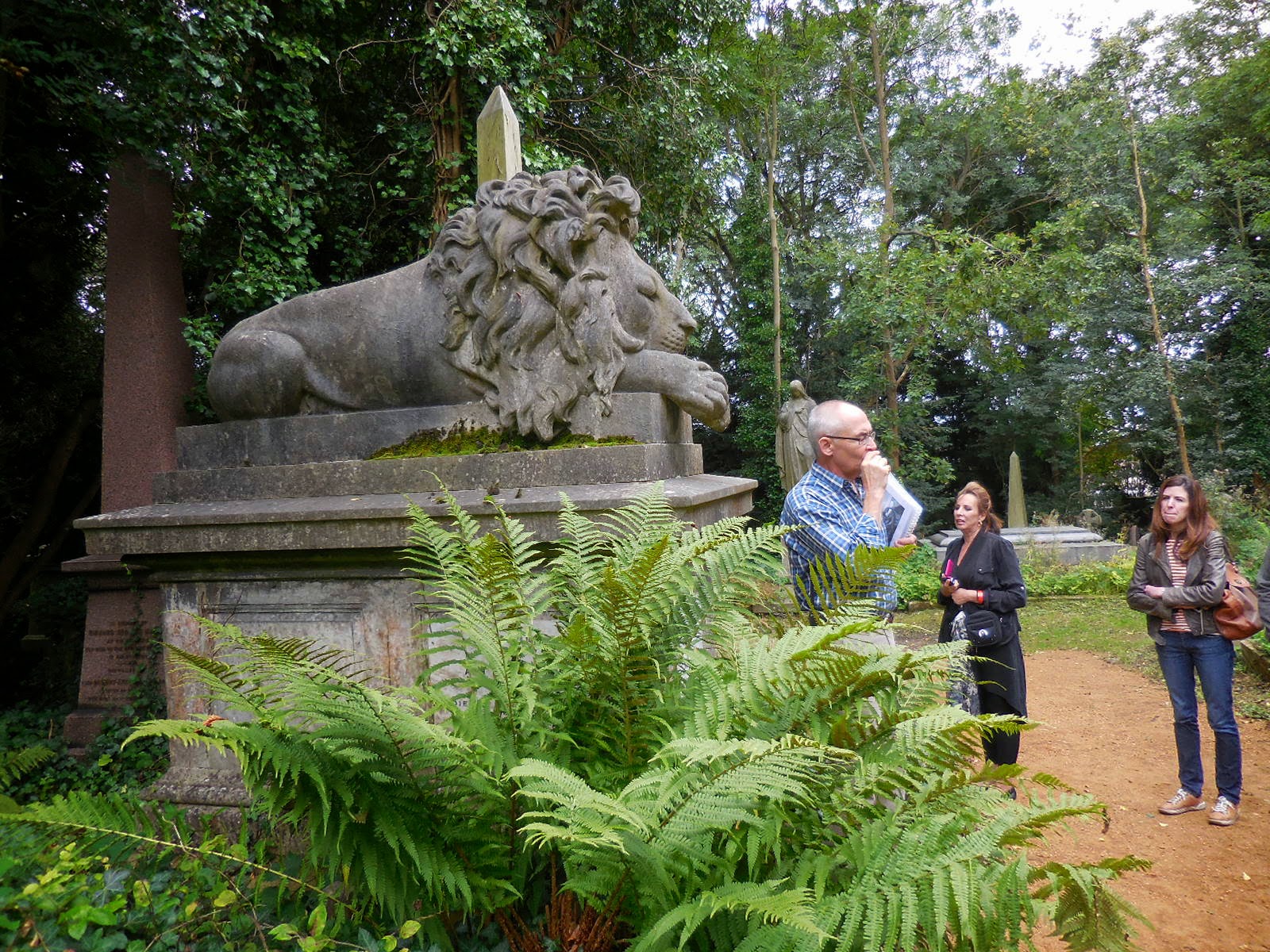
Our Guide tells us about the tomb of George Wombwell 1777-1850
known as The Menagerist, owner of a Victorian Traveling circus, 
interred below a statue of his favorite lion, Nero
Highgate was begun as a garden cemetery on the outskirts of London; by the mid-19th century, parish graveyards were running out of space.  In 1836, Parliament established joint-stock companies to build cemeteries. Stephen Geary (1797-1854) headed the group that laid out (so to speak) Highgate, planning to hold 30,000 gravesites

The slope on which Highgate was located had excellent views and clear clean air, contributing to the appeal of the site.

Victorian families acquired lots in the cemetery and sometimes adorned them with statuary before anyone died.  They often visited for picnics or just to admire their property. 
In preparation for this visit, I read Audrey Niffenegger’s interesting novel set at Highgate, Her Fearful Symmetry.  And I re-read Tracy Chevalier’s Falling Angels, also set at a Victorian burial ground. Both novels are fascinating for the subject matter and also for excellent prose styles.
RIP, Mary Nichols, and family. And all the other souls in this amazing place.

LOOSE IN LONDON: KRISTINE MUSES ABOUT HIGHGATE CEMETERY

Highgate Cemetery is another of those places that have been on my bucket list for years. I’ve always wanted to visit, but somehow never had the luxury of time in order to add it to past itineraries. So, after Kenwood House in the morning, Victoria and I headed over to Highgate via the bus. The bus itself was another thing I’d never done before – whilst navigating my way across London and England via the tube and railway seems easy peasey, the bus system mystified me before Victoria took me in hand and explained all the vagaries of the process. I admit I’m still a bit puzzled, as often during the coming weeks Victoriawould say that the approaching bus wasn’t the one we were waiting for, but let’s get on anyways. Huh? Why are we getting on a bus that isn’t ours? It doesn’t matter, she’d say, climbing aboard. I, of course, followed. Blindly and like a trusting sheep. Granted, we always reached our destination, but I still don’t have the whole bus thing down in my head, so I doubt I’ll be using it again if I’m in London without Victoria (quelle horror!).
The weather was glorious – warm and mild, with bouts of watery sunshine. And I was still wearing my fur lined boots. That morning, Victoria had found me sitting on the side of my bed, applying cushioned bandages to my feet.
“What are you doing?” she’d asked.
“Covering my blisters. Then I’m going to put on socks and then my boots.”
“Not those fur lined boots again!”
“Have to. They’re the only shoes I’ve got with me that don’t cause me to scream in pain with every step.”
“Do you really need all those band aids?” I raised my as yet unbandaged foot so that she could get a better look. “Holy Crow! I had no idea your feet were that bad!”
“Thus the fur-lined boots. And the fact that I’ve got no shame in wearing them in the middle of a balmy English summer. We have so much to do, none of which I want to miss out on, so band-aids it is. As Wellington said, `A man’s gotta do what a man’s gotta do.’”
“He did not. Wellingtondid not say that.”
“You don’t think so?” I said, ripping open another plaster. “I’ll bet he did. Many times. Think about it.”
“Okay, he might have said something along those lines, but who really said it?”
“John Wayne. And maybe Winston Churchill.”
So now here we were, on the bus traveling from Kenwood House in Hampstead towards Highgate Cemetery. As we rode, I thought about what Victoriahad said at Kenwood – that I always expect there to be people at these sites who are dressed in period costume. Sometimes, no kidding, I do find myself a tad disappointed in the reality of a place. I do expect period people to be present. Georgiana should be strolling the grounds at Chatsworth, complete with straw bonnet and a saucy tilt to her chin. Brummell should be sauntering up St. James’s Street with a walking stick in hand and clever insults at the ready. A carriage or two, along with a fresh pile of horse manure, would not go amiss. It would add to the period ambiance. As would a regiment of foot practicing squares in Hyde Park. Or milkmaids standing round Green Park with their cows nearby. I want to eat ices at Gunter’s and present my card at Apsley House, preferably to FitzRoy Somerset himself. I’d like to be able to visit Almack’s in order to see, first hand, just how lousy the refreshments were. I want to look up in the sky and witness balloon ascents. And go to the Exeter Change. I want a waterman to row me across the Thames to Vauxhall Gardens. If I met Caro Lamb and Princess Lieven, would they be as awful as I imagine they were? Would the original Earl Grey tea really taste like the 21st Century blend? How long would I last without Bacardi rum? Did Queen Victoria really bray like a donkey when she laughed? Was Prince Leopold really drop dead gorgeous at the time of his wedding to Princess Charlotte? 
“Our stop is next,” Victoriasaid, bringing me out of my reverie. We were almost at Highgate Cemetery– I’d finally be able to strike it off my bucket list. And it would most certainly not disappoint as the place would be filled with period people. Granted, they’d be dead and buried and not on view as they strolled the paths, but technically they’d still be there. 

 Highgate Cemetery Coming Soon!