CAPTAIN LINNAEUS TRIPE: PHOTOGRAPHER OF INDIA AND BURMA 1852 – 1860

Captain Linnaeus Tripe: 
Photographer of India and Burma, 1852-1860 

Part of the V&A India Festival 24 June – 11 October 2015 


www.vam.ac.uk/linnaeustripe| #LinnaeusTripe Captain Linnaeus 

Tripe (1822-1902) was a pioneer of early photography who created an outstanding body of work depicting the landscape and architecture of India and Burma (now Myanmar) in the 1850s. This major presentation of Tripe’s photographs will include more than 60 of his most striking views taken between 1852 and 1860.

On display will be Tripe’s photographs of architectural sites and monuments, ancient and contemporary religious and secular buildings, as well as roads, bridges, moats, landscape vistas and geological formations throughout India and Burma. Many of the images are the first photographic records of these sites and the prints on view represent the highlights of Tripe’s output. They will be shown alongside bound albums of his work, a panoramic scroll and two models of monuments similar to his subjects.

Linnaeus Tripe was born in 1822 in Devon, the ninth of 12 children, joining the East India Company army in 1839 and stationed in India throughout the 1840s. He learned to photograph during several years on leave in England in the early 1850s. The exhibition will highlight Tripe’s considerable skill at a time when photography was about to undergo rapid change and the practice and recognition was becoming more widely adopted. It will also show his understanding that photography could be used to convey information about unknown cultures and places to the general public.

The photographs on view represent two major expeditions and preserve an important period in Indian, Burmese and British history. In 1855 Tripe was appointed by the governor-general of India to accompany a mission to Burma to study the area. Here Tripe became the first person to photograph the region’s remarkable architecture and landscapes. He then went on to be the first to photograph extensively in south India after his subsequent appointment as photographer to the Madras government. Through this official role Tripe aimed to capture as much of the south Indian region as possible. After each trip he returned with more than 200 large format paper negatives, from which he carefully oversaw the complex printing in his Bangalore studio that he founded for this purpose. Amerapoora: Colossal Statue of Gautama Close to the North End of the Wooden Bridge, 1855, Collection of Charles Isaacs and Carol Nigro Tripe’s photographs are technically complex and he is known for his innovative precision with the camera, paying close attention to both his composition and its realisation when printing.

To evoke atmospheric effects Tripe retouched most of his negatives by applying pigment in thin layers and included in the exhibition will be a selection of waxed-paper negatives that reveal these working methods. Also on display will be a segment of a panoramic scroll showing the inscriptions around the base of the Great Pagoda temple in Tanjore. Composed of more than 20 prints assembled and mounted onto a long canvas scroll, it is now regarded as a considerable technical achievement, given the physical and climatic conditions of the time.

Captain Linnaeus Tripe: Photographer of India and Burma, 1852-1860 is organized jointly by the National Gallery of Art, Washington and and the Metropolitan Museum of Art, New York, in association with the V&A. It includes photographs from the collections of the National Gallery of Art, the Metropolitan Museum, the British Library and many private lenders, as well as photographs and objects from the V&A’s own extensive collection of Tripe’s works.

For more information, visit the V and A website here.

THE SEARCH FOR PAGET'S LEG

This post was originally published here on June 19, 2011

Wellington comforts Paget after his surgery at Waterloo

I am so glad, for so many reasons, that my very good friends are Jo Manning and Victoria Hinshaw, not least because we share the same historic interests and the same mania for researching, and visiting, little remembered facts and places in British history. Recently, Victoria kept Jo and I in thrall with the minutae of her research itinerary whilst in England via a series of rapid fire emails – where she was going, what she was researching, the research matrix she’d prepared, who her contacts were at various archives, what the train timetable was and where she’d be eating lunch. And Jo and I swooned at the prospects. In addition to shared interests, all three of us have our own, unique historic quests and we support each other fully in these, no matter how crazy they seem. Last year, my particular quest was something the three of us termed “The Search for Paget’s Leg.” 
Being an avowed Wellington afficianado, you wouldn’t think that I’d spare much energy worrying about either Henry Paget, Lord Uxbridge (created Marquis of Anglesey by Geo. IV five days after the Battle of Waterloo) or his leg, as Paget had earlier run off with Wellington’s sister-in-law, his brother Henry’s wife, Lady Charlotte. At the time, Paget was also married – to Lady Jersey’s daughter, Lady Caroline Elizabeth Villiers, by whom he’d sired eight children. (Yes, eight – the bounder! He went on to have TEN more with Charlotte). Wellington felt the impact of this desertion as well, as it threw Henry into a decline from which he was slow to recover and, in the meantime, Wellington and his wife, Kitty, had to take care of Henry’s two young children, as Henry was incapable of doing so himself.
You’ll recall that last year Victoria and I embarked on a whirlwind London/Waterloo tour, during which I was most looking forward to seeing the spot in Waterloo where Paget’s leg was buried. Yeah, yeah – totally nuts. But you have to bear in mind that Victoria, Jo and I are the Lucy Ricardos of historical research.
I realize that I’m writing this blog as if you already know the story behind Paget’s leg. If for some odd reason you’re not familiar with it, click here for the condensed version of the story. So . . . all along the route of our tour, from London to Waterloo, I’d sigh at intervals and tell Victoria, “I can’t wait to see Paget’s leg.” After the re-enactment of the Battle of Waterloo itself, Paget’s leg was to be the highlight of the tour for me. I’ve already admitted that this notion of mine was strange, but it becomes stranger still when you realize that Paget’s leg isn’t even at Wellington’s headquarters in Waterloo any longer. It was disinterred and shipped back to England when Paget (Anglesey) died in 1854 and was  buried along with the rest of him in St. Paul’s Cathedral in London. Yes, Paget and Wellington are buried in the same place. Poor Artie couldn’t shake this guy loose, even in death.
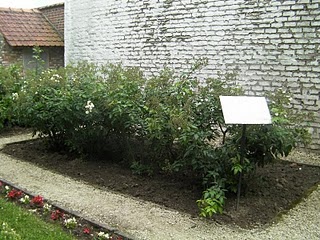
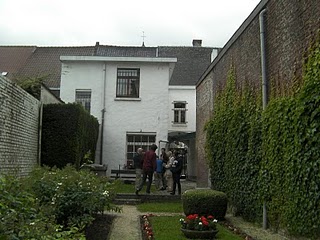
So . . . . the very last stop on the Waterloo portion of our tour was the Wellington Museum (formerly Wellington’s headquarters), where, out in the back garden, stands the spot where Paget’s leg (once) was. Even though the Heavens didn’t direct rays of sunight onto the grave whilst I was there, nor did a choir of angels sing whilst I gazed upon it, I was in alt.

The (rather smallish) back garden

The (once) final resting place of Paget’s leg


The sign by the (former) grave
Of course, the grave itself was not the Holy Grail, rather it had become to me the symbol of all that was the Battle of Waterloo – the tragedy, the drama, the irony, the heartbreak and the heroics. I could have as easily fixated upon the site of the Duchess of Richmond’s Ball, which would have been just as fitting, as that no longer exists, either.
So . . . what’s next on my 19th century bucket list? The decoupage screen Beau Brummell was toiling away on and which was meant to be a present to his great good friend Frederica, Duchess of York.  Brummell stopped working on it when news of her death reached him in France. Trouble is, I have no idea where to begin looking for it. If you’re an aged aristocrat living in the back of beyond who happens to have the screen in your attic, email me. Heck, email me even if the screen only used to be in your attic.  Victoria, Jo and I will then embark on what we shall no doubt call “The Quest for Brummell’s Screen.”

WHAT WE SAW IN BRUSSELS IN JUNE, 2010

Victoria here, telling you about how Kristine and I began our visit to the Battlefield of Waterloo in June 2010. We took the Eurostar from London to Brussels, an easy trip. After we checked into the Hotel Bedford (note very British name), our bus took us to Evere Cemetery, where we walked to the British Waterloo Monument, a huge memorial set atop a crypt.

It was commissioned by Queen Victoria in 1870, said to be the “first to honor the dead of a campaign, as opposed to the many memorials that commemorate a victory.”  Seventeen officers remains are buried here. It was dedicated in 1890.
Col. Sir William Howe de Lancey  and Lt. Col. the Hon Sir Alexander Gordon, ADC to the Duke of Wellington, are the highest ranking men buried here.
The pictures above and below were taken in the fall, with fewer leafy trees in the way.
Above you can see the door leading into the crypt. This was reached via very steep steps leading down from the lawn surrounding the monument.
The monument was designed by Belgian sculptor Count J. De Lalaing, whose talent is obvious in the life-like representations of the lions guarding the tombs and the way the fabric seems to flow as it drapes the tomb.
The inscription reads: “In memory of the British officers non-commissioned officers and men who fell during the Waterloo Campaign in 1815 and whose remains were transferred to this cemetery in 1889. This monument is erected by Her Britannic Majesty Queen Victoria, Empress of India, and by their countrymen on a site generously presented by the City of Brussels.” 
In 1815, this park in the upper town in Brussels would have been full of British and Allied soldiers. In fact, it is the very park through which the diarist Creevey used to pursue the Duke of Wellington in hopes of gaining some news of the expected battle. Time and again, the Duke confounded Creevey with his nonchalance about upcoming events and his apparently carefree attitude, prompting Creevey to write that he thought the Duke must be either mad or drunk. It never occurred to Creevey that the Duke wouldn’t dare tell him anything, as Creevey was well kno
wn to be a gossip who simply couldn’t keep his mouth shut.
A few years later, in 1830, some of the fighting for Belgium’s  independence from the Netherlands took place here in this lovely park.
Above is what we saw of the Duke of Wellington’s Headquarters in Brussells which was undergoing renovations during our visit. We couldn’t get a clue as to what the building looked like — unless it was a twin of the building on the left.
The two above photos above show the City Hall in the Grand Place in Brussels. Below is an image from the web which show’s the building’s location within the Plaza.
The entire Grand Place is surrounded by elegant buildings and filled with strollers and tourists rubber-necking at their baroque splendor.

Although we visited the site of the Duchess of Richmond’s Ball, it now contains an ordinary office building and I didn’t even bother to take a picture. The painting above hangs at Goodwood House, country home of the Dukes of Richmond.

 Unfortunately, the modern world has obscured many of the features of the city from the 18th and early 19th centuries, but we were certainly thrilled to have stood in these places and to cast our minds’ eye back to what it must have been like in 1815.

NATIONAL PICNIC WEEK


by Guest Blogger Ahmed Al-Ansari

From the 13th to the 21st June 2015 the nation celebrates National Picnic Week! For those busy working or who live in one of the many high rise apartments in the city we have compiled a list of the top green spaces that you can enjoy while on a lunch break, day out or simply a stroll.
We have even gone to the trouble of listing the closest tube station to show how easy it is to reach these fantastic communal parks.


Image Source: www.royalparks.org.uk
    The Green Park

Closest Tube Station: Green Park or Hyde Park Corner

Green Park is one of the smallest royal parks in the city centre with just 40 acres. It lies next to Buckingham Palace and is a popular location for picnics.
This park opened to the public in 1826, previous to then it was an enclosed area used as a hunting ground by King Charles II.
Although the area is smaller and has just one kiosk for refreshments the location is so central it is perfect for those wanting to take part in the ‘Picnic Week’ during a lunch hour with use of some very British striped deck chairs for hire.

Image Source: www.hampsteadheath.org.uk


   Hampstead Heath
Closest Tube Station:  Golders Green, Hampstead Heath or Kentish Town

‘The Heath’ as it is known is one of the oldest areas of common land in London dating back to 986 and it is even mentioned in the Doomsday Book of 1086.
This open space, although much smaller than back in the 9thCentury, encompasses 790 acres of land, with a zoo, athletics track, education centre, and three free swimming pools and a Lido!
If you are not the sporty type the park offers one of the best views of London standing at one of the highest points in the city.
The Heath also has a recognised status as one of London’s best places for wildlife.


Image Source: www.qpark.org.uk
       Queens Park
Closest Tube Station: Queen’s Park 


Queens Park, named after Queen Victoria in 1887, is also a registered charity.
The 12 hectares of space, although far smaller than the likes of Hampstead Heath, provide a green space in one of London’s most densely populated areas.
The park includes a tennis court, pitch and putt course, ornamental garden, paddling pool, small zoo and café.
Image source: www.gardenvisit.com
   St Dunstan in the East
Closest Tube Station: Monument or Tower Hill

This popular space was opened as a garden in the 1970’s, one of the more recent additions to London’s green spaces. Originally the Church of St Dunstan stood on the area but after damage from the Great Fire of London and the Blitz in 1941 the church went into disrepair and in 1967 it was decided that the ruins would be used as a garden area.
Those with green fingers will really appreciate this green space, rich with flowers webbing through the ruins.

Image Source: www.royalparks.org.uk

       
Hyde Park
Closest Tube Station: Lancaster Gate and Marble Arch

This is London’s biggest royal park at 350 acres which equates to approx. 1.5 miles long and 1 mile wide. The park once owed by King Henry VIII was opened to the public in the 1600’s but during that time only very high class members of society were allowed to enter the parks enclosures.
It is the home to landmarks including Serpentine Lake, Speakers Corner and Diana, Princes of Wakes Memorial Fountain, but what it is perhaps best known for in recent times is as a popular location for mass demonstrations, the Christmas Winter Wonderland and live music events.
The park also offers a volunteer run electric buggy service. ‘Liberty Drives’ are small sightseeing buggies driven by volunteers around the parks which do not charge a fare, but ask for a donation.
National Picnic Week runs from Saturday the 13th June to Sunday 21st June you can find out more here www.nationalpicnicweek.co.uk.
Author Bio: Ahmed Al-Ansari, Media Manager at Morgan Pryce, commercial property agents in London

logo