MERRY CHRISTMAS!

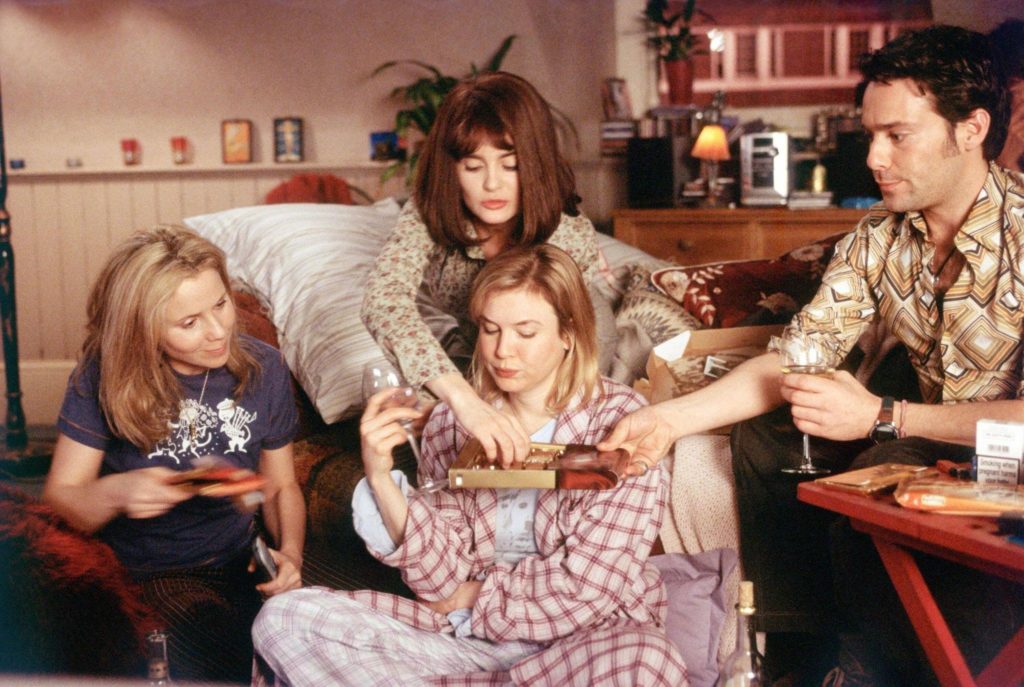
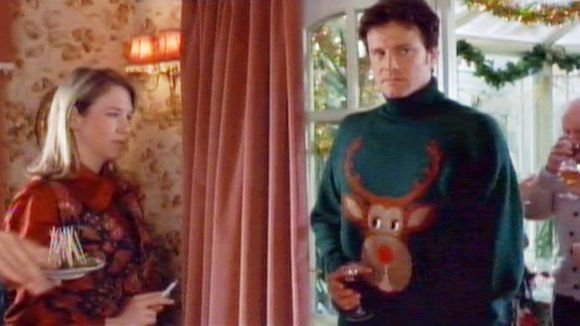
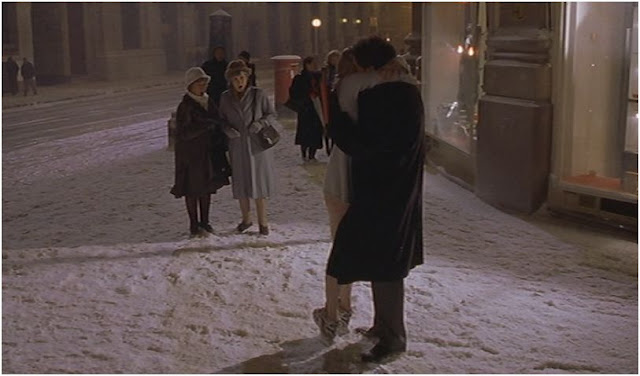
One of our favourite Christmas movies of all time at Number One London is Bridget Jones’s Diary. Taking our inspiration from the film, here are our Christmas wishes to you . . . . .


May you always be surrounded by good friends


May you always find the perfect thing to wear


May you always find joy in singing out loud


May you never run out of a supply of emergency ice cream


May you use your gift cards wisely


May you never run out of good books to read


May you always be up for new challenges


May you experience good will towards men


May all your recipes turn out perfectly


May you always have good hair days


May you never be forced to wear an ugly Christmas sweater

and . . . . .

may you always realize your heart’s desire

  Merry Christmas!

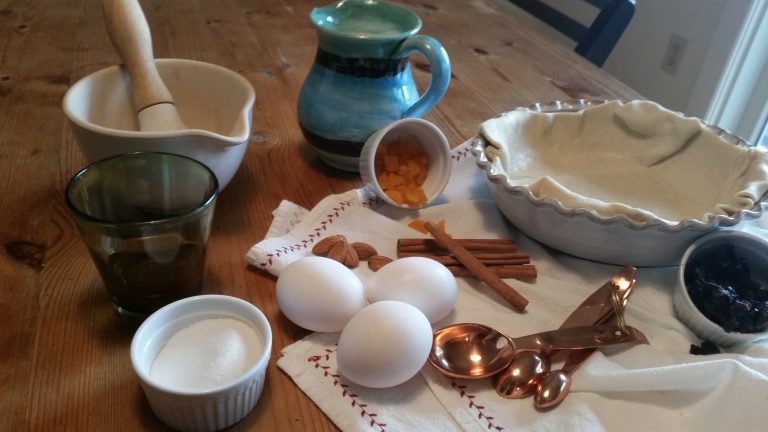
GEORGIAN CHRISTMAS PUDDING by Guest Blogger Gina Conkle

by Guest Blogger Gina Conkle

Does pudding make you think sex? Probably not. When someone says “pudding” most people think of the dessert easily made from a box. Its popularity has fallen in favor of cakes, pies, and ice cream.

But once upon a time, pudding was polarizing. Political factions rose up over the food. Laws were debated in England’s Parliament. Citizens clashed (and yes, even rioted!) over the right to feast as they saw fit. Pudding was surprisingly a contentious issue in England’s history. For a time, the dish was on the outs.

Georgian England, thank goodness, recovered their decorum. King George I was served pudding at Christmas dinner and he thought the dish divine. Pudding was back.

But, why all the hubbub over…pudding? Let me explain.

A funny thing happened during Christmas

Medieval England was largely Catholic. Christmas Day was generally somber with Epiphany (the twelve days following Christmas) the time to party big—in many cases with Mardi Gras-esque debauchery. Historically speaking, Mardi Gras actually begins on January 6th (Twelfth Night).

In modern times, that kind of revelry stays in New Orleans. But, imagine what would happen if it cropped up all over? Some would denounce the excess. In early 17th century, many did.

Naughty, sexy pudding

When Oliver Cromwell came to power, Parliament demanded change in England’s Christmas festivities. Pudding was an often-discussed dish. Lawmakers (many of them Puritans) called pudding “lewd” and “unfit for God-fearing people.” Puritans weren’t the only pudding-bashing group. Quakers claimed pudding was “the invention of the scarlet whore of Babylon.”

These groups objected to what went into dessert puddings, brandy being a chief ingredient. Those opposed to pudding felt the food added to drunken, licentious behavior. Of course, we know today high temperatures cook the alcohol, leaving only the flavor. You won’t get drunk on pudding.

But, Cromwellian leadership took the excesses to heart. They banned Christmas. They ordered shops to stay open on Christmas Day. Soldiers patrolled the streets and seized “Christmas feast food” which especially meant sinful pudding!

To be fair, the Scottish Kirk (church) had outlawed Christmas decades earlier. People north and south of the River Tweed were sickened by the gluttony of sins. When Cromwell’s reign ended, Charles II was restored to the English throne. Yet, Christmas and its famed pudding didn’t come roaring back. Citizens worn out from in-fighting didn’t rush to reinstate the old way of celebrating the holiday.

The Complaint of Christmas

It took satirist John Taylor to bring people to their senses. In his pamphlet, The Complaint of Christmas, Taylor decried the “harmless sports” of the holiday which “are now extinct and put out of use… as if they had never been.” He rightfully pointed out “the merry lords of misrule [are] suppressed by the mad lords of bad rule at Westminster.”

Christmas crept back…more like a lamb than a lion, but it was back. In moderation.

It took George I enjoying his first Christmas dinner as England’s monarch to bring pudding again into holiday popularity. The tasty dish was de rigueur!

Here’s to your Christmas feast (with pudding or without).

Gina Conkle writes lush Viking romance and sensual Georgian romance. Her books always offer a fresh, addictive spin on the genre with the witty banter and sexual tension that readers crave. She grew up in southern California and despite all that sunshine, Gina loves books over beaches and stone castles over sand castles. Now she lives in Michigan with her favorite alpha male, Brian, and their two sons where she enjoys recreating recipes from the past.

Gina’s website can be found here and you can also find her on Twitter, Facebook, Pinterest and BookBub. You can also subscribe to Gina’s newsletter for Bonus Reads.


ALL I WANT FOR XMAS IS A BIT OF OXFORD A CAPPELLA


Holiday Spirit?       Check!
Christmas Carols?   Check!
Gorgeous men?  Check!
It must be a bit of Oxford A Cappella Out of the Blue, Oxford’s all-male a cappella group looked dapper while dancing and caroling along to the 1994 hit single, which turned 20 years old last month.


Filmed entirely on the Oxford campus, Harry Potter movie fans will recognize the background scenery as the primary filming locations for the Hogwarts School of Witchcraft and Wizardry. The a cappella group even got special permission to film inside the world renown Bodleian Library of Oxford, including the beautiful Old Schools’ Quad and the Divinity School.

Out of the Blue put together the arrangement and the music video to promote the Helen and Douglas House charity. The charity provides support for families requiring children hospice care in the U.K.

Click here to start your Christmas Season off right with this fun and fabulous video.

ALL THE RIGHT SNUFF

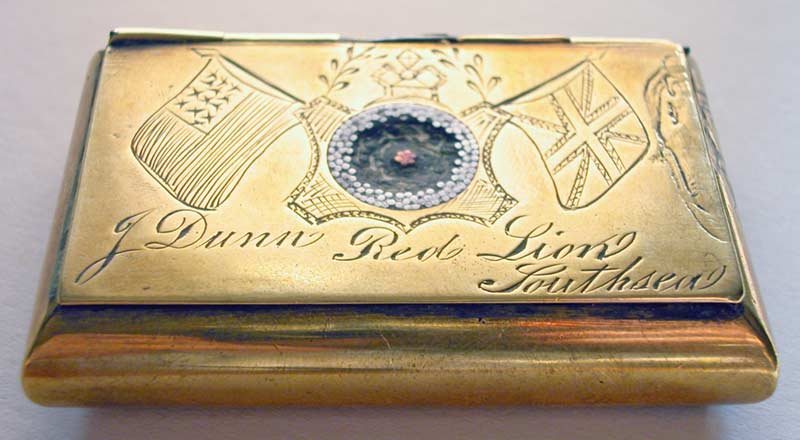
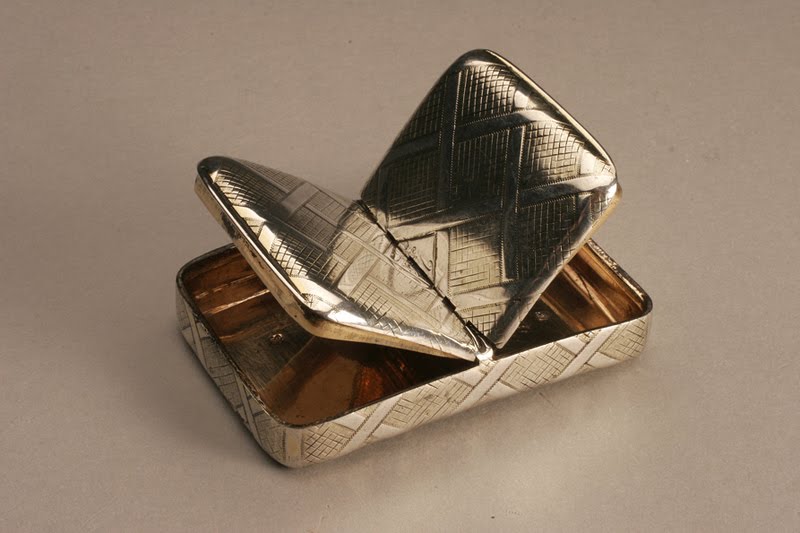
Many snuff-takers, following the example of Frederick the Great of Prussia, made it a hobby to collect snuff-boxes, Beau Brummell having had a very curious and extensive assortment. On one occasion, when dining at Portman Square, on the removal of the cloth, the snuff-boxes made their appearance, and Brummell’s was particularly admired. It was handed round for inspection, and a gentleman, finding it rather difficult to open, incautiously applied a dessert knife to the lid. Poor Brummell was on thorns. At last he could not contain himself any longer, and, addressing the host, said, with his characteristic quaintness — “Will you be good enough to tell your friend that my snuff-box is not an oyster?”

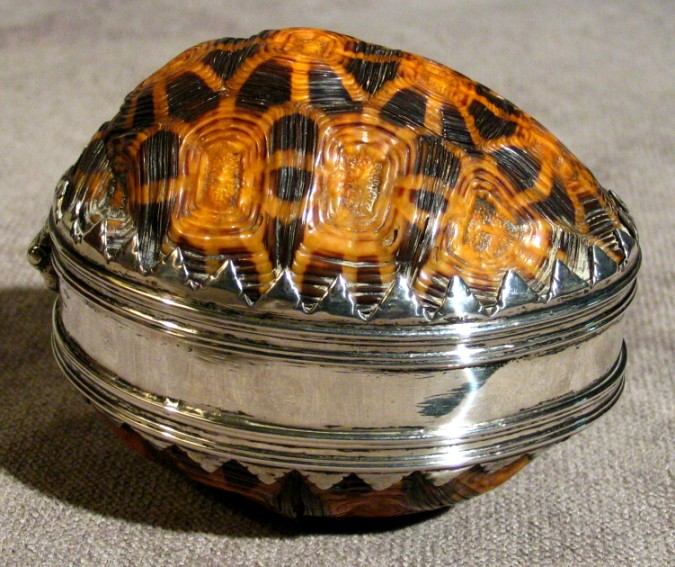
Tortoise shell and silver snuff box,
courtesy of Ernest Johnson Antiques

Beau Brummell also prided himself on his graceful manner of opening the snuff-box with one hand only—the left. Judging from a satirical advertisement which appeared in the Spectator, it would seem that much attention was paid to this act, which afforded an opportunity of displaying the jewelled finger. So important was the act of opening a snuff box that classes were offered:

“The exercise of the snuffbox, according to the most fashionable airs and motions in opposition to the exercise of the fan, will be taught with the best plain or perfumed snuff, at Charles Lillie’s, perfumer, at the corner of Beaufort Buildings, in the Strand, and attendance given for the benefit of the young merchants about the Exchange for two hours every day, at noon, except Saturdays, at a toy-shop, near Garraway’s Coffee House. There will be likewise taught the ceremony of the snuff-box, or rules for offering snuff to a stranger, a friend, or a mistress, according to the degrees of familiarity or distance, with an explanation of the careless, the scornful, the politic, and the surly pinch, and the gestures proper to each of them.”

Another great collector of snuff-boxes was Edward Wortley Montagu, the eccentric son of Lady Mary, who is said to have possessed more boxes than “would suffice a Chinese idol with a hundred noses,” a collection which perhaps was never equalled unless by that of George IV, who was not less extravagant and recherche in snuff and snuff-boxes than in other things.
Then there was Lord Petersham, who boasted a stock of snuffs worth three thousand pounds, while he had boxes adapted for all occasions— boxes for winter wear, boxes for summer use. Indeed, the story goes that he had a different box for every day in the year, and Captain Gronow saw him one day use a beautiful Sevres box, which on being admired, he said, “was a nice summer box, but would not do for winter wear.” He was a great connoisseur of snuffs, and “Lord Petersham’s Mixture” has long been proverbial as a popular snuff. He actually devoted one room of his mansion in Whitehall Gardens to properly storing his snuff. That room was a curiosity in its way, with its rows of well-made jars, and proper materials of all kinds for the due admixture, and management, of the snuffs they contained, under the able superintendence of a well-informed man, who was the guardian angel thereof. After the earl’s death the collection was sold, and prices that seem fabulous to the uninitiated were realized for the finer sorts.
Lord Stanhope used to calculate that a regular snuff-taker took one pinch every ten minutes, each pinch, and its accompanying ceremonies, occupying a minute and a half. One minute and a half out of every ten, it has been pointed out, if sixteen hours be allowed to the day, gives two hours and twenty-four minutes per day, or thirty-six and a half days in the year as the time wasted by a snuff-taker upon his nose.

On the other hand, Talleyrand defended snufftaking, not as a habit, but on principle. He maintained that all diplomatists ought to take snuff, as it afforded them an opportunity of delaying a reply which they might not have ready at hand. It further sanctioned, he said, the removal of one’s eyes from those of the interrogator, and occupied the hands, which otherwise might betray a nervous fidget calculated to expose, rather than conceal, his feelings.

Dryden was a snuff-taker, and was in the habit of frequenting Willis’ Coffee House, in Bow Street, Covent Garden, which consequently became one of the leading resorts of the wits of his time. Thus Ned Ward relates in his ” London Spy ” how “a parcel of raw, second-rate beaux and wits were conceited if they had but the honour to dip a finger into Mr. Dryden’s snuff-box.”
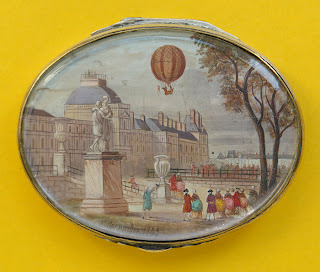
The eleventh Earl of Buchan—brother of Thomas Erskine, who by the force of his eloquence rose to be Lord Chancellor of England—was remarkable for his penuriousness, and eccentricity. In the year 1782 the Goldsmiths of Edinburgh presented him with a mounted snuff-box, made from the tree to which William Wallace had once been indebted for his safety. Ten years afterwards, however, Lord Buchan obtained permission from the Goldsmiths to give the snuff-box to Washington, at that time President of the United States. As a reason for so doing he maintained that Washington was the only man in the world to whom he thought the snuff-box justly due.

When a Mrs. Sterne was about to join her husband in Paris, in the year 1762, he wrote:— “You will find good tea upon the road from York to Dover. Only bring a little to carry you from Calais to Paris. Give the Custom-house Officer what I told you. At Calais give more, if you have much Scotch snuff; but, as tobacco is good here, you had best bring a Scotch mull, and make it yourself—that is, order your valet to manufacture it, ’twill keep him out of mischief;” and in another letter he adds, “You must be cautious about Scotch snuff; take half-a-pound in your pocket, and make Lyd do the same.”
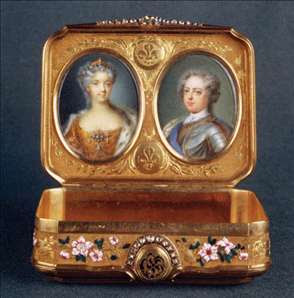
When manager of Drury Lane Theatre, Garrick brought into fashion a particular snuff mixture. It appears that a man named Hardham had been his numberer—to count the audience in the theatre—and on inventing his
“mixture,” Garrick rendered him the following service. Whilst enacting the character of a man of fashion on the stage, Garrick offered a pinch of his snuff to a fellow comedian, observing that it was the most fashionable mixture of the day, and to be had only at Hardham’s, 37, Fleet Street. As may be imagined, the puff answered beyond Garrick’s expectation, and for many years afterwards Hardham’s was the favourite mixture, when snuff-taking was the rage and fashion of the time. It may be added that Hardham, having made a large fortune by his snuff trade in Fleet Street, retired to Chichester, where he died in the year 1772, bequeathing a portion of his well-earned wealth to charitable institutions of that city, which, by-the-bye, was his native place.
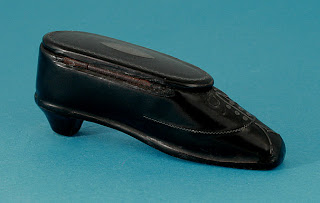

Sir Joshua Reynolds took snuff so freely when he was painting that it occasionally inconvenienced his sitters. The story goes that when he was painting the large picture at Blenheim of the Marlborough family, the Duchess one day ordered the servant to bring a broom and sweep up Sir Joshua’s snuff from the carpet; but Reynolds, who would not permit any interruption while engaged in his studio, ordered him to let the snuff remain until the completion of his picture, observing that the dust, raised by the broom, would do more injury to his picture than the snuff could possibly do to the carpet.

According to another story, a gentleman told Wilkie he’d sat to Sir Joshua, “who dabbled in a quantity of snuff, laid the picture on its back, shook it about till it settled like a batter-pudding, and then painted away.”

PUB GRUB – IN PRAISE OF THE HUMBLE PUB PIE

Steak and Ale Pie The Quintessential British Pub Grub


On visiting any pub in England one would be hard pressed not to find at least one meat pie on the menu. They have been a staple of pub fare since the medieval era, if not before. There  is something infinitely hearty and comforting about meat and vegetables swimming in a rich gravy wrapped in a thick, flaky crust. I daresay working men in England have been popping round to the pub for a pie and a pint in the middle of the day to get them through afternoons on the job since that very same medieval era.

As a historical note, wrapping food in a sort of pie crust has been around since the Egyptians. Once Alexander the Great started building his empire this Egyptian staple soon moved on to Greece and eventually the Romans acquired it… about the same time they acquired Greece. The Romans moved on to occupy Britain and whilst those early Brits did all they could to shove the Romans back to Rome, they did like the idea of baking meat and vegetables into a pie crust so they pilfered the recipe. Seems a small price to pay for slaughtering a large portion of the Celtic population and murdering Bodiccea.

Fast forward to today and the meat pie is part of the very culinary fabric of Britain. And it is definitely one of the very best things to order in any pub in England. Pubs take a great deal of pride in the reputations of their pies. There are even annual contests for the best pub pies in counties, districts, and even the entire country.

By definition, a meat pie is any meat dish served in a pie crust. Which means everything from the lofty Beef Wellington to the lowly Cornish pasty can be considered a meat pie.

Chef Gordon Ramsey’s recipe for Beef Wellington is considered the epitome of Beef Wellington recipes.

https://www.bbcgoodfood.com/recipes/2538/beef-wellington

Beef Wellington

The D-shaped Cornish Pasty, a hand pie with a storied history that comes filled with beef, potatoes, swede (rutabaga) and onion was developed as lunch fare for workers in the ancient English tin mining region of Cornwall. it played such an important part in the history of mining in Cornwall that the dish was awarded Protected Geographical Indication status in 2011 to prevent it being copied by imitators.

Here is a recipe you can imitate for a scrumptious pasty.

https://www.thespruceeats.com/traditional-cornish-pasty-recipe-435042

Cornish Pasty


Now cooking your own pub pie might sound well and good, but frankly I much prefer acquiring a good pub pie in its natural habitat – a pub in the UK! There is something to be said for the flavor added to a pub pie by the rafters and hearth of a pub that has been around for several hundred years. And nothing can compare to strolling about an English village or a stately home or the grounds of an ancient castle only to wind up in the local pub with a delicious pub pie and the local ale or a hot cup of tea on a scarred oak table ready for you to enjoy.

Pub pie at The Windmill in Mayfair


The Windmill – Mayfair

Check out some of the other pubs on this list !

http://www.traveller.com.au/where-to-find-the-best-english-pub-and-pie-13eb4h

For me, however, it is the out-of-the-way, small village pubs that cook up the best pub pies. Nothing can compare to a local cook striving for bragging rights and desiring nothing more than to provide the comfort of a great pub pie for their friends, families, and neighbors.

The George – Lacock


The George – Lacock
The George – Lacock
The George – Lacock
Steak and ale pie at The George

And nothing can compare to a meal of steak and ale pie at a historic pub with one’s fellow travelers after a day visiting stately homes and a village unchanged in hundreds of years. Sometimes it is the food that makes an indelible memory. Sometimes it is the company. And if you are very fortunate, it is both. Who’s ready to take a trip to The George for some glorious pub grub?