The Story Behind True Soldier Gentlemen by the Author, Guest Blogger Dr. Adrian Goldsworthy

Writing historical novels is a long cherished dream. I love history, and if the Romans have always had a special place in my heart, I find plenty of other periods almost as fascinating. For all that widespread interest, the Napoleonic and Regency has long been a particular obsession.

It probably began as a boy, watching the film Waterloo on television, and then when Bernard Cornwell’s Sharpe’s Eagle – the first of the series – was released. I devoured this and all its successors, along with C.S. Forester and his many imitators, as well as Patrick O’Brian who gave such a unique take on the genre. The fiction quickly led me to the real history of those times, and especially the wealth of letters and memoirs left by the men and women of those years of Regency in England and Revolution and Empire in France. So many of the real events and characters were stranger and more dramatic than anything a novelist would dare to invent, and there is so much human detail of everyday life during peacetime and on campaign. It was such a remarkable age, gaudy and inspiring, filled with larger the life characters and epic moments.

There is a lot of naval fiction out there, and new series seem to begin almost every year. Oddly, in spite – or perhaps because of – the success of Sharpe in books and on TV, there are very few adventure stories about Wellington’s men. Allan Mallinson’s series about the Light Dragoon Matthew Hervey begins in 1814, and apart from a few flashbacks, deals mainly with the world after Waterloo. Cornwell has on the whole moved on to other periods.



Dr. Adrian Goldsworthy

 I wanted to go back to the world of the redcoats, and True Soldier Gentlemen is the result. The big events and the major figures are all real. My main characters are invented, but I wanted them to act and speak in ways in keeping with the period, so that they could have existed. For most people, Regency England is inseparably linked with Austen’s novels and their frequent dramatisation on the large and small screens. The aim was to capture something of their feel. (Reading them at school had anyway always made me wonder what her various military and naval characters got up to as the war with France raged off-stage. Austen can seem desperately slow-paced to a boy, and I did not really take a delight in her work until I returned to the books as an adult).

Army officers were in many ways the male counterparts of Austen’s heroines. The majority of army officers were not rich or well connected, and their claim to genteel status resting on precarious grounds. Few could afford to purchase promotion, and they had little control over postings. A man’s career might stagnate in Britain, or be ended abruptly by disease if the battalion was sent to the West Indies, which consumed units at quite staggering rates. War service brought more opportunities for advancement at the risk of death and dreadful injury – and indeed increased chance of succumbing to disease. All the time a man’s conduct was regulated by strict rules. No gentleman could strike another, unless in a formal duel. (Richard Sharpe is a wonderful creation, but no one could have got away with behaving like that. Knowing that has never made me take any less delight in the stories, and I wish I could write half as well as Cornwell).

Like wider Regency Society, most army officers drank heavily and many gambled freely. There were plenty of opportunities to disgrace themselves and be forced to resign. There were also constant frustrations as better connected or wealthier men advanced their careers far faster than was possible for most. Officers who chose to marry, or who had to assist their parents and siblings struggled even harder to cope, but many somehow managed to do this.

I could not resist including Wickham in the story. At the end of Pride and Prejudice Austen has Darcy buy him a commission in the regular army and help his future career, and this gave me the opportunity. Using the excuse that she is vague about the date, I decided to accept the view that ‘the Peace’ she mentions was the short-lived Peace of Amiens. Wickham is not really interesting enough to be the centre of the stories in the style of George MacDonald Fraser’s marvellous Flashman novels. Instead he is there, charming and untrustworthy, doing his best to seduce pretty women and avoid paying his debts, while other characters do most of the work. Yet his connection to Darcy will allow him to rise, as long as his misbehaviour does not become too blatant. He also helps to add to the humour of the story. Over-serious adventure stories tend to be tiresome. Apart from that, all the soldiers I have known or read about always laugh a lot, and the aim was to capture something of that spirit.

The real heroes of the stories will be a group of young men without influence. One of them, Williams, serves in my fictional 106th Regiment as a Gentleman Volunteer. This was a peculiar status, where a man lived with the officers, but served in the ranks, wearing the uniform and doing the duty of an ordinary soldier. They hoped to be commissioned when disease or battle created vacancies. At the height of the Peninsula War, about one in twenty of Wellington’s officers were commissioned in this way. This is the sort of strange status that is fun to explore, and not really that well known about these days.

True Soldier Gentlemen has always been intended as the start of a series, and I hope readers will have patience with a book that takes a while to introduce a large cast of characters. The idea is to take them through the years up to Waterloo. Although I have plenty of ideas, and a fair notion of where they will go, I am not yet sure what will happen to them all. I have also tried to give something of the sedate feel of Austen’s world, so that the peace and formality of England contrasts all the more with the extreme savagery of the Peninsula War.

It is an adventure, hopefully an enjoyable yarn, and has no pretensions whatsoever to being literature. Ultimately, it is the sort of novel I enjoy reading.

Today is the official release date for True Soldier Gentlemen in the UK and at present there no US edition planned. You can order
here through Amazon UK
.  The sequel, Beat the Drums Slowly, is due out in August of this year.
You can visit the author’s website here.
Let's Play Telephone Contest Winner

We’re pleased to announced that the winner of the contest is Louisa Cornell, who submitted the following (most amusing) telephone conversation:
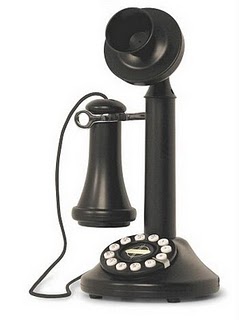
Hello? Maria, dear, I told you never to call me here. I know dearest. I’ll try my best to be home for dinner, but affairs of state and all that, you know. Wait a moment, dear, I’m getting another call. —- Mary! How did you get this number? I mean, aren’t you in rehearsals, dear? No, of course not. Of course there’s not another woman. Who can compare with my lovely Perdita? Tonight? Oh… Uhm … I have another call. Let me call you back. —- Maria, I really need to get to a meeting with – Who? Oh, no of course not, Grace. Maria is my … housekeeper in Brighton. Grace, how did you get this number? What? Tonight? Well, I don’t exactly- I have another call, Grace, dear. You’ll hold? Wonderful. —- Hello? Who is this? Of course this is George! Who else would it be? Oh! Lady Jersey, what a surprise. What? Caroline who? Caroline of Brunswick. I thought you said she looks like a horse and smells like one as well. …. You’ve changed your mind? I see. Well, I am certain the privy council will agree with you. This afternoon? I’m not exactly sure what I’ll be doing. Getting another call. Let me call you back. — Brummell! You unmitigated ass! I should have known. Who else have you given this number to, you overdressed . . .  All of them? Oh God!
 
Louisa – Email us off line with your snail mail address and we’ll get your prizes in the post to you!


On The Shelf – NOOK Color Kicks Off Our Author Recommendations

I was once out shopping with a friend when I spotted a killer pair of Ralph Lauren sunglasses. When I told her that I really liked them, but that at the same time I already had many pair of sunglasses and didn’t need yet another, she sniffed and pronounced, “My dear, it’s not a matter of need. It’s a matter of want. Buy them.”
While I’ve lived by her words many times over the years, I must admit that I dragged my feet when e-readers first came out. Why buy something that’s the size of a book, that you can hold in your hand and read like a book when you could just read a book? And why pay for a book, when you could get it free at the local public library?
Then, Barnes and Noble came out with the NOOK color, an Android tablet fronted by a 7-inch color touchscreen with 8GB of internal memory and a microSD card slot for cards up to 32GB. It functions as both an e-reader and a web browser. All for $249.00 – much cheaper than an iPad or notebook. Curious, I went on the Barnes and Noble website in order to invesigate and found that it offered lots of capability. The NOOK sounded like a good deal. It sounded like something I didn’t absolutely need, but certainly wanted. And what do you know – Greg took it upon himself to surprise me with one for Xmas. Here are a look at the features:
1. You can download books into the NOOK in seconds. Using the NOOK to read a book is so easy, you don’t even need the instructions. Just tap on a book cover and it opens. A swipe at the corner of the screen turns the page, just like a “real” book. When you’re done reading, turn the NOOK off and when you turn it on again, it remembers what page you were on and opens to it. Downloaded books are stored on your “shelves,” which you can customize. My NOOK shelves are named tbr and done. Yes, tbr, as in to be read. No more tottering piles of tomes by the side of my bed. Still a pile, true, since every book ever written is not offered as a NOOK download as yet and since some books, especially non-fiction titles, were simply not meant to be read in any other format than that of a good, old fashioned hard-bound book. I plan on using my NOOK for fiction only. But that may change.

2. The NOOK has built-in wifi that allows you to browse the web. The only thing that’s a tad difficult to do is to click on individual results, as the screen is pretty small. There’s a plus (+) and minus (-) icon that comes up fairly intuitively in the lower righthand corner of the screen that allows you to magnify the screen when you’re performing a function that requires data entry. And you can call it up any other time you need it. Having web capability in an e-reader is a plus – you can shop for more book titles, check your email, Google to your hearts’ content, etc. It’s handy, especially when on the road.
3.  NOOK’s built-in MP3 player lets you listen to audio books. Boy, did I get excited over this one! I cannot wait to do this – I can “read” and do needlework at the same time – oh, joy! But now we open another can of worms – can I download any audiobook? And a cursory browse on the web shows that I may be able to download e-books, including audio books, from my public library. Technology begets further technology and now I’ll have to spend time investigating these options, but it’s nice to know they’re available.
4. You can subscribe to magazines and each issue is automatically delivered to your NOOK each month. Or you can buy single issues. Have yet to try this . . . . as with non-fiction books, I think reading magazines in this format may take some getting used to.
5. The NOOK’s LendMe function means that books can be shared once with a friend who also has a NOOK at no cost, for up to 14 days. From the B and N website: “NOOKcolor makes it easy to borrow books from friends for up to 14 days. Just pull up your list of contacts, then browse a friend’s NOOKcolor library to choose the book you want to borrow. Within seconds, NOOKcolor will send an email to your friend with a request to borrow that book. Once they give the ok, the book will appear right on your NOOKcolor in seconds ready for you to download and enjoy.” This sounds pretty exciting, until you realize that the number of lendable books is fairly limited. While I have current titles on my tbr shelf (Ruth Rendell’s Portobello), and have even pre-ordered titles, (such as Maeve Binchey’s Minding Frankie, due out on March 1), only two of the titles on my shelf have a LendMe icon – The Black Moth by Georgette Heyer (my cost – .99) and Barchester Towers by Trollope (my cost – $1.99). LendMe might not be as fabulous as I first thought. Even Austen’s Pride and Prejudice isn’t lendable.
6. The NOOK is supposed to last 8 hours on a charge. The more you use the web, the more power you use up. Even when used just for reading, I find a single charge lasts around 6 hours.
As an e-reader the NOOK color is fabulous. How did I get by without it? True, I’m now spending money on books that I would have gotten free from the library, but then again, I’m not 187th on the list for new releases. Even so, I’m sure I’ll still be borrowing books from the library, the old fashioned way, but the NOOK is a useful tool and a wonderful addition to my bookshelves.
Understandably, the appearance of my NOOK has prompted much book browsing for me of late, in addition to reflections about favorite authors whose work I haven’t read in a while. And Victoria has a Kindle, which she uses often. She and I met at a Barnes and Noble store here in Florida recently and&nbsp
;spent some time discussing favorite authors, old and new, and we’ve decided to bring you our author recommendations in forthcoming On The Shelf posts, beginning on January 31st. It is our fondest hope that you’ll find a few new favorites amongst them, too.

The Royal Wedding on the Telly

With just 90-something days to go till the Wedding of the Year/Decade, you can bet that news outlets and television stations on both sides of the pond, and elsewhere, are plotting their strategies and schedules for the weeks and days leading up to the big event at 11 a.m. on April 29th. So far, TLC is the only channel that’s given out any information on their royal line up – during the five days leading up to royal wedding, TLC said on Wednesday that it will air specials featuring archived and other footage, interviews and a round-table discussion with experts on royalty. The U.K.-themed week, in partnership with ITV Studios, also will include a show focusing on both British and American hoarders and “extreme” collectors of royal memorabilia. One hopes they’ll focus on the lady featured in our right sidebar and not on, er, one.

TLC also plans live coverage of the wedding, with a condensed version of the event set to air April 30-May 1. But you won’t have to wait till April – beginning next month, TLC will show “The Queen,” a new two-hour special that explores romance, weddings and divorce among members of Queen Elizabeth II’s family. The special will air Feb. 13 (9 p.m. EST). The program will be preceded by repeats of two specials about William and his fiancee: “William and Kate: A Royal Love Story” (7 p.m. EST) and “William, Kate and Royal Weddings” (8 p.m. EST).

For TLC, home of “Four Weddings,” “Say Yes to the Dress” and other wedding-themed shows, the week long coverage is intended to enhance viewers’ “overall royal experience” of the Westminster Abbey ceremony, said programming executive Nancy Daniels.

“This is without question the most widely anticipated wedding in a generation,” Paul Buccieri, ITV Studios America president and CEO, said in a statement, promising American viewers “intimate access to this landmark event.”

Right . . . . . Just you, me and a couple of million others . . . . . Reports are that Rupert Murdoch’s British Sky Broadcasting Group is negotiating with royal officials to show the nuptials on television, and the talks, which involve the BBC, also are said to include a plan to possibly shoot the ceremony in 3-D and broadcast it to cinemas throughout the world. Which will delight the folks at Royal Caribbean Cruises, who plan to broadcast the wedding live across all 40 ships in their fleet on 29th April.

Stay tuned . . . . . .

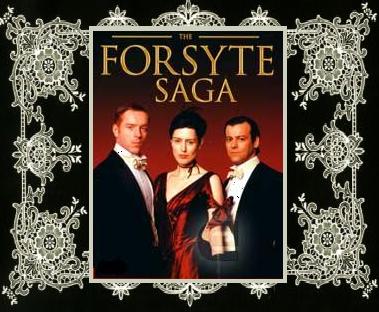
Do You Know About the Forsyte Saga?

While Downton Abbey has recently premiered on Masterpiece Theatre, we thought we’d tell you about another great period drama, The Forsyte Saga. Whether, like me, you prefer the older version (1967) or the new (2002), settling in to watch the Forsyte Saga is like snuggling up with a brandy in front of the fire – comfortable, cosseting and considerably entertaining. Like all good costume dramas, the Forsyte Saga provides romance, drama and skull duggery based on a series of three novels – The Man of Property, In Chancery and To Let -and two interludes published between 1906 and 1921 by author John Galsworthy, who won the Nobel Prize for Literature in 1932. The twenty-six episodes cover the history of the aristocratic Forsyte family between the years 1879 and 1926. You should be aware that the 2002 version only covered the first two of Galway’s novels and only ran for seven episodes. The plot revolved around the feuds and machinations of the Forsyte family and their London merchants’ business, with each episode culminating in a melodramatic cliffhanger ending. Together with the fact that the original version was filmed in black and white, the series has a decidedly “soap opera” feel to it, and we say Bravo!

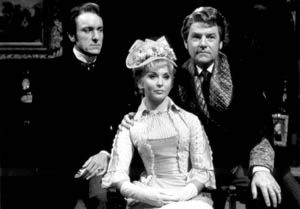
The Forsyte Saga chronicles the ebbing social power of the upper-middle class Forsyte family through three generations, beginning in Victorian London during the 1880s and begins with Soames Forsyte (right, played by Eric Porter), a successful solicitor who buys land at Robin Hill on which to build a house for his wife Irene and future family. Little does he suspect (at first) that Irene has only married him for his money. Beneath his very proper exterior lies a core of unhappiness and a string of brutal relationships. Eventually, the Forsyte family begins to disintegrate when Timothy Forsyte, the last of the old generation, dies at the age of 100. Soames’ cousin Jolyon abandons his distraught wife and won’t see his children again for some years, whilst architect Philip Bosinney, besides having an affair with Irene, plays fast and loose with Soames’ money while building him a house.

A much darker and condensed version of the novels appeared in the movie That Forsyte Woman (1949), which starred Errol Flynn as Soames, Greer Garson as Irene, Walter Pidgeon as young Jolyon, Robert Young as Philip Bosinney and Janet Leigh as June.
 

In his novels, Galsworthy documented a departed way of life, that of the affluent middle class that ruled England before the 1914 war. Galsworthy’s masterly narrative examines not only their fortunes but also the wider developments within society, particularly the changing position of women. Honestly, you’ll find yourself cheering for the good guys, absolutely loathing Soames and losing patience with the aristocratic ladies who fail to hear you yelling at the screen, “For God’s sake, speak up, walk out, do something!”

One of our favorite acresses, Susan Hampshire (Monarch of the Glen), plays Fleur in the original version.
The series attracted no less than six million viewers on its first showing and when repeated on BBC1 the following year, a staggering 18 million people tuned in. The success of the series, which won a Royal Television Society Silver Medal and a BAFTA award for Best Drama, prompted the BBC to plough further resources into similar blockbusting “costume” dramas, a strategy that led to the production of such series as The Pallisers and Upstairs, Downstairs.

You can watch a bit of Episode One here.