On The Shelf – Discovering New Authors – Part Three

Part Three of our series focuses on Comic Reads and, really, one can’t help but opening with P.G. Wodehouse . . . . can one?

P.(Pelham) G.(Grenville) Wodehouse is best known (and loved) for his comic novels, which include the Jeeves and Wooster series and the Blandings Castle series. If you think of Stephen Fry and Hugh Laurie when you hear “Jeeves & Wooster,” I’m here to tell you that the unlikely pair began life as characters in Wodehouse’s books, including What Ho, Jeeves, Carry On, Jeeves and Jeeves and the Feudal Spirit, to name but a scant few. Wodehouse’s books, characters and plots are just plain silly and, boy, do we love them. Prepare to stretch the limits of belief, to suspend reality and to chuckle aloud. Bertie Wooster invariably gets himself into a bind (money, girls, relatives, etc.) and Jeeves gets him out – whether Bertie ever learns about Jeeves’s involvement or not. One thing Bertie is not clueless about is his dependence upon Jeeves, which this passage from Jeeves and the Hard Boiled Egg clearly illustrates:
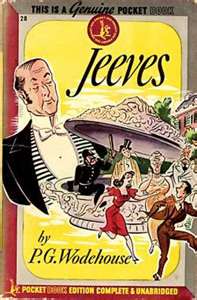
Sometimes of a morning, as I’ve sat in bed sucking down the early cup of tea and watched my man Jeeves flitting about the room and putting out the raiment for the day, I’ve wondered what the deuce I should do if the fellow ever took it into his head to leave me. It’s not so bad now I’m in New York, but in London the anxiety was frightful. There used to be all sorts of attempts on the part of low blighters to sneak him away from me. Young Reggie Foljambe to my certain knowledge offered him double what I was giving him, and Alistair Bingham-Reeves, who’s got a valet who had been known to press his trousers sideways, used to look at him, when he came to see me, with a kind of glittering hungry eye which disturbed me deucedly. Bally pirates!

The thing, you see, is that Jeeves is so dashed competent. You can spot it even in the way he shoves studs into a shirt.

I rely on him absolutely in every crisis, and he never lets me down. And, what’s more, he can always be counted on to extend himself on behalf of any pal of mine who happens to be to all appearances knee-deep in the bouillon. Take the rather rummy case, for instance, of dear old Bicky and his uncle, the hard-boiled egg.

Read more here and once you’ve finished, you can visit The World of P.G. Wodehouse here and the P.G. Wodehouse Society here.  And what a backlist! For Sebastian Faulks’ take on Jeeves’s place in popular fiction, click here.
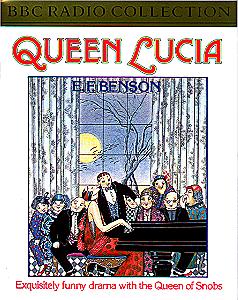
If Wodehouse is literary slapstick, E.F. Benson’s humour is subtle – his characters don’t realize that they’ve received a proverbial pie in the face until several pages on. Social one-upsmanship is rampant, and Mrs. Emmeline Lucas, known to her friends as Lucia, has artistic pretensions and exchanges Italian phrases with her consort, the perennial bachelor Georgey Pilson, alongside whom she can often be found practising the piano. Lucia’s adversary is Miss Elizabeth Mapp, who once ruled as the town of Tilling’s social queen until Lucia moved in and displaced her. Let the games begin. For a taste of just how far Lucia will go where pretension is concerned, here’s a passage from Queen Lucia, in which Lucia returns to her new home in Tilling: “Something of the consciousness of her sovereignty was in her mind, as she turned the last hot corner of the road and came in sight of the village street that constituted her kingdom. Indeed it belonged to her, as treasure trove belongs to the Crown, for it was she who had been the first to begin the transformation of this remote Elizabethan village into the palace of culture that was now reared on the spot where ten years ago an agricultural population had led bovine and unilluminated lives in their cottages of grey stone or brick and timber. Before that, while her husband was amassing a fortune, comfortable in amount and respectable in origin, at the Bar, she had merely held up a small dim lamp of culture in Onslow Gardens. But both her ambition and his had been to bask and be busy in artistic realms of their own when the materialistic needs were provided for by sound investments, and so when there were the requisite thousands of pounds in secure securities she had easily persuaded him to buy three of these cottages that stood together in a low two-storied block. Then, by judicious removal of partition-walls, she had, with the aid of a sympathetic architect, transmuted them into a most comfortable dwelling, subsequently building on to them a new wing, that ran at right angles at the back, which was, if anything, a shade more inexorably Elizabethan than the stem onto which it was grafted, for here was situated the famous smoking-parlour, with rushes on the floor, and a dresser ranged with pewter tankards, and leaded lattice-windows of glass so antique that it was practically impossible to see out of them. It had a huge open fireplace framed in oak-beams with a seat on each side of the iron-backed hearth within the chimney, and a genuine spit hung over the middle of the fire. Here, though in the rest of the house she had for the sake of convenience allowed the installation of electric light, there was no such concession made, and sconces on the walls held dim iron lamps, so that only those of the most acute vision were able to read. Even then reading was difficult, for the book-stand on the table contained nothing but a few crabbed black-letter volumes dating from not later than the early seventeenth century, and you had to be in a frantically Elizabethan frame of mind to be at ease there. But Mrs Lucas often spent some of her rare leisure moments in the smoking-parlour, playing on the virginal that stood in the window, or kippering herself in the fumes of the wood-fire as with streaming eyes she deciphered an Elzevir Horace rather late for inclusion under the rule, but an undoubted bargain.”

For an in-depth article on these characters and the series, read the Philip Hensher article here. You’ll find the E.F. Benson Society’s website here.

< a href="http://4.bp.blogspot.com/_jXNyvNsF2To/TTX2kPm_0vI/AAAAAAAAE7o/wFq_XsoLjpY/s1600/suetownsend.jpg" style="clear: right; cssfloat: right; float: right; margin-bottom: 1em; margin-left: 1em;">
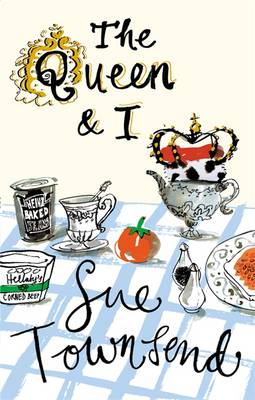
Sue Townsend set Victoria’s sense of humor zinging with her hilarious book The Queen and I.  Somehow, the characters of Queen Elizabeth, the Duke of Edinburgh, and the Queen Mother rang completely true when I first read it back in 1992.  After they became non-royal in the fictional republic, they seemed quite natural. I completely bought the idea that Liz would turn into an excellent cook with the cheapest cuts of meat and that the Duke of E. would be very upset that Liz wanted to be known as Mrs. Windsor rather than Mrs. Mountbatten from now on.
Sue Townsend has written a sequel called Queen Camilla, published in 2006, which I have not found, But it’s now high on my list.  She is well-known for her wonderful series of books about Adrian Mole.

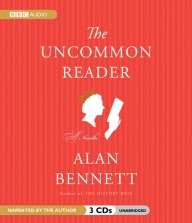
Another book featuring royalty is Alan Bennett’s The Uncommon Reader, a novella by the writer of the Tony-winning play The History Boys and The Madness of King George, this story has the Queen discovering the joys of reading through a palace kitchen worker named Norman. Soon, Her Majesty’s preoccupation with literature leads to fears of senility amongst royal insiders. If they thought the Queen’s reading a book was bad, just wait till they learn she means to write one . . . . .

                         Part Four Coming Soon!

Please Help to Save the Cleveland Street Workhouse

There’s a petition over at the London Historians’ Blog, which can also be found in our right sidebar under “Amusing Blogs.” They are feverishly trying to save the Cleveland Street Workhouse, which is thought to be Dickens’ inspiration for the workhouse in Oliver Twist, from demolition. Please take a moment to log onto their site and sign this document in the hopes of saving an important part of London’s disappearing history. Thank you!

The Wellington Connection – Attempted Assassination


Fitzroy Somerset, later Lord Raglan

 From The Letters of George Canning:

A letter written by Lt.-Col. Lord FitzRoy Somerset to Wellesley Pole dated Thursday, February 12, 1818.

My Dear Mr. Pole,

You have so often expressed apprehensions for the Duke’s safety, that you will be more shocked, than surprised to learn, that he was shot at, the night before last, just as his carriage was entering the Porte Cochere of his house (The Duke’s house was in the Rue Champs Elyses. It was from this house that the first shot was fired by Le Grange in the Revolution of 1848. It was subsequently pulled down by order of Napoleon III).  Fortunately the shot missed entirely; but however one may exult at his escape on this occasion, the fact that it is intended to take away his life is so clear, that one cannot but dread that another attempt may be more effectual.


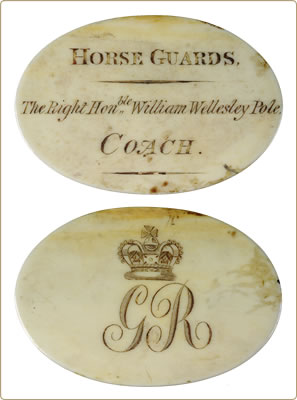
Ivory coach pass belonging to
William Wellesley Pole, Master of the
Royal Mint 1814-1823


It appears by the evidence of the coachman and footman, that as the carriage passed by the Hotel  d’Abrantes, which you may recollect is at the entrance of the Rue des Champs Elysees, they observed a man standing opposite to it, who, on the approach of the carriage moved on and kept pace with it till he reached the nearest sentry box at the Duke’s door, when he stopped and as the carriage was in the act of turning into the gateway the villain fired his pistol. Upon hearing the shot, the horses rather quickened their pace, which the coachman had checked to go more easily over the gutter, and the Duke arrived without accident at the house, totally unaware that he had been fired at, till the footman opened the door and said ‘J’espere, Monseigneur, que votre Excellence n’est pas blesse’.’ He had conceived that one of the sentries’ muskets had gone off by accident. Upon ascertaining how the fact stood, the Duke ordered the assassin to be pursued, but as no step had been taken till he gave the directions to that effect, the scoundrel of course made his retreat good. If however, the sentries had been as indeed they ought to have been outside the Porte Cochere, instead of being in it, or if the footman (a Frenchman) had had his wits about him, and upon seeing the man fire, had immediately jumped down and run after him, or had even cried out he must have been taken; for two of the Duke’s English servants were at the moment coming down the street, and heard the report of the pistol, and whilst they were debating upon what was the cause of the shot at such an hour (it was after midnight) they met the man running: and as one of them had said that the shot might have been fired at the Duke’s carriage they had a great mind to stop him, but hearing no alarm they thought it most prudent to let him go by without molestation.

Shortly after, some of the guard detached from the Duke’s came up to them and asked them if they had seen anybody, to which they replied in the affirmative, and immediately joined with the soldiers in the pursuit. One of the servants ran so fast, that he thinks he saw the same man go into a house in the Rue de la Madeleine, and stay at the door till he came up, when it was slammed in his face. This house was afterwards examined some hours after, I believe, and it appears that the only lodger is a laquais-de-place now in the service of an Englishman. The soldiers and servants continued their researches but ineffectually. The whole of yesterday was occupied by the police in the examination of everybody who could throw any light upon the affair, and in the evening a man came forth who had formerly lived as servant to Burgh, who acknowledged himself the author of an anonymous letter he had addressed Sir Ulysses about a month ago, who had communicated it to the Duke stating that he had been offered a sum of money to assassinate him. He now said that he had no personal acquaintance with the man who had made the proposition to him, but that he should know him if he were to see him, and that he was apprehensive that his own life was in danger in consequence of his refusal to undertake the murder. This laquais had been in the army and had afterwards lived with General Exelmans where he was probably remarked by the villain who wanted to induce him to perpetrate the crime. Nothing else has transpired which may tend to the discovery of the assassin, with the exception of a letter from Lord Kinnaird to Sir George Murray which you will receive through Sir Charles Stuart.


Charles, 8th Lord Kinnaird of Inchture (1780-1826)

In this it is stated that a man had asked Lord Kinnaird if he thought the Duke of Wellington could be prevailed upon to exert his influence with M. De Cazes to grant permission for the return to Paris of three French exiles. Lord Kinnaird replied in the negative, upon which the Frenchman enquired if the Duke would be induced to facilitate their return, on condition of his disclosing a plot, which had been some time in agitation against his life. The rest of the letter contains Kinnaird’s answer to this proposition and the steps which the other considers necessary, if it should be admitted. Murray by the Duke’s desire has written to K. to say that before any other step is taken, he must disclose the name of his informer, and as the attempt to assassinate has since been made, Kinnaird’s letter will be sent to Lord Clancarty (Ambassador to the Netherlands) who will act upon it as he thinks proper. It is impossible so immediately after the event to judge of the effect whi
ch the commission of such an outrage will make in Paris. The only people whom I have yet seen are connected with the Court and they as may naturally be supposed, express in strong terms their abhorrence of it, but the French in general are, as Lord Stanhope truly says, so unprincipled, and they carry their detestation of the Duke and of the English to such an extreme, that I do not believe many of them will really feel shocked that such an attempt should have been made, more particularly as they consider the Duke to be the author of their present degradation.


Duke of Wellington

Much as I have been accustomed to the unostentatious courage and strength of mind so peculiar to the Duke, I acknowledge that he has on this occasion displayed a firmness and a tranquillity which has astonished me, while at the same time he has evinced a disposition to take every precaution in his power to preserve his valuable life. He is aware that if a man is determined to destroy him at the certain sacrifice of his own existence, he cannot prevent him; but he thinks, and I am inclined to entertain the same opinion, that as nobody can have any private pique against him, the person who would undertake to assassinate him, would not venture to do so except on an occasion when he might have a good chance of effecting his escape. Self predominates in the minds of every individual in this nation, and I hope that feeling may be the cause of the preservation of the Duke.

Measures are taken to guard the Duke’s house and to watch the streets immediately leading to it, and he will have an Aide-de-camp always in the house, and he will have a person armed though not in uniform with his carriage. He has promised also never to go about alone and will not make use of his own carriage which is so well known.

Should I hear anything further before the messenger is dispatched I will communicate to you.

Yours most affectionately,

FitzRoy Somerset.

P.S.—Since writing the above, the Duke has shown me his letter to Lord Bathurst which is a very good one; you will observe that at the end of it he expresses a hope, that if it should be thought advisable to publish any part of his letter, care will be taken not to make known that part of it which relates to the channels which may lead to the discovery of the assassin, or to the precautions which he may think it proper to adopt. I have heard nothing further, except that an Officer of the Landers de la Garde was close to the carriage at the time, whose first impulse was to rush upon the villain, but upon second thoughts he judged it best not to attempt to seize him lest he should fail and being seen to run should be suspected of being the assassin. He therefore contented himself with enquiring if the Duke was hurt.

Regency Reflections: Fashions of the Era


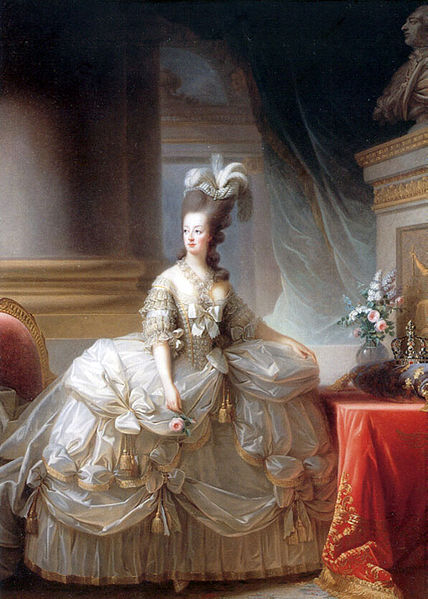
Fashions for females in the Georgian Era changed dramatically, from wide skirts and narrow waists, high-piled coiffures, and fussy decoration to simple, high waisted gowns — and back again in the space of a few decades. Marie Antoinette (1755-1793), Queen of France, right, might have been the most extreme. She was painted in 1778 by Elisabeth Vigee le Brun (1755-1842) in a huge hooped skirt and hair powdered,  drawn high and topped off with a fountain of feathers.  In an upcoming post, we will look at some of the fashion plates from various lady’s magazines of the Georgian era. In this post, however, we will indulge in the representations of fashion shown in portraits by celebrated artists.

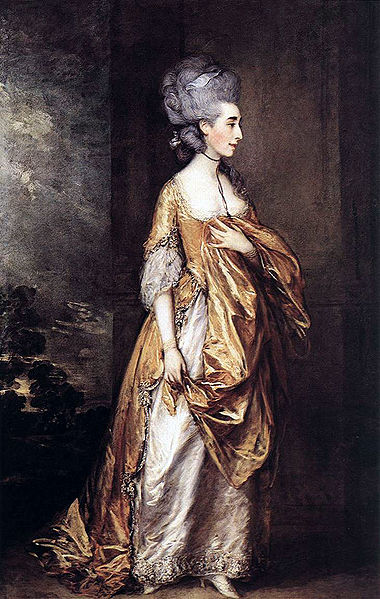
Left is Grace Dalrymple Elliott, subject of Jo Manning’s excellent biography.  My Lady Scandalous: The Amazing Life and Outrageous Times of Grace Dalrymple Elliott, Royal Courtesan.  She was painted by Gainsborough in the late 1770’s.   One of the outstanding features of Gainsborough’s portraits is the depiction of the sumptuous silks and satins worn by his subjects. Again, the hair-do is exaggeratedly high and powdered to a pewter shade rather than the white powdering of a few years earlier.  Imagine how many hours had to be spent by these ladies while their minions teased each strand up and over whatever bird-cage-like platform was used.

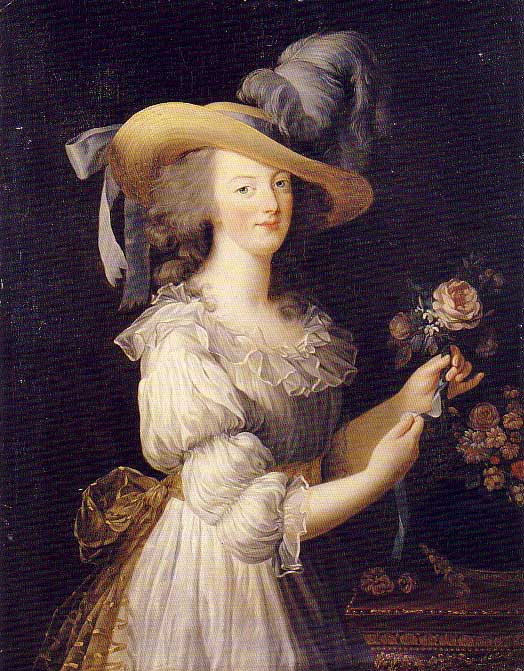
In the 1780’s and 1790’s, the styles became simpler, perhaps bucolic. Even the French Queen favored a version of the  simple muslin chemise.  The mode, color and fabric were copied by aristocrats on both sides of the Channel.  Hair is more naturally arranged, though still powdered a little, and one could hardly say the hat would be worn by a peasant.  Again, the painter is Vigee le Brun.

The Frankland Sisters by John Hoppner, 1795
National Gallery of Art, Washington, D. C.

Jane Elizabeth, Countess of Oxford, 1797 by John Hoppner
Tate Britain

Gradually the gowns evolved into looser skirts with high waists just below the bosom. The two portraits below by Sir Henry Raeburn(1756-1823) show the exact changes.


Mrs. Eleanor Urquhart, 1795
National Gallery of Art, Washington, DC.

Elizabeth Campbell  1812

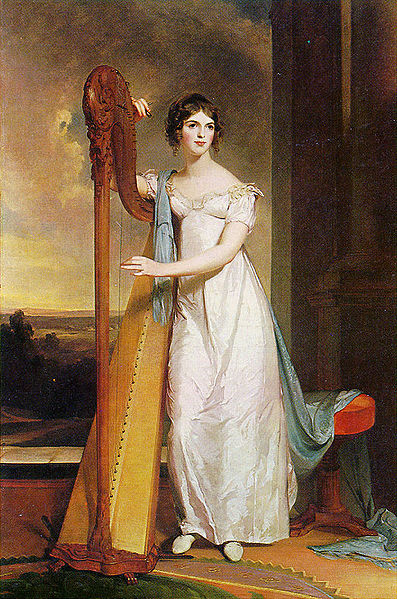
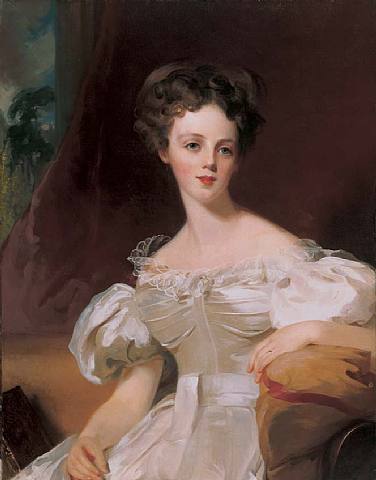
During the nine years of the Regency, fashions became more elaborate with fancy work and embellishments for the sleeves and around the hems. After about 1800, the hair powder is gone for good and the styles are simpler. By the official end of the regency in 1820, waistlines had begun to sneak back to their natural spot. In the 1820’s, the corseted waist and wide skirts returned, and in the 1830’s, the hair rose again. Below are two portraits by Thomas Sully (1783-1872), born in England but who lived most of his life in the United States.


 Lady with a Harp, Eliza Ridgel
y, 1818,
National Gallery of Art, Washington, DC

Abby Ann King Turner Van Pelt, 1832

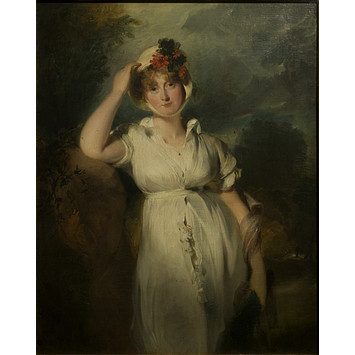
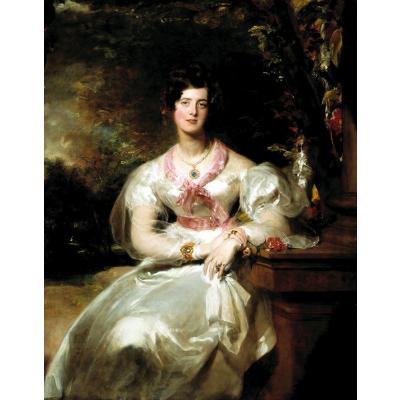
Sir Thomas Lawrence (1769-1830) painted many portraits throughout the regency and afterwards.  Here are a few of his portraits, showing the change from the late 18th century to several decades into the 19th.

Queen Charlotte, 1789, National Gallery, London

Caroline of Brunswick, Princess of Wales, 1798, Victoria and Albert Museum, London

Mrs. Jens Wolff, 1815
Chicago Art Institute

 Julia Hankey, later Lady Bathurst, c. 1825
Dallas Museum of Art

Hair has remained unpowdered throughout the late Georgian period, but by the 1830’s, there were some fantastic top-knot arrangements, as seen below.  Not to mention the fantastic hats that came back into style.

To the left is a portrait of Fanny Kemble (1809-1893) with her aunt Sarah Siddons (1755-1831) painted by Henry Perronet Briggs (1791-1844) in 1831, shortly before Sarah went to her considerable reward.

The  print to the right is Princess Victoria, later Queen, based on an 1833 painting by Sir George Hayter (1792-1871).  Fanny and the princess share a top-knot hair style.

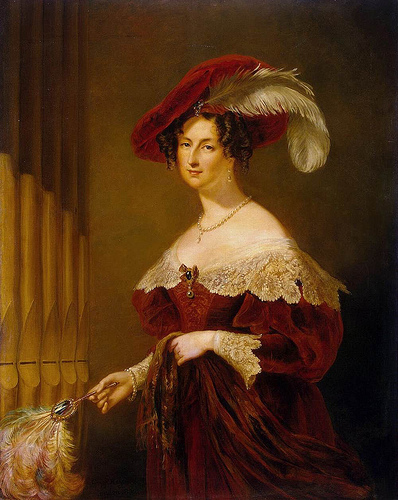
Below is a feathered hat even Marie Antoinette would have loved. The painting hangs in the Hermitage, St. Petersburg; Sir George Hayter portrays Countess Vorontsova in 1832.  Another hat the ill-fated queen might have enjoyed wearing is shown in a portrait of Julia, Lady Peel, nee Floyd (1795-1859) by Sir Thomas Lawrence; the real thing can be viewed at New York City’s Frick Collection.

 So the fashion cycle comes full circle in about seventy years from the 1760’s to the 1830’s.

Hand Made Tales: Women and Domestic Crafts

Drawing on the current resurgence in sewing, gardening and cooking and the historical roots of the domestic arts within the home, this exhibition at The Women’s Library in London runs until April 1 and explores the ways in which household crafts have traditionally been the domain of women, their role as sources of knowledge and self-expression shared between generations and communities, and as cultural experiences nurturing the creative spirit is celebrated in the displays. Curated by Carol Tulloch, this timely exhibition will allow visitors to explore and learn the stories of crafts and the women involved in them through personal tales and fun interactive projects.

The Women’s Library is a cultural centre housing the most extensive collection of women’s history in the UK. We run exhibitions and events in addition to the Reading Room Service. The Women’s Library has an extensive Printed collections cataloguesearch online. (books, pamphlets, periodicals and videos). Most of the Library’s books, pamphlets, periodicals and videos are catalogued and available to use. The collections cover a variety of topics, such as women’s rights, suffrage, sexuality, health, education, employment, reproductive rights, the family, and the home. The emphasis is primarily on women in Britain, but some international material is included.

The Library houses over 500 archives (arranged in 11 strands) that document women’s lives and the issues that have concerned and interested them. They date primarily from the mid-nineteenth century to the present day and extend in size from one file to hundreds of boxes. Included are the personal papers of a wide variety of individuals, ranging from the papers of the famous suffragette Emily Wilding Davison to the papers of 2nd wave feminist Sheila Rowbotham. The records of societies and associations are also covered, including female emigration societies, women’s suffrage associations, societies for the abolition of the state regulation of prostitution, societies for the suppression of traffic in persons, women’s employment organisations and a myriad of other pressure groups and campaigning organisations on issues as varied as peace, single parenthood, women clergy and home economics. The records of research and oral history projects are also collected.

An online catalogue is available for searching the archives.