On The Shelf – Discovering New Authors – Part Four

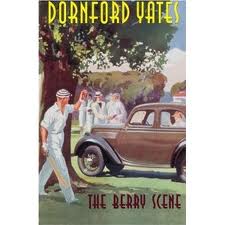
Dornford Yates, real name Cecil William Mercer, born in 1885 at Walmer, Kent, is the author of the comic Berry books. The main characters of the Berry Books are the Pleydell family who reside at ‘White Ladies’ in Hampshire, made up of Berry Pleydell, Daphne Pleydell, his wife (and cousin), Boy Pleydell (Daphne’s brother and narrator of the books), Jonathan (Jonah) Mansel (cousin to all the above), Jill Mansel (Jonah’s sister) and with occasional appearances by Boy’s American fiancée (and later wife), Adèle. This is a group of privileged and pretty young things who excell at verbal barbs, comedic situations and much good humoured malice. Berry refers to Boy as “my brother-in-law, carefully kept from me before my marriage and by me ever since.” 

The stories are anecdotal, and involve some sort of privileged problem – their Rolls-Royce is stolen, a hat is blown away in the wind, an offensive neighbour is rude about Nobby, their dog. The resolution often involves outrageous coincidence. No one works, although the male members of the family occasionally do “go up to Town” on some vague business related matters which are never fully explained, and pithy conversations abounds.
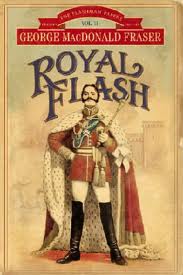
Created by author George MacDonald Fraser, Sir Harry Paget Flashman (VC, KCB and KCIE) (1822–1915) is the fictional hero of the Flashman series, first begun in 1969. As Wikipedia tells us:  “Presented within the frame of the supposedly discovered historical Flashman Papers, the book begins with an explanatory note saying that the Flashman Papers were discovered in 1965 during a sale of household furniture  Leicestershire. Flashman is a well known Victorian military hero (in Fraser’s fictional England). The papers were supposedly written between 1900 and 1905. The subsequent publishing of these papers, of which Flashman is the first, contrasts the previously believed exploits of a (fictional) hero with his own more scandalous account, which shows the life of a cowardly bully. Flashman begins with his own account of expulsion from Rugby and ends with his fame as the “Hector of Afghanistan”, detailing his life from 1839 to 1842 and his travels. It also contains a number of notes by the author, in the guise of a fictional editor, giving additional historical information on the events described. The history in these books is quite accurate; most of the people Flashman meets are real people.” Flashman is in turn charming, brave, cowardly, a liar and a legend in his own mind, but you can’t help but be amused by him.

I’ve never cared for Alexander McCall Smith’s Number One Ladies Detective Agency books, but I love the 44 Scotland Street and Corduroy Mansions series.  The Corduroy Mansions books are set in a four-storey mansion that’s been divided into flats in London’s Pimlico section.  The flats are occupied by an ensemble of cheerfully eccentric characters who are all too human and with whom the reader can readily relate. Smith handles the multi-faceted plots deftly and gives us readers to both love and loathe. Plot devices come in the form of situations with which most can identify. The third floor tenant, William French, a widower and wine merchant, is trying to get rid of his free-loading son Eddie, a young man who simply cannot take a hint. Playing on Eddie’s dread of dogs, William gets one, in the form of Freddie de la Hay, who manages to dislodge Eddie, but who also sets the stage for further problems for William. 
Set in Edinburgh, the 44 Scotland Street series focuses on yet another set of residents. As Publisher’s Weekly said, the book, “drolly chronicles the lives of residents in an Edinburgh boarding house— it’s episodic, amusing and peopled with characters both endearing and benignly problematic. Pat, 21, is on her second “gap year” (her first yearlong break from her studies was such a flop she refuses to discuss it), employed at a minor art gallery and newly settled at the eponymous address, where she admires vain flatmate Bruce and befriends neighbor Domenica. A low-level mystery develops about a possibly valuable painting that Pat discovers, proceeds to lose and then finds in the unlikely possession of Ian Rankin, whose bestselling mysteries celebrate the dark side of Edinburgh just as Smith’s explore the (mostly) sunny side. The possibility of romance, the ongoing ups and downs of the large, well-drawn cast of characters, the intricate plot and the way Smith nimbly jumps from situation to situation and POV to POVworks beautifully in book form. No doubt Smith’s fans will clamor for more about 44 Scotland Street, and given the author’s celebrated productivity, he’ll probably give them what they want.”
Really, the only problem with these books is deciding which dog is more delicious, Cyril with the gold tooth (44 Scotland Street) or Freddie de la Hay (Corduroy Mansions). You can visit the author’s website here.
Part Five Coming Soon!

Do You Know About Gresham College?

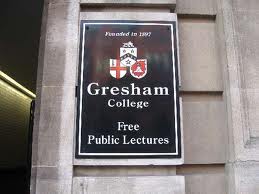
Gresham College has no students and does not teach courses, rather it is an educational institution of higher learning that exists to provide free public lectures, which have now been running for over 400 years. Gresham College was founded by Sir Thomas Gresham in 1597, son of Sir Richard Gresham who was Lord Mayor in 1537/38. Gresham College started long before there was a University of London.

Sir Thomas Gresham (1519-1579) stated in his will that Gresham College was to provide free public lectures in Divinity, Astronomy, Music, Geometry, Law, Physic and Rhetoric, endowed by revenue from the Royal Exchange, which he founded in 1570.

The Royal Society can trace its roots back to Gresham College and to 28 November 1660, when 12 of the members met at Gresham College after a lecture by Christopher Wren, the Gresham Professor of Astronomy, and decided to found ‘a Colledge for the Promoting of Physico-Mathematicall Experimentall Learning’. This group included Wren himself, Robert Boyle, John Wilkins, Sir Robert Moray and William, Viscount Brouncker.

The first college location was Gresham’s mansion in Bishopsgate where Tower 42 is now built. It stayed there until 1768, and next settled in 1842 in Gresham Street EC2. Gresham College did not become part of the University of London on the founding of the University in the 19th century, although a close association between the College and the University persisted for many years. Since 1991, the College has operated at Barnard’s Inn Hall, Holborn EC1.

A look at recenlty past and upcoming lectures will show how varied the programs are:

Fakes, Completions and the Art of Borrowing – Professor Christopher Hogwood CBE – Date/Time: 25/01/2011, 1pm Venue: Museum of London

Although Mozart’s unfinished Requiem is the most publicised composition requiring a helping-hand, there are many similar incomplete may-be masterpieces which have been assisted in some way, plus a number of well-loved classics which have very little connection with their supposed author (‘Albinoni’s Adagio’ heads such a list). In addition composers of all periods have been open to the ‘art of borrowing’ – Handel was particularly active in this area and the reasons and results of his ‘borrowings’ shed a new light on some very familiar compositions.

The Victorians: Gender and Sexuality – Professor Richard J Evans – Date/Time: 14/02/2011, 6pm
Venue: Museum of London 

‘Victorian’ came in the twentieth century to stand for sexual repression and social convention. Personal life was governed by complex and rigid rules of behaviour. Like other aspects of Victorian culture this began to break down in the fin-de-siécle. Yet recent research, discussed in this lecture, has undermined this rather simplistic picture and begun to explore some of the contradictions and complexities of Victorian attitudes to marriage and sexuality. The place of women in Victorian culture was by no means as passive or subordinate as conventional images of the era suggest.

The Gresham Astronomy Weekend – Professor Ian Morison – Date/Time: 18/03/2011 Venue: Farncombe Estate, The Cotswolds

The primary aim is to encourage newcomers to take up observational astronomy. There will be demonstrations of telescopes, planispheres and star charts, plus workshops and practical sessions for beginners, but more advanced amateurs are also welcome. There will be advice on astro-imaging using web-cams, digital cameras and dedicated CCD imagers. A set of annotated star charts will be provided. There is a charge for this event.


Engraving by George Vertue of Gresham College, looking east, showing the entrance in Old Broad Street, from John Ward’s Lives of the Professors of Gresham College (1740).


Knebworth House Visit

Knebworth House in Hertfordshire, just north of London, was the home of Edward Bulwer-Lytton (1803-1873), politician, statesman, and author of dozens of novels. Our tastes in literature have left poor B-L far, far behind.  But his house is often a star in its own right, currently as the home of Logan Mountstuart’s wife, Lottie (Lady Laeticia) and her father, the earl of Edgefield, in the series Any Human Heart on PBS’s Masterpiece.

Any Human Heart is based onWilliam Boyd’s 2002 novel, subtitled The Intimate Journals of Logan Mountstuart. The story goes from Logan’s coming of age through his lifetime. Though the novel is said to be a literary attempt to put political and social events into a personal context, the television version seems more to be an amazingly frequent set of encounters with famous persons, such as Miro, Hemingway, Wallis Simpson, James Joyce, et. al., while Logan has a series of life crises in which he usually turns out to be a cad.
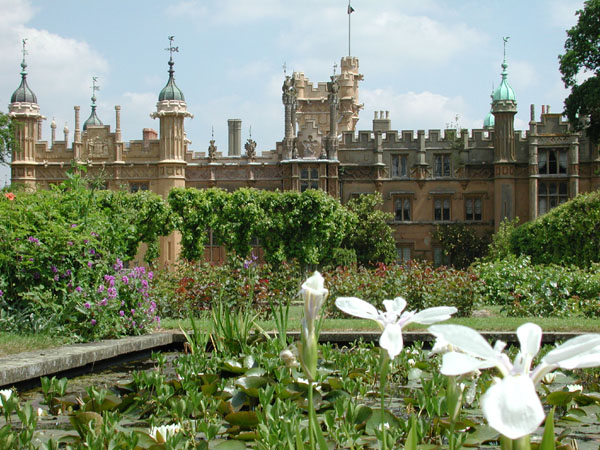
But the point of this post is the house, Knebworth, playing the role of fictional Thorpe Hall. Knebworth has been in many films and tv shows, including The King’s Speech, and Batman, where it purports to be David Wayne’s elegant manor. Kristine and Victoria, with a group of their friends, visited Knebworth on cloudy day a few years ago. The grey skies seemed a perfect background for the ornately gothic pile of yellowish sandstone. Take a look at the Knebworth website here.

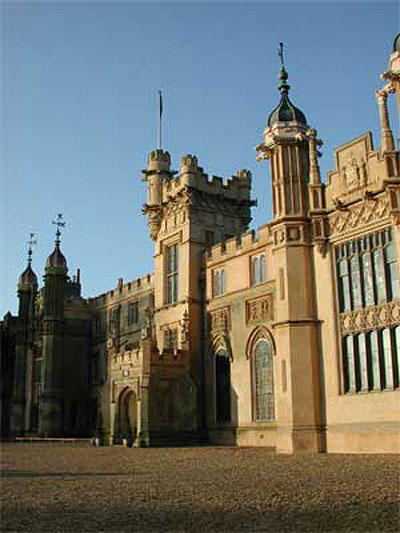
A mere thirty miles north of London, Knebworth House raises its ornate turrets, decorative crenellated chimneys and fanciful columns topped with heraldic beasts to the Hertfortshire sky. The Lytton family has occupied the property for more than 500 years.


Although every stately home in England has a fascinating history peopled with interesting inhabitants, Knebworth is particularly well endowed with eccentric, even tragic, characters. The medieval era house, with assorted changes, stood until the early 19th century. Freed from an unhappy marriage by the death of her husband, the redoubtable heiress, Elizabeth Lytton (1773-1843), made the first of extensive architectural changes in the early 19th century.


She and General William Bulwer (1757-1807), had several children, the youngest of whom became Sir Edward Bulwer-Lytton, (1803-1873), probably the most famous family member, immortalized by Snoopy’s efforts to begin his novel, “It was a dark and stormy night.”

Elizabeth had three sides of the sprawling old structure demolished. The remaining side, preserving the ancient Banqueting Hall with its carved screen, was remodeled in the fashionable gothic style, with a medieval style towers and battlements.

Bulwer-Lytton, a budding poet, had a love affair with Lady Caroline Lamb (known particularly for her pursuit of Lord Byron, the poet) in the 1820’s. A copy of her notorious novel Glenarvon (1816) is on display at Knebworth inscribed by Bulwer-Lytton: “Poor Lady Caroline . . . she could not but inspire deep pity that was heightened by admirations for talents and qualities that well trained, might have made her one of the first women of her time.”

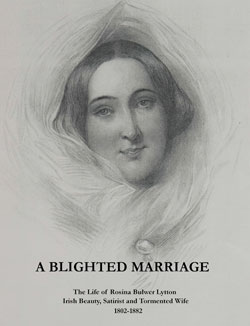
Soon after the affair concluded and against the wishes of his mother, Bulwer-Lytton married Rosina Doyle Wheeler in 1827, one of the most disastrous mismatches of the era. Always short of funds, nevertheless they lived extravagantly. Their two children, a daughter, Emily, and a son, Teddy (later first Earl of Lytton), both suffered from the constant battles between their parents.

At times Rosina was banished from her husband’s presence. Once, after she interrupted a political campaign meeting to denounce him, she was placed in a mental institution until public outrage brought her release. Rosina published thirteen novels and many other works on women’s issues. Quoting the guidebook to the house (p. 11), “Ostracised (sic) by the family for a century, Rosina has now been readopted. Her contribution to the struggle for women’s rights has been recognized . . . and the present Lord Cobbold (David Lytton Cobbald) named his daughter after her.”

Bulwer-Lytton, a member of parliament, a journalist and playwright, as well as th
e author of seventy novels, did not live at Knebworth until after his mother’s death in 1843. When he took over the estate, he began further changes to enhance Gothic elements of the house. Separated permanently from Rosina, he entertained frequently, often staging amateur and professional theatricals with his friend and fellow writer, Charles Dickens. In the sober library of the house, some of Bulwer-Lytton’s novels are on display, the most famous of which is probably Last Days of Pompeii (1834).
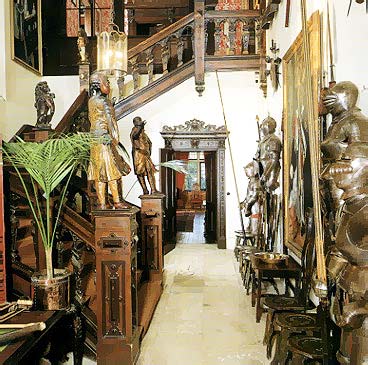
Additional changes to the house were made by his grandson, Victor, second earl of Lytton, with the help of his brother-in- law, the renowned architect Sir Edwin Lutyens. In addition to the fine ancient banqueting hall, today’s visitors will enjoy the army’s many suits of armor, the High Gothic State Drawing Room, and Elizabeth’s regency-era bedroom, preserved as it was in her day at the request of her son. All the afore-mentioned persons are pictured in the extensive family portrait collection. The house gave me a rather melancholy impression, only partially offset by the handsome Knebworth gardens. Below are views of Knebworth, inside and out.

Entrance Hall

The Amoury

Two pictures above, the adventure playground woods

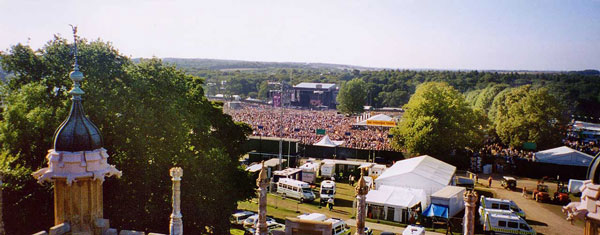
Like so many stately homes in Britain, Knebworth House must pay its own way, and thus is not only a fascinating historical site and a rich source of settings for films.  There are a variety of attractions for children, frequent corporate events and weddings, charity fetes and shows is all kinds (antiques, cars etc etec.) and many, many concerts, mostly rock music, with audiences upwards of 50,000.  Dark and stormy it was not!

Royal Wedding Weekend Getaway Plans

Not content to settle for an extra Bank Holiday and late openings for pubs on the Royal Wedding Day (RWD), airlines and hoteliers are offering extended getaway specials themed around the Big Day.  British Airways is offering Royal Wedding weekend packages and London hotels have been raising their room rates over the weekend accordingly, but really, anyone can book a BA flight or a room at the Savoy, no matter how inflated the cost. So, we’ve rounded up some unique options for the big RWD, each with its own twist on the festivities and all far away from the madding RWD crowds. Book early!
Why not book yourself into the Celtic Manor Resort, where they’ll be throwing a RWD Street party? Their website invites us to “join (them) to celebrate the Royal Wedding in the most traditional British way, with a spectacular outdoor ‘street party’ with live entertainment and big screens to watch the wedding celebrations, in the glorious surroundings of the Rooftop Garden. Immerse yourself in nostalgia with Union Jack bunting and trestle tables laden with tasty treats including jam sandwiches, homemade pork pies, Scotch eggs and sausage rolls, along with favourites such as Victoria sponge, fondant fancies, trifle and of course, traditional wedding cake.” This Five Star Welsh resort features award winning dining, the Forum Spa and was home to the 2010 Ryder Cup.

Forget the RWD, The Castle Hotel in Taunton, Somerset, is offering a Royal Honeymoon package to die for – it includes penthouse accommodation, a private butler, massage, flowers, wine and . . . a throne. I’ve stayed here and it’s just lovely. Of course, I didn’t have a butler. Or a massage. But it was still lovely.


Personally, the offer from the Ambassador Bed and Breakfast in Brighton sounds like a hoot – book into the gay friendly hotel for a minimum of 3 nights over the Royal Wedding weekend and you’ll be invited – at no extra cost – to join  them at a garden party where you’ll watch the wedding and be treated to a free buffet lunch, afternoon tea and wedding cake.

Even Grand Rapids, Michigan is getting in on the weekend wedding getaway deals, which isn’t as far fetched as it seems once you realize that the exhibit, “Diana – A Celebration” will be in town over that weekend, with items on loan from the Spencer family.

And lastly, if you want to do the Royal Wedding in royal style stateside, The Trump International Hotel and Tower in Chicago has announced the “Trump Royal Wedding Experience” where guests will watch the televised version of the Royal Wedding during an exclusive breakfast at the Michelin three-star restaurant Here’s the description from the official press release: “After a night of ultimate comfort in a newly renovated guest room designed by Ivanka Trump, guests will descend to Jean Georges for an exclusive breakfast in the restaurant’s main dining room starting at 5 a.m. A special tasting menu fit for a prince or princess will include selections like scrambled eggs with caviar, mini-French toast, and pains au chocolat. Guests will toast the royal couple with sparkling mimosas as they watch the Royal Wedding on monitors strategically placed around the dining room. The breakfast event will conclude by 9 a.m., at which time guests may choose to hit the town or return to their rooms for a nap. A 4 p.m. late checkout is guaranteed. As a memento of the occasion, each guest will receive a piece of official Royal Wedding china commissioned by The Royal Collection.”  What, no massage?

Valentines Day 1829

Bell’s World of Fashion
A MONTHLY MAGAZINE DEDICATED EXPRESSLY TO HIGH LIFE, FASHIONABLES, AND FASHIONS, POLITE LITERATURE, FINE ARTS, THE OPERA, THEATRES, No. 56.
LONDON, FEBRUARY 1, 1829.

Good morrow to my Valentine,” sings the poor Ophelia. “Good morrow! ’tis St. Valentine’s day, all in the morning betime, and I a maid at your window to be your Valentine!

Rude as these lines may be, they are sacred for they are Shakspeare’s, one of the wild and beautiful snatches of song, which are drawn from the heart of the love torn, riven-hearted maid of Denmark! It, moreover, celebrates a custom in the olden time, of looking for a Valentine through your bed-room window, which has partially descended to us, by the first person we see, of the opposite sex, on this festive morning, being Our Valentine.

Our fair readers will perhaps be gratified with a few reminiscences of the practices in former periods, on this
day, from which originated our Valentines. It was the practice in ancient Rome, during a great part of the month of February, to celebrate the Lupercalia, which were feasts in honour of the deities Pan and Juno. On this occasion, among a variety of other festive ceremonies, the names of all the young females were put into a box, from which they were drawn by the men, as chance directed. The pastors of the early Christian church, who by every possible means endeavoured to eradicate the vestiges of pagan superstitions, substituted the names of saints for those of women; and, as the feast of the Lupercalia had commenced about the middle
of February, they chose a saint’s day for the purpose of celebrating it. As it was, however, impossible to extirpate altogether any ceremony to which the people had been so long accustomed, especially one which was so consonant to their feelings, as the original Lupercalia, the practice of choosing partners or sweethearts, was kept up, and, from the day upon which it was celebrated, all persons so chosen
were called Valentines.

And now we will record some of our own customs peculiar to Saint Valentine. In many parts of England and
Scotland, an equal number of maidens and bachelors assemble together, and each write their name upon separate scraps of paper, which are all rolled up and put into bags; the papers are then drawn, and each young man lights upon a female who is to be his Valentine. The company being thus divided into so many happy, laughing couples, the gentlemen give balls and other amusements to their mistresses, and wear the paper with the lady’s name subscribed on it, upon their bosom or sleeve. The festival is kept up several days, and we need scarcely add that this little amusement generally ends in love!

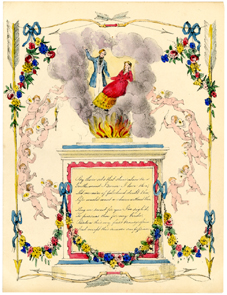
In some parts of Kent they have a curious kind of sport on Valentine’s Day. The young girls of the diiferent villages construct a figure, which they call an ivy girl, while the young men make up another figure, which is denominated a holly boy, and after amusing themselves therewith, the girls steal the holly boy and burn him, and the men run away with the ivy girl, and serve her in a similar manner. The origin, or the meaning of this amusement, we confess ourselves at a loss to guess.

Who would not wish to receive a Valentine? Who is there so dead to all the fascinations of beauty, all the
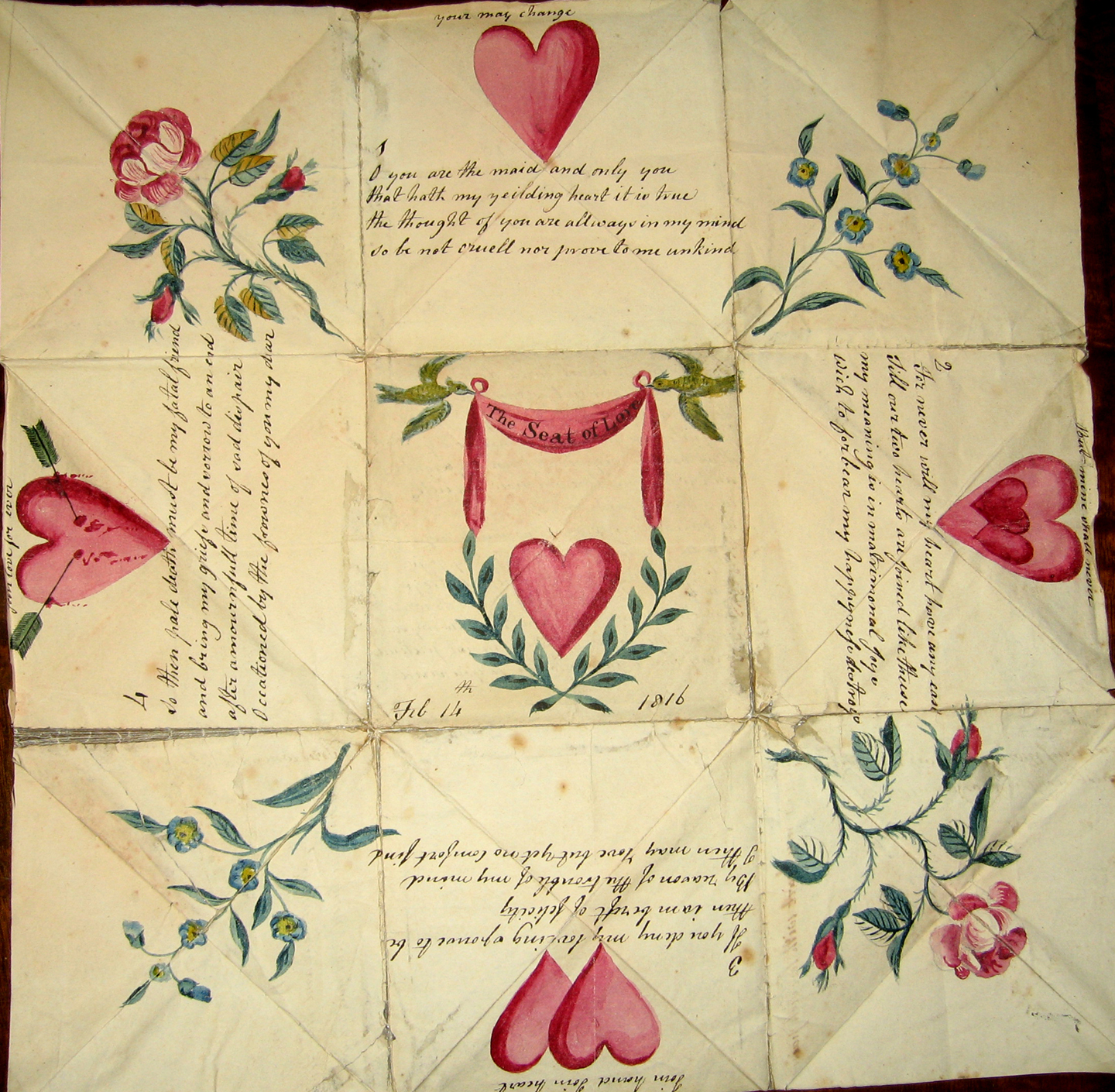
endearments and allurements of life, as to refuse paying two-pence or three-pence, or whatever it may be, for one of those neat folded, tale telling, blissful billets, even though it should contain nothing more than two hearts transfixed with a dart, or a true lover’s knot, and a poesy from the song, ” If you loves I as I loves you,
no knife shall cut our love in two.”

Who, I enquire, is there that would not feel delighted by any of these tender morceaux? Does it not plainly evidence that there are persons who feel a warm and ardent interest in your welfare, and, humble as the scrap may be, is it not a Valentine? and ought you not to be thankful?

If such simple prettynesses then are to be esteemed, what are we to say of the bright and gorgeous emanations of the artist’s pencil, the glittering and highly wrought bijouterie which adorn the windows of our fancy stationers, and are more splendid than the beautiful annual pocket-books which we should never touch but with new gloves on our hands, for fear of sullying their brilliancy. Roses, which unfolding, discover gorgeous temples, sparkling in gold and glitter, surmounted with bands of little cherubs that seem starting into life, and quaint devices, which speak more forcibly to the heart than the finest poetry of Byron or of Moore. Wreaths and bouquets of flowers, with Cupids springing from the leaves, painted in the finest style of art,
the symbolical flowers arranged in an expressive manner; honeysuckle and jasmine twining fondly round the lilies, roses, and other beauty blossoms, with the little meek and blue-eyed ” Forget Me Not,” peering from between its more splendid compeers, but rivalling all in beautiful allusion. What a present for a lover ! how dearly does his lady esteem it! how fondly does she press the bright gem to her heart, and willingly believe its silent eloquence, the tender avowal of this pledge of love!

The practice of sending Valentines is not confined to one class or body of persons, for the same disposition is found in every rank of life; and every juvenile, as soon as he is old enough to fancy himself in love, thinks it very necessary to write Valentines. Nay, every village clodhopper must also have one for his charming Moggy Dumpling, or Betsy Blossom, and “comes up to town ‘ith’ waggon,” on purpose to buy the prettiest, and have a “real Lonnon one.” With what a happy face he enters the stationer’s shop, and enquires for a “nice looking Woluntine,” and after he has turned over some score or two of cupids, and hearts, and churches, and lovers knots, at length pounces upon one which tickles his
fancy, and chuckling to himself, with what a triumphant air he ulls out his leather pouch, and throws down the demanded sixpence; then borrowing a
pen and ink, he scribbles under the gaudy-coloured picture,

” I’ll be your’n if you’ll be mine,
So be my charming Woluntine.”

Afterwards, begging the shopkeeper to fold it up nicely for him, he sallies out of the shop with as much pride and consequence as if he had been made high constable of his parish . . . .

* Two hundred thousand letters, above and beyond the usual daily average, annually pass through the two-penny post-office in London alone, on St. Valentine’s day. What a tiribe of lovers!