Look What I Found

During my decades long research into the life and times of the Duke of Wellington, I often think I’ve exhausted every scrap of info ever posted on the web about him. In frustration, I began to enter weird search terms in the hopes of finding something new – Wellington + dogs, Wellington + lobster, Wellington + Charlie Sheen. This worked fairly well, turning up scraps of new, odd and decidedly informative data. Then, I started doing the same semi-random searches using Google Images for other areas of research. I swan, you never know what’s going to pop up. I had so much fun with a recent image search, I’ve decided to share it with you.

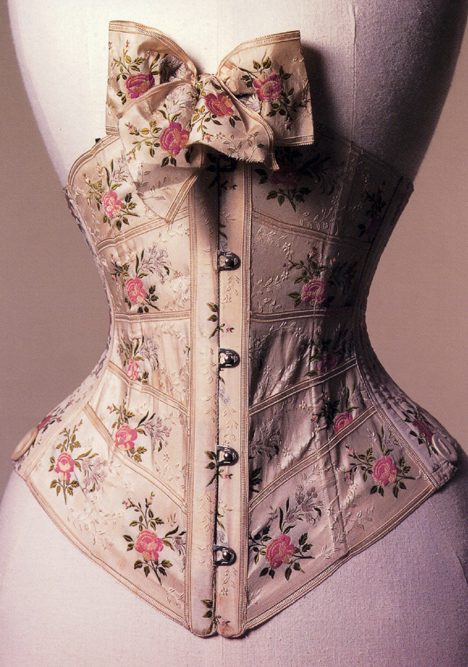
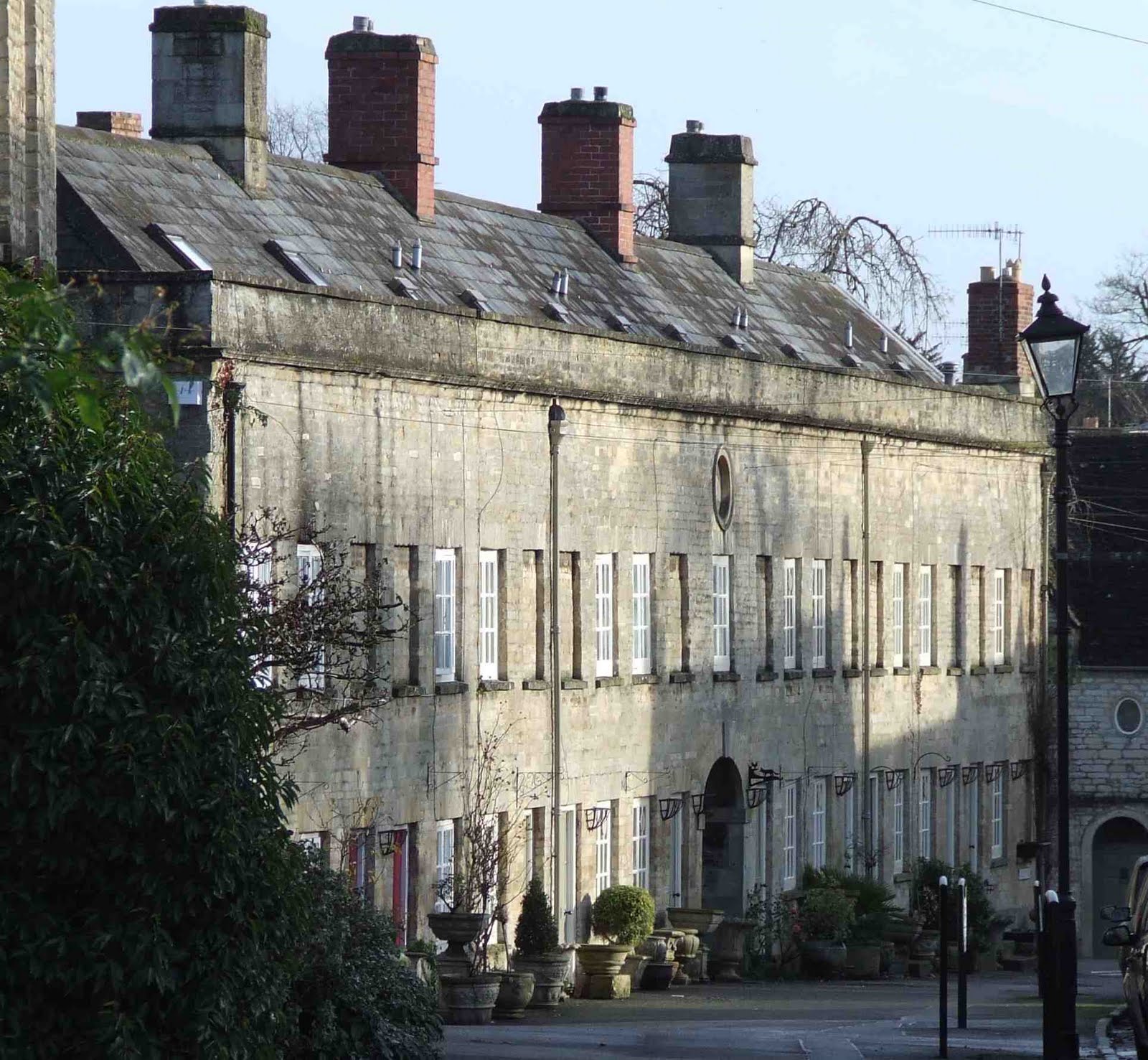
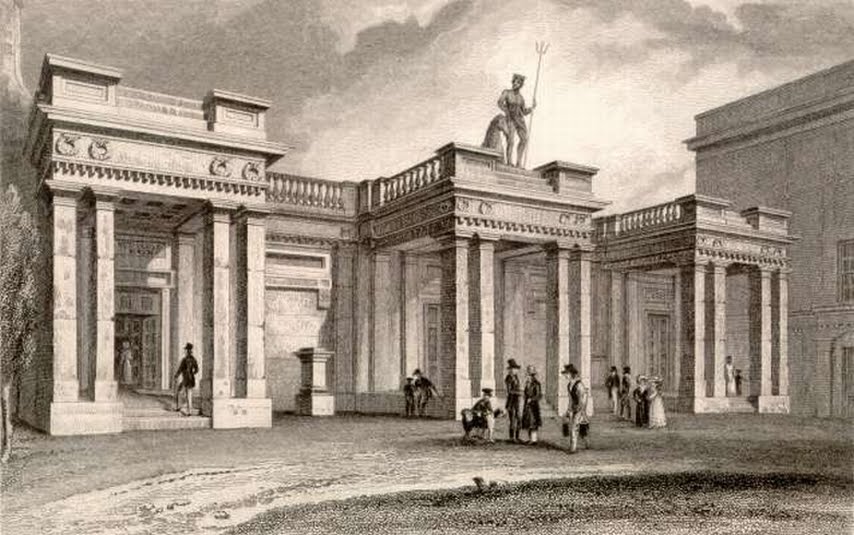
I entered “Regency+Row+Bath” in Google Images and got . . . .

This photo led me to a fabulous site titled Cheltonia, all about “the Curiosities of Cheltenham Spa, Past and Present.” It’s a site filled with articles and photos on various architectural details, old streets, placenames, maps and tons of historical tidbits. Warning: you’ll be there awhile.

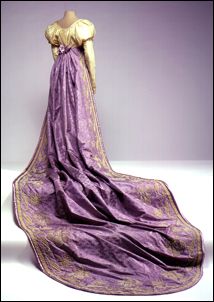
This photo linked to an Illustrated Glossary of Victorian Sartorial Terms, a subpage of A Compendium of 19th Century Fashions published by the University of Texas. Here’s a photo of an 1801 Court Dress found on the site.

There are tons of fashions on the site, each photo gorgeous and each can be enlarged. Enjoy!

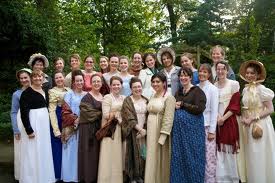
This photo led to a site called In Jane Austen’s England, written by the lady who also runs Sense and Sensibility Patterns. It’s a travel blog about her trips to England to walk in the Regency era. Last post appears to be 9/24/10, but there are tons of pages and pics from this amusing lady who now apparently lives in Kenya. The photos are beautiful and numerous and her text engaging.

 
I  was led to a site called English Buildings: Meetings With Remarkable Buildings run by Philip Wilkinson, the author of The English Buildings Book, by the photo above. I liked the site so much that I’ve added it to our “Amusing Blogs” section.

And the photo below led me to a site called Demolition Exeter, about the destruction of that City’s historic buildings and old streets.

And finally, I met a girl with a sense of fashion and a sense of humour, Miss Nightingale, at Beyond the Pale, via this photo

Here’s a taste of Miss Nightingale’s prose from her “About Me” section: “Affianced to a wonderful man, I currently reside in rather grandly named Royal Tunbridge Wells, located in the county of Kent in the UK. Far from living in the castle (or, at the very least, a medium sized mansion) we so obviously deserve, we live like paupers rent a small flat. I am waiting for that benevolent [yet previously unknown] relative to leave me their entire estate, and expect the hand-written-on-vellum letter from their Dickensian solicitors any day now…

“It should be obvious to even the most casual observer that I am pretty much obsessed with the Victorian and Edwardian [also, to a lesser extent, 1920’s/30’s/40’s] eras, and have been for as long as I can remember. I distinctly recall my mother asking me what I would like to be when I was older. I replied: `A pickpocket!’ which didn’t exactly swell her maternal bosom with pride. Thank goodness I decided I wanted to be a ballet dancer [ha! Short-lived], an actress [secretly feel I missed my calling], a writer [secretly still wish] or Prime Minister [unwise] instead.”

Lots of fashions, yuks and gorgeous photos – I’ve added Beyound the Pale to our blogroll, too.

More finds soon . . . . . .

Do You Know About the Duchess of Duke Street?

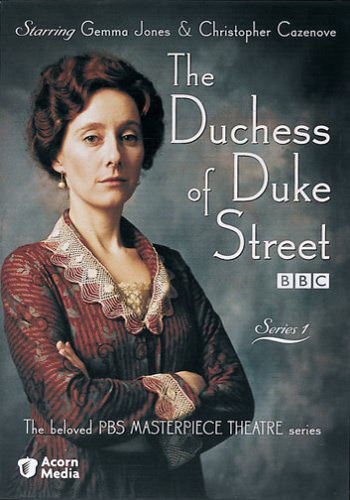
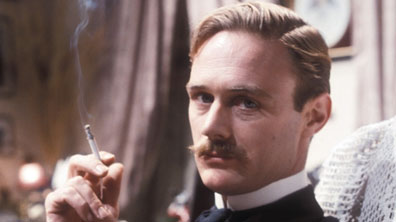
The Duchess of Duke Street is yet another gem from Masterpiece Theatre, in which Louisa Trotter works her way up from being a skivvy to being the Queen of cooks, cook to the King, and owner of the Bentinck Hotel. Based on the true story of Rosa Lewis, one of England’s first recognized female chefs, who worked her way up through the culinary ranks in order to own the Cavendish Hotel and to rub shoulders with celebrities and royalty along the way. Her no nonsense take on life and what it throws at you is at the core of this lavishly produced series that is chock full of humor and heart. Created by John Hawkesworth (Upstairs, Downstairs) and starring Gemma Jones (Bridget Jones’s Diary, Sense and Sensibility) as Louisa and Christopher Cazenove, above (A Knight’s Tale, TV’s Dynasty) as Charlie, the dashing love of her life. Spread out over two series, there are thirty-one episodes for viewers to relish.
                                                       The series more than loosely follows Rosa’s life story. Hired to work in the kitchens of the Comte de Paris, Rosa learned to cook at the elbow of the Comte’s French chef, copying his techniques and watching his every move as she rose through the ranks to become head kitchen maid. In 1887 Rosa was poached by the Duc d’Orleans as his cook. He hired her out on nights when her skills weren’t needed at his home, allowing Rosa the opportunity to see grander and grander kitchens and to learn from better and more experienced chefs along the way.  In time, Rosa became the first female cook to be employed at White’s Club, where a member made a pass at her. Rosa dubbed him “an amorous old woodcock in tights” and was dismissed shortly thereafter. But never fear, things only looked up for Rosa from then on.
There are several versions describing how the real life Rosa met Edward VII. According to Time Magazine, it was Lady Churchill who introduced them. However, the Cavendish Hotel biography states they first met while she was employed by Philippe, Comte de Paris and that Edward VII complimented her for the excellence of the dinner. Whatever the circumstances, Rosa and Edward formed a friendship that would last for years. Rumours of an affair between the two began to circulate and, in 1893 Rosa married a butler by the name of Excelsior Lewis (nicknamed Chiney, probably on account of his outlandish christian name). It was an arranged marriage, clearly intended to end the rumours and along with it came a stylish house in Easton Terrace. Rosa would later explain: “Me family said that if I didn’t marry Mr Lewis they’d shoot me. I told the parson to be quick and get it over and done with. We were married, I threw the ring at him outside the church door and left him flat.” Though the couple remained married, they only continuted to live together for a year. The Prince of Wales was understandably grateful that Rosa had made such a sacrifice on his behalf and it is widely believed that it was Edward, as King, who purchased the Cavendish Hotel in Jermyn Street for Rosa in 1902.
Whilst their romance might have cooled by that late date, Rosa and the King remained friends and Rosa had a private entrance installed for Edward and his royal guests so that nobody would notice their late-night parties in the grand drawing rooms of her hotel. Another admirer of her culinary skills was Kaiser Wilhelm II, who presented her with his portrait, which Rosa deigned to hang in the downstairs public loo. 
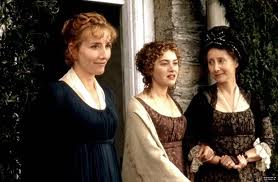
Rosa is played to perfection in The Duchess of Duke Street by actress Gemma Jones, who was first recognised outside the UK in 1974, after playing the Empress Frederick in the BBC television drama series Fall of Eagles. Gemma went on to play Mrs. Dashwood alongside Kate Winslet, Alan Rickman and Emma Thompson in the Academy Award-winning period drama Sense and Sensibility (1995).

To read more about the real Rosa Lewis . . . .
You can watch a bit of The Duchess of Duke Street here

A Look at Lover's Eyes by Guest Blogger Jo Manning – Part Two

Copyright The Art of Mourning

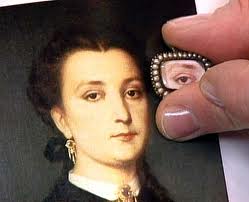
Although the craze for Lover’s Eyes – and it was a craze, thanks to the Prince Regent, later King George IV, who was said to have exchanged lovers’ eyes with his putative wife, Maria Fitzherbert and perhaps with his lover, Mary Robinson (the actress known as Perdita) – flourished for only a short time, his niece Queen Victoria years later was also said to be fond of them and gave them as gifts. To quote Candice Hern, a fellow writer of historical romance novels, “even though the notion of eye brooches was by that time very old-fashioned.”

Ah, but in their day…! Christopher Stocks, writing in the Patek Philippe Magazine last year, noted:
“The combination of royalty and society was as potent then as it is today, and before long the fashion for eye miniatures spread through European high society and as far as Russia and the U.S.”

I first became aware of eye miniatures when I sat in on a presentation given by Candice Hern, as a matter of fact. This was some years ago at a Romance Writers of America conference. Candice’s very fine website shows the eyes in her collection:


Copyright Candice Hern

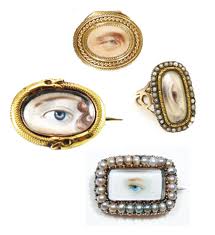
The examples displayed are prime, and are indeed lovely. Hers are all set into brooches; two show blue-eyed women; two are brown-eyed men. Who they are, again, is not known, and neither are the artists who painted them nor for whom they were intended, though we do have clues that several – and maybe a lot more than several – were painted by the prolific and noted miniaturists Richard Cosway and George Engleheart. (Ozias Humphry is said to have painted a few, also.)

Though a number of miniatures bearing the signature of Cosway are suspected not to be his, Engleheart did make a practice in his later years of initialing or signing his name to his work and these are considered genuine, not fakes. (These jottings are not easy to see unless the eye miniature is removed from its setting.)

Speaking of fakes, they are, alas, proliferating in this age of photo-shopping and cropping and Internet image borrowing. They can, however, be distinguished easily from the real thing upon close inspection owing to the presence of pixels rather than brushstrokes. See this very good article by the late Barry Weber, an expert in the field who often appeared on PBS’s Antiques Road Show.

Weber went on to say that “murky colors that use dark sepia tones” should make one wary, as these colors may be “a heavy-handed effort to falsify age.” He also cautioned, “an antique frame doesn’t add authenticity to the painting.” Camilla Lombardi, director of the portrait miniatures department at Bonham’s in London has been seeing an increasing number of fakes as the real thing becomes rarer, particularly noting caution if a nose, or part of a nose, appears in an eye miniature. She says that in genuine eye miniatures there should be “no real sign of the nose where you would expect it, whereas in a cut-down eye miniature you would see the line of the nose and shadow where the corner of the eye meets the bridge of the nose.”


Copyright PBS

What George Williamson had to say in The Art of the Miniature Painter about the care of miniature portraits would apply as well to the much tinier lover’s eyes:

“Miniatures should not be exposed to a strong light… Violent changes of temperature are to be avoided, and should the ivory become too dry it may crack… Lockets and pendants containing miniatures should not be worn at dances, or on any occasion where the wearer is liable to become overheated, as acid condensation takes place inside the glass which may ruin the painting.”

Ather problem – which perhaps accounts for the rarity of eye miniatures set into rings rather than brooches, pendants, or cases – is that water could get under the glass protecting the miniature and wash away the watercolors. Washing hands was death to a lover’s eye set into a ring.

Copyright parisatelier.blogspot.com

And what are these eye miniatures, these oh-so-romantic lover’s eyes, worth in today’s antique jewelry market? Barry Weber noted, “Few pieces cost less than $1,000.” He added, “American pieces are spectacularly rare,” mentioning “one jewel-encrusted example worth $20,000.” Christopher Stocks values unattributed pieces at $1,500, whilst attributed pieces could go as high as $7,500 each. In the 1950s, when no one wanted them, they could be gotten for next to nothing, out of favor and even considered “repulsive” – to quote the art critic David Piper in 1957 — as both jewelry and art.

The oft-cited reference – in Charles Dickens’ 1848 novel, Dombey and Son – reinforces Piper’s condemnation, with the dismissive description of the lover’s eye worn by the elderly spinster Miss Tox as “representing a fishy old eye…” How anyone could see these eyes in that way is just another example of how one person’s treasure can be considered another person’s trash, or, de gustibus non disputandum est.

Lover’s eyes are exquisite, in the opinion of many contemporary collectors, connoisseurs, and lovers of beautiful objects, and this exhibition will bring them to the forefront once again. It has only taken some 200 years! And, reader, do go through Great-Grandmother’s box of trinkets in the attic once more, for who knows what precious eyes may be lurking there, desperate for the light.

A 20th-century version of an eye miniature, from a Bronzino portrait; note the differences between this and a classic lover’s eye.

A Look at Lover's Eyes by Guest Blogger Jo Manning – Part One


Copyright – The Philadelphia Museum of Art


In February of 2012, “The Look Of Love,” an exhibition dedicated to the art of Georgian-era eye miniatures, will take place at Alabama’s Birmingham Museum of Art, curated by Graham C. Boettcher. It will feature the collection of Birmingham residents Nan and David Skier; theirs is perhaps one of the largest collections of this art-cum-jewelry in the world, at some 70 pieces.

I am one of the contributors to the exhibition catalog, though I own but one lover’s eye. Mine is a man’s eye surrounded by seed pearls and set in a gold ring. This ring is shown on page 165 of my biography of Grace Dalrymple Elliott, My Lady Scandalous (Simon and Schuster, 2005). I do not know who the man was, nor do I know the name of the artist. I also do not know for whom it was intended, but I believe it was a mourning ring.


Copyright – The Ornamentalist


The great majority of eye miniatures fall into this category of nameless subject/nameless artist/unknown owner. Moreover, not much has been written on this hybrid form of painting/jewelry, nor are there significant sources for research into this topic to fill in the gaps. What has been written tends to repeat the same historical anecdotes but does not provide much in the way of new material. This 2012 exhibit promises to change this situation. The three essays I have read recently quote exactly the same material; it is way past time to break new ground!

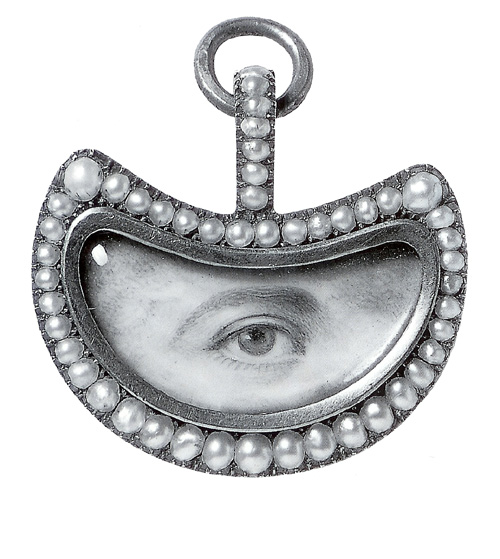
Portrait miniatures abounded in the time of the English Georges in the 18th century/early 19th century, eye miniatures did not. These miniscule paintings very carefully delineated one eye, one eyebrow, perhaps a some wispy strands of hair falling to one side [one of the ways to differentiate between men and women), but never a nose. It was, to put it romantically, an eye – usually the eye of a lover –floating untethered in space, gazing unabashedly at the beloved.

These miniatures were not meant to be seen by just anyone. Their nature was secret, more clandestine, as it were, not at all public. They were meant to be love tokens exchanged by a pair of lovers…and theirs alone. The owner of the eye miniature could carry it safely, knowing that only those with whom she/he chose to share her/his innermost secrets would know whose eye it was.

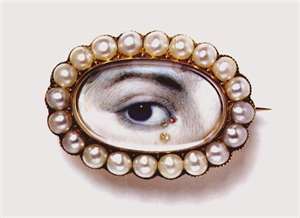
Those that were not tokens of a lover’s affection – and there are a fair number of these — fall into the category of sentimental or mourning jewelry and are identified by a single diamond tear falling from the eye, or a surround of seed pearls, pearls being another metaphor for tears or mourning. (Sometimes a tiny lock of hair was placed behind the painting, reminding one of those strange pieces of hair jewelry favored by the Victorians.)

Copyright The Art of Mourning

The eye miniatures were usually painted in watercolor on ivory, vellum, or even waxed playing card, and protected by a glass cover. Average size was barely half an inch across. The eyes not surrounded by pearls were often framed in garnets, amethysts, and other popular gemstones of the period. It has been estimated that only one to two thousand of these pieces were ever made, making them very rare and thus very collectible.

Copyright The V and A Museum

The tear(s) are easier to see here, and, of course, the seed pearls emphasize this is a bereavement brooch.

Part Two Coming Soon!

Nunhead Cemetery

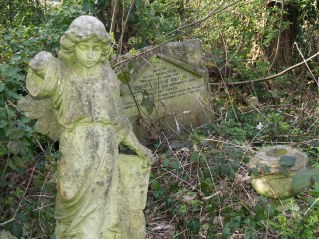
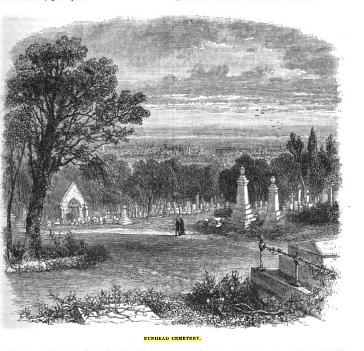
Nunhead Cemetery in Southwark is perhaps the least known, but the most attractive, of the seven Victorian cemeteries on the outskirts of London. It’s formal avenues of towering lime trees and original Victorian planting gives it a truly Gothic feel. Its history, architecture and stunning views make it a fascinating and beautiful place to visit. While much of the cemetery is mysterious and overgrown, many of its features have recently been restored to their former glory. This is thanks to funding from the Heritage Lottery Fund and Southwark Council.

There is a tour conducted by the Friends of the cemetery, open to all, on the last Sunday of each month, starting from the Linden Grove gates at 2:15 p.m. and the two-hour guided tour of a romantic and overgrown Victorian cemetery features 1,000 ivy-clad angels and mighty Victorians buried in the green heart of Peckham.  Consecrated in 1840, Nunhead contains examples of the magnificent monuments erected in memory of the most eminent citizens of the day, which contrast sharply with the small, simple headstones marking common, or public, burials. It’s formal avenue of towering limes and the Gothic gloom of the original Victorian planting gives way to paths which recall the country lanes of a bygone era.

The following account of Nunhead Cemetery appeared in a volume titled, Old Humphrey’s Walks in London and its Neighbourhood (1845) –

This Nunhead Cemetery of All Saints, occupies a commanding site between Peckham and the Kent road, sloping down to the east, north, and south-west, at a distance of some three or four miles from London, and, though far from being completed, gives a fair promise of equaling those which have already won the public approbation. It is the largest of all the cemeteries, comprising at least fifty acres.

In walking to this place I observed, on a neighbouring hill, a singular-looking erection, and the gravedigger, who is even now, with an assistant, preparing a “narrow house” for an inanimate tenant, tells me it is a telegraph. . . . There is a glorious view of London from this spot. The five oaks stretching themselves across the cemetery are strikingly attractive; and when the church is erected on the brow of the hill yonder, it will be a goodly spectacle. The palisades of the boundary, mounting tier above tier; the fine swell of the ground and commanding slope; the groups of young trees, and flowers of all hues, are very imposing. In a few fleeting years the cemetery will be, indeed, an interesting spectacle.

I have walked round the spacious enclosure. What an extended space for a grave-ground ! What a goodly homestead for the king of terrors! Here seems to be room enough to bury us all! At present the monuments are but few; but this is a want that mortality will soon supply. Fever, and consumption, and death, and time, are industriously at work. It is not to one, but to all, that the voice of the Eternal has gone forth: ” Dust thou art, and unto dust shalt thou return,” Gen iii. 19.

And in The Sunday At Home, Voume 25 (1878), we read:

MANY “parks” in the suburbs of London are now treeless, or planted only, in front “gardens,” with shrub-like trees. A visitor of Nnnhead Cemetery, however, unacquainted with its history, must feel inclined to say, “Here is a picturesquely wooded and undulating Surrey park, in which double rows of houses have not supplanted shady avenues; the turf and trees, over and under which a favoured few once wandered, have been turned into a receptacle and a canopy for thousands of the dead, who, whatever was their station in life, are like the dead slave in the Greek Anthology, all now “equal to Darius.'”

Nevertheless, some forty years ago, the cemetery was simply fifty acres of field and meadow. All the tasteful planting has been done by the cemetery company, and it is rare as well as rich, including shrubs which prove that landscape-gardening here is made a speciality, and that no expense is spared upon it. Within the cemetery, there is an ably superintended, strongly-manned nursery, which keeps the flower-beds bright, and the graves also, after the old Welsh custom. It is curious to think of little coffin-shaped parterres, bordered with whitewashed stones, and planted with old-fashioned flowers, far away in the quiet hollows of the Welsh hills—most of the graves with no other memorial than the piously-tended flowers, when on a summer day we see the blaze of blossom at the foot of gleaming marble and glittering granite in Nunhead. But it is winter at the time of our pleasant wanderings there. Some of the graves are still bright with flowers, but glossy shrubs are their chief adornment. Throughout the place, however, laurustinus blossoms freely, although chrysanthemums hang wilted heads, and rowan trees and holly and rose bushes are red with equally seasonable berries. In spite of gardener’s care, and the mildness of the season, there is nevertheless, an unmistakable look of winter in the place. Trees and bushes are leafless; dark, dank dead leaves lie trodden, or waiting to be trodden, into the fat clay; jungles of leafless sprays bend under sugared-almond-like ovals.

Although, since the Bishop of Winchester consecrated the forty-acre All Saints portion of the ground in 1840, some 45,000 persons have been buried in that portion, and the unconsecrated divided from it by no invidious boundary,—there are solitudes still in Nunhead cemetery; graveless, or only dotted with single tombstones, white, grey, black or green. Moss-grown red paths wind into nooks that seem, so far as either dead or living are concerned, as far from London as if thoy were in the Fiji Islands, until we hear the rumble and panting of one of the trains that frequently rush around. The roar of London is audible in Nunhead; the drab masonry of South London, redeemed from meanness only by its smokily, mistily, mysterious mass, spreads almost to the gates, but on other sides you see green swelling country, houseless, or only marred by straggling lines of brick and mortar.

The first grave in Nunhead was dug in October 1840. The average number of burials in it, during the last ten years, has been 1685 per annum, 1350 in the consecrated, and 335 in the unconsecrated ground. The total of burials having been more than four myriads, it is almost startling to hear the number of the “square” in which any one of the slightest notability or notoriety lies, given without a second’s hesitation by the superintendent. Before singling out graves of any kind o
f note, let us ramble round the cemetery.

The birds are not singing, but their half sad little chirpings and twitterings seem more in harmony with a burial ground than full sung, especially on a day like this, when a winter sun is vainly trying to shine through brown-holland-like clouds. The sheen of the silver birches’ bark seems self-evolved in the sombre midday dusk; willows and ashes “weep” still over green stones, on whose graves they have already shed their leaves.

Nunhead Cemetery is open daily, 8am-4pm in winter.
You can read a poem entitled Nunhead Cemetery by Charlotte Mew here and watch a video of the cemetery here.