Attempt On The Queen's Life

From The Greville Memoirs
June 12th. (1840) — On Wednesday afternoon, as the Queen and Prince Albert were driving in a low carriage up Constitution Hill, about four or five in the afternoon, they were shot at by a lad of eighteen years old, who fired two pistols at them successively, neither shots taking effect. He was in the Green Park without the rails, and as he was only a few yards from the carriage, and, moreover, very cool and collected, it is marvellous he should have missed his aim. In a few moments the young man was seized, without any attempt on his part to escape or to deny the deed, and was carried off to prison. The Queen, who appeared perfectly cool, and not the least alarmed, instantly drove to the Duchess of Kent’s, to anticipate any report that might reach her mother, and, having done so, she continued her drive and went to the Park. By this time the attempt upon her life had become generally known, and she was received with the utmost enthusiasm by the immense crowd that was congregated in carriages, on horseback, and on foot. All the equestrians formed themselves into an escort, and attended her back to the Palace, cheering vehemently, while she acknowledged, with great appearance of feeling, these loyal manifestations. She behaved on this occasion with perfect courage and self-possession, and exceeding propriety; and the assembled multitude, being a high-class mob, evinced a lively and spontaneous feeling for her—a depth of interest which, however natural under such circumstances, must be very gratifying to her, and was satisfactory to witness.
Yesterday morning the culprit was brought to the Home Office, when Normanby examined him, and a Council was summoned for a more personal examination at two o’clock. A question then arose as to the nature of the proceeding, and the conduct of the examination, whether it should be before the Privy Council or the Secretary of State. We searched for precedents, and the result was this: The three last cases of high treason were those of Margaret Nicholson, in 1786; of Hatfield, in 1800 (both for attempts on the life of the Sovereign); and of Watson (the Cato Street affair), for an attempt on the Ministers in 1820. Margaret Nicholson was brought before the Privy Council, and the whole proceeding was set forth at great length in the Council Register. There appeared no entry of any sort or kind in the case of Hatfield; and in that of Watson there was a minute in the Home Office, setting forth that the examination had taken place there by Lord Sidmouth, assisted by certain Lords and others of the Privy Council. There was, therefore, no uniform course of precedents, and Ministers had to determine whether the culprit should be brought before the Privy Council, or whether he should be examined by the Cabinet only—that is, by Normanby as Secretary of State, assisted by his colleagues, as had been done in Watson’s case. After some discussion, they determined that the examination should be before the Cabinet only, and consequently I was not present at it, much to my disappointment, as I wished to hear what passed, and see the manner and bearing of the perpetrator of so strange and unaccountable an act.

Up to the present time there is no appearance of insanity in the youth’s behaviour, and he is said to have conducted himself during the examination with acuteness, and cross-examined the witnesses (a good many of whom were produced) with some talent. All this, however, is not incompatible with a lurking insanity. His answers to the questions put to him were mysterious, and calculated to produce the impression that he was instigated or employed by a society, with which the crime had originated, but I expect that it will turn out that he had no accomplices, and is only a crackbrained enthusiast, whose madness has taken the turn of vanity and desire for notoriety. No other conjecture presents any tolerable probability. However it may torn out—here is the strange fact—that a half-crazy potboy was on the point of influencing the destiny of the Empire, and of producing effects the magnitude and importance of which no human mind can guess at. It is remarkable how seldom attempts like these are successful, and yet the life of any individual is at the mercy of any other, provided this other is prepared to sacrifice his own life, which, in the present instance, the culprit evidently was.

The Wellington Connection – Bond, James Bond

In 1961, American oilman and Trustee of the Metropolitan Museum of Art Charles Wrightsman bought Goya’s “Portrait of the Duke of Wellington” for $392,000 from the Duke of Leeds and planned to take it stateside. Public outcry resulted in the painting being temporarily barred from export to the United States and  two months later, the UK purchased the work from Wrightsman with the financial support of the Wolfson Foundation and the government. It proudly hung in London’s National Gallery for a scant three weeks before being stolen, with the thief apparently having gotten both in and out through an open bathroom window.

Because the painting had so recently been the subject of public furor, it’s theft quickly made it a cultural icon. In the first James Bond film, released in 1962, Sean Connery can be seen walking down an elegant staircase in the lair of the villainous Dr No when he spots Goya’s portrait of the Duke of Wellington and says, “So that’s where it went.”

Actually, no one knew where the painting had gone for several weeks, when finally a ransom note was delivered. The ransomer was able to identify marks visible only on the back of the painting, proving that it was in his possession. The ransomer, whose notes were theatrical and flamboyantly written, thought it outrageous that the British government would spend such a sum on a painting when retired British citizens had to pay to watch television. The Goya would be returned, wrote the ransomer, if a charitable fund of equivalent value, £140,000, were established to pay for television licenses for old age pensioners. There seemed to be no personal motivation for the theft, only outrage at the government’s TV license scheme.

The police refused to negotiate and a second ransom note was received and read:

Goya Com 3. The Duke is safe. His temperature cared for – his future uncertain. The painting is neither to be cloakroomed or kiosked, as such would defeat our purpose and leave us to ever open arrest. We want pardon or the right to leave the country – banishment? We ask that some nonconformist type of person with the fearless fortitude of a Montgomery start the fund for £140,000. No law can touch him. Propriety may frown – but God must smile.

Still the police would not respond and a third ransom letter followed:

Terms are same. . . . An amnesty in my case would not be out of order. The Yard are looking for a needle in a haystack, but they haven’t a clue where the haystack is. . . I am offering three-pennyworth of old Spanish firewood in exchange for 140,000 of human happiness. A real bargain compared to a near million for a scruffy piece of Italian cardboard.

The police held their ground and the case went cold until 1965, when a note arrived at the offices of the Daily Mirror newspaper along with a luggage check ticket for the Birmingham rail station. Checking the locker, the police found the stolen painting, which had been deposited by someone identifying himself as a “Mister Bloxham,” likely a reference to Oscar Wilde’s The Importance of Being Earnest, in which an infant is found in a handbag at a rail station luggage check. The painting had been recovered, handed over as a sign of good will by the thief, who realized that his demands, which he felt were entirely reasonable and noble, would not be met.

Rather than being a handsome and debonair art thief, the perpetrator turned out to be a middle aged, over weight,  unemployed bus driver named Kempton Bunton, who gave himself up six weeks later and told police that he had planned to use the ransom money to buy TV licenses for the poor, serving three months in jail for his offense.

During the trial the jury only convicted Bunton of the theft of the frame (which was not returned). Since his defence successfully claimed that he never wanted to keep the painting, he was not convicted of stealing the portrait itself. Bunton was sentenced to 3 months in prison. A provision in the Theft Act 1968, where section 11 makes it illegal to remove without authority any object displayed or kept for display to the public in a building to which the public have access, was enacted as a direct result of this case.
Many people have doubts about Bunton’s involvement in the theft, particularly as the large sized man could hardly have slipped in and out of the NPG through a partially opened window. And it’s been said that documents released in 1996 by the National Gallery are said to reveal his possible innocence. The mystery surrounding the Duke of Wellington continues. One thing’s for certain – Goya’s portrait of the Duke hangs once more in the National Portrait Gallery where, one would hope, the loo windows are now kept locked.

From the Pen of Horace Walpole


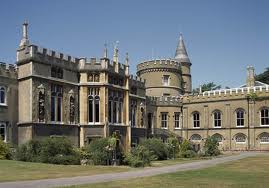
Walpole’s home, Strawberry Hill


From Horace Walpole to the Miss Berrys.
Berkeley Square, June 8, 1791.
Your No. 34, that was interrupted, and of which the last date was of May 24th, I received on the 6th, and if I could find fault, it would be in the length; for I do not approve of your writing so much in hot weather, for, be it known to you ladies, that from the first of the month, June is not more June at Florence. My hay is crumbling away; and I have ordered it to be cut, as a sure way of bringing rain. I have a selfish reason, too, for remonstrating against long letters. I feel the season advancing, when mine will be piteous short; for what can I tell you from Twickenham in the next three or four months? Scandal from Richmond and Hampton Court, or robberies at my own door? The latter, indeed, are blown already. I went to Strawberry (Hill) on Saturday, to avoid the Birthday [4th June] crowd and squibs and crackers. At six I drove to Lord Stafford’s, where his goods are to be sold by auction; his sister, Lady Anne [Conolly], intending to pull down the house and rebuild it. I returned a quarter before seven; and in the interim between my Gothic gate and Ashe’s Nursery, a gentleman and gentlewoman, in a one-horse chair and in the broad face of the sun, had been robbed by a single highwayman, sans mask. Ashe’s mother and sister stood and saw it; but having
no notion of a robbery at such an hour in the high-road, and before their men had left work, concluded it was an acquaintance of the robber’s. I suppose Lady Cecilia Johnstone will not descend from her bedchamber to the drawing-room without life-guard men.

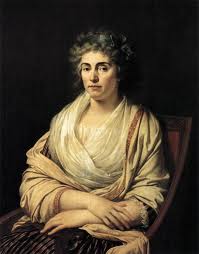
Madame d’Albany
The Duke of Bedford eclipsed the whole birthday by his clothes, equipage, and servants: six of the latter walked on the side of the coach to keep off the crowd—or to tempt it; for their liveries were worth an argosie. The Prince [of Wales] was gorgeous too: the latter is to give Madame d’Albany (1) a dinner. She has been introduced to Mrs. Fitzherbert. You know I used to call Mrs. Cosway’s concerts Charon’s boat: now, methinks, London is so. I am glad Mrs. C.[osway] is with you; she is pleasing—but surely it is odd to drop a child and her husband and country all in a breath!
I am glad you are disfranchised of the exiles. We have several, I am told, here; but I strictly confine myself to those I knew formerly at Paris, and who all are quartered on Richmond-green. I went to them on Sunday evening, but found them gone to Lord Fitzwilliam’s, the next house to Madame de Boufflers’, to hear his organ; whither I followed them, and returned with them. The Comtesse Emilie played on her harp; then we all united at loto. I went home at twelve, unrobbed; and Lord Fitzwilliam, who asked much after you both, was to set out the next morning for Dublin, though intending to stay there but four days, and be back in three weeks.
. . . . . The Duke of St. Albans has cut down all the brave old trees at Hanworth, and consequently reduced his park to what it issued from—Hounslow-heath: nay, he has hired a meadow next to mine, for the benefit of embarkation; and there lie all the good old corpses of oaks, ashes, and chestnuts, directly before your windows, and blocking up one of my views of the river but so impetuous is the rage for building, that his Grace’s timber will, I trust, not annoy us long. There will soon be one street from London to Brentford; ay, and from London to every village ten miles round! Lord Camden has just let ground at Kentish Town for building fourteen hundred houses—nor do I wonder; London is, I am certain, much fuller than ever I saw it. I have twice this spring been going to stop my coach in Piccadilly, to inquire what was the matter, thinking there was a mob—not at all; it was only passengers. Nor is their any complaint of depopulation from the country: Bath shoots out into new crescents, circuses, and squares every year: Birmingham, Manchester, Hull, and Liverpool would serve any King in Europe for a capital, and would make the Empress of Russia’s mouth water. Of the war with Catherine Slay-Czar I hear not a breath, and thence conjecture it is dozing into peace.
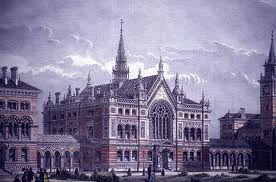
Dulwich College

. . . . . This morning I went with Lysons the Reverend to see Dulwich College, founded in 1619 by Alleyn, a player, which I had never seen in my many days. We were received by a smart divine, tre bien poudri, and with black satin breeches—but they are giving new wings and red satin breeches to the good old hostel too, and destroying a gallery with a very rich ceiling; and nothing will remain of ancient but the front, and an hundred mouldy portraits, among apostles, sibyls, and Kings of England. On Sunday I shall settle at Strawberry; and then woe betide you on post-days! I cannot make news without straw. The Johnstones are going to Bath, for the healths of both; so Richmond will be my only staple. Adieu, all three!
1.  Mme. d’Albany was the widow of Prince Charles Edward, who had died in 1788 in Italy. She was presented at Court, and was graciously received by the Queen. She was generally believed to be married to the great Italian tragic poet, Alfieri. Since her husband’s death she had been living in Paris, but had now fled to England for safety.

Riding in Rotten Row – 2011


copyright oldpicture.com

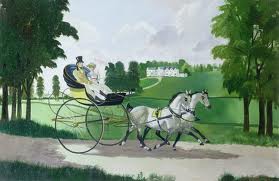
When I was booking my New Year’s Eve trip to England this past January, I searched high and low for a company that offered carriage drives through the London parks, a la New York’s Central Park. There are none. What with the state of London traffic, one can hardly blame them. And no doubt there are at least 37 laws currently on the books against the practice. But what a pity that the City once known for it’s fashionable promenades through the centuries should have let this tradition disappear altogether. Fashionables, fops and fair ladies with fine figures (not to mention splendidly attired servants) are now but distant ghosts. Phaetons have fallen by the wayside and Gunter’s is gone. Oh, the humanity!

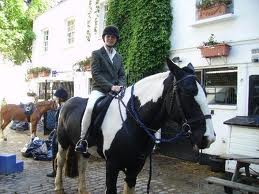
However, a very last vestige of London’s equine past can yet be found at Hyde Park Stables, Bathurst Mews, W2, housed in an authentic mews used for stabling horses. Here, at least, not much has changed through the centuries. Although I don’t think they buy their horses from Tattersalls. No matter, the horses and ponies from Hyde Park Stables are well-known for their calm temperament and you’ll be escorted around the five miles of bridleways across Hyde Park so there’s no fear of getting lost.

“There have been horses here continually since 1835, aside from just two years in the Second World War when the building was used for motor vehicles,” says Catherine Brown, manager of Hyde Park Stables. “Mews are not very spacious but we’ve fitted air conditioning and rubber flooring for the horses. . . people are amazed there are still horses in an area like this. They just expect homes.”


Hyde Park Stables London
© Laura Porter, licensed to About.com, Inc.


Cost is about $115 per hour, helmets and boots provided. One drawback, no cantering allowed. A trot is all you’ll be allowed unless you pre-book an hour lesson in order to have your riding skills assessed.

One can only wonder at what Count d’Orsay must be thinking of this turn of events.

The View from Downshire Hill

Through the courtesy of Hester Davenport and Jo Manning, I have read the little book of memoirs published by the late Elizabeth Jenkins (1905-2010), The View from Downshire Hill, a collection of reminiscences and vignettes of some fascinating personalities.  Miss Jenkins published many novels, biographies, wrote for the BBC, and was one of the founders of the Jane Austen Society. As a matter of fact, she was the last of the original group who first organized to save the cottage in Chawton, Hampshire, where Jane Austen lived from 1809 to just before her death in 1817. It was saved, and the society has grown and flourished, a model for many more Austen societies in North America, Australia and elsewhere.
Elizabeth Jenkins was born on October 31, 1905, Hitchin, Hertfordshire, and died ast the age of 104 last September. She studied at Newham College, Cambridge, beginning in 1924. Through the head of her college, Pernel Strachey (Lytton Strachey’s sister), Jenkins met Virginia Woolf. After Cambridge, Jenkins settled in Bloomsbury, London, and worked on her first novel. She was invited to visit Mrs. Woolf and her huband, Leonard, a visit repeated many times. 


 Jenkins found Virginia as fascinating as we imagine she must have been.  To quote the Telegraph’s obituary, published 6 September, 2010, Jenkins “found the famous writer ‘very beautiful’ and the ‘ineffably distinguished’ company ‘enough to take one’s breath away’. But after a few months she found herself frozen out of conversation, or addressed in ‘contemptuous and mocking’ tones. Scorned, she did not seek to meet Woolf again, even after the Bloomsbury figurehead subsequently inquired after her and described Virginia Water (1928) as ‘a sweet white grape of a book’.
 

Jenkins’ first novel was published by the first publisher she contacted, the famous Victor Gollancz who himself was a leading literary figure in the London of pre- and post World War II.  Of course this is the kind of situation, the lack of any rejection, that stirs some of us to great envy.  But even with considerable literary success, Elizabeth Jenkins had many boring and unfulfilling jobs in dull offices. Nevertheless she never stopped writing. And publishing.  Gollancz (1893-1967) also published Ford Madox Ford and George Orwell, among others. He was knighted in 1965.

In addition to novels, Jenkins wrote many biographies, the first being of Lady Caroline Lamb, a wild young woman whose shocking behavior with Lord Byron and whose society connections in regency England made her a perfect subject for a life story.  Jenkins followed this work with a still-admired biography of Jane Austen in 1938. Two years later, she was a co-founder of the Jane Austen Society, as mentioned above. Today, the rescued cottage is known as Jane Austen’s House Museum and has an excellent website.

Probably the most admired novel by Jenkins is The Tortoise and the Hare. The Telegraph wrote, “…tales of human intrigue were to recur throughout Elizabeth Jenkins’s fiction, notably in her best-known novel, The Tortoise and the Hare (1954), about the gradual collapse of an apparently perfect marriage. The title refers to the two women competing for the affections of a wealthy barrister, Evelyn. His beautiful wife, Imogen, seems to have little to fear from a stout, capable neighbour, Blanche. But as her own insecurities overwhelm her, Imogen can only watch as Blanche’s dull charms win the day. Like her other works, The Tortoise and the Hare relied on Elizabeth Jenkins’s subtle portrayal of complex human relationships. By the end of the book, the author makes it clear that though Imogen is suffering, she has collaborated fully in own her pain. “

Another great author and friend of Jenkins was Elizabeth Bowen, whose novels and short stories are admired. I have to admit I have not read many of them, but I have alsways wanted to add them to my TBR pile, along with Elizabeth Jenkins’ novels and nonfiction.

Though I am eager to read more of Elizabeth Jenkins’ life, we are fortunate indeed to have this fine book, The View from Downshire House, random recollections which really whet our appetites. In fact, I can quote Jane Austen’s Emma:  “It was a delightful visit – perfect, in being much too short.”

Elizabeth Jenkins 1905-2010

I feel sure that Elizabeth Jenkins would have liked the headline on her New York Times obituary: “Woman of Letters.”