Sherlock Holmes: A Game of Shadows

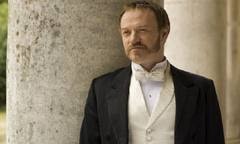
In this sequel, Sherlock Holmes and his sidekick Dr. Watson join forces to outwit and bring down their fiercest adversary, Professor Moriarty, played by Jared Harris, below.

Stephen Fry is Mycroft Holmes, elder brother of Sherlock.

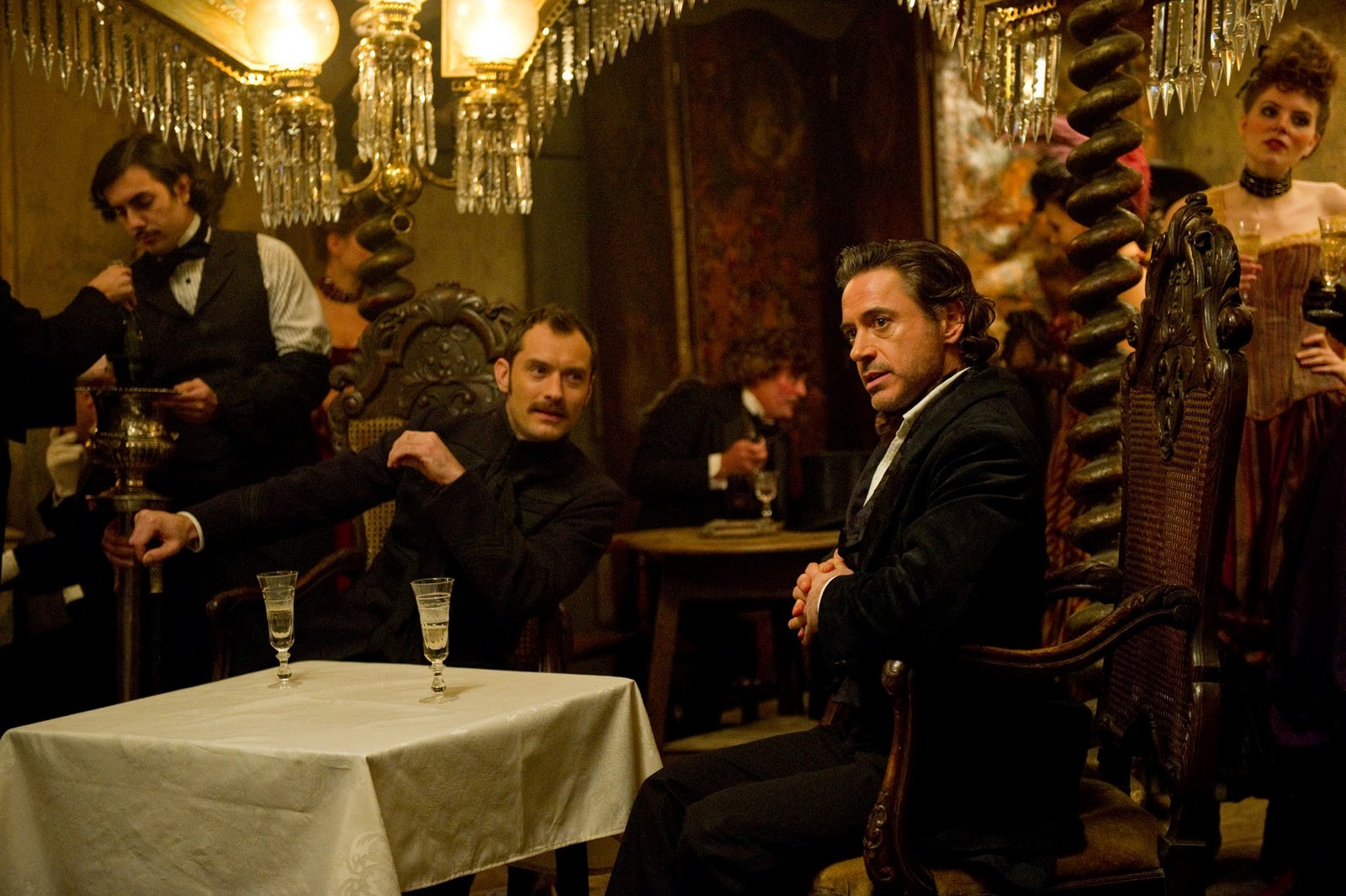
And then, of course, there are Robert Downey, Jr. and Jude Law –

This cast alone should be more than enough encouragement to see the film, but should you be the odd man out and need even more incentive, Wikipedia offers this plot synopsis: “Sherlock Holmes (Robert Downey, Jr.) has always been the smartest man in the room…until now. There is a new criminal mastermind at large—Professor James Moriarty (Jared Harris)—and not only is he Holmes’ intellectual equal, but his capacity for evil, coupled with a complete lack of conscience, may actually give him an advantage over the renowned detective. When the Crown Prince of Austria is found dead, the evidence, as construed by Inspector Lestrade (Eddie Marsan), points to suicide. But Sherlock Holmes deduces that the prince has been the victim of murder—a murder that is only one piece of a larger and much more portentous puzzle, designed by one Professor Moriarty. Mixing business with pleasure, Holmes tracks the clues to an underground gentlemen’s club, where he and his brother, Mycroft Holmes (Stephen Fry) are toasting Dr. Watson (Jude Law) on his last night of bachelorhood. It is there that Holmes encounters Sim (Noomi Rapace), a Gypsy fortune teller, who sees more than she is telling and whose unwitting involvement in the prince’s murder makes her the killer’s next target. Holmes barely manages to save her life and, in return, she reluctantly agrees to help him. The investigation becomes ever more dangerous as it leads Holmes, Watson and Sim across the continent, from England to France to Germany and finally to Switzerland. But the cunning Moriarty is always one step ahead as he spins a web of death and destruction—all part of a greater plan that, if he succeeds, will change the course of history.” Yowza!

Watch the trailer here.


On The Shelf: Annie Groves

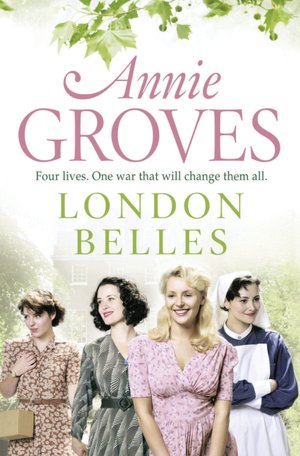
Recently, I was given that which every avid reader covets – the gift of discovering a new author. Annie Groves, who also writes as Penny Jordan.  Her writing style is reminiscent of Catherine Cookson  and Groves also writes family sagas, most of them being set around World War II London, rather than 19th century Tyne and Wear. Her latest series begins with London Belles, a tale of four very different young women thrown together by war. Finding freedom and independence – as well as love, passion and heartbreak – for the very first time, a unique bond is formed as the hostilities take their toll on Britain.

United by chance, bound together in times of need When tragedy strikes, Olive is forced to seek lodgers. Three girls come knocking at her door, each in need of a roof over their heads. Sally has left Liverpool to work as a nurse in London and when she arrives she is a shell of her former self. Where once stood a vivacious, sociable girl, now stands one plagued by homesickness and a betrayal that is devastatingly fresh in her mind. Dulcie is living the high life in the West End, a world away from her home in Stepney. Working at Selfridges gives her access to the most fashionable clothes and makeup, but at home she is the black sheep of the family; always second to her sister. So she decides it’s time to make a bid for freedom. Agnes grew up in an orphanage, having been left on the steps as a new-born baby. But with war looming, and the orphanage relocating to the country, she must now seek out a job and lodgings. But with change comes exciting new opportunities, worlds away from the life she’s known… As the women prepare for war, all of their futures hang in the balance. Soon their lives will change irrevocably and the home that binds the London Belles is no longer the sanctuary they once sought.

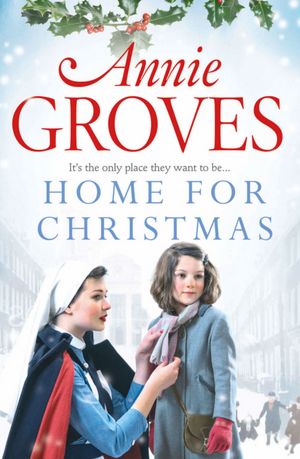
Imagine my delight when, upon finishing London Belles, I rushed to the Barnes and Noble site only to find that there’s already a sequel, Home for Christmas, which picks up the tale exactly where it left off.

There’s nothing new or shocking in Groves’s storytelling, but that’s a good thing. She uses a gentle voice to relay the wants, desires and motivations of four 1940’s girls, each of whom has their own distinct personality. Like Cookson, Groves charms the reader with good, old fashioned storytelling that left me wanting more.  Best of all, Groves has a couple of previous WWII series in her backlist, so I’ll have a title of hers in my TBR pile for a while to come. You can visit Annie Groves’ website here.

Jane Austen's 236th Birthday December 16, 2011

On Saturday, December 10, the Wisconsin region of JASNA celebrated Jane Austen’s birthday with a gala luncheon. 

Marylee Richmond and Susan Flaherty at the registration table.
Suan and Diane Judd made individual souvenirs for all participants, a series of stunning silhouettes (as below).  What an acomplishment!

We dined on individual Beef Wellingtons or Quiches, followed by delicious desserts not to be believed. (Remember, desserts is stressed spelled backwards.) 

Below, Sara Bowen and Jane Glaser have a chat before the luncheon.

Above, our Chicago colleague, William Phillips, gave the annual toast to our favorite author’s birthday.
Below, Jeff Nigro, Regional Coordinator for the neighboring Chicago group,  as he presented his talk on “Austen and the Beauty of Place.”

Jane Austen did not write a great many long descriptions of locations in her fiction.  Sometimes, Nigro said, when characters spoke rhapsodically, their fawning images illustrated the superficial nature of the speaker, such as Mr. Collins talking of Rosings (Lady Catherine’s estate) or Mrs. Elton in Emma with her inflated images of Maple Grove.
Above, Chawton House and Church, by an unknown artist


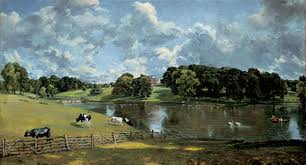
Austen favors descriptions, such as that Edward gives in Sense & Sensibility, of a landscape that unites beauty and utility.  An excellent example would be the view of Wivenhoe Park by John Constable,  1816, National Gallery of Art, Washington, D. C., below.

Among the best known of Austen’s landscape descriptions comes from Emma:    “It was a sweet view — sweet to the eye and the mind. English verdure, English culture, English comfort, seen under a sun bright, without being oppressive.” 

Nigro went on to compare such images from Austen to sets and locations used in various movie and television series based on the novels, sometimes finding the film version less than accurate.

Instead of trying to define a universal standard of beauty, he concluded, Austen raises queries about what constitutes true  beauty;  more than just a nice view, she finds perfection is based on a complex web of emotions that we bring to our personal images  — of home.  Thank you, Jeff, for your stimulating talk!

Above, Sue Zimmerman and Victoria Hinshaw

                                                 &n
bsp;          Liz Cooper with Beverly Levin

The Wisconsin Region invites you to its website, here.
The renowned calendar prepared by Liz Philosophos Cooper and Kim Wilson has even more entries on the activities of Jane Austen, her family, and her characters to fill almost every day.  This year’s pictures are all on color, some of everyone’s favorites from the Brock Brothers. To order, contact Liz Cooper at
or click Merchandise on the website.

Below, a sample page (October 2012)

Christmas Turkeys

From The Book of Christmas: Descriptive of the customs, ceremonies, traditions … By Thomas Kibble Hervey (1845)

Amongst the signs of the time that are conspicuous upon the roads, the traveller whose journeyings bring him towards those which lead into the metropolis, will be struck by the droves of cattle that are making their painful way up to the great mart, for this great festival. But a still more striking, though less noisy, Christmas symptom forms a very amusing object, to him who leaves London by such of its highways as lead eastward. Many a time have we seen a Norfolk coach, with its hampers piled on the roof and swung from beneath the body, and its birds depending, by every possible contrivance, from every part from which a bird could be made to hang. Nay, we believe it is not unusual with the proprietors, at this season, to refuse inside passengers of the human species, in favor of these oriental gentry, who “paybetter;” and, on such occasions, of course, they set at defiance the restriction which limits them to carrying “four insides.” Within and without, the coaches are crammed with the bird of Turkey;—and a gentleman town-ward bound, who presented himself at a Norwich coach-office, at such a time, to inquire the “fare to London,” was pertly answered by the book-keeper, “Turkeys.” Our readers will acquit us of exaggeration, when we tell them that Mr. Hone, in his Every Day Book, quotes, from an historical account of Norwich, an authentic statement of the amount of turkeys which were transmitted from that city to London, between a Saturday morning and the night of Sunday, in the December of 1793;—which statement gives the number as one thousand seven hundred, the weight as nine tons, two cwt., and two lbs., and the value as £680. It is added that, in the two following days, these were followed by half as many more. We are unable to furnish the present statistics of the matter; but, in forty years which have elapsed since that time, the demand, and, of course, the supply must have greatly increased; and it is probable that the coach proprietors find it convenient to put extra carriages on the road, for these occasions.

Norfolk must be a noisy county. There must be a ” pretty considerable deal” of gabble, towards the month of November, in that English Turkistan. But what a silence must have fallen upon its farm-yards, since Christmas has come round! Turkeys are indisputably born to be killed. That is an axiom. It is the end of their training,—as it ought to be (and, in one sense, certainly is) of their desires. And, such being the destiny of this bird, it may probably be an object of ambition with a respectable turkey, to fulfil its fate, at the period of this high festival. Certain it is that, at no other time, can it attain to such dignities as belong to the turkey who smokes on the well stored table of a Christmas dinner, the most honored dish of all the feast.

JASNA Birthday Tea in Chicago

The Greater Chicago Chapter of JASNA celebrated Jane Austen’s 236th  birthday with toasts to Jane and tea at the Fortnightly on Saturday, December 3, 2011.  The Club was festive with Christmas lights and set a perfect atmosphere for our afternoon.

The speaker for the program was Mona Scheuermann, a professor at Oakton Community College in Illinois, whose topic was “Jane Austen and Making Do.”  Of particular interest to her was the morality of the choice of plays chosen to be performed by the young people in the novel Mansfield Park. The choice of “Lover’s Vows,” an adaptation by Elizabeth Inchbald of a German play by von Koetzbue, defined each character and gave us a strong insight into their views.

Jane Austen, according to Scheuermann, did not believe that this play, with its theme of redemption after a  illicit affair, was a proper vehicle for the young, unmarried participants in the Mansfield Park dramatic effort.  Fanny Price, of course, refused to participate, and Edmund also balked, placing them in the forefront of good behavior, always a value to Jane Austen.

The Club’s lovely silver urns for our tea.  Our favorite winter beverage was accompanied by an assortment of savory sandwiches and sweets, as shown.

Above, the required watercress and cucumber sandwiches.  Once we are all served and reassembled, it was time for the annual birthday toast to our Jane. Leading us in extolling our favorite author was Karen Doornebos, author of the new novel, Definitely Not, Mr. Darcy. Look for more information on Karen here.

After we raised our champagne glasses to the memory of Austen, Karen posed with JASNA GCR regional coordinator Jeff Nigro.

Another debut author showing off her new work was Elizabeth Lenckos of the University of Chicago, who is a contributor to the volume entitled Wooing Mr. Wickham, a collection of stories inspired by Jane Austen’s heroes and villains, from the Jane Austen Short Story Award 2011 entries, sponsored by the Chawton House Library.  A total of 20 authors are included in a wide variety of formats and approaches.

Elizabeth’s story is based on the wartime experiences of her family in Berlin at the end of World War II.  It is a poignant story that shows just how deeply the love of Jane Austen can dwell within our hearts, even at the worst moments of existence.

Above, Elizabeth Lenckos speaks to the JASNA AGM in Ft. Worth, TX, in October 2011.

So now you have two books to add to your list for Santa this year.  And I have another Jane Austen Birthday Celebration to attend soon.  Hurrah!! Regardless of various kerfluffles about murder charges and newly-discovered portraits of somebody or other, our essential love of and admiration of Jane Austen remains indiminished.