New British Galleries at the Met

by Victoria Hinshaw

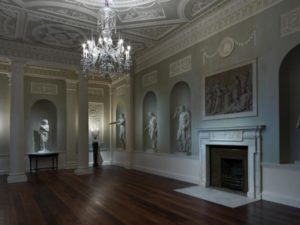
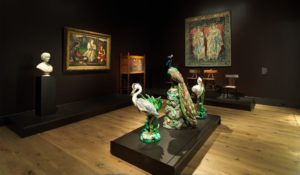
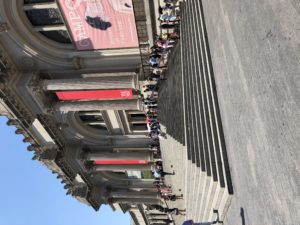
Just before closing for the covid 19 pandemic, New York City’s Metropolitan Museum of Art reopened the British Galleries after a total reinstallation. When  was last in NYC, I was disappointed not to visit favorite spots such as the Lansdowne House Dining Room, removed from the London structure and brought to the Met many years ago. But now that room and many other treasures have been restored, reinstalled, and reinterpreted.

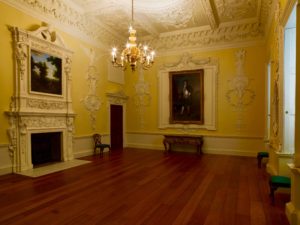
The Lansdowne House Dining Room

I have not visited the new Galleries (the Met is scheduled to reopen in late August), but they have received widespread comments from art and cultural sources, enough to give us a pretty good idea of the new approaches.

19th Century Gallery

From the Met’s press release last March, 2020: ‘The Metropolitan Museum of Art’s $22m reinstallation of its British galleries opens to the public on Monday with a stirring narrative on the anxious commercial striving that shaped the British decorative arts from 1500 to 1900. Featuring nearly 700 works in 10 rooms spanning 11,000 sq. ft, the galleries tell a warts-and-all story of empire in which dark elements like the slave trade emerge and cataclysmic events like the Great Fire of London in 1666 serve as dramatic punctuation points. Nearly a third of the works on view have been newly acquired, with a preponderance of those recent purchases in the 19th-century section.’

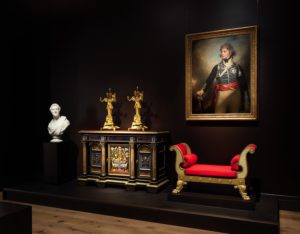
19th Century Gallery

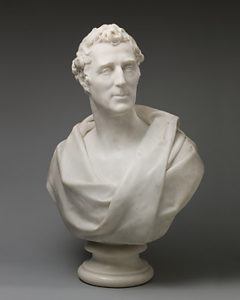
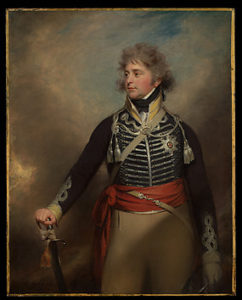
In the above picture, a bust by Sir Francis Chantrey (1781-1841)  of Arthur Wellesley, lst Duke of Wellington (1769-1852), is at the left and below.  At right and below is a portrait of George (1762-1830), Prince of Wales, later George IV, by Sir William Beechey (1753-1839). Beneath the portrait is a red bench by Thomas Hope (1769-1831), before 1807.

Duke of Wellington, marble, 1823
George IV

Other than these familiar objects, the installation is very different than past representations of British Art. Again, quoting the Met’s press release:  ‘The Met’s British collection is the largest of its kind in the US. The opening, part of the Met’s 150th anniversary celebrations, crowns a seven-year effort that began with the notion that “these galleries needed some attention and refreshment,” says Wolf Burchard, the Met’s associate curator of British furniture and decorative arts. “The previous galleries were all about the individual objects in historic interiors, and there was no thread that went through it,” he explains. “The new galleries are all about the cross section between creativity and entrepreneurialism.”’

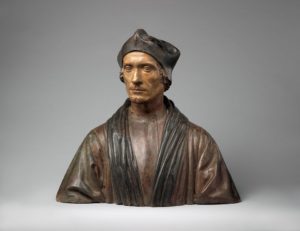
Pietro Torrigiano’s bust of Bishop John Fisher (1510-1515) Courtesy of Metropolitan Museum of Art
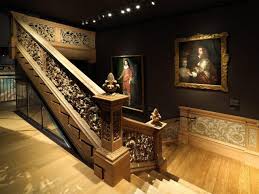
The newly conserved pine and elm staircase from Cassiobury Park, Herfordshire (around 1677-80) in the Metropolitan Museum of Art ‘s new British galleries Photo by Joseph Coscia, February 2020/Courtesy of the Metropolitan Museum of Art

The Met continues: ‘The first gallery, clad in paneling made for the merchant trader William Crowe, opens from the museum’s medieval sculpture hall, vaulting the viewer into the 16th-century Renaissance era. A wall text emphasizes how the House of Tudor competed to match the artistic splendors of papal Rome, the French courts and the Germanic centers of Hapsburg power, and how a new class of professionals with luxury appetites arose under the stable reign of Elizabeth I amid an expansion of global trade. Surveying the gallery from its perch is a polychrome terra cotta bust that is thought to depict Bishop John Fisher, who was executed for opposing Henry VIII’s decision to lead the Church of England away from Roman Catholicism and papal authority. Leading to a mezzanine is another highlight, the magnificently ornamented and newly conserved pine and elm staircase from Cassiobury Park, Herfordshire (around 1677-80), with its naturalistic acanthus leaves, acorns, birds and snakes.’

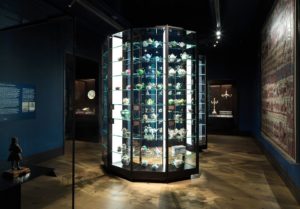
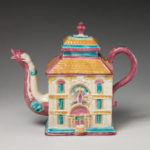
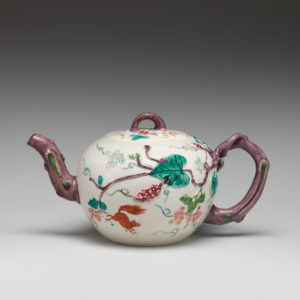
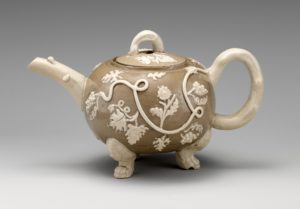
The Met continues: ‘A gallery titled “Tea, Trade and Empire” drives home how four commodities—tea, sugar, coffee, and cocoa—fuelled artistic innovation in Britain from the late 17th through the late 18th century. The museum has installed two towering semi-circular glass cases filled with a whimsical assortment of 100 teapots, underlining how that staple became a pivot point for social interaction in even modest British households and nurtured an enormous national ceramic industry. (The galleries are mindful not just of an aristocratic elite but of multiple layers of society.) At the same time, the 1789 title page of a slave’s memoir on the perimeter of the gallery alerts viewers to the exploitative nature of empire, with the trans-Atlantic slave trade rising in tandem with the spread of sugar plantations. “Much of the wealth of this period is built on the labor of enslaved Africans,” a wall text says simply.’

A gallery titled “Tea, Trade and Empire’ features two towering glass cases featuring 100 British teapots Photo by Joseph Coscia, February 2020/Courtesy of the Metropolitan Museum of Art
teapot in the form of a house, ca. 1775; Salt-glazed stoneware with enamel decoration
Staffordshire teapot, salt-glazed stoneware with enamel decoration, ca 1760
Staffordshire Teapot, ca. 1750-60
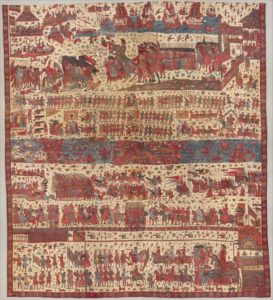
Hanging depicting a European conflict in South India, cotton, drawn & resist-dyed
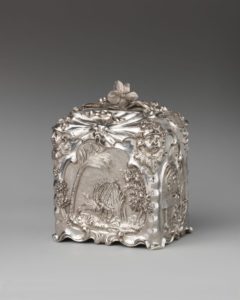
Sugar Box, Silver, Ca. 1738, by Paul de Lamerie
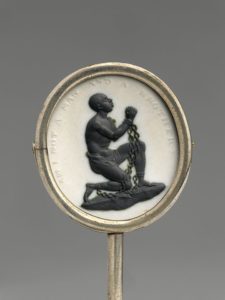
Josiah Wedgwood, anti-slavery medallion, 1787

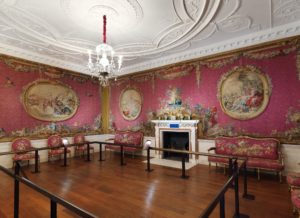
The Met continues: ‘Three galleries are devoted to the re-creation of striking 18th-century British interiors moved from Kirtlington Park (Oxfordshire), Croome Court (Worcestershire) and Lansdowne House (London). A wall text notes that the Lansdowne dining room, designed by Robert Adam and crowned by an intricately decorated ceiling, banished odor-absorbing textiles that would have retained “the smell of the victuals”.’

Kirtlington Park; photo by Richard Lee
Croome Park room, after Robert Adam, 1763-71, photo by Joseph Coscia

Last year I was at the Met in July but I won’t make it this year. What a strange year 2020 is!

July, 2019, photo by Victoria Hinshaw
View from the Met roof, July 2019, photo by VH

In the Garden with Empress Josephine

In a prior post in our gardening series we met nurseryman Mr. John Lee, who took up operation of the Hammersmith nursery garden upon his fathr’s death. Mr. Lee followed in father’s foot steps as far as the accumulation of new and rare plants was concerned, as well. He and the Empress Josephine of France, pictured above, in partnership, sent Francis Masson to the Cape of Good Hope in order to gather botanical samples in the hopes of introducing the beautiful flowers of that region to European gardens. In this connection it may be of interest to note that a large portion of Masson’s Herbarium is preserved in the collections of the Academy of Natural Sciences of Philadelphia.

Additionally, the Empress became patroness to James Niven, who worked in the Botanic Garden at Penicuick in Scotland and travelled to the Cape of Good Hope in 1798 to collect seeds, where he stayed until 1803. During his second visit between 1805 – 1812, he collected seeds for Empress Josephine, and embarked on a journey through the districts of Malmesbury, Piquetberg and Kamiesberg where he collected rare species of Protea. He returned home with a considerable herbarium, including a set of Erica specimens which found its home in the Botancial Garden in Edinburgh.

Joséphine de Beauharnais (23 June 1763 – 29 May 1814) was the first wife of Napoléon Bonaparte, and thus the first Empress of the French. Her first husband Alexandre de Beauharnais had been guillotined during the Reign of Terror, and she had been imprisoned in the Carmes prison until her release five days after Alexandre’s execution.

Josephine was born at the family’s sugar plantation on the French Caribbean island of Martinique and it’s slow pace of life she dubbed “nonchalance.” It was there, in a lush tropical atmosphere, that Josephine developed her passion for flowers and gardening. Later she would introduce flower gardening to France, particularly at Malmaison. So avid a cultivator and gardener was the Empress that we still have plants that are named in her honor.

Chateau Malmaison

When Josephine first purchased the property in April of 1799, Malmaison was a run-down estate, eight miles west of central Paris that encompassed nearly 150 acres of woods and meadows. Napoleon was incredulous when Josephine first bought Malmaison at an inflated price and then proceeded to fund it’s renovations. After her divorce from Napoléon, Joséphine received Malmaison in her own right, along with a pension of 5 million francs a year, and remained there until  her death in 1814. The gardens housed West Indian plants and is known as the birthplace of the tea rose. In fact, they housed over 250 varieties of roses from across the world, 170 of which were famously painted by Pierre-Joseph Redoute – prints of which remain favorites today, such as the one at right.

The aim of the Empress Joséphine was to transform her large estate into “the most beautiful and curious garden in Europe, a model of good cultivation”. And a model of modern gardening Malmaison became. Amongst other innovations, Josephine had installed a heated orangery large enough for 300 pineapple plants,  a greenhouse, heated by a dozen coal-burning stoves. Architects Charles Percier and Pierre-François-Léonard Fontaine initially enclosed the park and built stables and hot houses. The garden was subsequently remodelled by landscape architect Louis Martin Berthault.

Most importantly in gardening history, the Empress introduced nearly 200 new species of plants to France, including dahlias from Mexico, and encouraged her gardeners to create new species of roses. Her principal source for roses was the Lee & Kennedy Vineyard Nursery in London, of which the Mr. Lee mentioned above was co-owner. Josephine wanted every rose known in the world, and in 1804, by way of Lewis Kennedy, she was in proud possession of the new Chinese roses: Slater’s Crimson China, Parson’s Pink and Hume’s Blush Tea Scented China. These everblooming roses were recent imports to England from China, and it was a coup for the Empress (and for France) to have them growing at Malmaison. They became known as stud roses, potent parents of the modern everblooming rose cultivars.
The most famous rose, and a perennial favorite, to be named for Josephine is the Souvenir de la Malmaison, a Bourbon, shown at rght. 

According to Clair G. Martin III, the Ruth B. and E. L. Shannon Curator of the Rose Garden at the Huntingdon Library, “At the height of the war in the early 1800s, Napoléon was sending money to England to pay his wife’s plant bills, and the British Admiralty was allowing ships to pass through its naval blockades to deliver new types of roses to Malmaison.” Joséphine’s influence was felt across the channel, as well, as many British aristocrats joined the frenzied competition for the newest blooms.”

Josephine commissioned a book about the garden and its plants that was completed t
hree years after her death and published under the title “Jardin de Malmaison-Description des Plantes Rares Cultivees a Malmaison et a Navarre” with text by renowned French botanist Etienne-Pierre Vententat. The book contained 175 watercolors by Redoute and originally appeared in installments.
When I was in Paris recently, I thought to visit Malmaison and the gardens there until I learned that, sadly, the garden today is limited to a very small area with nothing to speak of remaining of Empress Josephine’s efforts or botanical collections.
To learn more about the history of the gardens at Malmaison, read Jardin De La Malmaison: Empress Josephine’s Garden with an essay by Marina Heilmeyer by H. Walter Lack.

Mr. Lee of Hammersmith

England has always been a land of gardens and gardeners and so we thought it appropriate to begin a few posts which deal with the subject. Of course, if you’re going to garden you are going to need plants. One of the most respected and most successful nursery gardens was that of Messrs. Lee, of Hammersmith, one of the oldest in the neighbourhood of London, which survived until the early part of the 20th century.

Mr. James Lee, who established the nursery, was born at Selkirk in 1715. When he first came to London he was employed at Syon, and afterwards at Whitton (pictured above), by the Duke of Argyll. About the year 1760 he entered into partnership with Mr. Lewis Kennedy, gardener to Lord Bolton, at Chiswick, and commenced a nursery, in what was called The Vineyard, at Hammersmith. About the middle of the 18th century, the vineyard was producing a considerable quantity of Burgundy wine each year. A thatched house was built in the grounds; with wine cellars beneath. Mr. James Lee and his partner took it and established a most successful Horticultural Nursery, remarkable for obtaining from distant countries everything rare and  beautiful to be obtained. They maintained collector at the Cape of Good Hope, and another in America and enjoyed world-wide celebrity. Every known, rare, or new plant could be obtained there. They once received a letter addressed, “Lees Nursery, England” which reached them readily. They were the first to obtain a China rose (right) in 1787. These roses changed the cultivation of roses in many ways, including the fact that they broadened the scents of roses, new blends becoming apparent as they were hybridized with other roses, such as damasks.

James Lee had an encyclopedic knowledge of plants and the greenhouses were quite extensive and almost as old as the nursery itself, offering a good stock of many species with a very full collection of Fuchsias, the best being F. ignea, a variety raised by Messrs. Veitch of Exeter. The flowers are very large, with the colours (crimson sepals and purple corolla) bright and strong, and the sepals reflexed. Other good varieties on offer were striata (Veitch); Don Giovanni, with a fine open corolla; Grand Master, similarly fine; and Prince of Orange, with pale and large flowers, shown at left.

In fact, so well known were Mr. Lee’s Fuchsia’s that there is a legend surrounding his acquisition of a certain variety. This tale has been told and appears in print numerous times, most floridly perhaps in the Ladies Repository of 1871. Here is the version that appeared in Sharpe’s London Magazine in 1846, entitled The Fuchsia Tree:

MR. SHEPHERD, the respectable and well-informed conservator of the Botanical Gardens at Liverpool, gives the following curious account of the introduction of that elegant little flowering shrub, the Fuchsia, into our English green-houses and parlour windows. Old Mr. Lee, a nurseryman and gardener, near London, well known fifty or sixty years ago, was one day showing his variegated treasures to a friend, who suddenly turned to him, and declared, “Well, you have not in your collection a prettier flower than I saw this morning at Wapping.”—”No! and ‘pray what was this phoenix like?”—”Why, the plant was elegant, and the flower hung in rows like tassels from the pendant branches; their colour the richest crimson; in the centre a fold of deep purple,” and so forth.

Particular directions being demanded and given, Mr. Lee posted off to Wapping, where he at once perceived that the plant was new in this part of the world. He saw and admired. Entering the house, he said, “My good woman, this is a nice plant, I should like to buy it.”—”I could not sell it for no money, for it was brought me from the West Indies by my husband, who has now left again, and I must keep it for his sake.”—”But I must have it.”—”No, Sir!”—” Here,” emptying his pocket, “here are gold, silver, copper;” (his stock was something more than eight guineas.)—”Well-a-day I but this is a power of money, sure and sure.”—”Tis yours, and the plant is mine; and, my good dame, you shall have one of the first young ones I rear, to keep for your husband’s sake.” —”Alack, alack!”—”You shall, I say, by Jove!” A coach was called, in which was safely deposited our florist and his seemingly dear purchase. His first work was to pull off and utterly destroy every vestige of blossom and blossom-bud; it was divided into cuttings, which were forced in bark-beds, and hot-beds; were re-divided, and sub-divided. Every effort was used to multiply the plant. By the commencement of the next flowering season, Mr. Lee was the delighted possessor of 300 Fuchsia plants, all giving promise of blossom. The two which opened first, were removed into his show-house, A lady came;—” Why, Mr. Lee, my dear Mr. Lee, where did you get this charming flower?”—” Hem! ’tis a new thing, my lady—pretty, is it not?”—” Pretty! ’tis lovely. Its price?— ” A guinea—thank your ladyship;” and one of the two plants stood proudly in her ladyship’s boudoir. “My dear Charlotte, where did you get it?” —” Oh! ’tis a new thing; I saw it at old Lee’s; pretty, is it not I”—” Pretty! ’tis beautiful! Its price?” —” A guinea; there was another left” The visitor’s horses smoked off to the suburb; a third flowering plant stood on the spot whence the first had been taken. The second guinea was paid, and the second chosen Fuchsia adorned the drawing-room of her second ladyship. The scene was repeated as new comers saw, and were attracted by the beauty of the plant. New chariots flew to the gates of old Lee’s nursery-ground. Two Fuchsias, young, graceful, and bursting into healthy flower, were constantly seen on the same spot in his repository.


He neglected not to gladden the faithful sailor’s wife by the promised gill; but ere the flower-season closed, 300 golden guineas chinked in his purse, the produce of the single shrub of the widow of Wapping; the reward of the taste, decision, skill, and perseverance of old Mr. Lee.

Along with Carl Von Linne, Mr. Lee wrote An Introduction to Botany, published in 1760, which went through five editions, and for many years was in the highest repute. James Lee died in the year 1795, at the age of eighty years, his partner,
Mr. Kennedy, having died previously.

The nursery was carried on by the sons of the two founders till 1817, when they dissolved partnership. It then became the sole property of James Lee, the second, who died in 1824, leaving it to his family. In 1827 John Lee was joined in the conduct of this important business by his brother Charles, who was born at the Royal Vineyard Nursery on February 8, 1808, and died on September 2, 1881. The firm was conducted under the title of John &; Charles Lee till 1877, when Mr. John Lee retired, and William Lee, the Son of Charles, joined his father in the management of the business. In 1881, however, upon the death of Charles Lee, the veteran John again, for a time, accepted harness, coming to the assistance of his nephew, who was very deeply affected by the loss of his father. The firm limped along until the early part of the 20th century and is, alas, no more.

Empress Josephine’s Connection to Mr. John Lee coming soon!

Renovation in Brighton

by Victoria Hinshaw

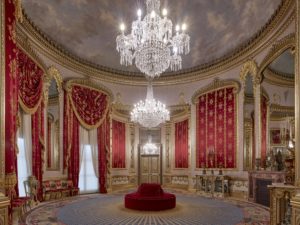
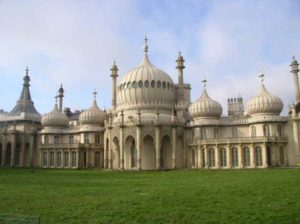
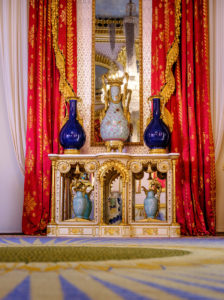
I was hoping to get to Brighton this year to see the restored Saloon in the Royal Pavilion, but I am not going anywhere for the time being. So I will pretend I’m going while I present a few pictures and on dits about the latest restoration of this absurdly appealing structure.

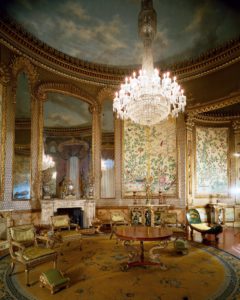
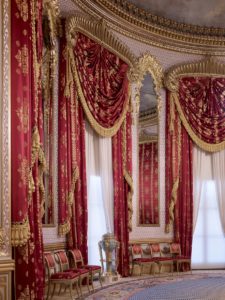
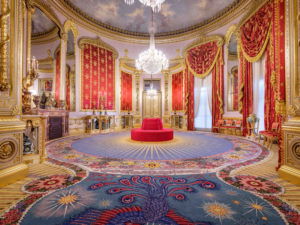
The Saloon, Brighton Pavilion, after 2018 restoration

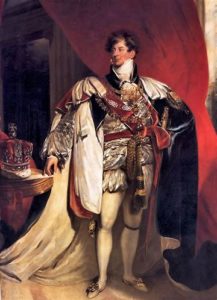
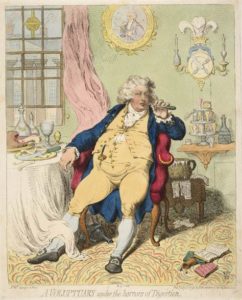
I’ve visited the Pavilion several times over the years. I regard it as the perfect representation of the personality and reign of George, Prince of Wales, the Regent for nine years beginning in 1811, and King George IV upon the death of his father George III on 29 January in 1820. In many ways, George IV was a magnificent fellow with excellent taste and great ambitions for improving art, architecture, and design;  in other ways, he was a spendthrift, selfish, narcissistic adulterer  whose unpopularity almost brought down the monarchy.

George IV by Sir Thomas Lawrence
A Voluptuary Under the Horrors of Digestion, 1792, by James Gillray

Like the Pavilion, one could say, magnificent or ridiculous, praiseworthy or laughable.

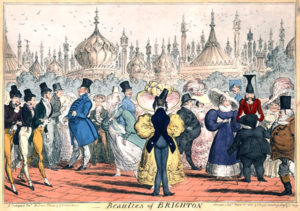
Beauties of Brighton, by George Cruikshank 1826

The restoration of the Central Saloon took more than eight years of work. Below is the way it looked when I first saw it, with handsome chinoiserie panels  and subdued draperies and carpeting.

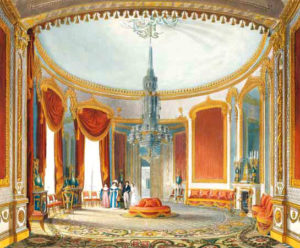
The restoration was based on a painting of the Saloon in 1826 by John Nash, who painted all the royal interiors around this time, and on historical drawings, photos, and accounts

Saloon, by Nash

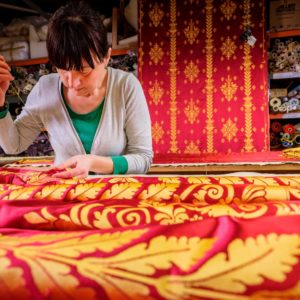
The walls were hand-stenciled in platinum leaf, a process that took several years to accomplish.

Likewise the draperies were expertly created from the finest silks.

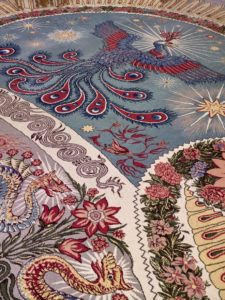
The Guardian wrote: ‘The staggering carpet, a swirling kaleidoscope of flowers, stars, dragons and exotic Chinese birds, had to be reinvented from the hazy detail in a 19th-century watercolour by Anne Sowden, artist and glass conservator for the pavilion, as her last challenge before retirement.

Queen Victoria was not amused by the pavilion and she sold it to the city of Brighton in 1850 after she removed most of the furniture and decorative material, much of which can be found at Buckingham Palace, it is said. Many items have been loaned back to the Pavilion and are on display there.

The Royal Pavilion Brighton
PICTURE BY JIM HOLDEN

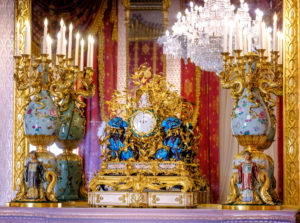
The magnificent ‘Kylin’ clock, purchased in France for the Saloon,  is decorated  with turquoise-glazed Chinese lions, known as kylins, after a mythical Chinese animal.

The Royal Pavilion Brighton; The Royal Collection
PICTURE BY JIM HOLDEN

The restoration was accomplished for about £380,000, with most work done by in-house experts on the museum staff. They certainly can be proud of their skills. Here are a few more angles on the Saloon. Let’s hope we can return soon!

Brighton Royal Pavilion
Restoration of the Saloon
Picture by Jim Holden


WALKING LONDON: A ST. JAMES’S STROLL

by Victoria Hinshaw

Originally published after Number One London’s 2015 Duke of Wellington Tour, we’re re-running this post on our St. James’s Walk as we regularly include it on all our tours that begin or end in London. Our next is the Country House Tour, May 2021. Complete details can be found here

Kristine and Victoria led a walking tour of St. James’s London, beginning with a view of Buckingham Palace and the Victoria Monument from Green Park. Being a Sunday, the  traffic circle and the Mall were closed to vehicle traffic and open to pedestrians and bicycles.  Our weather was perfect – warm and sunny.

Lancaster House
Spencer House

We then headed up the pedestrian path on the east side of Green Park, past Lancaster House and Spencer House, before cutting  through the narrow Milkmaids Passage, a pedestrian tunnel that brings one out opposite the Stafford Hotel.

Stafford Hotel
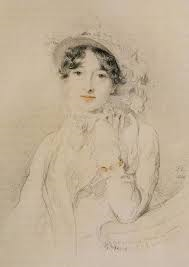
The Stafford  Hotel (now much remodeled) was once the home of Sir William, 3rd Baronet Lyttelton, and his wife (1787-1870), the former Lady Sarah Spencer, niece of Georgiana, Duchess of Devonshire. After her husband’s death, Lady Lyttelton became a governess to the children of Queen Victoria and Prince Albert.  During World War II, the Stafford was used as a club for American and Canadian officers, and the hotel remains known for its American Bar to this day.
The American Bar at the Stafford Hotel

Wandering around the maze of streets in this little corner of St. James’s, we found a mix of modern (often brutalist) office/apartment complexes and 18th century listed buildings. A post-war office complex now faces Spencer House and stands as evidence of the bomb that was dropped on the site during WWII, which also blew out most of the windows of Spencer House. Remarkably, no one was injured in the blast.

Above, and across from the Stafford, is the entrance facade to Spencer House in St. James’s Place. Built 1756-66 by architects John Vardy and James “Athenian” Stuart for John, 1st Earl Spencer, Spencer House is now owned by the Rothschild Enterprise’s RIT Capital Partners and open on most Sundays for a tour of the State Rooms.  The website is here and includes photos of both the exterior and interior.

A few doors down from Spencer House is this handsome brick house, once the residence of  Williams Huskisson (1770-1830). The blue plaque refers to him as a statesman; he was often a strong political opponent to the Duke of Wellington in Parliament.  Huskisson also became England’s first railroad fatality. During the inaugural run of the Manchester to Liverpool railroad, he was amongst the dignitaries invited to travel on one of two trains opening the route. When the trains stopped at a siding to take on water, Huskisson left his carriage and crossed the tracks to the second train, unaware that Stephenson’s train, the Rocket, was headed straight towards him on the middle track. Huskisson’s leg was crushed by the Rocket and he died a few hours later. Unfortunately, the accident was witnessed by several notables who were on the trip, including the Duke of Wellington.
Next door, No. 29 was once the residence of Winston Churchill.
No. 5  was the home of Sir Robert Walpole (1676-1745)
and his son Horace Walpole (1717-1797)
 
Duke’s Hotel is another elegant institution, located just off St. James’s Place.

St. James’s Place opens into St. James’s Street, famous for gentlemen’s clubs of the British variety and several very old and traditional merchants.  The numbering begins at the Palace and goes north up the east side of the street to Piccadilly then crosses to the west side and counts southward back to the Palace.

St. James’s Palace
A Grenadier Guard at St James’s Palace, built by Henry VIII
Entering St. James’s Street, we find many Georgian and Regency institutions, including Berry Bros. and Rudd, Ltd, Wine Merchants, at No. 3.
A Passage beside the wine store leads to Pickering Place, above.
This little space was once known as a spot for dueling, but it must have been pretty tight! Another plaque commemorates the location of the Texas legation 1842-1846.

Pickering Place,with a plaque of Lord Palmerston
Lock and Co. Hatters have served British dignitaries for more than 300 years.
Click here for their website..
Lobb and Co. Bootmakers

Closer to Piccadilly on the east side of the street are two famous Clubs

Boodle’s, #27  St. James’s Street

.

The chemist’s shop, D. R. Harris, founded in
1790, is located at #29. The website is here.
White’s Club, #37/38 St. James’s Street, founded 1693

On the west side, heading back to St. James’s Palace, you will find Brook’s Club.

Brooks’s 60 St. James’s Street,  club founded in 1762
The headquarters of Justerini and Brooks Ltd. at 61 St. James Street,
across Park Place from Brooks’s.


The Carlton Club, #69 St. James’s Street, founded in 1832
#74 St. James’s Street, formerly the Conservative Club, completed in 1845
Returning to Piccadilly, we stopped for a welcome sit-down and a coffee or tea. Even on a Sunday morning, Piccadilly was busy, as usual an international mish-mash of tourists globe-wide. Great people watching!
Burlington Arcade
We walked east on Piccadilly past a number of famous sites:
on the north side of the street, Burlington Arcade.
And Burlington House, home of the Royal Academy of Arts.
Tucked almost beside Burlington House is the  famous residence, Albany, once the home of Lord Byron and more recently, Georgette Heyer.  Built originally as Melbourne House. it was traded by that family to the Duke of York and Albany (2nd son of George III) in exchange for what became Melbourne House in Whitehall, now the Scotland office just south of Horse Guards. Later it became prestigious bachelor quarters, eventually open to women as well.
Albany
On the South side of the street, that esteemed purveyor of all things delicious, Fortnum and Mason, established in 1707 in Duke Street, and supplier worldwide, including to the army in the Peninsular War in the early 19th century, right up to today’s British forces — not to mention picnickers, racegoers, opera lovers, and  foodies everywhere. To visit, click here.
Fortnum and Mason
Hatchards Bookstore, above, established 1797  Their website is here.
Soon, we arrive at the wonderful St James’s Church, Piccadilly.
Outside the church is a small but lively marketplace
Baptismal font


The famous wood carvings of Grinling Gibbons
Floris Perfumers on Jermyn Street
Nearby, a plaque marking the location of the residence of Sir Isaac Newton (1642-1727)
Chequers Pub
Time for another pause that refreshes, this time at Chequers…a charming little pub in Duke street. At the rear of the building or accessible from a passage beside it is Mason’s Yard, another hidden collection of interesting sites, including the White Cube Gallery and the member’s entrance to the London Library.
William III in St. James’s Square
At last we came to St. James’s Square, still a leafy oasis, though a private park as so many of the squares in London are.
There are still a few of the buildings originally built here, though much remodeled, and many replaced.  At #4 is the Naval and Military Club, better known as the In and Out Club.
#4 St. James’s Square
The plaque honors Nancy Astor (1879-1964), first woman to sit in Parliament, who once lived here.
Henry Jermyn, 1st Earl of St. Albans, 1605-1684
Following the Restoration of King Charles II in 1660, Henry Jermyn was Lord Chancellor, and received a grant of land north of St. James’s Palace, which he had cleared and laid out for development. He is known as the Father of the West End.  He died shortly before the completion of St. James’s Church, just north of St. James’s Square.
At #10 St. James’s Square stands Chatham House, the Royal Institute of International Affairs, site of many important multilateral events.  The building was once home to three Prime Ministers, William Pitt, 1st Earl of Chatham (1708-1778), Edward Geoffrey Stanley, Earl of Derby (1799-1869), and William Ewart Gladstone (1809-1898).
Plaque honoring three Prime Ministers at #10 St. James’s Square


Ada, Countess of Lovelace (1815-52) at #12 St James’s Square
Ada Lovelace was the only legitimate child of Lord Byron and his wife, Anabella Millbanke.  She was a mathematician and a pioneer in computing.
London Library, #14 St. James’s Square
The private library, established in 1841, is a favorite of many British writers and historians. Kristine and Victoria returned here the week after the tour for a special viewing during London Open House Week.

#16 St. James’s Square, above, once the Boehm residence where the Prince Regent received the despatches of the Duke of Wellington after the Battle of Waterloo,now the East India Services Club.

By this time we were all ready for our tea, so we hiked back to Piccadilly and the wonderful Richoux Tea Room at #172.

Left to right: Kristine, Marilyn, Donna, Ki, Victoria and Diane

In 2018, the St. James’s Walk will be a part of our Georgian England Tour and our 1815: London to Waterloo Tour. Complete details on both Tours can be found here