The Look of Love at the Georgia Museum of Art

Gold oval pendant surrounded by seed pearls, ca. 1830. Brown right eye with clouds.
dimentiuons 1 7/8 (with hanger) x 1 3/8 x 1/4 in.

The Look of Love: Eye Miniatures from the Skier Collection opens on October 7, 2012 at the Georgia Museum of Art at the University of Georgia, Athens.  It continues until January 6, 2013, in the Dorothy Alexander Roush and Martha Thompson Dinos Galleries.

Georgia Museum of Art

This blog has covered the exhibition at its first showing in Birmingham, AL, several times:  Here by Victoria, and Here  and Here by Guest Blogger Jo Manning.  This is the first ever exhibition devoted to these unique miniature representations of lover’s eyes, and we hope that a number of our readers can attend this new venue.

Bracelet surmounted with miniature in gold surround with drop pearl; Gray right eye.
1 5/8 x 2 x 1/4 in. (surround only)

In the words of the Georgia Museum, “Exquisite in craftsmanship, unique in detail, and few in number, lover’s eye miniatures are small-scale portraits of individual eyes set into various forms of jewelry from late-18th- and early-19th-century England. Part of a trend that began with Britain’s Prince of Wales (later George IV), clandestine lovers exchanged these customized tokens depicting one another’s eyes, as such a feature might only be recognized by persons of the most intimate familiarity.”

Yellow gold brooch with border of thirty-two natural oriental half-pearls in a floral motif
with eight small turquoise stones
1 x 1 1/2 x 1/4 in.

In the exhibition catalogue, Jo Manning has provided five fictional vignettes of possible stories behind Eyes of Love.  As the Georgia Museum says,  “…behind the skilled artistry with which each of these tiny portraits was painted lie the enchanting stories of secret romance and love lost.”  Essays by several experts are also included.

The catalogue is available from the Birmingham Museum of Art, the Georgia Museum of Art and on Amazon.com.  Also available is an iPad app created by the Birmingham Museum of Art.
About one hundred examples of Eye Miniatures are shown.  Many were worn as pins or on rings, necklaces and bracelets.  Others are found on patch and toothpick boxes, stickpins and fobs.  Many are memorials to lost children or lovers.
Gold teardrop-shaped brooch surrounded by split pearls, ca 1790. Blue right eye.
3/4 x 1 1/4 x 1/4 in.
 Whatever their elusive meaning and purpose, you will be fascinated to see this stunning collection.
The Georgia Museum of Art website can be found here.

Royal London: A Guide

I came across this colorful book, most recently updated and published in 2012, in the library.  The full title is Royal London: A Guide to the Capital’s Historic and Iconic Royal Sites.  More than 100 locations are described from the Buckingham Palace we all know to a Coronation Stone in the Royal Borough of Kingston Upon Thames where seven Saxon Kings were crowned in the 9th and 10th centuries.

Coronation Stone
The author of the volume, Jane Struthers, has written many nonfiction books about England, 
English History, and other topics. 
Jane Struthers
As readers of this blog might guess, for both Kristine and Victoria, reading about London and looking at pictures are just about our favorite activities in the entire world, short of actually walking in London’s streets. So it will come as no surprise to know that Victoria spent quite a few hours with this book.  As usual, I (forgive the switch to first person, please) checked out how many of the places I have visited. 
The book begins with Westminster, and most of those we have even written about on this blog.  Multiple visits to the Palace and to the Queen’s Gallery, for example.  The processions in the Mall for Trooping the Colour and a walk in the Marlborough House Garden. A walk through Westminster’s residential area, just south of Westminster Abbey, including the church St. John’s, Smith Square, scene of many excellent musical events.
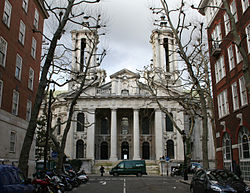
St. John’s, Smith Square
Struthers relates the story of how the church got the nickname “Queen Anne’s Footstool.” Supposedly the Queen was annoyed at being asked again what the new building should look like. She kicked over her footstool and said, “Like that!” Therefore the church has four tall towers, only two of which can be seen above.  Nevertheless, it is an excellent example of English Baroque and is renowned for its excellent acoustics. It was heavily bombed in WWII and restored as a concert venue.
The Guildhall
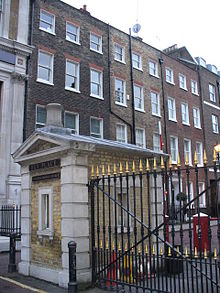
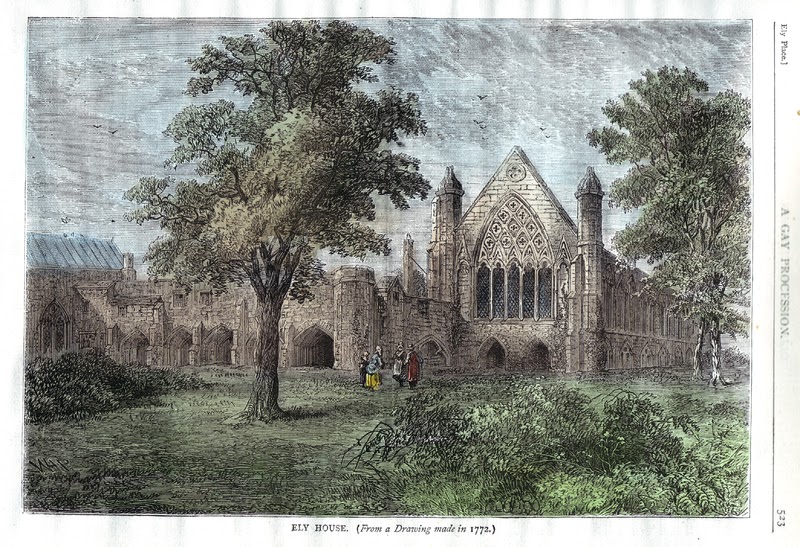
In other sections of the City and the metro area, you will find familiar spots described, such as the Guildhall, the Tower of London, and Trafalgar Square.  And there are other, lesser known sites with interesting royal connections.  Ely Place, for example, is now the site of crown-owned terrace houses, but once Ely House (long gone) was the place Philippa of Hainault stayed at Christmas 1327, before her marriage to Edward III.  Who knew?
Ely Place
1772 engraving of Ely House and St. Etheldredea’s Church
Familiar or unusual, it is our beloved London.  Now I have a few new targets for my next trip.  It can’t come soon enough!

The Naturalist's Diary, October 1826

The Naturalist’s Diary 1826 October

Swallow

At the beginning of this month, or latter end of September, some summer birds of passage, of which the swallow is the first, take their departure for warmer regions. The time of their leaving this country varies in different seasons; it is sometimes protracted till the end of October or the beginning of November, and swallows have been seen, in mild weather, to congregate previously to taking their departure, so late as the middle of December. A great diversity of opinion has existed respecting the torpidity and migration of this bird; it is an established fact, that, although the greater part of the swallows that visit England quit the country before the approach of winter, many remain and continue in a state of torpidity till the enlivening sun of April wakes them from their long sleep.

Common House Martin

The throstle, the red-wing, and the field-fare which migrated in March, now return; and the ring-ouzel arrives from the Welsh and Scottish Alps to winter in more sheltered situations. About the middle of the month, the common martin disappears; and, shortly afterwards, the smallest kind of swallow, the sand-martin, and the stone-curlew, migrate. The Royston or hooded crow (Corvus cornix) arrives from Scotland and the northern parts of England, being driven thence by the severity of the season. The woodcock returns, and is found on our eastern coasts.

Hooded Crow

Small birds now begin to congregate, and the common linnet is the first to lead the way. Various kinds of waterfowl make their appearance; and, about the middle of the month, wild geese quit the fens, and go to the rye and wheat lands to devour the young corn; frequently leaving a field as if it had been fed off by a flock of sheep.

Wild Geese feeding

Rooks sport and dive, in a playful manner, before they go to roost, congregating in large numbers. The starling sings. The awk or puffin visits for the purpose of incubation, some of the rocky isles of Britain, in amazing numbers.

Puffins

That singular appearance in nature, the gossamer, occurs in this month. Amid the floral gaieties of autumn, may be reckoned the Guernsey lily, which is so conspicuous an object in October, in the windows and green-houses of florists in London and its vicinity.

Guernsey Lily

 In mild seasons there are many flowers still in blow in this month. Generally speaking, however, the ‘last day of summer’ has passed away.

Rose Hips

Hips and haws now ornament the hedges. The berries of bryony and the privet; the barberry, the blackberry, the holly and the elder, from which an excellent winter wine may be made

Elderberries

—with sloes, bullaces, and damsons, are now in great plenty.—Blackberries also are ripe in this month, and the collecting of them affords an agreeable pastime to the younger branches of the peasant’s family, as well as some small profit to the parents. These are the fruits of the poor;–they who are more highly favoured with the gifts of fortune revel on the patrician peach and nectarine, the pine and the grape, whose purple clusters contrast so beautifully with the dazzling white of the silver epergne.

from MarthaStewart.com

But these transient pleasures, –the rose-crowned bowl,–the smiles of beauty, the music’s enchanting voice,–soon, too soon, flit away from our grasp and leave us nothing but the memory of a former day, those ‘blossoms of the past.’ During the months of October, November and December, at the fall of the leaf, insects become less numerous, but many of the Hemiptera may be found in the woods, by beating the ferns and underwood, also many very beautiful Tineae and Tortrices; and aquatic insects may be taken in ponds, in great numbers. Roots of grass, decayed trees may again be resorted to.

Keswick

October, like the proceeding month, is generally spent by the sea-side or in traveling over the varied surface of the United Kingdom. The lakes of Cumberland are an object of high attraction to the lover of the picturesque; the Highlands of Scotland also have a strong claim on his notice, and are frequently visited by our tourists in search of the sublime and romantic scenery of Nature. Scotland, indeed, is eminently entitled to our attention; and whether we take a trip by steam to the ‘modern Athens,’ and return by the land-route through the northern counties of England, or extend our journey and sail on the placid bosom of Loch Katrine, or climb the Alpine heights of Ben Nevis, we shall be amply repaid for the fatigue and expense of the tour.

Loch Long

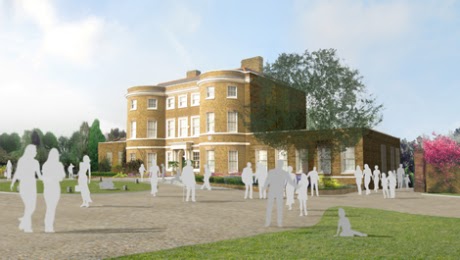
William Morris Gallery Reopens

Victoria here, delighted to hear that the William Morris Gallery in Walthamstow, part of northeast London, reopened last month (August, 2012)  after a £5m ($8.1m) renovation.  I visited the museum a few years ago as an admirer of Morris and his many activities, so an upgrade is welcome news.  The website of the museum is here. The museum is operated by the Waltham Forest Council and received assistance from the Heritage Lottery Fund.

William Morris, age 53, photo by Frederick Hollyer
Artist and designer, Visionary and cultural innovator, publisher and writer of prose and poetry, socialist thinker and political theorist, entrepreneur and mentor — William Morris was one of the leading figures of the late Victorian period.  He was an influential member of the Pre-Raphaelite Brotherhood and founded the Arts and Crafts Movement, both with enduring international influence.
Tapestry:  Dreams from Industrial London

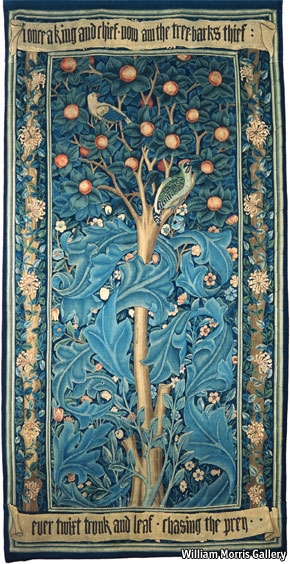
The Economist magazine wrote (More than Just a Pretty Swatch: Homage to a Colourful and Complex Victorian Polymath) recently of the museum’s renovation, here.  In addition to a collection of more than 10,000 Morris objects, the museum runs education programs, exhibitions of contemporary artists, and many more events, not to mention (naturally) the SHOP and the tea room.

I fell in love with William Morris Designs — fabric, tapestries, wallpaper, etc. — long before I even knew his name.  His art simply spoke to me on a personal level.

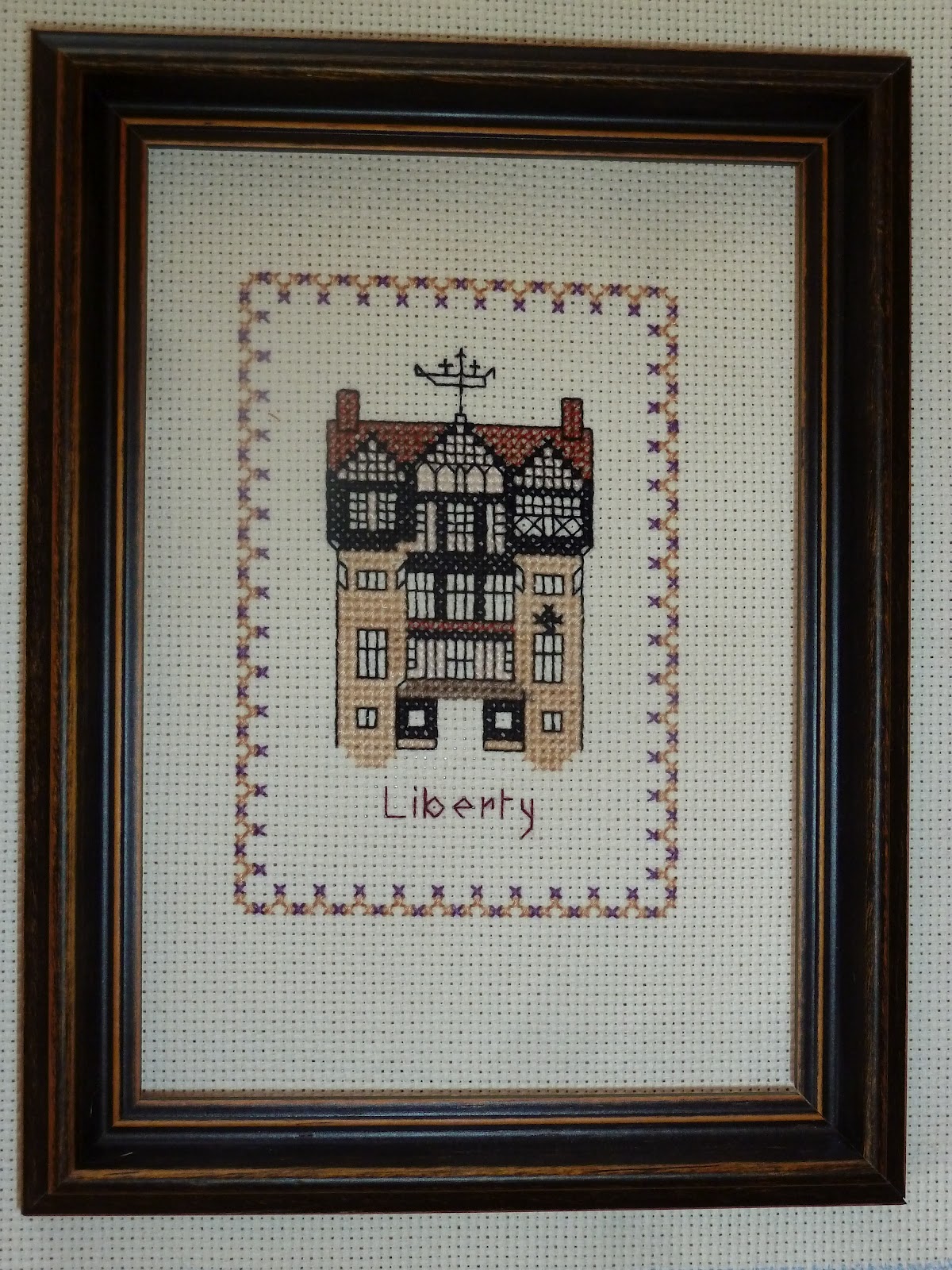
If you are a William Morris fan, come along with Kristine and me to Liberty of London on Regent Street …
Liberty, Regent Street
…where we have been known to leave more pounds than we should have!  I like it so much I’ve spent a few hours at home replicating it for my wall — and Kristine’s
counted cross stitch Liberty
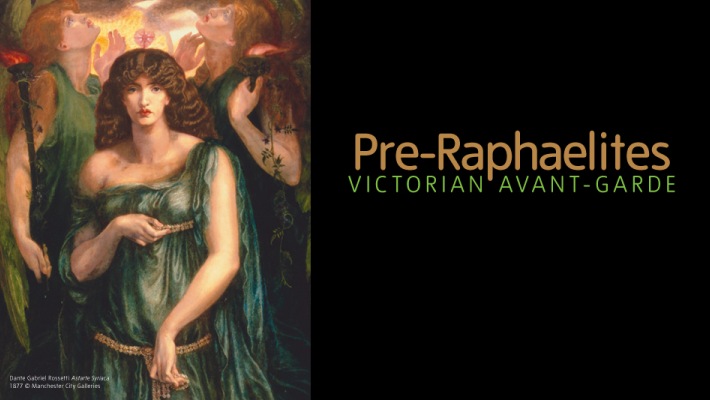
A current exhibition at the Tate Britain explores the Pre-Raphaelites: Victorian Avant-Garde through January 13, 2013.  The artworks of Dante Gabriel Rossetti, Sir John Everett Millais, William Holman Hunt, Edward Burne-Jones, William Morris and others are included.
I fear I shall have to miss this excellent show, as I will not be in London before next spring. Boo-hoo.  But I have seen many of the pictures and other objects before.  The Delaware Art Museum in the U.S. has an excellent collection of Pre-Raphaelites which I have visited. Some are included in the Tate exhibition.
Peacock and Bird Carpet by Morris, Wm. Morris Gallery
In addition to the Walthamstow Gallery, in which William Morris lived from  age 14 to 22, and the Tate Exhibition, two other National Trust buildings associated with William Morris are open to the public, but be sure to check for limited availabilities.
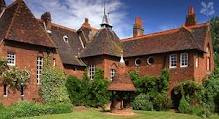
The Red House, NT
Morris co-designed The Red House in Bexleyheath, southeast London, for his wife, Jane Burden, and family. Once in the country and surrounded by orchards and pastures, it is now in the busy suburbs.  Jane and William had two daughters, but lived here only five years, moving due to financial problems. It is being restored to its original condition.  Jane often posed for Morris, and his only existing easel painting, below, now in the Tate Gallery, portrays her.
La belle Iseult, 1858
Jane also posed for other Pre-Raphaelites,  especially for Rossetti, with whom she had a long affair, though she and Morris never divorced.
Water Willow, by Rossetti, 1871;  Jane Burden Morris, with Kelmscott Manor in the background
After 1971, Morris and his family spent time at their country house, Kelmscott Manor, now open to the public on some days during the summer. It is operated by the Society of Antiquaries of London. 
Kelmscott Manor, Oxfordshire
 The original house dates from 1570 and was both a design project and an inspiration for Morris and his friends. The website is here. The house includes furnishings and textiles designed by Morris, in addition to changing exhibitions and a lovely garden.  William Morris is buried in the nearby village churchyard.
Now all I (we) need is unlimited time to wander about England.  Let’s go.

Upcoming Masterpiece Theatre


Sunday, September 30, at 8.pm. ET.
 

Call the Midwife is a moving and intimate insight into the colorful world of midwifery and family life in 1950’s East London. We are introduced to the community through the eyes of young nurse Jenny Lee as she arrives at Nonnatus House to live and work as a midwife alongside an Order of Nuns.
As Jenny comes to terms with her new life, we meet some phenomenal people who prove that their warmth, resilience and determination are to be admired beyond measure. At the heart of this world are the Sisters of St. Raymond Nonnatus who have been active in the East End as Anglican nursing nuns since the beginning of the 20th century.

The Sisters and the midwives of Nonnatus House carry out many nursing duties across the community. However, with between 80 and 100 babies being born each month in Poplar alone, their primary work is to help bring safe childbirth to women in the area and to look after their countless newborns.


The drama is based on the best-selling memoirs of the late Jennifer Worth and garnered good reviews, with the Daily Mirror hailing a “new ratings champion at the BBC.” A second series already commissioned and talks have now reportedly begun to keep the programme running beyond 2014.

 
Upstairs, Downstair – Series II – Premieres October 7, 2012 ET on PBS
 
In the year before WWII, 165 Eaton Place reopens its doors and welcomes viewers back into the lives of its inhabitants, upstairs and down. Lady Agnes and Sir Hallam’s family is now complete with the addition of two small children, but Sir Hallam is drawn into dangerous waters by his preoccupation with the threat of Nazi Germany and the return of troubled Lady Persie. Lady Agnes catches the eye of charismatic American multi-millionaire Casper Landry, and Sir Hallam’s aunt, Dr. Blanche Mottershead, has made herself comfortable in the house after Lady Maud’s death. Meanwhile, life downstairs adjusts to the absence of Rose and the addition of the spirited new nursery maid, Beryl. With upstairs and downstairs harboring life-changing secrets, and the menace of war creeping ever closer, the smooth running of Eaton Place threatens to come to a halt.

Gas masks are issued and long-buried secrets about the staff are revealed against an increasingly uneasy political backdrop. While the house staff struggles with the juxtaposition of patriotism and conscience, Sir Hallam stands firm in his diplomatic convictions, helping to negotiate what may be the final chance to avert war. But as the possibility of maintaining peace becomes more apparent, will England be able to sleep quietly for long?