The Tour of Dr. Syntax in Search of the Picturesque, Part 6

The Tour of Dr. Syntax in Search of the Picturesque, Part 6

Excerpts from Canto 8

Dr. Syntax, having entirely misunderstood his night’s accommodation at the sumptuous home of a lord, goes forward in his quest, determined to seek the picturesque and thus, with his trusty pen and ink, earn his fortune:

“…Thus Syntax, with reflection fraught,
Soliloquiz’d the moral thought;
While Grizzle, all alive and gay,
Ambled along the ready way.
Last night she found it no disaster
To share the fortune of her master;
She, ‘mong the finest hunters stood,
And shar’d with them the choicest food:
In a fine roomy stable plac’d,
With ev’ry well-trimm’d clothing grac’d.
Poor Grizzle was as fair a joke
To all the merry stable-folk.
As the good Doctor’s self had been
To the kind gentry of the inn.

True to his consistently inconsistent mind, Dr. Syntax wastes away half the day in contemplation and eventually asks a shepherd boy for direction to an inn:

“Keep onward by the church-yard wall.
When you will see a house of call;
The sign’s a Dragon — there you’ll find
Eating and drinking to your mind.”
Across the Down the Doctor went,
And towards the church his way he bent.
“Thus,” Syntax said, “when man is hurl’d
Upwards and downwards in the world;
When some strong impulse makes him stray.
And he, perhaps, has lost his way —
The Church — Religion’s holy seat,
Will guide to peace his wand’ring feet!

But, hark! the death-bell’s solemn toll
Tells the departure of a soul;
The Sexton too, I see, prepares
The place where end all human cares.
And, lo, a crowd of tombs appear!
I may find something curious here;
For oft poetic flowers are found
To flourish in sepulchral ground,
I just walk in to take a look,
And pick up matter for my book.”
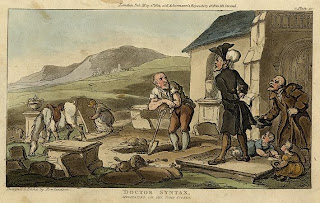
Dr. Syntax Meditating on the Tombs

Dr. Syntax looks through the tombstones in the churchyard and reads a few:

“EPITAPHS.

Here lies poor Thomas and his wife,
Who led a pretty jarring life;
But all is ended, do you see?
He holds his tongue, and so does she.”

“If drugs and physic could but save
Us mortals from the dreary grave,
‘Tis known that I took full enough
Of the apothecary’s stuff.
To have prolong’d life’s busy feast
To a full century at least;
But, spite of all the doctor’s skill,
Of daily draught and nightly pill,
Egad, as sure as you’re alive,
I was sent here at twenty-five.”

“Within this tomb a lover lies,
Who fell an early sacrifice
To Dolly’s unrelenting eyes;
For Dolly’s charms poor Damon burn’d;
Disdain the cruel maid return’d :
But, as she danc’d in May-day pride,
Dolly fell down, and Dolly died.
And now she lays by Damon’s side.
Be not hard-hearted, then, ye fair!
Of Dolly’s hapless fate beware!
For sure, you’d better go to bed
To one alive than one who’s dead.”

” Beneath the sod the soldier sleeps,
Whom cruel War refuis’d to spare:
Beside his grave the maiden weeps,
And Glory plants the laurel there.
Honour is the warrior’s need,
Or spar’d to live, or doom’d to die ;
Whether it is his lot to bleed.
Or join the shout of victory;
Alike the laurel to the truly brave,
That binds the brow, or consecrates the grave.”

“Beneath this stone her ashes rest.
Whose memory fills my aching breast!
She sleeps unconscious of the tear
That tells the tale of sorrow here;
But still the hope allays my pain
That we may live and love again:
Love, with a pure seraphic fire,
That never, never, shall expire.”

After a long chat with the sexton at the church, Dr. Syntax continues on his way:

“Syntax along the village pass’d.
And to the Dragon came at last;
Where, as the shepherd-boy had said.
There seem’d to be a busy trade;
And, seated in an easy chair.
He found that all he wish’d was there.

Excerpts from CANTO IX.

Having spent the night at the inn safe from a raging storm outside, Dr. Syntax decides to write to his wife:
“Nor can I pass the morning better,
Than to indite this wife a letter.”
He paus’d and sigh’d ere he began.
When thus the fond epistle ran: —
“My dearest Doll, — Full many a day
From you and home I’ve been away;
But, though we thus are doom’d to part.
You’re ever present in my heart…
And know the truth which I impart,
The offspring of my honest heart,
That wheresoe’er I’m doom’d to roam,
I still shall find that Home is home:
That, true to Love and nuptial vows,
I shall remain your loving spouse.
Such are the tender truths I tell;
Conjux carissima — farewell! ”

Thus he his kindest thoughts reveal’d —
But scarce had he the letter seal’d,
When straight appeared the trembling host,
Looking as pale as any ghost: —
” A man’s just come into the town.
Who says the castle’s tumbled down,
And that, with one tremendous blow.
The lightning’s force has laid it low*”
” What castle, friend?” the Doctor cried.
” The castle by the river side ;
A famous place, where, as folk say,
Some great king liv’d in former day:
But this fine building long has been
A sad and ruinated scene.
Where owls, and bats, and starlings dwell,—
And where, alas ! as people tell.
At the dark hour, when midnight reigns,
Ghosts walk, all arm’d, and rattle chains.”

“Peace, peace!” said Syntax, “peace, my friend.
Nor to such tales attention lend. —
But this new thought I must pursue:
A castle, and a ruin too!
I’ll hasten there, and take a view.”

…Around the moss-clad walls he walk’d.
Then through the inner chambers stalk’d,
And thus exclaim’d, with look profound.
The echoes giving back the sound  …
I’ll try to take the view,
As well as my best art can do.”

“A heap of stones the Doctor found,
Which loosely lay upon the ground.
To form a seat, where he might trace
The antique beauty of the place:
But, while his eye observ’d the line
That was to limit the design. “

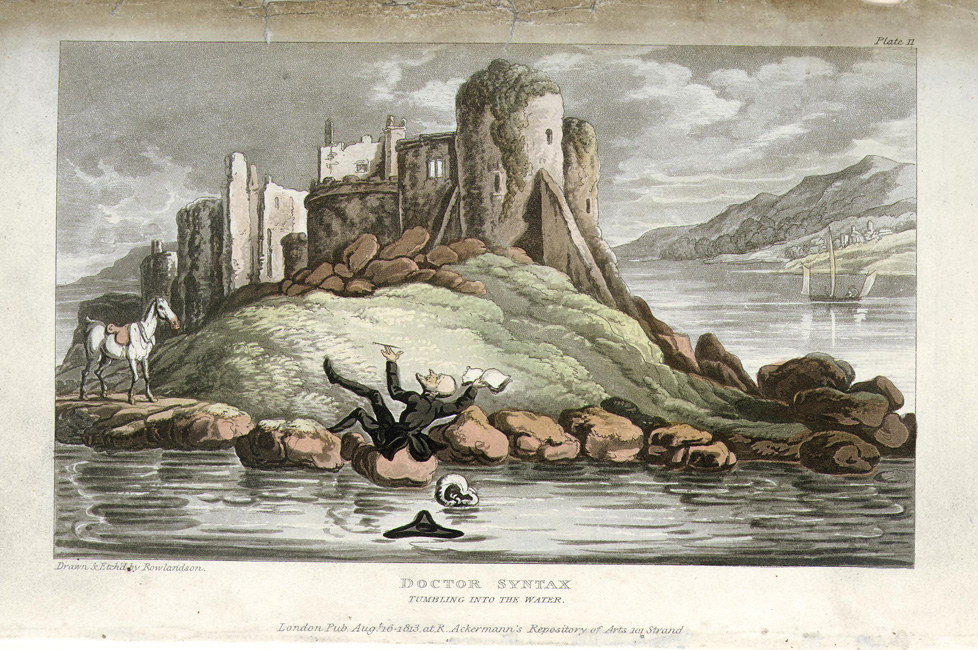
Dr. Syntax Tumbling into the Water

“The stones gave way, and, — sad to tell! —
Down from the bank he headlong fell.
The slush, collected for an age,
Receiv’d the venerable Sage;
For, at the time, the ebbing flood
Was just retreating from the mud:
But, after floundering about.
Syntax contriv’d to waddle out,
Half-stunn’d, amaz’d, and cover’d o’er
As seldom wight ha
d been before.
O’erwhelm’d with filth, and stink, and grief,
He saw no house to give relief;
And thus, amid the village din,
He ran the gauntlet to the inn.
… Glad in the inn to find retreat
From the rude insults of the street.
Undress’d, well wash’d, and put to bed,
With mind disturb’d, and aching head.
In vain poor Syntax sought repose,
But lay and counted all his woes.
The friendly host, with anxious care.
Now hastes the posset to prepare: —
The cordial draught he kindly gives;
Which Syntax with a smile receives:
Then seeks, in sleep, a pause from sorrow,
In hopes of better fate to-morrow. “

Poor Dr. Syntax has yet to create his picturesque views…and more adventurs await. To be continued


Boxing Day

From The Book of Christmas: Descriptive of the Customs, Ceremonies, Traditions … By Thomas Kibble Hervey (1845)

ST. STEPHEN’S DAY – 26TH DECEMBER
This day—which, in our calendar, is still dedicated to the first Christian martyr, St. Stephen (for John the Baptist perished in the same cause, before the consummation of the old law, and the full introduction of the Christian dispensation),—is more popularly known by the title of Boxing-day; and its importance, amongst the Christmas festivities, is derived from the practice whence that title comes.
We have already mentioned that the custom of bestowing gifts, at seasons of joyous commemoration, has been a form of thankfulness at most periods ;—and that it may have been directly borrowed, by the Christian worshippers, from the Polytheists of Rome, along with those other modes of celebration which descended to the Christmas festival, from that source,—introduced, however, amongst our own observances, under scripture sanctions, drawn both from the Old and New Testaments. The particular form of that practice, whose donations are known by the title of Christmas-boxes (and which appear to differ from New-year’s gifts in this,—that the former, passing from the rich to the poor, and from the master to his dependants, are not reciprocal in their distribution,—whereas the latter are those gifts, for the mutual expression of good-will and congratulation, which are exchanged between friends and acquaintances), was, perhaps, originally one of the observances of Christmas-day, and made a portion of its charities. The multiplied business of that festival, however, probably caused it to be postponed till the day following,—and thereby placed the Christmas-boxes under the patronage of St. Stephen. The title itself has been derived, by some, from thebox which was kept on board of every vessel that sailed upon a distant voyage, for the reception of donations to the priest; who, in return, was expected to offer masses for the safety of the expedition, to the particular saint having charge of the ship—and, above all, of the box. This box was not to be opened till the return of the vessel; and we can conceive that, in cases where the mariners had had a perilous time of it, this casket would be found to enclose a tolerable offering. Probably the state of the box might be as good an evidence as the log-book, of the character of the voyage which had been achieved. The mass was, at that time, called Christmass;—and the boxes kept to pay for it were, of course, called Christmass-boxes. The poor, amongst those who had an interest in the fate of these ships,—or of those who sailed in them,—were in the habit of begging money from the rich, that they might contribute to the mass boxes; and hence the title which has descended to our day:—giving to the anniversary of St. Stephen’s martyrdom the title of Christmas-boxing day— and, by corruption, its present popular one of Boxing-day.
A relic of these ancient boxes yet exists, in the earthen or wooden box, with a slit in it, which still bears the same name; and is carried, by servants and children, for the purpose of gathering money, at this season—being broken only when the period of collection is supposed to be over. Most of our readers know that it was the practice, not many years ago (and in some places is so still), for families to keep lists of the servants of tradesmen and others, who were considered to have a claim upon them for a Christmas-box at this time. The practice,—besides opening a door to great extortion,—is one, in every way, of considerable annoyance,—and is on the decline. There is, however,—as they who are exposed to it know,—some danger in setting it at defiance, where it is yet in force. One of the most amusing circumstances, arising out of this determination to evade the annoyances of Boxing-day, is related by Sandys. A person in trade had imprudently given directions that he should be denied, on this day, to all applicants for money; and amongst those who presented themselves at his door, on this errand, was, unfortunately, a rather importunate creditor. In the height of his indignation, at being somewhat uncourteously repulsed, he immediately consulted his lawyer; and, having done that, we need scarcely relate the catastrophe. It follows, as a matter of course. A docket was struck against the unsuspecting victim of Christmas-boxophobia.

Boxing-day, however, is still a great day, in London. Upon this anniversary, every street resounds with the clang of hall-door knockers. Rap follows rap, in rapid succession,—the harsh and discordant tones of iron mingling with those of rich and sonorous brass, and giving a degenerate imitation of the brazen clangor of the trumpet which formed the summons to the gate, in days of old,—and which, together with the martial music of the drum, appears to have been adopted, at a later period, by the Christmasboxers, on St. Stephen’s-day. Pepys, in his diary (1668), records his having been “called up by drums and trumpets;—these things and boxes,” he adds, “have cost me much money, this Christmas, and will do more.” Which passage seems to have been in the memory of our facetious publisher, when he made the following entry in his journal of last year,—from whence we have taken the liberty of transcribing it.—” Called out,” says Spooner (1834), “by the parish beadle, dustmen, and charity-boys. The postman, street-sweepers, chimney-sweepers, lamp-lighters, and waits, will all be sure to wait upon me. These fellows have cost me much money this Christmas,—and will do more, the next.”
There is an amusing account, given by a writer of the querulous class, of a boxing-day, in London, a century ago. “By the time I was up,” says he, “my servants could do nothing but run to the door. Inquiring the meaning, I was answered, the people were come for their Christmas-box; this was logic to me; but I found at last that, because I had laid out a great deal of ready-money with my brewer, baker, and other tradesmen, they kindly thought it my duty to present their servants with some money, for the favor of having their goods. This provoked me a little; but being told it was the ‘custom,’ I complied. These were followed by the watch, beadles, dustmen, and an innumerable tribe; but what vexed me the most was the clerk, who has an extraordinary place, and makes as good an appearance as most tradesmen in the parish; to see him come a-boxing, alias a-begging, I thought was intolerable: however I found it was ‘the cus.torn too,’ so I gave him half-a-crown; as I was likewise obliged to do the bellman, for breaking my rest for many nights together.”


The manner in which the beadle approaches his “good masters and mistresses,” for a Christmas-box,—particularly in the villages near the British metropolis,—is, as we have before said, by the presentation of a copy of printed verses, ornamented with wood engravings. These broadsides are usually termed “Bellman’s verses;” and we quite agree with Mr. Leigh Hunt in his opinion, that “good bellman’s verses will not do at all. There have been,” he remarks, “some such things of late ‘ most tolerable and not to be endured.’ We have seen them witty,—which is a great mistake. Warton and Cowper unthinkingly set the way.” “The very absurdity of the bellman’s verses is only pleasant, nay, only bearable, when we suppose them written by some actual doggrel-poet, in good faith. Mere mediocrity hardly allows us to give our Christmas-box, or to believe it now-a-days in earnest; and the smartness of your cleverest worldly-wise men is felt to be wholly out of place. No, no! give us the good old decrepit bellman’s verses, hobbling as their bringer, and taking themselves for something respectable, like his cocked-hat,—or give us none at all.”
Upon the bellman’s verses which were last year circulated by the beadles of Putney, Chiswick, and other parishes on the west side of London, it was recorded, that they were “first printed in the year 1735;”—and our curiosity induced us to inquire of the printer the number annually consumed. “We used, sir,” said he, “not many years ago, to print ten thousand copies, and even more; but now I suppose we don’t print above three thousand.” Whether the trade of this particular dealer in bellman’s verses has passed into other hands,—or whether the encouragement given to the circulation of these broadsides has declined,—the statement of an individual will not of course enable us to determine. But we are inclined to think that,—like other old Christmas customs, —the popularity of bellman’s verses is passing away; and that, before many years have elapsed, penny magazines and unstamped newspapers will have completely superseded these relics of the rude, but sincere, piety of our ancestors.

Dr. Syntax, Part Five (Cantos 6 and 7)

  Adventures of Dr. Syntax in Search of the Picturesque Part 5

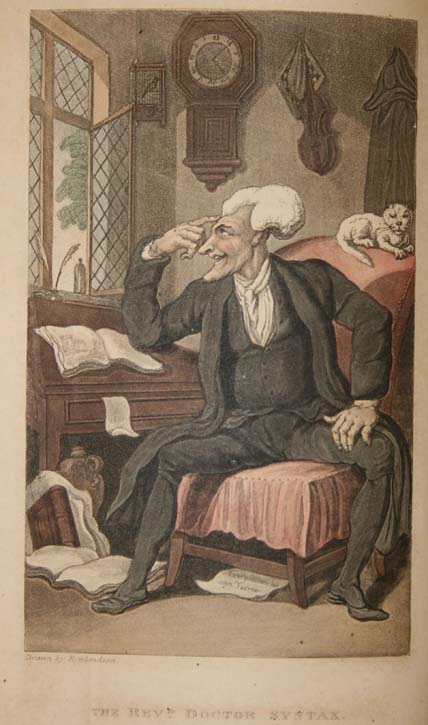
Dr. Syntax, frontispiece, by Thomas Rowlandson, 1812

Excerpts from Canto  VI

We left Dr. Syntax, having already survived several misadventures and not having seen anything more picturesque than a bunch of braying donkeys, has suddenly had hot water poured over his feet by accident. The maid at the inn takes care of him and invites him to stay another night, but he declines.

“…The Doctor clos’d the kind debate,
By ordering Grizzle to the gate.
Now, undisturb’d, he took his way,
And traveled till the close of day;
When, to delight his wearied eyes.
Before him Oxford’s tow’rs arise.
O, Alma Mater!” Syntax cried,
My present boast, my early pride;
To whose protecting care I owe
All I’ve forgot, and all I know:
Deign from your nursling to receive
The homage that his heart can give! …”


Dr. Syntax, Entertained at College, by Rowlandson

Dr. Syntax rides through Oxford, admiring the place he loves, and puts up at The Mitre for the night.  Next morning, he gets a shave from the barber:

“…From him he learn’d that Dicky Bend,
His early academic friend,
As a reward for all his knowledge.
Was made the Provost of his College;
And then declared that he had clear
At least twelve hundred pounds a year.
“O ho !” says Syntax, “if that’s true,
I cannot surely better do
Than further progress to delay.
And with Friend Dicky pass a day.”
Away he hied, and soon he found him,
With all his many comforts round him…”

Dr. Syntax and the Provost discuss many things are enjoy their conversation:
“…At length the bell began to call
To dinner, in the college-hall;
Nor did the guests delay to meet,
Lur’d by the bounty of the treat.
The formal salutations over.
Each drew his chair and seized his cover.
The Provost, in collegiate pride,
Plac’d Doctor Syntax by his side;
And soon they heard the hurrying feet
Of those that bore the smoking meat.
Behold the dishes due appear, —
Fish in the van, beef in the rear; ..”

After a friendly evening in college:

“…Next morning, at an early hour.
Syntax proceeded on his Tour;
And, as he saunter’d on his way,
The scene of many a youthful day,
He thought ‘twould give his book an air,
If Oxford were well painted there;
And, as he curious look’d around,
He saw a spot of rising ground.
From whence the turrets of the city
Would make a picture very pretty..”

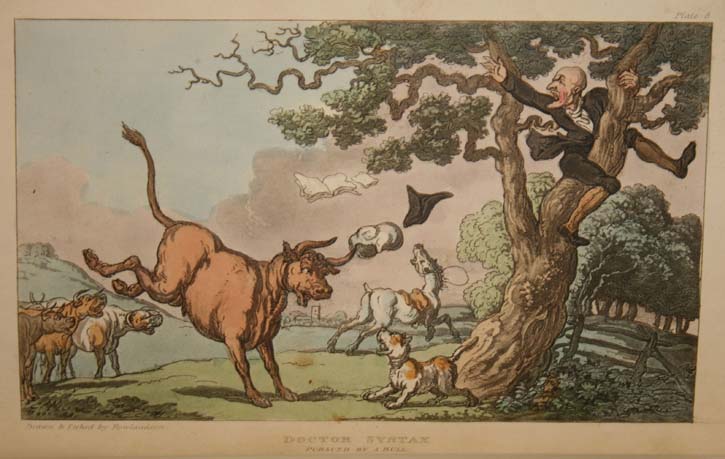
“…But, as he sought to choose a part.
Where he might best display his art,
A wicked bull no sooner view’d him,
Than loud he roar’d, and straight pursu’d him.
The Doctor, finding danger near,
Hew swiftly on the wings of fear,
And nimbly clamber’d up a tree,
That gave him full security…”

Dr. Syntax Pursued by a Bull, by Rowlandson

Excerpts from Canto VII

While riding onward, Dr. Syntax thinks about his wife, left behind at home…

“…though full many a year was gone.
Since this good dame was twenty-one,
She still retain’d the air and mien
Of the nice girl she once had been.
For these, and other charms beside,
She was indeed the Doctor’s pride;
Nay, he would sometimes on her gaze
With the fond looks of former days. …”

Dr. Syntax Mistakes a Gentleman’s House for an Inn

 He meets a curate and shares a long afternoon of conversations about their mutual poverty, then rides so long that he is exhausted,  As he looks for an Inn, he arrives at a Gentleman’s House and makes free with his guests, servants and accommodations, another error.  He addresses the Gentleman thusly:

… “Landlord! I’m sadly splash’d with mire And chill’d with rain, so light a fire;
And tell the ostler to take care
Of that good beast, my Grizzle mare;
And what your larder can afford,
Pray place it quickly on the board….”

Dr. Syntax becomes quite inebriated and, though he does not realize it, becomes the evening’s entertainment for the squire and his guests, who are quite amused.  The next morning, over breakfast, the good doctor learns of the jest.

“…At length the ‘Squire explained the joke;
When thus the Doctor quaintly spoke: —
” I beg, Sir, no excuse you’ll make,
Your merriment I kindly take;
And only wish the gods would give
Such jesting ev’ry day I live.”
The ladies press’d his longer stay,
But Syntax said — he must away.
So Grizzle soon her master bore,
Some new adventure to explore. “

End of Canto VII


A Couple In England – Windsor

As you probably know by now, my Husband, who is accompanying me on my trip to England in a week, is not a history buff, nor is he very good at playing tourist. I have been trying my best to add items to our London and Bath itineraries that he will also enjoy and don’t mind telling you that it’s been a hard slog. Therefore, when it came time to plan our stay in Windsor, the final leg of our trip, I gave up any pretence of pretending that this entire trip wasn’t designed for my sole pleasure and have crafted an itinerary sure to make my Husband’s head spin, whilst no doubt making his feet hurt. You may recall that Victoria, Jo Manning and I have a good friend who lives in Windsor, the author Hester Davenport. Who has actually met the Queen, I might add. You can read all about it here. Last time Vicky and I were in Windsor with Hester, we toured the Castle and visited the grave of Mary Robinson, mistress of George IV, about whom Hester has written a biography.

This time out, Hester and I have been fiendishly crafting an itinerary to gladden any history buff’s heart. No matter that it is guaranteed, at the same time, to send Hubby off the deep end.  We shall be visiting the Windsor and Royal Borough Museum, which Hester has played a part in developing, and will then again be touring Windsor Castle. This time out, we will also be taking a rarely open tour of the royal kitchens, something we are both looking forward to seeing. And I’ll get to see this magnificent portrait of the Duke of Wellington that hangs in the Castle again.
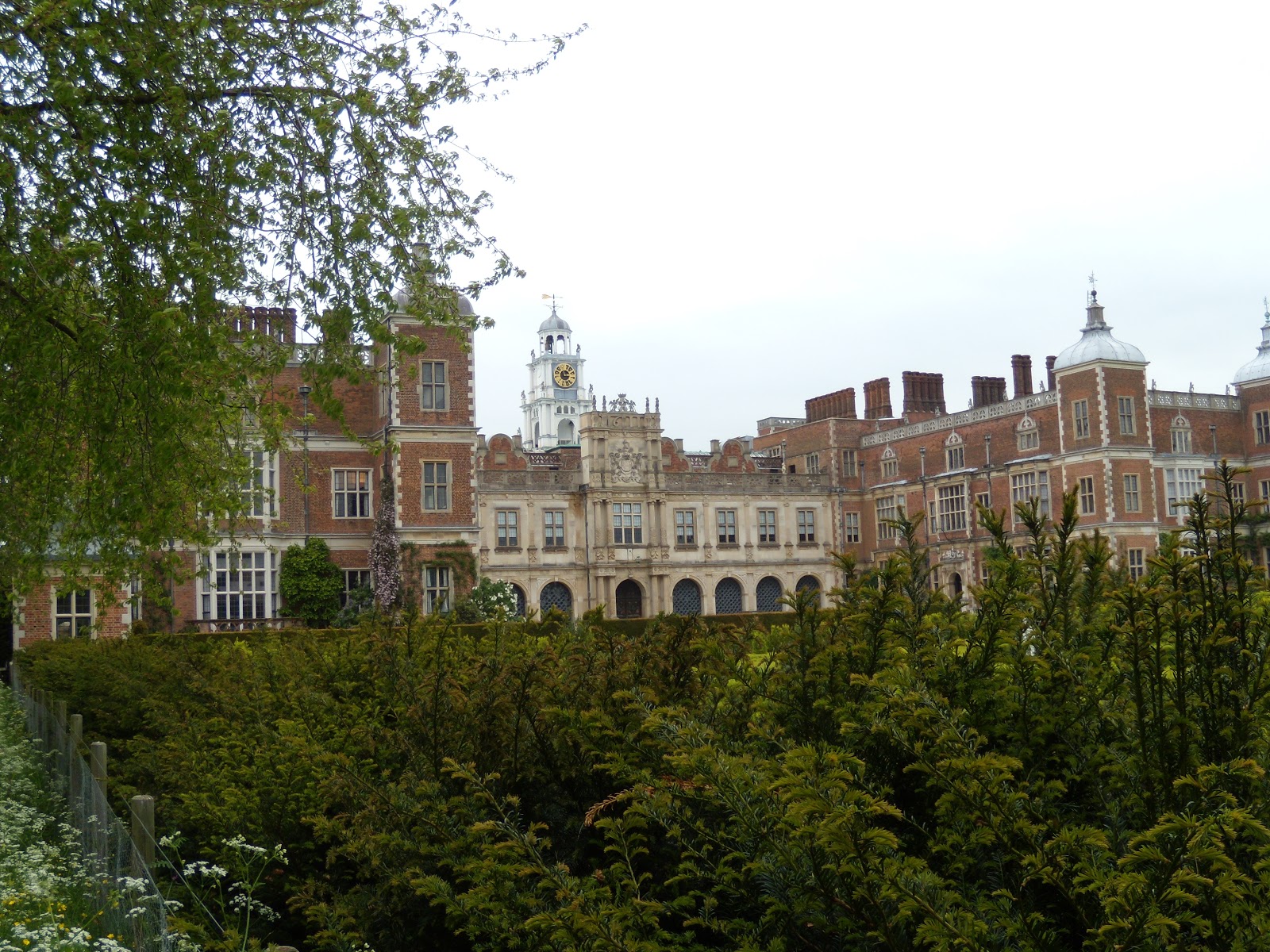
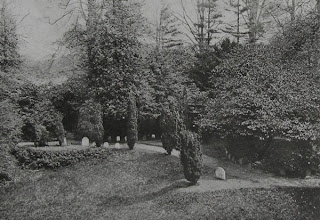
Next day, we’ll be driving to Oatlands in order to visit the pet cemetery of Frederica, Duchess of York, pictured above in black and white. Naturally, Hester and I are both excited about this stop – I can only imagine what Hubby’s reaction will be . . . . Then it’s on to Hampton Court Palace, a place I have never seen, if you can believe it. I’m especially interested in seeing Apartment 8, where the Duke of Wellington’s sister, Lady Anne Smith, lived.
No doubt Hubby will opt out of certain of the aforementioned entertainments. Unfortunatley, the thing he can’t opt out of is our nine hour flight home, followed by a seven hour layover in Newark, and then another flight to Florida. We’ll be leaving England at ten a.m. and not landing in Florida until 11 p.m. – a total of 18 hours travel time. Hubby, naturally, has no idea what he’s in for, as I’ve decided not to spoil the trip by telling him in advance what fate awaits. Have I mentioned that he has a bad back? Reader, it won’t be pretty. So, while I’m looking forward to the trip, at the same time I’m dreading our return journey. I can’t help but think that January 5th, 2013 will be the date of my very own Waterloo. . . . . to be continued (one hopes).

Believe It or Not, Regency Version

From The Annual Register for 1811, Chronicle, p. 140-141

December 19, 1811

Greenholme Mill, Yorkshire

“A girl named Martha Stowell, working at a mill at Greenholme, Yorkshire, crossing an adjoining field, slipped and dislocated, or otherwise injured her hip.

Greenholme Close

She was rendered lame and unable to work, and continued in that state for week when her uncle came to fetch her home.

picture by J. B. Long


On her way, riding a single horse between Burley and Ilkley, she met a gig upon the road, at which her horse took fright, threw her, and dragged her a short distance in the stirrup; when disengaged, she got up, and it is added, to the great surprise of herself and her uncle, found herself quite well, and being perfectly able to walk, returned to her work.

Bobbin Girl by Winslow Homer

So, do you believe the story, that the hip was slipped back into place?  And, have you ever fallen off a horse???   Were you hurt?

Victoria says she has fallen off many times, been nipped, stamped on and kicked at, but, since she was near a horse, it NEVER hurt.  She also says she had lots of lovely rides, many loving nuzzles and lots of quality time with her equine friends.  Are you a horse lover? 

An old favorite by Marguerite Henry with superb pictures by Wesley Dennis