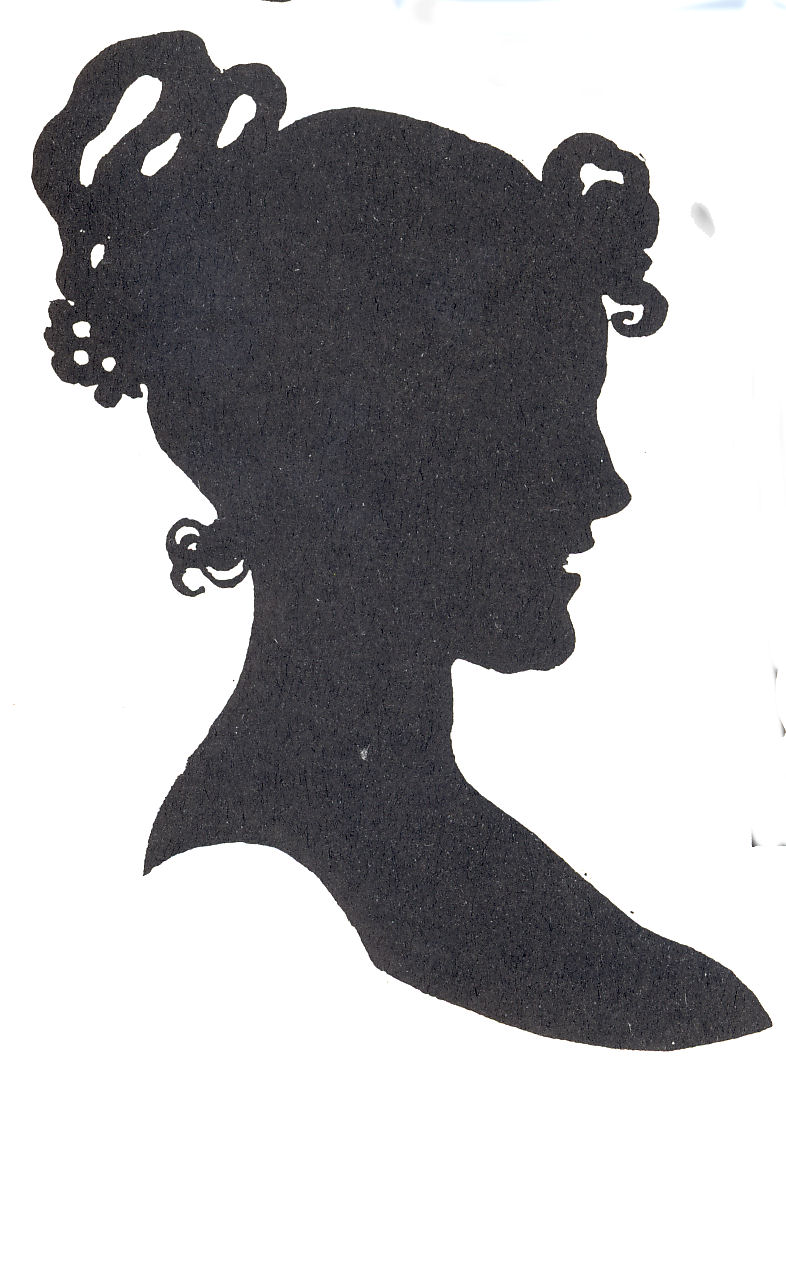
Secrets of Bloxley Bottom: Episode 12: Anne's Treasures

            Anne shut the door of her bedchamber behind her and leaned against it.  How she would love to have a sketch of Prudence, her own beautiful child.  Though even now, after sixteen years, she  winced at the name Prudence,  which was not a name she would have chosen for her daughter. If only….if only…
         Anne opened her wardrobe and reached inside for the worn bag in which she hid her treasures, the little brooch that contained Frederick’s hair woven into a pattern preserved now beneath glass and the two cherished remembrances of  their child.  The tiny cap she’d knitted with the finest strands of soft lambswool and the little silver rattle that had grown dark with tarnish.  She pressed them to her bosom and let the tears flow, recalling the panic and the helplessness she felt when Frederick went off to the battle, just hours before their wedding was to be held. She remembered how he had kissed her and how he had reassured her that her worries over his safety were for naught.
            Anne had felt uneasy as she watched him ride out; she’d wondered for years if she suppressed her premonition of his loss. Somehow the  feeling of utter despair that had come over her as he rode away was as alive today as it had been seventeen years ago.  Some days she fought it better than others, but there was a great dark hole in her heart, a hole that she was certain would never again be filled.
            After the Battle of Waterloo, Anne had fled Brussels, then tended the wounded before scouring every published report of the fighting and interrogating every man she encountered in an effort to learn more. She’d been desperate. Eventually, four days after the battle, she and a few others had searched the looted battlefield, seeing firsthand what the horrors had been. She could still smell the stench of decay, see the mutilated corpses of horses, the tangle of broken cartwheels, and watch in her mind’s eye the human vultures picking through the debris.
            She had not suspected a child was already on the way, even as she searched the makeshift hospitals and private homes of Brussels.
            It had been Lady Louisa, via the Duke of Wellington, who had finally found the man who’d seen Frederick die. Anne had insisted upon speaking to him personally, no matter how chilling his account. She’d kept in touch with him until he died two years later, never recovered from his wounds, but at least in the arms of his wife. No such last respite for Frederick, who had died without knowing that he was to be a father.           
            Lady Louisa had taken charge of Anne, keeping her safe and once they could travel, bringing her back to London. Anne had almost nothing to her name at that point, no money, no family, no husband.
            All she had was a baby girl, born as the next winter turned to spring. How she loved the precious little bundle she’d held for those first few weeks. She’d defied Lady Louisa and nursed the girl herself, though there had never been any question that parents would have to be found for the child.
            Louisa had handled all the arrangements, whilst protecting both Anne and the new family from gossip. And in all these years, as far as she knew, there had never been a whisper of a rumor. No one knew Anne had given birth to Prudence Newton, the pretty young daughter of Bloxley’s rector and his wife. No one suspected that Prudence got her good looks from Frederick Weston, who died at Waterloo, and her sweet disposition from her mother, Miss Anne Humphrey, longtime companion to the dowager baroness Bloxley.
            Anne now cherished her afternoons with Prudence in Lady Louisa’s drawing room at the Dower House. But the young lady that Prudence was today seemed a different person from that tiny child. There remained a connection and Anne’s feelings for Prudence were warm and sincere. Yet there was a distance she thought would never be bridged.  From the day Lady Louisa took the baby from Anne’s arms in order to deliver her to the Newtons, there existed two children in Anne’s heart – one forever the infant at her breast, the other growing up as the daughter of the rector and his wife.

          Anne clutched the cap to her and sank onto her bed.  She could not stop the tears and only with a great effort was able to keep herself from sobbing out loud.

What Are You Reading? Contest Winner!

 
Linda, who is reading The Heretic’s Wife, is our contest winner! Thanks to all who participated – look for another contest soon. Linda, please email us using the link in the left sidebar and provide your mailing address. We’ll get the books out to you this week.


Victoria and Kristine here, in a rather nosey mood. We want to know what you’re reading. Let us know by leaving us a comment that includes a link to the book and also let us know if you give the book a thumbs up or a thumbs down. Short reviews would also be welcome. One lucky winner will receive a copy of these two books, which we have just read:


The winner will be chosen on Monday, April 29th
 
Good Luck!
 

A Couple In England – Day Five – Part Two

When last we met, I was sitting in the first class carriage of the Bath bound train shivering, coughing and feeling feverish. Beyond the windows, the English countryside sped by as I sat huddled beneath two coats, my gloved hands shoved deep into the pockets of the top coat. I tried to focus my mind . . . how long could this illness (cholera, typhus, the bird flu, whatever it was) possibly last? Was there even the ghost of a chance that it was but a passing fancy and I would recover by tomorrow? I took stock of my symptoms and decided that it was highly unlikely.
 
The ticket guy came through the car at this point. What is the ticket guy actually called? The conductor? Wasn’t the conductor the guy who drove the train? Was he a ticket taker? Nah, that didn’t sound right. Does anyone actually drive trains anymore, or are they all on auto-pilot like the airplanes? Remember when you could actually smoke on an airplane? What were they thinking?
 
“Tickets, please.” The ticket guy’s voice interrupted this fascinating stream of thought. I pulled my bag towards me, fished around for my wallet and finally presented my credit card along with the required tickets. 
 
The ticket guy/ticket taker/conductor upgraded us for the aforementioned fifteen pounds each, sliding my credit card through his hand-held credit card thingy before handing me two new tickets and moving on.
 
Hubby was looking at me expectantly. “Done and dusted,” I told him.
 
“Huh?  How much did he charge us? Did it work? Speak English, will ya?”
 
Sigh. Cough. Shiver. “Yes, just like the woman told me. We’re now officially first class passengers for only fifteen pounds more. You can relax.”
 
Done and dusted? Where do you get this stuff? What was that thing you said to me when we were first dating? Remember? That English thing you threw at me?”
 
“Behoove.”
 
“Yeah. Behoove, that’s it. I mean, who talks like that? And our wedding ceremony, oh brother!”
 
“I told you to read through the vows beforehand. I encouraged your participation. You couldn’t be bothered. You left it all up to me, remember?”
 
“Who knew you were going to go with I pledge you my troth? What in the Hell was that? What in the Hell is a troth?”
 
I chose to interpret Hubby’s question as being rhetorical and closed my eyes. The next thing I remember is pulling into Bath Spa Station. I got up, unsteadily, from my seat and took a few steps towards our luggage.
 
“I’ve got it,” Hubby said, in a brook no argument sort of way.
 
“You can’t manage it all,” I told him.
 
“I can. You just worry about yourself.” God, I must look even worse than I feel. I directed Hubby to the elevator and we went down a flight.

Coming out of the lift, I marshaled what little strength I had to hand, took one of the bags from Hubby, headed towards the exit turnstiles and tried to get through.
The bar wouldn’t budge. Again I tried. Again the bar wouldn’t move. After my fourth attempt, and just before I was ready to duck beneath the arm and get the Hell out, a nice young man in a Great Western uniform approached.
“May I help you?” he asked. “Do you have your ticket?”
My ticket? What’s my ticket got to do with the price of turnstiles? Not in the mood to argue, I felt in my coat pocket and produced our tickets, which the nice man took from me and inserted into the little slot on the top of the turnstile, which then magically slid open. Yes, Reader, that’s how sick I was. Imagine my forgetting the reason for keeping one’s ticket handy.

Outside, it was a miserable day – grey and wet with a dash of blowing wind. I huddled under the awning and looked bleakly at the empty forecourt. Don’t let the picture above fool you. I swiped it off the web. When Hubby and I arrived, there was not a cab in sight. You’d think the cabs would have the arrival times down pat, especially in such bad weather, but there we were, marooned at Bath Spa Station.
“Where do we get a cab?” Hubby asked.
“Here.”
“But there aren’t any.”
“They’ll be along in a minute,” I told him, pulling my scarf up to my chin.
“Are you going to be okay?”
“I’m fine,” I said, lying through my chattering teeth, whilst all the while thinking a cab, a cab, my kingdom for a cab. Sigh.
 
Part Three Coming Soon!

The Secrets of Bloxley Bottom, Episode 11 Suspicions Confirmed

     At Dower House, Lady Louisa and her companion Anne received Aurelia and Millicent with evident pleasure.
     “I had only just commented to Anne about how quiet things seemed today.” Lady Louisa motioned to her butler. “Tea and cakes, Hartley.”
     “Yes, milady.”
     As soon as he had gone, Aurelia leaned forward in her chair. “We have come with our suspicions, Lady Louisa. Our suspicions of what that Frenchman is up to.”
     “Frenchman? Do you mean Tournell? You know he is here to paint my granddaughters.” Lady Louisa wore a look of wariness.
     “Well, yes,” said Millicent. “That is just our concern.”
     “You see, Lady Louisa, we have learned that he is also painting some of the village girls.” Aurelia gave a decisive nod of her head. “He has asked one to pose for him, and we saw him riding in the Rector’s donkey cart with Miss Newton and they appeared to be talking in earnest.”
     Lady Louisa’s mouth formed a concerned frown, “And you are concerned that this will interfere with his work on the portrait of Daphne and Valeria?”
     Seated on a nearby chair, Anne, her hand pressed to her heart, also looked concerned at the news.
     “Not exactly,” said Millicent. “But neither Aurelia nor I feel that he would be a good influence on any of the local girls, your granddaughters included. I assume they will be well chaperoned while they are with him.”
     A cloud darkened Lady Louisa’s features. “I assume their mother will be with them, though I sometimes wonder about how closely Elizabeth watches over them. At times, she seems to be far more interested in her garden than in her daughters.”
     Anne’s voice was thin. “You said Miss Newton was driving Mr. Tournell?”
     “She was!” Aurelia could not fathom what made Anne so anxious, but there was no use pussy-footing about the situation. “Little Polly, a maid from the inn, brought us some mail yesterday. Poor little dear was confused. It seems that Frenchman asked her to pose for him, and she did not know what to do. Seeing that he is French, I advised her to be very careful and be sure that if he were to draw her at all, it should be in the presence of other people. Do not be alone with him, I said.”
     “To you, Mrs. Gammersgill, an artist’s model is of questionable character?” Lady Louisa inquired.
     “Not at all. Many people sit for their portraits. But as he should be occupied with working on his portrait of your granddaughters, I cannot see why he would he ask a pretty young girl, a virtual stranger to him, to pose as well.”
     “Perhaps he needs a pretty girl for another of his pictures.” The Dowager raised her eyebrows. “Most artists paint portraits, I have been given to understand, in order to make money. They also paint pretty pictures to show at exhibitions, and there are usually young girls in them. Perhaps that is all it is about.”
     Aurelia nodded. “I sincerely hope that is the case. Polly did not mention he’d asked her to, ah, well, appear in less than her full complement of clothing.”
     Lady Louisa could not help smiling. “But you, Aurelia, my dear, suspect that he wants to paint her au naturale?”
     Aurelia sniffed. “I have to admit the possibility occurred to both Millicent and myself. I believe some artists like to include nymphs and goddesses in their works, some in a state of undress. I do not care for these pictures myself.”
     “Of course we don’t,” Millicent added. “But one never knows…” She let the conclusion of her thought hover in the imaginations of her listeners.
     Anne made a little sob.
     Lady Louisa gave her a cautionary look before saying, “I am under the impression that there are women in London who hire themselves for such modeling. Women of less than moral character.”
     Aurelia nodded. “I believe I have read the same kind of information. In a book, of course.”
     “The point is,” Lady Louisa directed her remarks to Anne. “That that is the kind of model Tournell would engage if he was interested in nudes. Not maids at a village inn or an innocent miller’s daughter.”
     “I suppose so, and everything is probably above board if it is done at the inn or in the presence of other people. But if he wanted her to go with him to Major Twydall’s house, where he is using the old conservatory, I’m suspicious.”
     Once the two ladies had left, Anne gave way to a spate of tears.
     “My dear,” Lady Louisa said, “I do not think there is a particle of concern here. However, when Prudence comes to us tomorrow, we shall be sure to warn her.”
     But Lady Louisa was too late. Prudence had already spent an hour with Tournell, an hour in which he had sketched her face from several angles, including a profile. And for which she had modestly slipped the bodice of her dress low on her shoulders so that he might capture the beauty of her neck.
And she had agreed to come back another time. Tournell assumed it would be only a matter of time before she would agree to remove the bodice altogether.
     When Prudence arrived at Lady Louisa’s the next afternoon, the dowager had shed her air of unconcern. After the initial pleasantries were concluded, she peered at Prudence through her rarely-worn spectacles. “I think you are aware of the presence of a Frenchman, an artist in Bloxley Bottom.”
     Neither Lady Louisa nor Anne was prepared for the blush that appeared on Prudence’s cheeks as she squirmed in her chair. “I, ah, I gave him a ride to Major Monty’s the other day. And he made some sketches of me…”
     “What!” Lady Louisa’s sharp retort came at the same moment as Anne’s groan.
  
   “I asked him to draw a picture of me, for my mother’s birthday.”
     Lady Louisa settled back on the sopha, relief evident on her face. “You asked him?”
     Prudence looked from Lady Louisa to Anne and back again. “Was that not all right? Did I do something wrong?”
     Anne found her voice. “Where, I mean in what location did he draw you. At your home?”
    “Oh no, then it would not be a surprise for Mama.
     Anne grimaced, but Prudence did not notice.
     “We went to Major Monty’s house. Monsieur Tournell has a sort of studio there.”
     Lady Louisa gave Anne a warning look. “And was Major Twydall there?”
     Prudence decided she could tell most of the truth. “Yes, and his manservant too.” She left out the fact they had left the studio after only a few moments. “Was that wrong of me?”
     Lady Louisa summoned a smile. “No, dear. But I hope you will be careful not to be alone with him. I think it is quite lovely that you want a picture for your mother. I must say, I would welcome one also, if he can make a replica.”
     “Yes, indeed.” Anne said, able now to manage a smile. “A portrait of you, Prudence, would be most welcome to us.” 


The Pre-Raphaelites: Victorian Art and Design

The Pre-Raphaelites: Victorian Art and Design 1848-1900 is now at the National Gallery of Art, Washington, D. C. through May 19, 2013.

 
At the Tate Britain, the Show was titled as above.
Picture: Astarte Syriaca, 1877, by Dante Gabriel Rossetti

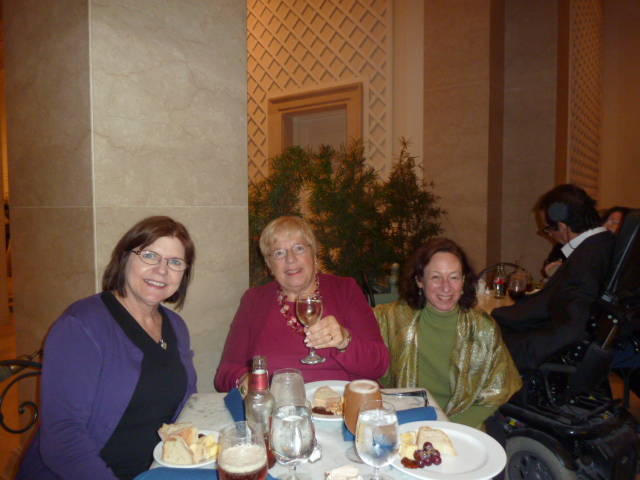
Victoria, here.  On my recent trip to Washington DC, I met fellow writers Diane Gaston and Julie Halperson to tour the exhibition, have lunch and see what other fun we could have at the NGA.

Diane, Victoria, Julie at the Garden Cafe

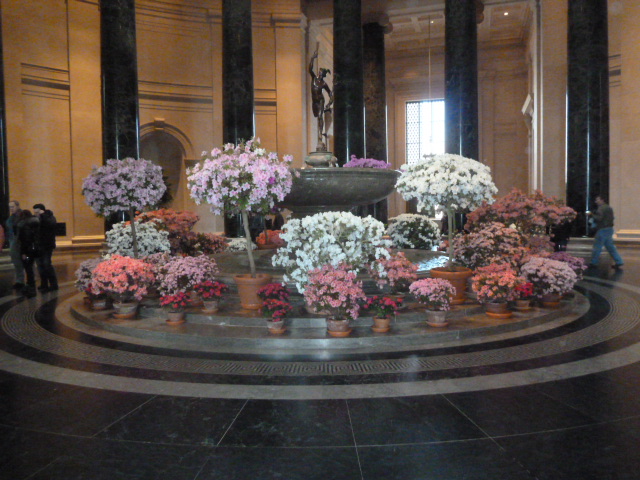
Rotunda, NGA, Constitution Avenue, Washington, DC
 
 We go almost every year, and we never run out of delicious meals or fascinating artwork.  See my post about the collection of American Furniture of the Federal Period here.
 
You might have noted above that when the Pre-Raphaelites exhibition was shown at the Tate Britain in London, the title includes “The Victorian Avant Garde.” Why it was altered for the American run, I do not know, but the original title seems more apropos since there were several other movements in Victorian Art and Design from 1848-1900. You can access the Tate’s website on the Pre-Raphaelite Exhibition here.
 
 
Ophelia, 1851–52, by John Everett Millais (1829-1896)
 
According to the NGA, this exhibition is “The first major survey of the art of the Pre-Raphaelites to be shown in the United States features some 130 paintings, sculptures, works on paper, and decorative art objects. The young members of the Pre-Raphaelite Brotherhood, formed in 1848, shook the art world of mid-19th-century Britain by rejecting traditional approaches to painting. Combining scientific precision, an innovative approach to subject matter, and brilliant, clear colors, Pre-Raphaelitism was Britain’s first avant-garde art movement.”
 
 
Laus Venens 1873-75, by Edward Coley Burne-Jones
Tyne & Wear Museums
 
The Pre-Raphaelite Brotherhood formed in the mid-19th century by a  groups of young artists who wanted to return the art of painting and associate art to the values of the early Quattrocento (Italy, 15th C).  The “rebels” admired the colors and focus of the early Renaissance masters such as Botticelli and Bellini.  Their principles extended into the decorative arts and even political movements, particularly those associated with  the Arts and Crafts movement and William Morris’s designs.


William Morris Bed, Kelmscott Manor Collections Photo


Upon conclusion of the Washington D.C.  show, the exhibition will travel to The State Pushkin Museum of Fine Arts, Moscow, June 10–September 30, 2013.