A Couple In England – Day 7 – Part Three

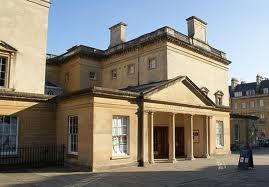
After touring the Fashion Museum, I went upstairs to visit the Assembly Rooms, which were designed by John Wood the Younger in 1769 and completed in 1771.  The Rooms are primarily made up of three main, public rooms – the first being the Ball Room, where balls were held twice a week, on Mondays and Thursdays.

 
Here is a plan of the Rooms


The plan, as well as an excellent article on English Assembly Rooms can be found on that most excellent blog, Austenonly.
 
 
The yellow Octagon Room was used for card play until the Card Room was added in 1777.
And the Tea Room was, naturally, where the fashionable went to take tea. Here is Rowlandson’s print of the Room –


It is remarkable that the Assembly Rooms exist today at all. During WWII, the historically important English cities of Exeter, Bath, Norwich and York were targeted by the Germans in a series of targeted attacks known as the Baedeker raids.
 
From Wikipedia: The Baedeker raids were conducted by the German Luftwaffe’s Luftflotte 3 in two periods between April and June 1942. They targeted strategically relatively unimportant but picturesque cities in England. The cities were reputedly selected from the German Baedeker Tourist Guide to Britain, meeting the criterion of having been awarded three stars (for their historical significance), hence the English name for the raids.
 
“Over the weekend of 25-27 April 1942, Bath suffered three horrifying reprisal raids, from 80 Luftwaffe planes which took off from Nazi occupied northern France. As the city sirens wailed few people took cover, even when the first pathfinder flares fell the people of Bath still believed the attack was destined for nearby Bristol. During the previous four months Bristol had been hit almost every night, and so the people of Bath did not expect the bombs to fall on them.
 
“The first raid struck just before 11 pm on the Saturday night and lasted until 1 am. The enemy aircraft then returned to France; refuelled, rearmed and returned at 4.35 am. Bath was still ablaze from the first raid, making it easier for the German bombers to pick out their targets. The third raid, which only lasted two hours but caused extensive damage, arrived in the early hours of Monday morning. The bombers flew low to drop their high explosives and incendiaries and then returned to rain the streets with machine-gun fire. 417 people were killed, another 1,000 injured. Over 19,000 buildings were affected, of which 1,100 were seriously damaged or destroyed including 218 of architectural or historic interest.  Houses in the Royal Crescent, Circus and Paragon were destroyed and the Assembly Rooms burnt out.
 
This is how the Tea Room looked after the Baedeker raids, or Bath Blitz, in April 1942.


And this what they look like today.


It is of interest to note that all of the rooms are today lit by their original 18th-century chandeliers, which had thankfully been taken down and placed in storage at the start of the war. For more on the history of the chandeliers and their preservation, visit author Lesley-Anne McLeod’s site here.

For further contemporary information about Regency Bath and the Assembly Rooms, read Pierce Egan’s Walks Through Bath: Describing Every Thing Worthy of Interest, published in 1819. It contains lots of detailed 1819 travel information.

And because so much of what we know and have seen of the Assembly Rooms and, indeed Bath itself, has come to us via films, especially those based upon the novels of Miss Jane Austen, you can download the Bath Movie Map here and use it as a guide to film locations throughout the City.
 

Part Four Coming Soon!

.

The Secrets of Bloxley Bottom – Episode 18 – A Stream of Words

          Having stumbled upon Prudence, so to speak, in the stream as she bathed Spot, Tournell now cleared his throat, hoping the sound would alert her to his presence so that she wouldn’t be startled.
 
         “Mr. Tournell!” she said, “I didn’t hear you coming.”
 
        “You were too busy laughing.” Prudence was almost as wet as the dog. Her hair was damp, as was the bodice of her gown, which clung wetly to her bosom. “It is good to see that Spot is getting a bath. He was beginning to stink.”
 
      “Mr. Tournell! How would you know whether Spot smelled or not?”
 
      Tournell shrugged. “I may occasionally find myself with a spare bit of meat and, keeping in mind that old adage, waste not, want not, I may throw it Spot’s way.” This was true enough, although Tournell often fed Spot with else besides meat. A few days ago it had been a bit of fruit cake, which the dog had seemed to enjoy.
 
     Prudence looked at the artist with new eyes. Why, Mr. Tournell was human, regardless of his being a man and being French. “That’s very good of you. I thought I was the only person who fed Spot.”
 
    “Well, now you know that you are not alone.” He smiled easily at Prudence. “You look quite lovely like that,” he told her.
 
     She gave him a level gaze. “I’m not lovely at all. Please do not mock me.”
 
    Tournell placed his palm upon his breast, “You wound me. To think that I would mock you! You are quite lovely, whether you choose to believe so or not. In fact, I am going to sit here and sketch you while you finish with Spot.” With that, he dismounted the horse and pulled his drawing tools from the saddle bag.
 
     “I’m a mess!” she protested.
 
      “Ah, but you are a glowing, lovely mess, little one.”
 
      Prudence sighed, “I wish I were beautiful, then I would have a hope of marrying well. I wish I could go to London and have gowns made and have my hair done and go to fabulous balls and mingle with sophisticated people.”

 
      Tournell raised an eyebrow and stopped his sketching. “That’s rather a broad wish, non? Still, it is not impossible. Although, I don’t know how much you would like the reality.”
 
      “What do you mean?”
 
      “Oh, just that society is very shallow, ma petite. It is comprised of many people, all of whom believe that they are the most important creature in the universe and who live their lives as though they were. It’s all quite superficial. French gowns and fripperies do not a nice person make. That’s it, Miss Newton – the sort of society you so envy is filled with people who, underneath, are not very nice. At least that is the way I see it.”
 
     “Perhaps you are right, but I would like see it all, just once.”
 
     “So you shall.”
 
     “How do you know that?”
 
     “If you wish a thing, you can make it so. If you set yourself a goal in life, whatever it may be, you need only to keep an eye upon that goal and then to make the choices in life that will bring you nearer to it.”
 
     “You make it all sound so simple.”
 
     “Alors, it is not difficult! What is it that you really want from life? Beyond a silk embroidered ball gown?” As Tournell waited for her response, he sketched Prudence with sure strokes. The scene before him now would be used in one of his `daily life’ paintings for certain.
 
    “I suppose what I want most is to leave Bloxley Bottom.” How could she explain to Tournell, or to anyone, that she simply knew that she was destined for a bigger life than could be found here?
 
    “And so to London, hhmmm?”
 
    Prudence stood and filled a jug with water and began to rinse Spot’s coat. “It will never come true,” she sighed.
 
   “You give up too easily?”
 
   She sighed, “I cannot speak French.”
 
    Tournell laughed aloud. “It is not funny!” Prudence told him. “One must speak French if one is to be thought well educated and a lady.”
 
     “Who told you that?”
 
     “I read it in a magazine.”
 
      “You do not need to speak French to be thought worthy of membership in the bon ton.”
 
      Prudence looked at Tournell doubtfully. Surely The Lady’s Magazine knew more about the subject than he?
 
      “But just to put your mind at ease, Tournell will teach you to speak French.”
 
      Prudence dropped her water jug into the stream. “Oh, will you? Is it very difficult? How long will it take for me to be able to speak it properly?”
 
      “Oh, be calm, Mademoiselle Prudence, you are kicking up the water and getting my sketch pad wet! Sit, sit. Now, it would take you years to learn the nuances of the French language. I am not going to teach you the entire French language, feminine
verbs, nouns, plurals. . . . There is no need for it, no matter what your magazine advises. All you will need are a few phrases you can use to pepper your conversation at the appropriate moments.”

    “Do you think?”

 
    “Non, I know. I am certain, ma petite.”
 
   “Non, is that French for no?”
 
   “Oui. Which is French for yes. You see, it will not be difficult at all.”


The Adventures of Dr. Syntax in Search of the Picturesque, Part Ten

Just three sections to go before we come to the end of Dr. Syntax’s first set of adventures.  As we have followed the good reverend for the last eight or nine months, we have found him continually frustrated by his inability to find the picturesque…not only does he have extended misadventures, the poor man is confronted with one jolly scene after another, few of them fulfilling the strictures of Dr. Gilpin.  It’s all meant as a satire on the early nineteenth century’s obsession with wild beauty…sometimes referred to as the Romantic Movement. 

In this scene, Dr. Syntax encounters a Dairy Maid, most mundane but necessary.

Excerpts from Canto XVIII:

Now Nature’s beauties caught his eye,
Array’d in gay simplicity:
And as he pass’d the road along,
The blackbird’s note, the thrush’s song…

When lo! a dairy met his view,
Where, full of cream, in order due.
The pans, the bowls, the jugs were plac’d.
Which tempted the Divine to taste;
But he found something better there:
A village damsel, young and fair,
Attracted his admiring eye:
Who, as he enter’d, heaved a sigh. …

Dr. Syntax and Dairy Maid

Now Syntax, as we all must know,
Ne’er heard a sigh or tale of woe,
But instant wish’d to bring relief.
To dry the tear and soothe the grief.
“Come here, sweet girl,” he softly said;
“Tell me your cares — nor be afraid:
Come here, and seat you by my side;
You’ll find in me a friendly guide.
Relate your sorrows, — tell the truth;
What is it ? does some perjur’d youth
Unfaithful to his promise prove,
Nor make the fond return of love! …

The maid’s mama is not so interested in having the elderly doctor comfort her daughter, but as always with Dr. Syntax, he allays her complaints and manages to have a nice meal and be put up for the night at the farm.  Again, making lemonade from the lemons…

Excerpts from Canto XIX:

Dr. Syntax takes up his pen and brushes and contemplates the scenery:

I’ll add no more; for, to my mind, The scene’s complete, and well design’d.
There are, indeed, who would insert
Those pigs which wallow in the dirt;
And though I hold a pig is good
Upon a dish, prepar’d for food,
I do not fear to say the brute
Does not my taste in painting suit;…
.
For, to say truth, I don’t inherit
This self-same picturesquish spirit,
That looks to nought but what is rough,
And ne’er thinks Nature coarse enough.
Their system does my genius shock.
Who see such graces in a dock;
Whose eye the picturesque admires
In straggling brambles, and in briers;
Nay, can a real beauty see
In a decay’d and rotten tree.

Disappointed in his growing impatience with the concepts of the picturesque landscape, Dr. Syntax travels onward:   A city’s stately form appear’d: Upon the shore the mass was rear’d.
With glistening spires, while below
Masts like a forest seem’d to grow.
‘Twas Liverpool, that splendid mart.
Imperial London’s counterpart.
Where wand’ring Mersey’s rapid streams
Rival the honours of the Thames,
And bear, on each returning tide,
Whate’er by commerce is supplied,
Whate’er the winds can hurry o’er
From ev’ry clime and distant shore.

Dr. Syntax at Liverpool

Eventually, Dr. Syntax encounters some men who are interested in his journey:
Excerpts from Canto XX

…The exciseman, a right village sage,
(For he could cast accounts and gauge,)
Spoke for the rest — who would be proud
To hear his Rev’rence read aloud.
He bow’d assent, and straight began
To state what beauty is in man;
Or on the surface of the earth. …
Of all things in the realms of nature,
Or senseless forms, or living creature:
In short, he thus profess’d to show.
Through all the vast expanse below,
From what concentered state of things
The varying form of beauty springs;
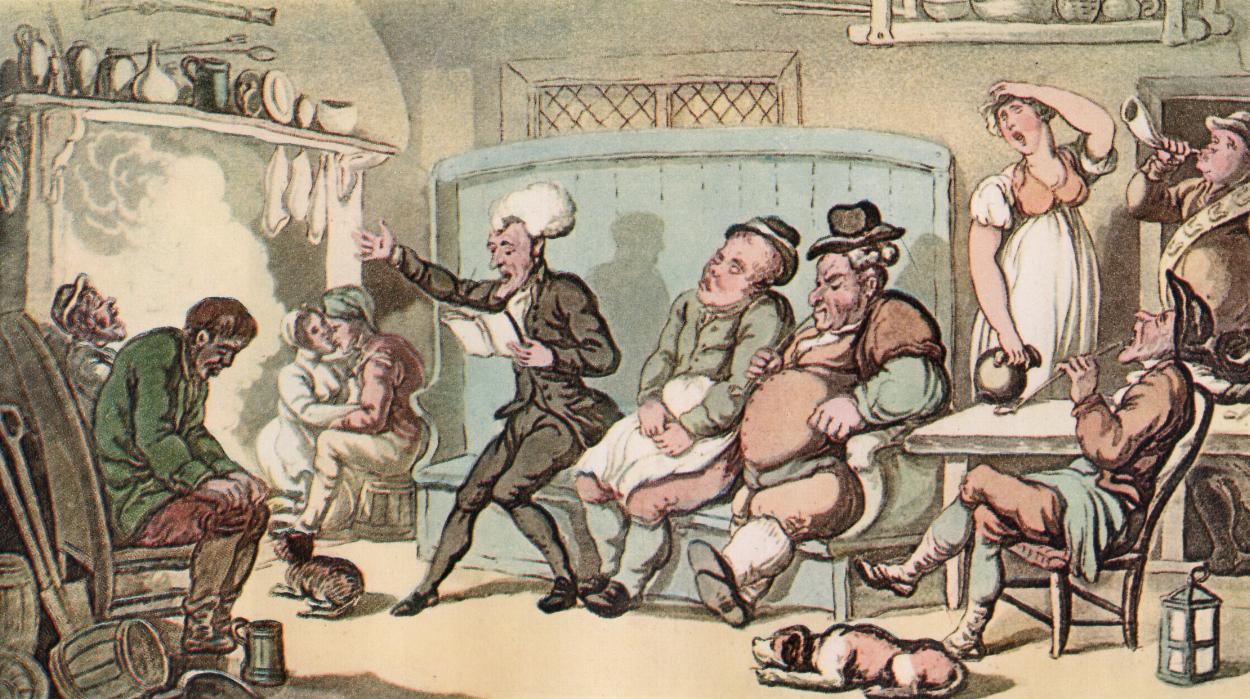
Dr. Syntax Reading His Tour

But, as he read, though full of grace,
Though strong expression mark’d his face,
Though his feet struck the sounding floor.
And his voice thunder’d through the door,
Each hearer, as th’ infection crept
O’er the numb’d sense, unconscious slept!
One dropp’d his pipe — another snor’d,
His bed of down an oaken board;
The cobbler yawn’d, then sank to rest,
His chin reclining on his breast;
All slept at length but Tom and Sue,
For they had something else to do.
Syntax heard nought; the enraptnr’d elf
Saw and heard nothing but himself:
But, when a swineherd’s bugle sounded.
The Doctor then, amaz’d — confounded.
Beheld the death-like scene about him;
And, thinking it was form’d to flout him,
He frown’d disdain — then struck his head,
Caught up a light, and rush’d to bed.

End of Canto XX; Illustrations by Thomas Rowlandson
A Couple In England – Day 7 – Part Two

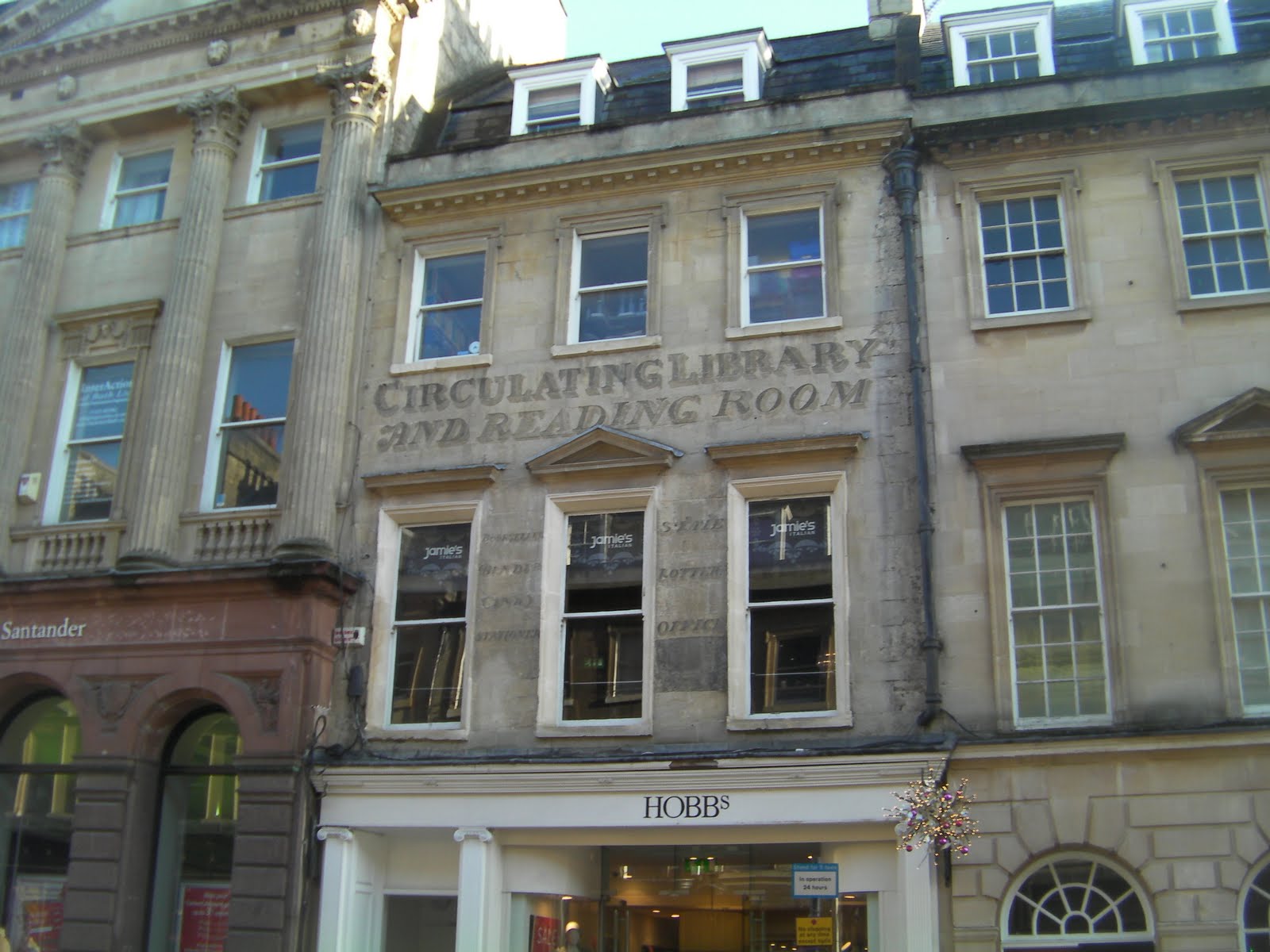
Leaving the shop with Hubby’s cold medicine in my bag, I felt as though things were looking up. I’d accomplished my mission of mercy and was now headed to the Fashion Museum via Milsom Street. Later today, I had secretly booked Hubby and I in for a couples massage at the Bath Priory Hotel and Spa. I was even in the mood to take pictures and what did I spy but this building below.
 
 
This is what I love about England, one literally stumbles upon history in every street. It turns out that Frederick Joseph owned the bookshop and circulating library at 43 Milsom Street in 1822. The premises were sold to Eliza Williams in 1829 and she remained there until 1868, when she moved the business to 19 Green Street. How the signage came to be preserved to this day, I have no clue, but I’m exceedingly glad that it still exists.
 
It was at this point that I was caught unawares and was again violently assaulted, this time by my bowels. You, Dear Reader, have stuck by me through my narration of this trip to England up to this point and I thank you for that. I have done my level best to report every part of this trip, good and bad, exactly as they happened and so I cannot but do the same now. I will try to make it as quick and painless as possible for you. Certainly less painful than it was for me.
 
Of a sudden, my bowels were gripped by a giant hand, which twisted them violently and endeavored to pull them from my body. Think childbirth, or two laxatives too many. Panicked, I clamped my sphincter shut and looked about wildly. The street was deserted. Nothing, and I mean nothing, was open. There was no hope of popping into a shop in order to use their loo. A cold, clammy sweat broke out upon my brow as I searched vainly for a bench, although I don’t know how wise putting myself in a seated position would have been at that point. Nothing. No relief in sight.
 
Have you been to Milsom Street? The sidewalks are cobbled. I was wearing boots with heels. I was headed for the Fashion Museum, meaning that I was walking uphill. It was freezing and I was in the grip of intense bowel pains. It was imperative that I find a WC. What in the world could possibly happen next? A plague of locusts perhaps?
 
Shivering and slightly bent over with the pain, blowing my nose on purloined loo paper, I forged ahead. You’ve got to hand it to me – I’m nothing if not determined. Oh, Lord, please let me get to the Museum in time. A few more steps . . .  Stop to pant . . . . More praying. . . . . . .Blow nose . . . . . A few more steps . . . . . I finally made it to George Street, the cross street at the top of Milsom, and wended my way through the back streets to the Assembly Rooms.  The Museum, and more importantly, the loo, was finally in sight.


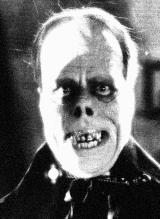
Inside, the place was deserted save for the girl behind the desk. Truly not knowing how much longer I could hang on, I pasted what could only have been a rictus smile upon my face and asked her for the loo. I imagine that I looked something like this, and cannot for the life of me imagine why she didn’t run screaming for her life.  
 
Of course the loo was located down a long hallway and then down several flights of stairs, which I bounded down at Olympic speed. I hurled myself through the outer bathroom door, hastily dropped my bag to the floor without a thought for germs and sprinted into a stall. Reader, I made it just in time.
 
It took me several minutes to recover from my ordeal, as you may well imagine. However, once it was over with, the pain disappeared and I returned to merely having to deal with the symptoms of cholera – a cake walk, comparatively speaking.
 
The good thing was that, this being New Year’s Day, I had the entire Museum to myself for the length of my visit. There was a special exhibition on, titled Sport And Fashion, as a nod to the recent Olympics – I looked, but there was no outfit specifically made for the Downstairs Bathroom Sprint event.


The permanent collection offers many old favorites, from panniers


to Regency gowns


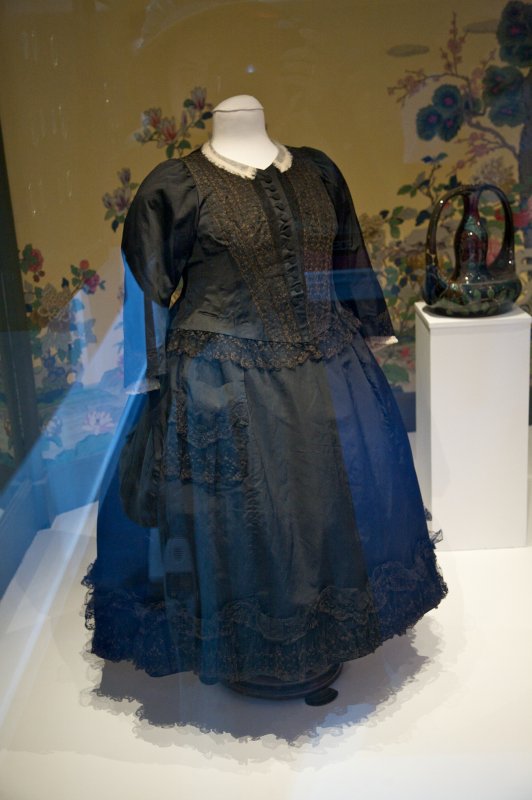
To Queen Victoria’s dress


and right through to today. The collection also includes menswear, shoes, accessories and more. You can visit the Museum website here and search the collection. If you don’t mind, I’ll save the Assembly Rooms themselves until next time – recounting the horrors of the day has left me exhausted.
 
 
Part Three Coming Soon!