A Couple In England – Day 8

I woke up on our last day in Bath to a truly gruesome sight – Hubby. He was pale, clammy and looking for all the world as though he were on his last legs.
 
“How do you feel?” I asked in the hopes that I might have misread the signs.
 
“Doctor.”
 
“What?”
 
“I need a doctor. Or maybe an undertaker. I need something more than that crappy Bell’s cough stuff you gave me. No kidding, I want a doctor.”
 
This was serious. As a rule, Hubby runs from medical practitioners.
 
“Okay,” I said, my mind working. “Let’s go downstairs and see about getting you a doctor then. Can you get dressed?”
 
Together, we got us both dressed, and packed, and went downstairs to the reception room, where we found Michael on duty. Michael, it should be said, worked for a time as house steward to the premier land owner in the neighborhood. I don’t think I’m at liberty to tell you all I know about it, confidentiality and all, but think a stately home with the word “long” in it’s name and put that together with another word for “tub” and you might figure it out. Clue: the peer Michael worked for has a harem.
 
Michael took one look at us and said, “Oh, dear.”
 
“We’re supposed to take the train to Windsor today, to meet my friend Hester, but Hubby wants a doctor. Can you get us a doctor?”
 
Michael is the epitome of the word “dapper.” Dressed in a suit and tie, his hair and mustache immaculate, he exudes an air of calm and classy competence. Have I mentioned his pocket square? “I could, of course, call a doctor for you. However, if you’re going to be staying in Windsor, perhaps it would be more expedient for you to call your friend and have her arrange for Hubby to see her practitioner, who would be on the spot, so the speak.”
 
He slid the telephone towards me as Hubby collapsed on the couch by the fireplace. I called Hester, who said she’d call her doctor and see what she could do. She’d ring me back.
 
“Medicine,” Hubby croaked.
 
I explained to Michael that the shops had been closed yesterday and so I hadn’t been able to find any 21st century cold medicine for Hubby.
 
“The chemist down the street is open today,” Michael told me. And so off I went, down Great Pulteney Street to the chemist hard by the bridge.


A. H. Hale, dispensing chemists, have been in business since the 1800’s and the shop looks like something out of a Jane Austen novel.


Their window is filled with glass bottles containing variously coloured liquids and powders and, best of all, modern day cold medicine. I conversed with the clerk, who listened to Hubby’s symptoms and stocked me up with an assortment of remedies. Back at the hotel, I found Hubby on the couch, drinking a bottle of Schwepps ginger ale, provided by Michael. I handed over the cough syrup and decongestant pills and within minutes he proclaimed himself much improved. Hester, it turned out, had gotten Hubby an appointment with her doctor for this afternoon, but Hubby now proclaimed himself fit to travel and no longer in need of dire medical intervention. He swore that it was the Schwepps, rather than the medicines, that had cured him. Ingrate. I called Hester, cancelled the doctor and before much longer we were in a cab headed to the station.

You can tell that I was feeling a bit better  myself, as I actually took these photos myself from the platform. We had a few minutes to wait for the next train, so I got us a couple of coffees and brought them out to Hubby.

“No smoking,” he said, as he took the coffee from me.

“Huh?”

“The sign,” he said, pointing in its direction with his chin. “No smoking. We’re outside on the platform and we can’t smoke. You can’t smoke in England.”

“Well, let’s not worry about it until you can’t smoke in France. Or Greece. Or Turkey. Then we’ll worry about it.”

“How long is the train ride to Windsor?”

Uh, oh. Here we go. “It’s about two hours. We, uh, we have to change trains though.”

“Where?”

“At Reading. And Slough.”

Two changes?”

I could feel his pain. It wasn’t that long ago that I was myself close to death on a train. Only we had been traveling in the opposite direction.

“Reading is close to Stratfield Saye,” I sighed. Stratfield Saye, whose opening times never seem to coincide with my trips to England.

“What’s that?”

“Artie’s house.”

“I thought Apsley House was Artie’s house.”

“It is. He bought Apsley House himself. The country bought Stratfield Saye as a sort of thank you gi
ft for his having defeated Napoleon at Waterloo.”

“What?”

“Yeah. Napoleon was seen as the Hitler of his day. A tyrant. He proclaimed himself as Emperor of France and then turned his eye on the rest of the world. He threatened democracies everywhere. And Wellington and his army and the allies defeated him at Waterloo. Napoleon’s army was notorious for looting and stealing whatever they needed, wherever the went. Napoleon’s troops were the ones who shot the nose off the Sphinx.”

“The Egyptian Sphinx?”

“Yes. Destruction wherever they went. On the other hand, Wellington went out of his way to make sure that people were compensated to some degree for whatever his troops requisitioned. Not that the British didn’t indulge in some looting and pillaging of their own, but still, Artie had a completely different mindset about it. Remember the story about the looted Spanish art I told you about at Apsley House?”

“Oh, yeah.”

“There was this guy called Congreve and he worked at the Royal Arsenal, trying to perfect rockets Wellington had first seen at Seringapatam.”

“Where?”

“In India. Congreve worked to perfect them, but it took several attempts. He demonstrated them to Wellington, hoping he’d use them during his campaigns. It turns out that the rockets were unreliable and their trajectory uncertain. And then they’d set things on fire instead of blowing them up. And the things set afire were not necessarily the things one was aiming at. Wellington said that when he entered a town it was most often in order to liberate it, rather than destroy it. Wellington refused to use them because of the wholesale damage they caused and the destruction they left behind. In his own words, he had a bad opinion of them.”

“So Congreve didn’t get the commission?”

“Not from Wellington, but Congreve had gotten in tight with Prinny, who was pushing for the use of the rockets.”

“Who?”

Sigh. “Prinny, the Prince Regent. King George the fourth. They kept pestering Wellington to use them. When Wellington was in Portugal in 1810, the matter was again raised in a letter from Vice Admiral Berkeley. Wellington said that they wouldn’t answer for his purposes on land, but he allowed that every thing deserved a fair chance. So it was that eventually the Royal Navy used them and fired them from the decks of their ships.”

“How’d that go?”

“You’ve heard of `the rockets red glare’?”

“The bombs bursting in air?”

“Exactly. Those were Congreve’s rockets. They put on a great show, but weren’t very effective.”

Our train arrived and I helped Hubby get ourselves and our luggage onboard. I must say that Hubby was a brick, changes and all, up until the last leg of the journey, when a guy got on the train with a pit bull.

Hubby elbowed me in the side. “He’s got a dog on the train. A pit bull.”

Now, as you know, I pride myself on reporting this trip exactly as it happened. There was a pit bull on the train. Which now allows me to segue neatly into this photo of our granddog, Coco, the pit bull. Who believes with all his heart that he’s a Yorkshire terrier and who is constantly trying to climb onto my lap. But I digress . . . . .

“You’re allowed to bring dogs on the train in England,” I told Hubby.

“You can’t smoke outside on the platform, but you can bring a dog into a crowded train?”

“Look!” I said as I pointed out the window.

“What? What is that? Is that a castle?”

 Part Two Coming Soon!

Fanny Burney's Bath Plaque Unveiled

By guest blogger and author Hester Davenport


Hester Davenport, right, with Maggie Lane, both members of the Burney Society.
 
 
On Saturday 15 June a plaque was unveiled in the gallery of St Swithin’s Church, Bath to Fanny Burney the novelist and diary-writer, or Mme d’Arblay as she was known after her marriage. This righted a wrong dating from 1958, when plaques to her and her half-sister Sarah Harriet were lost. When the St Swithin’s organ was moved downstairs the church authorities, fearing damage, sought to protect them by taking them away beforehand – ironically they then disappeared completely.
There is a strong Burney connection with Bath and with St Swithin’s. Fanny visited it many times and lived there with her husband, Alexandre d’Arblay, after their return from France in 1815. Alexandre died in 1818 and was buried at Swithin’s, and in 1837 her son Alexander joined his father in the churchyard. Fanny, who died in London in 1840 at the age of 88, had asked in her will to be buried there too so all three could be united in death. She had already erected a memorial plaque to her husband in the church gallery and shortly after her own death her heirs paid for an elaborate memorial to her. Her half-sister died in 1844, in Cheltenham, but as she had lived for several years in Bath a memorial plaque was placed beside Fanny’s. (She was also a novelist, and though not achieving the fame of her sister her novel Clarentinewas read three times by Jane Austen, a recommendation indeed.)
The convoluted story does not end there. A huge table-top tomb had been placed over the graves of Fanny and Alexander by Burney descendants, but in 1955 the church decided to exhume the bodies and reinter them near the church (and near the grave of Jane Austen’s father). In the event only the massive tombstone was placed where it is today and the bodies were, without identification, reinterred in a communal graveyard. The tombstone had become an empty sarcophagus.
The Burney Society decided to do something about matters. The sarcophagus was cleaned and re-engraved, and in 2005 a ceremony was held, with onlookers scattering flower petals and the author UA Fanthorpe reading a specially-written poem. Since that event the Society has been fund-raising to replace the missing plaques. Marble plaques with lengthy inscriptions cost a lot of money, and only in the summer of 2012 was the target reached at least for Fanny’s. There was money left over, and a plaque with a simple inscription was planned for Sarah Harriet since the original wording was thought lost. But then a Burney scholar discovered in an obscure volume a photograph of it! This was exciting news except that now another £2000 would be needed for all the extra letters.


At least now Mme d’Arblay’s spirit must be at rest. The plaque, superbly engraved by Tony Brown (at right in photo below), was unveiled by Maggie Lane (at left in photo below with Burney Society President Bill Fraser). Maggie, well-known to members of the Jane Austen Society, was a founder member of the Burney Society and was for many years one of its Vice-Presidents; she is the author of A City of Palaces: Bath through the Eyes of Fanny Burney.


But poor Sarah Harriet (Harriotte in the baptismal register) still has no plaque and the empty space is all too obvious. We are now fund-raising as hard as we can; donations of any size would be much appreciated and could be sent to me: Hester Davenport (Chair British Burney Society), 60 Church Road, Old Windsor, Berkshire SL4 2PG.

A Couple In England – Day 7 – Part Four

Leaving the Fashion Museum and Upper Assembly Rooms behind, I now took myself, high heeled boots and all, back down Milsom Street via the cobbled sidewalk. What in the world had I been thinking when I slipped into them this morning? When I got to Pulteney Bridge, I stopped in at the newsagents and bought two more bottles of juice to take back to the room.

Once back at Duke’s Hotel and in the Wellington Suite, I found Hubby pretty much as I’d left him – all loose limbs and pale skin and laying on the bed looking for all the world like Garbo in the death scene from Camille.

“I brought you juice,” I said. “You want some?”

“Unh.”

“Have you eaten anything?”

“Unh.”

“Did you take your medicine?”

“Unh.”

I sat on the bed and thought about the best way to broach the subject of the couples massage I’d booked for us in two hours time. Hubby is not a fan of massage at the best of times, but I had gone ahead and booked it months ago, thinking it would be the perfect way for us to recover from the revelry of New Year’s Eve the night before. Little did I know that we’d miss the New Year entirely or that what we’d be recovering from would be cholera, rather than your run-of-the-mill late night out.

“So . . . I had meant this as a surprise, but I, er, I booked us in for a couples massage at the Bath Priory Hotel and spa.”

Hubby turned a truly horrified gaze upon me. Think “aghast” and you’d only be getting half the picture.

“For when?” he croaked.

“In about two hours.”

“Are you crazy?”

“I booked it months ago. I didn’t know we’d be sick. You don’t want to go?”

“No! I’m dying here. The last thing I want right now is some stranger rubbing me!”

“Okay, okay.

“You go.”

“I don’t want to leave you alone all afternoon,” I lied.

“I’ll be fine. I can’t get in too much trouble lying here in bed. Unless, of course, I do actually die.”

“Well, I’ll put the phone on the bed right next to you and if you die, or even feel like dying, you can call downstairs for help.”

“Thanks. Go and enjoy yourself. What are you going to do, sit here all afternoon and watch me sleep?”

“Well, if  you’re sure . . . . “

 “I’m sure. I know how much you love the spa. I just can’t believe you feel well enough to have some stranger rubbing you.”

I tried hard to think of a scenario in which I wouldn’t welcome a massage and couldn’t think of a single one. I’ve had massages in various U.S. cities, in England, at sea, in a tropical rain forest, in Paris, in Aruba and in Zurich and . . . .  well, you get the idea. I must have lived in ancient Egypt in another life, as there’s nothing I enjoy more than being anointed with fragrant oils and massaged into a state of semi-consciousness. Pedicures aren’t too shabby, either.

So it was that I hopped into a cab at the appointed hour and went to the Bath Priory Hotel and Spa, located about ten minutes outside of the Bath city centre.
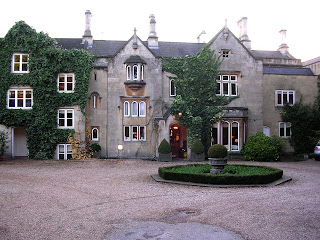
Pulling up into the forecourt, I began to see why the country house hotel had won the Relais and Chateaux Garden of the Year Awards in 2013, the same year their chef was awarded a Michelin star.
From the hotel’s website: “The hotel, built in 1835 as a private residence on land once owned by The Priory of Bath Abbey, is steeped in history and gives more than a nod to its Gothic influences – with cheeky gargoyles and dramatic arches, tempered by soft furnishings inside – beautiful paintings adorning the walls, objects d’art, freshly cut flowers and French Belle Epoque chandeliers. Sit by the smoldering embers of the log fires, sink into the sofas and enjoy a good book or an afternoon tea at leisure. If you are yearning for a well earned spa break, then the Garden Spa, complete with indoor and outdoor pools and the full range of beauty treatments, will ensure you are blissfully content.”

I had definitely come to the right place. Now, if my bowels held firm and my nose didn’t run like a faucet, I’d be fine. I walked through the front door and into a world of posh English luxury. The Elemis spa is located downstairs and I was escorted there by the hotel receptionist and turned over to the spa receptionist, who brought me back to the dressing room so that I could change into my bathing suit.

The spa has an indoor pool, but the amenities I wanted to take advantage of were the sauna and steam room. I was determined to sweat the cholera from my body.


Back and forth I went, from sauna to steam and back again for forty minutes. When I was about the consistency of a wet noodle, my masseuse collected me and brought me back to the couple’s treatment room, complete with garden view.


Cocooned in the semi darkness, breathing in the aromatherapy oils, I gave myself over to the ministrations of a stranger and allowed myself to be rubbed. By the end of my massage, I was, indeed, `blissfully c
ontent.’

When I got back to our hotel Hubby asked, “All better now?”

I smiled dreamily. “Much better. Still not all better. But better. What do you want to do for dinner?”

“I’m not really hungry.”

“I know. Neither am I, but we haven’t eaten since yesterday, so I think it would be a good idea to get something. How about a pizza? They deliver. We don’t even have to be dressed.”

“Sold.”

“I’m going take a hot bath first, then we’ll order, okay? You should take a bath. It’ll make you feel better.”

“No, thanks,” Hubby said, emphatically shaking his head. “The way my luck is going, I’d probably slip and fall and end up in a full body cast for the rest of the trip.”

I laughed. I couldn’t help it. I laughed because the way the trip was panning out, a scenario like that wasn’t outside the realm of possibility.

So I bathed, we ordered pizza, which was delivered to our door by the hotel staff, and then we watched a little television, namely Bear’s Wild Weekend, the premise of which is that Bear Grylls – British adventurer, writer and television presenter – takes celebrities on exhilarating adventures well outside their comfort zones. In this episode the celebrity was Miranda Hart, of Call the Midwife fame.


Here’s a description of the show: “Bear Grylls takes comedy writer and actress Miranda Hart on a once-in-a-lifetime expedition to the spectacular Swiss Alps. Bear challenges novice Miranda to go far beyond her comfort zone with a series of exhilarating adventures during an intense two-day expedition. Miranda traverses a glacier, crosses crevasses roped to Bear, tackles deep snow in snow shoes and completes a huge boulder scramble. She also faces her greatest fears when she flies in a helicopter and abseils down a waterfall.”

It was a hoot and Hubby and I both enjoyed it immensely. Click the link to watch a clip of the show.

When the show was over, Hubby asked, “What’s on for tomorrow?”

“We take the train to Windsor.”

“Unh. What’s Windsor? Is it crazy like London or quiet like here?”

“Even quieter than here.” I refrained from elaborating and telling Hubby that our train journey tomorrow would require two changes. I didn’t think he’d be able to handle it just then. “I can’t believe we’re leaving Bath already and we didn’t get to do anything we’d planned.”

“You planned. I know how much you were looking forward to it and I’m sorry it was ruined for you. It seems like all we’ve done in Bath is lay in bed, take medicine, blow our noses and wait to die.”

Other than that Mrs. Lincoln, did you enjoy the play?

Day 8 Coming Soon!

Historical Research Meets Social Media

Immediacy is not a word one typically used when describing historical research back in the day. I remember when you had to read an entire book, and take copious notes, in order to discover nuggets of interesting and/or usable information. Prior to that, one had to first track down a useful bibliography, preferably one put together by someone who came before you in your field and whose research you could trust; then you had to track down each individual book, whether it be in a library, through inter-library loan or from an antiquarian or used book shop. When you were done with the book, you then scoured the bibliography for more leads on research possibilities. It took time. Don’t get me wrong – I still love doing research the old fashioned way. In fact, if I could, I’d spend my days in some cobwebbed basement archive blowing the dust off contemporary sources and making notations with a fountain pen. Which is why Victoria had to practically drag me into the 21st century and into the scary world of social media.
 
First there was this blog. Oh, the angst of creating it! What’s Blogger and what does one do with it? Step by step, Victoria and I fumbled our ways through the mysteries of writing, saving, scheduling, linking and posting each post. Later, like cubs finally leaving the den, we boldly tested our new found skills and added gadgets to our sidebars. And they actually worked – woot woot! After a while, Blogger became second nature to us and I in particular settled into it comfortably and congratulated myself. You did it, I told myself, you mastered Blogger, you have a working blog and you can now sit back on your laurels and enjoy your success.
 
Like the devil on ones shoulder, Victoria was not content with this success. “We should branch out,” she soon whispered into my ear. “We should establish a presence elsewhere,” she cajoled.
 
“Huh? Like where, for instance?”
 
“Oh, I was thinking Twitter, maybe.”
 
“Twitter!? Tweet? Us? Me? What’s a tweet, anyways? I mean, I’ve heard of it, but what is it, exactly? And why do we need it? Would using Twitter make us twits?”
 
You may believe that I hemmed, hawed and dragged my 19th century feet for quite some time before finally taking the Twitter plunge. I went in and set up an account – auspiciously, NumberOneLondon was still available.
 
 Kristine Hughes Kristine Hughes @NumberOneLondon
 
My first tweet was a repost of that week’s installment of “A Couple In England.” Within minutes, I saw this tweet:
 

Hstry.org@HstryOrg 11 Apr

We’ve had a couple of requests to create a timeline for the Battle of Waterloo. What do you think? Yay or nay?

to which I replied
 
Kristine Hughes @NumberOneLondon 11 Apr
@HstryOrg Yay, my good man.


Hey . . . this Twitter lark was pretty okay. I mean, I’d only just shown my face and I was already being asked my opinion on a Waterloo timeline. Right up my street, what? I entered a couple of search terms in the box at the top of the Twitter page and found some other likely suspects, people with descriptions that pegged them as having an historical bent.
 
I emailed Victoria. “Hey, this Twitter thing is pretty okay! Already found some really interesting history thingys to follow.”
 
To which Victoria replied, “Good for you! See, I told you it wouldn’t be hard.”
 
“History.org wants to know if Waterloo timeline good idea.”
 
“Woo Hoo! Hope you said yes.”
 
“You may depend upon it, madam.”
 
Within the hour, I was being followed by Sir Arthur Wellesley@TheFirstDuke ,   Apsley House@ApsleyHouse and DukeofWellington@PillarofState
 
 I emailed Victoria. “I’m being followed by Apsley House.”
 
“Yay.”

“No kidding – the real Apsley House. And a couple of Dukes of Wellington.”
 
“But not the real DoW.”
 
“Probably not. But real Apsley House.”
 
“Excellent. Go to bed now.”

Over the course of the following days, the benefits of Twitter became obvious to me – it was a bit like having one’s own `London, England, Regency, Georgian, Victorian, Historical Research, Interesting Tidbits’ ticker tape machine. Little nuggets of historic information arrived on my screen every few minutes – if not seconds. These nuggets pertained to everything from historic house preservation to museum exhibits, from research materials to pop-up walks in major cities, from gripes about scholarly work loads to historic trivia. For example, below is an exchange I had recently with author Rachel Knowles, which began with my tweet re: Brummell’s birthday:


Kristine Hughes @NumberOneLondon 7 Jun

Happy Birthday to Mr. Beau Brummell. http://fb.me/1X2tY7U8y

RegencyHistory
Georgiana, Duchess of Devonshire, was born #onthisday 7 June 1757 and married 17 years later on the same day

Kristine Hughes @NumberOneLondon 7 Jun

@RegencyHistory Georgie and the Beau? An auspicious date, indeed.
 

RegencyHistory

Absolutely! @numberonelondon
RegencyHistory
Amazingly enough the Dss of Devonshire and Beau Brummell died on the same day too – 30 March
 
I don’t know about you, but I hadn’t put that together before. Born and died on the same dates!? Hhhmmm. If you don’t find that interesting, you’re reading the wrong blog.
 
Just when I came to believe that using Twitter was a bit of a doddle, it dawned on me that the immediacy of Twitter lent itself to a Facebook page. I could use all the interesting bits and bobs I found on Twitter and elsewhere to keep our FB page current, relevant and, with luck, interesting. Now I was the one playing devil’s advocate. And whispering into my own ear. I emailed Victoria.
 
“Hey, we should do something with all this great stuff coming in over Twitter.”
 
“Like re-tweet?”
 
“Like a Number One London Facebook page.”
 
“We have a blog, remember?”
 
“Blog is more static. Doesn’t lend itself to constant, real time change.  Whereas you’re meant update FB page on fairly consistent basis. So it would be the blog in a different, more immediate format.”   
 
“Uhm . . . . okay?”
 
So in I dove and found myself navigating my way through creating yet another page on yet another social media platform. Not only did I manage to get it up and going, I even figured out how to link my Facebook posts to Twitter. At this rate, I might try my hand at neurosurgery next week. Within days, I had found some really diverse items to post on the FB page and it was starting to look like something. Please take a moment to log on and see – you’ll find our Facebook page here. Do “like” us if you find yourself so inclined. You can find us on Twitter here. We hope you’ll become a follower.

Upon finishing this post, I emailed Victoria. “Finished post. Go in and look at it, will ya?”

“Looks good!”

“I think I’ll go in and fiddle with Pinterest for a while.”

“Go to bed.”

I signed off. And only then realized that Victoria had never answered my question – are we now twits?


.