The Adventures of Dr. Syntax in Search of the Picturesque, Part 12

Excerpts from Cantos XXIV, XXV, XVI , in which Dr. Syntax returns home at last

At the beginning of Canto 24, the author William Combe employs a favorite technique: commentary on the quality of popular culture in his day.  Though the central thrust of Dr. Syntax is a satire on the idea of the picturesque as promoted in the works of William Gilpin and others, through Syntax, Combe has plenty to say about other aspects of his world:

 Excerpts from Canto 24.


Dr, Syntax at Covent Garden Theatre
 

…”I’ve seen a play,” he (Syntax) mutt’ring said; —

“Twas Shakespeare’s — but in masquerade!
I’ve seen a farce, I scarce know what 
‘Twas only fit to be forgot.
I’ve seen a critic, and have heard
The string of nonsense he preferred.
Heaven bless me! where has Learning fled?
Where has she hid her sacred head?
Oh, how degraded is she grown,
To spawn such boobies on the town!”…  

“Well,” said my Lord, when he appear’d,
“I hope the play your spirits cheerd;
Falstaff, the morning critics tell,
Was never surely play’d so well”
“These critics,” Syntax smiling said,
“Are wretched bunglers at their trade;
One sat beside me in the pit.
No more a critic than a wit!… 

They engage in a long discussion of the theatre and critics until they get back to the subject of Dr. Syntax’s book.  Anyone  familiar with publishing will enjoy the remarks of the publisher Vellum:

 Vellum appeared, with solemn look.
To talk about the Doctor’s book.
He said, “Twas true, a learned friend
The manuscript did much commend;
He thinks it is a work of merit.
Written with learning, taste, and spirit;
The sketches too, if he don’t err.
Possess appropriate character;
‘Tis to the humour of our age.
And has your Lordship’s patronage;
I therefore wish the work to buy.
And deal with liberality.
‘Tis true that paper’s very dear,
And workmen’s wages most severe:
The volume’s heavy, and demands
Th’ engraver’s with the printer’s hands;
Besides, there is a risk to run;
Before the press its work has done.
New taxes may, perhaps, be laid
On some prime article of trade.
And then the price will be so high; —
The persons are but few who buy
Books of so very costly kind;
But still the work is to my mind:
I’ll try my luck, and will be bound
To give, my Lord, three hundred pound.”

 “After some little chat on trade.
The bargain was completely made —
The work transferr’d, the money paid.

“Tho’,”
said my Lord, “I think your gains
By no means equal to your pains:
(For Vellum will a bargain drive
As well as any man alive;)
The work must give my friend a name,
And stamp his literary fame;
‘Twill Paternoster Row command,
And keep old Vellum cap-in-hand;
And when a name is up, ‘tis said
The owner may lay snug in bed. –
Write on — the learned track pursue —
And booksellers shall cringe to you.”  

“Much pass’d upon his Lordship’s part,
Which shew’d the goodness of his heart;:
While Syntax made his full replies,
Not with his tongue — but with his eyes.

Dr. Syntax will indeed be a published author!  Music to his ears.

Selections from Canto 25

My Lord retir’d–the Doctor too,
As he had nothing else to do,
Thought he would take a peep and see
His noble Patron’s library.
So down he sat, without a care,
In a well-stuff’d morocco chair.
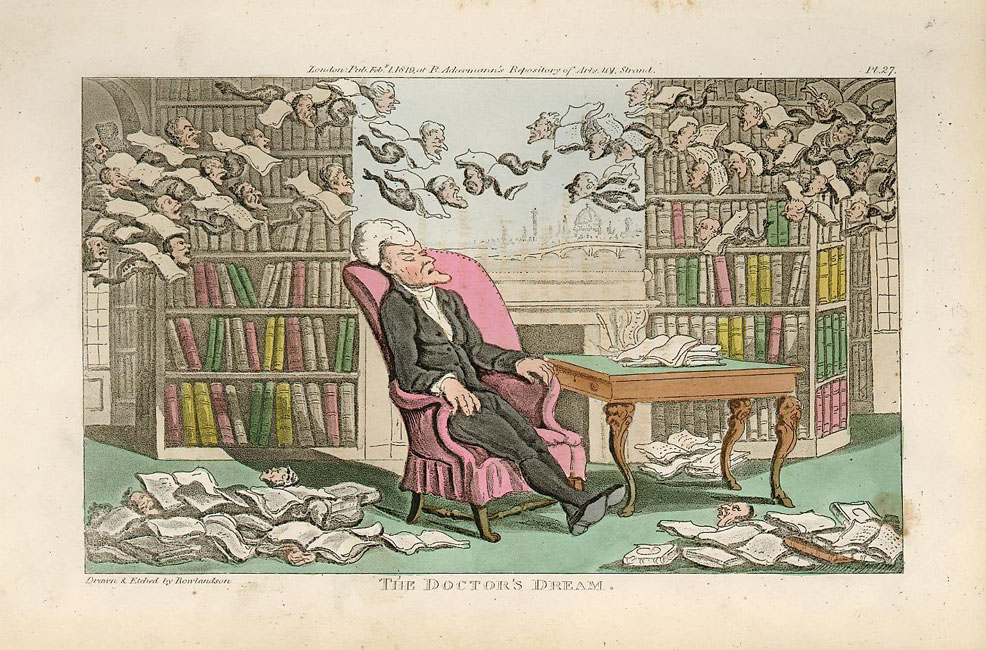
And seiz’d a book; but Morpheus shed
The poppies o’er his rev’rend head;
While Fancy would not be behind.
So play’d her tricks within his mind.
And furnish’d a most busy dream,
Which Syntax made his pleasant theme. .
The Doctor’s Dream


When he awakes, he tells My Lord about the dream…
 My Lord continued the debate;
And time pass’d on in pleasant prate.
Till night broke up the tete-a-tete.
Selections from Canto 26
 
CROWN’D with success, the following day
The Doctor homeward took his way;
And on the ‘morrow he again
Was borne by Grizzle o’er the plain; …
 Some days before, (I had forgot
To say,) a letter had been wrote.
To tell how soon he should appear.
And re-embrace his dearest dear;
But not one solitary word
Of his good fortune he preferred.  
So when he arrives at home, his wife is hardly glad to see him, thinking him a failure.
‘Twas thus he thought, when, at the gate.
He saw his Doll impatient wait;
Nor, as he pass’d the street along.
Was he unnotic’d by the throng;
For not a head within a shop
But did through door or window pop.
He kiss’d his dame, and gravely spoke.
As now he brooded o’er a joke
While she to know, impatient bum’d,
With how much money he retum’d.
” Give me my pipe,” he said, ” and ale,
And in due time you’ll hear the tale.”
 
He sat him down his pipe to smoke,
Look’d sad, and not a word he spoke;
But Madam soon her speech began.
And in discordant tones it ran: —
“I think, by that confounded look.
You have not writ your boasted book;
Yes, all your money you have spent,
And come back poorer than you went;
Yes, you have wander’d far from home.
And here a beggar you are come…
 Thus, as she vehemently prated,
And the delighted Doctor rated.
From a small pocket in his coat,
He unobserv’d drew forth a note,
And throwing it upon the table.
He said, “My dear, you’ll now be able
To keep your mantua-maker quiet;
So cease, I beg, this idle riot:
And, if you’ll not make such a pother,
I’ll treat you with its very brother:
Be kind — and I’ll not think it much
To shew you half-a-dozen such.”
 
 
Doctor Syntax Returned From His Tour
 
 
She started up in joy’s alarms.
And clasp’d the Doctor in her arms;
Then ran to bid the boys huzisa,
And gave them all a holiday.  
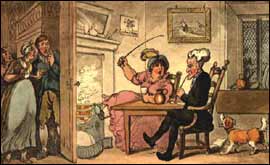
“Such is the matrimonial life,”
Said Syntax ; — “but I love my wife.
Just now with horsewhip I was bother’d;
And now with hugging I am smother’d;
But wheresoe’er I’m doom’d to roam,
I still shall say—that home is home…
 Dr. Syntax reflects on life in general…
 More had he spoke: but, lo! the Dame
With the appointed haslet came:
When Syntax, having bless’d the meat,
Sat down to the luxuriant treat.
“And now,” he said, “my dear, ’twill be
As good as Burgundy to me.
If you will tell me what has pass’d
Since we embrac’d each other last’
“ Oh,” she replied, ” my dearest love,
Things in their usual order move….
 After a long litany of troubles his wife endured, the Doctor finishes his dinner.
 
The Doctor thought his jolly wife
Ne’er look’d so handsome in her life.
Her voice he thought grown wond’rous sweet;
To him a most uncommon treat…
 Though to each virtue often blind,
The world to wealth is ever kind ;
For lo ! a certain tell-tale dame,
Yclep’d and known as Mistress Fame,
Had told to all the country round.
That Syntax, for a thousand pound.
Had sold a learned book he wrote;
That now he was a man of note. …
 But all these views soon found an end:
A packet came, and from a friend,
From ‘Squire Worthy, who resides
On Keswick’s bold and woody sides. …
 ” Good Rev’rend Sir, Our Vicar’s dead.
And I have nam’d you in his stead.
I often wish’d his neck he’d break.
Or tumble drunk into the Lake…
 
 “You will perceive I keep my word,
And to this church you’re now preferred…
You, Sir, may make the living clear
Above three hundred pounds a year;
And if you will but condescend
To my Son’s learning to attend;
If you’ll direct his studious hour,
I’ll add some fifty pounds or more:
Nay, soon we hope that you will cheer
The parish with your presence here
Miss Worthy and her sister join
Their kindest compliments to mine;
And to your prayers I recommend
Your faithful and admiring friend,
Jonathan Worthy.”
 …The time soon came, when, quite light-hearted.
The Doctor and his spouse departed:
And as they journey’d on their way. …
 When rising ‘mid the tufted trees.
Syntax his sacred structure sees.
Whose tow’r appeared in ancient pride.
With the warm vic’rage by its side.
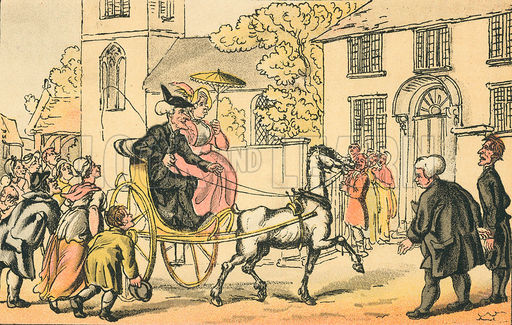
“ At length, dear wife,” he said, ” we’re come
To our appointed tranquil home.”


Doctor Syntax Taking Possession of His Living
 
 
Syntax, whom all desir’d to please,
Enjoy’d his hours of learned ease;
Nor did he fail to preach and pray,
To brighter worlds to point the way;
While his dear spouse was never seen
To shew ill-nature or the spleen;
And faithful Grizzle now no more
Or drew a chaise, or rider bore.
Thus the good Parson, Horse, and Wife,
Led a most comfortable life.
  
The End
 
Note that the Horse is mentioned before the Wife in the conclusion…author William Combe always went for the rhyme!!!. 

Victoria's Day One in London, Part Two

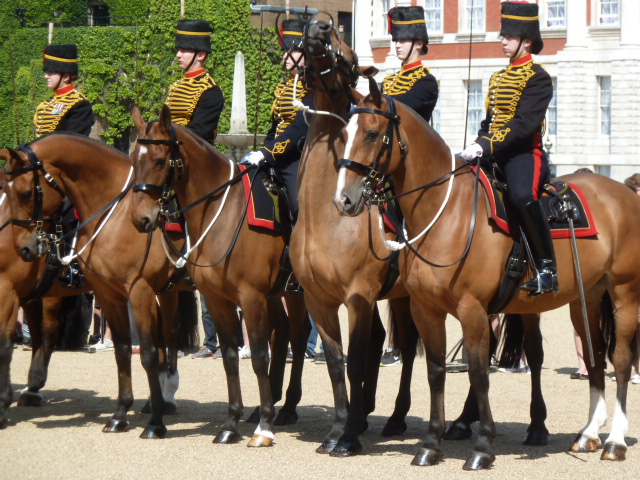
As you might recall, in Part One, Ed and I were standing on Horse Guards Parade, watching a ceremony of mounted riders.  Instead of the familiar Red Coats, they were wearing black uniforms, which shocked me. What was the story?  Ed was probably thinking more about his sore foot, with its burst blisters and pain with every step.
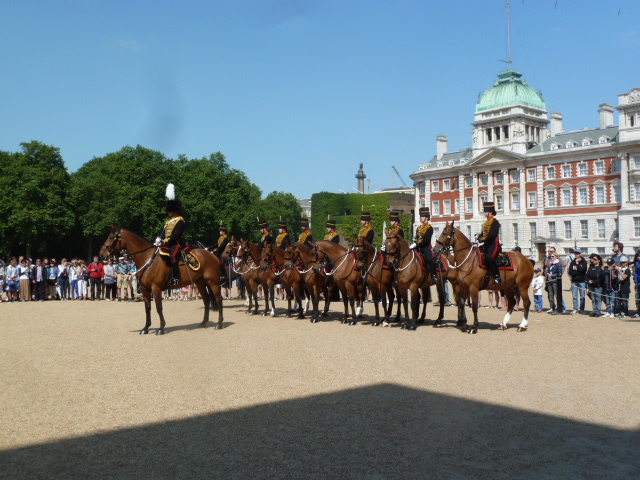
Horse Guards Parade, in the background: the Old Admiralty Building

And behind us was the museum, with the hope of a seat where Ed could rest his aching foot.
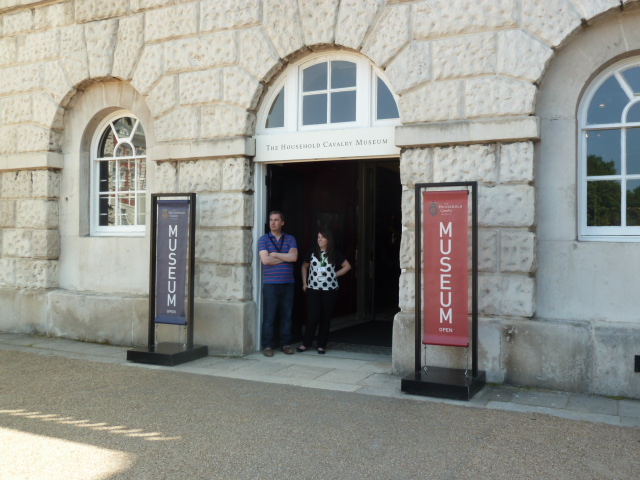
Museum Entrance
 
We entered and paid our admission — and miraculously there were benches, several of them. One problem solved.  Now what about those uniforms?
 
The Guide explained that every summer the Household Cavalry has time away from Horse Guards  for maneuvers; their duties are taken over by the King’s Troop Royal Horse Artillery, usually stationed at Woolrich.  For more information, click here.
 
 
King’s Troop Royal Horse Artillery
 
As you might be able to see in the above view, some members of the KTRHA are female.  That was a bit of a surprise, though a nice one.  This unit is responsible for all the artillery salutes in the park.  Click here for an account of the salutes to the new baby Prince George of Cambridge.
 
 
In Green Park, ©Getty Images 
 
 
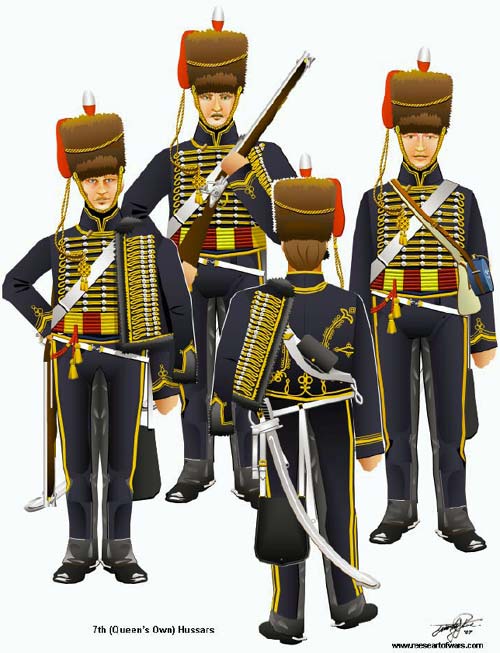
So, the mystery of the uniforms was solved; I later found out that the King’s Troop Royal Horse Artillery uniforms are almost identical to those worn by their predecessor unit in the Battle of Waterloo. 


7th (King’s Own) Hussars, Waterloo Uniform


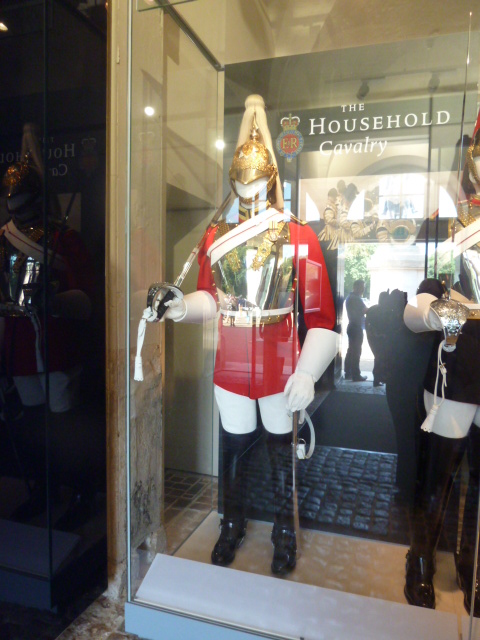
The more familiar Redcoat uniform
 
 
We found Ed several seats placed conveniently around the museum. Unlike Kristine and me, our hubbies (would you believe I actually wrote hobbies there?) do not necessarily read every word of every text panel in a museum like this. 


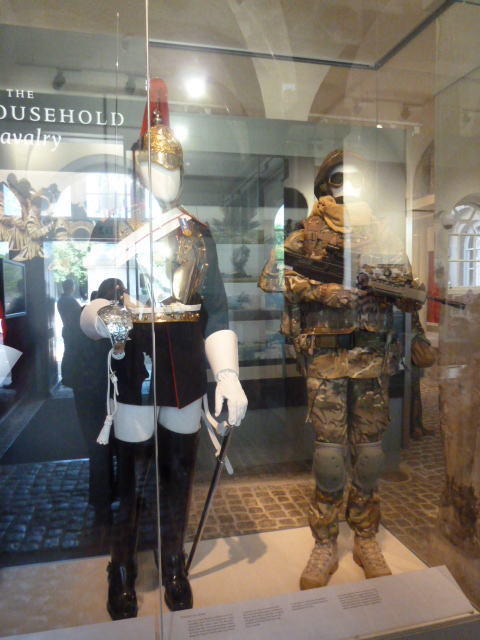
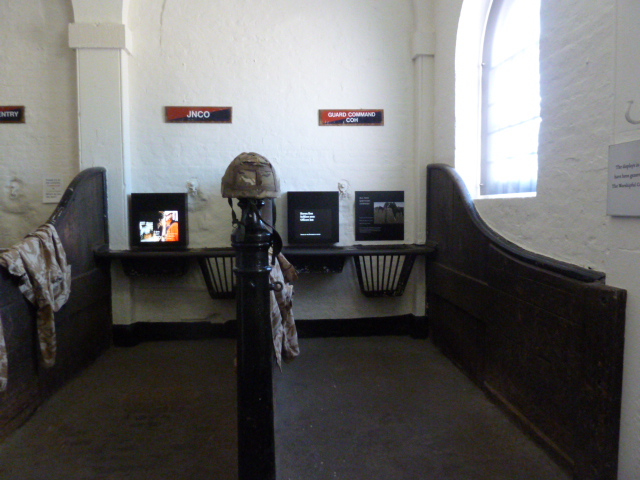
As you can see above (sorry for the reflections, but it was a bright and sunny day, a delight for London), the Household Cavalry wears various uniforms, including the kind of desert camouflage needed in Afghanistan.


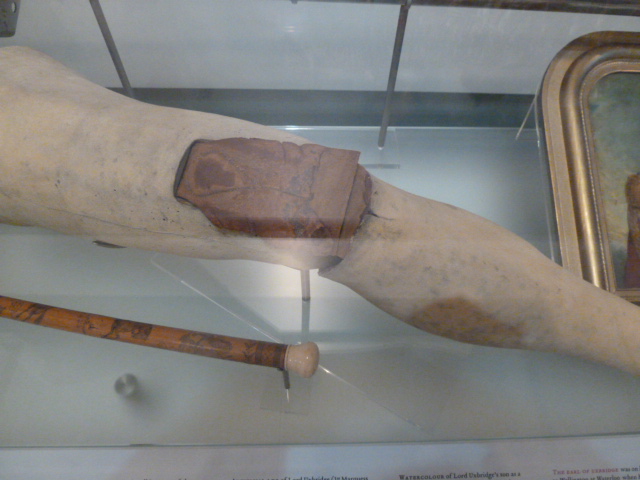
Second in command of the British troops during the Battle of Waterloo was Henry Paget, Earl of Uxbridge (1768-1854) who led the cavalry.  In a famous incident at the very end of the battle, Paget and Wellington were side by side on horseback watching the action.  A cannon shot hit Paget in the leg.  He is reported to have said, “By God, sir, I’ve lost my leg,” to which the Duke responded, “By God, sir, so you have.”  Thus, the epitome of sang froid.
 
 
Paget’s Artificial leg
 
 
After the amputation of his leg, Paget recovered and led a long and illustrious career, his need for artificial limbs and his willingness to experiment leading to many advances in the science of prosthetics.  Click here for the story of his actual limb and its bizarre fate as told by Kristine.


Examples of stalls for the horses
 
For more information on the Household Cavalry Museum, click here.
 
 
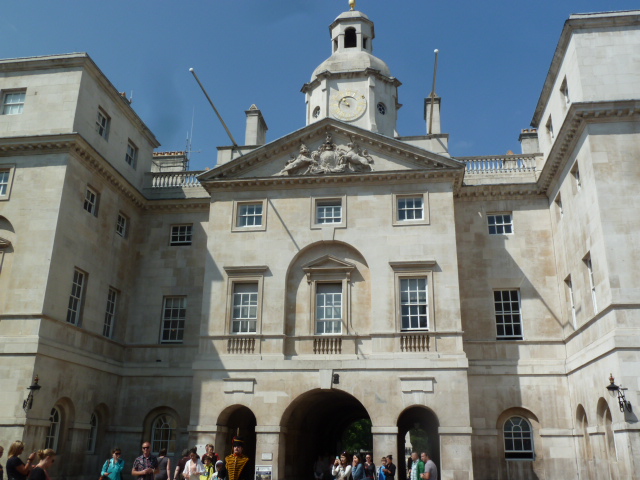
Horse Guards
 
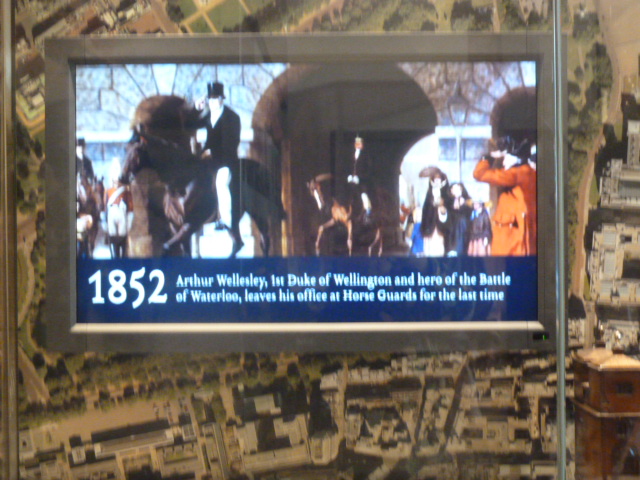
The Duke of Wellington for many years was the commander in chief of  the British Army.  As such his office was in Horse Guards, in the room directly above the arch.


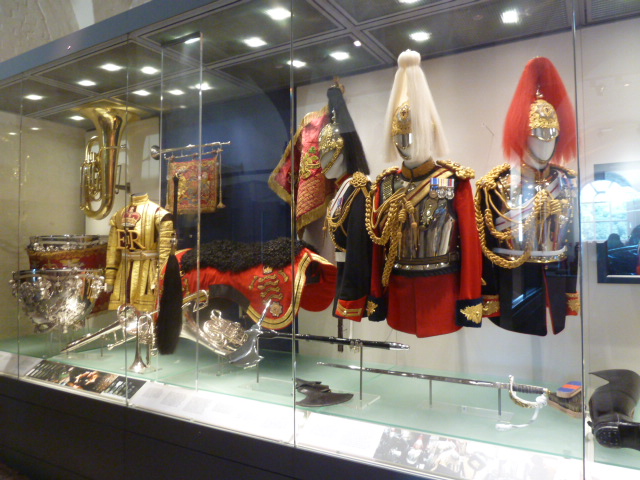
Museum display
 
 
In the museum, a display tells the story of the Duke and his Armies, and shows a picture of him in  leaving Horse Guards for the last time.


After Ed’s foot was adequately rested and I had read every word of the descriptions and explored the small gift shop, we went back outside, where the original troops had been joined by a new set of horsemen and horsewomen. Their commanders seemed to be completing a changing of the guard.  With a glance at the crowds of onlookers, Ed led the way back to Whitehall where we grabbed a taxi en route to our next stop, Mallett at 37 Dover Street in Mayfair.  More about that in Part Three, coming soon.


Shoe Help Needed

I have a question regarding shoemaking. Many contemporary diaries and letters refer to highborn ladies making shoes as a pastime during the early 19th century. It seems that even the Duchess of Wellington got into the act sometime later but I can find nothing more concrete than this passage from Alice Morse Earl’s Two Centuries of Costume in America: “In Mrs. Gaskell’s My Lady Ludlow we are told that my lady would not sanction the mode of the beginning of the century which “made all the fine ladies take to making shoes.” Mrs. Blundell, in one of her novels, sets her heroine (about 1805) at shoe-making. The shoes of that day were very thin of material, very simple of shape, were heelless, and in many cases closely approached a sandal. . . . I have seen several old letters which gave rules for shaping and directions for sewing party-shoes of thin light kid and silk. It is not probable that any heavy materials were ever made up by women at home.”

I’ve seen another passage from a contemporary letter which relates how a group of women chipped in on the cost of hiring themselves a master in shoemaking to come to one of their houses in order to give the group lessons on the art. Does anyone have any more information about this unique occupation?  Victoria seems to think that the ladies worked on the decorative uppers, rather than actually constructing a shoe, but we’d be grateful for any information or research leads you can provide.

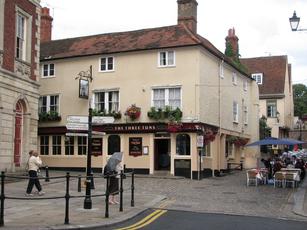
A Couple In England – The End

And so Hubby and I arrived at the end of our journey. We decided to have our last English meal at the Three Tuns, another of the historic pubs of Windsor that happens to be located directly behind the Guildhall. I wanted my last meal of bangers of mash. And enough rum to drown my sorrows.

“Are you sad about going home tomorrow?” Hubby asked once we were seated.

“I’m home now. I’m sad about going back to Florida.”

“Most people in England would love to trade places with you,” Hubby commented.

“Mad dogs and Englishmen,” I replied.

“Huh?”

“Only mad dogs and Englishmen go out in the midday sun,” I said, referring to our sub tropic Florida weather. Humid doesn’t begin to cover it. I expect that Gunga Din and Wellington felt the same about India.

“The grass is always greener,” Hubby went on.

“How droll. Actually, the grass does happen to be greener in England, where it isn’t scorched by the blazing midday sun on a constant basis.”

“Droll?”

I gave Hubby a scathing look and he dropped it. “What time do we leave tomorrow?” he asked instead.

Oh boy. Here we go. “About tomorrow . . . . “

Now it was Hubby’s turn to glare. “C’mon, out with it.”

I ordered another round from a passing waiter and forged ahead. “After we fly into Newark, we have a four hour layover before our three hour flight to Florida.”

What?”

“Ssshhhh! Don’t get excited.”

Excited? Is that what you think I am? Excited? Because I’m telling you right now, excited I’m not. Why would you do that to me?”

“It was either that or wait till the next day to fly home.”

“For Christ’s sake, why didn’t you wait till the next day?”

“I didn’t know which option to choose and then I decided that you’d have blown a fuse no matter which way I went, so I opted for the layover. But it’s okay because Brooke is going to come to the airport to pick us up. We’ll all go out to eat, then we’ll go back to her house for a while and then she’ll bring us back to the airport. So we won’t be stuck at the terminal for four hours.”

This mollified him a bit. A very little bit.

“Listen, the next time you plan a trip to England for us, do it in the summer, will ya? And don’t include London on the itinerary. London is too crazy for me. I liked Bath and I like Windsor. Think small. And when you come over here to look for houses, you’re coming by yourself. I’m not traipsing all over England looking at houses. Understand?”

I kept my counsel, wisely deciding that now was not the time to tell Hubby that when a man was tired of London, he was tired of life.

“Alright, then, I’ll just bring Vicky with me.”

“And that’s another thing,” Hubby went on. “Don’t think I haven’t noticed that Ed and I don’t figure in the plans that you and Vicky have for living in England. I’m just hoping you two plan on letting us die natural deaths first.”

“Ideally you and Ed would be dead, granted, but I’ve got everything planned out in case you’re still alive when I move here.”

“Oh, brother. Go on. I can’t wait to hear this.”

“When we move to England, you’re going to raise chickens.”

“What?”

“I’ll take care of the sheep and you’ll raise chickens.”

“Are you nuts? Why would I raise chickens?”

“So that you can barter the eggs, of course. Just think about it, you’ll put on your tweed coat and make your way out every day to collect the eggs. Then you’ll take your basket and you’ll toddle your way down to the pub and trade your eggs for pints of beer. `Here are six fresh eggs in exchange for a pint of your best, my good man.’ I can hear you now.”

“It’s the twenty-first century. No one barters any more.”

“They do in England.”

“You’re nuts. You do realize that, don’t you? Explain to me why I wouldn’t just get in the car, drive to the pub and pay money for a pint of beer. You know, the way normal people do.”

“See, this is why you don’t figure into my plans for living in England. If I asked Vicky to collect the eggs and trade them in at the pub, she’d do it without an argument.”

“Because she’s as nuts as you are, that’s why. You’ll be known as the two crazy American women.”

“Widows.”

“Huh?”

“We’ll be known as the two crazy American widows.”

“Listen, all joking aside, dead or alive, I am not raising chickens. Got it?”

Our dinners arrived and we ate silently for a while. Then I asked, “Did you enjoy anything at all about the trip?”

Hubby looked at me. “Sure. Sure I did, Hon. I enjoyed all the parts that weren’t London, that didn’t involve walking, or rain or being sick.”

As near as I could figure, that left the plane ride over. And Burger and Lobster. And Café Nero.

“I wish you loved England as much as I do.”

“I don’t have to love England. I love you and that’s all that matters.”

I smiled at him as we joined hands across the table. “Next time, I promise we’ll go somewhere warm.”

“It doesn’t matter, as long as we’re together.”

“You mean that?”

“I do, my good man. Now tell me what in the Hell you think you know about raising sheep.”

THE END

Victoria's Day One in London, Part One

After our two weeks in the Czech Republic and Germany last July, my husband Ed and I flew to London.  I had been preparing for months to cram our days in England with a maximum of activity. But Ed was of another mind.  He was limping on a very sore foot, and no matter what advice the Boots pharmacist gave us, the only way Hubby was comfortable was sitting down. Or prone on the mattress.

I was undeterred.  We checked into our hotel, the Pullman London St. Pancras, 100 Euston Rd.  On my various trips to London, I try to find hotels in different parts of the city, so I can get to know more of various neighborhoods.  Until recently, the Pullman was part of the French chain, Novotel; it’s had extensive renovation since its purchase by the Pullman chain. It is located immediately west of the British Library which is just west of the St. Pancras Hotel and Station, where the Eurostar operates.  Above, looking east from our floor.

The little bistro where we had dinner featured a gnome on the table.  LOL.
 
Alongside the hotel, Charlton Street has an abundance of pubs, bistros and other small shops, many of which I suspect are under some threat from the extensive gentrification going on around there.  Since the Eurostar moved to St. Pancras, the entire neighborhood has been upgrading, with all the positive and negative features of the process. 
 
Before leaving for Cambridge, we had one full day in London. In the morning, we started by taking the tube to Charing Cross station and waving our greetings to Charles I as he looks down Whitehall.


Charles I
 
The bronze statue has an interesting history. Charles I (1600-49) took the throne of England after the death of the first Stuart King, his father James I, in 1625.  Hubert Le Sueur, a French sculptor, cast the statue in 1648, but before it was erected, the Civil War broke out and Charles I was beheaded.  The statue was sold for scrap, but the purchaser never broke it down, instead hiding it until after the Restoration in 1660 when Charles II was welcomed back as the new monarch. Charles II purchased the statue of his father and had it installed where it now stands, looking toward the site of his beheading in front of the Banqueting House, about halfway down Whitehall toward Parliament.
 
 
At the junction of The Strand and Whitehall
Charles I is behind the traffic light at the right
 
As Ed limped along, we made our way to Horse Guards.
 
“We’ve been there before,:” he reminded me, as if I needed to be told.
 
“Yes,” I replied, thinking if you only knew how many times.  “But we’ve never been to the Household Cavalry Museum.”
 
“Do they have places to sit down?” he said between clenched teeth.
 
“Of course,” I said, not really knowing if there was anything resembling a bench within 500 feet of the place.
 
Horse Guards on Whitehall
 
I tried to divert Ed from his painful left foot by pointing out the Palladian style of the building, completed in 1753  to the plans of William Kent.  “Remember the Kent name,” I said to Ed.  “We’ll run into him later in Norfolk.”
 
Ed looked skeptical.  “I thought we were in Kent a couple of years ago. What do you mean, run into him?”
 
“This time I mean William Kent, the 18th century architect, not the English county.  And definitely nor the cigarette brand I remember from college.” 
 
 Ed shrugged. 
 
 
Entering Horse Guards
Museum Poster at the gate
 
Though I’d visited many times, I had not known about the museum until Kristine and Greg went there (click here) and I had no idea where it was, though I didn’t dare admit it at that moment, not wanting to drag Ed one more step than he needed to make… but what was this?  In the place of the two red-coated guards always on either side of the gate, were riders in Black jackets. What was going on?


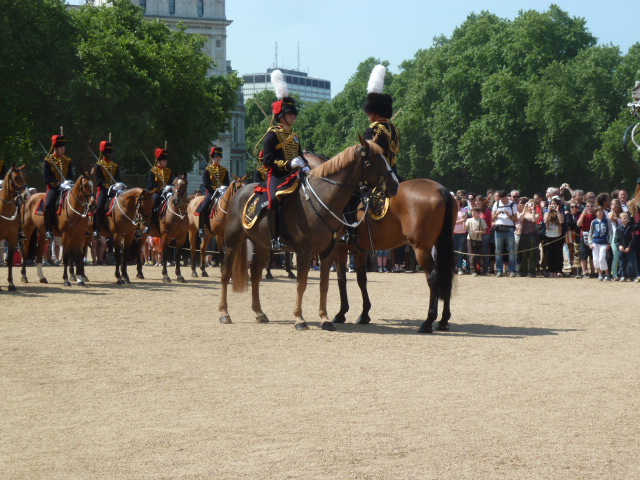
For a moment I wondered where I was,  But there were crowds of people pouring into the parade grounds behind the building.  Something was up.  We followed along and sure enough, there was a group of horses and riders in formation.

 
I think Ed even forgot his aching foot for a few minutes as we watched other riders join in. Below, the bugler arrives.


A good shot of the back of the uniforms.
 
 
There were scads of tourists and hundreds, perhaps thousands of cameras clicking away.  The riders formed up in a line headed by an officer.  Nothing more happened except that the horses stamped and tossed their heads. The riders stayed as motionless as possible.


Horse Guards Parade is the location of the annual Trooping the Color when the Queen reviews the Household Cavalry; it was the tiltyard for jousting of the old Palace of Westminster. During the 2012 Olympics, it was the scene of the Beach Volleyball competition.


Beach Volleyball at Horse Guards Parade, 2012


2nd Footguards on parade, by John Chapman, 18th Century
 
Quite a contrast among the views of Horse Guards, isn’t there?  I was happy to say that it showed no bad effects from the Olympics — looked just the same as it had the last time I saw it for the Trooping of the Color in 2011.  For that story, start by clicking here.

Household Cavalry Museum Entrance


As we stood there watching the unmoving tableau, I looked around for a place for Ed to sit and rest his foot.   Aha!!  The Museum entrance.  Certainly they’d have a bench!

In the next adventure, we solve the mystery of the unusual uniforms on the riders and complete our visit to Horse Guards.  And does Ed find a place to sit??  Coming soon.