The Strange Death of . . . .

From The Gentleman’s Magazine, and Historical Chronicle, Volume 79, Part 1

Deaths. 1808
March 19. Aged 18, Miss Bradshaw, of Yarwell, near Wansford. She had been abruptly informed of the death of a younger brother at Crowland (who had been on a visit to her but a few days before); which had such an effect on her as to occasion her death in a few hours.
Aged 70, Mrs. Edwards, an infirm widow lady, residing at the house of Mr. Aldrich, postmaster, at Enstone, Co. Oxford. She was burnt to death in her own apartment. When discovered, her body was consumed to a cinder; and so rapid was the progress of the flames, that very little of the furniture could be saved, and the house was burnt to the ground. It is supposed the accident was occasioned by Mrs. F.’s cloaths catching fire.
22. Mr. Ricketts, who fought a duel on Lemon common, Herts, on the 13th, with a Mr. Wright, and who was wounded in the thigh. He died in consequence of a mortification, having refused to undergo amputation of the limb.
23. Found drowned in the Thames, above Vauxhall, J. Meyhurst, an Italian, butler to Mrs. Seret, of Chelsea. He had been missing several days; and for some time previous had appeared in a desponding way, which proves to have arisen from an embarrassment in his accounts. Upwards of 20/. in notes and cash were found in his pockets.
Aged 57, Mr. Ingram, tailor, of Northampton. He was attending a meeting assembled for religious exercise early in the morning, a practice which he had observed with punctuality for some years, when he suddenly dropped down, and expired without a struggle. By some expressions which fell from him the day previous to his decease, he appeared to have taken his leave of the world, and to have had some presentiment of the near approach of his dissolution.
25. Mr. Neighbour, a farmer, near Maidenhead. On his return home, after spending the evening at the Bell with some friends, be lost his way, the night being dark, fell into the Thames, and was found in it, about a fortnight afterwards, near Windsor.
27. — Bates, a labouring man. While going to his work, at Hoxton, and talking cheerfully to a fellow-labourer, he dropped down, and instantly expired.
29. Isaac Edney, a lad residing in the Holloway near Bath, was found smothered in the snow. He had been driving a horse and cart; and the animal being prevented from proceeding by the great depth of snow, it is supposed he had alighted to endeavour to extricate it, but, unable either to effect his purpose or regain his seat, perished.
A child, the eldest of five, belonging to — Higgs, a wool-comber at Leicester, being left in the care of other children whilst the parents went to market, incautiously fell asleep with a candle in her lap, and was so miserably burnt as to occasion her death in a few hours.
In the Newington-road, Miss Charlotte Hachel, a young lady from Lincolnshire; whose death was occasioned by failing off the outside of a stage-coach, in consequence of the sudden jerk of the vehicle.
April 8 In Charlotte-str. Portland-place, Lieut Col. Henry Knight, on half-pay. In consequence of a nervous fever, he had become deranged, aud had been attended by Dr. Simmons; but was thought better, and. was living again with his family, when this morning, during the absence of his servant, he threw himself out of a backroom window, and survived the fall but three quarters of an hour.
April 20 Mr. Isaac Hester, a gentleman of independent property, who resided in Northampton-place, Mary-le-bone-road. His body was found in a Held near Newington, in a putrid state, with the head half severed from it, by some boys who were seeking bird-nests. He had been some in a state of dejection bordering on insanity, and effected his escape on the 9th. It was evident he had commited suicide with a knife, which was found in his band closely grasped.
21. At her residence in Half-moon-street, Piccadilly, Miss Cummins, daughter of a gentleman of fortune in the West Indies, and, with a sister and brother, living at the house of an uncle. She had returned with a party from the Opera the preceding night; and, on retiring to her dressing-room, the candle communicated to her muslin-dress. Her shrieks brought other young persons from the drawing-room to her assistance, but not till her garments were reduced to tinder. She lingered in torture till this evening.
24  Mrs. Ford, of Sidbury, Worcestershire, one of the people called Quakers. Her death was occasioned by circumstances peculiarly distressing: she had taken her child to an eminent surgeon, to have a swelling on the throat lanced; when the operation was about to be performed she fainted through terror, and almost instantaneously expired.
27. By taking laudanum, Mrs. Farwell, a widow lady, of Wilson-buildings, Hampstead-road. The loss of her husband, who died about twelve months since, and that of a daughter about a fortnight ago, preyed on her mind, and is supposed to have led to the melancholy event.
30 Aged 103, Richard Williams, of Boddewran, in the parish of Honeglwys, co. Anglesea; who had been blind upwards of six years, but whose sight was restored a short time before his death; and he had also four new teeth.

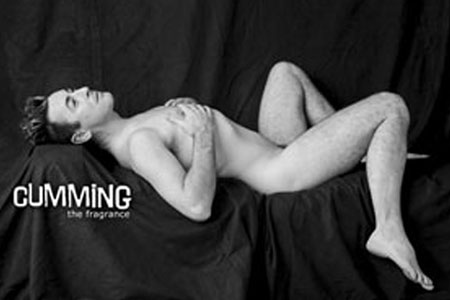
Meet Alan Cumming, Host of Masterpiece Mystery!

This coming Sunday, Masterpiece Mystery will debut the first of three new Hercule Poirot espisodes featuring David Suchet as the suave Belgian detective. In the first, Three Act Tragedy, a cocktail party is the scene of a crime. This programming note reminded me of my interest in the Mystery host, Alan Cumming. As I began watching him as the new host of Masterpiece Mystery! last season, I became intrigued by the Scotsman, whose attraction owes much to the fact that he seems such a Cheeky Monkey.

Born on January 27, 1965, in Aberfeldy, Scotland, Cumming is an actor -Mr. Elton in the 1996 film version of Emma, X2: X-Men United, Goldeneye, Eyes Wide Shut and Spy Kids, while on Broadway he’s appeared as Mac the Knife in The Threepenny Opera, and as the Emcee in Cabaret, for which he won the Tony in 1998. Cumming is also an author, Tommy’s Tale, and once fragrance mogul with his scent, Cumming. Cheeky Monkey
As well as playing host on Masterpiece Mystery! Cumming also plays Eli Gold on the CBS television show The Good Wife, a character who became a series regular this season. Additionally, he recently took up the role of a drag queen in a t.v. drama. His character, Desrae in Sky1’s The Runaway, is unusual not only because he is a transvestite  but also because with his Italian gangster boyfriend Joey (Ken Stott) and the runaway murderess Cathy (Joanna Vanderham) they take in, the threesome are the most law-abiding, functional family unit in the piece.

Cumming has also written articles for magazines, notably as a contributing editor for Marie Claire magazine, writing on the haute couture shows in Paris. Additionally, Cumming recorded a duet of “Baby, It’s Cold Outside” with Liza Minnelli to raise money for Broadway Cares/Equity Fights AIDS and the September 11 Fund.

In 2005 he released a fragance called “Cumming,” and a related line of scented bath lotion and body wash sold exclusively at Sephora until the partnership was dissolved due to a distribution agreement. Cumming lives in New York City with his husband (via UK civil union), graphic artist Grant Shaffer, and their dogs, Honey and Leon. The couple dated for two years before entering into a civil partnership at the Old Royal Naval College Greenwich on January 7, 2007. One can only wonder what ghosts in the hallowed halls of the Naval College thought of that progressive move.

Cumming was appointed Officer of the Order of the British Empire (OBE) in the 2009 Queen’s Birthday Honours List for services to film, theatre and the arts and activism for LGBT rights. On November 7, 2008, Cumming became a dual-national and was sworn in as a citizen of the United States of America at a ceremony in New York City.
Cumming was recently wow-ing them in Alan Cumming: UNCUT at the Santa Monica College Performing Arts  Center. BroadwayWorld.com says, “The show is  a comedic and topical evening of provocative monologues and music and offers an eclectic range of witty, biting compositions, from songs by Sondheim, Bacharach, and Kander to a selection from Hedwig and The Angry Inch. It’s not only the music but what Cumming has to say that makes the evening so hilarious and haunting. He played to sell-out audiences and rave reviews in New York at Feinstein’s at Loews Regency with a one-man cabaret show based on his recently released his debut album, I Bought a Blue Car Today, Stephen Holden of The New York Times says ‘Taking command of the stage with the ease of a vaudevillian who has been treading the boards for decades, Mr. Cumming entertained with a capital E.'”

I knew he was a Cheeky Monkey.

Alan will take you on a behind-the-scenes video tour of the Masterpiece Mystery! set if you click here.

Hercule Poirot Returns to Masterpiece Mystery!


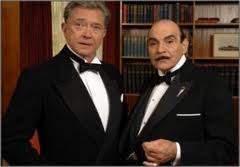
Actor Martin Shaw as Cartwright and Suchet as Poirot
This Sunday, David Suchet returns as Hercule Poirot in the first of a trio of new (to the US) episodes, Three Act Tragedy, in which Poirot is one of 13 guests who attend a party at the great actor Sir Charles Cartwright’s Cornish mansion. A local reverend dies while drinking a cocktail, but no poison is found in his glass. Poirot and Cartwright decide to investigate when another victim dies in the same manner.


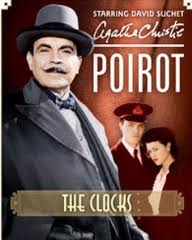
In The Clocks, airing on June 26, multiple frozen clocks factor into a murder. Sheila Webb, a typist for-hire, arrives at her afternoon appointment to find a well-dressed corpse surrounded by six clocks, four of which are stopped at 4:13. Lieutenant Colin Race (Tom Burke) is investigating the death of two Navy personnel when a distraught Sheila Webb (Jaime Winstone) runs out of 19 Wilbraham Crescent and into his arms. Poirot (David Suchet) arrives in Dover to help Colin determine if Sheila is responsible for the murder of the middle-aged man found stabbed on the sitting room floor.

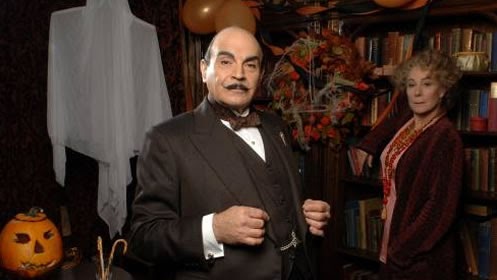
Poirot investigates a death at a festive event turned foul in Hallowe’en Party, airing on July 3. Ariadne Oliver attends a children’s Hallowe’en party and hears a young girl boasting that she has witnessed a murder. Later that evening, the child is found dead, drowned in a bucket. Ariadne sends for Poirot, who takes the young victim’s story seriously and finds there have been several other suspicious deaths in the village. When another child is found drowned, Poirot realizes that a third is in danger.
Suchet has been playing Poirot perfectly for twenty years now, beginning 1989 with The Adventure of the Clapham Cook. Suchet explained how he gets into character in an interview given to The Guardian, saying that he can’t eat much on the days he is Poirot “because that padding is not the most comfortable, especially in the summer”, so he has a bowl of fruit and heads into makeup. “And then as I’m being made up I’m thinking about the day,” he says. “And I’m watching, very closely, the face change. And it does change, very subtly. My makeup artist and I work very closely together, so every detail is done and the hair is all put back. And then the touchstone, absolutely the pivotal point – the moustache – goes on. And as soon as my lip feels that moustache, two things happen – first of all, I know he’s there, but it also gives my top lip a very, very slight restraint. So I can’t smile like that,” he grins broadly, “I can only smile like that,” he gives a tight half-smile. “And 20 years of that, I don’t know what it is, but psychologically it enables me to come back to him. And from then on, until lunch, I’m him . . . “
With these three espisodes in the can, there are only six of Christie’s Poirot stories left to film and Suchy hopes to be on board. Speaking about Poirot, Suchy told The Guardian, “I’m not bored, not bored at all. He’s irritating, but he’s wonderful as well, and he’s so interesting to be. And I’m going to eat them up.”
As will we.

Attempt On The Queen's Life

From The Greville Memoirs
June 12th. (1840) — On Wednesday afternoon, as the Queen and Prince Albert were driving in a low carriage up Constitution Hill, about four or five in the afternoon, they were shot at by a lad of eighteen years old, who fired two pistols at them successively, neither shots taking effect. He was in the Green Park without the rails, and as he was only a few yards from the carriage, and, moreover, very cool and collected, it is marvellous he should have missed his aim. In a few moments the young man was seized, without any attempt on his part to escape or to deny the deed, and was carried off to prison. The Queen, who appeared perfectly cool, and not the least alarmed, instantly drove to the Duchess of Kent’s, to anticipate any report that might reach her mother, and, having done so, she continued her drive and went to the Park. By this time the attempt upon her life had become generally known, and she was received with the utmost enthusiasm by the immense crowd that was congregated in carriages, on horseback, and on foot. All the equestrians formed themselves into an escort, and attended her back to the Palace, cheering vehemently, while she acknowledged, with great appearance of feeling, these loyal manifestations. She behaved on this occasion with perfect courage and self-possession, and exceeding propriety; and the assembled multitude, being a high-class mob, evinced a lively and spontaneous feeling for her—a depth of interest which, however natural under such circumstances, must be very gratifying to her, and was satisfactory to witness.
Yesterday morning the culprit was brought to the Home Office, when Normanby examined him, and a Council was summoned for a more personal examination at two o’clock. A question then arose as to the nature of the proceeding, and the conduct of the examination, whether it should be before the Privy Council or the Secretary of State. We searched for precedents, and the result was this: The three last cases of high treason were those of Margaret Nicholson, in 1786; of Hatfield, in 1800 (both for attempts on the life of the Sovereign); and of Watson (the Cato Street affair), for an attempt on the Ministers in 1820. Margaret Nicholson was brought before the Privy Council, and the whole proceeding was set forth at great length in the Council Register. There appeared no entry of any sort or kind in the case of Hatfield; and in that of Watson there was a minute in the Home Office, setting forth that the examination had taken place there by Lord Sidmouth, assisted by certain Lords and others of the Privy Council. There was, therefore, no uniform course of precedents, and Ministers had to determine whether the culprit should be brought before the Privy Council, or whether he should be examined by the Cabinet only—that is, by Normanby as Secretary of State, assisted by his colleagues, as had been done in Watson’s case. After some discussion, they determined that the examination should be before the Cabinet only, and consequently I was not present at it, much to my disappointment, as I wished to hear what passed, and see the manner and bearing of the perpetrator of so strange and unaccountable an act.

Up to the present time there is no appearance of insanity in the youth’s behaviour, and he is said to have conducted himself during the examination with acuteness, and cross-examined the witnesses (a good many of whom were produced) with some talent. All this, however, is not incompatible with a lurking insanity. His answers to the questions put to him were mysterious, and calculated to produce the impression that he was instigated or employed by a society, with which the crime had originated, but I expect that it will turn out that he had no accomplices, and is only a crackbrained enthusiast, whose madness has taken the turn of vanity and desire for notoriety. No other conjecture presents any tolerable probability. However it may torn out—here is the strange fact—that a half-crazy potboy was on the point of influencing the destiny of the Empire, and of producing effects the magnitude and importance of which no human mind can guess at. It is remarkable how seldom attempts like these are successful, and yet the life of any individual is at the mercy of any other, provided this other is prepared to sacrifice his own life, which, in the present instance, the culprit evidently was.

The Wellington Connection – Bond, James Bond

In 1961, American oilman and Trustee of the Metropolitan Museum of Art Charles Wrightsman bought Goya’s “Portrait of the Duke of Wellington” for $392,000 from the Duke of Leeds and planned to take it stateside. Public outcry resulted in the painting being temporarily barred from export to the United States and  two months later, the UK purchased the work from Wrightsman with the financial support of the Wolfson Foundation and the government. It proudly hung in London’s National Gallery for a scant three weeks before being stolen, with the thief apparently having gotten both in and out through an open bathroom window.

Because the painting had so recently been the subject of public furor, it’s theft quickly made it a cultural icon. In the first James Bond film, released in 1962, Sean Connery can be seen walking down an elegant staircase in the lair of the villainous Dr No when he spots Goya’s portrait of the Duke of Wellington and says, “So that’s where it went.”

Actually, no one knew where the painting had gone for several weeks, when finally a ransom note was delivered. The ransomer was able to identify marks visible only on the back of the painting, proving that it was in his possession. The ransomer, whose notes were theatrical and flamboyantly written, thought it outrageous that the British government would spend such a sum on a painting when retired British citizens had to pay to watch television. The Goya would be returned, wrote the ransomer, if a charitable fund of equivalent value, £140,000, were established to pay for television licenses for old age pensioners. There seemed to be no personal motivation for the theft, only outrage at the government’s TV license scheme.

The police refused to negotiate and a second ransom note was received and read:

Goya Com 3. The Duke is safe. His temperature cared for – his future uncertain. The painting is neither to be cloakroomed or kiosked, as such would defeat our purpose and leave us to ever open arrest. We want pardon or the right to leave the country – banishment? We ask that some nonconformist type of person with the fearless fortitude of a Montgomery start the fund for £140,000. No law can touch him. Propriety may frown – but God must smile.

Still the police would not respond and a third ransom letter followed:

Terms are same. . . . An amnesty in my case would not be out of order. The Yard are looking for a needle in a haystack, but they haven’t a clue where the haystack is. . . I am offering three-pennyworth of old Spanish firewood in exchange for 140,000 of human happiness. A real bargain compared to a near million for a scruffy piece of Italian cardboard.

The police held their ground and the case went cold until 1965, when a note arrived at the offices of the Daily Mirror newspaper along with a luggage check ticket for the Birmingham rail station. Checking the locker, the police found the stolen painting, which had been deposited by someone identifying himself as a “Mister Bloxham,” likely a reference to Oscar Wilde’s The Importance of Being Earnest, in which an infant is found in a handbag at a rail station luggage check. The painting had been recovered, handed over as a sign of good will by the thief, who realized that his demands, which he felt were entirely reasonable and noble, would not be met.

Rather than being a handsome and debonair art thief, the perpetrator turned out to be a middle aged, over weight,  unemployed bus driver named Kempton Bunton, who gave himself up six weeks later and told police that he had planned to use the ransom money to buy TV licenses for the poor, serving three months in jail for his offense.

During the trial the jury only convicted Bunton of the theft of the frame (which was not returned). Since his defence successfully claimed that he never wanted to keep the painting, he was not convicted of stealing the portrait itself. Bunton was sentenced to 3 months in prison. A provision in the Theft Act 1968, where section 11 makes it illegal to remove without authority any object displayed or kept for display to the public in a building to which the public have access, was enacted as a direct result of this case.
Many people have doubts about Bunton’s involvement in the theft, particularly as the large sized man could hardly have slipped in and out of the NPG through a partially opened window. And it’s been said that documents released in 1996 by the National Gallery are said to reveal his possible innocence. The mystery surrounding the Duke of Wellington continues. One thing’s for certain – Goya’s portrait of the Duke hangs once more in the National Portrait Gallery where, one would hope, the loo windows are now kept locked.