The Jubliee Flotilla – LIVE UPDATES

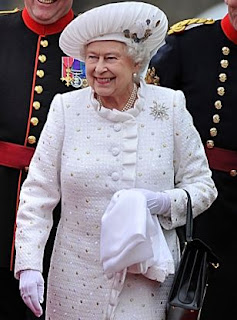
The Queen is onboard – click link for more photos

SCROLL DOWN FOR REAL TIME UPDATES

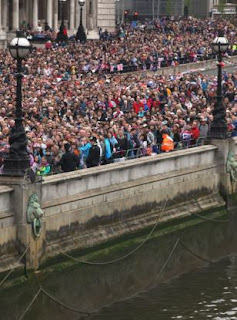
Crowds line the Thames – see the pictures
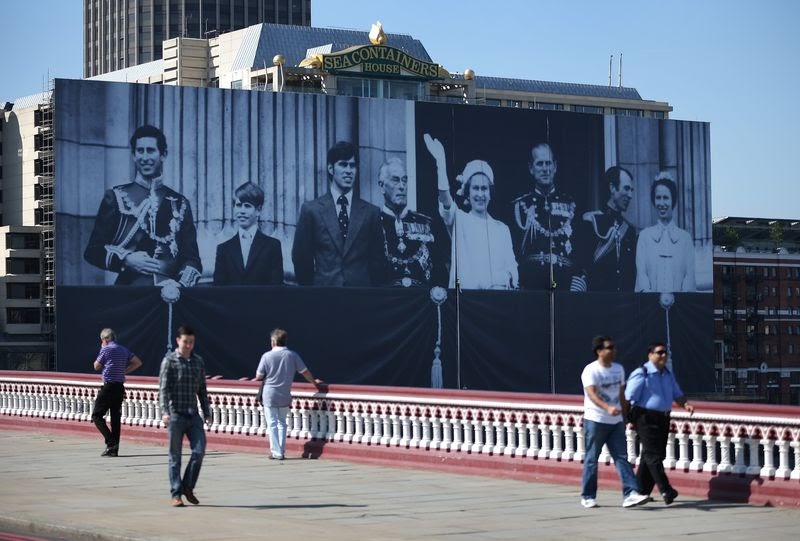
Royal Family photo lines the Shore

More about The Shard, the River’s newest landmark
Click here for the Flotilla Musical Programme
Read more about the Dunkirk Little Ships
Rooftop Semiphore Message to the Queen – What Are They Saying?
The St. Paul’s Cathedral Website
The history of Tower Bridge
Listen to the Opening Fanfare of the Royal Marine Trumpeters
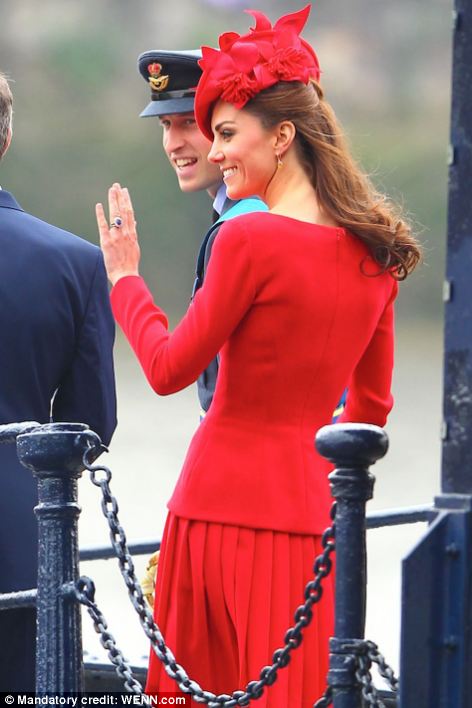
The Middleton’s enjoy the festivities aboard steamer
What the Royals are saying about the festivities
More about the Sailing Ship Tenacious

The London Philharmonic’s New Water Music for the Diamond Jubilee

Did I just hear the BBC commentator say that Lock Hatters
made Lord Nelson’s hat for the Battle of Waterloo!?

All about narrowboats

More about Paul Weston’s Maxime

Update: Weather forces cancellation of Royal Navy Flyby

Oh, God, this jaunty turn around in front the the Royal Barge is hysterical!

Rule Britannia!

Fireworks! Tower Bridge! Whistles! Crying!

Flotilla crowd one million strong

God Save the Queen

Period Properties For Sale

Guide Price Of £350,000 – The Boatswain’s House, also known as Dockyard Cottage, is an elegant late Georgian style house, circa 1826, which is now in need of restoration. It is part of an exciting project to give new life to an historic group of buildings which fall within an area of World Monument Fund Watch List Status and in a rapidly improving Conservation Area. The property lies within the historic Royal Dockyard and is Listed Grade II.

Restoration is already well underway on many of of the historic houses which formed the officers’ accommodation in the early 19th century Royal Dockyard. The rebuilding of the naval base between 1813 and 1826 brought together some of the country’s most eminent engineers and architets of the time, Edward Holls and George Ledwell Taylor, architects, and John Rennie the Elder and Sir John Rennie the Younger, engineers. The entire scheme was built in one phase. It remained an important strategic naval base until the Royal Navy withdrew in 1960. After years of undercertainty, the historic residential quarters are to be preserved, following a campaign fought by the Spitalfields Historic Building Trust. With the support and enthusiasm of a number of private investors work is well underway and their poineering spirit and determination are already transforming the area.

The Boatswain’s House is an elegant symmetrical double fronted house with walled garden to the rear. The interior is a double-depth plan with a central hall and fine staircse. The decorative detail in the principal rooms is not elaborate but was designed to relfect the status and importance of its original occupant. The accommodation is arranged on lower ground, ground and two upper floors, the rooms, which include a double reception room, are well proportioned and although the restoration will require a future owner to plan a kitchen and bathrooms the house offers considerable scope with a total of about 3,016 sq.ft. Once the renovation is complete the property would potentially provide a hall, double reception room, dining room, study, 4 or 5 bedrooms, 2 or 3 bathrooms, large kitchen, 2 cloakrooms and 3 lower ground floor rooms. For further details, contact Jackson-Stops and Staff.

Offers in Excess of £400,000 – FIRST TIME TO THE MARKET FOR 400 YEARS. A one off opportunity acquire a charming thatched cottage in need of updating and offered with no forward chain. Ashley Lodge, a former Gate House to Somerley House, is a delightful thatched cottage located on the edge of Ringwood with access and views of the Ringwood Forest.

Although the late owner of the cottage believed it to date back to 1482, whilst writing this we have only been able to access public records dating back to the early 1800’s. A map of the Somerley Estate dated 1810, headed as in possession of Henry Baring, has what looks to be a small building on the edge of the estate. Sale particulars dated 23rd May 1811 include “Two handsome Entrance Lodgers from the Ringwood and Harbridge Roads”. Documents show Henry Bearing selling the Somerley Estate to the Normanton’s in the 1820’s when “The Lodge” and “Somerley Lodge” appear upon documents and is assumed to be Ashley Lodge.

Census records show a Charles Shave aged 3 living at “Somerley Lodge” in 1841with parents William and Martha Brown and William and Caroline Shave during 1881. The Cottage is known to some locals as “Shave’s Lodge” which is believed to originate from the name of these residents.

Numerous postcards illustrating the circular iconic lodge in the early 1900’s were produced by a local printing company who were located within the shop currently occupied by W H Smith. Heavy snow during April 1908 gave the printers an excellent opportunity of creating further picturesque postcards.

The late owner, Brian Spence inherited Ashley Lodge from his parents, Mr and Mrs Batstone, who are believed to have bought the lodge from Lord Normanton in 1962. Mr Batstone, an architect and army officer, extended the one bedroom cottage which is believed to have housed a lady with eight children who may have worked for the Somerley Estate. The property is now being sold, for the first time in 50 years on the open market by the family of the late Mr Brian Spence. No doubt further information relating to Ashley Lodge and its previous tenants will unfold. For further info, click here.

 
The Pavilion, Hampton Court Palace – £8,950,000 – Situated on the historic Barge Walk between The Thames and Hampton Court Palace, the property enjoys views of the adjoining 560 acres of the Palace Home Park and river. The Pavilion is offered in superb condition and is now being sold with planning permission and listed building consent (March 2011) to erect a second Pavilion and two summer houses within the wonderful 2 acres of gardens and to reinstate the original vista from The Palace to the site. Further details and a number of computer generated images are shown in the comprehensive brochure as well as being available upon request. The Pavilion is the one remaining of four originally built on the site under the guidance of Sir Christopher Wren and was completed in 1702 for William III surrounding the largest formal garden, including a bowling green at the time. This is a very special property of both architectural and historic interest.                        

A Stroll Down Piccadilly

From Walks in London by Augustus Hare (1894)

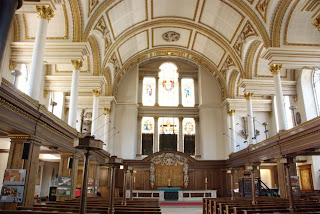
Turning eastwards (out of St. James’s Street and onto Piccadilly), we find, on the right, St. James’s Church, built by Wren, 1684. Hideous to ordinary eyes, this church is still admirable in the construction of its roof, which causes the interior to be considered as one of the architect’s greatest successes—probably his best interior, except St. Stephen’s, Walbrook.

The marble font is an admirable work of Gibbons: the stem represents the Tree of Knowledge, round which the Serpent twines, offering the apple to Eve, who stands with Adam beneath. The organ was ordered by James II. for his Catholic chapel at Whitehall, and was given to this church by his daughter Marj’. The carving here was greatly admired by Evelyn.

‘Dec. 10, 1684.—I went to see the new church at St. James’s, elegantly built . The altar was especially adorned, the white marble inclosure curiously and richly carved, the flowers and garlands about the walls by Mr. Gibbons, in wood: a pelican, with ber young at her breast, just over the altar in the carv’d compartment and border invironing the purple velvet fringed with richly embroidered, and most noble plate, were given by Sir R. Geare, to the value (as is said) of £200. There was no altar anywhere in England, nor has there been any abroad, more richly adorned.’—Diary.

The Princess Anne of Denmark was in the habit of attending service in this (then newly built) church, and it was one of the petty insults which William and Mary offered to the Princess (after her refusal to give up Lady Marlborough) to forbid Dr. Birch, the rector, to place the text upon the cushion in her pew, an order with which the rector, an especial partisan of the Princess, refused to comply.
Among the illustrious persons who have been buried here are Charles Cotton, the friend of Izaak Walton, 1687; the two painters Vandevelde, 1693 and 1707 ; Dr. Arbuthnot, the friend of Pope and Gay, the slouching satirist, of whom Swift said that he could ‘do everything but walk,’ 1735; Mark Akenside, the harsh doctor who wrote the ‘Pleasures of Imagination,’ 1770; Michael Dahl, the portrait-painter, 1743; Robert Dodsley, footman, poet, and bookseller, 1 764; the beautiful and brilliant Mary Granville, Mrs. Delany, the beloved and honoured friend of George III. and Queen Charlotte, 1788; William, the eccentric Duke of Queensberry, known as’ Old Q.,’ 1810; James Gillray, the caricaturist, 1815; and Sir John Malcolm, Governor of Bombay, 1833.i In the vestry are portraits of most of the rectors of St. James’s, including Tenison, Wake, and Seeker, who were afterwards Archbishops of Canterbury.

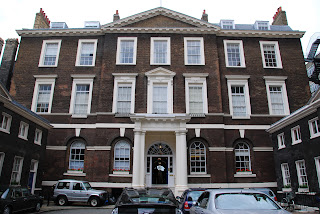
On the other side of Piccadilly, nearly opposite the church, are the Albany Chambers (above), which take their name from the second title of Frederick, Duke of York, second son of George II., to whom the principal house (first known as Melborne, then as York House) once belonged. ‘The Bachelor of the Albany’ was a character well known at the beginning of the present century.
‘In the quiet avenue of the Albany (Albany court Yard), memories of the illustrious dead crowd upon you. Lord Byron wrote his “Lara” here, in Lord Althorpe’s chambers, afterwards (1837) occupied by Lord Lytton; George Canning lived at A. 5, and Lord Macaulay in E. 1; Tom Duncombe in F. 3; Lord Valentia, the traveller, in H. 5, and Monk Lewis in K. 1.’—Blanchard Jerrold.

Sackville Street, which opens on the north, has the distinction of no standard lamps, retaining the first form of gas-lamp, projecting from the walls of the houses.

On the right, in returning, is Burlington House (now the Royal Acadamy of Arts, above), built from designs of Banks and Barry, 1868-74. The inner part, towards the courtyard, is handsome; that towards the street, and the sides of the building, are spoilt by the heavy meaningless vases by which they are overladen. In the construction of this commonplace edifice one of the noblest pieces of architecture in London was wantonly destroyed—the piazza, of which Sir William Chambers wrote as ‘one of the finest pieces of architecture in Europe,’ and which Horace Walpole said ‘seemed one of those edifices in fairy-tales that are raised by genii in a night-time.’ Its stones were removed to Battersea Park, but London, which has spent £10,696 on the Temple Bar Memorial, has never been able to afford the sum necessary for their reconstruction!
The old house (the second on the site) was built from the designs of Richard Boyle, third Earl of Burlington, but the portico has been attributed to Colin Campbell. Burlington House was bought by the nation in 1854. The central portion of the modern buildings is devoted to the Royal Academy, which was founded in 1768, with Reynolds as President. It consists of forty Academicians and thirty-one Associates. Their first exhibitions took place in Somerset House, but, from 1838 to 1854, they were held in the eastern wing of the National Gallery. How great was their early mediocrity may be seen from the cuttings in vellum and paper, landscapes in human hair, and devices in shell-work described in Exhibition catalogues of the last century, though these were interspersed with great works by Reynolds and Flaxman.
In Cork Street, facing the back of Burlington House, General Wade’s house was built by Richard Boyle, Earl of Burlington, a house which was so uncomfortable as to make Lord Chesterfield say that the owner could not be at his ease in it, and so intended to take the house over against it and loot at it. The famous tavern of the ‘Blue Posts’ in this street has been recently rebuilt.

From the end of Savile Row, an archway and passage lead into Conduit Street, through what was once the two-winged garden
pavilion of Burlington House, the countrified position of which in the seventeenth century was chosen by its founder ‘because he was determined that no one should build beyond him.’ All the streets in this neighbourhood—Cork Street, Old and New Burlington Street, and Boyle Street—record the names and titles of the Boyle family. In Boyle Street still stands the school founded by Lady Burlington, on the edge of her gardens, for the maintenance and education of eighty poor girls.

Hard by, in Savile Row (named from Dorothy Savile, wife of the architect Earl of Burlington), at No. 12, George Grote, the historian of Greece, died, June 19, 1871; at No. 17 Richard Brinsley Sheridan (above) died, July 7, 1816. His so-called friends suffered him to be arrested by a sheriff’s officer upon his death-bed, and he would have been carried off, in his blankets, to a spunging-house, if his physician had not threatened the officer with the responsibility of his dying on the way; yet seldom has there been such an array of rank as when he was borne hence to his grave in Westminster Abbey!

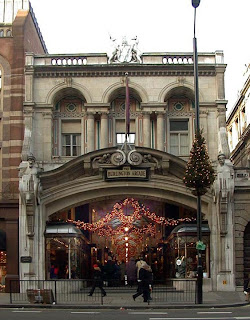
The Burlington Arcade (above) was built from designs by Ware for Lord George Cavendish in 1815, and is ‘famous,’ as Leigh Hunt says, ‘for small shops and tall beadles.’ Just beyond, in Piccadilly, was the little underground newsvendor’s, whither Louis Napoleon Bonaparte ‘would stroll quietly from his house in King Street, St. James’s, in the evening, with his faithful dog Ham for his companion, to read the latest news in the latest editions of the papers.’

In old times this was the celebrated ‘White Horse Cellar,’ where might be seen what Hazlitt calls ‘the finest sight in the metropolis,’ the starting of the coaches in Piccadilly. Latterly there has been a revival of the love of the road, and a number of coaches (frequently with amateur drivers) in Northumberland Avenue attract the enthusiasm of a little crowd on their morning departures and their evening arrivals. Bond Street, Albemarle Street, Dover Street, and Grafton Street occupy the site of Clarendon House and its gardens, built by the Lord Chancellor Earl of Clarendon, who laid out the gardens at a cost of £50,000.

In The English Garden

Gardeners the world over seek to re-create their own patch of Englishness by way of a garden. No matter where in the world one lives, it is possible to obtain such quintessentially English plants as lavender, hollyhocks and roses. One can even go so far as to install hedgerows, herbaceous borders and a ha-ha in the garden. But it occurred to me that what really sets an English garden apart are the things one finds in the garden, decoration-wise. A few urns or a lichen covered bit of crumbling statuary are both fine and dandy, but nothing says “English garden” quite like a dovecote or, say, a hen house. In fact, you could do worse than to take a page from the Duchess of Devonshire’s book and get yourself an entire flock of fowl.  To that end, we’ve taken a stroll around the internet and rounded up a host of unique – and beautiful –  garden decorations on offer for feathered friends.

The Dorset based company Flytes of Fancy offer Gypsy hen houses in such themes as the Willow, below

The Gypsy Daydream, above, is offered at £3900.00, depending on any additional bespoke requirements and your delivery preferences. Each henhouse is hand-painted by the resident artist and can be further customized to your specifications.

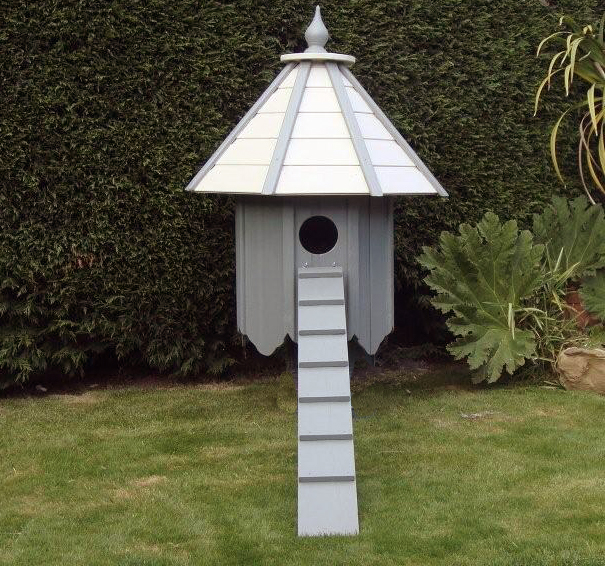
The Branscombe model dovecote, above, available from http://www.dovecotes.co.uk/, offers four storeys of living space for 20 to 24 pair of doves. No doves? No problem . . . . whilst called “dovecotes” these houses have always been used to more commonly house pigeons.


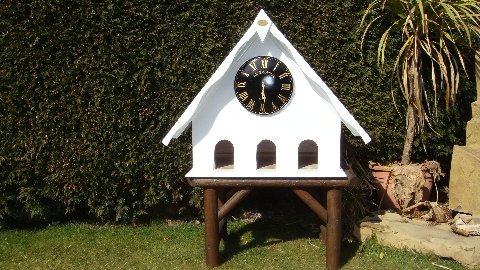
Marks Dovecotes offer even more variety in dovecote construction, including the Westminster Slate model shown here

Should you not be a fan of either hens or doves, have no fear – Marks Dovecotes also offer a duck house

Should you wish to house smaller feathered friends, this birdhouse from the Highgrove Shop is just the ticket

Looking to attract a particular species of bird? The Patch birdiebox below, from Garden Loverz, features a lever on the front gives you control over the type of birds you would like to nest in your garden.

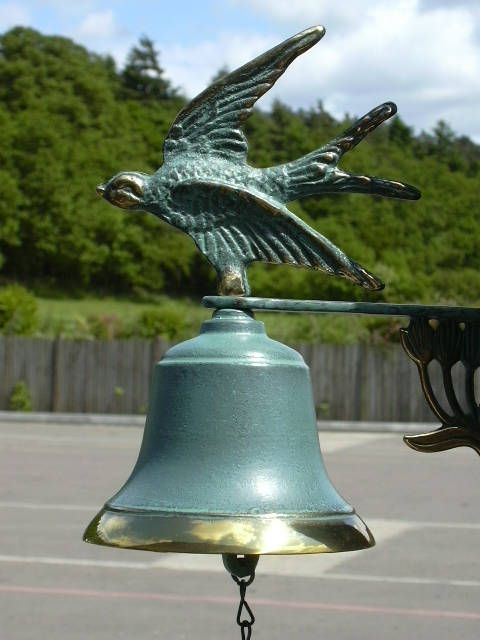
Finally, we just couldn’t resist showing you this Flying Bird porch bell in a verdigris finish available from Gifts and Gardens.

Thomas Crapper Is Alive And Well

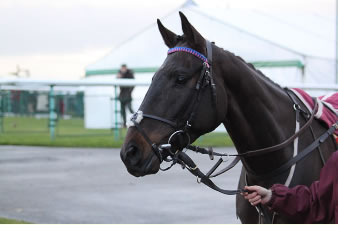
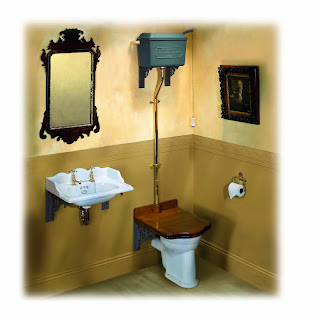
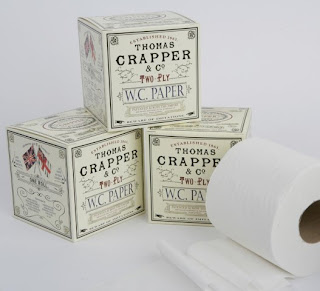
No, not the racehorse named Thomas Crapper, above. Though he’s doing well, too – even has his own website and is owned by a syndicate that includes – you guessed it – Thomas Crapper and Co., which is the Crapper I was talking about. I recently discovered that they’re still in business and offer a select range of bathroom fittings manufactured along the same Victorian and Edwardian designs first used by the firm.

As everyone is aware, Thomas Crapper invented the W.C. as we know it today. According to the Company’s website: “By the 1880’s, Crapper and Co.’s reputation was such that they were invited to supply the Prince of Wales (later Edward VII) at Sandringham. Subsequently, Windsor Castle, Buckingham Palace and Westminster Abbey all benefited from Crapper goods and services. Crapper and Co. remained by Royal Appointment to Edward when he became king and was also warranted by George V, as Prince of Wales and once again as king.

“Thomas Crapper died in 1910 and was buried near the grave of the cricketer, W.G. Grace, in Elmers End Cemetery. The company continued under the guidance of his old partner Robert M. Wharam, his son Robert G. Wharam and Mr. Crapper’s nephew George Crapper. However by the late 1950s, after the demise of the original partners, it was evident to Robert G. Wharam that with no Crappers or Wharams left to run the business, the sale of the company was becoming inevitable. In addition, perhaps people cared little for quality and tradition during that period. In 1963 came the end of an era; Thomas Crapper and Co. became the property of a rival, Messrs. John Bolding and Sons, Ltd.”

Today, the firm has been resurrected and, whislt the website doesn’t tell us quite how this came about, do we really care? The fact remains that we can now purchase and use authentic period lavatory items designed by Crapper himself, including, but not limited to: