A Pinterest Post: Juana Galán

This is one of my favorite Pinterest posts because Juana Galán (1787–1812), above, was fierce, feisty and would no doubt have been a favorite of the Duke of Wellington. During the Peninsular War, twenty year old Juana worked in a tavern in her home town of Valdepeñas, Spain, when she gathered the intelligence that the French were preparing to invade the town. As most of the men were away from the town already fighting in the war against Napoleon, Juana took matters into her own hands and rallied the townswomen in order to form a battle plan of their own.

On June 6, 1808, Napoleon’s troops entered the town, whereupon the women, strategically placed in windows about the square, poured boiling water and oil over the heads of the soldiers who rode past. Juana, armed with either a baton or a cast iron stew pot (depending on which version you believe) then went into the street and beat the soldiers about their heads like there was no tomorrow. No doubt Juana had help in the pummeling, as a single person, man or woman, could not have taken on an entire regiment of French cavalry by themselves, however history credits Juana alone for the deed. The French fled and subsequently abandoned their aim of conquering the region of La Mancha altogether. Soon afterwards, the Spanish army were victorious at the Battle of Bailen against the French.

On May 2, 1810, Juana married Bartolomé Ruiz de Lerma,  with whom she had two daughters. She died during the birth of her second daughter on September 24, 1812.

 
You can find all my Pinterest boards here.

The Wellington Tour – Devonshire House

No matter how many times I visit London, I always find new nuggets of historic trivia that are hugely interesting. I thought I’d do a bit of investigation recently in preparation for the St. James’s Walk Victoria and I will be leading during The Wellington Tour in September, when I discovered some interesting facts.

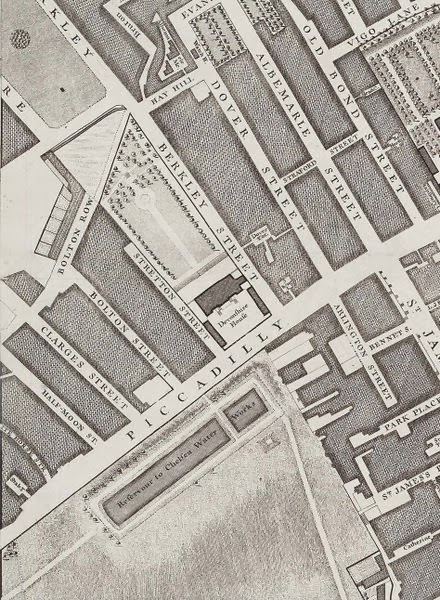
Firstly, I did some research into Devonshire House, London home to the Dukes of Devonshire since 1697, when the 1st Duke purchased the home, then known as Berkeley House, from Lord Berkeley. You can get an idea of it’s prime location on Piccadilly from Roque’s map below.

The house burned down in 1733 whilst undergoing renovations, allowing the Duke to rebuild in a contemporary style better suited to entertaining on a grand scale. The prime example of such an entertainment came over a hundred years on at The Duchess of Devonshire’s Ball, a fancy dress entertainment held in order to celebrate Queen Victoria’s Diamond Jubilee on 2 July in 1897. The Duchess encouraged guests to take their inspiration for fancy dress from history, literature and mythology. Thankfully, the Duchess hired photographer James Lauder of the Lafayette Company to be on hand to photograph the 200 costumed guests in front of different backdrops over the course of the evening.

The Duchess of Devonshire as Zenobia, Queen of Palmyra

The Ladies Churchill as Watteau shepherdesses.

Princess Henry of Pless as the Queen of Sheba

Unfortunately, Devonshire House (below in 1905) was demolished in 1920, when it was sold by the 9th Duke of Devonshire in order to pay death duties. Today, an office building stands on the site.

The new bit of trivia I learned is that the gates from Devonshire House were saved and moved to the entrance of Green Park off Piccadilly. I can’t tell you how many times I’ve walked past, and through, these gates, never realizing their history.


Another piece of London history I’ve walked past numerous times is the Porter’s Rest above, located just down the street from the Green Park Gates as you walk towards Apsley House. As E. Beresford Chancellor tells us, there is a plaque on the object that reads “At The Suggestion Of R.A. Slaney Esq. Who For 20 Years Represented Shrewsbury In Parliament This Porter’s Rest Was Erected In 1861 By The Vestry Of St. George Hanover Square For The Benefit Of Porters And Others Carrying Burdens.” You can be sure we’ll be pointing this piece of street furniture out to everyone on the Wellington Tour – who knew?


Have Yourself a Luxurious London Christmas

In case you’re feeling the need for a little luxury this holiday season, we’ve rounded up some gift ideas that might come in handy whether you’re on the giving or receiving end of things.

This year, Harrods, that venerable institution dedicated to conspicuous consumption, has chosen
the classic British steam train as the theme for their holiday windows.


Of course, what Harrods is famous for are it’s hampers and this Christmas, Harrods offers it’s Decadence Hamper at a mere twenty thousand pounds.


Filled with everything one might need for an over the top culinary Christmas, the Decadence Hamper includes such staples as goose foie gras flavoured with truffle, Beluga caviar, table top decorations, a variety of cheese, mince pies, meats, jams, puddings, a Christmas cake and enough high end wines and liquors to make Mr. Carson envious. The hamper also includes Christmas crackers, but we doubt they can compare to those offered this year by Tiffany and Co.


The Tiffany and Co. Christmas Cracker, £180,000,  is available at the Bond Street Store and includes eleven pieces of Tiffany jewelry: a circlet diamond necklace in platinum, a pink tourmaline ring, Cobblestone earrings in platinum with diamonds, a yellow diamond ring, 8.75 carat aquamarine ring in platinum and a Marquise diamond cluster bracelet.


Should you prefer your jewels to come complete with historic provenance, you may want to turn to one of London’s venerable auction houses. Here’s a little something we found from the Sotheby’s Fine Jewelry auction that took place on December 13th in London –


Diamond tiara, circa 1900 – The centre designed as two wreaths, each swing-set to the centre with circular-cut and pear-shaped diamonds, between two modified rectangular panels of open work floral and foliate design, set with circular-cut and rose diamonds, inner circumference approximately 290mm, central motif detachable and can be worn as a brooch or pendant, the panels can be worn as brooches. Sold for 18,750 GBP                 
Should selecting gifts for everyone on your list become overwhelming, head to Selfridge’s, where this year they are offering shoppers their very own Elfridge.

The festively attired elves have been sprinkled about the Oxford Street store to guide shoppers through departments, find the perfect gifts, gift wrap and carry packages and hail taxis.

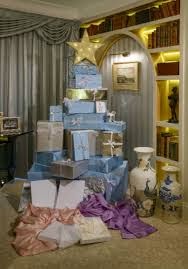
Of course, you’ll need to put all of those pretty packages under a tree and for inspiration on that score we direct you to The Goring Hotel and it’s 2013 Luxury Christmas Tree Collection.  This year, the trees have been created by iconic British brands including The Real Flower Company, Olivia Von Halle and Honeyjam. You can read more and see all of the trees here.

Once your shopping has been completed, reward yourself by booking in for Claridge’s Timeless Christmas offer that includes:

  • A two night stay in Claridge’s
  • Welcome bottle of champagne and festive treats in room on arrival
  • Overnight stocking delivery filled with edible delights for the younger guests
  • English breakfast on Christmas Day
  • Horse-drawn carriage ride through Mayfair on Christmas morning with refreshments
  • 5-course Christmas Day lunch in Claridge’s Ballroom
  • Boxing Day breakfast
                            
From £860 per room per night (including all taxes).


On The Shelf: Across The Pond

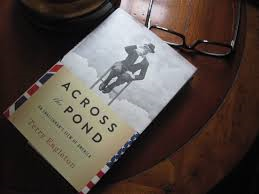
In Across The Pond: An Englishman’s View of America, author and literary critic Terry Eagleton skewers Americans relentlessly – but it’s okay, because Eagleton gets around to other nationalities, as well. Especially his own (British, as the title of the book implies).  Eagleton sets a wry tone in his introduction, where he writes, ” . . . the discerning reader will note that when I make large generalizations about the British, Irish and Americans in this book, my comments must occasionally be seen as involving a degree of poetic license and a pinch of salt.” From there we embark on a tour de force of political incorrectness that’s by turns either oddly refreshing or startlingly at odds with what one personally knows to be true.

Eagleton compares the Americans to the British early on while setting forth one cause for the divide in our national characters: “Henry James thought that America lacked mystery and secrecy, that its landscapes were all foreground, but found just such an air of enigma in Europe. This was not, he considered, by any means wholly to its credit. Civilisations which prize the mannered, devious, playful and oblique generally have aristocratic roots, since it is hard to be mannered, devious and playful while you are drilling a coal seam or dry-cleaning a jacket. And aristocratic social orders, as James was to discover, can be full of  suavely concealed brutality. A dash of American directness would do them no harm at all. A culture of irony requires a certain degree of leisure. You need to be privileged enough not to have any pressing need for the plain truth. Facts can be left to factory owners.” Of course, this example supposes that British aristocrats make up the whole of the English population. Or at least that part of it which is playful and/or enigmatic. And surely the UK has at least one or two plain talking dry cleaners available to them in a crisis?

In an attempt to rationalize American zeal, willingness and industry, the author writes, “It was a communal act of willing that brought America about in the first place. The nation itself is the work of the will. It is not just a country like any other but a project, a vocation, a mission, a destiny, a spiritual enterprise. Nobody thinks this about Belgium. It is not the case with Wales, Slovenia or the United Arab Emirates, which some Americans might suspect is a movie company. Britain is not the work of the will. The British never planned their empire, for example. It just fell into their laps in a fit of absent-mindedness. They awoke one morning to find that they were governing India, even though nothing had been further from their thoughts. They did not particularly savour the prospect, but it seemed churlish not to get on with it.” One can just about hear the Wellesley’s turning over in the respective graves now.

As Eagleton warned in his introduction, much salt was pinched in the writing of this book and oddly enough, the majority of it falls on the British Isles, rather than on America, as the title would suggest. “Like comedy, the British are traditionally suspicious of the success ethic. Unlike Americans, they are not an affirmative nation. Among their national icons are a ship that sank (the Titanic) and a calamitous military defeat (Dunkirk). Defeat is what the British are particularly good at. They are maestros of utter disaster. No doubt there are bunkers deep below Whitehall where intensive seminars in how to screw up are secretly conducted. Glorious defeats, like the Charge of the Light Brigade, are almost to be elevated over stupendous victories. The British are not particularly heroic, but brave out of necessity. Unlike Americans, the only kind of heroism for which they have a sneaking admiration is one forced on you when the odds are hopeless and your back is to the wall. After such sporadic bursts of self-sacrificial glory, they resume their normal, grumpy, unheroic existence until the next catastrophe happens along. They need the occasional hardship in order to show what stuff they are made of, and suspect that American civilization is too easy and flaccid in that respect. The States may be full of virile, chisel-jawed, bestubbled types, but all those stretch limos and Jacuzzis are fatally weakening. This is ironic, since quite a few Americans see the British themselves as effete. This is largely because their accents can sound vaguely gay, rather like their prose styles.”

Wellington continues to roll, Churchill’s moaning aloud and I’m left wondering exactly what England ever did to Eagleton to deserve such treatment. Perhaps Across the Pond would have been funnier if it had been based on truths. Even stereotypical truths. Like this one:

“An American friend of mine once confessed to me that he found a certain philosopher rather standoffish. I told him that he had the word almost correct: it wasn’t standoffish, it was Scottish. Scottish men tend to smile less than American men do, a fact that can easily be mistaken for churlishness. In fact, a male Scot will probably smile only faintly if he meets you after a twenty-year absence and you are his mother.”

Now, that’s funny.

Published by W.W. Norton and Company, Hardcover ISBN: 9780393088984

On The Shelf: London Villages

In London Villages: Explore the City’s Best Local Neighbourhoods author Zena Alkayat breaks down London’s current sprawl into 30 villages and introduces readers to each via a short description, maps, photos and five highlighted places of interest in each neighborhood. These are further broken down into areas of the City: central, north, south, east and west.  All of the usual suspects make an appearance: Shepherd Market, Camden Passage, Queen’s Park, Little Venice. What truly sets Alkayat’s guide apart are the newly evolved villages introduced to the reader, some of which are still works in progress, and her discovery of overlooked gems in well loved areas.

Zayat’s chatty tone allows the reader to feel as though they are getting inside information from a local, with all the “need to know” details thrown in for good measure. Here’s Zayat’s take on Turnham Green (near Chiswick Common): “Though situated a little north of Chiswick’s main attractions, Turnham Green has established itself as the commercial heart of the area. To the south runs an incredibly scenic stretch of the Thames dotted with rowing clubs and pubs for walkers. Inland, Palladian villa Chiswick House attracts vast numbers of tourists, as does Hogarth’s House . . . For Londoners, the rather upmarket Chiswick car boot sale operates on the first Sunday of every month from the school on Burlington Lane, and the area’s centuries-old brewing heritage means there are plenty of historic pubs to enjoy. Frustratingly, there’s little to get excited about along Chiswick High Road itself, dwarfed as it is by standard high street restaurants and chains but offshoots Turnham Green Terrace and Devonshire Road lay claim to a stronghold of independent retailers. On Turnham Green Terrace, a number of delis have made the street a destination for fans of fine food, and Foubert’s Café (a local institution since 1980) is famous for its Italian ice cream. Devonshire Road, meanwhile, offers clothes boutiques, gift shops and the ramshackle Strand Antiques at number 46.” One of the five highlighted places of interest chosen by Alkayat includes Fosters’ Bookshop on the High Road: “The Foster family has run this tightly packed antiquarian store since 1968 and continues to acquire and sell a choice selection of rare books and first editions, together with volumes of local history and more general Penguin paperbacks and illustrated children’s novels.” I don’t know about you, but I can’t wait to head to Turnham Green some first Sunday soon.

Other places I’m looking forward to visiting thanks to Alkayat include:

The Prince Alfred & Formosa Dining Room (Little Venice): “The Prince Alfred’s original snug rooms, snob screens and decorative tiles make it one of the best examples of a late Victorian pub in London. The ornate bar is adjoined to the intimate Formosa Dining Room, which enjoys repeated recommendations in Michelin’s Eating out in Pubs guide.”

Jane Bourvis (Golborne Road): “Walking into this vintage bridal shop feels like wandering to Miss Haversham’s dressing room. Dozens of antique lace dresses hang from the ceiling, corsets weigh down rails, and every available surface is topped with trinkets, strings of pearls and wind-up music boxes.”

Cannon & Cannon (Brixton Road): “Cannon & Cannon can sort cheese and charcuterie board dilemmas with minimal fuss. Its selection of British cured meat (sourced from as close as Kent and as far as the Scottish Highlands) is matched by a stellar range of artisan cheese. Pair with the deli’s chutneys and pickles and wash down with pale ale from Bermondsey’s Kernel Brewery.”

Virginia (Clarendon Cross): “Clarendon Cross’s concentration of eccentrics and artists may be thinning these days, but long serving establishments such as Virginia keep the area’s unconventional personality alive. Virginia Bates opened up shop in 1971 and is renowned in the upper echelons of the fashion industry for her incredible collection of antique apparel from the 1850s to the 1930s.”

London Villages should be on every Anglophile’s shelf. For visitors to the City, it will be indispensable when either planning your next trip or in order to learn more about the history of London. For locals, London Villages will no doubt keep that age old question, “What should we do this weekend?” at bay for months to come.

London Villages by Zena Alkayat with photographs by Kim Lightbody
 and illustrated maps by Jenny Seddon is published by Frances Lincoln
 in paperback, £9.99. 192 pages, ISBN 9780711234666