A VISIT TO THE FIELD OF WATERLOO

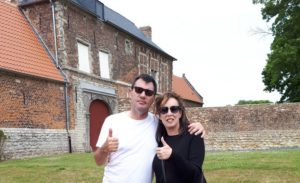
Kristine and Ian Fletcher, Waterloo, May 2017

Back in May, I revisited the Battlefield at Waterloo with author and battlefield guide Ian Fletcher, accompanied by one of my favourite travel mates, Denise Costello. Ian and I were on a mission to put together a different kind of Waterloo Tour. He is experienced in battlefield tours and can bring every moment of the Battle to life in a way that is both engaging, educational and exacting – which regiments were where, who was leading the charge, why were certain geographic points chosen by the French and Allied armies, what went wrong . . . . and what went right?
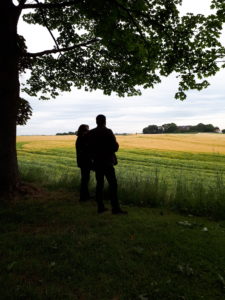
Denise Costello and Ian Fletcher overlooking the Battlefield at Waterloo.

On the other hand, my tours are focused more upon social history – which English families were living at Brussels during the Battle, who attended the Duchess of Richmond’s Ball, how did the civilians fare before, during and after the Battle and what wide ranging impact did the Battle, and the victory, have upon life in London and England at large?

In an effort to blend these two views of Waterloo, Ian and I hit upon the idea of doing a tour that focuses on the year 1815 as a whole, instead of focusing on the Battle alone. And so the 1815 London to Waterloo Tour was born.  Before the Tour heads for Belgium, our group will explore the London of 1815, including Apsley House and the many clubs, houses, streets and sites that have a connection with the campaign, including the house in St. James’s Square where Henry Percy delivered the captured French Eagles to George IV after the Allied victory. Author Louise Allen will speak to our group on the subject of her book, To The Field of Waterloo: The First Battlefield Tourists 1815 – 1816. Once in Waterloo, we will walk the key sites on the Battlefield and also visit a host of museums and related sites including the superb new Waterloo Memorial with its high-tech exhibits and 3D cinema, the famous Lion Mound and panorama, the wonderful presentation at refurbished Hougoumont and the headquarters of both Wellington and Napoleon.

Speaking of Waterloo tourists, below is an account of Dr. Samuel Butler’s visit to the Battlefield a year after the Allied victory. His vivid impressions take in all of the sites we’ll be seeing on the Tour, complete details of which can be found here.

The Forest of Soignes

From: The Life and Letters of Dr. Samuel Butler: Headmaster of Shrewsbury School

July 9th. 1816 —From Brussels through Waterloo to the field of battle, about fourteen miles, through the Forest of Soignies, almost all the way a most detestable pavi full of holes. Waterloo is a miserable village of about twenty houses; its small red brick church, designed in segments of ellipses, is about twenty-five or possibly thirty feet in diameter. Here are monumental inscriptions to the memory of many of our brave country men. In about half a mile from Waterloo we quit the Forest of Soignes, and the ground becomes an elevated plain with some moderate undulations. In about two miles more we come to a place where a bye-road crosses the principal road. Here is an elm of moderate size on the right-hand side of the road, some of whose branches have been torn off by cannon balls; this is the famous Wellington tree, where the Duke was posted during the greater part of the battle, and is somewhat nearer the left wing than the centre of the battle. Close to the cross-road opposite this runs La Haye Sainte, a broken stumpy hedge. Directly opposite this tree, on the road-side, lay the skeleton of an unburied horse, and near the tree itself I picked up a human rib. The whole field of battle is now covered with crops of wheat and rye, which grow with a rank and peculiar green over the graves of the slain and mark them readily. About one hundred and fifty yards below the Wellington tree, which itself stands on the top of Mount St. Jean, in the hollow, is the little farm of La Haye Sainte, where the dreadful slaughter of the German Legion took place; they defended the place till they had spent all their ammunition, and were then massacred to a man, but not till they had taken a bloody revenge. The house and walls, the barn doors and gates, are full of marks from cannon and musket balls. In the barn are innumerable shot holes, and the plaster is still covered with blood, and the holes which the bayonets made through their bodies into it are still to be seen.

La Haye Sainte

“In a hollow near this scene of carnage lie the bodies of two thousand French Cuirassiers in one grave, and about twenty yards farther is the spot to which Bonaparte advanced to cheer the Imperial Guard for their last charge; it is scarcely possible but that he must have exposed himself greatly in so doing. The little valley between the undulation of Mount St. Jean, where the British were posted, and that of La Belle Alliance, which was occupied by the French, is not more than about a quarter of a mile across; the Duke of Wellington and Bonaparte, whose general station was on this hill, cannot have been more than that distance, or a very little more, from each other. On going to the station of Bonaparte we had a fine view of the whole field, and, though quite ignorant of military affairs, could not but see the superiority of the British position. The undulation on their side being a little more abrupt than that of the French, they were themselves protected in some measure, and their force considerably concealed, while that of the French was perfectly distinguishable. The right wing of the British was at Hougoumont [rather Goumont], a chateau of great importance and of very considerable strength. Their left wing was at the end of La Haye, about a short half-mile or less from the farm of St. Jean, which was almost of the same importance for its protection as Hougoumont for that of the right. The whole line could not extend more than a mile and a quarter. The French were posted on the opposite eminence, and here in this small space three hundred cannon, independent of all other weapons, were doing the work of death all day. Our guide, a very intelligent peasant, told us that the whole ground was literally covered with carcasses, and that about five days after the stench began to be so horrid that it was hardly possible to bury them on the left of the British, and of course on the right of the French position. At less than a mile and a half is the wood from which the Prussians made their appearance. La Belle Alliance is about half a mile or a little less from Mount St. Jean; here we turned off to see the chateau of Hougoumont, which was most important to secure the British right and French left wing, and was therefore eagerly contested; four thousand British were posted here, and withstood with only the bayonet and musketry all the attacks of an immense body of French with cannon. The French were posted in a wood, now a good deal cut down, close to the wall of the garden at Hougoumont. The British had made holes in the wall to fire through, and the French aimed at these holes. The whole wall is so battered by bullets that it looks as if thousands of pickaxes had been employed to pick the bricks. The trees are torn by cannon balls, and some not above eight inches in diameter, being half shot away on one side, still flourish.


Hougoumont

“Passing round the garden wall to the gates, the scene of devastation is yet more striking. The front gates communicate with the chateau, a plain gentleman’s house, the back ones (which are directly opposite) with the farmer’s residence. This was occupied three times by the French, who were thrice repulsed; but the English were never driven from the chateau. The tower, or rather dovecote, of the chateau was burnt down, but a chapel near it, about twenty feet long, was preserved in the midst of the fire; the flames had caught the crucifix and had burnt one foot of the image, and then went out. This was of course considered a great miracle. From the chapel we went into the garden. Its repose and gaiety of flowers, together with the neatness of its cultivation, formed a striking contrast with the ruined mansion, the blackened, torn, and in some parts blood-stained walls, and the charred timbers about it. In a corner of this garden is the spot where Captain Crawford and eight men were killed by one cannon ball, which entered opposite them by a hole still there and went through the house and lodged in another wall; I have seen the ball in the Waterloo Museum.

The Waterloo Musuem, Wellington’s former headquarters

Going along the green alleys of the garden, quite overarched with hornbeam, we see the different holes broken by the English to fire on their enemies, and a gap on the northeast angle of the garden is the gap made by the French, who attempted to enter there, but were repulsed. Had they gained entrance the slaughter would have been dreadful, as we had four thousand men in the garden, which from its thick hedges has many strongholds, and they were greatly more numerous. The English also lined a strong hedge opposite the wood in which the French were, which they could not force, but the trees are terribly torn by cannon. The loss of Hougoumont would probably have been fatal to us. From the gap above mentioned, looking up to the line of the British on Mount St. Jean, is one small bush; here Major Howard was killed.

La Belle Alliance

“Leaving Hougoumont, we returned to La Belle Alliance, where we once more reviewed the field of battle, and found some bullets and fragments of accoutrements among the ploughed soil. The crop is not so thriving on the French side, but it was still more richly watered with blood; in fact the soil, which on the British position is rather a light sand, is here a stiffish clay. From La Belle Alliance we proceeded to Genappe, another post, passing by a burnt house called la maison du roi; here Napoleon slept on the eventful eve of the battle. Following the course of the French in their retreat, we proceeded to another post, to Quatre Bras. Here was the famous [stand ?] made by the Highlanders against the whole French Army on the 16th. It is a field a little to the left at the turning to Namur. Hence we proceeded, having Fleurus on our right, to Sombreffe, where was the severe battle of the Prussians on the 16th, and thence to Namur, where the French continued their retreat.


The tourqoise circle upper right marks Genappe

“At Genappe, which is a straggling village, with narrow streets, dreadful slaughter was made by the Prussians on the night of the 16th; here Bonaparte’s carriage was taken, and he narrowly escaped himself. From hence to Namur the road was strewed with dead, the Prussians having killed, it is thought, not less than twenty thousand in the pursuit. Nothing can be more detestable than the paved roads, more miserable than the villages, or more uninteresting in the natural appearance of the country than the whole course from Brussels to Namur, about forty-seven miles, the scene of all these great historical events in the present and past ages.”
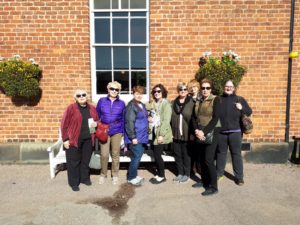
AND A GOOD TIME WAS HAD BY ALL – THE COUNTRY HOUSE TOUR

I’m pleased to say that Number One London’s Country House Tour was a resounding success and that a good time was had by all! Our group was the perfect size – eight like-minded people traveling together through Derbyshire in search of houses, history and a whole lot of fun.

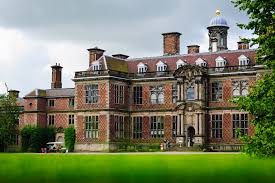
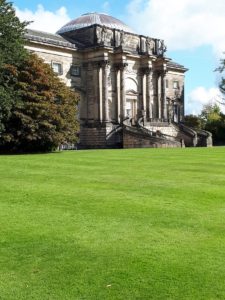
Of course, the Tour included stately homes, amongst them were –

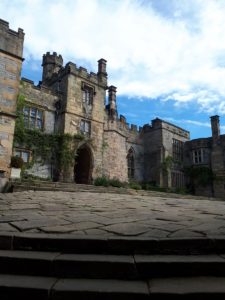
Kedleston Hall
Haddon Hall
Sudbury Hall

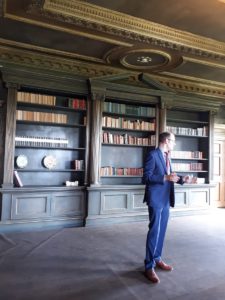
Along the way, we met house stewards and curators who provided our group with private, behind-the-scenes tours –

Wentworth Woodhouse

And we were fortunate enough to be joined by author Catherine Curzon, who spoke to us about the Georgian Royals over lunch at Chatsworth House

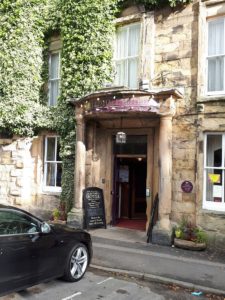
Our group stayed in the historic Old Hall Hotel in Buxton, below . . .

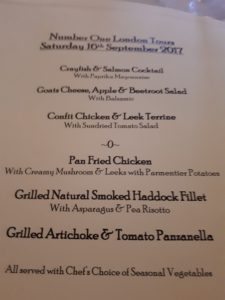
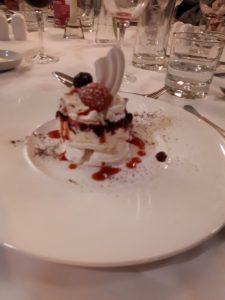
which provided us with atmospheric accommodations and memorable meals


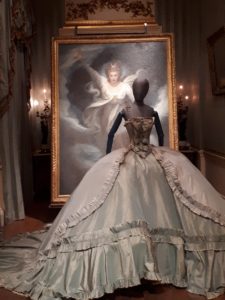
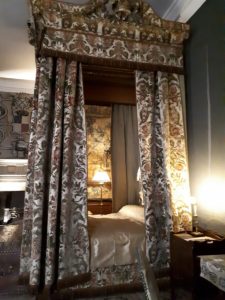
In addition to stately homes, we were also able to study examples of historic fashion and furnishings

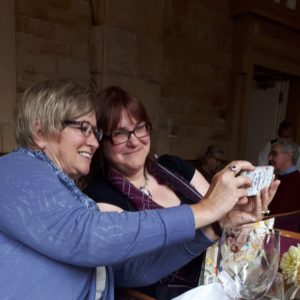
We found photo opportunities around almost every corner

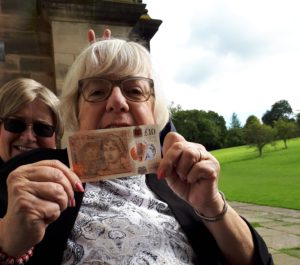
And a few of us were lucky enough to find the new Jane Austen ten pound note

Victoria Hinshaw and Sandra Mettler

I’ll be doing future posts on the individual sites we visited, but I wanted to take this opportunity to thank everyone who joined me on this Tour for making it so memorable, and so much fun!

If you’d like to join me on the next Country House Tour, this one with an Upstairs, Downstairs twist, please visit Number One London’s Tour website for complete details of the April 2018 tour.

REVISITING MINSTER LOVELL CHURCH AND RUINS

Originally published in 2010

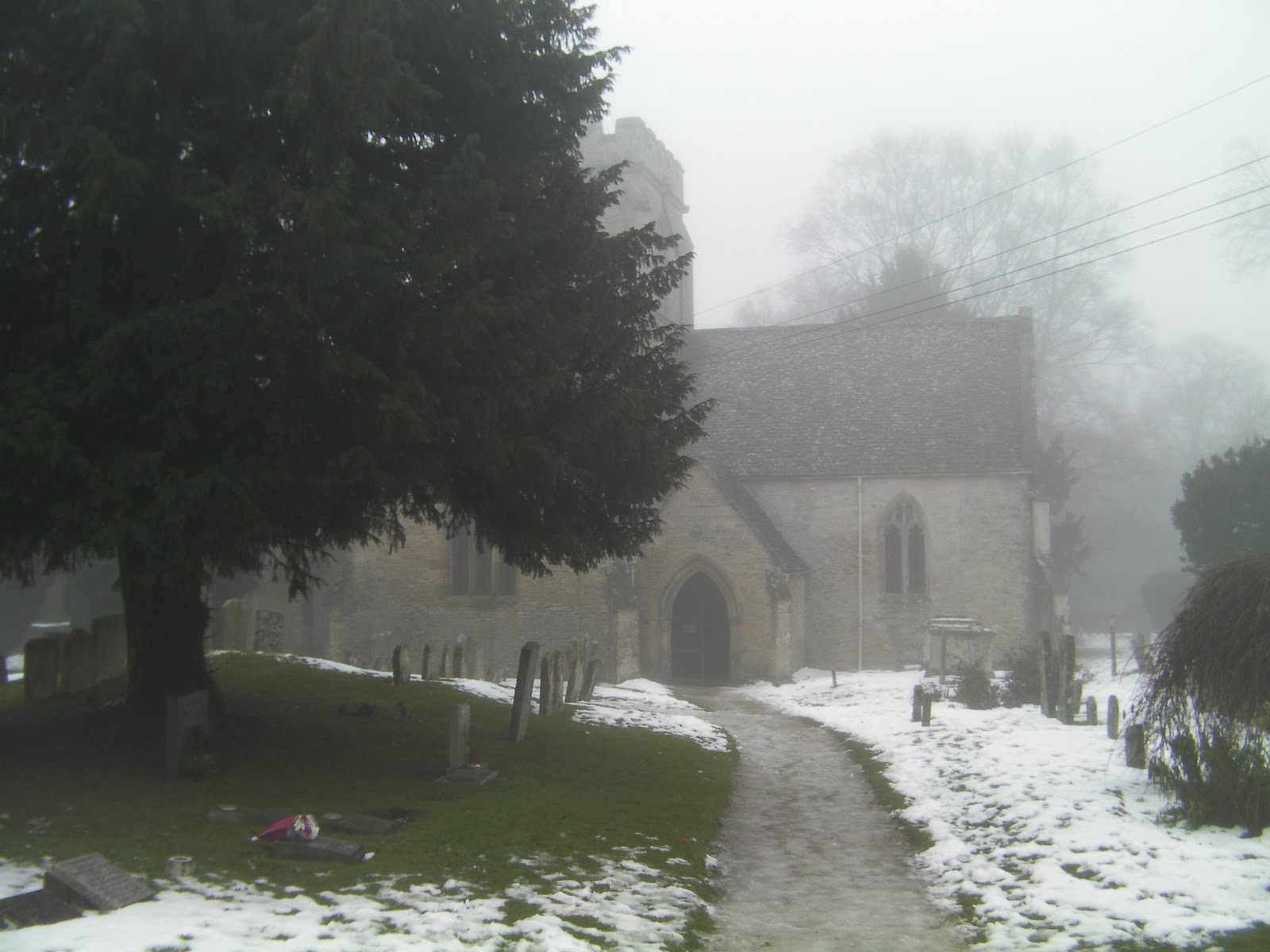
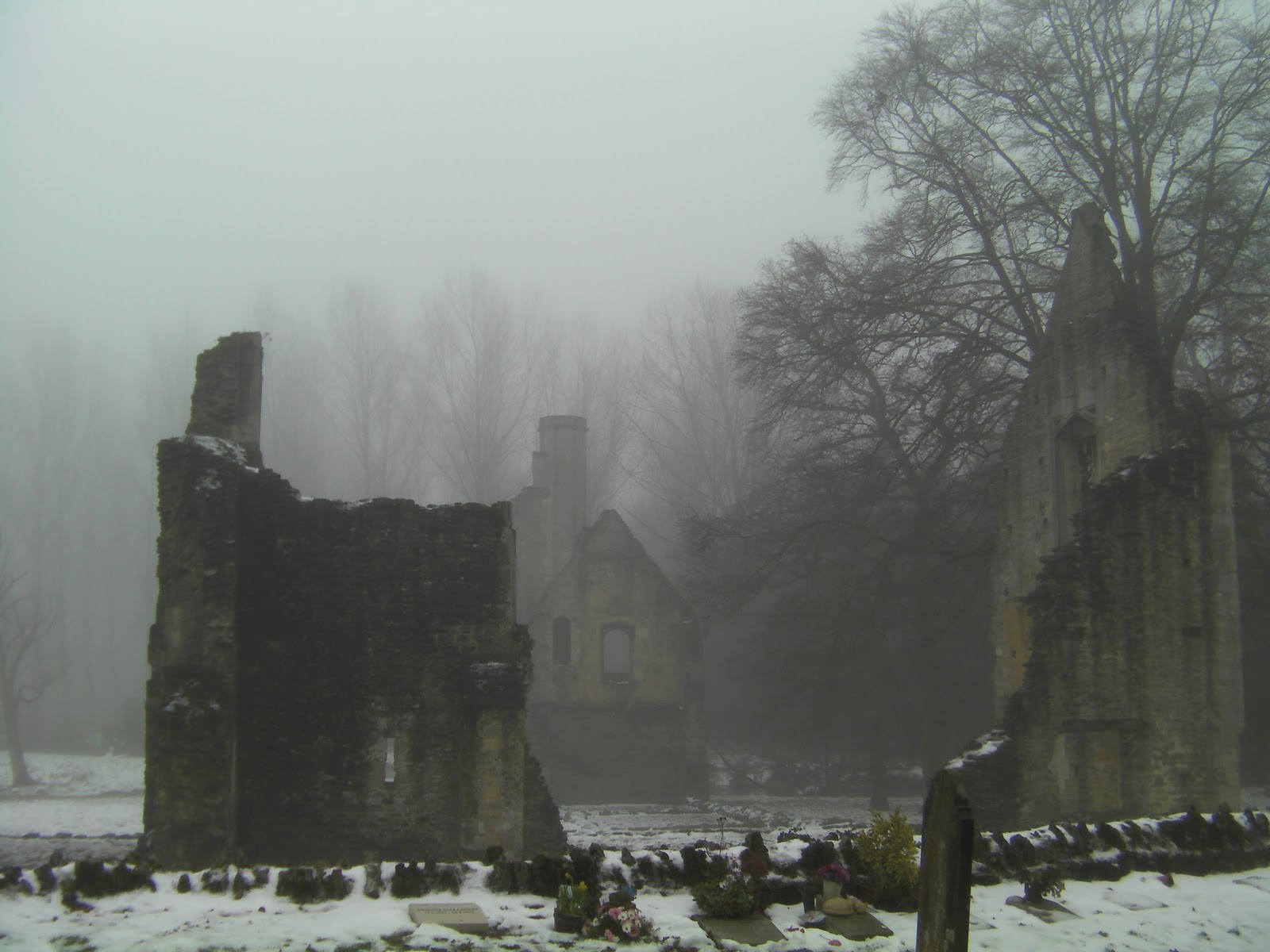
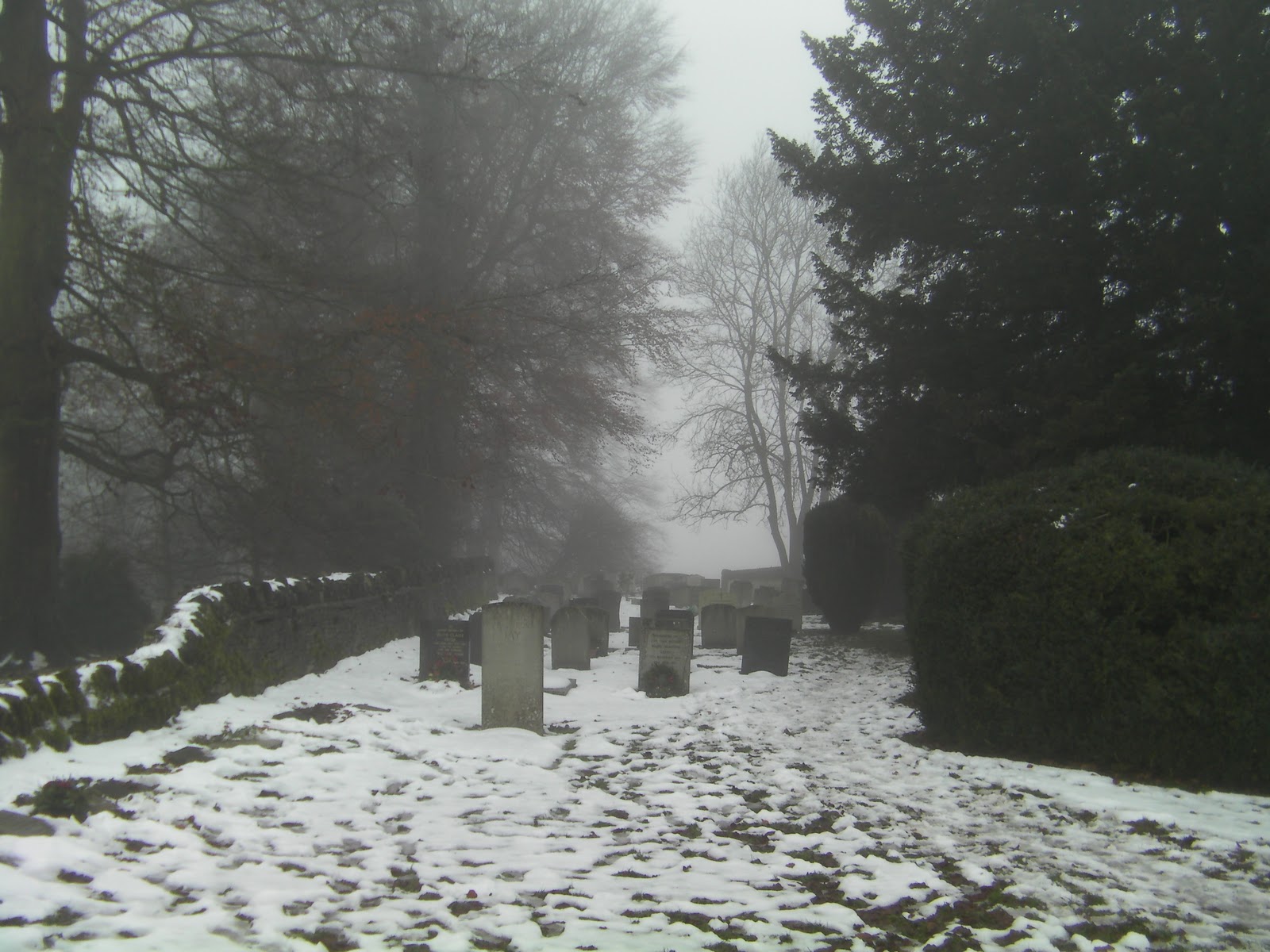
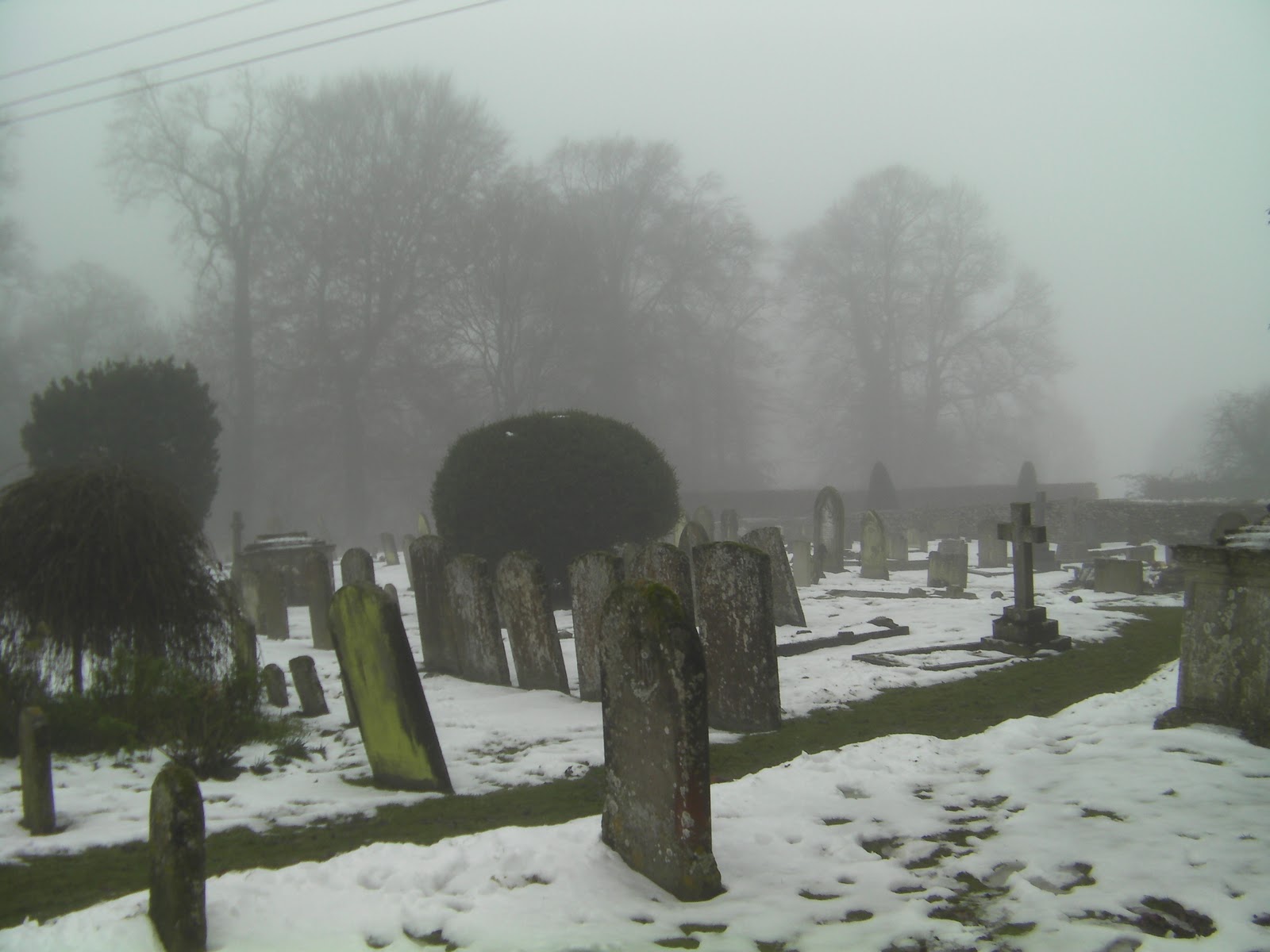
So, here we are at St. Kenelm’s Church on a cold, wet, foggy December day when our surroundings look for all the world like a Hammer Studios horror movie set. On the day we visited, the air was crisp and cold and the place was as deserted as it looks in the photos below. There was nary a footprint to be seen in the graveyard and it was so quiet that you could hear the snow crunch beneath your boots with each step. . . no one spoke . . . . . no one dared to break the eerie silence as we made our way through the ancient tombstones . . . . .  don’t be afraid – I’m sure the legends of the Minster Lovell Hall ghost are just rumour . . . . . . . .

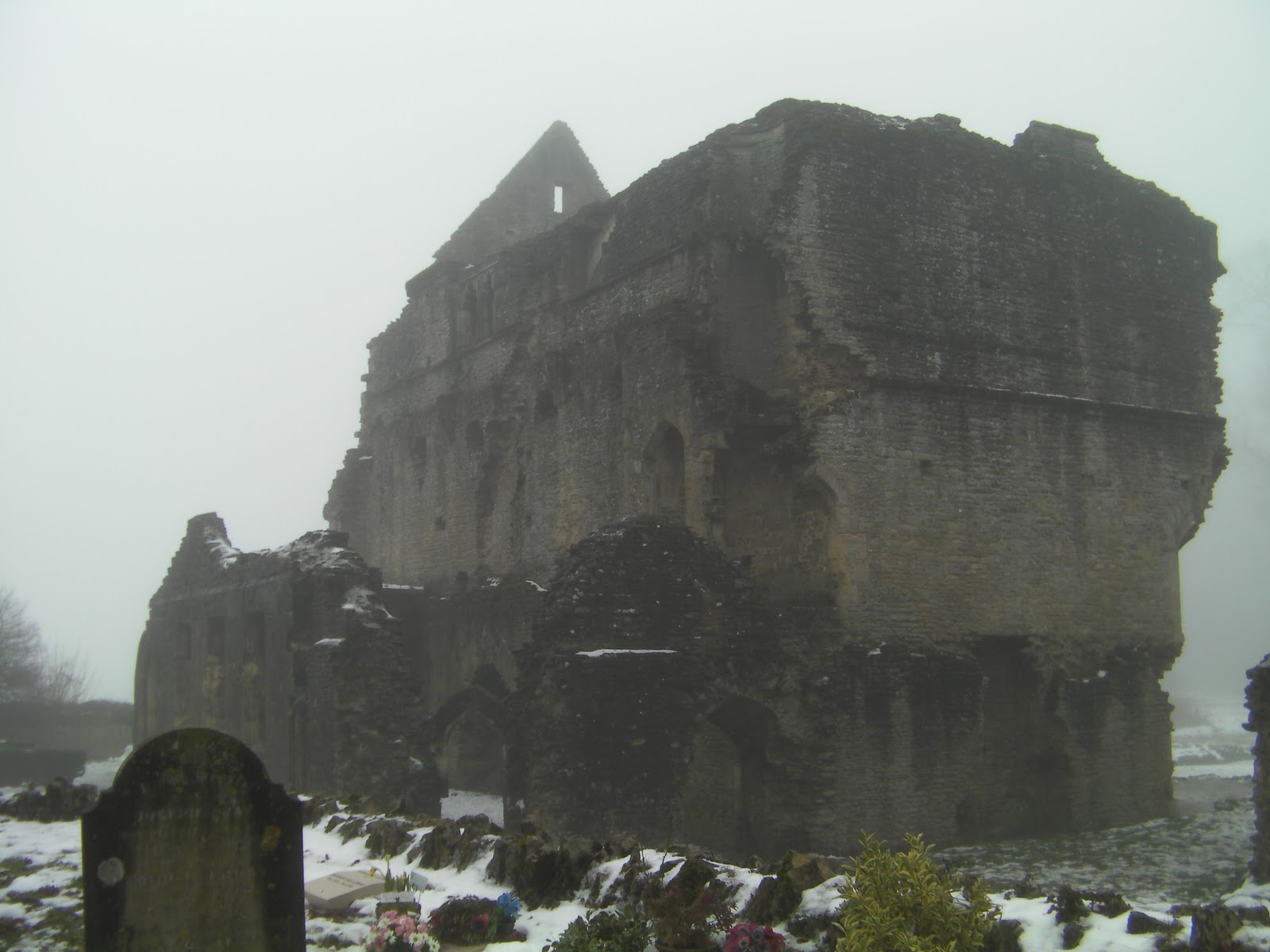
St Kenelm’s church in Minster Lovell (above) is mainly 15th century, built on the foundations of an earlier priory minster. This explains the unusual cruciform shape with a central tower. The whole church is “almost entirely unaltered and has handsome details” (Pevsner). It is situated next to the ruins of Minster Lovell Hall, pictured below.

From Kelly’s Directory 1891 – To the south-east of the church, near the river Windrush, are the ruins of an ancient mansion, formerly the residence of the Lovell family: the buildings, when perfect, formed a square, the south side being parallel to the river and within a few feet of its bank; the whole of the south and east sides are now destroyed and the only portions standing are the north side, part of a tower at the south end of the western side and a low wall attached to it, with several fine but now roofless and dismantled apartments; in 1708, during the rebuilding of a chimney here, a large vault was discovered in which was found the entire skeleton of a man sitting at a table on which were writing materials and a book and it has been assumed that Lord Lovell, who disappeared after the battle of Stoke, made his way to his house here, and concealing himself in this vault, was eventually starved to death; on his death, his titles, including the baronies of Lovell and Holland, Dean Court and Grey of Rotherfield, became extinct, and that of Beaumont fell into abeyance between his sisters, but was called out 16 Oct. 1840, in favour of Miles Thomas Stapleton esq. of Carlton, Yorks, one of the co-heirs thereto. The estates of the Lovells, confiscated by Henry VII, were subsequently granted to the Comptons, Cecils and other powerful families.

** An alternate version of the story of Lord Lovell is that he returned with his faithful dog to the Hall and was locked into the secret chamber by his faithful valet, who breathed not a word of Lord Lovell’s whereabouts to a single soul and who came twice a day to feed his master and his master’s dog. The valet, unfortunately, died before he could share his secret with anyone and so Lord Lovell and the faithful dog perished together, starving to death in their self imposed hiding place.

*** Yes, the place is rumoured to be haunted. By both man and dog.  And what a perfect location for a ghost, visually. You couldn’t get much more Byron-esque if you tried.

I’ll leave you with images that are sure to conjure up visions of Christopher Lee . . . . .

A MACABRE LOOK AT DEATH MASKS

Benjamin Disraeli
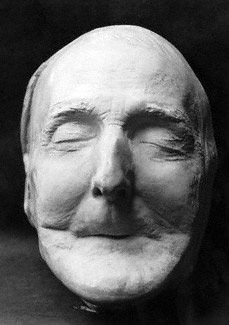
Sir Issac Newton
Viscount Henry Palmerston


Richard Brinsley Sheridan

Originally published October, 2010

Recently, I came across a book online called The Laurence Hutton Collection of Life and Death Masks: A Pictorial Guide by John Delaney, held in the Manuscripts Division in the Department of Rare Books and Special Collections at Princeton University Library. The making of death masks became popular in the 1800s, but the practice has much older roots. The first masks and effigies made in wax directly from the features of the deceased date from medieval Europe. Personally, I don’t get death masks. All of the people from whom death masks were taken were prominent people who had had numerous portraits and busts taken during their lifetimes. Why not remember them thusly, in the prime of their lives, rather than take an image of them in old age – withered, toothless and, more often than not, after having just suffered hours of agony? Perhaps my aversion to death masks is a woman thing. After all, I’ve yet to come across the death mask of a female.

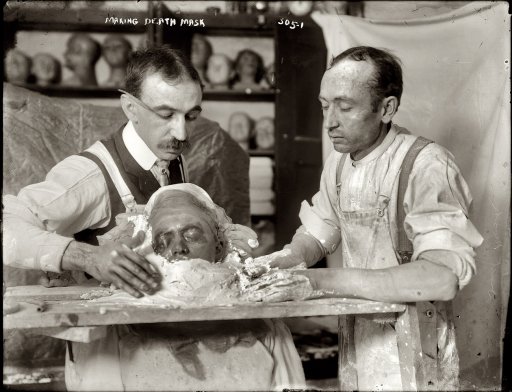
Making a plaster death mask, New York circa 1908, George Grantham Bain Collection, Library of Congress
I’d much rather remember, and hang on my wall, a picture of the Duke of Wellington looking like he does in the banner of this blog rather than like this:

 The Duke of Wellington

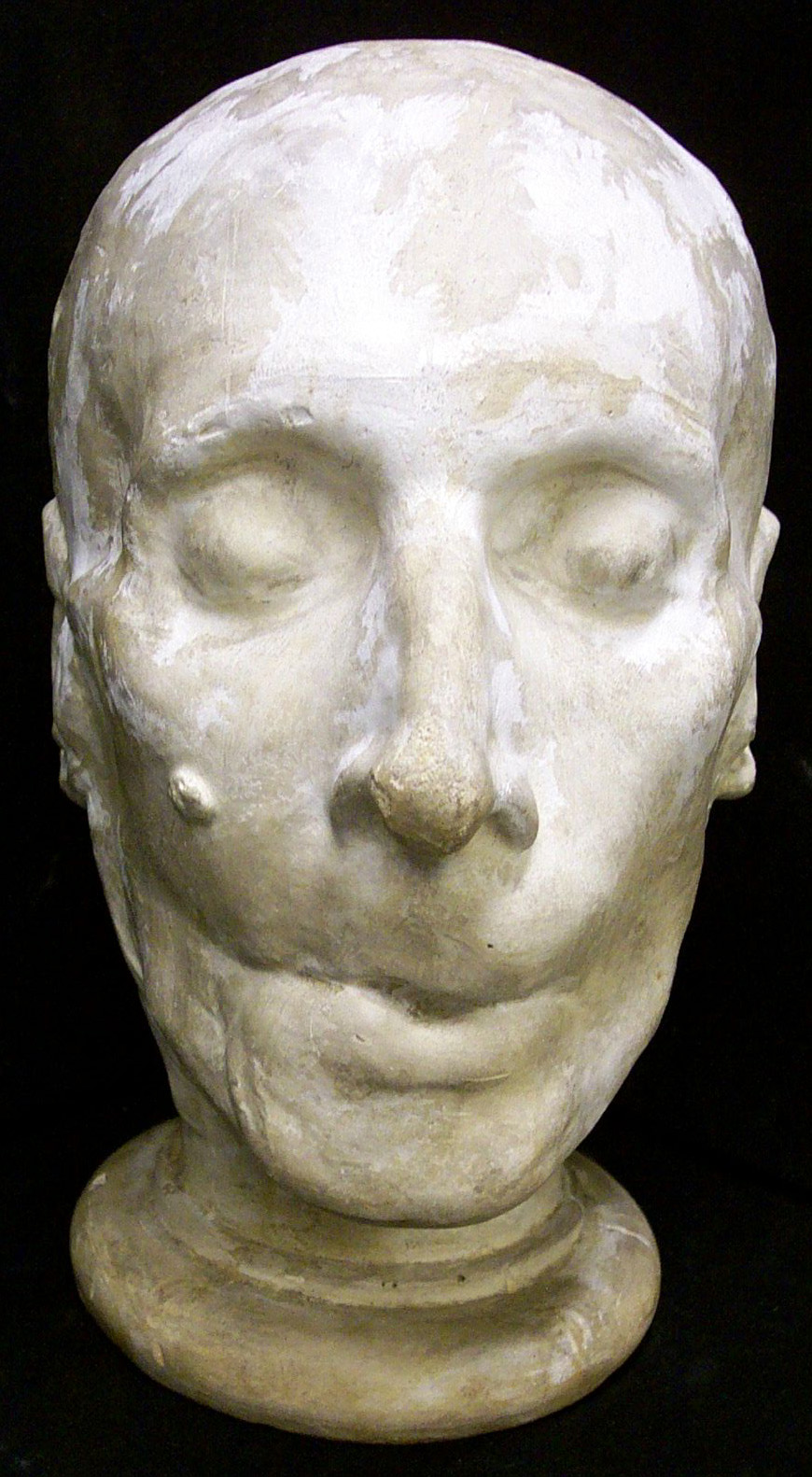
In a volume titled, “The life of Richard Owen”, by Rev. Richard Owen (1894) there is reference to the death mask above in a letter written on November 13, 1852, to Mr. Thomas Poyser, of Wirksworth : ” I have been particularly favoured in respect of the remarkable solemnities in honour of the memory of the great Duke. The present amiable inheritor of the title called on me last Wednesday to request that I would call on him to see the cast that had been taken after the Duke’s demise, and give some advice to a sculptor who is restoring the features in a bust, intending to show the noble countenance as in the last years of the Duke’s life. It is a most extraordinary cast. It appears that the Duke had lost all his teeth, and the natural prominence of the chin and nose much exaggerates the intermediate space caused by the absorption of the alveoli. He of course wore a complete set of artificial teeth when he spoke or ate. My last impression of the living features is a very pleasing one. I brought it away vividly in my mind from Lord Ellesmere’s great ball last July.”
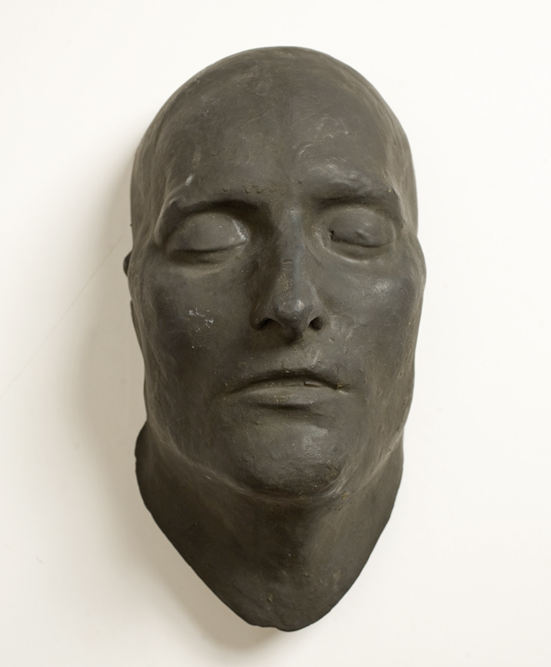
Napoleon’s Death Mask
Or is it? Is this the face of a short and rather dumpy fifty-one year old man? Napoleon died on May 5th, 1821, on the small island of St. Helena where he had been exiled for life after his shattering defeat at the Battle of Waterloo in 1815. A cast for a death mask was made by Dr. Francis Burton within a day and a half of Napoleon’s death. But, there was another doctor present at the time of Napoleon’s death, Dr. Antommarchi, who some say was mistakenly credited as the doctor who made the original mold. Immediately after the cast was made, it was stolen. It is believed that a woman named Madame Bertrand, Napoleon’s attendant, took the mold and sailed back to England. Dr. Burton tried but was unsuccessful in getting the cast back. Several years later a death mask turned up and was authenticated as being the original by Dr. Antommarchi, though historians have always argued against it, as the Antommarchi mask looked much too young to have been Napoleon, no to mention that bones of the face are heavier, the face itself longer and proportionally different when compared to the portraits that had been painted of the Emperor Napoleon. It is the official mask currently on display at Les Invalides in Paris, France.
Some believe that the death mask above was actually molded from the living face of the Emperor’s valet, Jean-Baptiste Cipriani. This is the mask that is thought to be authentic:

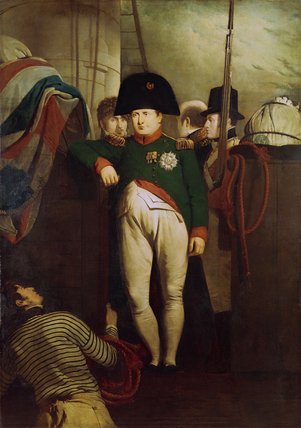
This death mask was on display at the Royal United Services Institute Museum in London for many years prior to 1973, when the mask was sold. You decide . . . . . here is one of the last portraits of Napoleon, painted by Sir Charles Lock Eastlake on board the ship Bellerophon.

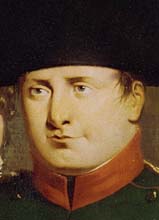
And here is an enlargement of the face  

Viola. Ze case it has rested. At least in my mind.

And the strange tales concerning death masks continue – It seems that there was once a special tunnel used to transport the bodies of the hanged from Worcester Gaol to the nearby Royal Infirmary, which stood across the road from the prison and has since been demolished. Until 1832, only criminals’ bodies were allowed to be dissected for medical research in the UK. The tunnel was found during work to transfom the former hospital into the new campus for the University of Worcester in the 1950’s – as were a number of death masks in the tunnel. These casts had been made to study the characteristics of the criminals’ personalities using physiognomy (shape and size of the head) and phrenology (study of the site of different abilities on the head), once thought to be useful in predicting criminal behaviour. The masks are now on display at the George Marshall Medical Museum in Worcester.
Perhaps the strangest story concerning a death mask – and physiognomy – is that involving Gershon Evan, who went on to live another 64 years after his mask was taken. In September 1939, 16 year old  Evan was arrested along with 1,000 other young Jewish men and taken to Vienna’s Prater Stadium, where all were detained for weeks. Seeking out those with classic “Semitic” features, Nazi scientists — a commission of the anthropology department of the Natural History Museum — selected 440 men for study. Hair samples, fingerprints, hereditary/ biological appraisals and numerous photographs of the men were taken. The length and width of their noses, lips, chins and other facial features were meticulously documented. Evan was one of them. Soon after, Evan was ordered to submit to having a death mask taken.
“My head on the pillow, I stretched out on the table and closed my eyes,” he recalled in his memoirs years later. “The man advised me to relax, while he coated my face with a greasy substance. He applied it from the top of my forehead down to the throat and from ear to ear. The lubricant, he explained, was to prevent the hardened plaster of Paris from sticking to my skin.” At the end of the procedure, the death mask was removed, catalogued and archived. Evan was given a single cigarette for his troubles before being moved to Buchenwald, from where he was miraculously released four months later. At age 80, Evan was shown his preserved death mask and barely recognised himself in the youthful face held between the hands of a museum curator.

For more on death masks, including instructions on how to make one, visit Carlyn Becchia’s Raucous Royals blog.

A TOUR GUIDE IN ENGLAND: WATERLOO 2017 – PART 4

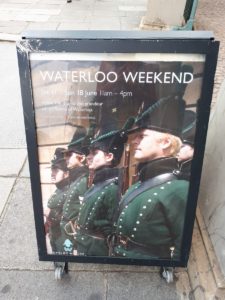
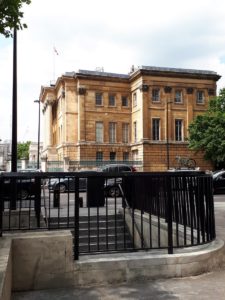
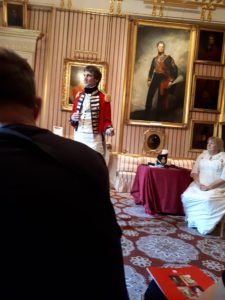
What better place to spend Waterloo Day than in London? More precisely, at Apsley House. Well before the day, I had planned to meet my old mates Dawn Wood and Andrew Clark at Apsley House, where they were slated to do a series of talks on Regency dress and Napoleonic uniforms over the two day weekend.

Upon walking through the front door of the House, I saw one of the house guides, Alex, who I’ve known for some time now. We chatted for a few minutes and then I headed up the stairs to the Striped Drawing Room.

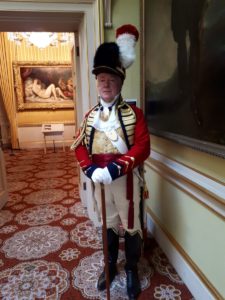
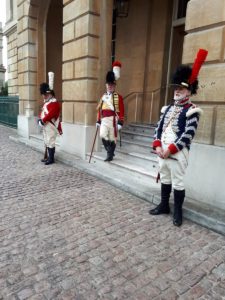
Upon reaching the landing, I spied a bloke in full Napoleonic uniform – it was my pal, Michael Paterson, who is a part of the City of London Portsoken Volunteers re-enactment group.

“Michael?”

“Kristine? What are you doing here?”

“Where else would you expect me to be on Waterloo Day?”

“Ah, right. Silly question.”

It would have been handy had I snapped a photo of Michael to insert here, but I didn’t. This is John Mead, also with the Portsoken, and an historical tailor who makes all of the Regiments’ uniforms. Michael was on hand to present a talk on Napoleonic soldiers, which was fabulous. He had the crowd enraptured.

Before long, Dawn found me and we caught up for a bit before it was time for her talk.


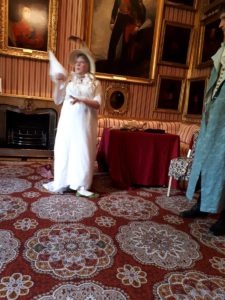
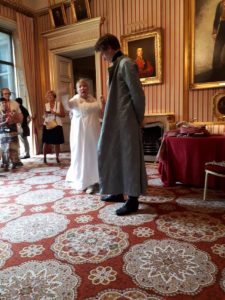
Into the Striped Drawing Room we stepped and Dawn launched into her costume presentation, enthralling the crowd with details of exactly what it took to dress a Regency lady – from the inside out. Beginning in her chemise, Dawn then described each garment she donned, giving us the history of each, detailing the materials that would have been used and the care involved in each piece.

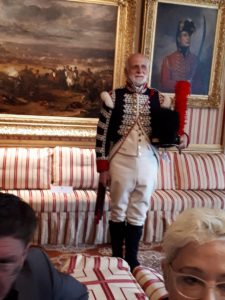
I first met Dawn a few decades ago when she was with a re-enactment group called The Salon, now disbanded, who put on a Regency soiree for one of my tour groups at Gunnersby Park. She and I, and her husband, Andrew, have been friends ever since and they will be on hand in Bath for Number One London’s Georgian Tour, April 2018. Dawn is a modiste who recreates historic costume and dress, while Andrew is an expert on uniforms and all forms of military weapons and accouterments. Here he is in full Napoleonic kit as Captain Clark.

And here he is in mufti as Mr. Clark. Very versatile is Our Andrew.


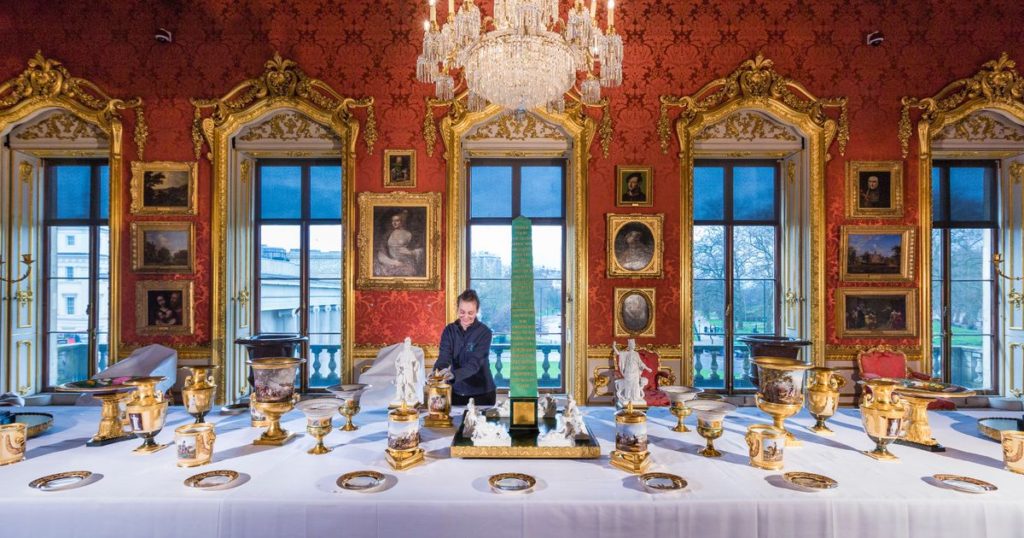
Once the presentations were over with, I nipped off to the Waterloo Chamber, where in honour of the Waterloo Anniversary they had set a dinner table with the Prussian Dinner Service commemorating the achievements of Wellington’s life, as it would have been at one of Wellington’s annual Waterloo Banquets.

copyright Getwestlondon

You’ll find an article on the china here. Upon entering the Chamber, who did I run into again but Alex, who asked me about Wellington’s relationship with the young Queen Victoria. As I was telling him about William IV’s fateful birthday dinner, at which the King stood up and gave spleen to the Duchess of Kent in front of all the guests at table, including Wellington, a gentleman came to stand beside us and listened to my story. Then he interjected something. Then he became a part of our conversation and we chatted about Wellington for about fifteen minutes. Then the man said, “I suppose this is the point in the conversation where I should mention that I’m Graham Wellesley, 8th Earl Cowley.”

Naturally, this pronouncement caused Alex and I to look at one another like two deer caught in the headlights. What a turn up. Oh, dear.

“You’re Henry’s grandson then,” said I. He’s actually Henry’s eight or ninth great grandson, but why split heirs.

“Yes,” replied the Earl. “Fancy your knowing that.” Alex shot me a look, but kept silent. Wise man.

“May I ask you a question?” I asked the Earl.

“Of course.”

“Why has no one elaborated on the story of Henry and Anne and the kidnapping?”

And we were off again. The conversation lasted at least another fifteen minutes before the Earl excused himself and left Alex and I alone once more.

“I didn’t refer to Wellington as ‘Artie’ in front of the Earl, did I?”

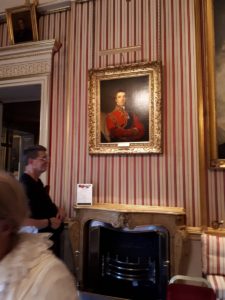
“No. Not in front of the Earl. I don’t think,” Alex semi-reassured me. Really, I must stop doing that. Obviously, one never knows who one may run into at Apsley House. Speaking of which, upon returning once more to the Striped Drawing Room, who did I find but my mate, Loretta Chase. You can just see the top of her beautiful blonde head in the photo below.

Loretta and I had already seen each other several times in London during this trip and I’d invited her to join me at Apsley House on the day. Imagine my surprise when she told me that she’d never been to the House in all her visits to London. I had promised to take her on a Cook’s Tour.  I suggested we start on the ground floor and so we sashayed our way downstairs. Where I again ran into Alex.

“Leaving?” he asked.

“No, no, just giving my friend Loretta a tour of the House.”

“Oh, right then.”

“Don’t they think it’s strange that you’re giving me a tour of Apsley House?” Loretta asked as we turned a corner.

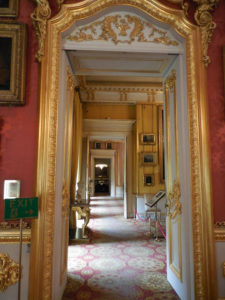
“Nope. Not in the least. I suppose they’re used to it by now.” We saw the entry hall –

and the inner hall –

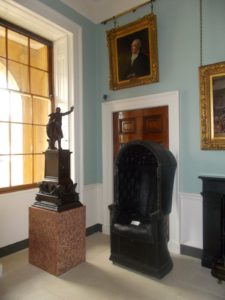
and the statue of Napoleon –

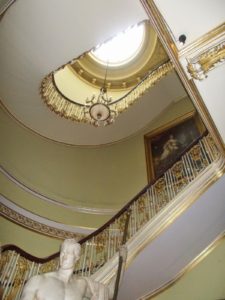
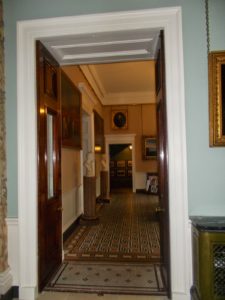
and the upstairs hallway –

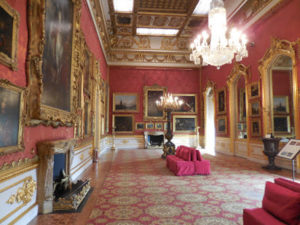
and several other rooms before we found ourselves in the Waterloo Chamber.

Where I showed Loretta a secret feature of the room. I wish I could share it with you, but I’ve promised Loretta that she can use it as a plot device in an upcoming book, so I can’t talk about it until that’s published. (Sorry!)
At the end of the day, I left Apsley House replete after seeing old friends and making a few new ones and headed off to dinner in the company of Dawn and Andrew, who both agree with my sentiment – where else would anyone spend Waterloo Day?