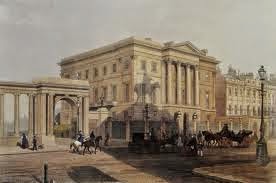
THE LONDON POST OFFICE 1850 – Part One

In this series, we turn to the words of Mr. Charles Dickens which appeared in the March 30, 1850 edition of the publication he edited, Household Words. The following article is chock full of details about how the Post Office operated in Victorian London and also about the mail and other items it processed on a daily basis.

The piece follows the progress of two gentlemen who make a visit to the Post Office –


Great National Post-Office in St. Martin’s-le-Grand

Most people are aware that the Great National Post-office in St. Martin’s-le-Grand is divided into halves by a passage, whose sides are perforated with what is called the ” Window Department.” Here huge slits gape for letters, whole sashes yawn for newspapers, or wooden panes open for clerks to frame their large faces, like giant visages in the slides of a Magic Lantern; and to answer inquiries, or receive unstamped paid letters. The southern side is devoted to the London District Post, and the northern to what still continues to be called the “Inland Department,” although foreign, colonial, and other outlandish correspondence now passes through it. It was with the London District Branch that the two gentlemen first appeared to have business.

Having been led through a maze of offices and passages more or less dark, they found themselves—like knights-errant in a fairy tale—” in an enormous hall, illumined by myriads of lights.” Without being exactly transformed into statues, or stricken fast asleep, the occupants of this hall (whose name was Legion) appeared to be in an enchanted state of idleness. Among a wilderness of long tables, and of desks not unlike those on which buttermen perform their active parts of legerdemain in making ” pats”—only these desks were covered with black cloth—they were reading books, talking together, wandering about, lying down, or drinking coffee—apparently quite unused to doing any work, and not at all expectant of ever having anything to do, but die.

In a few minutes, and without any preparation, a great stir began at one end of this hall, and a long train of private performers, in the highest state of excitement, poured in, getting up, on an immense scale, the first scene in the ” Miller and his Men.” Each had a sack on his back; each bent under its weight; and the bare sight of these sacks, as if by magic, changed all the readers, all the talkers, all the wanderers, all the liers-down, all the coffee-drinkers, into a colony of human ants.

For the sacks were great sheepskin bags of letters tumbling in from the receiving-houses. Anon they looked like whole flocks suddenly struck all of a heap, ready for slaughter; for a ruthless individual stood at a table, with sleeves tucked up and knife in hand, who rapidly cut their throats, dived into their insides, abstracted their contents, and finally skinned them. “For every letter we leave behind,” said the bagopener, in answer to an inquiry, ” we are fined half-a-crown. That’s why we turn them inside out.”
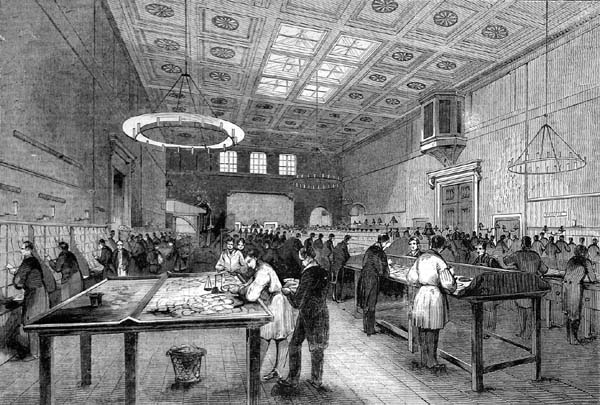
The mysterious visitors closely scrutinised the letters that were disgorged. These were from all parts of London to all parts of London and to the provinces and to the far-off quarters of the globe. An acute postman might guess the broad tenor of their contents by their covers:—business letters are in big envelopes, official letters in long ones, and lawyers’ letters in none at all; the tinted and lace-bordered mean Valentines, the black-bordered tell of grief, and the radiant with white enamel announce marriage. When the despatch of the Fleet-street receiving-house appeared the visitors tracked it, and the operations of the clerk who separated the three bundles of which it consisted were closely followed. With the prying curiosity which now only began to show itself, one of the intruders took a copy of the bill which accompanied the letters. It set forth in three lines that there were so many ” Stamped,” so many ” Prepaid,” and so many ” Unpaid.”

The clerk counted the stamped letters like lightning, and a flash of red gleaming past showed the inquirers that one of their epistles was safe. Suddenly the motion was stopped; the official had instinctively detected that one letter was insufficiently adorned with the Queen’s profile, and he weighed and taxed it double in a twinkling. Having proved the number of stamped letters to be exactly as per account rendered, he went on checking off the prepaid, turning up the sender’s green missive in the process. He then dealt with the unpaid, amongst which the lookers-on perceived their yellow one. The cash column was computed and cast in a single thought, and a short-hand mark, signifying ” quite correct,” dismissed the Fleet-street bill upon a file, for the leisurely scrutiny of the Receiver-General’s office. All the other letters, and all the other bills of all the other receiving-houses, were going through the same routine at all the other tables; and these performances are repeated ten times in every day, all the year round, Sundays excepted.

” You perceived,” said one of the two friends, “that in the rapid process of counting our stamped letter gleamed past like a meteor, whilst our money-paid and unpaid epistles remained long enough under observation for a careful reading of the superscriptions.”

“That delay,” said an intelligent official, “is occasioned because the latter are unstamped. Such letters cause a great complication of trouble, wholly avoided by the use of Queen’s heads. Every officer through whose hands they pass—from the receiving-house-keeper to the carriers who deliver them at their destinations—has to give and take a cash account of each. If the public would put stamps on all letters, it would save us, and therefore itself, some thousands a year.”

” What are the proportions of the stamped to the prepaid and unpaid letters which pass through all the post-offices during the year?”

” We can tell within a very near approximation to correctness: 337,500,000 passed through the post-offices of the United Kingdom during last year, and to every 100 of them about 50 had stamps; 46 were prepaid with pennies; and only 4 were committed to the box unpaid.”

While one of the visitors was receiving this information, the other had followed his variegated letters to the next process; which was that of stamping on the sealed face, in red ink, the date and hour of despatch. The letters are ranged in a long row, like a pack of cards thrown across a table, and so fast does the stamper’s hand move, that he can mark 6000 in an hour. While defacing the Queen’s heads on the other side, he counts as he thumps, till he enumerates fifty, when he dodges his stamp on one side to put his black mark on a piece of plain paper. All these memoranda are afterwards collected by the president, who reckoning fifty letters to every black mark, gets a near approximation to the number that have passed through the office.


 

Part Two Coming Soon!

ON THE SHELF – PATRICK LEIGH FERMOR: A LIFE IN LETTERS

by Kristine Hughes Patrone

Selected and edited by Adam Sisman, a New York Review Book, 2016 (available through Amazon)

I have so much to thank James Lees Milne for, really. It was through reading his diaries and letters that I have found so many flamboyant, larger-than-life, madcap and  interesting people. He introduced me to a circle of his friends and acquaintances and a time period that has become one of my favourite: England between and just after the War(s). One of the people Mr. Lees-Milne introduced me to is Patrick Leigh Fermor, whose author bio on Amazon reads thus:

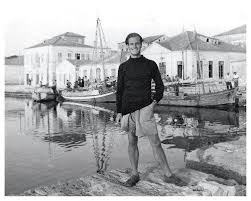
“In December 1933, at the age of eighteen, Patrick Leigh Fermor (1915-2011) walked across Europe, reaching Constantinople in early 1935. He travelled on into Greece, where in Athens he met Balasha Cantacuzene, with whom he lived – mostly in Rumania – until the outbreak of war. Serving in occupied Crete, he led a successful operation to kidnap a German general, for which he won the DSO and was once described by the BBC as ‘a cross between Indiana Jones, James Bond and Graham Greene’. After the war he began writing, and travelled extensively round Greece with Joan Eyres Monsell whom he later married. Towards the end of his life he wrote the first two books about his early trans-European odyssey, A Time of Gifts and Between the Woods and the Water. He planned a third, unfinished at the time of his death in 2011, which has since been edited by Colin Thubron and Artemis Cooper and published as The Broken Road.”

A potted history, to be sure, and a fuller bio can be found on Wikipedia. A respected British author and travel writer, PLF also felt a pull to Greece, where he travelled extensively and eventually built a house along with his wife, Joan.

Desk in Fermor’s garden near Kardamyli, 2007 copyright R. de Salis, Wikipedia

But it’s PLF’s circle of friends, also his correspondents, that make this book so interesting. Here again we meet Duff and Diana Cooper, the Devonshires, Andrew and Debo, Evelyn Waugh, Ann Fleming, Cyril Connolly, Lawrence Durrell and a host of others who seemingly all lived out sized lives and who are all people with whom one would have loved to share the odd shaker of martinis. The one slight quibble I had with this book is that it only contains PLF’s letters to people, and none from them, but this can hardly be seen as a flaw when the writing is this good.

While in an army hospital in Surrey recovering from pneumonia in February, 1940, PLF wrote the following to Adrian Pryce-Jones:

“Last night something marvellous happened. I am just being tucked up for the night, when I hear strange foreign noises outside the door, which opens, and in bursts Anne-Marie Callimachi (1) followed by Costa (2). She was dressed in black satin and dripping with mink, with pearls and diamonds crusted at every possible point, topped by the maddest Schiaparelli hat I’ve ever seen. Then Costa, who is very dark, with a huge grin, and quite white hair at the age of thirty. He was dressed in a bright green polo jersey over which he wore a very long black new coat with an immense astrakhan collar: both laden with huge presents. The nurses were struck dumb. Shrill squeals burst from us all, and then we were gabbling the parleyvoo like apes. The nurses fled in  disorder. Then, of course, they couldn’t get a taxi as Anne-Marie had left the Rolls Royces etc. in London; but they had their luggage, and stopped the night at the hospital! We all pretended they were married, so the Sister, with girlish squeaks, got their room ready, with screens coyly arranged between the beds. By this time Costa was telephoning to the Ritz to say Her Highness wouldn’t be back that night, his voice echoing down the passages. The sensation in the hospital was absolutely phenomenal. Huge princely coronets on the luggage – such nighties! Slippers! Oh!! The hospital hasn’t recovered yet, and my glamour value among the nurses is at fever pitch. . . . They left this morning, Anne-Marie leaving a munificent cheque for the Hospital Fund, which I tendered with a languid gesture to the head doctor. Their passage will not be forgotten for ages!”

Fourteen years later, in September 1954, such hobnobbing with the cream of society was still in full flow. PLF writing to Ann Fleming from Hydra:

“Diana’s (Lady Cooper) presence proved a magnet for other yachts, first of all Arturo Lopez (3) in a vast sodomitical-looking craft, done up inside like the Brighton Pavilion, a mandarin’s opium den and the alcove of Madame de Pompadour. . . but this is nothing compared to five days ago, when a giant steam yacht (with a aeroplane poised for flight on the stern) belonging to Onassis came throbbing alongside. . . . On board were Lilia Ralli, several blondes, a few of the zombie-men that always surround the immensely rich, Pam Churchill & Winston Jr.”

We can forgive PLF his forays into the world of the rich and famous, not only because they’re so amusing, but as these brief interludes are tempered with quiet, bucolic and often mundane passages. To Jessica Mitford, PLF wrote in 1983, “Went to a marvelous sheep sale yester’een with Debo (her sister, Deborah, nee Mitford, Duchess of Devonshire), it was wonderful, faces like the whole of Gilray and Rowlandson, and an auctioneer haranguing, in what sounded like Finnish but was just rustic north country. This is the sort of whirl I like to  live in.”

PLF’s friends were generous as well as amusing, several of them allowing he and Joan to use their homes whenever they chose, as was the case with Gadencourt, a manor house in Normandy owned by Sir Walter and Lady Smart – to Patrick Kinross, February 1952 – “They frightfully kindly  let me live here for the whole winter. Why don’t you come and move in on your way home?” He also often stayed at a mansion owned by artist Niko Ghika on Hydra. PLF wrote, “He was seldom there, and, with boundless generosity, he lent it to Joan and me for two years.” Additionally, PLF was a regular house guest of such friends as Lady Diana Cooper, staying at her house in Chantilly and the Duke and Duchess of Devonshire, spending many Christmas’s with them at Chatsworth House. In February 1960 PLF wrote to Ann Fleming, “Christmas was glorious and went on for ages, consisting of Andrew, Debo and children, Andrew’s mother, Nancy (Mitford) and Mrs. Hammersley, for whom I developed a reciprocated passion. She strikes a wonderful note of bilious gloom about anything.”

Joan and Patrick would eventually build a house in Greece and spent many of their happiest years there, coming back to England regularly and staying at Joan’s family home in Devon. Occasionally, PLF stayed at the Easton Court Hotel in Devon, especially when he was seeking solitude in which to write. In a letter to Lady Diana Cooper, September 1956 –

” . . . . My muse and I are cloistered here, a gale howls down the chimney, cats and dogs come down on the sodden fields outside in an almost unbroken stream and a wind blows that would unhorn cows. I don’t think you’ve ever been here, but it’s a great retiring place for literary purposes, for E. Waugh, & Patrick Kinross and others – I first came here seven years ago with Patrick . . . and have been back several times in extremis . . . It is owned & run by an odd couple, Mrs. Carolyn Postlethwaite Cobb, an elderly American of very improbable shape, now largely bedridden, and her middle-aged ex-lover Norman Webb, a Devonshire chap she met a number of decades ago running a team of donkeys in Biskra or Fez. . . . ”

I found that PLF and I had a lot in common in the end, very odd considering that I’m neither a man, British nor a lover of all things Greek and that I come from a different generation. In a letter to his publisher, Jock Murray in July of 1953, PLF writes that he’d travelled through Greece, finally arriving in Missolonghi by sea:

“Here the great search for Byron’s shoes began. I hadn’t got Lady Wentworth’s (4) letter with me, containing the address . . . I asked all over the town – mayors, local bigwigs, etc. – for a old man who had a pair of Byron’s shoes. . . I tracked him down in the end, a very decent, wall-eyed old man called Charalambi Baigeorgas or Kotsakaris . . . along with a lot of scimitars, yataghans, pistols, powder horns, etc., he produced a parcel, already addressed, on the strength of my letters last year, to Baroness Wentworth. . . . Since then, though, he seems to have fallen in love with them, and (rather understandably) wants to leave them to his children. . . He undid the parcel, and produced a pair of slippers that looked more Turkish, or Moroccan or Algerian (or Burlington Arcade oriental) than Greek . . . . I enclose a sketch and a description of the colours . . . the age looks just about right. I made a tracing of both of them, also of the parts of the soles where the criss-cross tooling is worn smooth, in case it should corroborate, or conflict with, known facts about Byron’s malformation.”

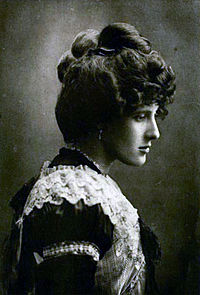
Lady Wentworth

Do admit, these are the sort of lengths I might conceivably go to if the artifact involved Wellington. There’s no information in the book regarding the outcome or provability of the shoe’s being Lord Byron’s but there is PLF’s description of Lady Wentworth herself, and it’ s a pip –

To Lady Diana Cooper, March 1954: “. . . The house (Crabbet Park, Sussex) is untidy as a barn – trunks trussed, and excitingly labelled `LD BYRON’S papers – LDY BYRON’S papers’ in chalk, pictures stacked, furniture piled, wallpaper, curtains etc. exactly the colour and shape of coloured Phiz or Leech . . . . gilt, faded plum and canary, v. grand and dusty. We had rather a mouldy luncheon, ending up with spotted-dog, in a room as full of papers, pictures, horsey accoutrements and favours as a jackdaw’s nest. Lady Wentworth was wearing, as usual, gym-shoes from playing squash, a Badminton skirt to the ground, a woollen shawl, a gigantic and very dishevelled auburn wig that looked as though made of strands from her stallions’ tails gathered off brambles, and on top of this a mushroom-like, real Sairey-Gamp mob-cap, but made of lace and caught in with a Nile-green satin ribbon. Rather a fine, hawky Byronic face under all this, but scarlet patches on the cheeks as from a child’s paint-box; I think she’s eighty-two or three – and a very thin, aristocratic, bleak voice – `have some more spotted-dog?’ sounding like a knell.”

PLF  was a writer with projects constantly on the go, but he was easily distracted by passing fancies, often missing deadlines and being forced to write the dreaded mia culpa letter to editors or friends to which he’d promised pieces.  In a letter to Lady Diana Cooper in November of 1975, PLF confesses: “Michael Stewart has sent us the Oxford Dictionary of English Place Names, which I’ve been deeply immersed in for the last two days: all their derivations, etc.” And to her son, John Julius Norwich, PLF writes: “Last year Jock Murray suddenly told me that about two hundred pounds had mounted up (in royalties) so I blew the lot on the DNB (Dictionary of National Biography) . . . so give me a few minutes notice and I can be pretty knowing about almost anyone in England – before 1900 – up to William Tytler (1711-1792) . . . it would be hard to find a more fascinating and time-wasting acquisition.” Both examples could be me to a T.

A Life In Letters is a delight, some parts reading like a travel book, other parts a glimpse into a vanished lifestyle, all of which is bound up with great friendships, anecdotal offerings and humour.


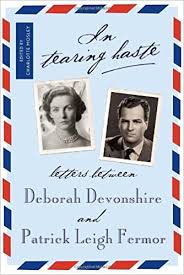
So, what will I read next? In Tearing Haste, edited by Charlotte Mosley, was one of PLF’s last projects and is a compilation of the letters exchanged between himself and Deborah, Duchess of Devonshire, over the course of a friendship that spanned more than forty years. However, having already read this when it was first published, I’m thankful that Patrick Leigh Fermor has led me to another possibility, as so often happens with the best books –

From a letter to Lawrence Durrell, November 1954 –

“. . . I’ve just got . . . Daphne’s (5) autobiography Mercury Presides . . . . which is rattling, splended stuff, not a bit the niminy-piminy society memoir you would think, but hell for leather, a mixture of lyrical charm and touchingness with a clumsy, rustic tough edge to it which is most engaging and terribly funny. Rather like the letters of Lady Bessborough or Caroline Lamb, half-sylph, half-stablehand.”

Leave a comment below in order to be entered
into a drawing to win a copy of this book! 


  1. Rumanian Princess Anne-Marie Callimachi.
  2. Greek photographer Costa Achillopoulos.
  3. Arturo Lopez-Willshaw, Chilean millionaire.
  4. Judith Anne Dorothea Blunt-Lytton, whose mother had been Byron’s granddaughter.
  5. Daphne Fielding, formerly Marchioness of Bath.

EARTHQUAKE!

On the 8th of February, 1750, an earthquake was felt in London, followed exactly a month afterwards by a second and severer one, when the bells of the church clocks struck against the chiming-hammers, dogs howled, and fish jumped high out of the water. Horace Walpole, in a letter to Sir Horace Mann, draws a lively picture of the effect created by the event, and we cannot do better than borrow his narration:

“. . . . . as far as earthquakes go towards lowering the price of wonderful commodities, to be sure we are over-stocked. We have had a second, much more violent than the first; and you must not be surprised if, by next post, you hear of a burning mountain springing up in Smithfield. In the night between Wednesday and Thursday last, the earth had a shivering fit between one and two; but so slight that, if no more had followed, I don’t believe it would have been noticed. I had been awake, and had scarce dozed again,—on a sudden I felt my bolster lift my head. I thought somebody was getting from under my bed, but soon found it was a strong earthquake that lasted nearly half a minute, with a violent vibration and great roaring. I got up and found people running into the streets, but saw no mischief done. There has been some; two old houses flung down, several chimnies, and much earthenware. The bells rang in several houses. Admiral Knowles, who has lived long in Jamaica, and felt seven there, says this was more violent than any of them. The wise say, that if we have not rain soon we shall certainly have more. Several people are going out of town, for it has nowhere reached above ten miles from London: they say they are not frightened, but that it is such fine weather, “Lord, one can’t help going into the country!” The only visible effect it has had was in the Ridotto, at which, being the following morning, there were but 400 people.

“A parson who came into White’s the morning after earthquake the first, and heard bets laid on whether it was an earthquake or the blowing up of powder mills, went away exceedingly scandalised, and said, “I protest they are such an impious set of people, that I believe, if the last trumpet was to sound, they would bet puppet-show against judgment!” The excitement grew intense: following the example of Bishops Seeker and Sherlock, the clergy showered down sermons and exhortations, and a country quack sold pills “as good against an earthquake.” (Walpole himself advised anyone who would listen to “take bark”). A crazy Life-guardsman predicted a third and more fatal earthquake at the end of four weeks after the second, and a frantic terror prevailed among all classes as the time drew near.”

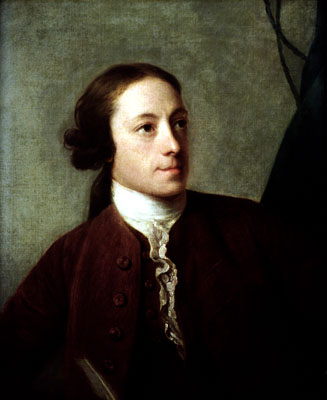
Horace Walpole

On the evening preceding the 5th of April, the roads out of London were crowded with vehicles, spite of an advertisement in the papers threatening the publication “of an exact list of all the nobility and gentry who have left or shall leave this place through fear of another earthquake.” “Earth-quake gowns “—warm gowns to wear while sitting out of doors all night—were in great request with women. Many people sat in coaches all night in Hyde Park, passing away the time with the aid of cards and candles; and Walpole asks his correspondent, ‘What will you think of Lady Catherine Pelham, Lady Frances Arundel, and Lord and Lady Galway, who go this evening to an inn ten miles out of town, where they are to play brag till four o’clock in the morning, and then come back, I suppose, to look for the bones of their husbands and families under the rubbish?’

On the 18th of March in the same year an earthquake was felt at Portsmouth, Southampton, and the Isle of Wight. In April, Cheshire, Flintshire, and Yorkshire were startled in like manner: this was followed by an earthquake in Dorsetshire in May, by another in Somersetshire in July, and in Lincoln-shire in August, the catalogue being completed on the 30th. of September by an earthquake ex-tending through the counties of Suffolk, Leicester, and Northampton.

N.B. The feared third London earthquake did not occur.

THE WELLINGTON CONNECTION – TOURISTS

As many of you know, I always make time to visit Apsley House when I’m in London, either dropping in on my own or scheduling the visit as a stop on one of my tours. In April 2018, we’ll be visiting Apsley House as part of the 1815 Waterloo Tour, but our group will be far from the first tourists to pay a call in order to admire the stunning interiors and artwork. In fact, tourists have been trying to gain entry into Apsley House since the time when the first Duke still lived there. Oddly enough, it seems that people were commonly writing to the owners of various houses in the hopes of being allowed inside and of being given a tour of the premises. Horace Walpole was plagued by applications for admission to his Strawberry Hill and owners of other unique properties were also applied to for the same purpose.
In 1850, the Duke of Wellington replied to a letter written to him by Lady Salisbury inquiring as to how best she and Lord Salisbury should deal with those who applied to them with requests to see their home, Hatfield House. In other words, how best to deal with 19th century tourists. The Duke answered her thusly:
London, July 27, 1850
  ” . . . . . I permit my servants to show the House and Place to whom they please and as they please. But I avoid to give an order that anything should be shown to anybody. I enclose the Lithograph answer sent to every application. You will find some regulation of the same description very convenient to yourself and Lord Salisbury. . . . . . “
Copy of Lithograph
 
   Field Marshal The Duke of Wellington presents his 
compliments. He is not in the habit of giving orders 
to his Servants to show his House or its contents to 
Gentlemen with whom he is not acquainted. They 
are responsible for the good, cleanly and safe 
keeping thereof, and they must form their own 
judgment as to whom they will admit to see it, taking 
care always that those whom they may admit do 
not interfere with the convenient occupation of their 
apartments by his son, his daughter-in-law and himself. 
 
Unfortunately, the Duke was also plagued with requests from tourists at Walmer Castle, as the following letter to Lady Salisbury the following September illustrates –
Walmer, September 19, 1850
     “. . . . . You are amused by the applications made to me. I have had a most curious one from one of the young ladies who were in the habit, as children, of coming to my Garden Gate in Hyde Park. This young lady is now with some friends a Broadstairs! and she insists upon my sending her an order that the interior of Walmer Castle should be shewn to her and her friends during the time that I am residing there; at which time, she has heard that the interior of the Castle is not usually shewn.
I have told her that my Predecessor in the office of Lord Warden had fitted up part of this Castle as a residence for the Lard Wardens, which I now occupy! that I have one room in this Residence, in which I sleep, dress and write all day! that the remainder of the House is occupied by my daughters-in-law and their Children or by other visitors, male or female! That I permitted the Servants to shew to whom they pleased, excepting when inhabited. But at such periods only when not inconvenient to the inhabitants. I added that I believed that I was the only individual in England who would be required by anybody to make a shew of his Bed Room and Dressing Room; and that I doubted much whether my daughters-in-law, or their Children, or any Ladies or Gentlemen, inhabitants of Rooms in this Residence, would much like the proposition that their Rooms should be made a shew of while they should inhabit them. I have received no answer.”
Alas, visitors are no longer allowed into the private apartments at Apsley House, though Wellington’s room at Walmer Castle has been preserved as it was at the time of his death and is still on view. As our visit will be confined to viewing the public rooms only at Apsley House during the 1815 Waterloo Tour, I like to think that the Duke won’t mind our presence too much. Complete details regarding the upcoming Tour can be found here.