THE WELLINGTON CONNECTION – THE MARCHIONESS OF WORCESTER

Originally published May, 2014

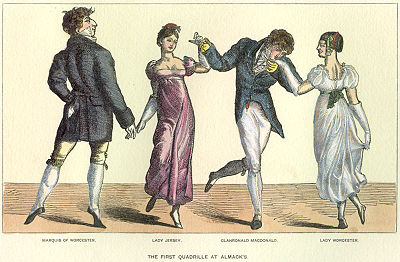
The first quadrille was danced at Almack’s –  pictured are the Marquis of Worcester, Lady Jersey, Claronald Macdonald and Lady Worcester.


The Duke of Wellington’s ties to the Marquis and Lady Worcester were fastened on both sides – Lord Worcester had served as an aide-de-camp to the Duke of Wellington during the Peninsular War, while the Marchioness of Worcester, Georgina Frederica, was the daughter of the Hon. Henry Fitzroy and the Duke’s sister, Lady Anne, and therefore Wellington’s niece. Prior to their marriage, Lady Shelly wrote in her diary, “Georgiana Fitzroy’s marriage was announced. It was to take place on the following Monday, when the Duke was to give her away. I hope that it will turn out well, but I have my doubts! Lord Worcester is only twenty-one, and very wild.”

The marriage proved happy enough but, at the age of 28, Georgina became gravely ill. The following account is from The Letter Bag of Lady Elizabeth Spencer-Stanhope – ” . . . Lady Worcester was not expected to live thro’ last night. She was at the Birthday and at the ball, danced a great deal, felt unwell, and was fool enough to take a shower bath before she went to bed. She was seized with inflammation in her bowels and in great danger immediately. Lady Worcester’s sufferings were most extreme, her complaint a twisting of the guts. She died sensible but screaming. On one side of the bed sat Lady E. Vernon, on the other, Lady Jersey, also screaming with grief. The Duke of Wellington had to drag them by force out of the room. There were eighty people standing round when she died.”
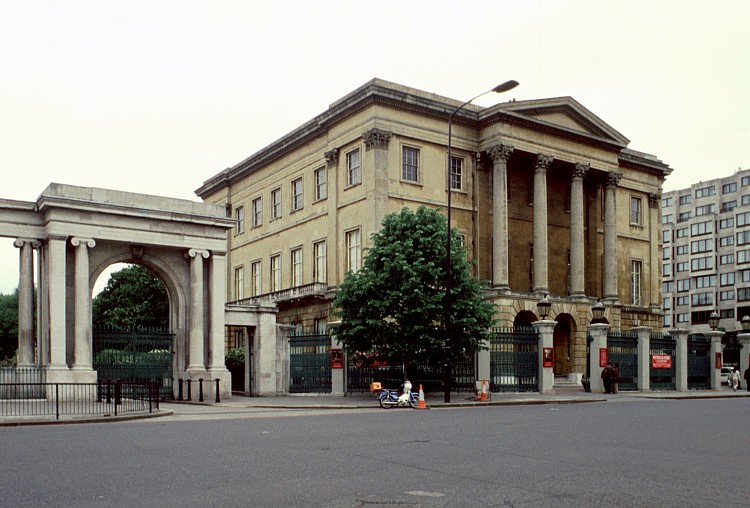
Apsley House


Mrs. Arbuthnot’s Journal gives us another view of the events leading up to Lady Worcester’s death:
“Lady Worcester died after a week’s illness of inflammation brought on by going into a cold bath after dancing at the ball at Carlton House. She was only 28, one of the handsomest women in England, had made the most brilliant marriage and was flattered, followed and admired by all the world. It is sad to contrast all this brilliancy with the cold and dreary grave that will so soon close over her; and yet she will then have more tranquility, for her prospects were not happy ones. Lord Worcester, overwhelmed with debts, had lately had executions in his house and, if the Duke of Wellington had not given her rooms in his house, she would not have had a hole to put her head into. . . . .

The New Monthly Magazine ran the following report about her death on May 11, 1821 — At Apsley House, the Marchioness of Worcester, of an internal inflammation. Her Ladyship was Georgiana Frederica Fitzroy, eldest daughter of the late Hon. Henry Fitzroy, son of Charles, first Lord Southampton, brother of the Duke of Grafton, by Lady Anne Wellesley, sister of the Duke of Wellington and Marquis Wellesley; and was married to the Marquis of Worcester on the 25th of July, 1814. Her Ladyship was one of the most intimate and favourite friends of the late Princess Charlotte.

And from the Greville Diary – May 12th.—I have suffered the severest pain I ever had in my life by the death of Lady Worcester. I loved her like a sister, and I have lost one of the few persons in the world who cared for me, and whose affection and friendship serve to make life valuable to me. She has been cut off in the prime of her life and in the bloom of her beauty, and so suddenly too. Seven days ago she was at a ball at Court, and she is now no more. She died like a heroine, full of cheerfulness and courage to the last. She has been snatched from life at a time when she was becoming every day more fit to live, for her mind, her temper, and her understanding were gradually and rapidly improving; she had faults, but her mind was not vicious, and her defects may be ascribed to her education and to the actual state of the society in which she lived. Her virtues were inherent in her character; every day developed them more and more, and they were such as to make the happiness of all who lived with her and to captivate the affection of all who really knew her. I have never lost anyone I loved before, and though I know the grief I now feel will soon subside (for so the laws of nature have ordained), long, long will it be before I forget her, or before my mind loses the lively impression of her virtues and of our mutual friendship.

“This is one of those melancholy events in life to which the mind cannot for a long time reconcile or accustom itself. I saw her so short a time ago ‘ glittering like the morning star, full of life and splendour and joy;’ the accents of her voice still so vibrate in my ear that I cannot believe I shall never see her again. What a subject for contemplation and for moralising! What reflections crowd into the mind!

“Dr. Hume told me once he had witnessed many death beds, but he had never seen anything like the fortitude and resignation displayed by her. She died in his arms, and without pain. As life ebbed away her countenance changed, and when at length she ceased to breathe, a beautiful and tranquil smile settled upon her face.”
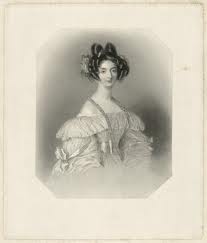
Emily, Duchess of Beaufort

As stated above, Lady Worcester died on 11 May 1821, and on 29 June 1822, her husband Lord Worcester married Lady Anne’s other daughter, Emily Frances. This opens up a whole can of worms, as it was against the law for a widow or widower to marry a brother or sister-in-law. How did they get around this? It might have been due to the fact that Emily had been Lady Worcester’s half sister – their mother, Lady Anne’s husband, Henry Fitzroy died on the 19 March 1794, and on 2 August 1799 Lady Anne was remarried to Charles Culling Smith. Their daughter Emily Frances Smith was born on the 3 March 1800. Regardless, the Duke of Wellington was not happy with the match, which caused a rift between himself and his sister.

On 23 November, 1835 Emily became the Duchess of Beaufort.  She died on 2 October 1889 at age 89 and was buried at Badminton. Her mother, Lady Anne Smith, died in 1844.

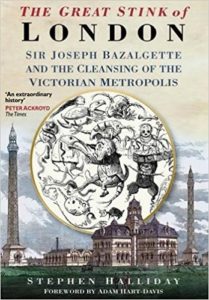
THE DARKER SIDE OF 19TH CENTURY LONDON – THE GREAT STINK

by Kristine Hughes Patrone

If you’d been watching Season 2, Episode 4 of the PBS Masterpiece series Victoria, you would have seen Prince Albert addressing the problem of the outdated, and stinking, drains at Buckingham Palace. In reality, the problem of outdated and overburdened drains extended far beyond the Palace and permeated through the entire city of London. So prevalent was the problem that it came to be known as The Great Stink, a condition once so grave that it’s remediation has gone down in history as one of the greatest engineering feats of its day.

 The Great Stink actually took place in 1858, but of course London had been stinking for centuries prior. In the first half of the 19th Century, London’s population was 2.5 million, all of whom ultimately discharged their waste directly onto the streets or into the Thames.  Besides people, there were hundreds of thousands of horses, cows, dogs, cats, sheep, etc. adding their daily contributions to the waste problem. John Cadbury, social reformer and candy company founder, wrote:  “Foul odors emanated from more than 200,000 cesspools across London, in alleyways, yards, even the basements of houses. It was not a smell that could be easily washed away.”

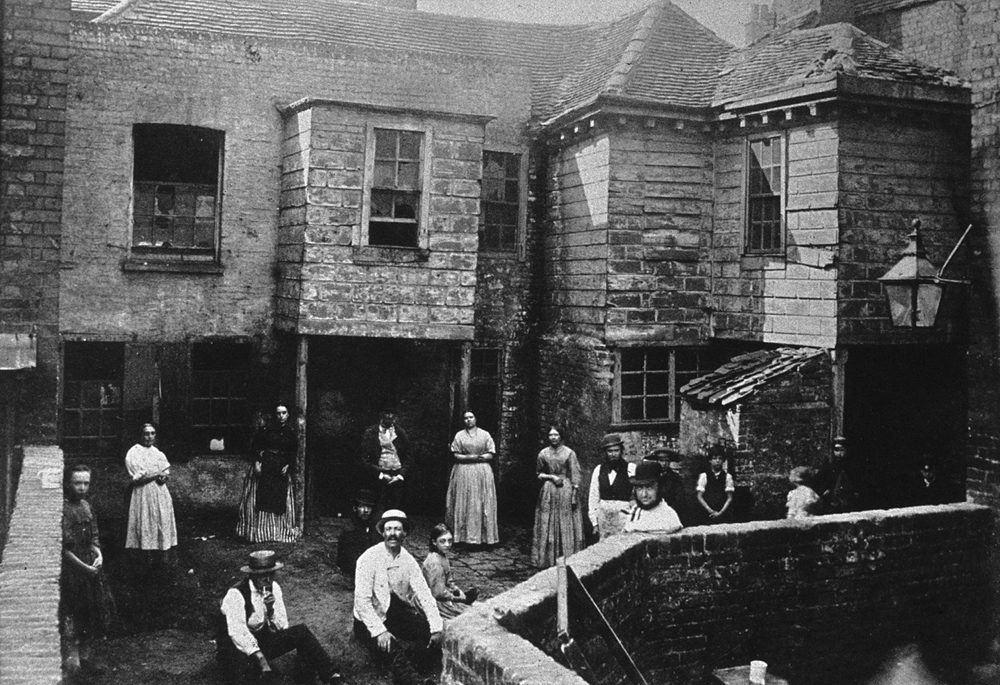
Most homes and businesses were built above cesspits, designed to drain to the street by means of a crudely built culvert to a partially open sewer trench in the center of the street. The design was faulty, to say the least. Cesspits often overflowed and waste soaked foundations, walls and floors of living quarters. Culverts typically became blocked and caused sewage to spread under buildings and contaminate shallow wells, cisterns and water ways from which drinking water was drawn. In October 1660, Samuel Pepys recorded in his diary: “Going down to my cellar…I put my feet into a great heap of turds, by which I find that Mr. Turner’s house of office is full and comes into my cellar.

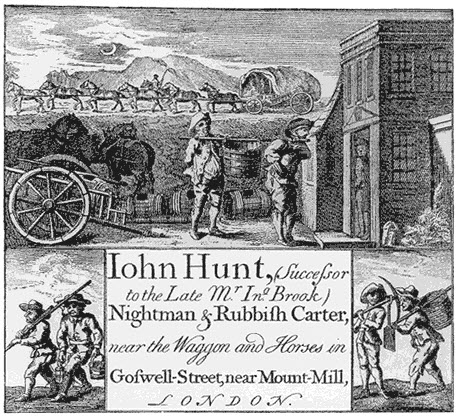
While causing disgust in Pepys and thousands of other Londoners, cesspits gave work to a portion of the population who included night soil men and saltpetre men. Saltpetre is another name for potassium nitrate, an essential ingredient in the manufacture of gunpowder. It was typically generated by collecting vegetable and animal waste into heaps and mixing it with limestone, mortar, earth and ashes. These heaps were kept moist from time to time with urine or other waste from stables. Digging for ingredients in outbuildings such as dovecotes and stables provided adequate supplies of gunpowder for the navy. Beginning during the reign of Elizabeth I, official saltpetre men were given powers to requisition any suitable deposits they came across. In 1621 James I appointed Lords of the Admiralty as Commissioners for Saltpetre and Gunpowder. They divided the country into districts for collection, and specialised saltpetre men were appointed and given weekly quotas to meet. They were also awarded powers with the right to enter premises to dig for nitrogenous earth.

In addition to saltpetre men, night soil men removed human waste that they then sold as fertilizer for crops. It was filthy job that involved crawling through cesspits and sewers or descending into them from ladders. Henry Mayhew describes them in his London Labour and the London Poor. You can read it here.

By 1810, the city’s one million inhabitants had to be content with 200,000 cesspits. The pressure on these and the haphazard sewer system caused the pits to overflow into street drains designed originally to cope with rainwater, but now also used to carry waste from factories, slaughterhouses and other activities, contaminating the city before emptying into the River Thames, or into the old London streams – the Fleet, the Wandle, the West Bourne, the Ravensbourne, the New, the Holbourne and many others that had been partially covered. WC’s discharged human waste directly into these streams and as most of those on the south side were tide-locked and drained into the Thames only at low tide, the results were catastrophic – much of London’s drinking water was still being extracted from the Thames, often downstream from the sewage discharge points.


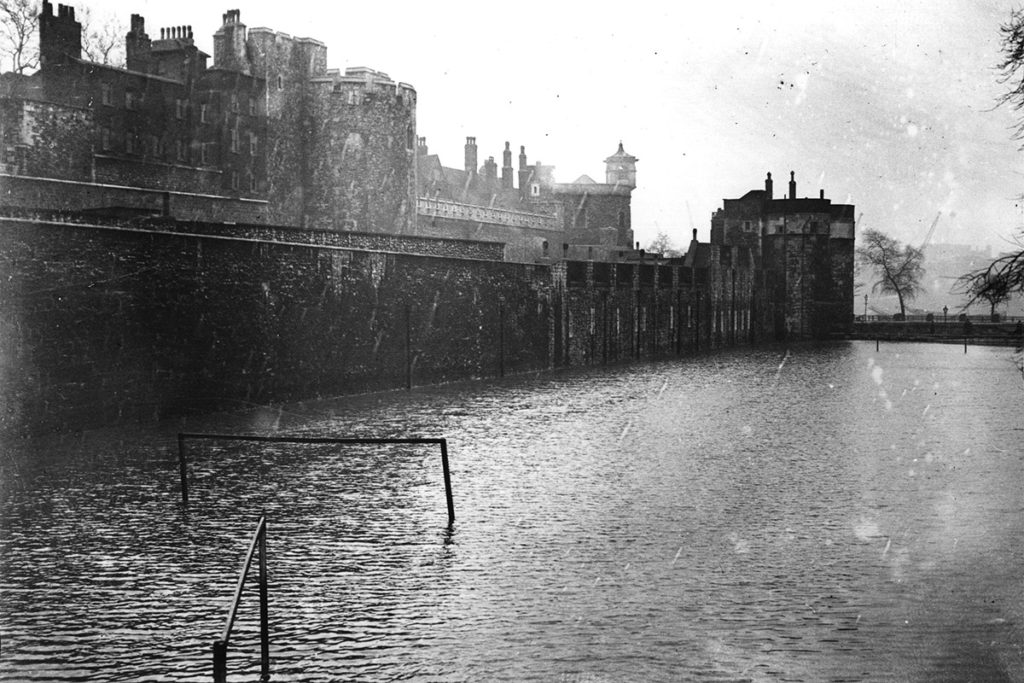
Whilst the government and various commissioners and officials put forth plans for cleaning up London’s cesspits and sewers, the Duke of Wellington forged ahead with action of his own at the Tower of London – he was Constable of the Tower for 26 years. Centuries before, latrines and been built and desgined to empty directly into the moat set into the outer wall of Edward I’s Brass Mount in the north-eastern corner of the Tower. In addition, the moat connected to the River Thames, which washed its foul and putrid self about the Tower at both high and low tide.  In 1830, the Duke of Wellington ordered the silt from the moat be taken to fertilize market gardens at Battersea, but this was not enough to prevent complaints in 1841 that the banks exposed at low tide were ‘impregnated with putrid animal and excrementitious matter … emitting a most prejudicial smell,’ resulting in 80 men from the garrison being taken to hospital. Wellington ordered the moat to be completely drained and covered over, the work being completed in 1845.

Dire problems with London’s water supply inevitably took their toll on the City’s inhabitants – cholera first struck London in 1832 and again in 1840. In 1854 London physician Dr John Snow discovered that the disease was transmitted by drinking water contaminated by sewage after an epidemic broke out in Soho, but this idea was not widely accepted even by that late date.

The lawyer Edwin Chadwick, secretary to the Poor Law Commision, was one of many to draw attention to London’s unsanitary living conditions. In 1842, he produced an uncompromising and influential paper, ‘The Report on the Sanitary Condition of the Labouring Population of Great Britain.’ Shocked by the squalor of the slums, he cited ‘atmospheric impurities produced by decomposing animal and vegetable substances,’ ‘damp and filth,’ and ‘close and overcrowded dwellings” as leading inevitably to disease and epidemics. Chadwick enlisted the aid of Charles Dickens, who personally recorded graphic accounts of the terrible state of reeking graveyards from his brother-in-law, Henry Austin, a leading sanitary reformer.

However, attempts at sanitary clean up were slow, as this letter to the editor of The Times – written in 1849 – shows –

TO THE EDITUR OF THE TIMES PAPER

Sur, -May we beg and beeseech your proteckshion and power. We are Sur, as it may be, livin in a Wilderniss, so far as the rest of London knows anything of us, or as the rich and great people care about. We live in muck and filthe. We aint got no privies, no dust bins, no drains, no water splies, and no drain or suer in the hole place. The Suer Company in Greek Street, Soho Square, all great rich and powerful men, take no notice watsotnedever of our complaints. The Stenche of a Gully-hole is disgustin. We all of us suffur, and numbers are ill, and if the Colera comes Lord help us… Teusday, Juley 3, 1849″.

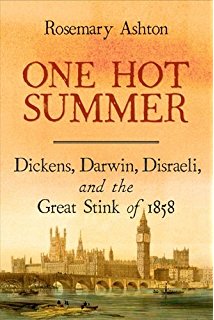
Nearly a decade later, the situation had hardly improved. The year 1858 saw an exceptionally hot summer, over the course of which the Thames and many of its urban tributaries continued to overflow with sewage. Bacteria grew and the miasma of noxious smells increased until even the members of the House of Commons couldn’t ignore it, being driven out of the House by the foul odours. A House of Commons select committee was appointed to report on the Stink and recommend solutions and within 18 days a bill was passed into law that provided the funds necessary for a comprehensive sewer scheme for London, and to build the Embankment along the Thames in order to improve both the flow of water and of traffic.


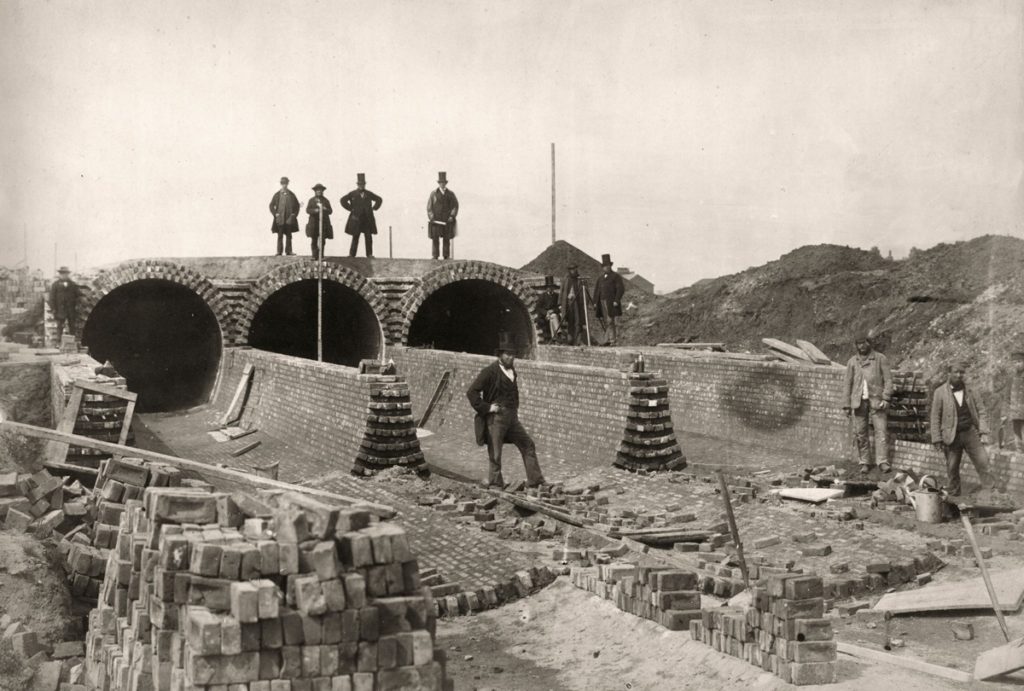
In 1855 the Metropolitan Board of Works which, after rejecting many schemes for “merciful abatement of the epidemic that ravaged the Metropolis”, accepted a scheme to implement sewers proposed in 1859 by its chief engineer, Joseph Bazalgette. The intention of this very expensive scheme was to resolve the epidemic of cholera by eliminating the stench which was believed to cause it.


Massive sewers were built running along the north and south banks of the river Thames. These captured the waste that would otherwise pour into the river. The sewers gently inclined downwards to the east, resulting in the waste flowing towards the sea. In areas such as Victoria, the muddy foreshore was reclaimed, and sewers and the new underground railway were installed. On the surface, a 30 metre width of landscaped road and pavement was established, providing a modern and elegant
boulevard now known as the Embankment, which also served to guard against flooding. These new sewers terminated at pumping stations east of London in Kent and Essex, where the waste was carried out to sea on the outgoing tide. The Prince of Wales opened the pumping station at Crossness in Kent in 1865.

Work on London’s massive new sewer system continued over the next six years and, eventually the “Great Stink” became but a thing of memory, as did cholera.

Thames Water has produced a film about the construction of the sewer, which you can watch here.

LOST COUNTRY HOUSES

Warter Hall/Priory
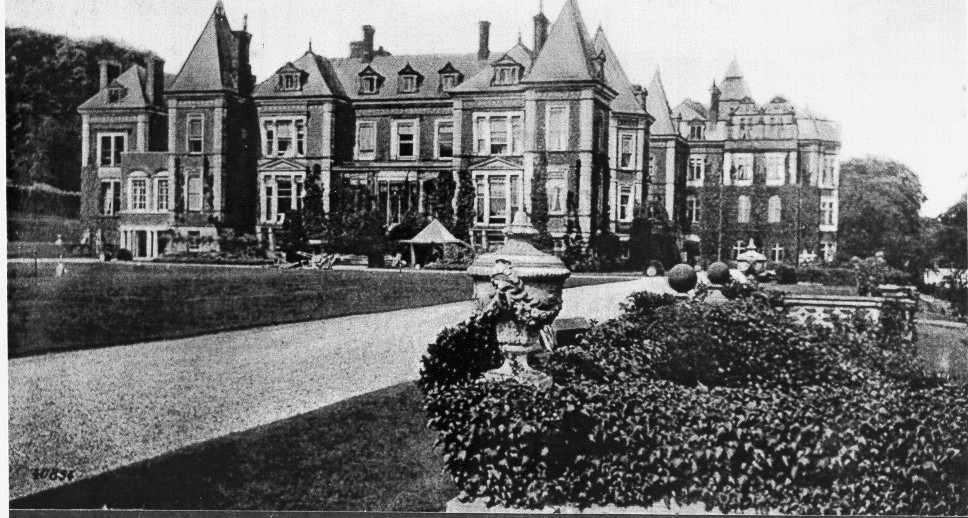
If you’re a regular visitor to this blog, you’ll know that I spend an inordinate amount of time researching anything and everything to do with the Duke of Wellington. Often, this research leads me down unexpected paths, as happened when I found myself stumbling upon Lady Nunburnholme and her home, Warter Hall, on the Lost Heritage website:  The Victorian and Edwardian owners of Warter Hall (or Priory).
Florence Jane Helen Wellesley (1853-1932), Lady Nunburnholme, OBE by Edward Hughes, National Trust, Beningbrough Hall

The Formidable Lady Nunburnholme

“From the purchase of the Warter Estate by her husband in 1878 until its sale over 50 years later, the village of Warter and the lives of the villagers were dominated by Lady Nunburnholme.

“Born in London in 1854 Florence Jane Helen Wellesley was the eldest daughter of Colonel William Henry Charles Wellesley, a nephew of the great Duke of Wellington. She married Charles Wilson in 1871 and they lived at Cottingham, near Hull before moving to Warter Priory in 1878.

“(Local man) George Noble had many stories of Lady Nunburnholme: She was a Wellesley, the Duke of Wellington’s family. Warter Priory was full of Duke of Wellington’s busts and oil paintings. She used to say “I’ve got the blood and Mr Wilson has the money.” Which he had. … By jove she was a rum un, I’ll tell you that, yes, but when she was alright, she was alright, but by jove she was a goer on as we say… She liked entertaining and she was the boss, and it was no good anybody what worked there telling her off, for she would get his notice just after, you know, pack-up … she would nearly clear him off the place straightaway and pay him up… The butler used to say to me dad, and he was there a long time, and knew ’em all. “Bill”, he used to say “Devil’s abroad, she’s on the warpath … she’s playing devil with me and everybody else she’s come across – if you can find another job, getaway, out of road.”

“The Dowager Lady Nunburnholme died in 1932. The Warter estate had by then been sold by her grandson Charles John, 3rd Baron Nunburnholme. It was bought in 1929 by George Vestey who made Warter Priory his home until his death in 1968. Warter was then sold to the 4th Marquis of Normanby and the Guiness Trust.

“The Marquis bought Warter as a subsidiary shooting lodge and did not intend to live there as his principal family seat was at Musgrave Castle. The contents were auctioned in March 1969, the garden statuary the following September. Attempts were made to find a tenant but when one could not be found it was decided to demolish the house and a final auction of all the remaining furniture and fittings, down the last loo seat, was held in May 1972. Shortly afterwards the house was demolished, the splendid gardens bulldozed and the rubble used to fill in the nearby lake. The 5th Marquis of Normanby sold the Warter estate covering 11,910 acres (4,820 hectares) with 63 houses and cottages to a Hull-born businessman Malcolm Healey in 1998.”

Meeting Lady Nunburnholme thus was pleasantly surprising, but sadly Warter Priory’s fate was all too familiar. Since WWII, nearly 1,000 of Britain’s stately homes have vanished, either fallen to ruin or demolished when changes in social climate and the industrial landscape combined with diminished fortunes and death duties to sound the final bell on a way of life that had become unsustainable.

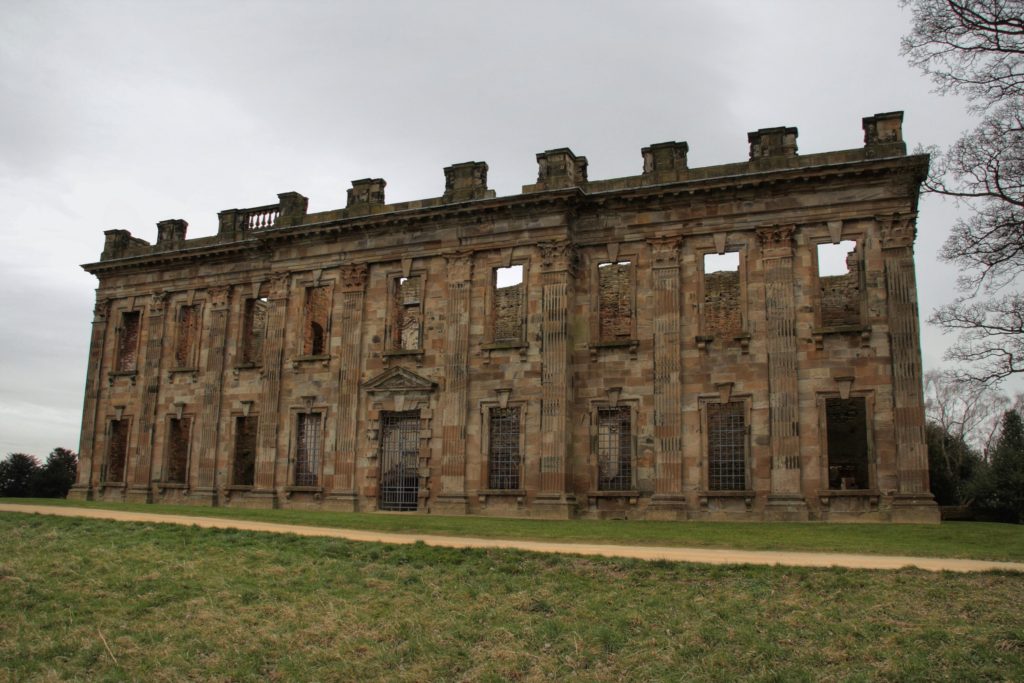
As we were going to be Derbyshire, I built a stop at Sutton Scarsdale into Number One London’s 2017 Country House Tour, as I wanted to show our guests the state that some of the houses were in when acquired by the National Trust or English Heritage. Sutton Scarsdale is a prime example of the condition so many important houses were allowed to fall in to after the second World War.

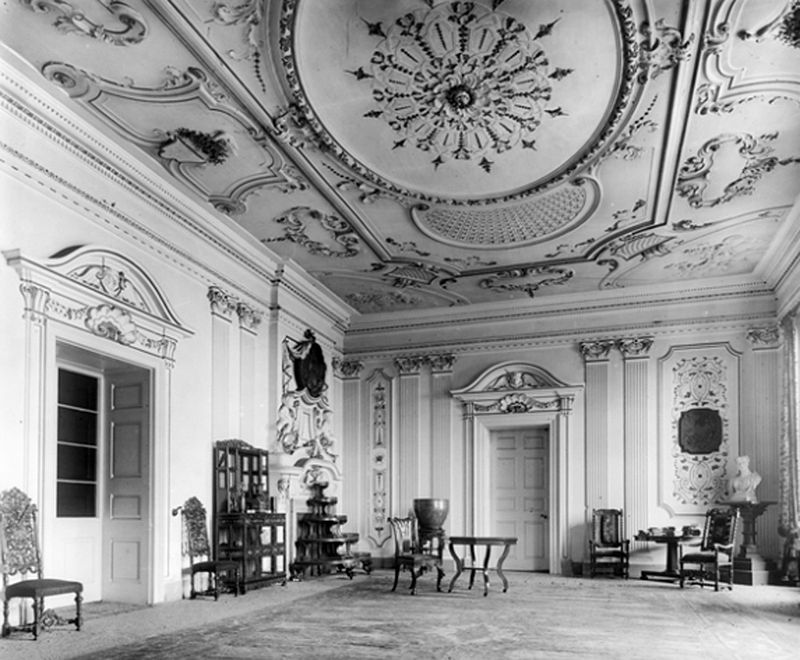
In 1724, Nicholas Leke, 4th Earl of Scarsdale commissioned the building of a design by architect Francis Smith, to develop a Georgian mansion with gardens, using parts of an existing structure. The estate was sold to the Arkwright family in 1824 and remained in their possession until 1919, when Major William Arkwright sold the house and grounds at auction. The estate was bought by a group of local businessmen who asset-stripped the house, with some parts of the building being shipped to the United States, where one room’s oak panelling was bought by  William Randolph Hearst, who planned to use it at Hearst Castle. After many years in storage in New York City, Pall Mall films bought the panelling for use as a set in their various 1950s productions. Another set of panels are now resident in the Philadelphia Museum of Art. In 1946, the estate was bought by Sir Osbert Sitwell of Renishaw Hall, with the intention of preserving the remaining shell as a ruin. Scarsdale Hall is now in the care of English Heritage, who are in the process of restoring the structure.

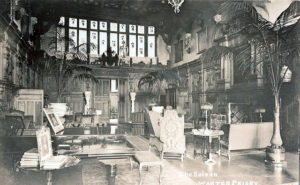
Interior of Sutton Scarsdale, circa 1920

While the efforts of organizations such as English Heritage, the National Trust, the Landmark Trust and myriad local councils and organizations have helped to preserve so much historic property for us to enjoy, it remains heartbreaking to consider all the houses that have gone forever.

You can read the entire Wikipedia entry for Sutton Scarsdale here, and watch a YouTube video that captures the majesty of the property here. Do visit the Lost Heritage website at the link above and take some time to explore their extensive archives. Additionally, there’s a very good Daily Mail article on vanished country houses here.

THE LONDON POST OFFICE 1850 – Part Three

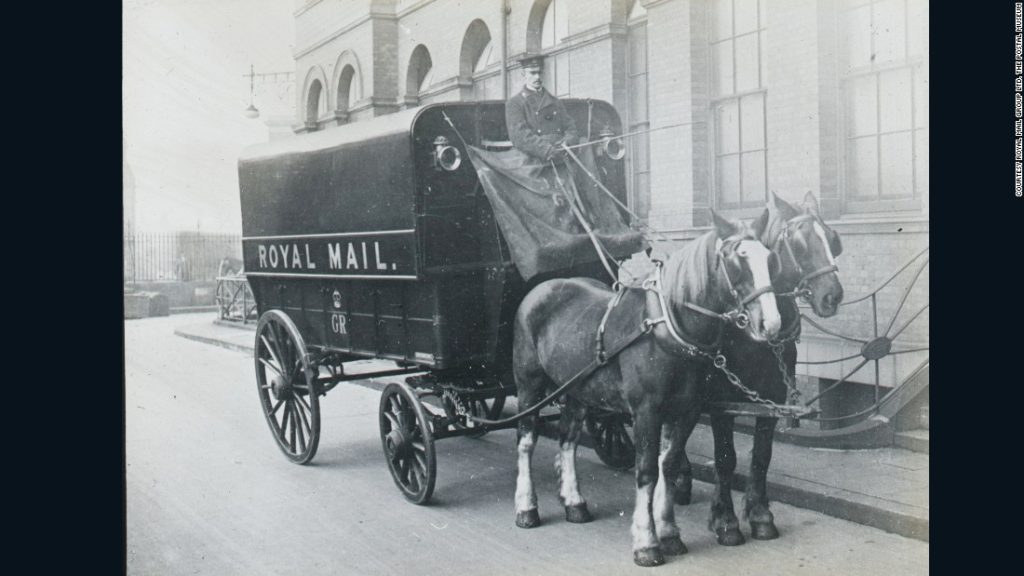
In this series, we turn to the words of Mr. Charles Dickens which appeared in the March 30, 1850 edition of the publication he edited, Household Words. The following article is chock full of details about how the Post Office operated in Victorian London and also about the mail and other items it processed on a daily basis.

The piece follows the progress of two gentlemen who make a visit to the Post Office and Part Three continues –

The friends were informed that 70,000,000 newspapers pass through all the post-offices every year. Upwards of 80,000,000 newspaper stamps are distributed annually from the Stamp office; but, most of the London papers are conveyed into the country by early trains. On the other hand, frequently the same paper passes through the post several times, which accounts for the small excess of 10,000,000 stamps issued over papers posted. In weight, 187 tons of paper and print pass up and down the ingenious ” lift” every week, and thence to the uttermost corners of the earth—from Blackfriars to Botany Bay, from the Strand to Chusan.

The system of stamping, sorting, and arranging, is precisely similar to that in the District Branch; and, by his recently acquired knowledge of it, the person who posted the coloured letters was able to trace them through every stage, till they were tied up ready to be ” bagged,” and sent away.

In an opposite side of the enormous apartment, a good space and a few officials are devoted to repairing the carelessness of the public, which is, in amount and extent, scarcely credible. Upon an average, 300 letters per day pass through the General Post-office totally unfastened; chiefly in consequence of the use of what stationers are pleased to call ” adhesive” envelopes. Many are virgin ones, without either seal or direction; and not a few contain money. In Sir Francis Freeling’s time, the sum of 5000 pounds in Bank-notes was found in a ” blank.” It was not till after some trouble that the sender was traced, and the cash restored to him. Not long since, an humble post-mistress of an obscure Welsh post-town, unable to decipher the address on a letter, perceived, on examining it, the folds of several Bank-notes protruding from a torn edge of the envelope. She securely re-enclosed it to the secretary of the Post-office in St. Martin’s-le-Grand; who found the contents to be 1500 pounds, and the superscription too much even for the hieroglyphic powers of the “blind clerk.” Eventually the enclosures found their true destination.


It is estimated that there lies, from time to time, in the Dead-Letter-office, undergoing the process of finding owners, some 11,0007. annually, in cash alone. In July, 1847, for instance—only a two months’ accumulation— ,the post-haste of 4658 letters, all containing property, was arrested by the bad superscriptions of the writers. They were consigned—after a searching inquest upon each by that efficient coroner, the ” blind clerk”—to the Post-office Morgue. There were Banknotes of the value of 10107., and money-orders for 4077. 12s. But most of these ill-directed letters contained coin in small sums, amounting to 3107. 9s. 7d. On the 17th of July, 1847, there were lying in the Dead-Letter-office bills of exchange for the immense sum of 40,4107. 5s. 7d.

“I assure you,” said a gentleman high in this department, ” it is scarcely possible to take up a handful of letters without finding one with coin in it, despite the facilities afforded by the money-order system. All this is very distressing to us. The temptation it throws in the way of sorters, carriers, and other humble employes is greater than they ought to be subjected to. Seventy men have been discharged for dishonesty from the District-office alone during the past two years.”

“But the public do use the Money-Order-office extensively?”

This question was startlingly answered by reference to a Parliamentary return, which showed that there were issued in England and Wales alone, during the year which ended on the 5th of January, 1849, 3,468,823 Post-office orders for sums amounting to the enormous aggregate of 6,861,803 pounds.

 It was approaching eight o’clock, and the “Miller and his Men” above stairs were delivering their sacks from the mouth of the ever-revolving mill at an incessant rate. These, filled nearly to choking with newspapers, were dragged to the tables, which the brass label fastened to the corner of each bag marked as its own, to have the letters inserted. Our friends rushed to where they saw “Edinburgh” painted up on the walls, and there they beheld their yellow, green, and red letters in separate packets, though destined for the same place; just as they had come in at first from Fleet-street. The bundles were popped in a trice into the Edinburgh bag, which was sealed and sent away. Exactly the same thing was happening to every bundle of letters, and to every bag on the premises.
The clock now struck eight, and the two visitors looked round in astonishment. Had they been guests at the ball in ” Cinderella,” when that clock struck they would not have been more astonished; for hardly less rapidly did the fancy dresses of the postmen disappear, and the lights grow dim. This is the most striking peculiarity of the extraordinary establishment. Everything is done on military principles to minute time. The drill and subdivision of duties are so perfect that the alternations throughout the day are high pressure and sudden collapse. At five minutes before eight the enormous offices were glaring with light and crowded with men; at ten minutes after eight the glass slipper had fallen off, and there was hardly a light or a living being visible.

“Perhaps, however,” it was remarked, as our friends were leaving the building, ” an invisible individual is now stealthily watching behind the ground glass screen. Only the other day he detected from it a sorter secreting 140 sovereigns.”

It is a deplorable thing that such a place of observation should be necessary; but it is hardly less deplorable—and this should be most earnestly impressed upon the reader—that the public, now possessed of such conveniences for remitting money, by means of Post-office Orders and Registered Letters, should lightly throw temptation in the way of these clerks by enclosing actual coin. No man can say that, plac
ed in such circumstances from day to day, he could be steadfast. Many may hope they would be, and believe it; but none can be sure. It is in the power, however, of-every conscientious and reflecting mind to make quite sure that it has no part in this class of crimes. The prevention for this one great source of misery is made easy to the public hand, and it is the public’s bounden duty to adopt it. They who do not, cannot be blameless.

Such is the substance of information obtained by our friends before they took leave of the mighty heart of the postal system of this country.

The End

THE LONDON POST OFFICE 1850 – Part Two

In this series, we turn to the words of Mr. Charles Dickens which appeared in the March 30, 1850 edition of the publication he edited, Household Words. The following article is chock full of details about how the Post Office operated in Victorian London and also about the mail and other items it processed on a daily basis.

The piece follows the progress of two gentlemen who make a visit to the Post Office and Part Two continues –

” Is it possible?” exclaimed one of the visitors, regarding the piles of epistles on the numerous tables “that this mass of letters can be arranged and sent away to their respective addresses in time to receive the next collection, which will arrive in less than an hour?”

“Quite,” replied an obliging informant; ” I’ll tell you how we do it. We have divided London into seventeen sections. There they are, you perceive.” He then pointed to the tables with pigeon-holes numbered from one to seventeen; one marked “blind,” with a nineteenth labelled “general.” It was explained that the proper arrangement of the letters in these compartments constitutes the first sorting. They are then sorted into subdivisions; then into districts, and finally handed over to the letter-carriers, who, in another room, arrange them for their own convenience into ” walks.” As the visitors looked round they perceived their coloured envelopes—which were all addressed to Scotland, suddenly emerge from a chaotic heap, and lodged in the division marked ” general,” as magically as a conjuror causes any card you may choose to fly out of the whole pack. “These letters,” remarked the expositor, “being for the country, will be presently passed into the Inland-office through a tunnel under the hall. ” The ‘ blind’ letters have superscriptions which the sorters cannot decipher, and are sent to the ‘ blind’ table, where a gentleman presides, to whom, from the extreme sharpness of his vision, we give the lucus a non lucendo name of the ‘ blind clerk.’ You will have a specimen of his powers presently.”

While this dialogue was going on there was a general abatement of the noise of stamping and shuffling letters; and, when the visitors looked round, the place had relapsed into its former tranquillity. It was scarcely credible that from 30,000 to 40,000 letters had been received, stamped, counted, sorted, and sent away in so short a time. “A judicious division of labour,” remarked one of our friends, “must work these miracles.”

“Yes, sir,” was the reply of an official. “There are from 1200 to 1700 of us to do the work of the district post alone. When it was removed from Gerrard-street to this building there was not a quarter of that number. For instance—then, three carriers sufficed for the Paddington district; but, by the despatch you have just seen completed, we have sent off 2000 letters to that single locality by the hands of twenty-five carriers.”

” The increase is attributable to the penny system?” interrogated one of our inquiring friends.

” Entirely.”

The questioner then referred to a Parliamentary paper of which he had obtained possession. It showed him the history of general postal increase since the era of dear distance rates. In 1839—under the old system—the number of letters which passed through the post was 76 millions. In 1840 came the uniform penny, and for that year the number was 162 millions, or an increase of 93 millions, equal to 123 per cent. That was the grand start; afterwards the rate of increase subsided from 36 per cent. in 1841, to 16 per cent. in 1842 and 1843. In 1845, and the three following years, the increase was respectively, 39, 37, and 30 per cent. Then succeeded a sudden drop; perhaps the culminating point in the rate of increase had been attained. The Post-office is, however, a thermometer of commerce: during the depressing year 1848, the number of letters increased no more than 9 per cent. But last year 337,500,000 epistles passed through the office, being an augmentation of 8,500,000 upon the preceding year, or 11 per cent, of progressive increase. Another Parliamentary document shows, that, although the business is now four and a half times more than it was in 1839, the expense of doing it has only doubled. In the former year the cost of the establishment was not quite 690,000/.; in 1849 it was about 1,400,000/.

While one visitor was poring over these documents, the other deliberately watched the coloured envelopes. They were, with about 2000 other General Post letters, put into boxes and taken to the tunnel to be conveyed into the Inlandoffice upon a horizontal band worked by a wheel. The two friends now took leave of the District Department to follow the objects of their pursuit.

It was a quarter before six o’clock when they crossed the Hall—six being the latest hour at which newspapers can be posted without fee.

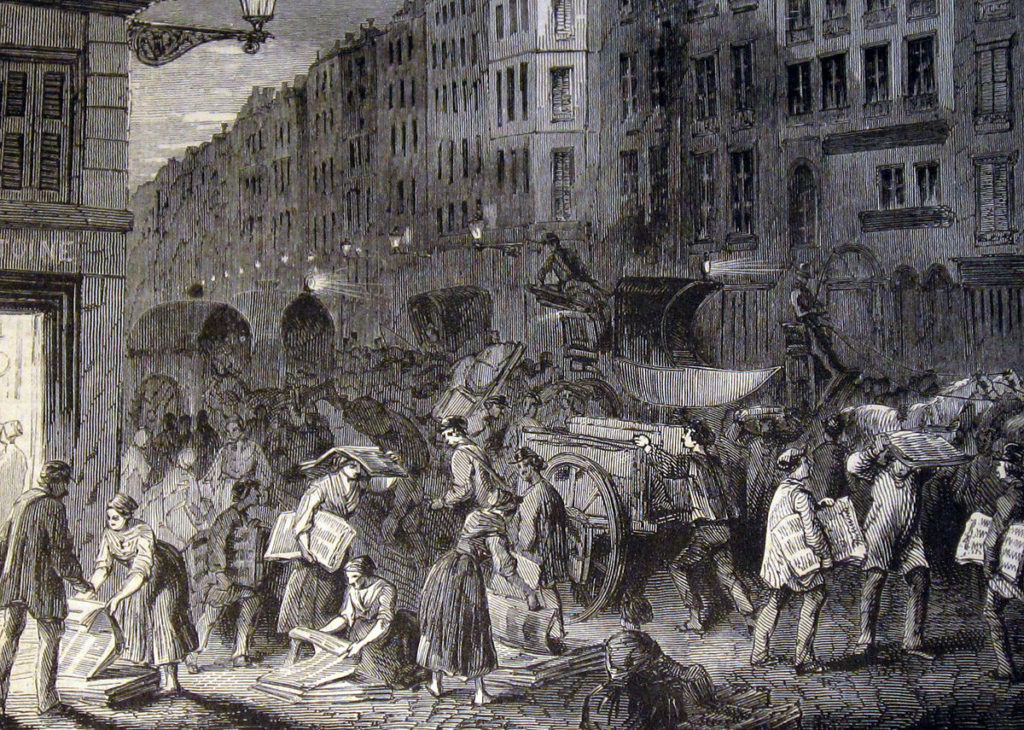
It was then just drizzling newspapers. The great window of that department being thrown open, the first black fringe of a thunder-cloud of newspapers impending over the Post office was discharging itself fitfully—now in large drops, now in little; now in sudden plumps, now stopping altogether. By degrees it began to rain hard; by fast degrees the storm came on harder and harder, until it blew, rained, hailed, snowed, newspapers. A fountain of newspapers played in at the window. Water-spouts of newspapers broke from enormous sacks, and engulphed the men inside. A prodigious main of newspapers, at the Newspaper River Head, seemed to be turned on, threatening destruction to the miserable Post-office. The Post-office was so full already, that the window foamed at the mouth with newspapers. Newspapers flew out like froth, and were tumbled in again by the bystanders. All the boys in London seemed to have gone mad, and to be besieging the Post-office with newspapers. Now and then there was a girl; now and then a woman; now and then a weak old man: but as the minute hand of the clock crept near to six, such a torrent of boys, and such a torrent of newspapers came tumbling in together pell-mell, head over heels, one above another, that the giddy head looking on chiefly wondered why the boys springing over one another’s heads, and flying the garter into the Post-office with the enthusiasm of the corps of acrobats at M. Franconi’s, didn’t post themselves nightly, along with the newspapers, and get delivered all over the world.

Suddenly it struck six. Shut, Sesame! Perfectly still weather. Nobody there. No token of the late storm—Not a soul, too late!

But what a chaos within! Men up to their knees in newspapers on great platforms; men gardening among newspapers with rakes; men digging and delving among newspapers as if a new description of rock had been blasted into those fragments ; men going up and down a gigantic trap—an ascending and descending-room worked by a steam-engine—still taking with them nothing but newspapers. All the history of the time, all the chronicled births, deaths, and marriages, all the crimes, all the accidents, all the vanities, all the changes, all the realities, of all the civilised earth, heaped up, parcelled out, carried about, knocked down, cut, shuffled, dealt, played, gathered up again, and passed from hand to hand, in an apparently interminable and hopeless confusion, but really in a system of admirable order, certainty, and simplicity, pursued six nights every week, all through the rolling year. Which of us, after this, shall find fault with the rather more extensive system of good and evil, when we don’t quite understand it at a glance; or set the stars right in their spheres?

Part Three Coming Soon!