2016: THE YEAR OF EMMA

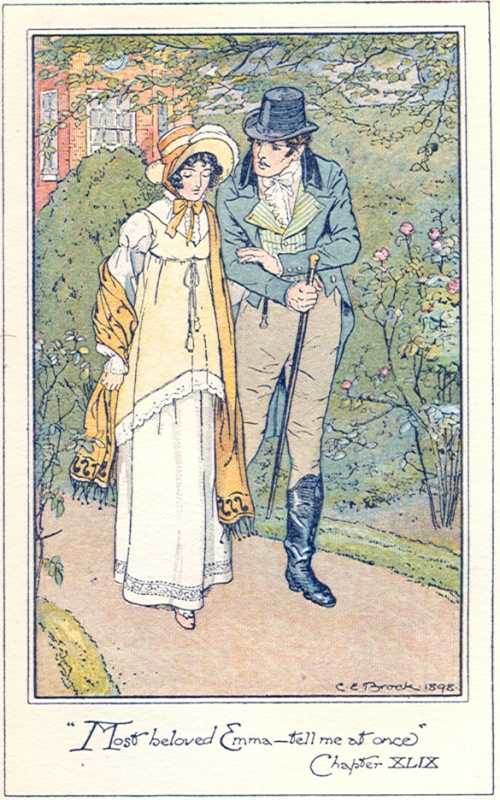
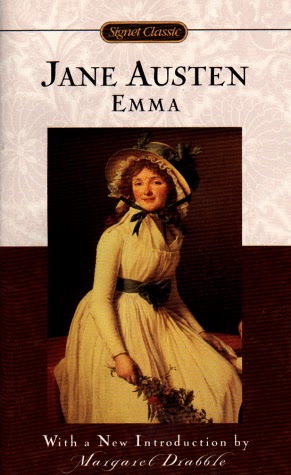
Victoria here, on a favorite subject — my favorite author. Jane Austen’s fourth novel, Emma, was published in late December, 1815, but listed on the title page as 1816. Therefore, the Jane Austen Society is officially celebrating the novel’s bicentenary in 2016.

Many Austen experts regard Emma as the author’s masterpiece, written in 1814 and 1815 when she was at the height of her mature powers, though any of the six complete novels she published has its supporters as the best of all.

In the famous opening sentence of Emma, she is described as  “handsome, clever, and rich, with a comfortable home and happy disposition…and…very little to distress or vex her.”
Nevertheless, Jane Austen wrote, “I am going to take a heroine whom no one but myself will much like” — a character who perhaps could be afflicted with “affluenza”?  Emma is generally considered to be self-centered and snobbish, though many readers are convinced she has understood her faults and learned to overcome them by the conclusion of the story — and in the light of Mr. Knightley’s love.
One of several excellent tv/film versions of Emma
Indeed, Laura Miller, in Slate, calls Emma A Perfect Novel (here).
And Austen Scholar John Mullan gives us an excellent view of how Emma created new novelistic directions, here.
The Jane Austen Society of North America will have many meetings and presentations devoted to Emma this year, including the AGM in October in Washington D.C. (Most of the politicians will be off campaigning leaving the lovely city to us history and literature buffs).
For everything Emma, all the time, click here for JASNA’s special page. 

THOMASINA'S NOTEBOOK, A TALK BY DR. GLYNIS RIDLEY

Back in October, I attended the 2015 Annual General Meeting of the Jane Austen Society of North America, held in Louisville, Kentucky. I have reported here on several of the presentations there (Ship’s Surgeon, JASNA  AGM Tidbits,  Mary Crawford at Almack’s?,  Age of Caricature,  men’s clothing) and associated jaunts to Locust Grove, the Kentucky Horse Park, and the Cincinnati Art Museum.

One of my favorites of the Special Interest talks at the AGM was “Thomasina’s Notebook and Thomas Lefroy’s House: Life of a Young Woman in Austen’s Dublin.”

Glynis Ridley, PhD, Professor of English, at the University of Louisville

Dr. Ridley spoke about a book found in a Paris Flea Market by her husband, and the fascinating mystery she is uncovering.

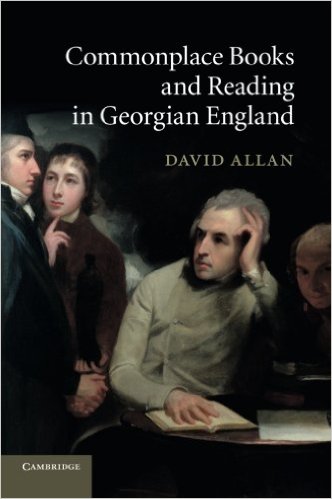
A commonplace book is a compendium of poems, prose excerpts, original observations, and daily commentary often belonging to a young woman of some status in the Georgian era. She might write in it herself, or ask various friends and acquaintances to enter material.

Literary historians have found many examples of commonplace books.

When he brought the book to his wife, Dr. Ridley’s husband was not fully aware of just what he had discovered. Only after considerable research has Dr. Ridley begun to unravel the stories of the owner and her family. And even more exciting, she discovered a link with Jane Austen.

The notebook belonged to Thomasina, daughter of Thomas Gleadowe-Newcomen, 2nd Viscount Newcomen (1776–1825) and his long-time mistress Harriet Holland, who bore him eight children. Like peeling an onion, layer by layer, more mysteries are revealed.

Newcomen was an unmarried banker and lived in a grand Dublin mansion with Harriet and their children; why did he and Harriet never marry? Obviously, from clues in Thomasina’s commonplace book, the family associated with Dublin’s leading citizens, some of whom wrote in the book. They lived together as a family in a fine Dublin mansion, and their country home was  Carrigglass, aka Carrickglass, about which more later.

The former Newcomen Bank, Lord Edward Street, Dublin

In 1825, the Newcomen Bank failed and Lord Newcomen killed himself, at age 48. Still to be tracked down are the movements of Harriet and her children, at first to France, then back to England.  In later years, where did they all end up, and particularly what happened to Thomasina? Dr. Ridley has a few leads and perhaps some clues, and we await her findings eagerly.

And now for the Jane Austen connection, a serendipitous a matter indeed. Carrigglass, the country home of the Newcomens, was purchased by Thomas Lefroy (17876-1869) in the 1820’s after the demise of the bank and its owner. Thomas Lefroy was the student whose flirtation with Jane Austen in 1796 has been the object of much attention in the last few years, turned into a romantic film (Becoming Jane, 2007).  After his “interlude” in Hampshire with Jane, Thomas Lefroy returned to Dublin, became a member of the bar and eventually Lord Chief Justice of Ireland. In 1837, he had the house rebuilt in the Tudoresque style.  He and his descendants lived at Carrigglass until its sale in  2005.

Carrigglass, Co. 

As a sad postscript about this property, one version of the wretched fate of Cairrgglass, can be found here.

Dr, Ridley certainly presented us with a fascinating account of her research mysteries and the need for further investigation. Along the way, she presented many comparisons to the characters in Jane Austen’s novels. We could easily identify a Marianne (SandS) and a Harriet Smith (Emma).  We continue to wonder, did Harriet Holland or Thomasina ever find themselves a Mr. Darcy or a Mr. Knightley?

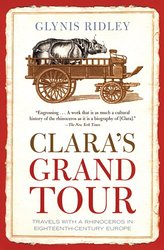
Previous books by Glynis Ridley:
AGATHA CHRISTIE'S MOUSETRAP

AGATHA CHRISTIE’S MOUSETRAP

Victoria here, reporting on the recent presentation of this venerable play  as the holiday offering of the Milwaukee Repetory Theatre

jonathan Gillard Daly

Featuring
Jonathan Gillard Daly

Laura Gordon

and Laura Gordon

A CELEBRATION OF THE 125TH ANNIVERSARY
OF AGATHA CHRISTIE’S BIRTH

The Mousetrap by Agatha Christie, Directed by J.R. Sullivan

Here’s the Rep’s blurb:  “A classic whodunit mystery for the whole family!
Playing to sold-out houses in London’s West End for over 60 years, The Mousetrap has been released to American audiences through a limited number of authorized productions – including at Milwaukee Rep! A murder is committed at a newly opened rooming house, and the snowbound hosts and guests—with the aid of a police inspector—must determine who the killer is before he or she strikes again. Agatha Christie’s masterful whodunit weaves an intricate plot filled with nerve-rattling suspense, all leading up to an unforgettable final twist!”
For all of you who have seen the play in London — or elsewhere — I’m sure you remember the experience fondly. I can’t remember how many times I’ve attended a London performance, but enough that I remember the characters including the perpetrator. But no spoilers here!

The Mousetrap opened in 1952 and is still running, the longest run in London history.

Here is an interesting article about some things you might not know. Even if you’ve seen it as many times as I have!

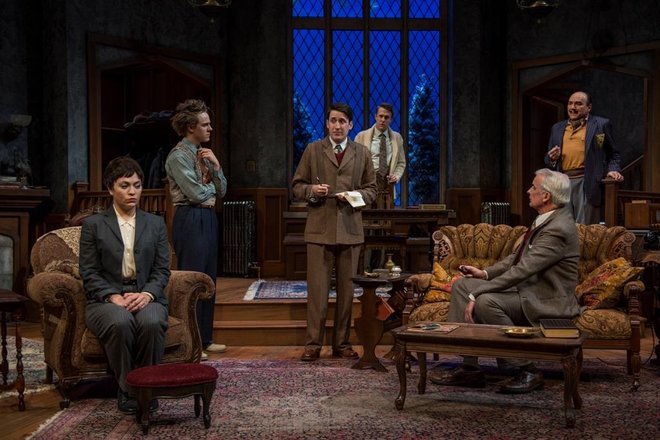
This American production was well done, with the shabby genteel set, the characters with all their secrets, and of course, our unexpected twist at the end.

Milwaukee Journal Sentinel photo by Michael Brosilow

In the J-S, critic Mike Fischer wrote of one of the characters, “‘Who am I?,’ he asks. ‘You do not know. Where do I come from? You do not know.’ When everyone is acting all of the time, how can we, ever? Forget the occasional creak in Christie’s plot. In this Mousetrap, the thrills and chills are timely and psychological, living as we do in a world where none of us is ever quite what we seem — leaving all of us caught in a trap of our own devising.”

It’s all fun — and as a wish for 2016, you could do no better than to hope for another evening of enjoyment at the hands of the skilled Miss Christie.