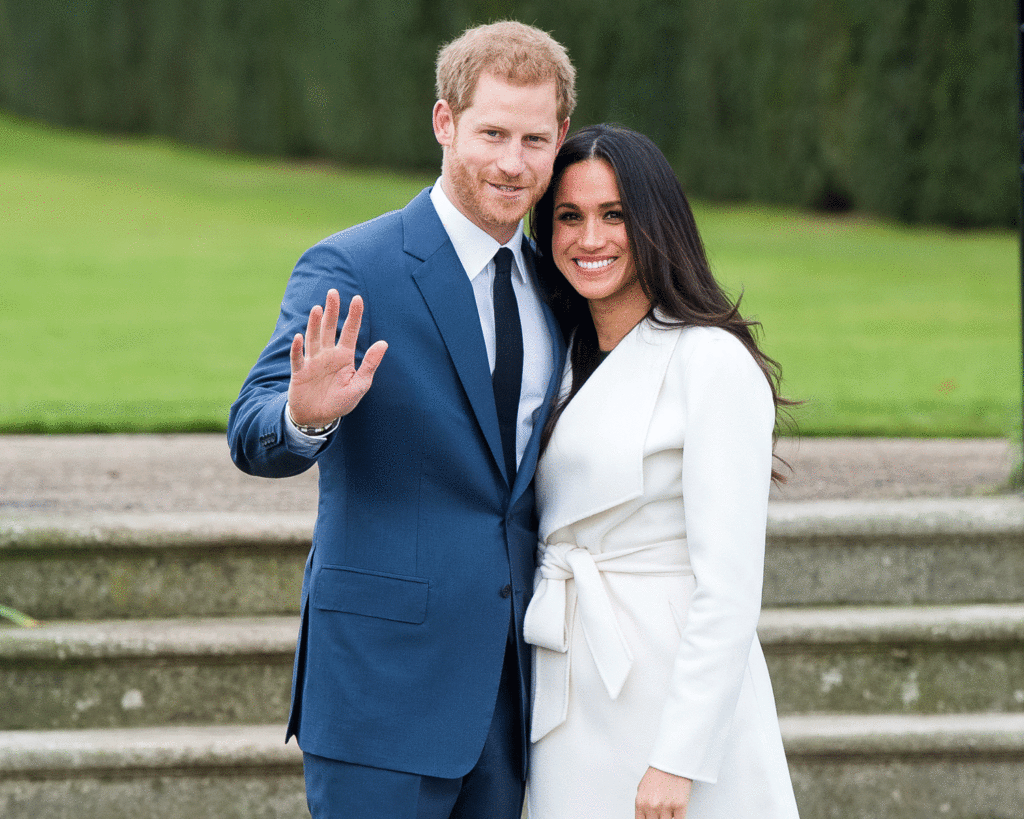
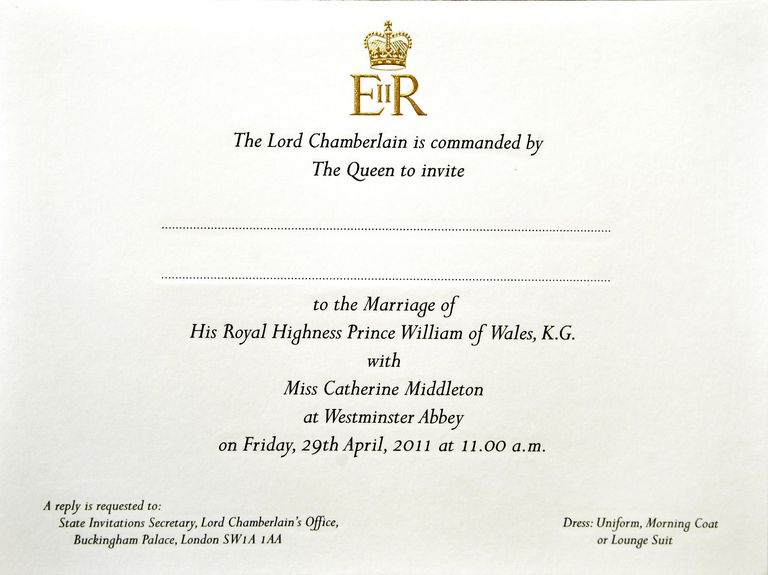
Just a little over two months to go until this year’s most anticipated wedding day arrives, so here’s a round-up of some of the news and a bit of the speculation surrounding the royal nuptials –
Here’s the lowdown on Harry’s childhood friend, Violet von Westenholz who, it’s finally been revealed, was the matchmaker who actually introduced Harry to Meghan
Meghan has finally chosen a designer for her wedding dress – but who is it?!
Entertainment Tonight further speculates about the dress and ceremony and offers up some Will & Kate news while they’re at it.
Hello Magazine explains the seating plan for the church service.
It’s been rumoured that the Spice Girls may make their comeback at the wedding reception. Two days ago, Mel B fueled those rumours during an appearance on “The Real,” but the world awaits definitive confirmation.
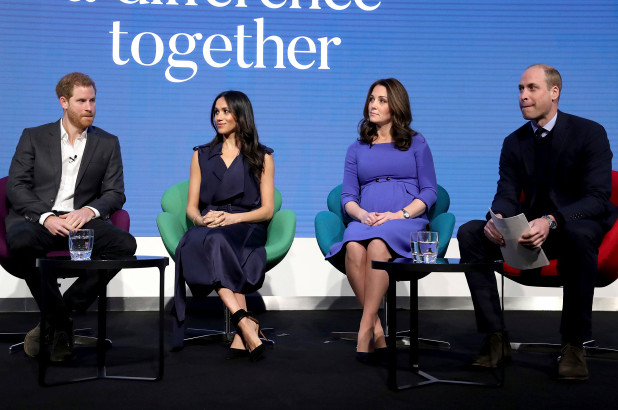
And on Wednesday, William and Kate and Harry and Meghan made their first joint appearance together on behalf of The Royal Foundation.
Breaking just a few hours ago, Harry and Meghan have announced that they will invite 2,640 members of the public inside the Castle grounds in order to watch the carriage procession.
And finally, learn why Meghan won’t be wearing the crown jewels until after the wedding.
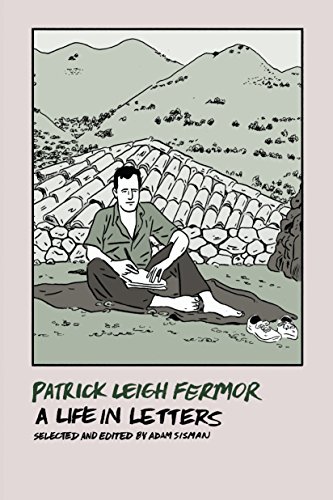
Selected and edited by Adam Sisman, a New York Review Book, 2016 (available through Amazon)
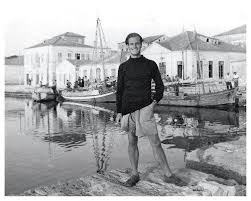
I have so much to thank James Lees Milne for, really. It was through reading his diaries and letters that I have found so many flamboyant, larger-than-life, madcap and interesting people. He introduced me to a circle of his friends and acquaintances and a time period that has become one of my favourite: England between and just after the War(s). One of the people Mr. Lees-Milne introduced me to is Patrick Leigh Fermor, whose author bio on Amazon reads thus:
“In December 1933, at the age of eighteen, Patrick Leigh Fermor (1915-2011) walked across Europe, reaching Constantinople in early 1935. He travelled on into Greece, where in Athens he met Balasha Cantacuzene, with whom he lived – mostly in Rumania – until the outbreak of war. Serving in occupied Crete, he led a successful operation to kidnap a German general, for which he won the DSO and was once described by the BBC as ‘a cross between Indiana Jones, James Bond and Graham Greene’. After the war he began writing, and travelled extensively round Greece with Joan Eyres Monsell whom he later married. Towards the end of his life he wrote the first two books about his early trans-European odyssey, A Time of Gifts and Between the Woods and the Water. He planned a third, unfinished at the time of his death in 2011, which has since been edited by Colin Thubron and Artemis Cooper and published as The Broken Road.”
A potted history, to be sure, and a fuller bio can be found on Wikipedia. A respected British author and travel writer, PLF also felt a pull to Greece, where he travelled extensively and eventually built a house along with his wife, Joan.
Desk in Fermor’s garden near Kardamyli, 2007 copyright R. de Salis, Wikipedia
But it’s PLF’s circle of friends, also his correspondents, that make this book so interesting. Here again we meet Duff and Diana Cooper, the Devonshires, Andrew and Debo, Evelyn Waugh, Ann Fleming, Cyril Connolly, Lawrence Durrell and a host of others who seemingly all lived out sized lives and who are all people with whom one would have loved to share the odd shaker of martinis. The one slight quibble I had with this book is that it only contains PLF’s letters to people, and none from them, but this can hardly be seen as a flaw when the writing is this good.
While in an army hospital in Surrey recovering from pneumonia in February, 1940, PLF wrote the following to Adrian Pryce-Jones:
“Last night something marvellous happened. I am just being tucked up for the night, when I hear strange foreign noises outside the door, which opens, and in bursts Anne-Marie Callimachi (1) followed by Costa (2). She was dressed in black satin and dripping with mink, with pearls and diamonds crusted at every possible point, topped by the maddest Schiaparelli hat I’ve ever seen. Then Costa, who is very dark, with a huge grin, and quite white hair at the age of thirty. He was dressed in a bright green polo jersey over which he wore a very long black new coat with an immense astrakhan collar: both laden with huge presents. The nurses were struck dumb. Shrill squeals burst from us all, and then we were gabbling the parleyvoo like apes. The nurses fled in disorder. Then, of course, they couldn’t get a taxi as Anne-Marie had left the Rolls Royces etc. in London; but they had their luggage, and stopped the night at the hospital! We all pretended they were married, so the Sister, with girlish squeaks, got their room ready, with screens coyly arranged between the beds. By this time Costa was telephoning to the Ritz to say Her Highness wouldn’t be back that night, his voice echoing down the passages. The sensation in the hospital was absolutely phenomenal. Huge princely coronets on the luggage – such nighties! Slippers! Oh!! The hospital hasn’t recovered yet, and my glamour value among the nurses is at fever pitch. . . . They left this morning, Anne-Marie leaving a munificent cheque for the Hospital Fund, which I tendered with a languid gesture to the head doctor. Their passage will not be forgotten for ages!”
Fourteen years later, in September 1954, such hobnobbing with the cream of society was still in full flow. PLF writing to Ann Fleming from Hydra:
“Diana’s (Lady Cooper) presence proved a magnet for other yachts, first of all Arturo Lopez (3) in a vast sodomitical-looking craft, done up inside like the Brighton Pavilion, a mandarin’s opium den and the alcove of Madame de Pompadour. . . but this is nothing compared to five days ago, when a giant steam yacht (with a aeroplane poised for flight on the stern) belonging to Onassis came throbbing alongside. . . . On board were Lilia Ralli, several blondes, a few of the zombie-men that always surround the immensely rich, Pam Churchill & Winston Jr.”
We can forgive PLF his forays into the world of the rich and famous, not only because they’re so amusing, but as these brief interludes are tempered with quiet, bucolic and often mundane passages. To Jessica Mitford, PLF wrote in 1983, “Went to a marvelous sheep sale yester’een with Debo (her sister, Deborah, nee Mitford, Duchess of Devonshire), it was wonderful, faces like the whole of Gilray and Rowlandson, and an auctioneer haranguing, in what sounded like Finnish but was just rustic north country. This is the sort of whirl I like to live in.”
PLF’s friends were generous as well as amusing, several of them allowing he and Joan to use their homes whenever they chose, as was the case with Gadencourt, a manor house in Normandy owned by Sir Walter and Lady Smart – to Patrick Kinross, February 1952 – “They frightfully kindly let me live here for the whole winter. Why don’t you come and move in on your way home?” He also often stayed at a mansion owned by artist Niko Ghika on Hydra. PLF wrote, “He was seldom there, and, with boundless generosity, he lent it to Joan and me for two years.” Additionally, PLF was a regular house guest of such friends as Lady Diana Cooper, staying at her house in Chantilly and the Duke and Duchess of Devonshire, spending many Christmas’s with them at Chatsworth House. In February 1960 PLF wrote to Ann Fleming, “Christmas was glorious and went on for ages, consisting of Andrew, Debo and children, Andrew’s mother, Nancy (Mitford) and Mrs. Hammersley, for whom I developed a reciprocated passion. She strikes a wonderful note of bilious gloom about anything.”
Joan and Patrick would eventually build a house in Greece and spent many of their happiest years there, coming back to England regularly and staying at Joan’s family home in Devon. Occasionally, PLF stayed at the Easton Court Hotel in Devon, especially when he was seeking solitude in which to write. In a letter to Lady Diana Cooper, September 1956 –
” . . . . My muse and I are cloistered here, a gale howls down the chimney, cats and dogs come down on the sodden fields outside in an almost unbroken stream and a wind blows that would unhorn cows. I don’t think you’ve ever been here, but it’s a great retiring place for literary purposes, for E. Waugh, & Patrick Kinross and others – I first came here seven years ago with Patrick . . . and have been back several times in extremis . . . It is owned & run by an odd couple, Mrs. Carolyn Postlethwaite Cobb, an elderly American of very improbable shape, now largely bedridden, and her middle-aged ex-lover Norman Webb, a Devonshire chap she met a number of decades ago running a team of donkeys in Biskra or Fez. . . . ”
I found that PLF and I had a lot in common in the end, very odd considering that I’m neither a man, British nor a lover of all things Greek and that I come from a different generation. In a letter to his publisher, Jock Murray in July of 1953, PLF writes that he’d travelled through Greece, finally arriving in Missolonghi by sea:
“Here the great search for Byron’s shoes began. I hadn’t got Lady Wentworth’s (4) letter with me, containing the address . . . I asked all over the town – mayors, local bigwigs, etc. – for a old man who had a pair of Byron’s shoes. . . I tracked him down in the end, a very decent, wall-eyed old man called Charalambi Baigeorgas or Kotsakaris . . . along with a lot of scimitars, yataghans, pistols, powder horns, etc., he produced a parcel, already addressed, on the strength of my letters last year, to Baroness Wentworth. . . . Since then, though, he seems to have fallen in love with them, and (rather understandably) wants to leave them to his children. . . He undid the parcel, and produced a pair of slippers that looked more Turkish, or Moroccan or Algerian (or Burlington Arcade oriental) than Greek . . . . I enclose a sketch and a description of the colours . . . the age looks just about right. I made a tracing of both of them, also of the parts of the soles where the criss-cross tooling is worn smooth, in case it should corroborate, or conflict with, known facts about Byron’s malformation.”
Lady Wentworth
Do admit, these are the sort of lengths I might conceivably go to if the artifact involved Wellington. There’s no information in the book regarding the outcome or provability of the shoe’s being Lord Byron’s but there is PLF’s description of Lady Wentworth herself, and it’ s a pip –
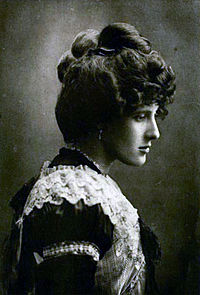
To Lady Diana Cooper, March 1954: “. . . The house (Crabbet Park, Sussex) is untidy as a barn – trunks trussed, and excitingly labelled `LD BYRON’S papers – LDY BYRON’S papers’ in chalk, pictures stacked, furniture piled, wallpaper, curtains etc. exactly the colour and shape of coloured Phiz or Leech . . . . gilt, faded plum and canary, v. grand and dusty. We had rather a mouldy luncheon, ending up with spotted-dog, in a room as full of papers, pictures, horsey accoutrements and favours as a jackdaw’s nest. Lady Wentworth was wearing, as usual, gym-shoes from playing squash, a Badminton skirt to the ground, a woollen shawl, a gigantic and very dishevelled auburn wig that looked as though made of strands from her stallions’ tails gathered off brambles, and on top of this a mushroom-like, real Sairey-Gamp mob-cap, but made of lace and caught in with a Nile-green satin ribbon. Rather a fine, hawky Byronic face under all this, but scarlet patches on the cheeks as from a child’s paint-box; I think she’s eighty-two or three – and a very thin, aristocratic, bleak voice – `have some more spotted-dog?’ sounding like a knell.”
PLF was a writer with projects constantly on the go, but he was easily distracted by passing fancies, often missing deadlines and being forced to write the dreaded mia culpa letter to editors or friends to which he’d promised pieces. In a letter to Lady Diana Cooper in November of 1975, PLF confesses: “Michael Stewart has sent us the Oxford Dictionary of English Place Names, which I’ve been deeply immersed in for the last two days: all their derivations, etc.” And to her son, John Julius Norwich, PLF writes: “Last year Jock Murray suddenly told me that about two hundred pounds had mounted up (in royalties) so I blew the lot on the DNB (Dictionary of National Biography) . . . so give me a few minutes notice and I can be pretty knowing about almost anyone in England – before 1900 – up to William Tytler (1711-1792) . . . it would be hard to find a more fascinating and time-wasting acquisition.” Both examples could be me to a T.
A Life In Letters is a delight, some parts reading like a travel book, other parts a glimpse into a vanished lifestyle, all of which is bound up with great friendships, anecdotal offerings and humour.
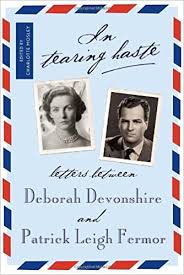
So, what will I read next? In Tearing Haste, edited by Charlotte Mosley, was one of PLF’s last projects and is a compilation of the letters exchanged between himself and Deborah, Duchess of Devonshire, over the course of a friendship that spanned more than forty years. However, having already read this when it was first published, I’m thankful that Patrick Leigh Fermor has led me to another possibility, as so often happens with the best books –
From a letter to Lawrence Durrell, November 1954 –
“. . . I’ve just got . . . Daphne’s (5) autobiography Mercury Presides . . . . which is rattling, splended stuff, not a bit the niminy-piminy society memoir you would think, but hell for leather, a mixture of lyrical charm and touchingness with a clumsy, rustic tough edge to it which is most engaging and terribly funny. Rather like the letters of Lady Bessborough or Caroline Lamb, half-sylph, half-stablehand.”
Leave a comment below in order to be entered
into a drawing to win a copy of this book!
Rumanian Princess Anne-Marie Callimachi.
Greek photographer Costa Achillopoulos.
Arturo Lopez-Willshaw, Chilean millionaire.
Judith Anne Dorothea Blunt-Lytton, whose mother had been Byron’s granddaughter.
This is really just a collection of pretty wedding pictures and gorgeous dresses. But, since it’s on our minds, these days, why not? Some of these brides are related to the U.K. royals, others from European families. At right is Crown Princess Victoria of Sweden with her husband, Daniel Wrestling. They were married in Stockholm in June, 2010.
The dress is elegantly simple and looks perfect on Princess Victoria. Only the tiara — though it looks more like a crown — is elaborately decorated.
Crown Princess Victoria Ingrid Alice Désirée was in 1977. She will become Queen of Sweden upon the death of her father, King Carl XIV Gustav. through her father, Victoria is related to the British royals and actually occupies a position in the line of U.K. royal succession. Now known as HRH Prince Daniel, Duke of Vastergotland, Victoria’s husband is her former personal trainer and ran a company owning several gyms.
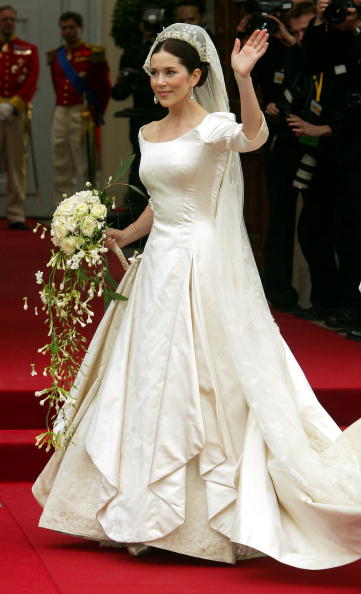
Another Scandinavian royal wedding was in Copenhagen Denmark on May 14, 2005, when HRH Crown Prince Frederik married Mary Donaldson, an Australian. They recently had twins, in January, 2011, a boy and a girl. Their older siblings are Prince Christian, born in 2005, and Princess Isabella, born in 2007.
Crown Princess Mary made a beautiful bride and her dress was picture perfect. The overskirt draping makes graceful detailing near the hem, rather an unusual but pleasing feature.
Hollywood royalty was united with royalty from the tiny but rich principality of Monaco when film star Grace Kelly married Prince Rainer in 1956.
The very nigh neckline of the gown amused many observers who were well aware of Kelly’s reputation for behaving entirely contrary to her look of a perfectly-proper ice queen. Princess Grace, mother of three royal children, died in a car crash in 1982. The Prince died in 2005.
David Armstrong-Jones, Viscount Linley, married Hon. Serena Stanhope in October of 1993 at St. Margaret’s, Westminster. He runs a thriving furniture business with a showroom in Pimlico which is quite fun to visit. Fashion observers noted how the gown, by Bruce Bobbins, resembled the neckline design of Princess Margaret’s gown from 1960. The Viscount is Margaret’s eldest child. The Linleys have two children, Charles, born 1999, and Margarita, born 2002.
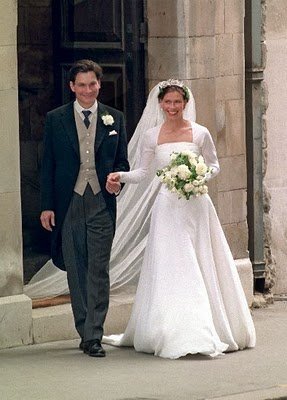
The very next year, Princess Margaret’s daughter Lady Sarah Armstrong-Jones married actor Daniel Chatto at St Stephen Walbrook in the City of London on July 14, 1994. Her gown by Jasper Conran is elegantly traditional, though the venue for the ceremony was unusual for a member of the royal family. The Chattos have two sons, born in 1996 and 1999.
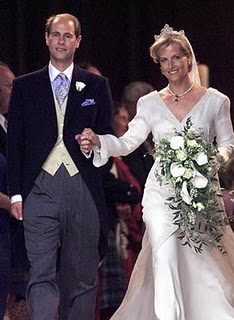
The last of Queen Elizabeth II’s sons to wed was Prince Edward. He married Sophie Rhys-Jones in 1999 at St. George’s Chapel, Windsor Castle, below. They are titled the Earl and Countess of Wessex. The gown was designed by Samantha Shaw. The Wessexes have two children, Lady Louise, born 2003, and James, Viscount Severn, born in 2007.
The Queen’s eldest grandchild, Peter Phillips, married Canadian Autumn Kelly at St. George’s Chapel, Windsor Castle, on May 17, 2008. The strapless dress was certainly au courant with its lace shrug, or bolero, if you wish. It was designed by Sassi Holford, one of the leading bridal gown providers in Britain. The tiara worn by Autumn was the “something borrowed” — from Anne, Princess Royal, Autumn’s new mother-in-law.
The Queen’s first great grandchild was born to Autumn and Peter on December 29, 2010, named Savannah.
Lady Rose Windsor, daughter of the Duke of Gloucester (cousin of Queen Elizabeth II), was married to George Gilman, on July 19, 2008 at the Queen’s Chapel, St. James Palace. The gown is lovely and the tiara one loaned from the royal collection, but finding the name of the dress designer was impossible — all the press reports focused on what Kate Middleton was wearing.
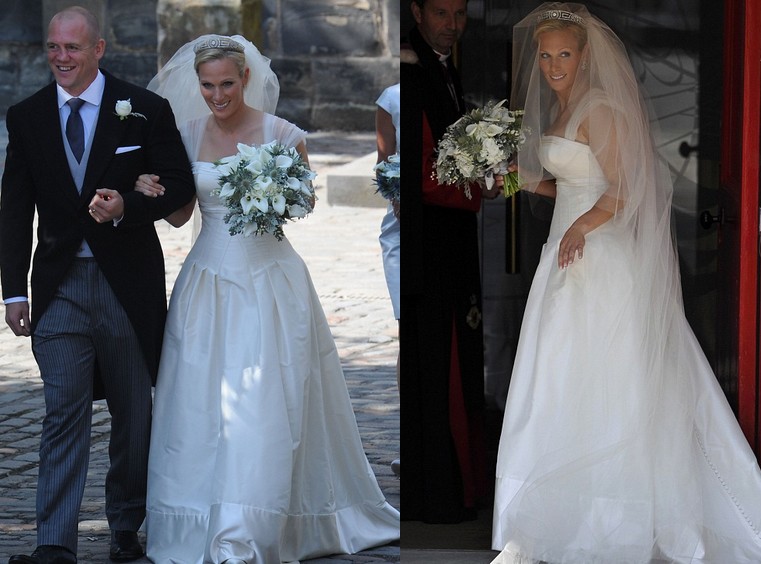
In addition to the wedding of Kate and Prince William, 2011 also saw the wedding of Zara Phillips, daughter of Anne, Princess Royal, and rugby star Mike Tindall on July 30.
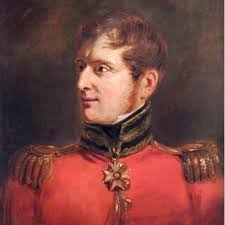
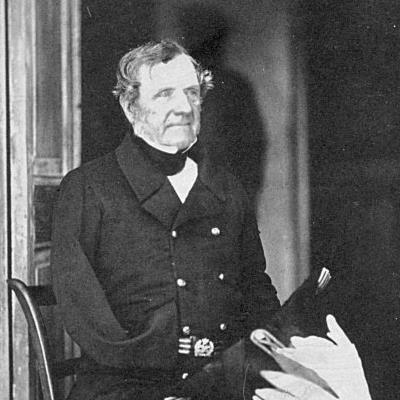
Recently, an article about the Raglan Sleeve brought home to me just how many garments and styles are named for people or places related to British History. Of course I’d been aware of the Raglan Sleeve prior to the article, but as I always think of Raglan as he was – FitzRoy Somerset, the Duke of Wellington’s ADC, private secretary and nephew-in-law (below) – I hadn’t readily connected the dots.
Fitzroy James Henry Somerset, later known as 1st Baron Raglan (below), was with Wellington at the Battle of Waterloo as a 23 year old aide-de-camp and suffered an injury caused by a musket ball that necessitated the amputation of his right arm. As the field surgeon was disposing of the limb, Raglan is purported to have cried out, “I say, bring me back my arm!” Those nearby thought he was delirious, until he explained that the ring his wife had given him was still on the finger. She might be alright with his losing an arm, but she’d never forgive his losing the ring.
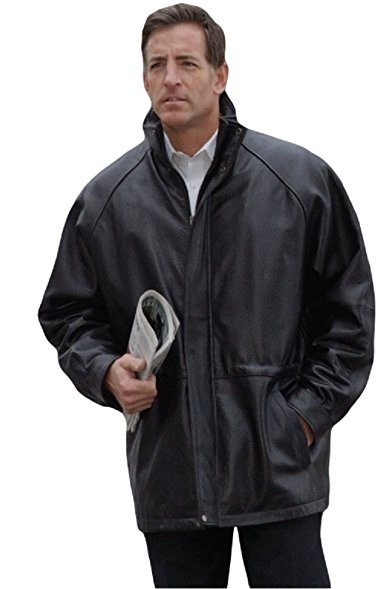
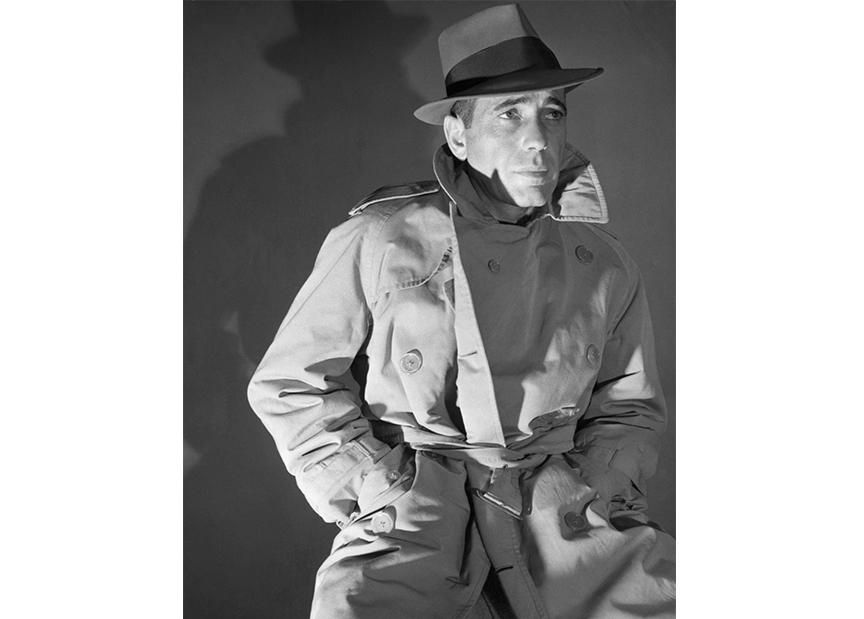
FitzRoy Somerset afterwards taught himself to write with his left hand and continued his military service and his work with Wellington. He also went on to wear a signature overcoat adapted with the sleeves set into a wide, loose armhole by the Aquascutum firm, with both sleeves continuing in one piece up to the neck, less defined shoulder seams and a more deconstructed appearance.
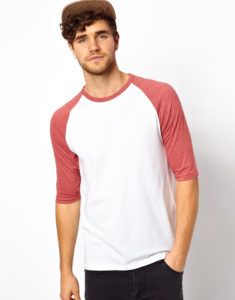
The Raglan coat remains a popular men’s style, while the Raglan sleeve is now a permanent part of our fashion lexicon thanks to the baseball t-shirt.
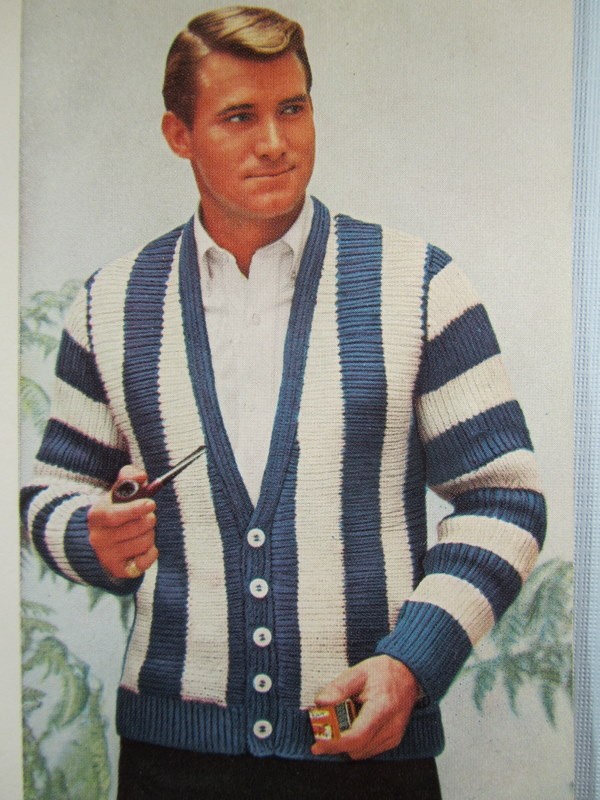
The cardigan sweater was named after James Brudenell, 7th Earl of Cardigan, who led the Charge of the Light Brigade at the Battle of Balaclava during the Crimean War. Fashion lore tells us it was modelled after the knitted wool waistcoat typically worn by British officers.
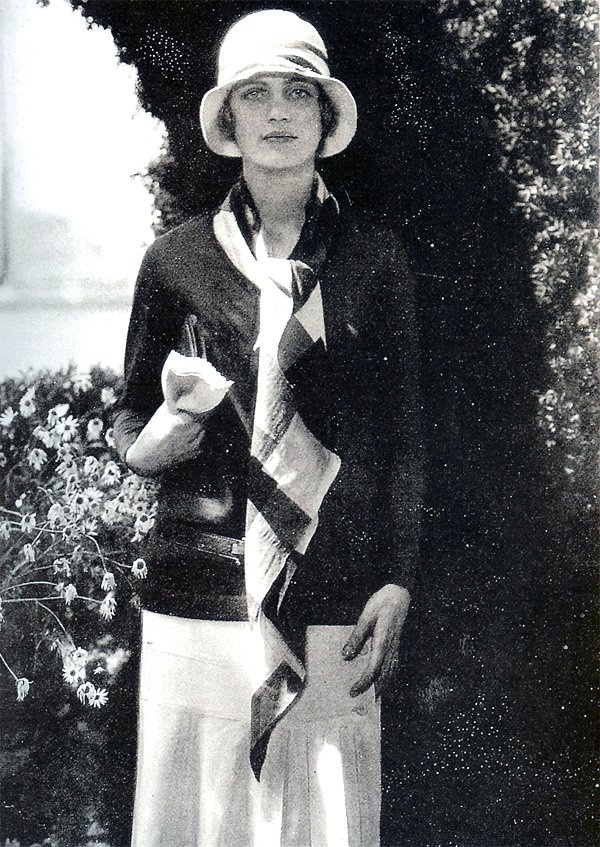
The Cardigan sweater remains a staple of men’s wear, while Coco Chanel is credited with popularizing the feminine version of the look.
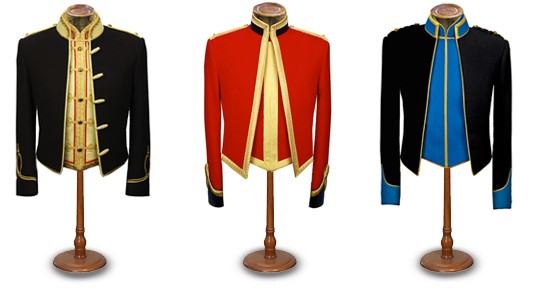
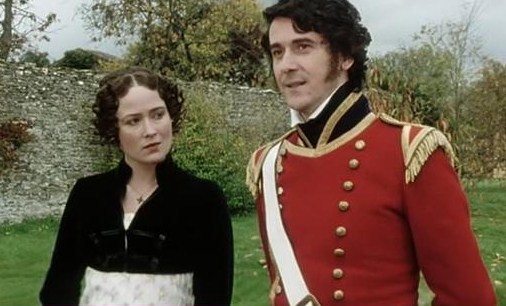
The Spencer coat dates from the 1790’s when, legend has it, George Spencer, 2nd Earl Spencer, got too close to an open fire and burnt the tails of his coat, prompting him to order his tailor to make him a jacket sans tails. The Spencer is a shorter, double breasted, waist-length coat, alternately called a mess jacket, as the style was taken up by officers in the British army, as seen below.
Fans of period dramas will recognize the Spencer as being a popular ladies’ garment during the Regency era.
The Macintosh, or Mackintosh, raincoat was invented by Scotsman Charles Macintosh as a waterproof coat made from an early rubberized fabric and first made it’s appearance in 1824.
The “mack” has nowadays evolved into the trench coat, but to be considered a true Mack, the coat should be made from waterproof material.
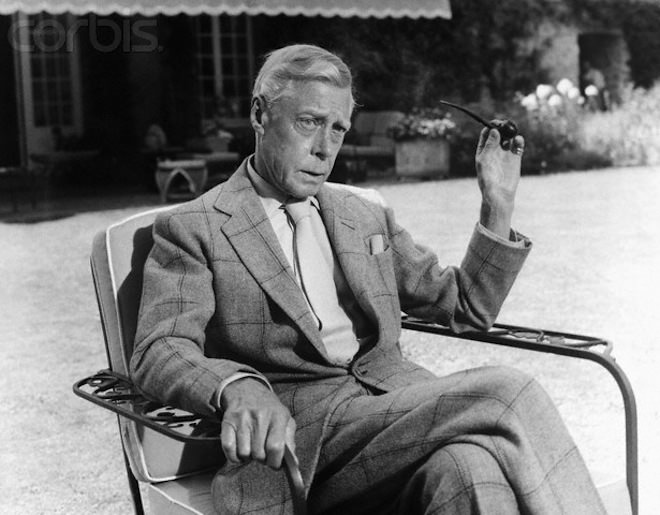
The Duke of Windsor did not invent the Windsor knot, or tie. That’s right. It was his father, King George V, who favoured wide tie knots and had his tailor cut his ties from a wider cloth, so that the knot would be wider than the traditional four-in-hand knot style that was preferred at the time.
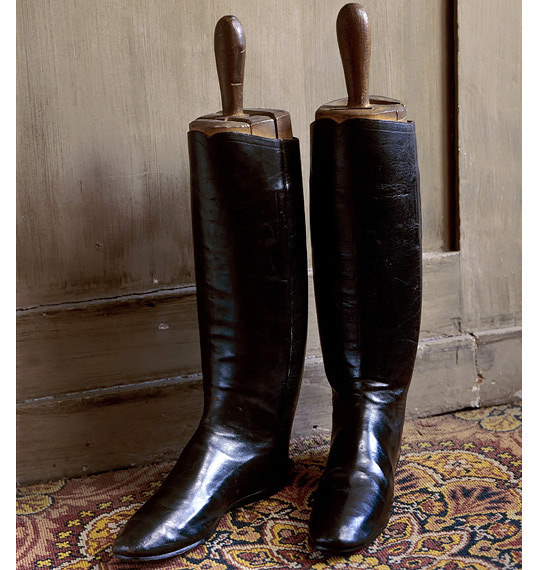
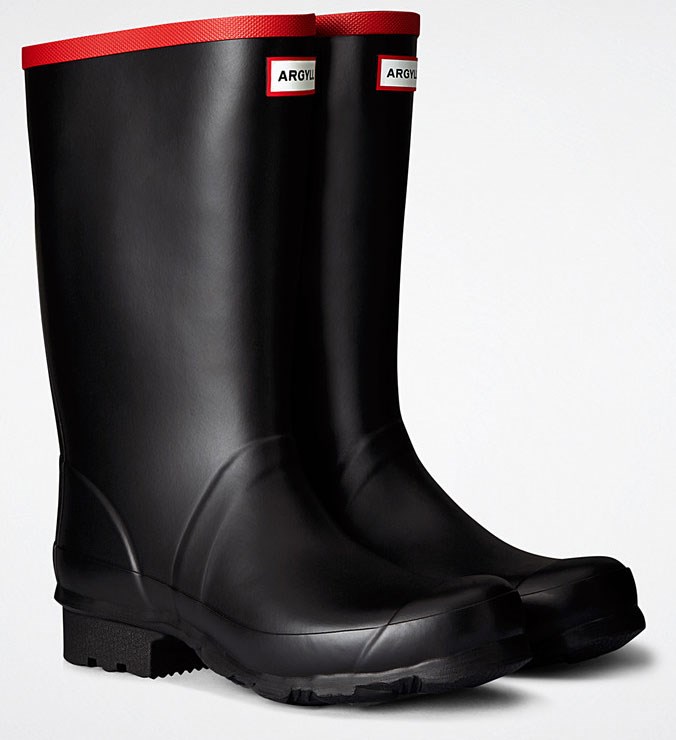
Wellington boots were “invented” by the Duke of Wellington, who directed his bootmaker, Lobb, to cut down traditional leather Hessian boots in order to make them more comfortable when riding on horseback for long periods of time. Today, Wellington boots are more often made of rubber and are indispensable for outdoor wear.
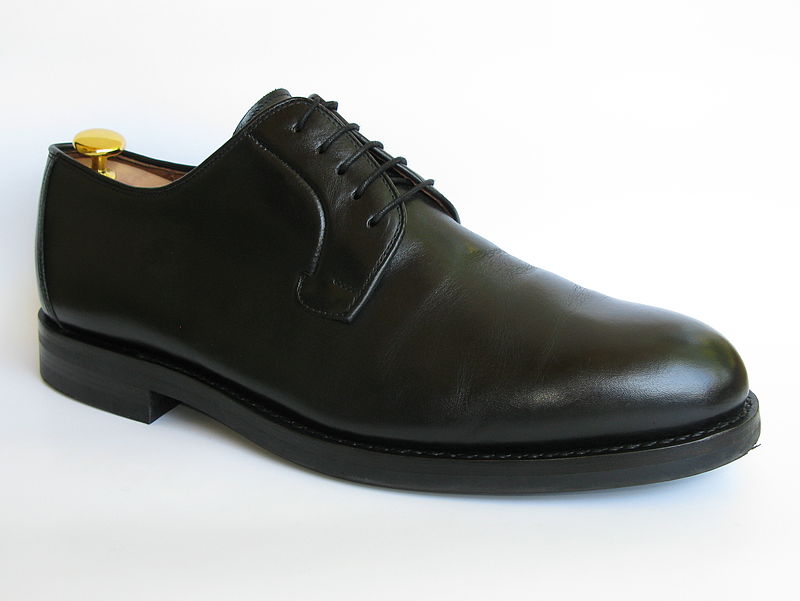
The Blücher is a type of oxford (closed shoe) in which the tongue and vamp (the front part of the shoe) are cut in one. The Blücher is named after the 18th century Prussian field marshal Gebhard Leberecht von Blücher, who commissioned a boot with side pieces lapped over the front in an effort to provide his troops with improved footwear.
The Blücher shoe.
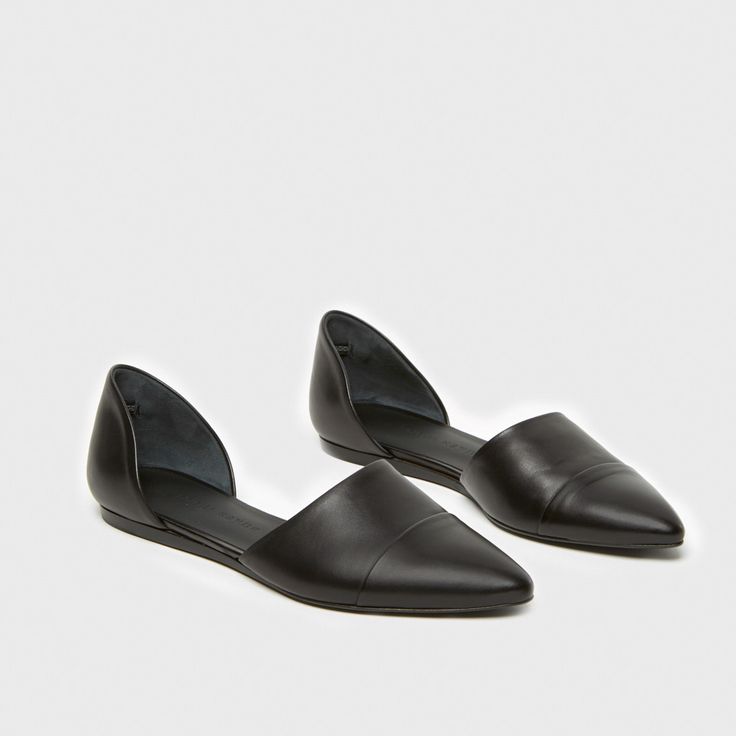
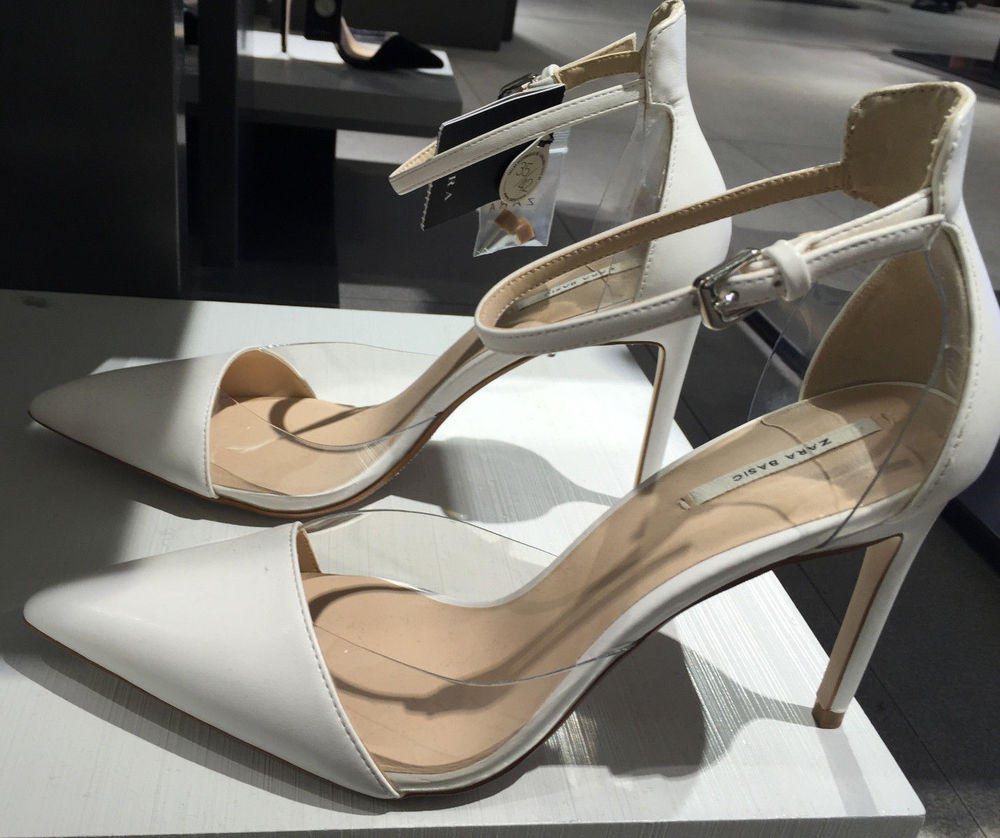
The d’Orsay shoe or slipper refers to any shoe that has a closed heel and toe but which is cut down to the sole at the sides. It can be made with a heel of any type and any style of vamp (front). The style is one of several fashions named after the Count d’Orsay, a fashionable dandy living Paris in the mid-1800s, who went on to marry Lady Blessington.
Today, the term “d’Orsay shoe” is used to describe any women’s shoe that exposes the arch of the foot.
Can you think of any other fashion terms named after persons from history? If so, please share them with us with a comment.
Originally posted on February 12, 2011, ahead of the other wedding of the decade, that of William and Katherine.
As I write this, there is no word on the designer Kate Middleton has chosen to create her wedding gown, though I have heard many breathless accounts of who is and who is not in the running. So let’s indulge our royal wedding mania by looking at some of the gowns worn in the past.
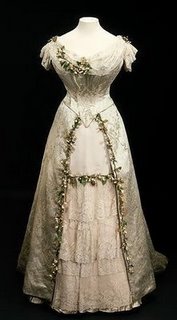
Above is the dress worn by Princess Charlotte of Wales at her May 2, 1816, wedding to Prince Leopold of Saxe-Coburg, as exhibited in the Museum of London here.
The Lady’s Magazine of May, 1816, described the gown: White silk net embroidered in silver strip with a spotted ground and borders. The wedding dress, composed of a most magnificent silver lama on net, over a rich silver tissue slip, with a superb border of silver lama embroidery at the bottom, forming shells and bouquets above the border; a most elegant fullness tastefully designed, in festoons of rich silver lama, and finished with a very brilliant rollio of lama; the body and sleeves to correspond, trimmed with a most beautiful point Brussels lace, in a peculiar elegant style.
The manteau of rich silver tissue lined with white satin, trimmed round with a most superb silver lama border, in shells to correspond with the dress, and fastened in front with a most brilliant and costly ornament of diamonds. The whole dress surpassed all conception in the brilliancy and richness of its effects. Head dress, a wreath of rose buds and leaves, composed of the most superb brilliants.” At right, an engraving of Charlotte and Leopold at their wedding in Carlton House.
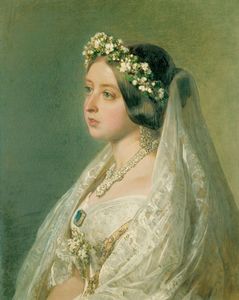
The portrait of Queen Victoria, at left, is by Winterhalter. It shows a rather wistful young bride at the time of her wedding to Prince Albert of Saxe-Coburg (nephew of the above-mentioned Leopold) on February 10, 1840 in the Chapel Royal of St. James Palace.
It was this gown and veil that supposedly has inspired generations of brides ever since to wear white for their ceremonies, though many brides had previously dressed in fashionable white as well as in a variety of other hues.
At right, an image of Queen Victoria’s dress on a mannequin in the collection of Kensington Palace.
Left, the wedding gown of Alexandra of Denmark, who married Victoria’s son, eventually King Edward VII, on March 10, 1863 in St. George’s Chapel at Windsor Castle. She was Princess of Wales for almost forty years before becoming Queen in 1901. After her husband’s death in 1910, she was known as the Queen Mother until she died in 1925.
Like Charlotte’s mother, Caroline, Princess of Wales, and like the first wife of the present Prince of Wales, Diana (see below), Alexandra had to endure the infidelity of her husband. But unlike the other two, she stuck with him to the end. We’ve all heard the possibly-apocryphal story about how Alexandra invited one of his mistresses, Alice Keppel, to comfort Edward VII on his deathbed.
Princess Mary of Teck wed Prince George, Duke of York on 6 July, 1893 in the Chapel Royal of St. James Palace. She had been engaged to Prince Albert Victor, eldest son of the Prince of Wales in 1891, but Albert Victor died in the great influenza epidemic of 1891-92. Mary and George fell in love and were married with the approval of Queen Victoria as well as Edward and Alexandra, Prince and Princess of Wales. George succeeded his father as George V in 1910. Queen Mary, who was a godchild of Queen Victoria, had five sons and one daughter.
Her eldest son, known to all as David, was more than a disappointment. After inheriting the throne as Eward VIII in 1936, he abdicated less than a year later to marry Wallis Simpson.
After her husband’s death, Queen Mary chose to be addressed as Her Majesty, Queen Mary, rather than as Queen Mother. She was very supportive of her second son, who became King George VI after his brother’s departure from the throne. According to several sources, she was the first dowager queen of Great Britain to ever attended the coronation ceremony of her husband’s successor.
As Duke of York, the second son of George V and Mary grew up in the shadow of his dashing older brother. He married Lady Elizabeth Bowes-Lyon on 26 April 1923 in Westminster Abbey. At the time of the wedding, it was not expected that “Bertie” would take the throne. Lady Elizabeth’s gown, perhaps for that reason, was not as elaborate as some of her predecessors. It was certainly in the style of the day, a rather loose gown, slightly less than floor length. Below is the dress on a mannequin in a Kensington Palace exhibition of several years ago, along with a detail of the veil and bodice.
On 20 November, 1947, Princess Elizabeth (later Queen Elizabeth II) married Prince Philip of Greece (later Duke of Edinburgh) in Westminster Abbey. The designer was Norman Hartnell and the fabric is silk spun at Lullingstone Castle in Kent. She wore a diamond and pearl tiara and a filmy veil. The long train was decorated with traditional symbols, such as Tudor roses and wheat. All the details of the royal romance, the wedding, the gown and the ceremony were eagerly read around the world. It is said the happy event was like a tonic to the war-weary Britons still enduring shortages of goods and rationing.
The Gown on a mannequin
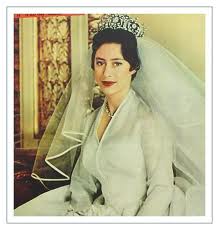
Princess Margaret, second daughter of King George VI, married Antony Armstrong-Jones (later Earl of Snowdon) on May 6, 1960, at Westminster Abbey. Television cameras covered the event and the broadcast was seen worldwide. Like her sister, Margaret chose Norman Hartnell to design her bridal gown.The couple had two children: David, Viscount Linley in 1961 and Lady Sarah Armstrong-Jones in 1964. The Snowdons were divorced in 1978 and Princess Margaret died in 2002.
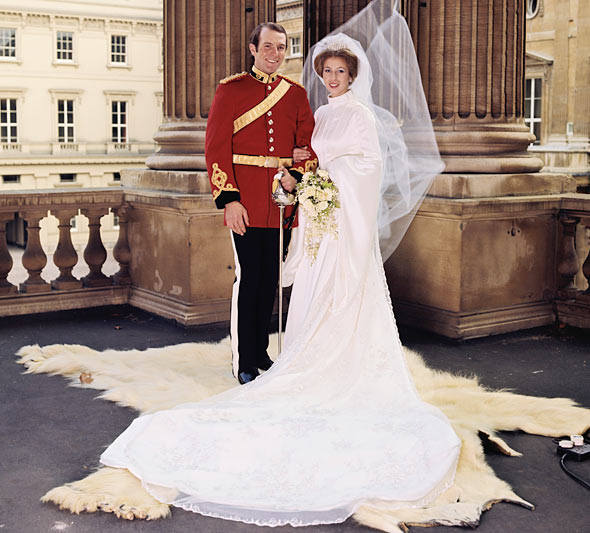
14 November 1973 – Anne, Princess Royal, married Captain Mark Phillips in Westminster Abbey. Born in 1950, she is Queen Elizabeth II’s only daughter.Anne and Phillips have two children, Peter Phillips born in 1977 and Zara Phillips born in 1981. After divorcing Phillips in 1992, Anne married Timothy Laurence, in Scotland on December 12, 1992.
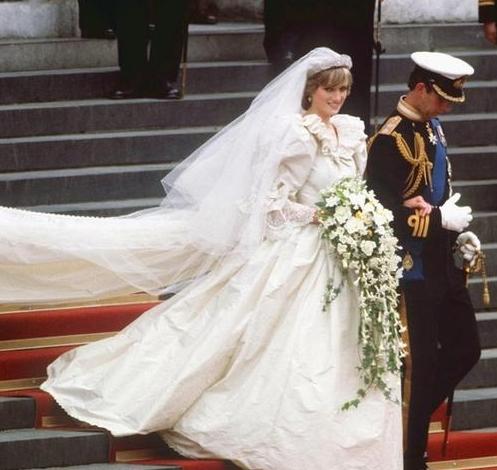
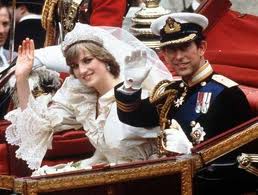
On 29 July 1981, Lady Diana Spencer and Charles, Prince of Wales, were married in St Paul’s Cathedral. Her dress was controversial — and still is. The designers, David and Elizabeth Emmanuel, immediately shot to the top echelon of British fashion. Like many of Diana’s fashions, the gown (or a replica) travels around the world for popular exhibition.
Charles and Diana had two sons, Prince William, born in 1982, and Prince Harry, born in 1984, before separating in the late 1980s, the Prince living in Highgrove and the Princess at Kensington Palace. Formal separation came in 1992 and the marriage of Charles and Diana ended in divorce on 28 August 1996. On 31 August 1997, a year after the Prince and Princess divorced, Diana died in a car crash in Paris.
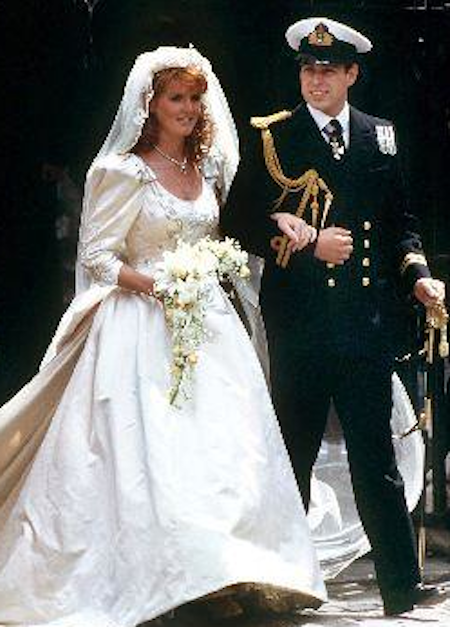
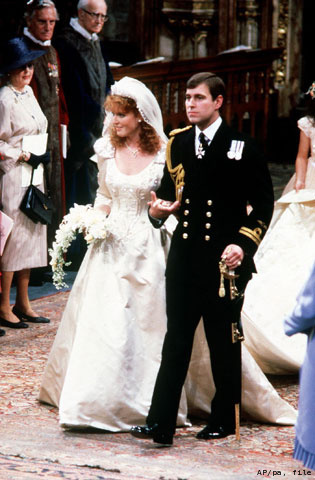
Sarah Ferguson and Prince Andrew, the Duke of York, married at Westminster Abbey on 23 July 1986. The Duke and Duchess of York had two children during their marriage: Princess Beatrice of York (born 1988) and Princess Eugenie of York (born 1990). They separated in 1992 and divorced in 1996, though they are often together for vacations and family events.
Of all the gowns shown above, I think I like Sarah’s best, as designed by Lindka Cierach. It is beautiful, flattering to her and has no gimmicks. Princess Elizabeth’s was lovely too, but I like Sarah’s veil better. All in all this one is the winner in the gown category, if perhaps not in the list of “most suitable royal brides.”
If like us, you can’t get enough of this wedding stuff, here is a wonderful exhibition from the Royal Collection you will enjoy.

 Leave a comment below in order to be entered