While in Paris, Brooke and I took a champagne cruise down the River Seine. Here is some video I took during that trip, which ended around sunset.
Author: Kristine Hughes
Happy Birthday to Prince Albert
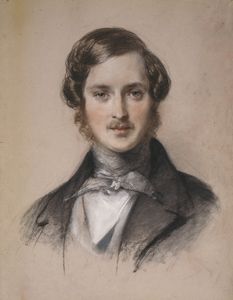
Prince Francis Albert Augustus Charles Emmanuel of Saxe-Coburg and Gotha was born August 26, 1819. His wife, Queen Victoria, was born on the 24th of May in that year. They were first cousins.
Right: Prince Albert by Charles Brocky, 1841
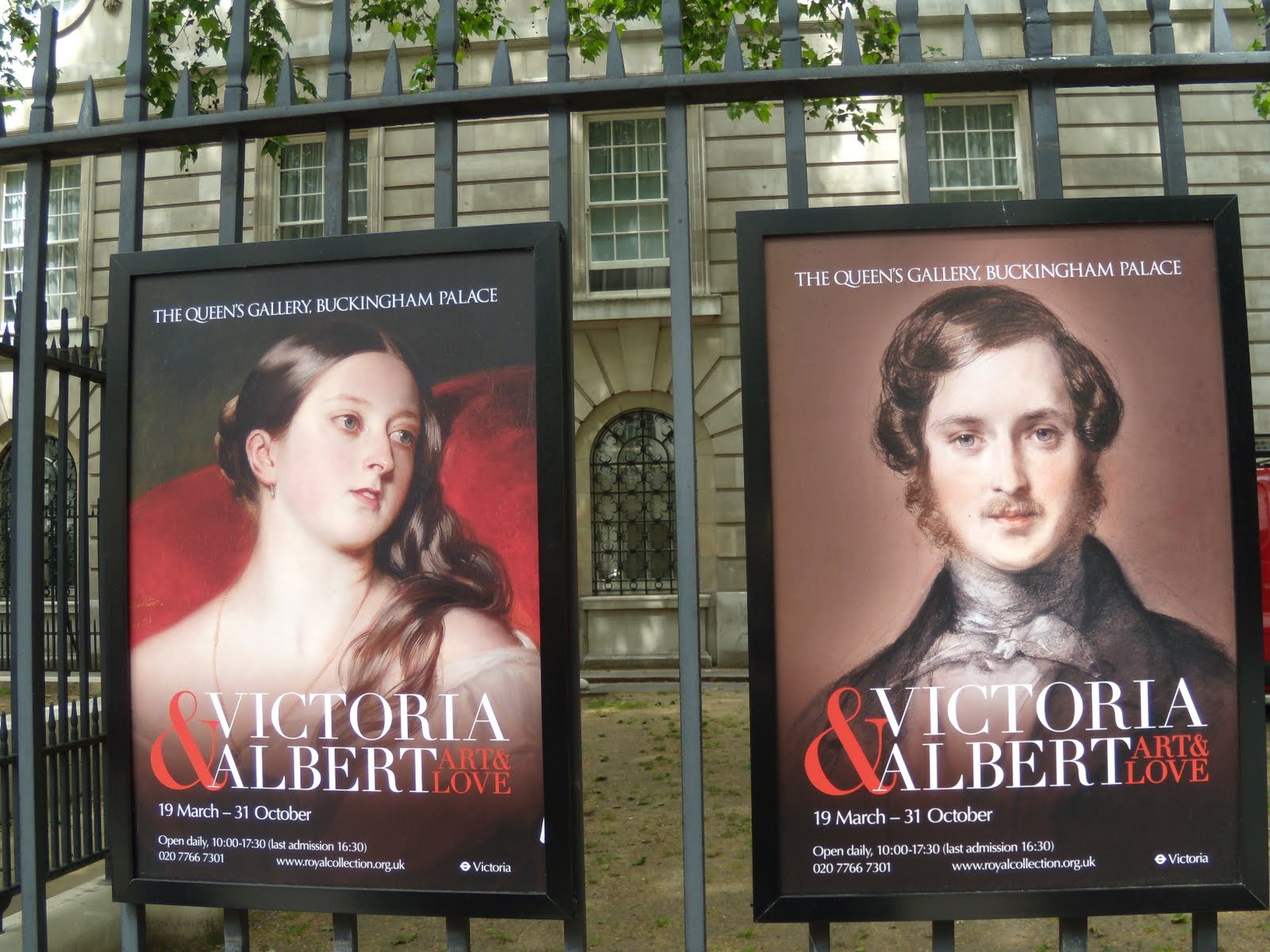 The exhibition Victoria and Albert in Love can be seen in the Queen’s Gallery, Buckingham Palace, London, until October 31, 2010.
The jewelry, musical compositions, drawings, paintings and furniture exchanged by the royal couple make an interesting statement about the depth of their love and commitment. Many of the items were birthday gifts given to the Prince by the Queen.
 Rupert Friend (right) as Prince Albert in the film The Young Victoria. The costumes and settings were sumptuous, but the story left a bit to be desired by those of us who paid attention to the details!
 John Lucas painted Prince Albert in 1841, left.
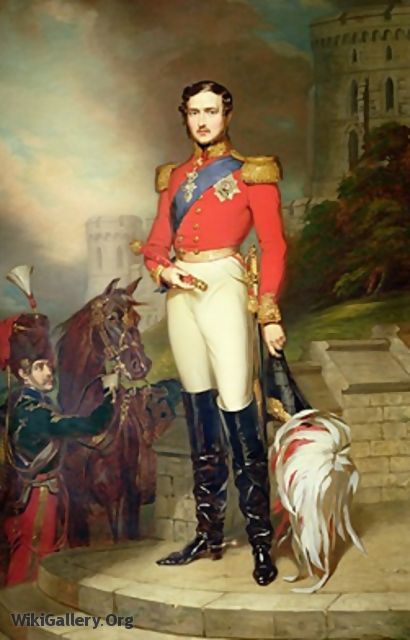
  Prince Albert, right, by Winterhalter, in 1842. Albert had an excellent private education. With his older brother Ernest, he was tutored at home and later attended the University of Bonn. He excelled in fencing and riding, and traveled in Italy. Almost from birth, many considered the possibility of uniting the cousins, and King Leopold encouraged the marriage. Victoria and Albert met several times and she was eventually quite taken with him, but after she took the throne at age 18 in 1837, she was in no hurry to wed.
 After her coronation, however, she wrote to Uncle Leopold: “Albert’s beauty is most striking, and he so amiable and unaffected — in short very fascinating.” Louis Auchincloss in his Persons of Consequence: Queen Victoria and Her Circle (1979) observes: “A principal industry of the German States in the nineteenth century was the production of marriageable princes and princesses.”
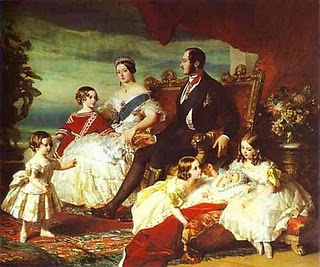 The wedding took place on February 10, 1840. Albert’s role in the realm was unclear, and it changed, evolving over the next few years until he became very influential and quite popular (though only after his death was his popularity recognized by most in the government). Albert and Victoria became the parents of nine children.
 At right is a family portrait, also by Winterhalter, of the family in 1846.
 One of Albert’s greatest achievements was the Great Exhibition of 1851. As a supporter of science and technology, he was particularly influential upon industrial advancements of the day. In addition, he single-handedly modernized and revamped the running of the royal palaces and the financial administration of the monarchy.
Prince Albert died of typhoid fever at 10:50 p.m. on 14 December 1861 in the Blue Room at Windsor Castle, in the presence of the Queen and five of their nine children, leaving the Queen devastated. Though she lived on until 1901, Victoria never shed her widow’s weeds.
Nanny McPhee's Triumphant Return

This past weekend, I went to see Nanny McPhee and I can tell all you NMc fans that her Return was as good as the original. And, this time out, Nanny has even more screen time. The new cast of characters are a hoot, especially Eros Vlahos as cousin Cyril. Vlahos plays him as a sort of miniature, self important prig who delivers sarcastic verbal barbs with Oscar Wilde-like precision. This kid deserves an Oscar nod.

Of course, Maggie Smith is wonderful as the dotty Mrs. Docherty, and the piglets steal the show.
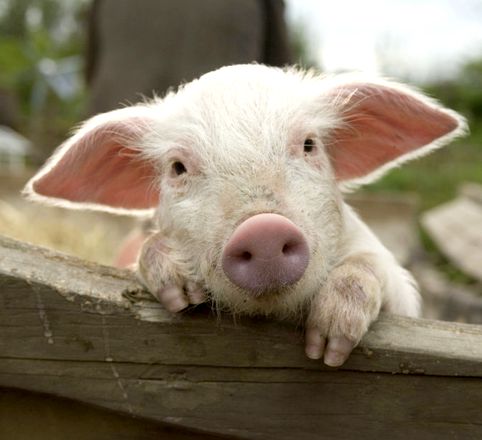
This time out, Nanny’s got a window putty eating crow, Mr. Edelweiss.

One of the funniest scenes in the first film was when Nanny tells Colin Firth that she’s a “government nanny” who has been sent to his aid. He seems to accept this, then sits down to read his paper and after a few beats looks up and says, “A government nanny?!” This time out, Nanny McPhee passes herself off as an “army nanny.” That’s all I’m going to say, as I don’t want to spoil the film for all of you who will be flocking to see it. Suffice it to say that my husband, who was a decidedly reluctant companion going in to the theater, found himself shedding a tear or two at its conclusion.
“When you need me, but do not want me, I must stay.
When you want me, but no longer need me, I must go.”
I'm a Big, Fat London Pig
My withdrawal from London was quite acute back in late July, when I found myself browsing the internet for flight deals back to the Old Smoke. Bear in mind that this was just a scant month since my whirlwind London/Waterloo tour with Victoria. However, the symptoms were all there – daydreams of walking down Piccadilly, a nostalgic longing for a pint and a proper serving of bangers and mash, the almost constant urge to throw up my arm and hail a black cab. At odd moments I’d hear a voice in my head urging me to “Mind the gap. Please mind the gap.” Aaarrrggghhh!
 And then I found it – Continental Airlines, Newark to London Heathrow . . . . . $345. What!? Okay, that was each way, but still, seven hundred round trip was a bargain. It was at that moment that a small, cheeky devil appeared at my left shoulder. This wasn’t your run-of-the-mill devil dressed in a red suit, with a pointed tail and holding a pitch fork. Oh, no. This devil was dressed in Regency garb and holding a snuff box. He looked uncannily like Beau Brummell.
 “Press that button, my dear. The one that says “Buy Now.”
“Don’t be silly. I can’t. I just went to London. My planning another trip to England would be nothing short of greed in piggy proportions.”
“I’ve never found anything wrong with greed, myself.”
“Ha! And look where it got you.”
The devil sniffed. “Be that as it may, I still maintain that you should push that button. Go on,” he cajoled, “push it now.”
“Stop it!”
“You know,” he began, his voice a blend of honey and warm oil, “you could take your husband with you this time. After all, you’ve already been to London twice since you’ve known him. Really, is that fair? I believe he deserves to see the City. . . . you’d be doing it for him.”
This was a novel way of looking at the situation. A very Lucy Ricardo way of looking at it, I might add. He had my attention.
“And,” the devil continued, “you could schedule the trip around Christmas. It could be your Yuletide present to him. In fact, your wedding anniversary is in September, is it not? You could make it a joint anniversary and Christmas gift. Only consider how much more thrifty that would make the expenditure.”
Thrifty? Hhmmm. My husband would like thrifty.
“Push the button.”
“Look, pushing that button is a big deal. I’d be committing myself, and my poor unwitting husband, to a trip to London.”
“Oh, poor dear! London. Such a sacrifice.” The imp removed a miniscule amount of snuff from his tiny snuff box and inhaled it. Once he’d stopped sneezing – into my left ear – he continued. “Push the button. Do it for your mother.”
“My mother? What’s she got to do with it?”
“Oh, for pity’s sake, you’re hopeless at greed justification, aren’t you? It’s a good thing for you I deigned to show up and help you with this. Look, if you go to London, you’ll have to fly out of one of the major New York airports. Yes? Or perhaps a nearby major airport. Say . . . Newark?”
“Right,” I allowed.
“And who lives but a scant few miles from Newark airport, hmmmm?”
“My mother.”
“Got it in one! So . . . you back out your departure date and instead fly into Newark a few days before Christmas. You spend the holidays with your mother and daughter, thus making their holidays joyous whilst removing the onus of their having to travel down to you for the festivities, as they usually do. You, my dear, kill three birds with one English stone. You make your mother, daughter and your husband all happy beyond their wildest dreams. In effect, you wouldn’t be going to London for your own greedy delight in the least. Instead, you’d be going in order to make them happy. And, you and your husband would be in London for New Year’s Eve. Whilst still being thrifty, of course.”
My mouth hung open. Why hadn’t I thought of this? It was nothing short of brilliant.
“Do you really think so?” I asked, already knowing the answer.
“I do. Truly. Push the button.”
Reader, I pushed the button. And just like Lucy Ricardo, I couldn’t keep my big mouth shut until my anniversary. I’ve already told my husband who, thank the Lord, is thrilled to bits, which means that the only fireworks we’ll be encountering will be those over the River Thames on New Year’s Eve.

Oink, oink.
On the Shelf: Remarkable Creatures
Victoria here. I picked up the latest Tracy Chevalier novel with a bit of trepidation. Again she was working in my period. I liked her earlier works until it came to Burning Bright, a novel about poet William Blake–which didn’t work for me.
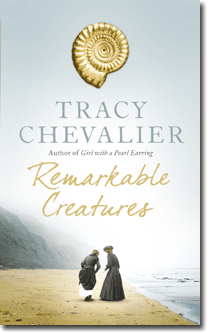
However, I truly enjoyed Remarkable Creatures, a story set in Lyme, and based on the life of Mary Anning, the woman who discovered many interesting fossils and played a role in the developing science of biology as well as in the roots of the theories of Darwin. Elizabeth Philpot, a collector of fossils, and Mary became friends and colleagues. Neither female could break out of the restrictions placed on women in those days, nor could they totally overcome class differences in their situations.

The novel is set in the pre-Darwin period of the early 19th century. However, fossils were well known and raised many questions for those trying to reconcile the fact that some living things had become extinct, a concept which clashed with conventional Christian interpretations of the creation of the world as told in Exodus.

Mary Annning and Elizabeth Philpot were real people and their heritage is honored today in their home town of Lyme Regis on the southern coast of England in Dorset. The local museum in Lyme is known as the Philpot Museum and contains more about the lives of local fossil hunters and how they contributed to the development of the knowledge of evolution.
 Right, part of the fossil beaches near Lyme. Popular today with fossil hunters, the beach gives up new finds frequently. Some make their living by guiding hunters to potential sites.
 Lyme Regis is also the setting for several well known scenes in other novels. Jane Austen set her famous stair-jumping silliness on the Cobb at Lyme in Persuasion. John Fowles in The French Lieutenant’s Woman used Lyme as a dramatic background.
 Tracy Chevalier’s most famous novel is probably The Girl with the Pearl Earring which brought her great fame and was made into a film starring Colin Firth as the artist Vermeer and Scarlett Johansson. Other novels included The Virgin Blue, Falling Angels, The Lady and the Unicorn, and Burning Bright. Happy reading!