A Visit to Salisbury Cathedral

Approaching the Salisbury Cathedral, the magnificent spire seems to pierce the blue canopy above, reaching for the heavens.  It is Britain’s highest at 404 feet,  and certainly the most graceful.  The Cathedral’s website is here.
 
Officially named the Cathedral Church of the Blessed Virgin Mary, it is more than 750 years old, completed in 1258, after just 38 years of construction, almost a miracle in the day. The rapidity of completion also ensured that Salisbury Cathedral is basically one style, the Early English Gothic; many cathedrals had several generations of builders involved, bringing evolving styles to their construction.

The West Front

The tower and spire were added somewhat after the main structure was finish.  Visitors may climb the 330-plus steps into the tower to the base of the spire, which gives an excellent view of the interior construction of medieval days.
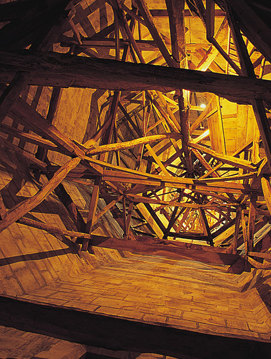
Interior of the spire

Though art and religious historians have tried to explain to the contemporary visitor just what a cathedral was, its symbolic role and its functions as a religious and community center, it is difficult for us to grasp just what these amazing buildings meant in medieval society.

The novel Pillars of the Earth by Ken Follett provides a fictional account of the building of a great cathedral, roughly based on Salisbury.  It was presented as a television miniseries in 2010, and it is well worth watching.

In addition to the book and tv versions, an expanded and amplified interactive editions is available for download to your iPad or other mobile device. For a preview, click here.

Novelist Susan Howatch also set a series of novels in the cathedral community of Starbridge, also modeled on Salisbury, though in the 20th century.  There are six novels in the series, beginning with Glittering Images.

Salisbury Cathedral, with the largest cathedral close (precinct) in England and also the largest cloister, is a major tourist attraction in Wiltshire, competing with the nearby stone circles at Stonehenge and Avebury, Old Sarum, stately homes such as Wilton House and Bowood, the Safari Park at Longleat, and extensive gardens such as at Stourhead.  In addition to the building and its art, one of four existing copies of the Magna Carta is on exhibit in the Cathedral’s Chapter House.

The Magna Carta was signed in 1215 by King John; it provides a foundation for democratic values in removing absolute power from kings and providing for liberty under the law.

The Chapter House, from the South
The Central Pillar and fan vaulting of the Chapter House

John Constable, brilliant painter — particularly of landscapes — painted Salisbury Cathedral many times.  Versions exist in many of Britain’s major museums as well as in several in the U.S.

Salisbury Cathedral from Lower Marsh Close, 1820
Artist: John Constable (1776-1837), Andrew W. Mellon Collection
Copyright © 2012 National Gallery of Art, Washington, DC

Salisbury Cathedral from the southwest
Aerial View
The Nave — from the altar
In addition to the Magna Carta, the Cathedral’s architecture and art works, the chapels and tombs, monuments and carvings, you will also find the oldest clock in Europe.
another view of the nave
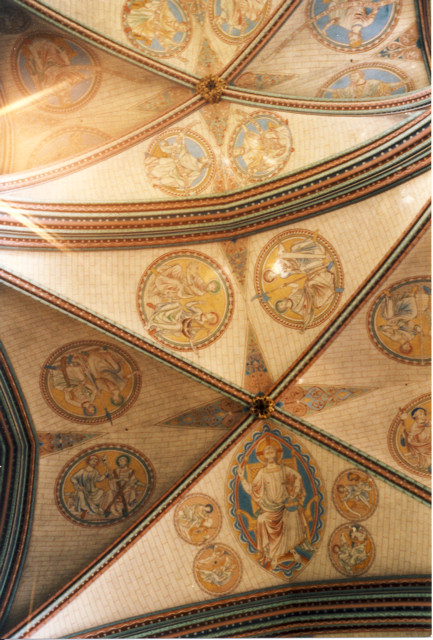
We are accustomed to seeing the stonework in old churches elaborately carved but merely gray, monochromatic stone.  However, originally most of these walls and ceilings were elaborately painted.  At Salisbury, many of these ancient decorations have been restored or replaced.


Many of the windows date from the Victorian era; others are much older.
The beautifully carved choir

Mompesson House in the Close, run the by National Trust
Featured as the London home of Mrs. Jennings in the Ang Lee-Emma Thompson 1995 film of  Jane Austen’s Sense and Sensibility

Across the Water Meadows
Most pictures from the Cathedral Website or by my sister-in-law, Patricia Biggers

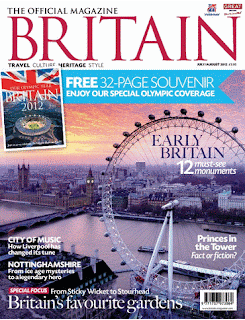
Britain Magazine: the Official Guide

September 2012 issue
Victoria here, writing again about favorite magazines.  Besides watching the BBC news and listening too, via public stations here in the U.S., I stay close to Britain while I am home by  reading lots of magazines, many from the UK.  Every two months, Visit Britain, the official tourism agency, publishes a glossy issue filled with travel suggestions, sumptuous pictures and tempting ads, aka gift ideas.  Sigh.

The latest issue to arrive is dated September 2012 and has many interesting articles, from ice age cave-dwellers to the Princes in the Tower to this summer’s favorite gardens. 

Creswell Crags
Tower of London
Highgrove House and Gardens

 It’s a wonderful mix of history and scenery, castles and stately homes, villages and cities.  The website, too, is excellent and could occupy you for a long afternoon of dreaming, here.   Subscriptions are available and the magzine can be found in most bookstores and newstands.

July 2012 issue
As you might have expected, the July issue of Britain had a major feature on The Diamond Queen, to celebrate Elizabeth II’s sixty years on the throne.

Other topics were the county of Somerset (Land of the Summer People), Royal Memorabilia, Inside Britain’s Palaces, and Britian’s Most Eccentric Events.  You can read the latter here.

A Morris Dancer in Chipping Campden

 You also have the opportunity to win weekends at posh hotels and tours — and if your letter to the magazine is chosen as the month’s favorite, you win a special prize.  But best of all is the material for dreams…and planning that next trip.

/

A Couple In England

Recently, I was reading Jerome K. Jerome’s Three Men In A Boat when I came upon the following passage:
“What we want is rest,” said Harris. “Rest and a complete change,” said George. “The overstrain upon our brains has produced a general depression throughout the system. Change of scene, and absence of the necessity for thought, will restore the mental equilibrium.” George has a cousin, who is usually described in the charge-sheet as a medical student, so that he naturally has a somewhat family-physicianary way of putting things.
I agreed with George, and suggested that we should seek out some retired and old-world spot, far from the madding crowd, and dream away a sunny week among its drowsy lanes—some half-forgotten nook, hidden away by the fairies, out of reach of the noisy world—some quaint-perched eyrie on the cliffs of Time, from whence the surging waves of the nineteenth century would sound far-off and faint.”
As I’ve recently been feeling the strain of a maternal broken hip, and as the exact meaning of the phrase “beck and call” has been made crystal clear to me in recent weeks, you can imagine the effect the above passage had upon my fatigued psyche. I agreed with every word I’d read, save for the bit about putting the nineteenth century far off.
Needing to get away, the three men in question eventually hit upon a fortnight’s boat trip as the answer to their problems. Unfortunately, rowing myself and my husband up and down the Thames held no appeal for me, so it became necessary for me to come up with an alternate itinerary. Naturally, the words “some retired and old-world spot” put me in mind of London. While the City might not, nowadays, be universally described as “far from the madding crowd,” I felt sure that my little bit of Mayfair and St. James’s would prove as soothing as ever. And nothing manages to calm my nerves more than a visit to Apsley House.
“Drowsy lanes – some half-forgotten nook . . . ” You may be sure that I gave this turn of phrase some thought. If I were a pipe smoking sort of lady, I’d have fired up a bowlful whilst ruminating on the myriad English places that fit this description. Where existed drowsy lanes?  I must admit, I got caught up on this one for a time, since there are endless possibilities. However, I then re-read the passage and saw again the “half-forgotten nook.” By Jove, we’d go to Bath! Half forgotten, indeed, as so much of the City remains as it was in a long forgotten time, said time being the Georgian period. Yes, Bath would do nicely, I thought.
Finally, I considered “some quaint-perched eyrie on the cliffs of Time,” which proved easily deciphered, as Windsor Castle, whilst not precisely on a cliff, is as quaint an eyrie as anyone might want. And practically speaking, if we circled back round for a stay in Windsor as the last leg of our visit, we should be ideally placed for the flight home.
Having determined our itinerary, I then informed my husband that we are going to London, Bath and Windsor at Christmas time. My husband is a study in understatment – so dignified, so reserved. And what a sense of humour! Where you or I would, upon hearing this marvelous news, have gushed and, at the very least, jumped for joy, my husband managed, no doubt by Herculean effort, to contain his excitement and offered me instead an admirably conservative, “Oh, eh?” 
I could tell that the husband was giving the proposed itinerary a goodly amount of thought. He tried to play it cool by keeping his eyes glued upon the t.v. and Pardon The Interruption, but after a time he turned towards me and asked what Bath was, what was there and why, exactly, we were going there. What a card!
I did get a rise out of him after I’d explained that we’d be doing a full Wellington day whilst in London – Apsley House, the Wellington Arch, Horse Guards and the daily 3 p.m. parade inspection, a stop by the Wellington Barracks and the Guards Museum, tea at the Langham, dinner at the Duke of Wellington pub and a night cap at the Grendadier. After hearing absolutely every last detail of my plans for a day simply steeped in Wellingtonia, my husband was so overcome with anticipation that the only words he could muster were “Oh. Joy.”
   I can only imagine what his response would have been to my proposing that he paddle us up and down the Thames for two weeks.

Royal Albert Hall, Since 1871

Royal Albert Hall,

On my very first trip to London — so long ago I dare not reveal the year — I attended a concert at this venerable institution.  Being a student and nearly penniless as were my companions, we sat way up at the top in the cheapest seats. Sad to say I don’t remember anything about the music we heard, but I will never forget the view of the vast auditorium packed with cheering fans. For what, I couldn’t say, though I assume it was one of the Proms.

Prince Albert, by F. X. Winterhalter

Prince Albert (of Saxe-Coburg and Gotha, 1819-1861) carved out a place in British history both as the Prince Consort who assisted his wife Queen Victoria in many ways, and as a promoter of science and technology developments.  He was the mover and shaker behind the Great Exhibition of 1851 and the development of South Kensington, which came to be known as Albertopolis, into a center of education, scientific and cultural development.

map showing the institutions of South Kensington/Albertopolis
For a fuller exploration of the architecture of the area, consult the Royal Institute of British Architects here.

Many now-great institutions grew here on the site of an agricultural oasis up to the mid-19th century:  the Natural History Museum…

Natural History Museum, Cromwell Road
… the Science Museum,
Science Museum, Exhibition Road 
  
… the Imperial College London, the Royal Geographical Society, the Royal College of Art, and the Royal College of Music. The Victoria and Albert Museum, sprawling repository of great works of the decorative arts is the eastern most part of the neighborhood.
Victoria and Albert Museum, Cromwell Road
Victoria and Albert Museum Entry

Northern most of the complex is the Albert Memorial, recently renovated, in Kensington Gardens opposite Royal Albert Hall. Sir George Gilbert Scott designed the Gothic structure, dedicated by Queen Victoria in 1872.

Albert Memorial
Prince Albert
Getting back to Royal Albert Hall, it was begun in 1867 and dedicated by Queen Victoria in 1871.  The design was conceived by Henry Cole, who was inspired by ancient Roman amphitheatres; the details were worked out by two Royal Engineers, Captain Francis Fowle and General Henry D. Scott.  The vast central auditorium is elliptical in shape, about 185 feet wide and 219 feet long; it can be rec
onfigured for many types of events both with traditional staging and in the round. 
Take a Virtual Tour of Royal Albert Hall here.
Funds for building the Hall came partially from profits of the 1851 Great Exhibition in Hyde Park. Prince Albert suggested that the area of South Kensington be filled with institutions to promote education and progress, but he died before the scheme was completed.

For a full timeline of the construction of the Hall and many of the events held there, click here.

Among the many stray facts about the Hall is the number of red bricks used: 6,000,000.  Originally it was lit by gas, which was replaced by full electric lighting in 1888.  Only minor damage to Royal Albert Hall occurred in Word War II; it was said that the German pilots, as they did for St. Paul’s Cathedral, left it alone because its distinctive appearance served as a landmark for their bombing runs. Refurbishment took place in 1996-2004, with the addition of many modern conveniences, upgrading the restaurant facilities and other amenities.

massed choirs in the RAH
Royal Albert Hall was purposely designed to adapt to all sorts of events, concerts, conferences, speeches, meetings, ceremonies, exhibitions, sporting events (tennis, wrestling, boxing) and even the circus.  Classical, opera, jazz, folk, rock and pop concerts have included the most famous performers in the world. Verdi, Wagner and Elgar all conducted their works at the RAH.  The list of stars who have play the Hall would illuminate not only the vast dome but the entire sky above.
Phantom of the Opera 25th Anniversary, 2011
Royal Albert Hall is held in trust for the nation of Great Britain but it operates entirely on its own earned funding.  Many educational programs are operated in collaboration with schools and other institutions.  Even if the hall is “dark” when you visit, you can book a tour.
The annual 8-week program of BBC Proms will run through Saturday, September 8, 2012.  For more info in the Proms, click here.
Rock on, RAH!

From the August 1801 Annual Register

Like many writers who dote on the late Georgian period, I have a selection of publications called Annual Registers, which are something like almanacks.  They contain a wide variety of articles, from serious accounts of international diplomacy to gossip and on-dits about unusual incidents.  Here are three items from The Annual Register, or A View of the History, Politics, and Literature for the Year 1801, from the Chronicle for  August p.47-48:

“1st  As the Marquis of Abercorn was driving the Marchioness and Lady Catharine Hamilton in a curricle, near Stanmore, the horses took fright, and set off at full speed;

Curricle

… in the attempt to pull them up, the reins snapped. The Marquis, embarrassed by the shrieks of the ladies, and unsteady in his seat, jumped into the road and broke his right thigh and left leg.

John James Hamilton, 1st Marquis of Abercorn (1756-1818)

The ladies kept their seats until the coachman, who was outrider, saw a convenient place, when, by forcing the horses towards the ditch, he contrived to have them thrown out upon the bank without injury. The horses again set off.

Lady Anne Jane Gore, Marchioness of Abercorn, 3rd wife of the 1st Marquis (d. 1827)
ca. 1800, New Orleans Museum of Art

The curate of Edgware coming along the road, made an attempt to stop them, but unfortunately lost the cap of his knee by a blow of the pole. A surgeon set the Marquis’s limb upon the spot.”

Royal Mail Coach, 1800

“At the Maidstone Assizes, on Thursday last, James and John Austin, brothers, were put to the bar on a charge of robbing the mail…from both of which they obtained a large booty, notes to a great amount having been paid previous to the discovery of those by whom the robbery had been perpetrated….It was proved that this bundle of notes consisted of the paper of different country banks, which had been stolen from the mails, and thus there was no doubt of the connection of this prisoner with the robbery….After all the various proofs of these facts had been minutely gone through, the jury brought in a verdict, acquitting the prisoner John, but finding James guilty. 


A Highwayman Re-enactor, near Belvoir Castle


The judge immediately pronounced sentence of death on the prisoner, adjudging him to be hanged in chains near the place where the robbery was committed….he confessed he was concerned in the robbery…at the same time confessed having stolen many letters and parcels while he was post-boy at Lamberhurst in Kent….”


Thames Wherry


“August 5th  As a party of ladies and gentlemen were amusing themselves in a wherry on the Thames near Shepperton, a salmon leaped from the river and fell into the boat.  In the struggle to seize the fish, the wherry was precipitated down the stream, and was at length overturned; but, the place was fortunately so shallow, that none of the parties were drowned, though they were immersed head over ears in the water.  Mr. Smith, who saw the accident, induced the party to accompany him to his hospitable mansion where a change of clothes was procured for the unfortunate party,  but the lady of Mr. Maintone, who was far advance in pregnancy, was seized with violent convulsions, in consequence of the fright, and expired before morning.”
 

Mourning Symbols