Victoria here. Our last post on the War of 1812 had the British withdrawing from the area after burning Washington City and capturing the town of Alexandria, VA, without firing a shot. Under the leadership of Naval Vice Admiral Alexander Cochrane and Army General Robert Ross, the British forces prepared to take the city of Baltimore, Maryland, a more formidable prize than the half-built capital had been.
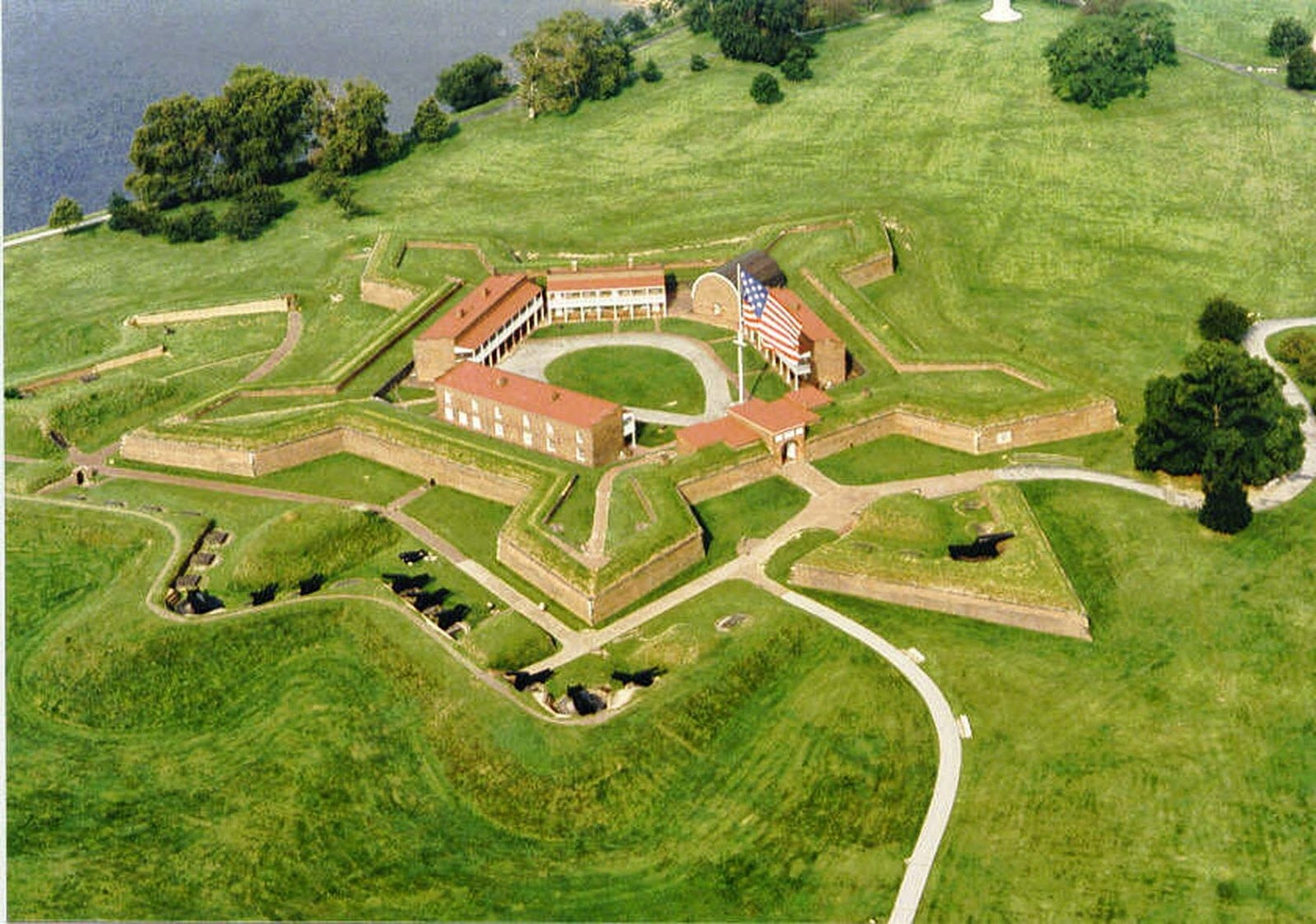
Fort McHenry, Baltimore, MD
In the ultimate settlement of the War of 1812, neither side achieved its aims. However, the independence of Canada from the U.S. was assured. The War of 1812 was almost forgotten (except by Canadians) until this bicentennial, with one important exception. The words to the United States National Anthem, The Star-Spangled Banner, were written as the battle raged. I wonder how many U.S. citizens know it was NOT written about the Revolutionary War.
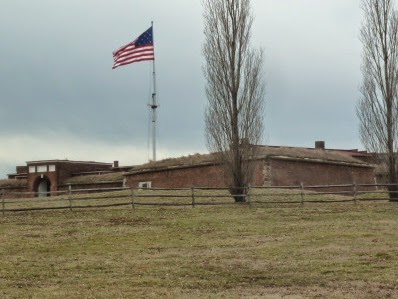
The historic flag that flew over Ft. McHenry,
I visited Ft. McHenry in February 2014, all fixed up for the bicentennial of its finest hour. The website
is here.
Jerry, Pat and Ed at Ft. McHenry
It was a sunny cool day, perfectly appropriate for a visit. The Visitor Center has a short film telling the story of the 1814 battle and some excellent displays of relics of the battle.
Model of the topsail schooner Chasseur
The Chasseur captured or sank 18 British ships and was known as “The Pride of Baltimore.”
Pair of flintlock pistols
The pistols were made in London about 1800 and engraved with the motto “Steady.”
Grapeshot
Made in Baltimore, about 1813; shot from a cannon, the 12-inch iron balls would scatter over a wide area and devastate a ship’s rigging or seamen at close range.
The Bombardment of Ft. McHenry by British warships
On September 13, 1814, British warships began the bombardment of Fort McHenry at 6 a.m. The British could not pass Fort McHenry because many had been sunk in the channel to prevent the enemy passage, as well as the attackers needing to sail close to the American cannons at the Fort. Eventually, after 25 hours of rather inaccurate shooting from both sides, the British ran low on ammunition and withdrew. The British ships received mostly minor damages, one person injured; the fort had four killed, 24 wounded, and damage to several of the buildings.
Walking up to the fort from the Visitor Center
The cannons aimed at the harbor
Up close and pers
onal
The day before the naval bombardment, General Robert Ross, who had led the attacks on and burning of Washington, led a group of British soldiers to what became the Battle of North Point. He was severely wounded by American sharpshooters and died as he was being returned to the fleet. After his body was placed in a barrel of Jamaican rum, it was taken to Halifax, Nova Scotia, where he is buried.
Fort McHenry
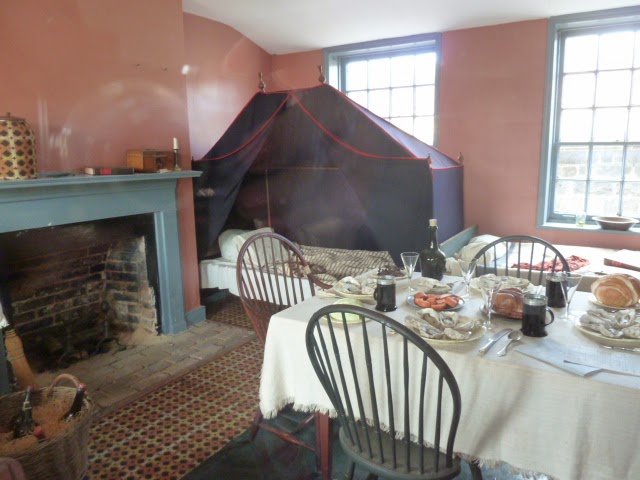
Buildings within the fort have been restored and are well maintained; displays in many of them tell the story of Fort McHenry during the War of 1812 and the Civil War.
Officer’s Quarters
Costumed Guides Explain life in the fort in 1814
Getting back to the U.S. National Anthem, the lawyer and poet Francis Scott Key watched the British attack on Ft. McHenry from aboard HMS Tonnant where he had been sent to negotiate the exchange of prisoners between the British and American forces. He watched the battle from the decks, and in the morning, saw the stars and stripes flag still flying over the fort. He reported to the prisoners below deck that the battle had been won by the Americans.
Statue of Francis Scott Key at Ft. McHenry
As Key returned to Baltimore, he wrote the poem “Defence of Fort M’Henry,” and planned to set it to the tune of a popular song by British composer John Stafford Smith, “To Anacreon in Heaven.” The poem was published on September 20, 1814, in The Patriot.
Francis Scott Key, ca. 1816
by Joseph Wood, artist (177801832)
Walters Art Museum, Baltimore, MD
We know the song today as “The Star Spangled Banner,” to which we wish a Happy 200th birthday. The legislation naming it the official national anthem was adopted by Congress in 1931 and signed by President Herbert Hoover.
The U.S. Flag of 1814 flies over Fort McHenry.
Oh say, can you see by the dawn’s early light,
What so proudly we hailed at the twilight’s last gleaming,
Whose broad stripes and bright stars through the perilous fight,
O’er the ramparts we watched, were so gallantly streaming?
And the rockets’ red glare, the bombs bursting in air,
Gave proof through the night that our flag was still there;
Oh say does that star-spangled banner yet wave,
O’er the land of the free and the home of the brave?
There are several additional verses, not often sung.
.



.JPG)
.JPG)
.JPG)

.JPG)
.JPG)


.JPG)
.JPG)



.JPG)