Author Mary Robinette Kowal in Milwaukee

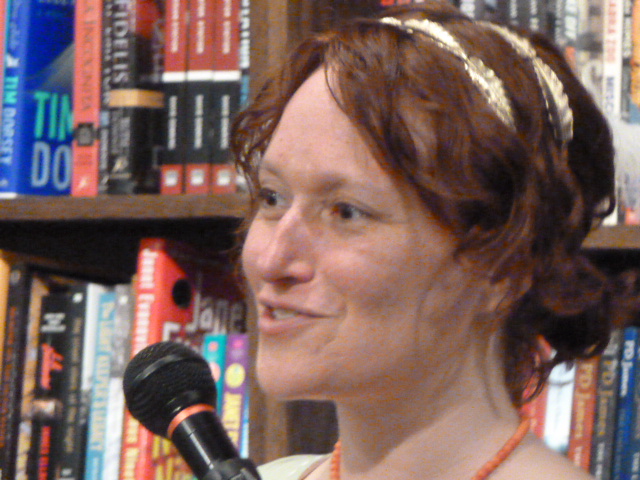
Mary Robinette Kowal at Boswell’s Books
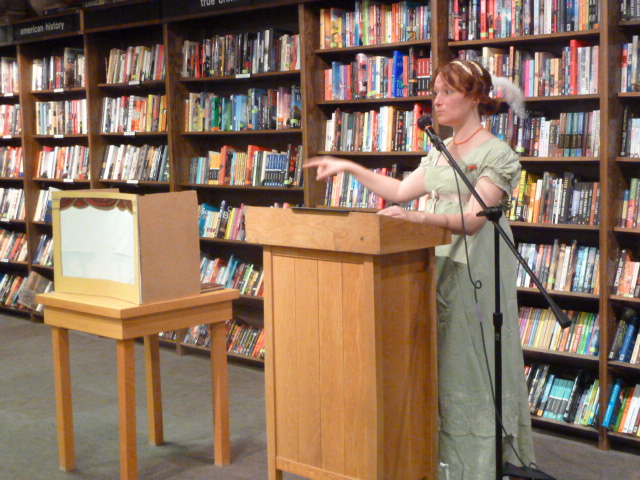
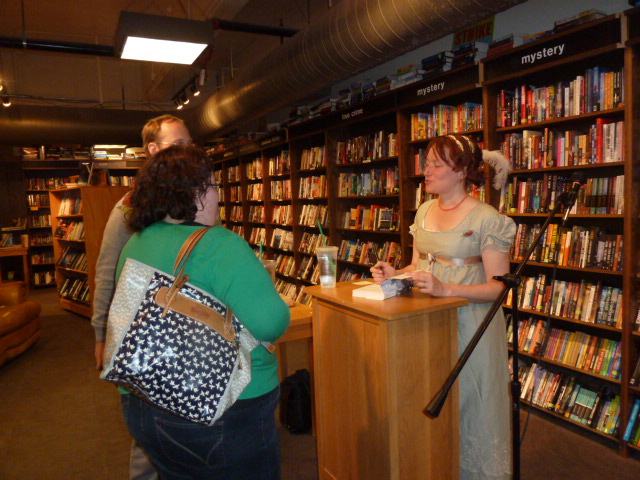
Rows of wonderful books at Boswell Book Store provided a perfect background for a performance and reading by Ms. Kowal, who is an accomplished puppeteer as well as an author of Regency-fantasist fiction.  She presented a brief shadow puppet show “The Broken Bridge,” much as it would have been seen 200 years ago.  It was farcical and very well acted, bringing appreciative laughter and applause from the audience.
Here is her website.
Book One of the Glamourist series
The audience was a mix of science fiction/Fantasy fans and devotees of Jane Austen, for Ms. Kowal’s novels are an engaging mix of the two.   Her primary characters, Jane and Vincent, combine their magical powers to entertain the Regency elite. 

Mary’s career extended over about ten years as a professional puppeteer, with a variety of types of puppets: shadow, hand, stick and marionettes.  She began writing fantasy fiction and soon was published and winning awards. 

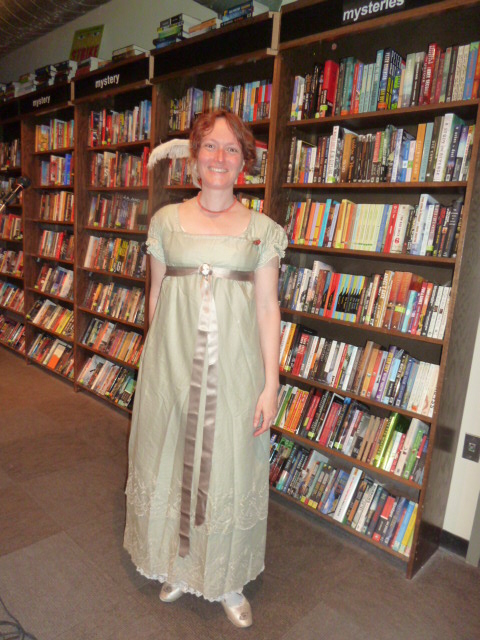
Hand-stitched Regency apparel
She was able to combine her love for Jane Austen into her fantasy writing with the creation of the Glamourist series set in the Regency and involving magical abilities on the part of the hero and heroine.  In her quest for authenticity, Ms. Kowal even sewed a number of faithfully designed Regency gowns, complete with their required underpinnings.
Second Book in the Glamourist series
Her work with puppets as well as her fiction has won awards and critical acclaim.  Ms. Kowal currently lives in Chicago with her husband, a wine-maker.
Signing books
Among the little games Ms. Kowal likes to play with her readers is the occasional appearance of Dr. Who in her novels, hidden in plain sight.

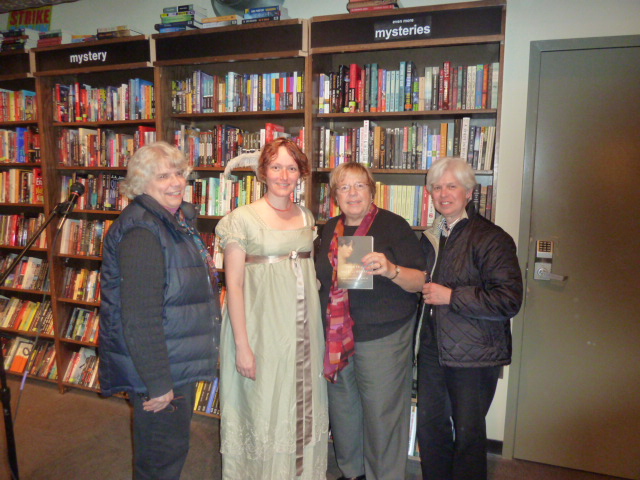
With JASNA-WI members Sara Bowen, Ms. Kowal, Victoria Hinshaw and Jane Glaisner
Book Three of the Glamourist series
Ms. Kowal assures us we can expect Book Four very soon…set in Venice and featuring Byron and a menagerie of animals…along with more magic.

A Couple In England – Day Six – Part Two


Hubby and I left the Skyline Tour bus and walked over to the City Tour bus, climbed aboard and settled in. Here’s a view out of the bus window – still drizzly, grey and cold, but I had half a roll of loo paper left in my shoulder bag to use as tissues so I was good to go. Well, maybe not good, but I was still alive. Had you asked me the chances of that yesterday, I’d have said slim to none.
 
Before long, the bus pulled out and headed toward the Grand Parade.

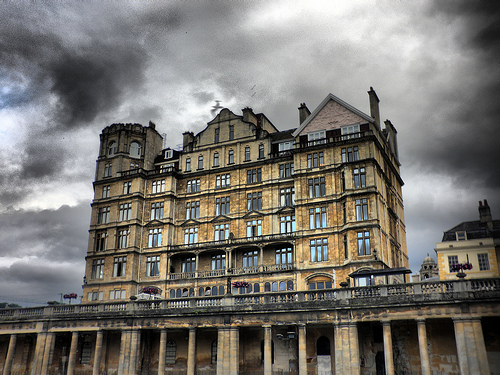
Can you see the colonnades at the bottom of the photo above? Interestingly, there’s currently a scheme to re-open them to the public and to redevelop the surrounding area. You can read more about those plans here.  We traveled down Avon Street and past the Westgate Buildings until we reached Queen Square, developed by architect John Wood the Elder. Queen Square is a key component of Wood’s vision for Bath. Named in honour of George II’s queen, and was  intended to appear like a palace with wings and a forecourt to be viewed from the south side.


Although outside the city walls, Queen Square quickly became a popular residence for Bath’s Georgian society. It was away from the crowded streets of medieval Bath, but only a short walk to the Abbey, Pump Room, Assembly Rooms and baths. To the north, Wood’s vision continued with Gay Street where Jane Austen lived, – and the Circus which became home to Thomas Gainesborough.


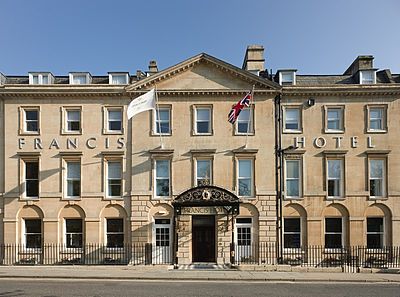
During the raids, a 500 kilograms (1,100 lb) bomb landed on the east side of the Square, resulting in houses on the south side being damaged. The Francis Hotel (above) lost 24 metres (79 ft) of its hotel frontage, and most of the buildings on the square suffered some level of schrapnel damage. Casualties on the Square were low considering the devastation, with the majority of hotel guests and staff having taken shelter in the hotel’s basement. Today, all the buildings are listed as Grade I.

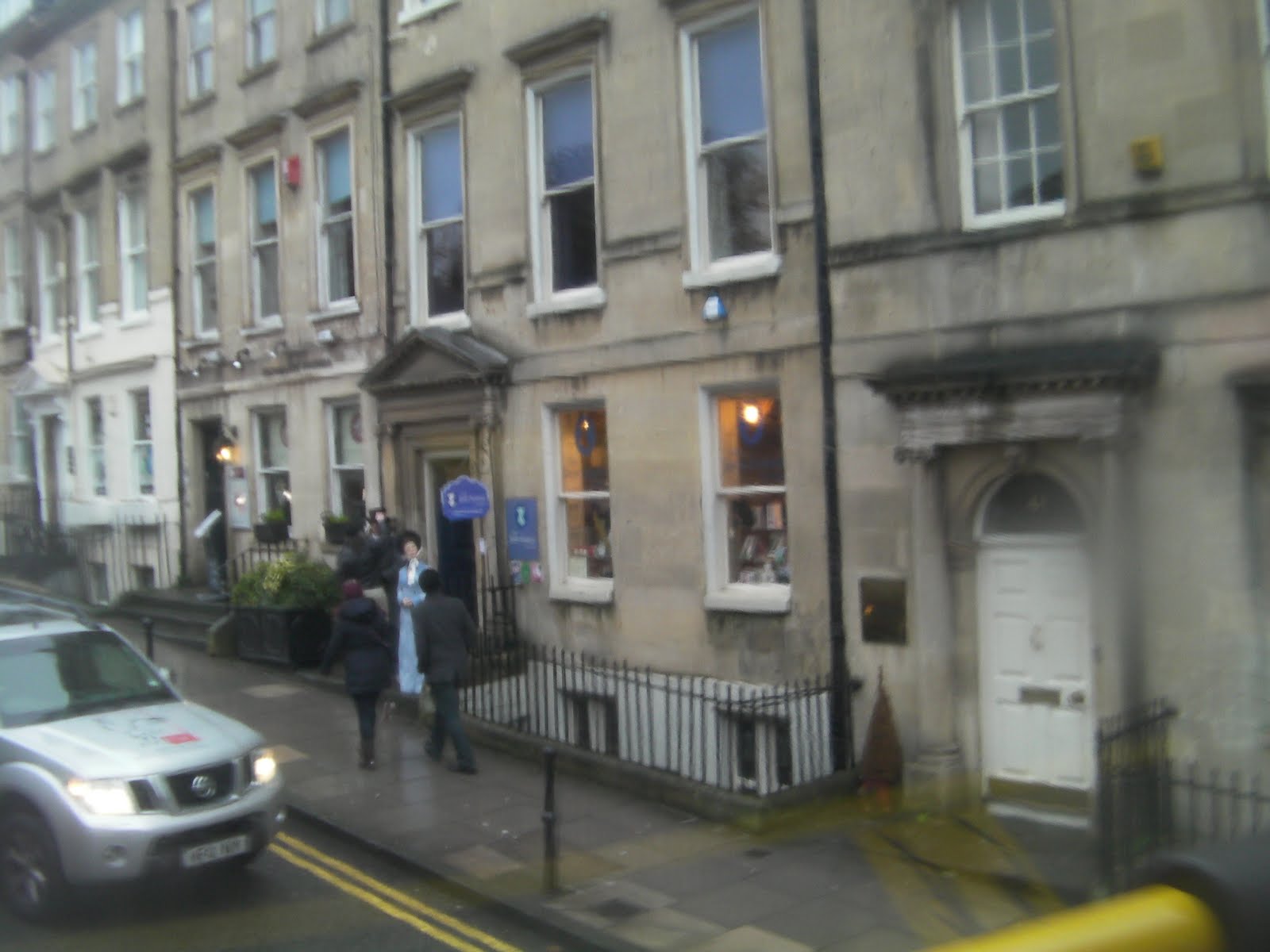
Before I realized it, we were passing the Jane Austen Centre. I took the photo above out of the bus window. If you look closely, you can see the mannequin dressed in blue Regency garb at the front door. The audio tour informed us that it was the JA Centre, prompting Hubby to groan aloud.
 
“What’s wrong with you?”
 
“Jane Austen. You’re going to want to get off the bus and go and look.”
 
“No I’m not,” I told him.
 
Hubby stared at me for a few beats. “Are you sure? Come on, I’ll go with you.”
 
I shook my head. “But it’s Jane Austen,” Hubby insisted.
 
Sigh. “Thanks, but I’m really not in the mood,” I told him while blowing my nose. And hacking.
 
Hubby gave me a searching look, probably trying to figure out where exactly along the route I’d been switched for a Stepford Wife. Before long, we were passing the Assembly Rooms and Fashion Museum. The audio guide told us that the Rooms had been at the centre of society in Georgian Bath, prompting Hubby to nudge me.
 
“Assembly Rooms, Hon.”
 
I nodded. “Beau Nash,” I said. I had been anticipating returning to the Assembly Rooms, and the Fashion Museum, for months and now that I was at them, now that I could simply step off the bus and visit them, I had no enthusiasm for them at all. I was still feeling awful and it was all I could do to watch Bath roll by through the bus window.


On our way to the Royal Crescent, we passed Number 1 Royal Crescent, below, which is currently closed. It’s a fabulous museum that illustrates upper class life as it was in Georgian and Regency times. Each room is furnished as it would have been then and it truly gives visitors a sense of what it was like to live in a gentleman’s townhouse of the day. Currently, the museum is expanding to incorporate servants quarters, which will also be open to the public, thus allowing visitors the full, upstairs/downstairs experience. Click here to visit the museum’s webs
ite
and learn the story of it’s past and future.


Next we saw the Royal Crescent itself, designed by the architect John Wood the Younger and built between 1767 and 1774. Interestingly, each original purchaser bought a length of the façade, and then employed their own architect to build a house behind the façade to their own specifications; hence what can appear to be two houses is occasionally just one.


Traveling down Upper Bristol Road, we passed Royal Victoria Park and the Botanical Gardens. The Park was the first to be named for Princess Victoria, who opened it in 1830, when she was eleven years old. This all took place during that misguided press tour organized by her mother, the Duchess of Kent. Supposedly, a journalist made derogatory remarks at the time she opened the Park regarding Victoria’s choice of dress, prompting her to turn her face against Bath for the rest of her long life.


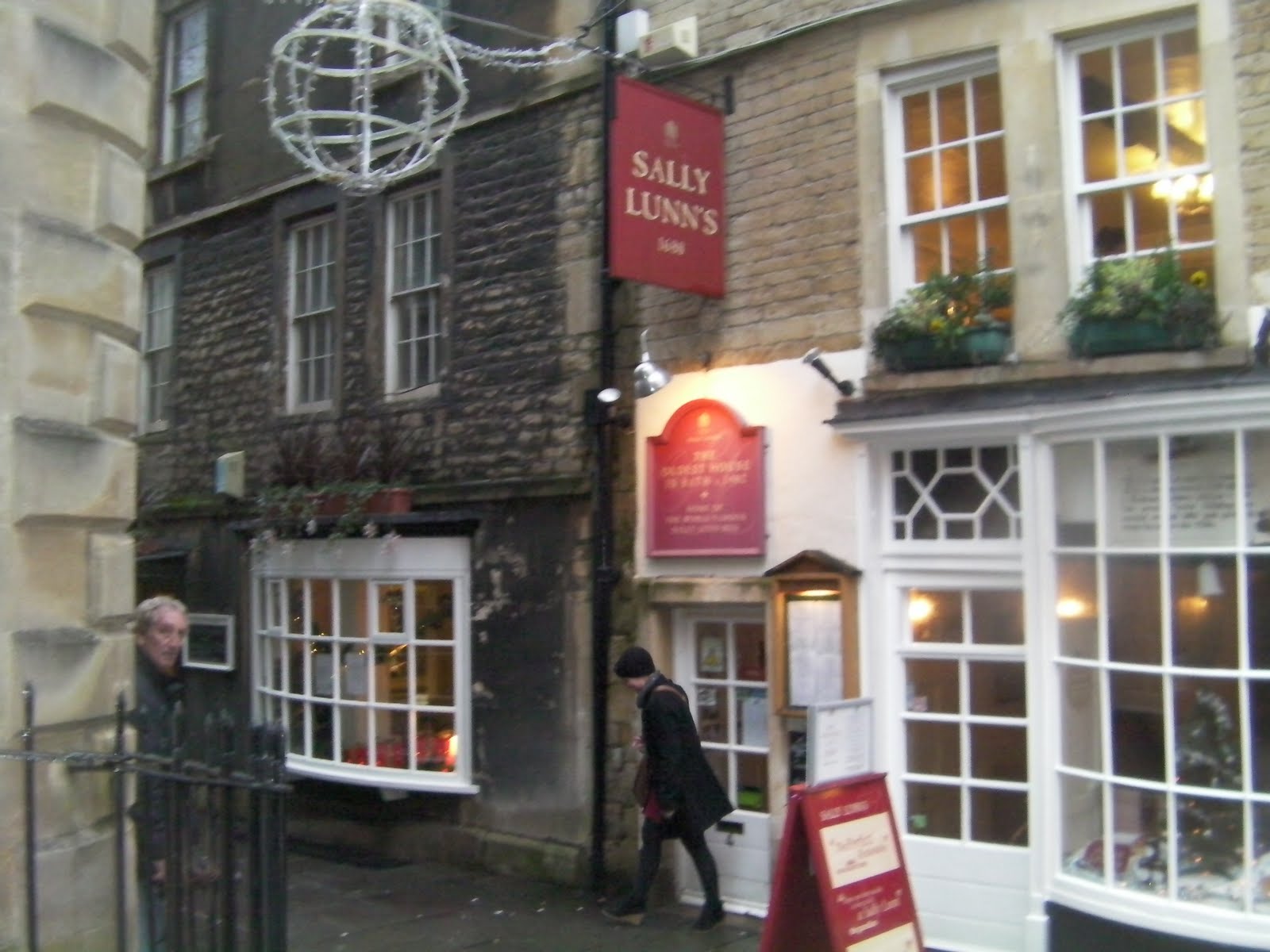
On our way to our final tour stop, we passed Sally Lunn’s house at Number 4 North Parade Passage. According to legend, Sally Lunn, a French refugee, arrived in Bath in1680 and established her bakery. The original ‘Bath Bun’ baked by Sally Lunn was a light, round bread similar to traditional French festival breads. The popularity of the Bath Buns was such that they were mass-produced for the Great Exhibition of 1851 in London. You can visit the Sally Lunn website here to read more about it’s history and traditions.
 
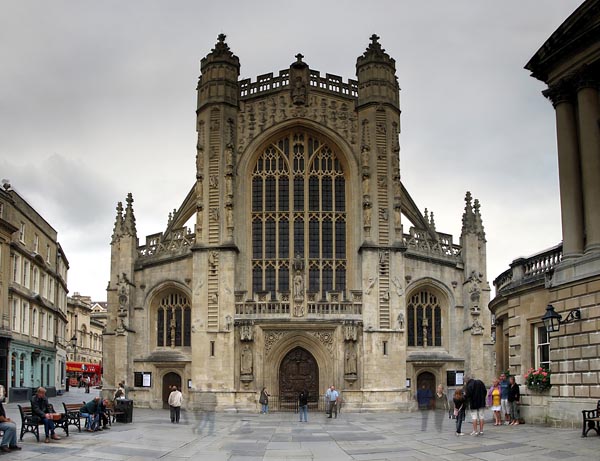
Hubby and I exited the tour bus and I walked us towards the Abbey.

“Do you want to go inside?” I asked him.
 
“Inside what?”
 
“The Abbey.”
 
“Not particularly.”
 
“Well then, we’re going to the Baths. You can’t make your first visit to Bath and not see the Baths.”
 
“Are you sure you feel up to it, Hon?” I really didn’t, but I wasn’t going let this cold/flu/cholera defeat me or make me miss any more of the City.
 
“Yes, I’m up to it,” I told Hubby, taking his arm while thinking about the fact that we were supposed to return here tonight in order to see the fireworks over the Abbey. Please, God, I silently prayed, send me a minor miracle. Sigh.
 
 
Part Three Coming Soon!


The Secrets of Bloxley Bottom, Episode 14

Major Monty Twydall paced back and forth across the broad terrace of Saxon Lodge, ignoring the handsome view of the park, focusing on nothing but the dark clouds hovering at the edge of his life. Monty was unaccustomed to rumination of any sort whatsoever, and he particularly had disdained self-examination.  But a crisis loomed if he could not think of a solution to his shortage of ready cash.

An objective observer could have listed for Monty the many times in which his continual good luck smoothed his way.  From being born to a wealthy family as a younger son, thus relieving him of duty due to the ancestral estate….to Life Guards postings which brought a certain degree of cache while Monty had only to stand upon the fringes of military action…to a welcome legacy from a distant aunt…Monty’s life thus far had been one in which his dark good looks, fine manners and impressive sense of humor took him everywhere. Above all the supplemental income provided by his skills at the card table and eye for fine racing horseflesh allowed him to frequent the fitting rooms of the finest tailors and paid the cost of his lease on the Lodge where he could entertain his friends and sport with the Naxians without limit.

Until now. Monty stopped and leaned against the corner of the house.  Nothing had come up for him lately, not the cards, not the runners, not the cocks, and not even the boxing mills.  His debts of honor added up to an inconceivable amount.

Almost all of the legacy had gone for the Lodge. Its furnishings put him in contact with a number of men who were happiest on dark nights which allowed them to bring ashore a considerable number of undeclared items from across the Channel. These proved quite lucrative for Monty, who sold these items on to well connected friends. Everyone loved French cabinetry, it seemed. The older the piece, the more Monty could realize. At first the smugglers thought he was daft, wanting the oldest objects they could find.  But he also took a large share of their primary product – the rich, red clarets so prized at a gentleman’s table.

As Monty stood deep in thought, his mind settled upon the few remaining pieces of furntiture that stood in a storage room behind his stables.  When the shipment had first arrived, Monty had given  the members of the Naxians their choice of the pieces, much to the delight of their wives, as Monty had he’d heard afterwards. It was time to sell what he had left, but the pieces were of fine quality and would benefit from being placed in surroundings which suited their quality. Monty needed a place to invite guests of a different sort than his raffish friends who came to the Lodge.

It was time, Monty chided himself, to call upon his most influential, and potentially profitable, contacts.  If he called upon his friend, the Dowager Baroness Bloxley, might he be able to persuade her to invite some of her own set to her home in order to show off a few of his pieces?  He needed to pique Louisa’s interest and to appeal to her sly sense of humour. Perhaps he should frame the party as a caper that would make for a tale she could tell many times over at the tea or dinner table.  Wouldn’t it be amusing for her to tell everyone how she, Lady Louisa, the imperious baroness, daughter of an earl, had dabbled in trade? 

The more he thought about it, the better Monty liked the idea. The suggestion was just outré enough to appeal to Louisa, who had, as Monty had learned to both his chagrin and amusement, a decidedly naughty side. An aristocrat Louisa may be; a pillar of the community and matriarch of a distinguished family. But as Monty well knew, Lady Louisa could also be a bit of a minx. Monty smiled. Oh, but he was a naughty boy. However, needs must as Shakespeare had so rightly pointed out.

Visiting the Crystal Bridges Museum of Art with Victoria

As we drove home to Milwaukee from Naples, FL, last month, we took a long detour to visit Bentonville, AR, to see the Crystal Bridges Museum of Art (website here), and I tried to think of an excuse to write about it on this blog — a connection to London. 

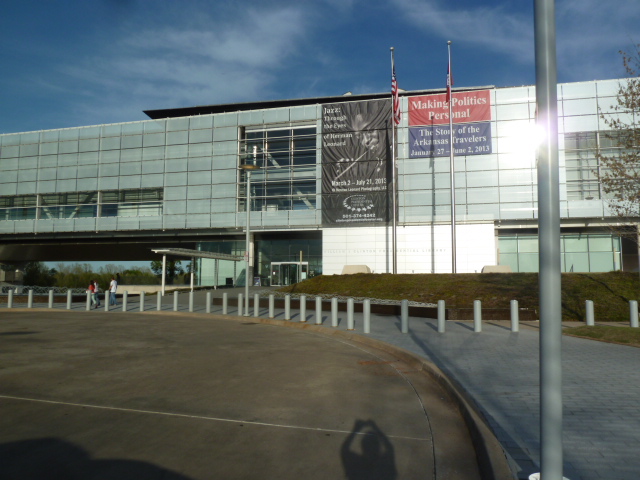
The William J. Clinton Presidential Center & Park
The first connection I found was as we drove around Little Rock, AR.  Well, President Clinton met the Queen, right?  A stretch for an entire blog post, I guess.
Then I snapped a sign on the way along Interstate 40. Go figure.

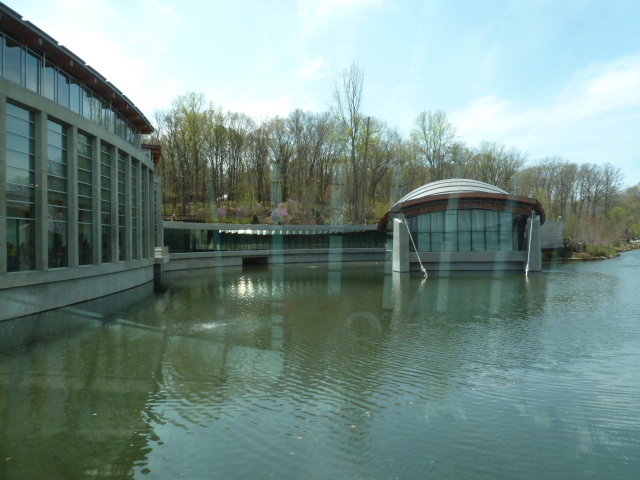
The Crystal Bridges Museum
Our drive was summer to winter in reverse.  In Florida, it was like summer, We saw wonderful blooms all through Georgia and even Tennessee.  But by northern Arkansas, it was just beginning to turn green. 

The setting and architecture of the museum is stunning.  The first thing we did was have lunch, but there wasn’t a single relative of Steak and Kidney Pie or Bangers and Mash on the menu.We comforted ourselves with California wine and hamburgers.

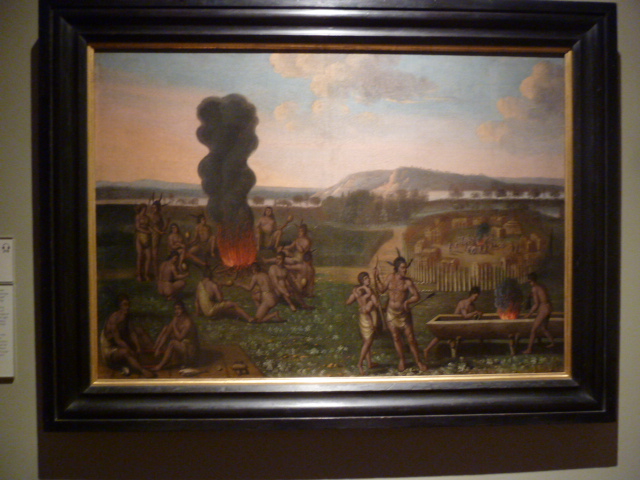
Indians of Virginia by James Wooldridge, ca. 1675
 I was really excited when we started through the galleries and found one of the first pictures was done by an Englishman, James Wooldridge, ca. 1635-1695.  It is the earliest painting in the collection.  The label tells us: “…Wooldridge spent his career in London, and never himself encountered Native Americans.”  He worked from sketches and engravings made by others.  Success!!  A REAL connection with Number One London!! Hooray.
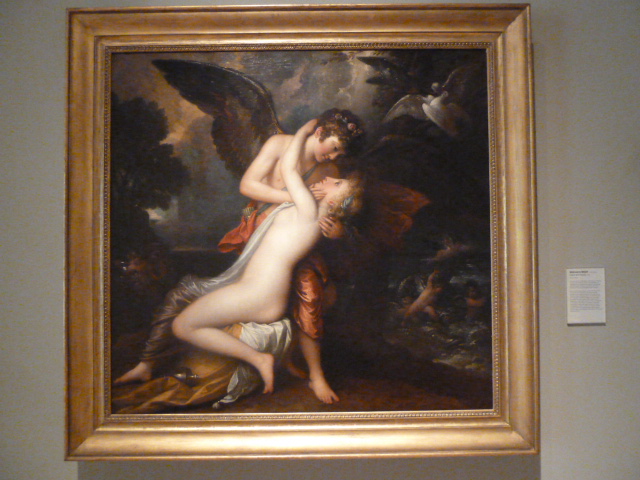
Cupid and Psyche, by Benjamin West, 1808
Of course I needed have worried.  The museum displays a number of works by Americans who spent parts of their careers in London.  Benjamin West  (1738-1820) was born in Pennsylvania, moved to London in 1765 and became Historical Painter for George III in 1772. Twenty years later West became the second president of the Royal Academy of Art; he is buried in St. Paul’s Cathedral.  

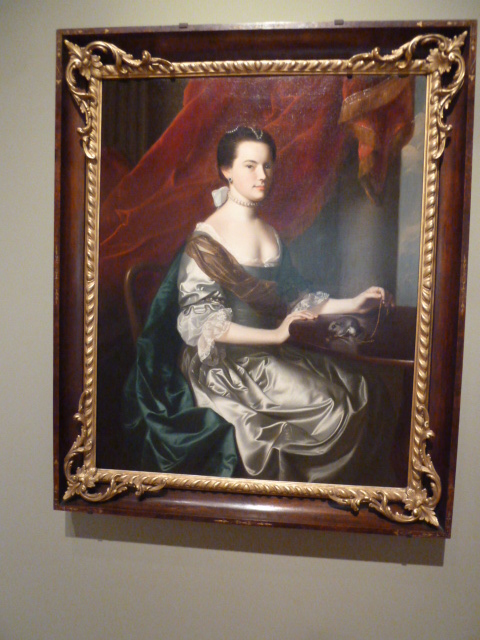
Mrs. Theodore Atkinson, jr. (Frances Deering Wentworth), 1765
John Singleton Copley 1738-1815
Copley was born in Boston and became well established in colonial America as a portraitist.  He left his family to study in London and Italy. He and his wife and children settled in London in 1775.  He enjoyed successes and disappointments, the latter particularly in regard to a painting he made of the Prince Regent which Prinny declined to purchase, perhaps assuming it was to be a gift.  Mrs. Atkinson (above) is sumptuously attired, showing the wealth of colonial society.  She holds a gold chain attached to a tame squirrel.
View of Mark di Suvero sculpture from the gallery
Alice Walton, daughter of the founder of the WalMart empire, founded the Crystal Bridges Museum of American Art and worked closely with the architect Moshe Safdie to integrate the buildings with the hilly woods of the Ozarks.  She is active in many philanthropies.
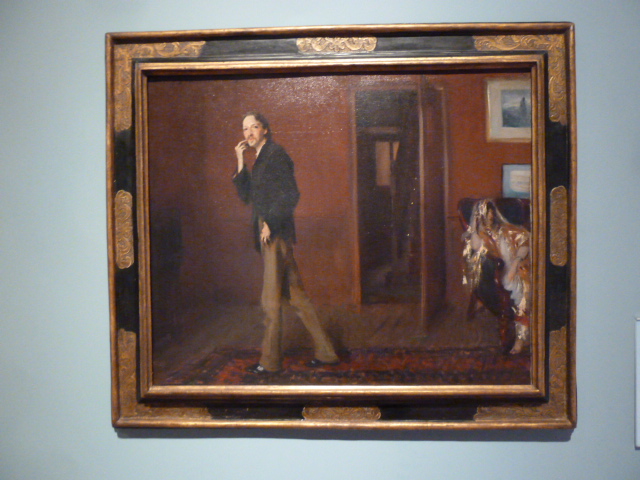
Robert Louis Stevenson and His Wife (Fanny Osborne), 1885
by John Singer Sargent 1836-1925
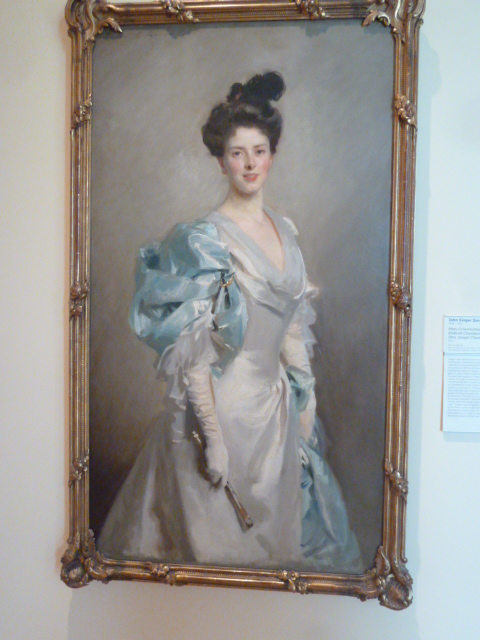
Though the museum is growing rapidly and filled with fascinating art, I will close with two paintings by another American who ended up making much of his career in Britain.  The label points out the contrast in the active figure of Scottish author Stevenson contrasted with the ease of his wife.  Sargent carried on the great portraitist tradition of Van Dyke, Reynolds, Gainsborough and Lawrence, below in the portrait of Mary Crowninshield Endicott Chamberlain.
Mrs. Joseph Chamberlain, 1902
by John Singer Sargent
Mary Chamberlain was born in the US and married in 1888, as his third wife, Joseph Chamberlain, a member of Parliament who also held several important positions in the British government.  She was the daughter of the U.S. Secretary of War, William C. Endicott.  Sargent’s work was particularly admired for his treatment of the “shimmering” satin of her attire.
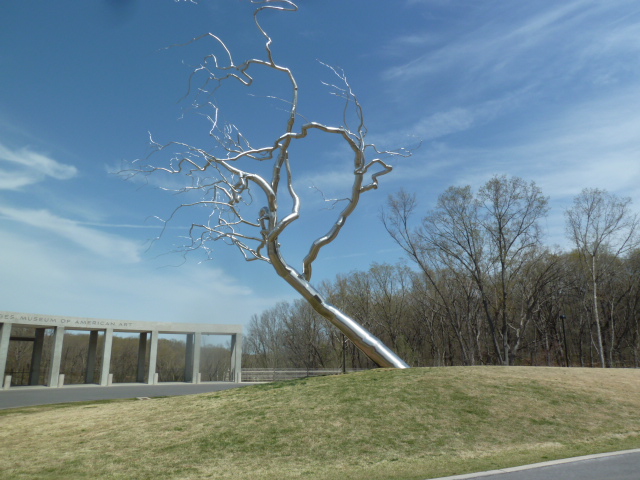
Yield, 2011, by Roxy Paine
If the crowds  at the Crystal Bridges Museum of American Art on the Sunday we visited is any indication, I would say Ms. Alice Walton has been very shrewd about what would bring tourists to this quiet spot in the middle of the continent. 

A Couple In England – Day Six – Part One

 
By the time I woke up the next morning, I felt marginally better, even though the flu/cold/cholera had now settled in my chest and head. I was alone and so I laid in bed for a bit taking stock of the day. It was New Year’s Eve – the New Year’s Eve I’d been planning for ages. We had dinner reservations tonight at Cote Brasserie restaurant for 8:30, with fireworks over the Abbey afterwards. Sigh. Thank goodness I hadn’t booked the horse and carriage drive I’d been contemplating for tonight.
 
Hubby came in the door. “You missed breakfast.”
 
“Don’t care,” I told him.
 
“How do you feel?”
 
“Like crap. What’s it doing outside?”
 
“Rainy, cold and grey. Typical English weather. There’s something fishy about this hotel.”
 
I stared at him. “It’s like they keep moving the Wellington Suite,” he went on. I stared at him some more. “Every time I climb those stairs and think our room is just one more flight up, it isn’t. It’s like they add a flight of stairs whenever I leave the hotel.”
 
“They don’t move the room. You’re just old. What do you want to do today?”
 
“Are you well enough to do anything?”

That was an excellent question. Was I well enough? Had I been this ill at home, I’d have either stayed in bed all day or checked myself into a hospital. As it was, we were in Bath and I was determined to see it.
 

“Well, I’m not dead. That’s something. And if I’m not dead, I’m not losing another whole day in Bath. Let’s start with the bus tour.”
 
“They have a bus tour here? Like in London?” Hubby asked with enthusiasm.
 
On that happy note I got myself washed and dressed and we trundled down the stairs, where we met Eliza.
 
“Are you feeling any better?” she asked.
 
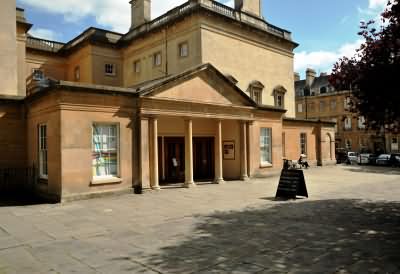
“I’m no longer convinced that I’m going to die, so I suppose it’s an improvement.” Eliza then told us that the tour bus made a stop one block away, in front of the Holburne Museum, which I’d wanted to visit anyway. So Hubby and I headed out into the drizzle.
We arrived at the Museum and spent a few minutes looking at the exhibits before Hubby parked himself on a bench and refused to budge. “You go look around. Take your time,” he told me. So I strolled about a bit, without really taking much in. I was simply too sick to appreciate the fabulous displays properly. Do check the Museum’s link above to properly view their permanent collections.
Before long, I put Hubby out of his misery and suggested that we wait for the tour bus in the shelter in front of the Museum. You can see the bus shelter in the bottom right of the photo above. By this time, it was raining a bit harder, so we huddled together and looked out at Great Pulteney Street.

After a while, I dug into my shoulder bag, found the roll of loo paper I’d put in there before leaving the room and blew my nose.
 
“We’ve been sitting here for more than fifteen minutes, haven’t we?” Hubby asked.
 
“I think so.”
 
“Eliza said the tour bus stopped here every fifteen minutes.” We waited another fifteen minutes in the misty cold. Still no bus.
 
“The main tour bus stop is by the Abbey. We can walk there.” I said, taking my travel umbrella out of the shoulder bag. So Hubby and I trudged up Great Pulteney Street towards Laura Place.
And we arrived at Bridge Street and crossed the bridge.
No sooner had we gotten properly into town than what did we spy but a Cafe Nero. Our spirits soared as Hubby and I shouldered one another out of the way in an effort to be first in the door.


Hubby used our loyalty card to get us two free coffees and we sat at a table and gratefully drank our brews. There is a God, I thought as I blew my nose again.
“Do you want some food?” Hubby asked. “You didn’t eat anything yesterday. Aren’t you starving?”
The thought of food was repulsive. I shook my head. I finally knew how Daphne “I’ll eat when I’m dead”
Guinness feels.
“Cigarette?”
Even that didn’t sound appealing, but I accompanied Hubby into the alley at the side of Café Nero’s that leads to a quaint shopping street.  If anyone knows it’s name, let me know.


From here, I led us to the bus stop at the Abbey, where we found the errant tour bus.

Bath City Tours offer two routes, the Skyline Tour and the City Tour. We began with the Skyline tour, boarded the bus and settled into front row seats on the top.
“This is great, Hon.”
We adjusted our earphones as the bus pulled away from the kerb and headed towards Manvers Street and North Parade, a terrace of Grade I listed buildings built by John Wood the Elder circa 1741 as a summer promenade, ending with a viewpoint high above the river.
In the distance, we could see Sham Castle, a folly that appears to be the entrance gate to an impressive baronial hall, but which is nothing more than a single wall. It was built at the direction of  Ralph Allen “to charm all visitors to Bath.”
 

Then we arrived at Great Pulteney Street. “Look, Hon, there’s our hotel!” I nodded. “And the Holburne Museum.”
Before long we arrived at Cleveland Bridge and the toll house.

The bridge, the third across the River Avon and the most northerly, was built by a private company at a cost of some £10,000 for the Earl of Darlington, owner of the Bathwick estate, who was created Marquess of Cleveland in 1827. One of the finest late Georgian bridges in the Greek Revival style anywhere, the bridge opened up the Bathwick Estate to considerably more traffic, and provided a new, and more dignified approach to the City by bypassing Walcot Street.
Leaving the City, we meandered along country lanes and were treated to gorgeous views of both the countryside and the City of Bath.
We passed the American Museum and  the National Trust Landscape Gardens before we returned to the City centre, where we left the bus, hand in hand. The weather was still bleak, but we had both enjoyed the tour, which had lifted our spirits. Somewhat.
 
“Do you want to do the other tour?” Hubby asked.
 
“Sure, do you?”
 
“Yeah. I love these tours, Hon.”
 
I smiled at Hubby. “I love you. Sorry I’m sick and ruining your time in Bath.”
“You’re not ruining it! We’re having fun, aren’t we?”
 
“Yes,” I said determinedly. “We are.”
 
 
Part Two Coming Soon!