THEY PAVED PARADISE . . . . AND MADE HOUGOUMONT INTO A B&B

The Duke of Wellington Describing the Field of Waterloo to HM George IV 

by Benjamin Robert Haydon

  • Date painted: 1840 – Royal Hospital, Chelsea

Duke of Wellington showing the field of battle of his greatest victory over the French to the young Queen Victoria

A DIALOGUE AT WATERLOO

“The most infamous army I ever commanded…”
-The Iron Duke on his troops at Waterloo.

Engraved By T.H. Atkinson after Sir Edwin Landseer. London Ca.1851

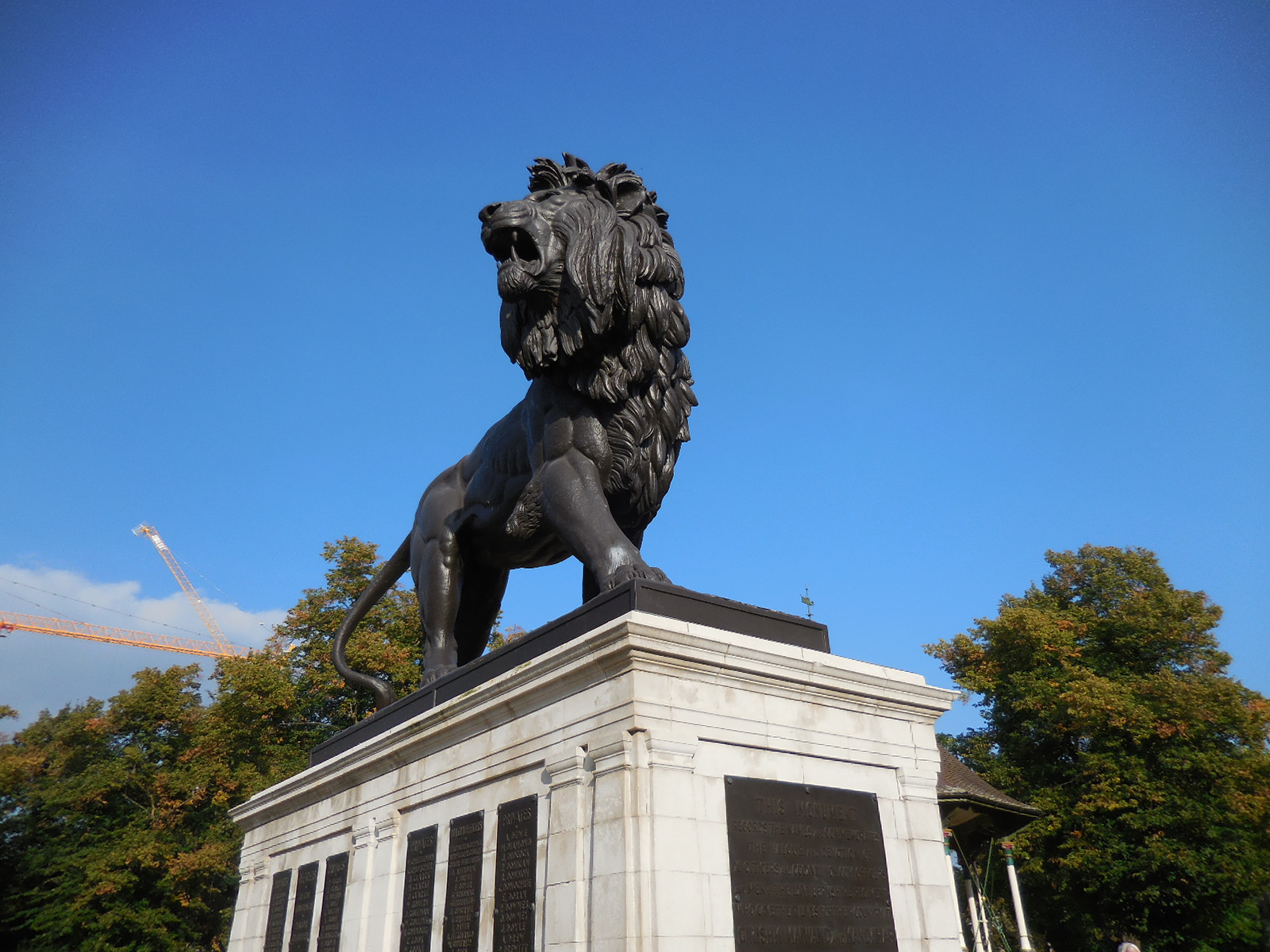
As immortalized in the paintings above, the Duke of Wellington did indeed return to the field of battle at Waterloo, often accompanied by prestigious guests. When he saw the Lion’s Mound for the first time, he lamented, “They have ruined my battlefield.” I don’t think that the Duke objected to the Mound itself, but rather to the fact that much of the dirt needed for the Mound was taken from the famous ridge behind which Wellington had placed his troops at a critical point in the battle. Ordered to lay down, the massive lines of British troops could not be seen by the advancing French, who believed that they had managed to catch Wellington unprepared and that victory would soon be theirs. As the French cavalry advanced, Wellington bided his time until the very last moment, when it is said that he ordered, “Up, men and at them!” Suddenly, the French found themselves confronted by the Long Red Line, fully armed with weapons cocked. Wellington had studied the ridge long before the Battle ever began and came prepared to use it to his advantage should the opportunity arise. The ridge was integral to the British victory at Waterloo and the construction of the Mound had diminished the scale of the ridge. Thus, Wellington was perturbed. 
I was also perturbed, to say the least, when I first heard rumours of the plans to turn Hougoumont into a B and B. Victoria and I had visited Hougoumont together in 2010 – you can read that blog post here
Throughout the Battle of Waterloo, Wellington was committed to British forces maintaining control of the farmhouse of Hougoumont, a strategic battle postition. From Wikipedia:
Wellington recorded in his despatches “at about ten o’clock [Napoleon] commenced a furious attack upon our post at Hougoumont” Other sources state that this attack was at about 11:30. The historian Andrew Roberts notes that, “It is a curious fact about the battle of Waterloo that no one is absolutely certain when it actually began”.
The initial attack by Maréchal de Camp Bauduin’s 1st Brigade of the 6th Division emptied the wood and park, but was driven back by heavy British artillery fire and cost Bauduin his life. The British guns were distracted into an artillery duel with French guns and this allowed a second attack by Maréchal de Camp Baron Soye’s 2nd Brigade of the 6th Division. They managed a small breach on the south side but could not exploit it. An attack on the north side by elements of the 1st Brigade of the 6th Division was more successful.
This attack led to one of the most famous skirmishes in the Battle of Waterloo — Sous-Lieutenant Legros, wielding an axe, managed to break through the north gate. A desperate fight ensued between the invading French soldiers and the defending Guards. In a near-miraculous attack, Macdonell, a small party of officers and Corporal James Graham fought through the melee to shut the gate, trapping Legros and about 30 other soldiers of the 1st Legere inside. All of the French who entered, apart from a young drummer boy, were killed in a desperate hand-to-hand fight.
Today, Hougoumont stands as a monumount to British bravery and to those who fought and died on the field as the Battle raged. As Paul Bray wrote in a Telegraph article in July 2014: 
Most of the farms are private and only visible from the outside. The glorious exception is Hougoumont, where three Guards regiments secured Wellington’s right flank throughout the battle.
In danger of collapse a few years ago, it is now being restored – thanks in part to a surprise £1million grant from the UK Treasury – and its official public opening will be a centrepiece of next June’s bicentenary celebrations.
Hougoumont, the farmhouse that played a significant role

The trees here are still bark-scarred by grapeshot, doors are riddled by musket balls – testimony to the more than 6,000 men killed or wounded in its attack and defence.
According to Graeme Cooper, founder of the Guild of Battlefield Guides: “The story here is most vivid. I have seen many visitors with tears in their eyes, not just because Hougoumont is a shrine to the British Guards but because the atmosphere is so heart-rending. If Hougoumont fails to engage one’s imagination with history, nowhere else will.”
Hougoumont 1915
Hougoumont today and in 1815
Thanks to Robbie MacNiven
Prince Charles and The Duchess of Cornwall visiting the Battlefield and Hougoumont 2015


Several years ago, Project Hougoumont, supported by the late and present Dukes of Wellington, had undertaken the monumental mission of restoring Hougoumont and the surrounding land in order to preserve this most important site. You can visit the Project Hougoumont website here and watch a very informative video regarding the site featuring historian and presenter Peter Snow.  We have had a link to the Project in the left hand sidebar of this blog for over a year now and we applaud their efforts to save the site for future generations to appreciate. 

All was right with world until I read this blurb by the Landmark Trust several months ago: “Just before Christmas it was announced that the Landmark Trust, working with Project Hougoumont, had submitted the only viable tender for the lease of the apartment on the first and second floors of the gardener’s house.  So, our dream of creating a place where people can stay and study the battlefield by day and night and in all kinds of weather has come true. The windows of the light and airy apartment look into the courtyard in one direction and towards the position of the French line in the other. The Landmark Trust assures us that it will be furnished and ready for occupation by 17 June.”

To repeat, upon learning of plans to turn Hougoumont into a B and B, I was perturbed. Okay, outraged might be closer to the mark. How could anyone be allowed to turn this sacred site into a money making venture? What was next – Waterloo Land? Wellington World? How had such a venture passed through the scrutiny of such a venerable restoration committee? 

Recently, I put my displeasure aside and actually went to the Landmark Trust website for the accommodations at Hougoumont. From the website: 


The walls of the courtyard have been limewashed but the brickwork of the external 
elevations has been left exposed, as it was during the battle.


I had to admit, Hougoumont looks much improved and the massive restoration project seems to have been sympathetically done. Hhhmmmm . . . . but what would the interiors of the two bedroom guest accommodation look like? Again from the website: This simple first floor apartment in the former gardener’s cottage beside the south gates is furnished to evoke the Napoleonic era and looks out on ancient sweet chestnut trees that also witnessed the bravery and sacrifice here.


This is a unique place to ponder the famous Battle of Waterloo by day and night.


Unique, yes. And it’s just the gardener’s cottage that will house guest rooms. Very tastefully done guest rooms, at that. Perhaps I jumped the gun when I set my face the enterprise.  In fact, staying at Hougoumont for a few nights in order to “ponder the famous Battle of Waterloo by day and night” sounds like a capital idea. Heck, it even sounds like a plan. 

How do you feel about the idea?


JASNA AGM: TALK BY RACHEL BROWNSTEIN "

AGM Closing Speaker Rachel M. Brownstein entertained us with a lively presentation on “The Age of Caricature.”  She compared some of Jane Austen’s descriptions and actions of her characters to the irreverent and often insulting caricatures drawn by artists such as Gillray ad Rowlandson.

Rachel Brownstein on the jumbo screen

High Change in Bond Street ou la Politesse du Grand Monde
by James Gillray (1756-1815)  1796

Like the exaggerated and comical portraits of these pedestrians on London’s Bond Street, Jane Austen’s characters often embody the culture of consumption and display of her day.  She had a witty turn of phrase which often told us more about a subject than pages of intricate description. As an example, think of Pride and Prejudice‘s Mr. Bennet who asks ironically “For what do we live, but to make sport for our neighbor, and laugh at them in our turn?”

Dr. Rachel Brownstein, Professor of English at CUNY
JASNA described Dr. Brownstein’s talk in the program book: “Although her novels, famously, do not describe what characters look like, Jane Austen’s friends and family praised the skill with which she ‘sketched’ them, and we still use that metaphor…in London heterogeneous crowds gaped at the latest exhibitions in print-shop windows…”
‘All Bond Street Trembled as he strode’ by Gillray, 1802
Jane Austen did not suffer fools gladly, and she found the culture of ostentation and conspicuous consumption distasteful, mocking such qualities in her less-than-heroic characters. Think of Frank Churchill In Emma traveling to London for a haircut, or Robert Ferrars taking so long to chose a simple toothpick-case at the jeweler. Like Gillray, Rowlandson, and others, Austen was an incisive social critic.
Tales of Wonder, by Gillray, 1802
satirizing the popularity of scary Gothic novels, like Northanger Abbey
Two Penny Whist by James Gillray, 1796
making fun of card-players and gamblers 
Rowlandson: A Bill of Fare for Bond Street Epicures, 1808
by Thomas Rowlandson (1757-1827)
mocking figures and fashions
Though Jane Austen rarely ventured remarks on specific political occurrences, the caricaturists loved to satirize political figures, even royalty.
“An Excrescence…a Fungus alias a Toadstool on a Dunghill”, Gillray, 1791
A favorite target was Prime Minister Pitt the Younger

Plum Pudding in Danger, Gillray, 1805
Here Pitt and Napoleon slice up the globe, aka a plum pudding

Dr. Brownstein’s talk was both significant and amusing, a perfect denouement for the 2015 JASNA AGM.

Adorning the stage was a reminder of Kentucky culture!

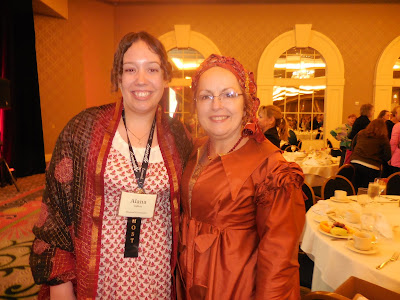
The hard-working AGM Coordinators Alana Gillette and Bonny Wise

RESULTS! WILL MARY CRAWFORD RECEIVE AN ALMACK'S VOUCHER???

At the 2015 AGM of the Jane Austen Society of North America, held last week in Louisville, Kentucky,  Victoria and colleague Susan Forgue presented a program on “London High Society in Austen’s Novels.”

Almack’s Assembly Rooms

We discussed the multiplicity of  reasons people in Jane Austen’s works travel to London, many to partake of the Season’s pleasures and responsibilities, not the least of these being the “Marriage Mart.”  Only one of Austen’s characters was described as being part of a Royal Court function, when Sir William Lucas was knighted for his speech to the King while Mayor of Meryton. As you will recall from Pride and Prejudice, Sir William suggested to Mr. Darcy that they would probably meet someday at the Palace, to Darcy’s evident disdain.

Jane Austen’s cousin, Eliza de Feuillide, was presented to Queen Charlotte at a Royal Drawing Room in St. James’s Palace in 1787, and she also attended Almack’s that night, under the sponsorship of none other than the high stickler lady patroness, Mrs. Drummond-Burrell.  Eliza later married Jane Austen’s brother, Henry.

Petitioners for Admission at Almack’s

Austen did not specify that any of her characters attended the exclusive balls at Almack’s Assembly Rooms, presided over by a self-selected group of lady patronesses. However, Susan and Victoria view themselves as thoroughly qualified to choose the lady patronesses of Almack’s and as such, we invited our audience to accept or reject the applications of several Austen characters.

Victoria and Sue before their presentation

 And who made the select list, you might inquire?

Sue Forgue created the vouchers with their red seals and each participant received one or two, for Mrs. Darcy and/or one with a blank in which she could insert her own name!  Sue did a brilliant job.

Being unable in the turmoil of the closing moments to decide on Mary Crawford’s application, we distributed ballots and asked people to vote.

RESULTS!!

Reader, she was accepted.  Hhhmmm…but it was a very close vote. We will have to keep a eye on her and be certain she maintains high standards.

Here are some of the attendee’s remarks:
“Give her the benefit of the doubt.”
“She should fit right in.”
“We have to have someone to talk about.”
“Without her, at whom shall we direct our most piercing barbs?”
“Her money trumps other considerations”
Several remarked she shouldn’t have to pay for her brother’s sins…
And some thought she was not a moral person and thus did not deserve a voucher.
What do you think?

Many thanks to those who attended and voted.

AND MANY THANKS TO EVERYONE IN LOUISVILLE WHO WORKED ON THIS FABULOUS CONFERENCE!!

AGM Coordinators Alana Gillett and Bonny Wise
A SURGEON AT SEA: NELSON'S NAVY

LOUISVILLE KY  JASNA AGM:  SPECIAL INTEREST PRESENTATIONS

A SURGEON AT SEA: ALBERT ROBERTS OF HMS  ACASTA

Alan Roberts has researched and presented many programs around the U.S. portraying an early 19th century British physician aboard the HMS Acasta, a frigate which served in the Atlantic for many years.  He is part of the re-enactor’s group,the HMS Acasta, with a website here.
Alan Roberts in his surgeon’s apron

Wearing his “blood” stained leather apron, he described the duties of a doctor aboard a British naval vessel of the early 19th century.  The Acasta was a real ship, pictured here in action in the Battle of Santo Domingo, the ship on the far right.

Action off Santo Domingo,  1806, by Thomas Whitcombe, artist, 1817
National Maritime Museum, Greenwich

Demonstrating his tools of the trade

Lined up like this, the doctor’s instruments look pretty gruesome.

At the top. a leather knot for the patient to clench in his teeth;
At the bottom, a saw to cut through the bone.
However, he was kind enough to neglect bringing his jar of leeches, perhaps his most-used remedy for various sailors’ laments..
Center, a long forceps to reach down and pull out a lead ball from a wound
The ship’s surgeon’s books and implements; note the jar of teeth in front of the books. The ship’s surgeon also served as dentist.
The bleeding bowl, showing barber’s tools in the design

Alan Roberts, from his Pinterest page
Find it here.

If you ever have an opportunity to see him at work, don’t miss it!!  Various appearances are listed on the website.