Yes, dear readers, we are pleased and proud to announce our home away from our London home – NUMBER ONE LONDON – has made the list of the top London blogs and websites.
Anyone who has not availed themselves of this list are missing a real treat! These blogs and websites cover a fair buffet of information about London. From the Londonist with its mix of current events, unique festivals, places to visit, and incredibly detailed posts about London past, present, and future to several blogs about living in London posted by young Londoners, ex-pat Americans living in London, women living in London, and every sort of Londoner in between – this list is a must have for anyone who loves our very favorite city in the world!
There are blogs about food and where to find the best of everything. There are blogs about fashion – the latest trends and the best places to find that one piece you simply must have this season. There is a blog on the life and work of a nurse in London. Blogs about SECRET London, with all of the best places you’ve never heard of, but must see!
Of course for those of us who study London of the past in order to convey its character to our readers, this list is a goldmine of blogs and websites on historical London. Spitalfields Life is a wonderful resource about a specific area of London and its history. London Past offers a palette of wonderful images of London from its beginnings through both World Wars. And the London Historians blog is a dangerous rabbit hole down which anyone interested in the history of the great city might fall and never return.
We at NumberOneLondon want to thank both the conveyors of this award and our loyal readers and followers for all of your support. NumberOneLondon is a labor of love for Kristine, Vicky, and I and we are so very pleased you all love London as much as we do!
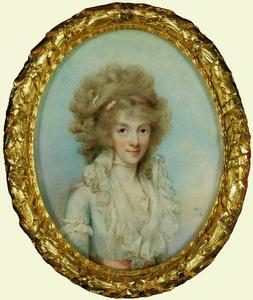
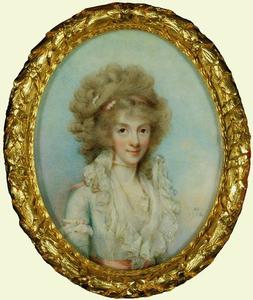
Frederica, Duchess of York, passed away on August 6, 1820, at Oatlands. For an account of that melancholy event, we turn to the Annual Register 1820 –
“On Sunday morning, at nine o’clock, died her royal highness Frederica Charlotta Ulrica, duchess of York, in the 54th year of her age. The death of her royal highness was preceded by a long and painful indisposition, which renders the event that releases her from suffering less a subject for regret. . . .”
“On Tuesday last the duchess experienced a relapse of her indisposition, of which the duke received information while in London. His royal highness, in consequence, got his levee over with all possible speed; and after he had seen all the gentlemen on his list, he hastened in his single-horse chaise from his office in the Horse Guards to York-house, where his travelling chariot and four horses were in readiness. The duchess recovering from the attack that evening, his royal highness returned to London. On Saturday the duchess was seized with another attack, which we are sorry to add proved fatal. An express was sent off from Oatlands to apprize the duke. The
duke found the duchess in a very alarming state, and in which state she continued during the night. . . .
“Thus died Frederica Charlotte Ulrica Catherine Duchess of York, in the 54th year of her age; a Princess whose meek spirit, and universal benevolence, will long be
remembered by all who came within the sphere of her observation. In person she was rather below the middle size, with blue eyes, fair hair, and a clear complexion, which, of late years, began to exhibit a sickly hue.
“Long previously to the mournful event of Her Royal Highness’s death, she had expressed an anxious wish that her remains should be deposited, not in the general mausoleum of the royal family, but in a small vault, which was prepared by her own orders under Weybridge church. His Royal Highness the Duke of York, upon being applied to upon the subject of the funeral, at once determined that the desire of his lamented consort in this respect should be complied with; and gave directions that she should be deposited in the silent mansion, which she had herself approved; and this too, also, according to her request, with as little ostentation as was consistent with the awful ceremony.
“The vault in question is situate on the south side of Weybridge church, immediately under the pew usually occupied by the humbler domestics of Oatlands. It is constructed of brick, and is capable of receiving only two coffins. The entrance is on the outside of the church, so that the body was, in the first instance, to be deposited in the aisle of the sacred edifice; and, after the first part of the burial service, to be conveyed in the usual manner to the place of interment . For the convenience of those who took part in the procession, a platform of boards was laid down from the church-porch to the mouth of the vault. This was about eight feet wide, and bounded on each side by a hand-rail, covered with black cloth. Immediately over the vault, and extending about twenty feet from the church-wall, was a covered way, which was also hung with black.”
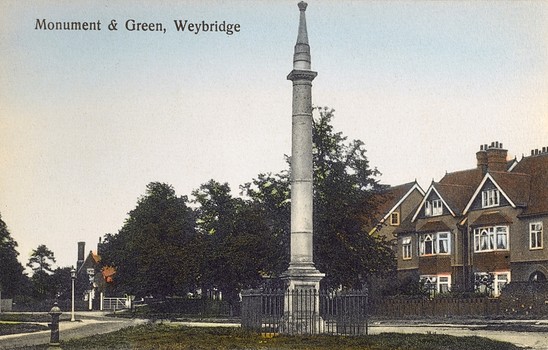
The Duchess of York was much beloved in Weybridge and adjoining towns, as she had for many years been benefactress to many in their times of need. Local residents, therefore, wished to erect a monument to the Duchess and for the tale of how this came about, and the connection between that monument and London’s notorious Seven Dials, we turn to The History of the Catnach Press by Charles Hindley (1887) –
“Several years ago Mr. Albert Smith, who lived at Chertsey, discovered in his neighbourhood part of the Seven Dials—the column doing duty as a monument to a Royal Duchess—when he described the circumstance in a pleasant paper, entitled ‘Some News of a famous Old Fellow’ in his “Town and Country Magazine.” The communication is as follows :—
“Let us now quit the noisome mazes of St. Giles’s and go out and away into the pure leafy country. Seventeen or eighteen miles from town, in the county of Surrey, is the little village of Weybridge.
“One of the lions to be seen at Weybridge is Oatlands, with its large artificial grotto and bath-room, which is said—but we cannot comprehend the statement—to have cost the Duke of Newcastle, who had it built, £40,000. The late Duchess of York died at Oatlands, and lies in a small vault under Weybridge Church, wherein there is a monument, by Chantrey, to her memory. She was an excellent lady, well-loved by all the country people about her, and when she died they were anxious to put up some sort of a tribute to her memory. But the village was not able to offer a large some of money for this purpose. The good folks did their best, but the amount was still very humble, so they were obligated to dispense with the service of any eminent architect, and build up only such a monument as their means could compass. Someone told them that there was a column to be sold cheap in a stonemason’s yard, which might answer their purpose. It was accordingly purchased; a coronet was placed upon its summit; and the memorial was set up on Weybridge Green, in front of the Ship Inn, at the junction of the roads leading to Oatlands, to Shepperton Lock, and to Chertsey. This column turned out to be the original one from Seven Dials.
“The stone on which the dials were engraved or fixed, was sold with it. The poet Gay, however, was wrong when he spoke of its seven faces. It is hexagonal in its shape; this is accounted for by the fact that two of the streets opened into one angle. It was not wanted to assist in forming the monument, but was turned into a stepping stone, near the adjoining inn, to assist the infirm in mounting their horses, and there it now lies, having sunk by degrees into the earth ; but its original form can still be easily surmised. It may be about three feet in diameter.
“The column itself is about thirty feet high and two feet in diameter, displaying no great architectural taste. It is surmounted by a coronet, and the base is enclosed by a light iron railing. An appropriate inscription on one side of the base indicates its erection in the year 1822, on the others are some lines to the memory of the Duchess.
“Relics undergo strange transpositions. The obelisk from the mystic solitudes of the Nile to the centre of the Place de la Concorde, in bustling Paris—the monuments of Nineveh to the regions of Great Russell Street—the frescoes from the long, dark, and silent Pompeii to the bright and noisy Naples—all these are odd changes. But in proportion to their importance, not much behind them is that old column from the crowded dismal regions of St. Giles to the sunny tranquil Green of Weybridge.”
In this installment in the series, we turn to contemporary sources for a look at the social circle of Frederica, Duchess of York, and thereby for more glimpses into the personality of the woman herself. What better place to start than with Charles Greville’s Diaries:
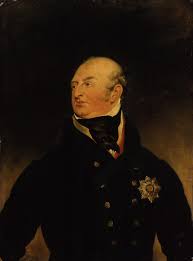
August 15th, 1818 — “The parties at Oatlands take place every Saturday, and the guests go away on Monday morning. These parties begin as soon as the Duchess leaves London, and last till the October meetings. During the Egham races there is a large party which remains there from the Saturday before the races till the Monday se’nnight following; this is called the Duchess’s party, and she invites the guests. The Duke is only there himself from Saturday to Monday. There are almost always the same people, sometimes more, sometimes less. We dine at eight, and sit at table till eleven. In about a quarter of an hour after we leave the dining-room the Duke sits down to play at whist, and never stirs from the table as long as anybody will play with him. When anybody gives any hint of being tired he will leave off, but if he sees no signs of weariness in others he will never stop himself. He is equally well amused whether the play is high or low, but the stake he prefers is fives and ponies (Five-pound points and twenty-five pounds on the rubber). The Duchess generally plays also at half-crown whist. The Duke always gets up very early, whatever time he may go to bed. On Sunday morning he goes to church, returns to a breakfast of tea and cold meat, and afterwards rides or walks till the evening. On Monday morning he always sets off to London at nine o’clock. He sleeps equally well in a bed or in a carriage.
The Duke of York
“. . . . (The Duchess’s) dogs are her greatest interest and amusement, and she has at least forty of various kinds. She is delighted when anybody gives her a dog, or a monkey, or a parrot, of all of which she has a vast number; it is impossible to offend her or annoy her more than by ill-using any of her dogs, and if she were to see anybody beat or kick any one of them she would never forgive it. She has always lived on good terms with the Royal Family, but is intimate with none of them, and goes as little as possible to Court. The Regent dislikes her, and she him. With the Princess Charlotte she was latterly very intimate, spent a great deal of time at Claremont, and felt her death very severely. The Duchess has no taste for splendour or magnificence, and likes to live the life of a private individual as much as possible.
“. . . . . The Duke and the Duchess live upon the best terms; their manner to one another is cordial, and while full of mutual respect and attention, they follow separately their own occupations and amusements without interfering with one another. Their friends are common to both, and those who are most attached to the Duke are equally so to the Duchess. One of her few foibles is an extreme tenaciousness of her authority at Oatlands; one way in which this is shown is in the stable, where, although there are always eight or ten carriage-horses which seldom do any work, it is impossible ever to procure a horse to ride or drive, because the Duchess appropriates them all to herself. The other day one of the aides-de-camp (Cooke) wanted to drive Burrell (who was there) to Hampton Court; he spoke of this at breakfast, and the Duke hearing it, desired he would take the curricle and two Spanish horses which had been given to him. The Duchess, however, chose to call these horses hers and to consider them as her own. The curricle came to the door, and just as they were going to mount it a servant came from the Duchess (who had heard of it) and told the coachman that her Royal Highness knew nothing of it, had not ordered it, and that the curricle must go home, which it accordingly did.”
September 3rd.— “I went to Oatlands for the Egham races. The party lasted more than a week; there was a great number of people, and it was very agreeable. . . . We played at whist every night that the Duke was there, and I always won. The Duchess was unwell most of the time. We showed her a galanterie which pleased her very much. She produced a picture of herself one evening, which she said she was going to send to the Duchess of Orleans; we all cried out, said it was bad, and asked her why she did not let Lawrence paint her picture, and send a miniature copied from that. She declared she could not afford it; we then said, if she would sit, we would pay for the picture, which she consented to do, when all the men present signed a paper, desiring that a picture should be painted and a print taken from it of her Royal Highness. Lawrence is to be invited to Oatlands at Christmas to paint the picture. The men who subscribe are Culling Smith, Alvanley, B. Craven, Worcester, Armstrong, A. Upton, Rogers, Luttrell, and myself, who were present. The Duchess desired that Greenwood and Taylor might be added. From Oatlands I went to Cirencester, where I stayed a week and then returned to Oatlands, expecting to find the Queen dead and the house empty, but I found the party still there.”
And from The Public and Domestic Life of His Late Majesty, George III by Edward Holt (1820) we get a glimpse at the celebrations for Frederica’s birthday in May of 1810 –
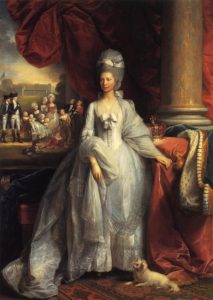
Queen Charlotte by Benjamin West
“A grand fete was given in honour of her Royal Highness the Duchess of York, at Oatlands. The preparations were unusually costly. The King, Queen, the Princesses Augusta, Elizabeth, Mary, Sophia, and Amelia; the Prince of Wales; Dukes of York, Kent, Clarence, Sussex, and Cumberland, were present. Indisposition only prevented the Duke of Cambridge from attending. The Duke and Duchess of York were in waiting to receive their illustrious relatives: from the bottom of the flight of steps leading into the great hall, the Duke escorted the Queen to the grand saloon. After viewing . and admiring the improvements made on the lawn, &c. the royal party partook of a most sumptuous banquet, served up in a costly service of silver gilt plate. During the time of dinner, the Duke of York’s band, in full uniform, played under the viranda on the green. The King wore the Windsor uniform. The Queen and the Princesses were dressed in plain white. His Majesty, it was remarked, looked uncommonly well, and possessed his usual flow of spirits. Their Majesties and the Princesses departed about eight o’clock, escorted, as usual, by a party of dragoons.
“About nine o’clock great merriment took place: the Duchess having ordered the park gates to be thrown open, the populace, principally composed of the neighbouring peasantry, rushed in, and made the best of their way to the lower part of the house, where a number of tables were set out with provisions of every description. Dancing commenced immediately afterwards. The tables were deserted for the library, where the Duchess led off the first dance, called the Labyrinth, with the Hon. Colonel Upton. Her Highness never appeared to better advantage; she was improved in health, and grown rather corpulent. The very awkward manner in which the country people paid their respects to the Heir-apparent in their going down the dance, excited the risibility of the Royal Party to an extreme degree. It was not until two o’clock in the morning that the music ceased, and then the company retired. The Prince of Wales slept at Oatlands that night. A similar entertainment was given at York-house, in the Stable-yard, the same night.”
And The New Annual Register Nov. 13 (1812) tells us that: “A ball was given by the duchess of York at Oatlands, for the purpose of introducing the Princess Charlotte into company. The “prince led off the dance, and chose his daughter for his partner; and whilst leading her briskly along, his right foot came in contact with the leg of a sofa, which gave the limb a twist, by which two tendons of his foot were broken. His royal highness took but little notice of it that night; but in the morning he found it so much worse, as to be obliged to resort to the assistance of surgeons.”
The incident above is elaborated upon in The Beloved Princess: Princess Charlotte of Wales by Charles E. Pearce (1912) –
” . . . . in November 1811, and in the same month the Duchess of York gave a ball at Oatlands for the purpose of introducing the Princess Charlotte into the world of fashion. This was done not only with the sanction of the Regent, but probably at his suggestion. In any case, it is evident that the Prince’s ideas with regard to Charlotte were not those which caused so much surprise during the following year. Creevey speaks of the Regent’s high goodhumour and fine spirits when at Brighton in the autumn of 1811, and it may be that in the fullness of his new position and powers he was disposed to put aside his worries and relax the tight hold he had hitherto maintained over the turbulent Charlotte. Whatever may have been the reason of the Regent’s complaisance, the young Princess must have felt justified in thinking that the days of her childhood were past.
“Into the gaiety of the ball at Oatlands she threw herself with all the exuberance of her nature. The Regent and his daughter that night were on the best of terms, and they took part together in one of the Scotch dances at that time very fashionable, thanks to the patronage given to Neil Gow, the celebrated Scotch violinist and the composer of numerous reels and strathspeys. The particular dance in which the Regent and Charlotte engaged was known as the ” Highland Flurry,” and it was reported in one of the newspapers that “the Prince led off the dance and chose his daughter for his partner, but whilst leading her briskly along, his right foot came in contact with the leg of a sofa which gave the limb a twist, by which two tendons of his foot were broken.
“As described here, the accident must have been of sufficient gravity to incapacitate his Royal Highness from further exertion during the evening. There is no evidence that it did so, and in fact doubts have been raised whether the Prince received any injury during this particular dance. It is true Fremantle, writing to the Marquis of Buckingham, corroborates with some slight variations the above version of the “accident,” but he does so with his tongue in his cheek after the following fashion: “As you will be interested in knowing the particulars of the Prince of Wales’s attack, I write to say that although it was nothing but a strain of the muscle, he has made so much of it and it affected him so greatly that it has created quite a sensation. It was done while Princess Charlotte was at Oatlands; she was endeavouring to dance a Scotch step called the ‘ Highland Flurry,’ and there was a laugh in endeavouring to make Adam (who was one of the party) teach her. The Prince got up and said he would show her, and in doing so evidently wrenched his ankle. This took place ten days ago, since which he has never been out of bed. He complained of violent pain and spasmodic affection, for which he prescribed for himself and took a hundred drops of laudanum every three hours. . . . He will sign nothing and converse with no one on business . . . and you may imagine therefore the distress and difficulty in which the Ministers are placed. The Duke of Cumberland is going about saying it is a shame and that he could get up and be perfectly well if he pleased.
“The Duke of Cumberland, after his usual fashion, did his best to make the “incident” tell against the Regent, and from the current gossip of the day it would appear that there was no accident at all, but that the indisposition of the Regent arose from a cause other than dancing. A fracas outside the ballroom was hinted at. Apparently this is what the writer (C. B. Wollaston) of the following letter (to be found in the “Journal” of Mary Frampton) refers to: “There have been strange rumours about the Regent, but I verily believe without foundation. The fact is, as Ryder [Secretary of State at this time for the Home Department] told me this morning, that he is in considerable pain from his legs, and obliged to keep them almost entirely in a horizontal position, which is an inconvenient one for writing; but certainly much distress and inconvenience has arisen on all public offices from the want of his signature. It has been said that a report of his being in the same state as his father [i.e. mental breakdown] was traced to the Duke of Cumberland, and that in consequence the Prince has broken off all intercourse with the Duke; but Ryder tells me that he saw the Duke at Oatlands two mornings ago, and that he and the Duke of Kent had been breakfasting in the Prince’s room.
“Mr. John Ashton says of this queer business that “whatever was the matter with him [the Regent] he did not leave Oatlands until the 9th December, or nearly a month. Nobody believed in the royal sprain, but the story that gained credence and was made the most of by the caricaturists was that the Regent had at the ball grossly insulted Lady Yarmouth, for which he was most heartily and soundly thrashed by her husband, Lord Yarmouth.”
In the next installment of this series, we will take a closer look at the Duchess of York’s friendship with Beau Brummell.
Though the Duke and Duchess of York agreed to separate about six years after their marriage, they continued to share the marital home, Oatlands, in Surrey, and apparently managed to live together in the house in various stages of harmony. Certainly, their friends were used to having both royalties present during house parties and other entertainments. A bit like the present Duke and Duchess of York, both preferred to live more or less in retirement and surrounded themselves with a select circle of friends. Let us take a look at the setting, courtesy of Highways and Byways in Surrey by Eric Parker, 1950 –
“Georgian days brought another being as a visitor. Oatlands came to the seventh Earl of Lincoln in 1716, and he built himself a house on the higher ground overlooking a fine stretch of water and many miles of Thameside country. From his son, who had inherited the dukedom of Newcastle, this house was bought by the Duke of York in 1794, but was burnt down the same year, and the royal Duke rebuilt it. He and his Duchess lived there until 1820, when she died. It must have been a curious household. George III brought Queen Charlotte there, and the Court with her; Georgian wits and beauties gathered in the duke’s dining-rooms and played cards in his grottoes. Charles Greville was often at Oatlands, and Sheridan and Beau Brummell and Horace Walpole; Mrs. Gwyn came there, and Mrs. Bunbury, Oliver Goldsmith’s “Jessamy bride” and “Little Comedy.” Both were buried in Weybridge old church. Samuel Rogers, in his Table-talk, gives a quaint picture of the household:
‘I have several times stayed at Oatlands with the Duke and Duchess of York—both of them most amiable and agreeable persons. We were generally a company of about fifteen; and our being invited to remain there ‘another day’ sometimes depended on the ability of our royal host and hostess to raise sufficient money for our entertainment. We used to have all sorts of ridiculous ‘fun ‘ as we roamed about the grounds. The Duchess kept (besides a number of dogs, for which there was a regular burial-place) a collection of monkeys, each of which had its own pole with a house at top. One of the visitors (whose name I forget) would single out a particular monkey, and play to it on the fiddle with such fury and perseverance that the poor animal, half distracted, would at last take refuge in the arms of Lord Alvanley.—Monk Lewis was a great favourite at Oatlands. One day after dinner, as the Duchess was leaving the room, she whispered something into Lewis’s ear. He was much affected, his eyes filling with tears. We asked what was the matter. ‘Oh,’ replied Lewis, ‘the Duchess spoke so very kindly to me !’—’ My dear fellow,’ said Colonel Armstrong, ‘pray don’t cry; I daresay she didn’t mean it.’
“The Duke of York died in 1827, and thirty years later Oatlands became a hotel. The building was greatly altered, but the grounds still keep some untouched memorials of the past. One is an extraordinary grotto, built by the Duke of Newcastle, and used by the Duke of York and his friends, according to local tradition, as a card-room, plentifully supplied with wine bottles. It is lined with a profusion of crystal spar and sea shells; it contains a deep bath, bashfully presided over by a statue of Venus, and the steps leading up to the door are paved with horses’ teeth picked up on the battle-field of Waterloo. How the Duke of Newcastle accomplished this feat it is difficult to imagine, for he died in 1794. Perhaps they belonged to other horses, or perhaps the gallant Duke of York made the addition. He was Commander-in-chief, and the grisly relics may have been sent him as a present.
“Another relic of the dead is the cemetery in which the Duchess of York used to bury her cats and dogs and monkeys. There may be, perhaps, thirty or forty little tombstones, each with a name.”
The diarist Charles Greville has left us a picture of his visits to Oatlands in his Memoirs. Here is an extract that mentions both the grotto and the Duchess’s love of animals:
“The week end parties were often large, and one of the principal amusements of the guests was to sit up playing whist till four o’clock in the morning. On Sundays,” he continues, ” we amused ourselves with eating fruit in the garden, and shooting at a mark with pistols, and playing with the monkeys. I bathed in the cold bath in the grotto, which is as clear as crystal and as cold as ice. Oatlands is the worst managed establishment in England: there are a great many servants, and nobody waits on you; a vast number of horses, and none to ride or drive.”
“The Duchess seldom goes to bed, or, if she does, only for an hour or two; she sleeps dressed upon a couch, sometimes in one room, sometimes in another. She frequently walks out very late at nights, or rather early in the morning, and she always sleeps with open windows. She dresses and breakfasts at three o’clock, afterwards walks out with all her dogs, and seldom appears before dinner-time. At night, when she cannot sleep, she has women to read to her. The Duchess of York is clever and well informed; she likes society, and dislikes all form and ceremony; but in the midst of the most familiar intercourse she always preserves a certain dignity of manner. Those who are in the habit of going to Oatlands are perfectly at their ease with her, and talk with as much freedom as they would to any other woman, but always with great respect. Her mind is not perhaps the most delicate; she shows no dislike to coarseness of sentiment or language, and I have often seen her very much amused with jokes, stories, and allusions which would shock a very nice person. But her own conversation is never polluted with anything the least indelicate or unbecoming. She is very sensible to little attentions, and is annoyed if anybody appears to keep aloof from her or to shun conversing with her. Her dogs are her greatest interest and amusement, and she has at least forty of various kinds. She is delighted when anybody gives her a dog, or a monkey, or a parrot, of all of which she has vast numbers; it is impossible to offend or annoy her more than by ill using any of her dogs, and if she were to see anybody beat or kick any one of them she would never forgive it.”
Author James Thorne give us more background on the house and about the plan and appearance of the famous Grotto in his Handbook to the Environs of London –
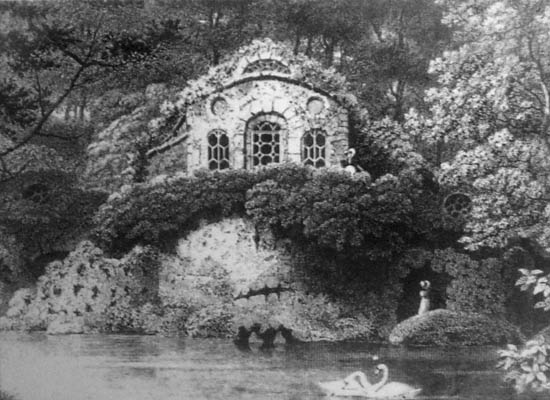
“(Oatlands) was constructed for the Duke of Newcastle by an Italian and his two sons, who were occupied over 20 years upon it. In the early accounts it is said to have cost £12,000 or £13,000, a sum since magnified to £40,000. The Grotto is a building of three or four chambers on the ground floor, connected by low dark passages, and a large room above. The exterior is formed of tufa curiously put together; the rooms and passages are a mosaic of minerals, marbles, spars of various kinds, and shells, worked into a multitude of quaint devices with infinite patience and skill. The ceilings are of stalactites and satin spars. In the bath-room is a copy of the Venus de’ Medici; painted glass obscures the light. The upper room, reached by an outer staircase, has an elaborate cupola of artificial stalactites of satin-spar; the walls a more complex repetition of the mosaic of the lower chambers. In this room George IV., when Prince of Wales, gave a splendid supper to the Emperor of Russia, the King of Prussia, and the princes and generals in their train, on their visit to England after the battle of Waterloo. The chamber for the occasion was lighted by cut-glass chandeliers; the chairs and sofas had satin cushions embroidered by the Duchess of York. In visiting the Grotto notice the many fine specimens of minerals still left, especially the various quartz crystals; also the ammonites and other fossil as well as recent shells.”
Unfortunately, the grotto was demolished in 1948, but these images give us some idea of what it looked like –
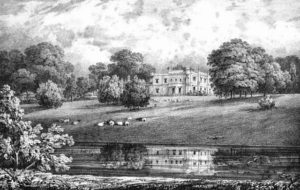
James Thorne continues: “Oatlands was purchased by the Duke of York, about 1790, for £45,000. The house was in great part destroyed by fire, June 6th, 1794, whilst the Duchess of York was residing in it. A new mansion was shortly after commenced on a grander scale, avowedly from the designs of Holland, the architect of Drury Lane Theatre (destroyed by fire in 1806), but John Carter (more favourably known by his etchings of Gothic buildings), who superintended its erection, claimed to be also its designer.* The house did little credit to the taste of either architect. It was a long, low, rambling structure ; the style a meagre variety of Strawberry Hill Gothic, battlemented throughout. It had, however, some noble rooms with ample.”
The celebrated Dandy, Edward “Golden Ball” Hughes purchased Oatlands from the Duke of York in 1824, in turn selling it on in 1846. Oatlands went on to become a school and is now a hotel. On a trip to Windsor, my dearly missed friend, author Hester Davenport, knowing my great affection for Frederica, offered to take me to Oatlands. Here I am sitting on a bench that is roughly situated to where the sheep are in the engraving.
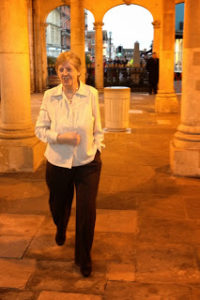
The late author, and much missed friend, Hester Davenport.
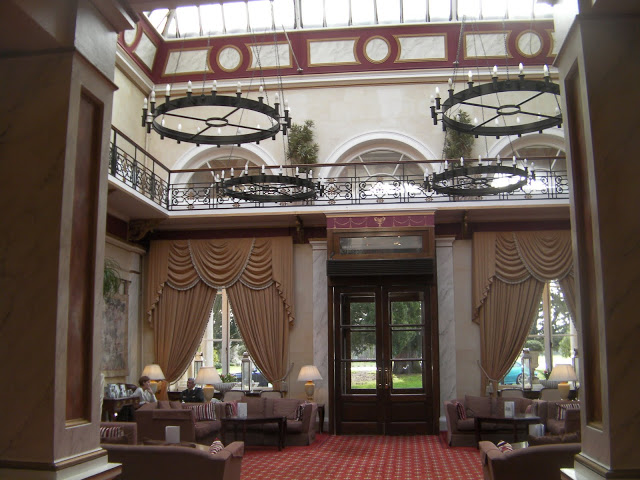
Hester and I had tea in the lobby of the hotel, poked our noses into various parts of the building and walked the grounds but, as she was well aware, the prime objective for my visit was to get a look at Frederica’s pet cemetery.
In his Handbook to the Environs of London, author James Thorne describes Frederica’s love of animals and gives us a glimpse of her pet cemetery at Oatlands:
“Fondness for animals was strongly developed in the Duchess. She protected the wild song birds, and would not allow a rook to be shot; the cows and pigs on the farm would run to her sure of a choice morsel; whilst for dogs her partiality was excessive, and to her visitors annoying; but doubtless she found, as she says in one of her shapeless rhymes, their “frolic play Enlivened oft the lonesome hours.’
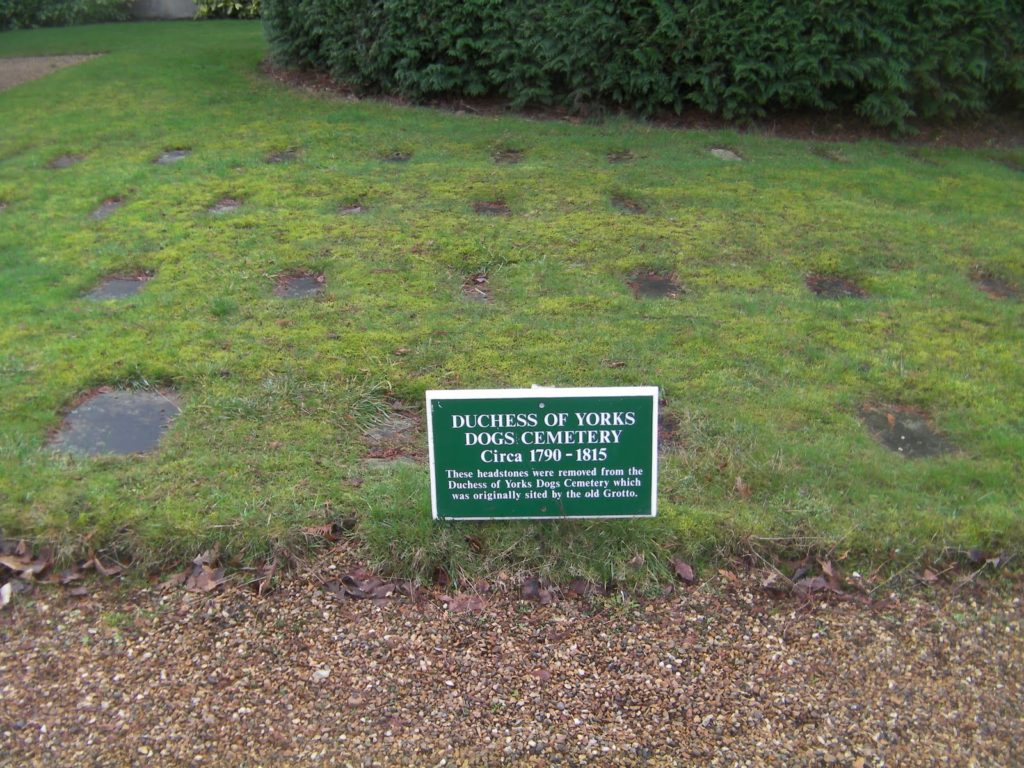
“She did not neglect them even when dead. Around the margin of a circular basin for gold fish (now drained), she formed a cemetery for her pets, burying each in turn with care, strewing its grave with flowers, and placing over it a little stone “with the animal’s name, date of decease, and, if its merit was remarkable, a tribute in verse from her own pen.* Sixty or seventy of these stones still fringe the margin of the hollow; and when the Queen visited Oatlands in 1871, noticing that the tombstones were out of order, she, with her usual kindliness, gave orders for their restoration. They now look quite fresh, and four or five have been added for dogs recently deceased.”
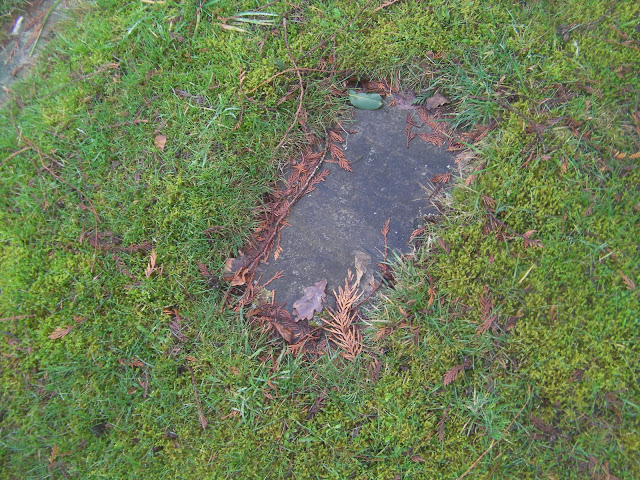
Unfortunately, Queen Victoria’s efforts were not maintained and this is all that’s left of Frederica’s cemetery, the stones now unreadable. Still, I will always thank Hester for ticking this particular item off my bucket list.
In Part 3 of this series, we’ll meet some of the people whom Frederica counted amongst her friends and get a bird’s eye view of the parties and entertainments she held at Oatlands.
Many years ago (decades), I was privileged to start up the Southwest Florida Chapter of the Romance Writers of America along with Tina Wainscott, Lynnette Halberg and Joyce Henderson, among others.
Joyce was a sort of den mother to us all, not because she was any older than we were, but because she was such a cheerleader of our work. With her newspaper background and no nonsense attitude, Joyce helped each of us to hone our craft, tighten our prose and stay on track where plot and dialogue were concerned. Most of all, Joyce encouraged all of us to keep going and to strive to be the best writers we could be. No matter what our personal genre or time period of choice, Joyce made each of feel as though our efforts were valid and our hopes of publication justified. And wouldn’t you know it – she was right. Most of us did go on to publication.
Now I’m proud as punch to let you know that the Southwest Florida Chapter of the Romance Writer’s of America have for several years been honoring Joyce’s memory with the Joyce Henderson Contest, open to entries in six romance genre categories and offering unpublished authors the chance to have their work seen by published authors and industry agents and editors.
Joyce was a lucky charm for many of us – her magic just may rub off on you, as well. Complete contest rules and entry form can be found here – deadline for entries is August 31. Good luck!





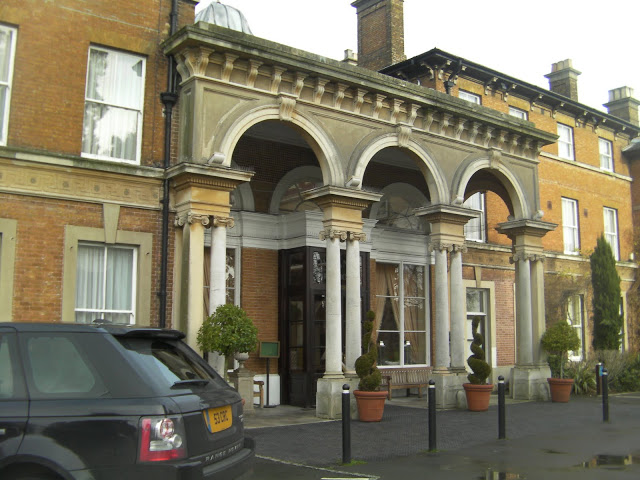 Hester and I had tea in the lobby of the hotel, poked our noses into various parts of the building and walked the grounds but, as she was well aware, the prime objective for my visit was to get a look at Frederica’s pet cemetery.