Christmas at Castle Howard, Yorkshire

Saturday’s Snow update: The roads to Castle Howard are open, but please drive with care. The House & Gardens, Stable Courtyard Shops, Farm Shop, Café and Garden Centre are open for business as usual from 10am daily, and ‘Audiences with Father Christmas’ will go ahead as scheduled this weekend. The snow covered gardens look stunning – so please wrap up, enjoy the views and have fun! Updated 4.00pm on 03/12/2010.Check the Castle Howard website for daily updates here.

Hurrah! All those lovely decorations and planned events no longer postponed!  Unless we live in a tropical climate, we expect snow in December, but I reckon the current situation in Europe is more than anyone expected.   If you are anywhere near Yorkshire, check the website and plan a Christmas visit to the Castle. Many events are planned, some already sold out.
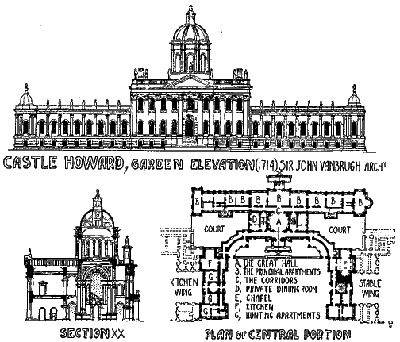
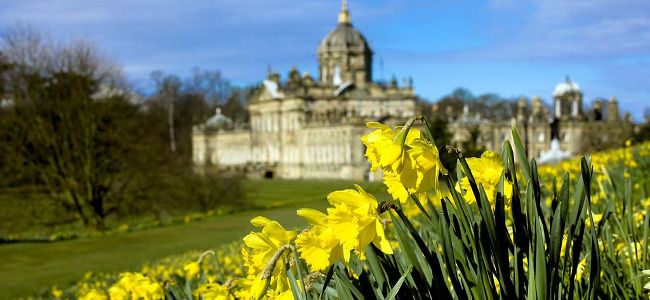
Castle Howard is the spectacular estate belonging to the Howard family, Earls of Carlisle, built in the early 18th century in the baroque style by Sir John Vanbrugh and Nicholas Hawksmoor. The building of Castle Howard  is the story of unique friendships. Under history in the website above you can learn about the trio of Charles Howard, 3rd Earl of Carlisle (c.1669-1738), John Vanbrugh (1664-1726) and Nicolas Hawksmoor (1661-1736), who cooperated to build this remarkable house.

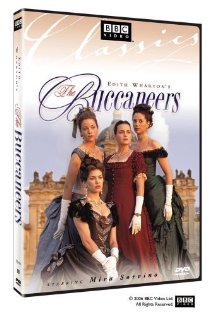
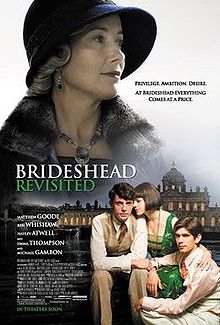
You may be familiar with it as the setting of the television series Brideshead Revisited. Both the 1981 eleven-episode version starring Anthony Andrews and Jeremy Irons and the 2008 film of the same name (if you are interested, definitely choose the former). Castle Howard  also served as one of the settings for The Buccaneers, a five-episode miniseries in 1995 of Edith Wharton’s last unfinished novel about American heiresses looking for English titles. More film appearances are detailed on the website.
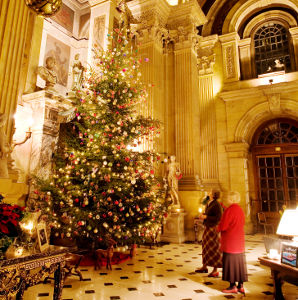
Christmas in the Great Hall

Castle Howard replaced the nearby Henderskelfe Castle, the ancient Yorkshire seat of the Dacre family from which the Howards are descended. This castle was destroyed by fire in 1693; today a large obelisk marks its former location.  The third Earl at the end of the 17th century, decided to bult a great house, and first chose William Talman (1650-1719), the architect who was redoing Chatsworth for the Duke of Devonshire. But they didn’t get along. 

The Earl turned to John Vanbrugh  (1664-1726),  a multitalented fellow, a former soldier, whose very first play was a success. He was an amateur architect, more familiar with theatrical design, but he was able to work closely with Nicholas Hawksmoor (c.1661-1736), a professional who was an assistant to Wren and, alone, the architect of several noteworthy buildings. The partnership worked so well it was continued in the building of Blenheim.

Castle Howard spreads out under a lanterned dome, perhaps inspired by the recent erection of Wren’s St. Paul’s. The dome was not part of the architect’s original drawings. Work on the house continued until Vanbrugh’s death in 1726. The planned west wing was not built until the 1750’s and then to plans altered by architect William Kent.

Nigel Nicolson writes of Castle Howard in the National Trust Book of Great Houses of Britain, “From a
distance it passes every test; it is noble, dramatic, splendid and in scale. From a closer view, there is almost nothing in British architecture to match the explosive vigour of its soaring stone…the minds of several great men have met here to create what is without question the finest memorial to the short-lived age of the English baroque.”


Chapel

 Frederick Howard, 5th Earl of Carlisle (1748-1825) went on the Grand Tour with Charles James Fox, then held a number of royal appointments. At 30, he became the Chief Commissioner to North America on the eve of the Revolution, and later was Lord Lieutenant of Ireland. He acquired many fine Italian paintings now in the house.

His son, George Howard, 6th Earl of Carlisle (1773-1848), married Georgiana Cavendish, daughter of the 5th Duke and Georgiana, Duchess of Devonshire. Lady Georgiana’s bedroom has been preserved as it was at her death in 1858 with its 18th century furniture intact.

Despite her fragile beauty, Lady Georgiana  bore the 6th Earl a dozen children, 6 boys and 6 girls.

Upon the death of the 9th Earl of Carlisle in 1911, the family estates were divided. The 10th Earl inherited Naworth Castle, Cumbria, and Castle Howard went to Hon. Geoffrey William Algernon Howard (1877-1935). His grandsons are now the trustees of the corporation that owns and operates Castle Howard. It’s worth noting that the Howards are the only great Catholic medieval family to survive to present day.

During World War II, the house was used as a girl’s school. During the school’s tenure, a fire destroyed the south wing and the central great hall and dome. The dome and Great Hall were restored but the interiors of one wing of the house are empty. These rooms, stripped to their unadorned brick walls, once held the major State Rooms, now all gone. In other areas of the house, many fine rooms are open to the visitor.

The park and the buildings scattered around the grounds, the Temple of the Four Winds by Vanbrugh and the Mausoleum  by Hawksmoor, and the handsome bridge are as admired as the house itself.
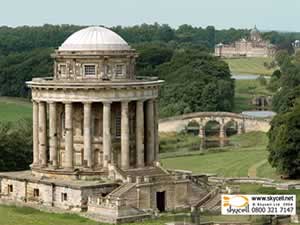
The Temple of the Four Winds, last work of Vanbrugh

The Mausoleum, by Hawksmoor

Hawksmoor’s Pyramid
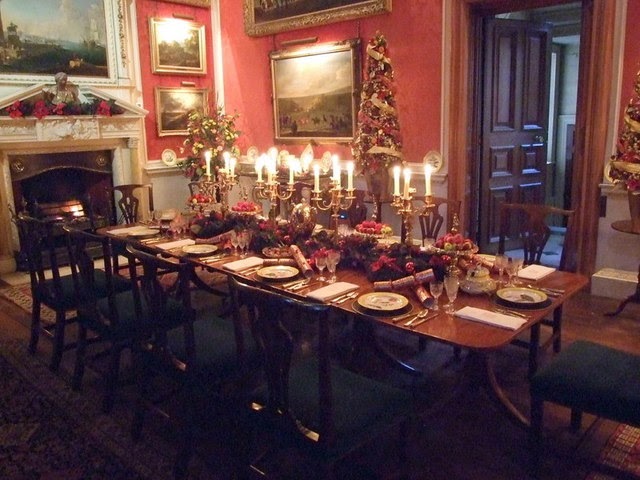
We hope that the snow does not cause anyone to miss Christmas Dinner at Castle Howard.

But one thing is sure — next spring the daffodils will bloom again in Yorkshire.

Those Fabulous Phaetons – Part Two

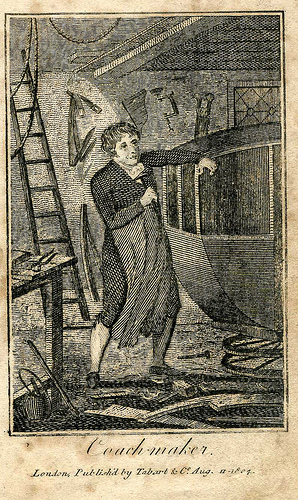
The area in and around Long Acre in London was noted for it’s many coach builders, who offered standard coach designs and could also make customized carriages to suit any need or taste. Rudolph Ackermann, most famous for his “Repository,” designed many coaches for the aristocracy. The delivery of a finished coach happened long after its initial order had been placed, as there many firms involved in the construction and outfitting of each. No one firm undertook all phases of the process. There were the Body Makers who made the body and panels, Carriage Makers who built the under-carriage, Blacksmiths who did all the iron work, Wheelwrights and Curriers, who fitted the seats and all leather parts. Finally, Painters attended to the coach bodies and heraldic designs upon the doors and the Trimmers fitted up the interior with lace edgings for pockets, tassel cords, hammer cloths and window blinds. Quality work produced by skilled craftsmen took time – but those Fabulous Phaetons were well worth the wait.

Charles Dickens gives us details of the process is All the Year Round:

The coachmaker’s wood-loft contains oak, ash, and elm, from trees which have lain a year after falling, and which, after I.-mis; cut into planks of various thicknesses, must remain unused as many years as they are inches thick. A certain class of carriage-builders use green wood of any quality, relying on paint to cover all defects, not expecting or caring to see any customer twice. There are some advertising fabricators of diminutive Broughams who are especially to be avoided.

Besides European woods, there is also a large demand for mahogany and knee-wood from the Gulf of Mexico, Quebec pine, birch and ash from. Canada, tulip-wood and hickory from the United States. These, for the most part, are cut ready for use by steam saws before going into the hands of the coachbuilder.

The first step for the construction of, say a Brougham, is to make a chalk drawing on a brick wall, of the same size. On this design depends the style of the carriage. Some builders are happy or unhappy in designing novelties; others have a traditional design, a certain characteristic outline, from which they will on no consideration depart. The next step is to make patterns of the various parts. In first-class factories, each skilled workman has been apprenticed to, and follows only one branch of, the trade. The leading workmen in wood are body-makers, carriagebuilders, wheelers, and joiners—all highly skilled artisans, as may be judged from the fact that a chest of their tools is worth as much as thirty pounds.


The framework is sawn out of English oak. The pieces, when cut by the band-saws, are worked up, rabbeted, and grooved to receive the panels, and thus a skeleton is raised ready for the smith and fitter, who, taking mild steel or homogenous iron, forge and fit a stiff plate along the inside cart-bottom framework, following the various curves, and bolted on so as to form a sort of backbone to the carriage, which, takes the place of the perch:—universally the foundation of four-wheeled carriages before the general adoption of iron and steel.


The frame is then covered with thin panels of mahogany, blocked, canvased, and the whole rounded off. After a few coats of priming, the upper part is covered with the skin of an ox, pulled over wet. This tightens itself in drying, and makes the whole construction as taut as a drum-head, the joints impervious to rain, and unaffected by the extremes of heat or cold. Meanwhile the “carriage-maker,” the technical name of the artisan who makes the underworks, arranges the parts to which the springs and axles are bolted, so that the body may hang square and turn evenly with the horses, on the fore-carriage. The coachsmith and spring-maker have also been at work arranging the springs, the length and strength of which must be nicely calculated to the weight estimated to be carried. The ends of these springs are filled with india-rubber, to make the carriage run lightly and softly.


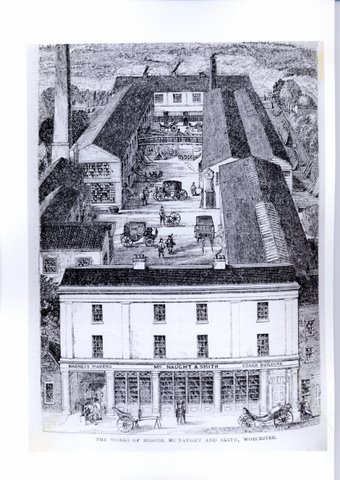
McNaught and Co., Worcester


Though from a much earlier date, Samuel Pepys records a visit to his coachmaker in his Diary: “I to my coachmaker’s, and there vexed to see nothing yet done to my coach, at three in the afternoon; but I set it in doing, and stood by till eight at night, and saw the painter varnish it, which is pretty to see how every doing it over do make it more and more yellow: and it dries as fast in the sun as it can be laid on almost; and most coaches are, now-a-days, done so, and it is very pretty when laid on well, and not too pale, as some are, even to show the silver. Here I did make the workmen drink, and saw my coach cleaned and oiled; and staying among poor people there in the alley, did hear them call their fat child Punch, which pleased me mightily, that word being become a word of common use for all that is thick and short. At night home, and there find my wife hath been making herself clean against tomorrow; and late as it was, I did send my coachman and horses to fetch home the coach to-night, and so we to supper, myself most weary with walking and standing so much, to see all things fine against to-morrow, and so to bed.”


The Coachmaker Pub
88 Marylebone Lane, London


And in closing, Dear Reader, you will not be too surprised to find that, yet again, the fates have brought us to another encounter with the Duke of Wellington with this passage from All the Year Round – “So recently as 1837 a . . . scientific book on pleasure carriages was published by Mr. Adams, then a coachbuilder, since a distinguished mechanical engineer, and he gives no hint of the coming carriage reform. Mr. Adams made an early display of his ingenuity by building a carriage now only remembered in connexion with the great Duke of Wellington, who drove one to the last, the Equirotal, which, in theory, combined the advantage of a two-wheeled and a four-wheeled carriage, the forepart and wheels being connected with the hind body by a hinge or joint, so that no matter how the horses turned, the driver always had them square before him; a great advantage. It was also, at the cost of something under five hundred pounds, convertible into a series of vehicles. Complete, it was a landau, holding four inside, besides the servants’ hind dickey; disunited, it formed at will a Stanhope gig, a cabriolet, or a curricle. In spite of the example of the Iron Duke, and the eloquent explanations of the inventor, the public, either not caring for such a combination, or not willing to pay the price, never took to the Equirotal.”


The Duke of Wellington’s Equirotal
carriage pictured lower left


In The Garden with Kristine

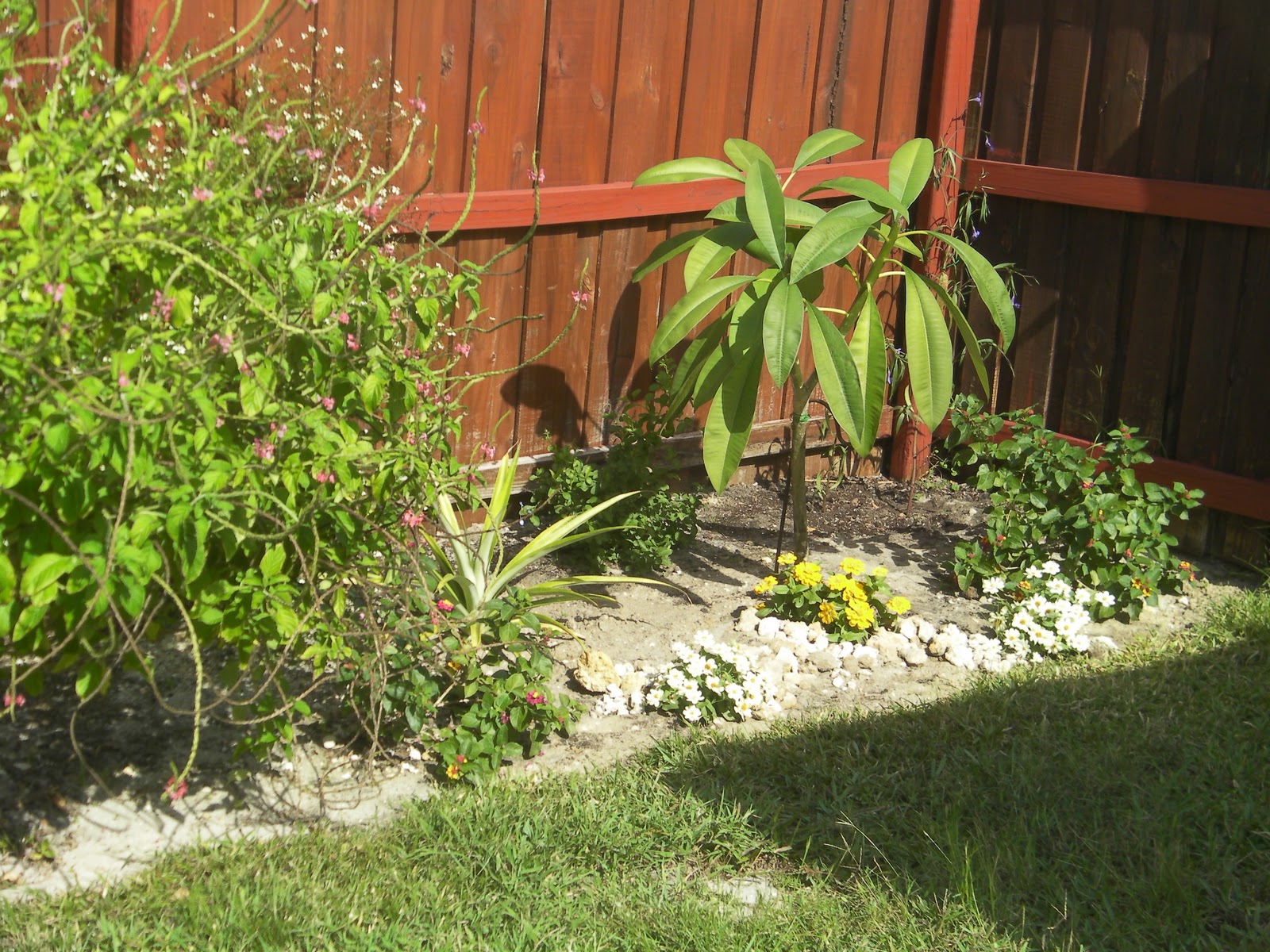
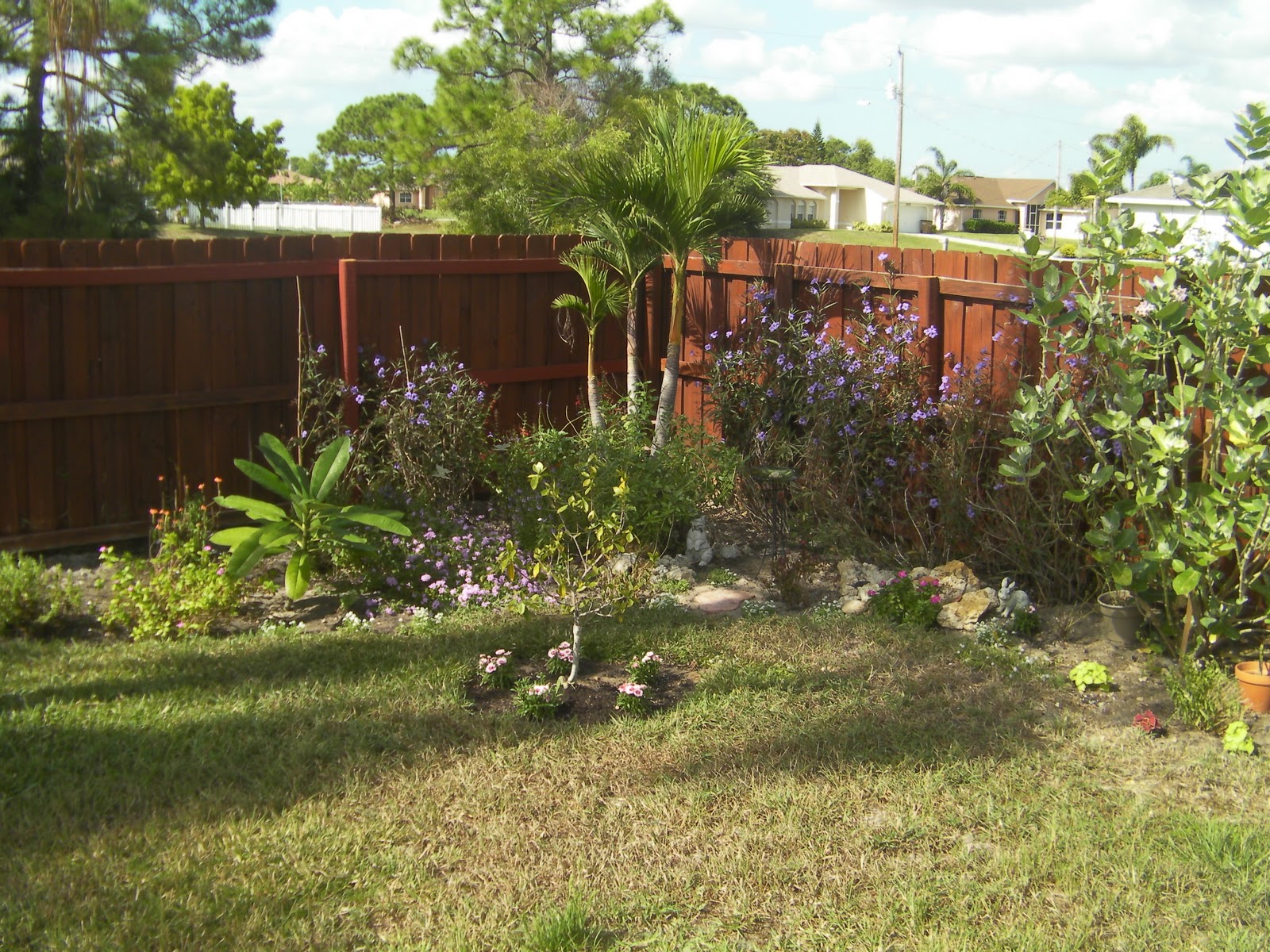
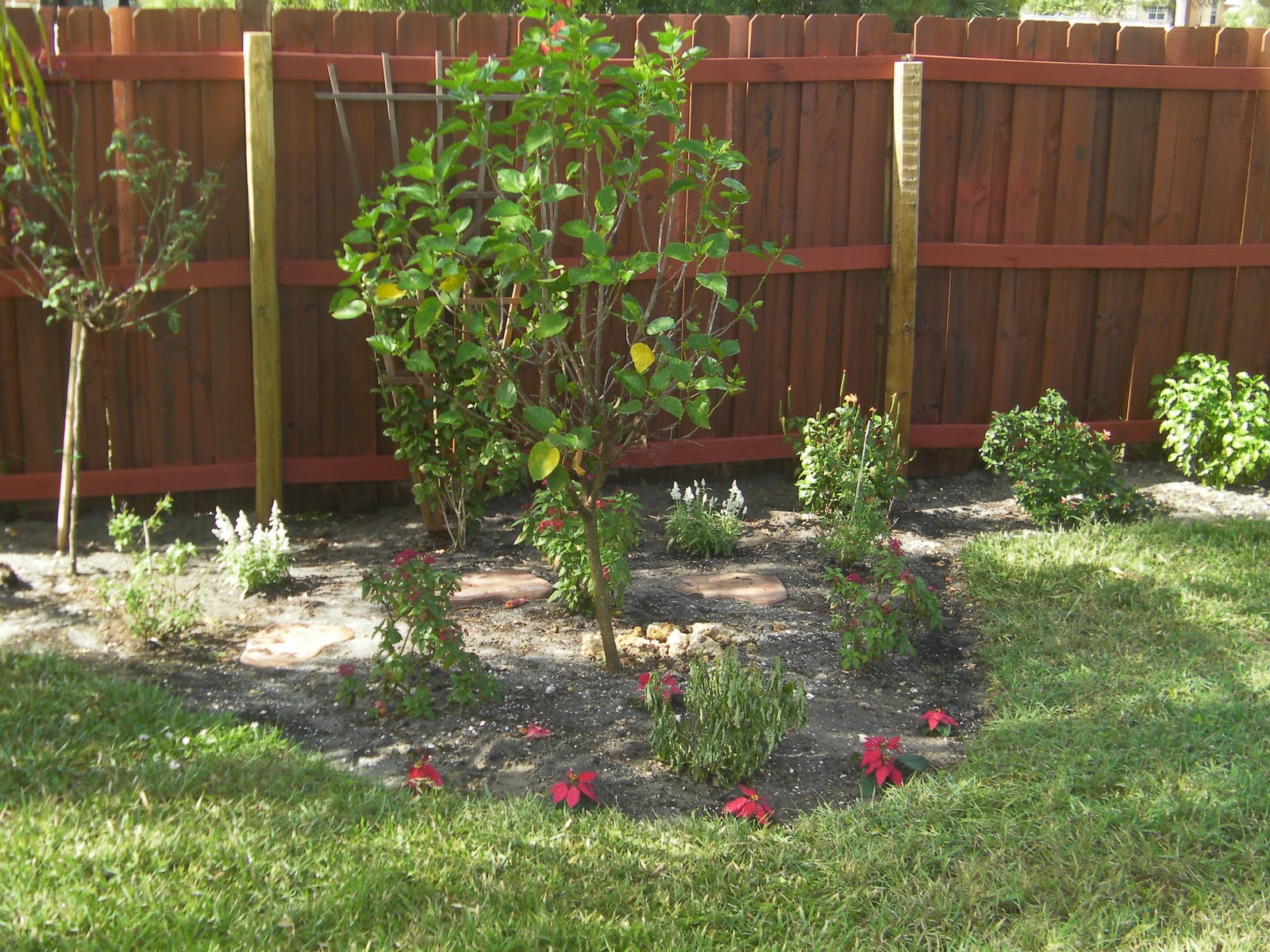
The beginnings of my garden lay in a butterfly seminar I attended, at which I bought rather a lot of plants that were meant to feed and attract the winged creatures. I had an entire, almost empty backyard at my disposal, with only a lawn, a fence and a few palm trees to work with. As if it weren’t bad enough that I live in hot and humid Florida, I also live on a Cape with sandy soil, coral rock and more roots than you can shake a stick at. What these are the roots to, I’ve still to discover. So the first thing I had to do was rent a sod cutter and begin fashioning beds. This done, I had to dig, which returns us to the rocks and roots. If it were just a matter of digging a hole in soil, the job would be a breeze. But, it’s a case of digging a bit and then tackling the roots you’ve uncovered. You must either cut through them or attempt to pull them out of the ground. These are not just any roots – they’re downright primordial and I’m convinced that there’s some poor person in China, sitting in their provincial garden in amazement as they watch their trees being inexplicably pulled backwards into the ground as I yank on the roots in my garden at the opposite Pole.

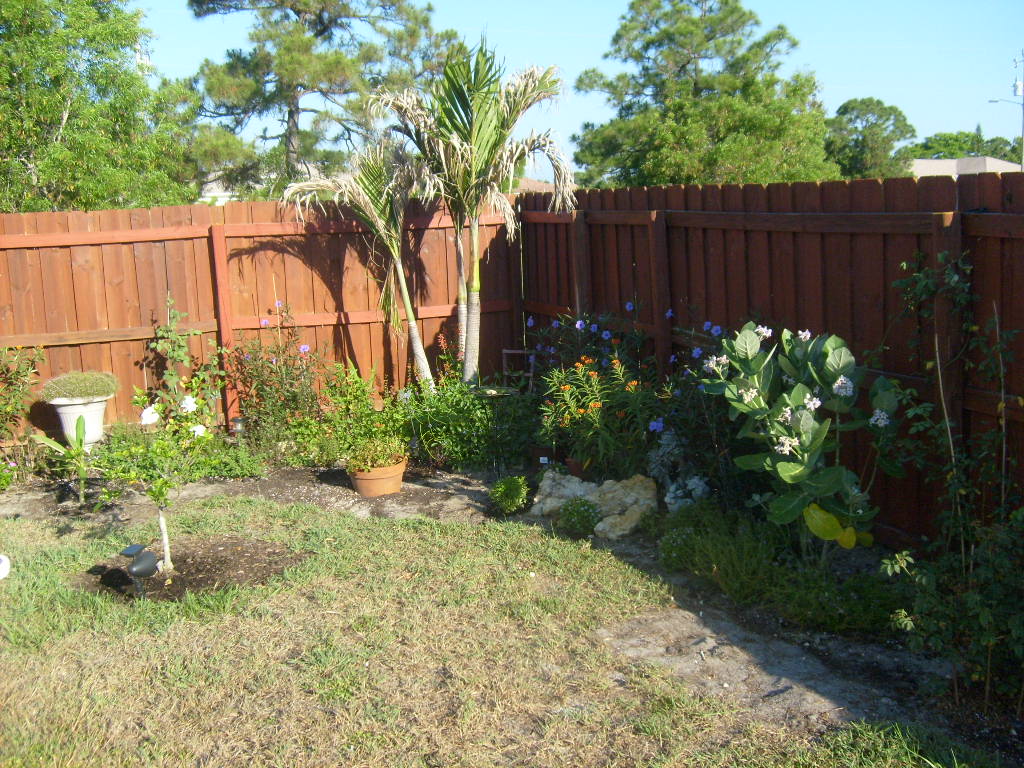
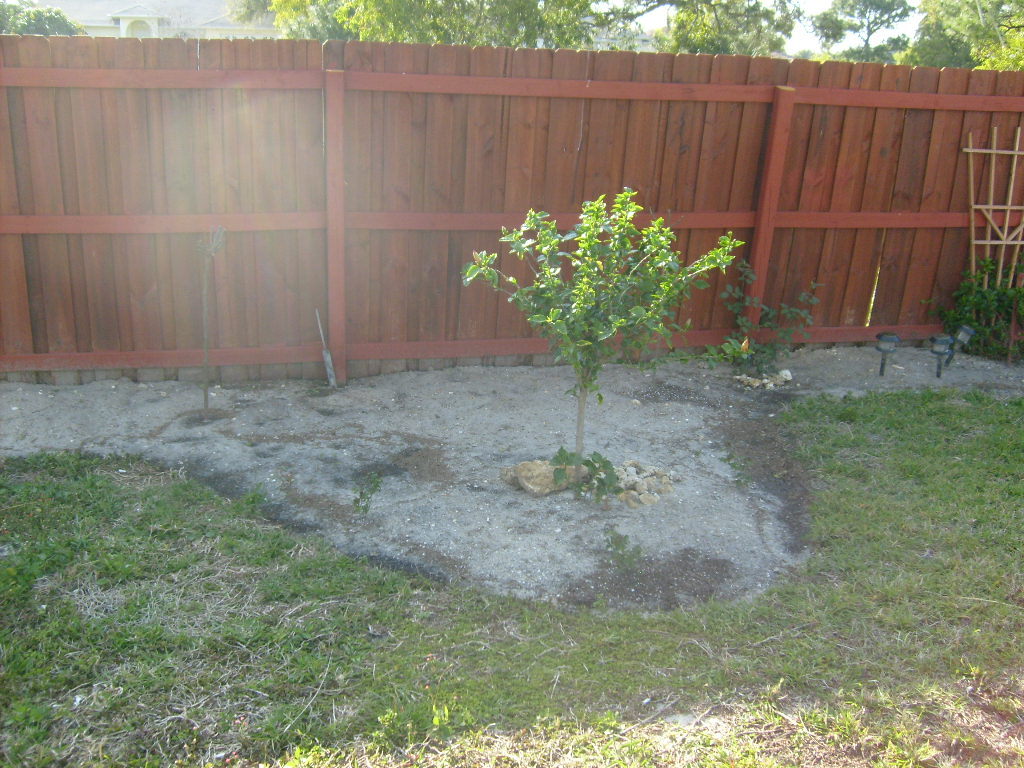
However, I’ve finally gotten everything planted (pant, pant, pant) and the beds are beginning to fill out. Here are some “before and after” photos:

And now . . . .

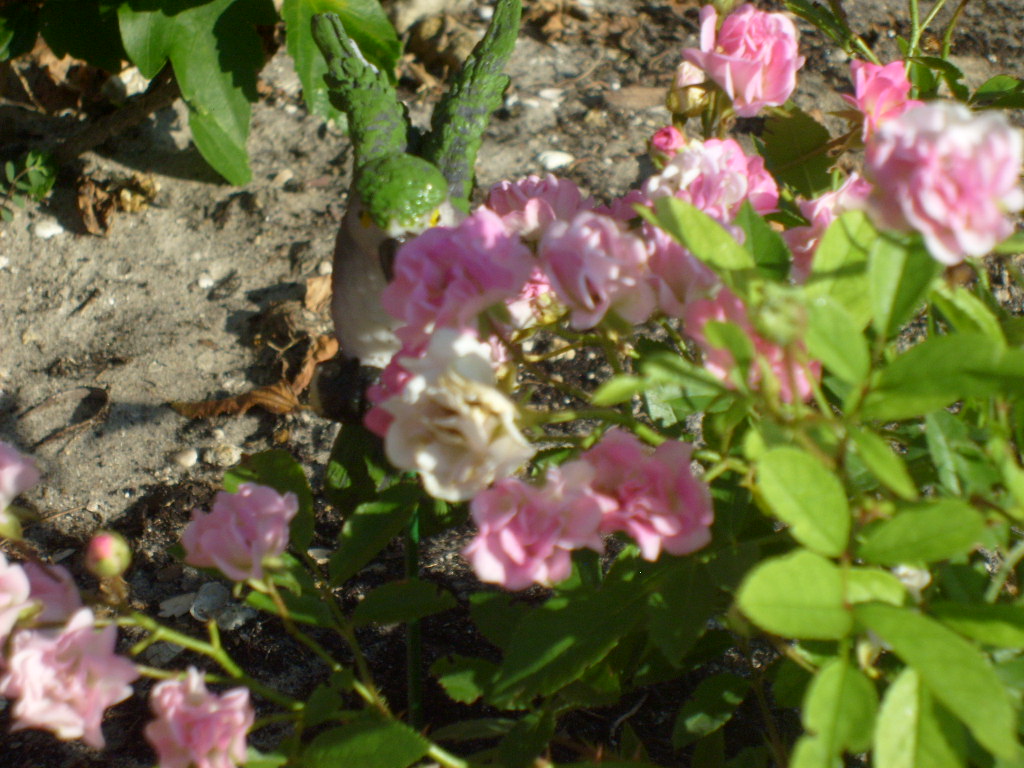
Now that I’ve filled everything in, it’s time to mulch. But things are coming along nicely, if I do say so myself, and are actually starting to flower.
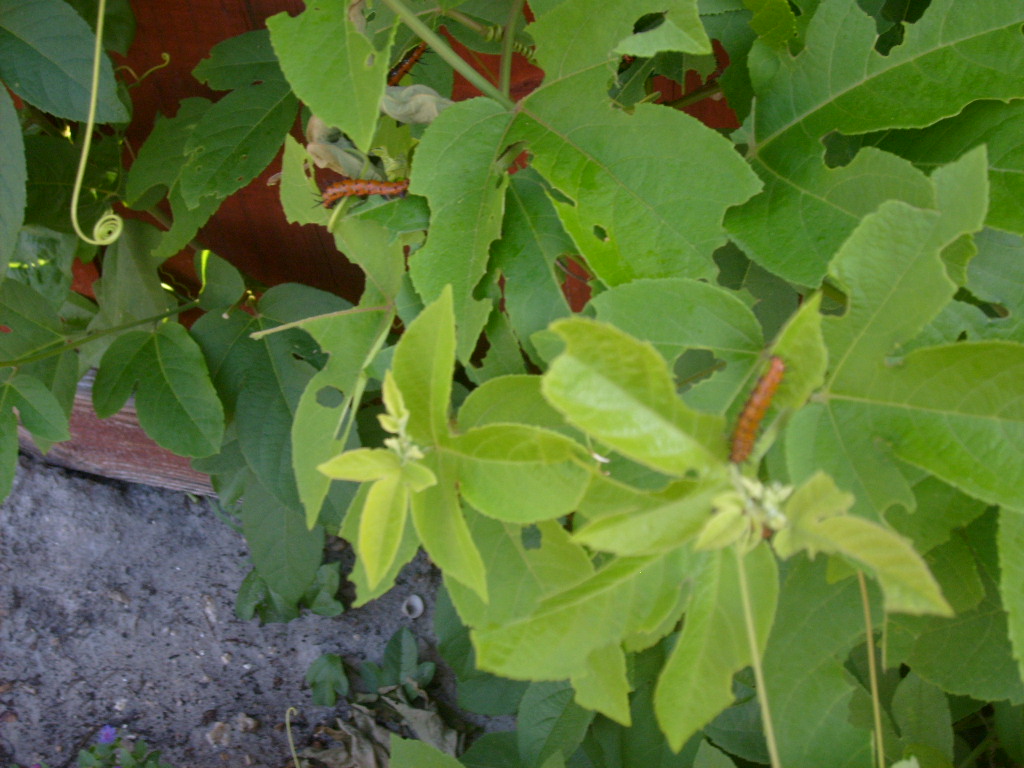
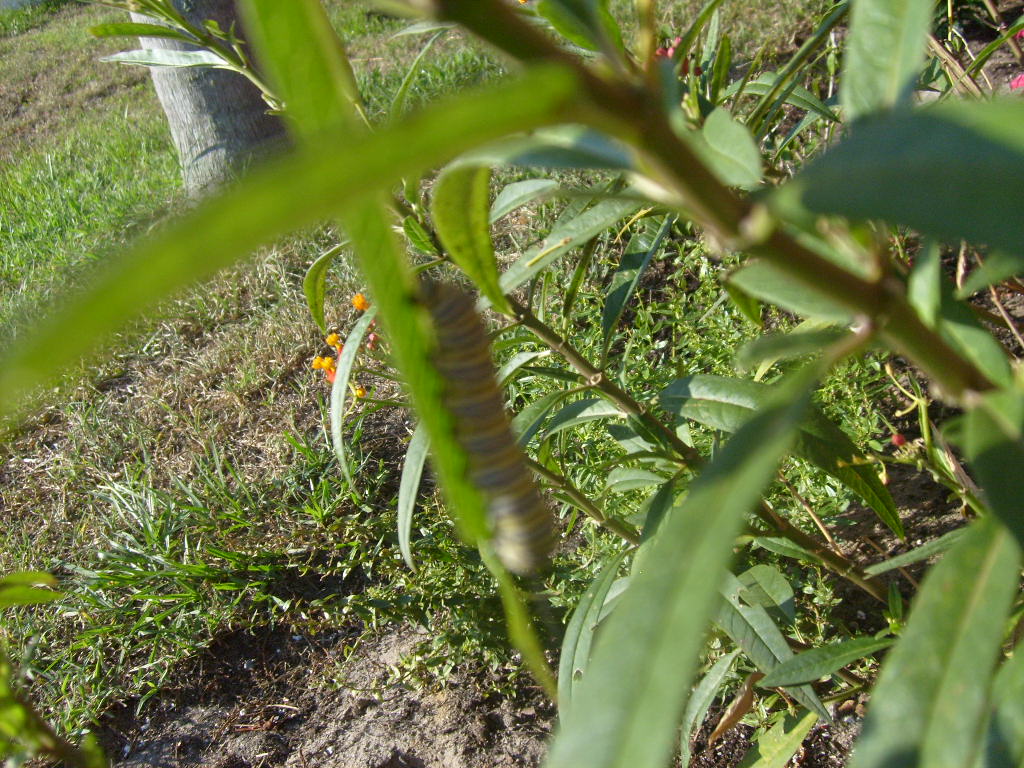
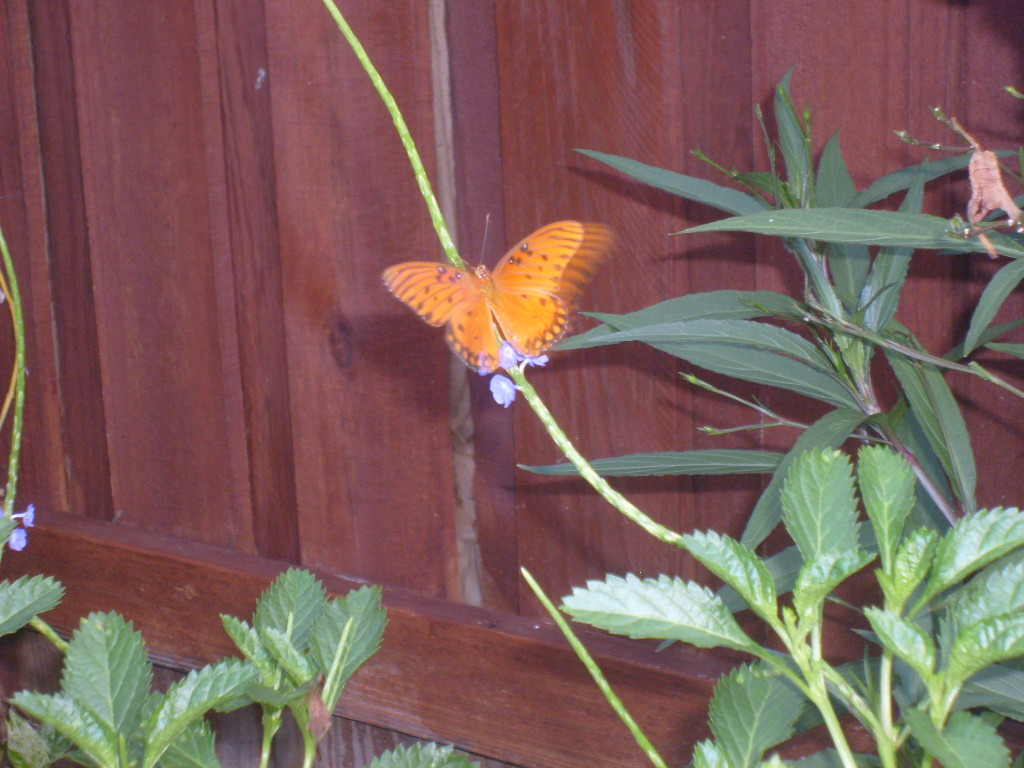
I’ve had the gardenia, above, for two years in a pot and it’s never bloomed, so you can imagine my joy when it finally flowered this year. So, you ask – and well you might – what about the butterflies? I’m happy to say that I’ve got caterpillars of all kinds –
The caterpillars completely decimate the leaves on the milkweed, stripping it bare, and then attach themselves to the fence and create cocoons

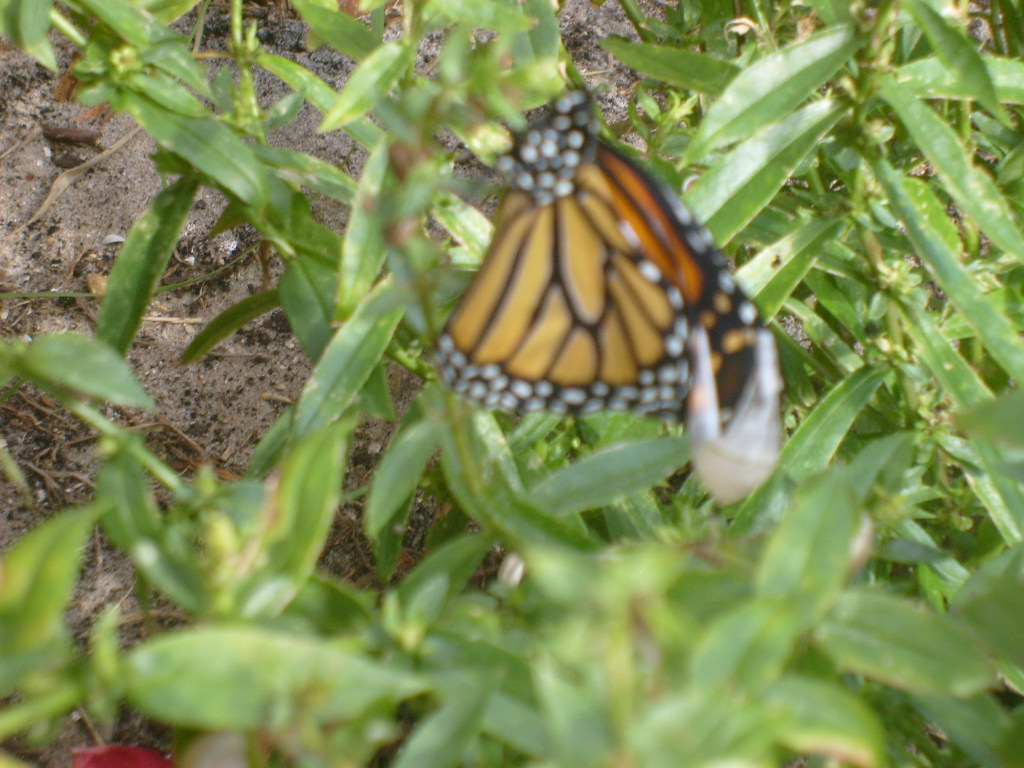
A few days later, they emerge as beautiful Monarch butterflies. Here is one newly born with the remnants of his cocoon still attached to his wing.
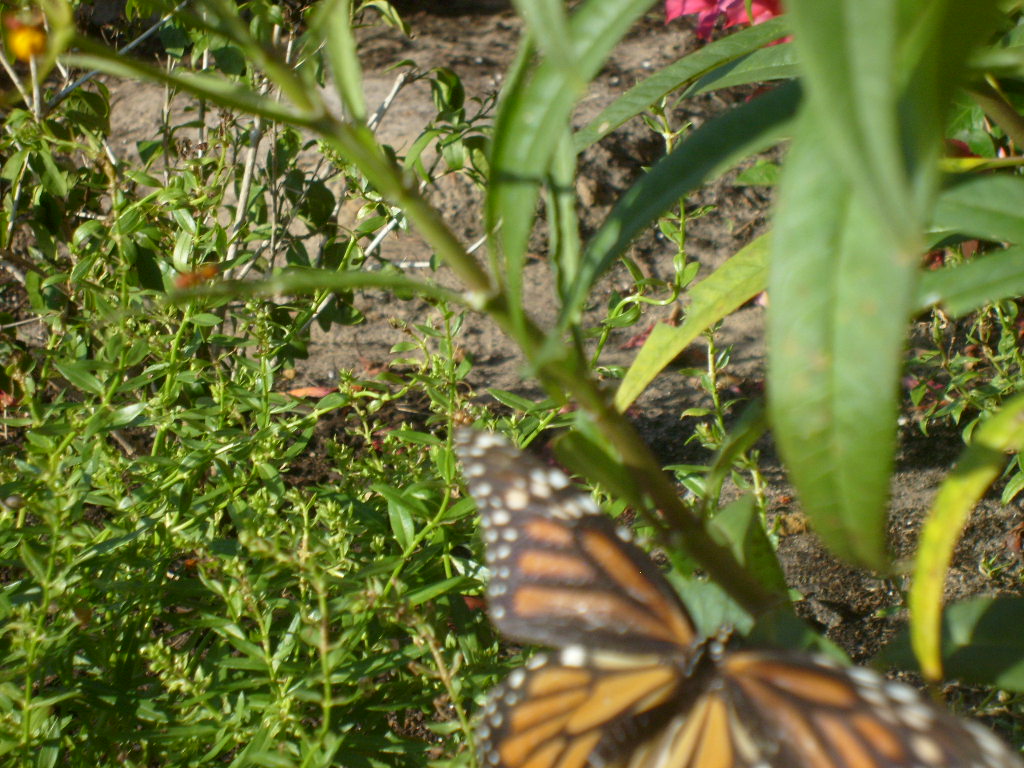
I now have Monarch, and other, butterflies galore! They flit about the garden, and my person, all day long. You should know that I didn’t set out to take the butterfly photos below – they simply got in my way as I was taking the flower photos – success!

Those in colder climates, who are already feeling winter’s weather, might be thinking that it’s a bit odd for me to be blogging about a summer garden in December. You should know that I finished this post by adding the latest photos on November 22 – it was still in the 80’s.

Favorite UK Christmas Movies

As far as we’re concerned, any time is a good time to steep oneself in all things British, but Christmas is a particularly grand time to do so. While the US has produced many more, and more recent, Christmas movies, we thought we’d share some of our favorites from across the pond with you.

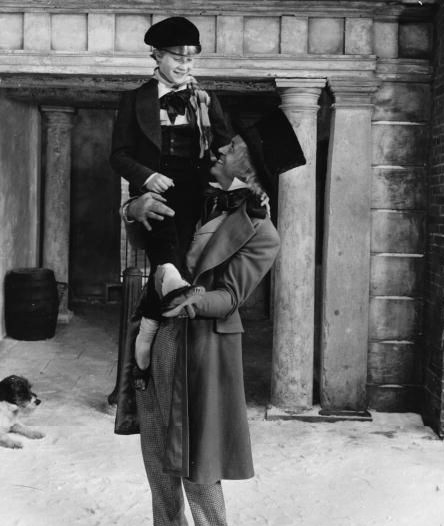
Scrooge (UK) or A Christmas Carol (US) – The 1951 Alastair Sim version remains the best version of Charles Dickens’s yuletide tale. The film also features Kathleen Harrison as Mrs. Dilber, Scrooge’s charwoman, and George Cole as a young Scrooge. Hermoine Baddeley plays Mrs. Cratchit. Now a Christmas staple, it was slated to premiere stateside at New York City’s Radio City Music Hall, but theatre management thought the film was too grim and somber and did not possess enough family entertainment value to warrant an engagement at the Music Hall. The fact that it was filmed in black and white gives a period feel. The film stands out because of its perfect balance of dark and light, which is what Dickens intended in his ghost story of misery, terror, loneliness and redemption, all serving to draw the viewer into the authentically bleak world of London during the early Industrial Revolution. You can buy it here.

Of course, one feels honour bound to now mention Blackadder’s Christmas Carol.

Leave it to the Blackadder crew to put their own spin on the Christmas classic. In this version, Scrooge is the nicest and most generous man going. Until the spirit of Christmas shows him the future and shows Scrooge that his goodness will play havoc upon his descendents, who will wind up as slaves. Scrooge turns mean and soon manages to offend everyone, including Queen Victoria and Prince Albert. A website called
Black Adder Hall sums up the episode thusly: “Dickens’ classic tale of kindness, truth and virtue is completely mucked up and ruined by having a member of the Blackadder family involved. Stuffed with deeply horrid people (many of whom are gigantically fat) and groaning with cartloads of seasonal bottom jokes, it manages to squeeze in not only a Victorian Black Adder but also his famous Elizabethan, Regency and Space Age relatives into a huge pie of entertainment that will satisfy all but the most discriminating viewers.”

Love Actually – This feel-good movie follows the lives of eight couples in London during a frantic month before Christmas. Though vastly different, their stories are interwoven in love, lust, and luck. Everywhere you look, love is causing chaos. From the new bachelor Prime Minister who falls in love 30 seconds after entering Downing Street, to a loser sandwich delivery guy who doesn‘t have a hope with the girls in the UK, so heads for Wisconsin; from a jilted writer who escapes to the south of France to nurse his broken heart to an aging rock star trying to make a comeback at any price; from a bride having problems with her husband‘s best man to a married woman having trouble with her husband; from a schoolboy with a crush on the prettiest girl in the school to his architect step–father with a crush on Claudia Schiffer. These London lives and loves collide, mingle and finally climax on Christmas Eve with romantic, poignant and funny consequences for all. That’s really all the plot line you need since the film stars Alan Rickman, Rowan Atkinson, Hugh Grant and Colin Firth and Emma Thompson. Ho, ho, ho.

Hope and Glory – The following well written synopsis is from a website called Rotten Tomatoes – “John Boorman’s 1987 epic written and directed by John Boorman (Deliverance, The General) serves as a picaresque and semi-autobiographical remembrance of a boy’s coming of age during the Second World War. Exhibiting a defiant and humorous take on life during the London blitz, the family of the young boy at the center of the story (Sebastian Rice-Edwards) is a close-knit and resilient bunch, undeterred in the face of the war and reveling in each other even as they hide from the incessant bombing. To be sure, there are some poignant moments in this childhood reminiscence. The boy’s mother (Sarah Miles) serves as a strong influence in the boy’s life as she leads her family through this tumultuous time. The majestic sweep of the film is contrasted with so many comic moments as the people in town go about the mundane details of their daily lives yet also engage in the most absurd rituals in dealing with the onslaught of German artillery, from taking the air raids for granted to wearing gas masks at school. Boorman doesn’t dwell on the horrors of war; instead he celebrates the richness and resilience of the people he remembers so fondly. An adventurous and nostalgic slice of life, Hope and Glory is a superb and memorable film.” Hope and Glory is worth watching for sheer atmosphere and period detail alone. The scene where the family and their guests are gathered around the wireless in order to hear the King’s Christmas speech and are urging the monarch past each stammer is priceless.  

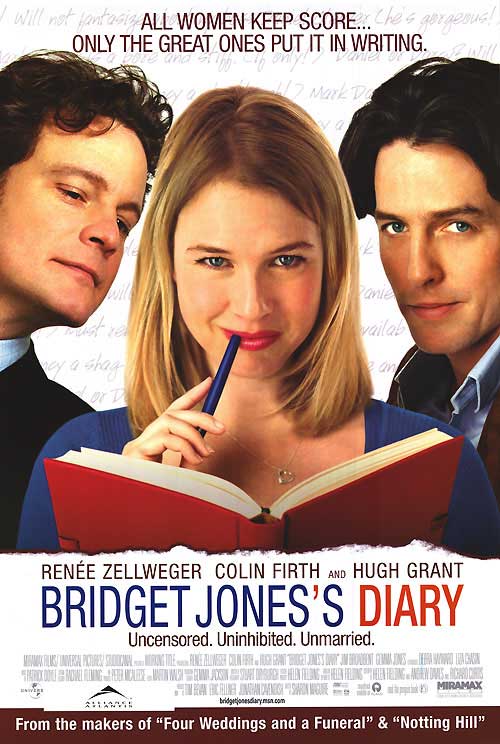
Bridget Jones’s Diary –  Yes, I know we watch this one all year round, but at Christmas we’ll pay extra attention to Colin Firth’s sweaters. Go on . . . put on your comfy pj’s and I’ll make the cocoa . . . . right then, pop in the disk . . . . Jeez, I can’t wait till the fight scene – “Shall I bring my dueling pistol or sword?” too funny!  . . . Ready? It all began on New Years day, in my 32nd year of being single. Once again I found myself on my own and going t
o my mother’s annual turkey curry buffet. Every year she tries to fix me up with some bushy-haired, middle-aged bore and I feared this year would be no exception
. . . . .

Merry Christmas Mr. Bean – O . . M . . . G . . . have you ever seen anything as funny as Mr. Bean’s turkey!? Okay, we’re cheating by including these as they aren’t full length movies, they’re episodes, but they’re hysterical. You can watch the bit with the turkey here and a bit where Mr. Bean goes Christmas shopping here. Keep an eye out for Teddy!

Have we missed any of your favourite Yuletide flicks? Suggestions? Let us know.