Sherlock Holmes Returns – Thrice

(1) Robert Downey Jr. will once again play the British detective in Sherlock Holmes 2, (2) a new, authorized Sherlock Holmes mystery novel will hit the stands in September of this year (3) Benedict Cumberbatch returns as Masterpiece Mystery’s 21st century incarnation of the detective. 
Sherlock Holmes II (the film) is set in the year 1891, a year after the events in the first film, and will have Holmes chasing Moriarity and Dr. Watson pursuing his love life whilst assisting the detective. Downey says: “Unlike last time, where Holmes kept getting Watson into trouble, this time Watson is getting Holmes out of trouble, and they’re both in deeper trouble than I think the audience could have imagined we could go…. All manner of nastiness has just occurred.”

This time out, the duo are joined by the feisty Sim, played by actress Noomi Rapace. Also making an appearance is Sherlock’s brother Mycroft Holmes, played by actor Stephen Fry, a character who producer Susan Downey (Robert’s wife) describes as “stranger and perhaps even more brilliant” than the English detective. Fry recently said, “I play Mycroft, Sherlock Holmes’ brother – the smarter brother, I hasten to add. He’s so lazy that he never gets the reputation that Sherlock does. Historically it’s a very interesting character, and as a lover of Sherlock Holmes since I was a boy I’ve always enjoyed that character myself. I hope that people enjoy it. It’s certainly been fun making the picture.” And how does Fry feel about a Yank playing the iconically British Holmes? “To some extent, but he’s such a charismatic and likeable screen presence, Robert, that you very soon forget it. More than most, he owns every second of screen time. He’s just wonderfully likeable. He’s the real thing.”
The film opens in October in the UK and in December in the US.
Meanwhile, author and screenwriter Anthony Horowitz has been tapped by the Arthur Conan Doyle Estate to write a brand new Sherlock Holmes mystery novel. Horowitz said he’s writing “a first-rate mystery for a modern audience while remaining absolutely true to the spirit of the original.” Orion publisher Jon Wood promised the author’s “passion for Holmes and his consummate narrative trickery will ensure that this new story will not only blow away Conan Doyle aficionados but also bring the sleuth to a whole new audience.”
This is the first time that the Estate has tapped anyone to continue the Holmes tradition and it’s no wonder they chose Horowitz, who has proven his story telling abilities by creating Foyle’s War and contributing to several other crime drama series, including Midsomer Murders and adaptations of Agatha Christie’s Poirot novels.

And finally, we can all look forward to Benedict Cumberbatch’s return as Holmes in three new Masterpiece Mystery episodes this Autumn. The game is certainly afoot.

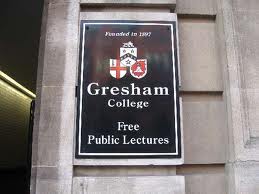
Do You Know About Gresham College?

Gresham College has no students and does not teach courses, rather it is an educational institution of higher learning that exists to provide free public lectures, which have now been running for over 400 years. Gresham College was founded by Sir Thomas Gresham in 1597, son of Sir Richard Gresham who was Lord Mayor in 1537/38. Gresham College started long before there was a University of London.

Sir Thomas Gresham (1519-1579) stated in his will that Gresham College was to provide free public lectures in Divinity, Astronomy, Music, Geometry, Law, Physic and Rhetoric, endowed by revenue from the Royal Exchange, which he founded in 1570.

The Royal Society can trace its roots back to Gresham College and to 28 November 1660, when 12 of the members met at Gresham College after a lecture by Christopher Wren, the Gresham Professor of Astronomy, and decided to found ‘a Colledge for the Promoting of Physico-Mathematicall Experimentall Learning’. This group included Wren himself, Robert Boyle, John Wilkins, Sir Robert Moray and William, Viscount Brouncker.

The first college location was Gresham’s mansion in Bishopsgate where Tower 42 is now built. It stayed there until 1768, and next settled in 1842 in Gresham Street EC2. Gresham College did not become part of the University of London on the founding of the University in the 19th century, although a close association between the College and the University persisted for many years. Since 1991, the College has operated at Barnard’s Inn Hall, Holborn EC1.

A look at recenlty past and upcoming lectures will show how varied the programs are:

Fakes, Completions and the Art of Borrowing – Professor Christopher Hogwood CBE – Date/Time: 25/01/2011, 1pm Venue: Museum of London

Although Mozart’s unfinished Requiem is the most publicised composition requiring a helping-hand, there are many similar incomplete may-be masterpieces which have been assisted in some way, plus a number of well-loved classics which have very little connection with their supposed author (‘Albinoni’s Adagio’ heads such a list). In addition composers of all periods have been open to the ‘art of borrowing’ – Handel was particularly active in this area and the reasons and results of his ‘borrowings’ shed a new light on some very familiar compositions.

The Victorians: Gender and Sexuality – Professor Richard J Evans – Date/Time: 14/02/2011, 6pm
Venue: Museum of London 

‘Victorian’ came in the twentieth century to stand for sexual repression and social convention. Personal life was governed by complex and rigid rules of behaviour. Like other aspects of Victorian culture this began to break down in the fin-de-siécle. Yet recent research, discussed in this lecture, has undermined this rather simplistic picture and begun to explore some of the contradictions and complexities of Victorian attitudes to marriage and sexuality. The place of women in Victorian culture was by no means as passive or subordinate as conventional images of the era suggest.

The Gresham Astronomy Weekend – Professor Ian Morison – Date/Time: 18/03/2011 Venue: Farncombe Estate, The Cotswolds

The primary aim is to encourage newcomers to take up observational astronomy. There will be demonstrations of telescopes, planispheres and star charts, plus workshops and practical sessions for beginners, but more advanced amateurs are also welcome. There will be advice on astro-imaging using web-cams, digital cameras and dedicated CCD imagers. A set of annotated star charts will be provided. There is a charge for this event.


Engraving by George Vertue of Gresham College, looking east, showing the entrance in Old Broad Street, from John Ward’s Lives of the Professors of Gresham College (1740).


Royal Wedding Weekend Getaway Plans

Not content to settle for an extra Bank Holiday and late openings for pubs on the Royal Wedding Day (RWD), airlines and hoteliers are offering extended getaway specials themed around the Big Day.  British Airways is offering Royal Wedding weekend packages and London hotels have been raising their room rates over the weekend accordingly, but really, anyone can book a BA flight or a room at the Savoy, no matter how inflated the cost. So, we’ve rounded up some unique options for the big RWD, each with its own twist on the festivities and all far away from the madding RWD crowds. Book early!
Why not book yourself into the Celtic Manor Resort, where they’ll be throwing a RWD Street party? Their website invites us to “join (them) to celebrate the Royal Wedding in the most traditional British way, with a spectacular outdoor ‘street party’ with live entertainment and big screens to watch the wedding celebrations, in the glorious surroundings of the Rooftop Garden. Immerse yourself in nostalgia with Union Jack bunting and trestle tables laden with tasty treats including jam sandwiches, homemade pork pies, Scotch eggs and sausage rolls, along with favourites such as Victoria sponge, fondant fancies, trifle and of course, traditional wedding cake.” This Five Star Welsh resort features award winning dining, the Forum Spa and was home to the 2010 Ryder Cup.

Forget the RWD, The Castle Hotel in Taunton, Somerset, is offering a Royal Honeymoon package to die for – it includes penthouse accommodation, a private butler, massage, flowers, wine and . . . a throne. I’ve stayed here and it’s just lovely. Of course, I didn’t have a butler. Or a massage. But it was still lovely.


Personally, the offer from the Ambassador Bed and Breakfast in Brighton sounds like a hoot – book into the gay friendly hotel for a minimum of 3 nights over the Royal Wedding weekend and you’ll be invited – at no extra cost – to join  them at a garden party where you’ll watch the wedding and be treated to a free buffet lunch, afternoon tea and wedding cake.

Even Grand Rapids, Michigan is getting in on the weekend wedding getaway deals, which isn’t as far fetched as it seems once you realize that the exhibit, “Diana – A Celebration” will be in town over that weekend, with items on loan from the Spencer family.

And lastly, if you want to do the Royal Wedding in royal style stateside, The Trump International Hotel and Tower in Chicago has announced the “Trump Royal Wedding Experience” where guests will watch the televised version of the Royal Wedding during an exclusive breakfast at the Michelin three-star restaurant Here’s the description from the official press release: “After a night of ultimate comfort in a newly renovated guest room designed by Ivanka Trump, guests will descend to Jean Georges for an exclusive breakfast in the restaurant’s main dining room starting at 5 a.m. A special tasting menu fit for a prince or princess will include selections like scrambled eggs with caviar, mini-French toast, and pains au chocolat. Guests will toast the royal couple with sparkling mimosas as they watch the Royal Wedding on monitors strategically placed around the dining room. The breakfast event will conclude by 9 a.m., at which time guests may choose to hit the town or return to their rooms for a nap. A 4 p.m. late checkout is guaranteed. As a memento of the occasion, each guest will receive a piece of official Royal Wedding china commissioned by The Royal Collection.”  What, no massage?

Valentines Day 1829

Bell’s World of Fashion
A MONTHLY MAGAZINE DEDICATED EXPRESSLY TO HIGH LIFE, FASHIONABLES, AND FASHIONS, POLITE LITERATURE, FINE ARTS, THE OPERA, THEATRES, No. 56.
LONDON, FEBRUARY 1, 1829.

Good morrow to my Valentine,” sings the poor Ophelia. “Good morrow! ’tis St. Valentine’s day, all in the morning betime, and I a maid at your window to be your Valentine!

Rude as these lines may be, they are sacred for they are Shakspeare’s, one of the wild and beautiful snatches of song, which are drawn from the heart of the love torn, riven-hearted maid of Denmark! It, moreover, celebrates a custom in the olden time, of looking for a Valentine through your bed-room window, which has partially descended to us, by the first person we see, of the opposite sex, on this festive morning, being Our Valentine.

Our fair readers will perhaps be gratified with a few reminiscences of the practices in former periods, on this
day, from which originated our Valentines. It was the practice in ancient Rome, during a great part of the month of February, to celebrate the Lupercalia, which were feasts in honour of the deities Pan and Juno. On this occasion, among a variety of other festive ceremonies, the names of all the young females were put into a box, from which they were drawn by the men, as chance directed. The pastors of the early Christian church, who by every possible means endeavoured to eradicate the vestiges of pagan superstitions, substituted the names of saints for those of women; and, as the feast of the Lupercalia had commenced about the middle
of February, they chose a saint’s day for the purpose of celebrating it. As it was, however, impossible to extirpate altogether any ceremony to which the people had been so long accustomed, especially one which was so consonant to their feelings, as the original Lupercalia, the practice of choosing partners or sweethearts, was kept up, and, from the day upon which it was celebrated, all persons so chosen
were called Valentines.
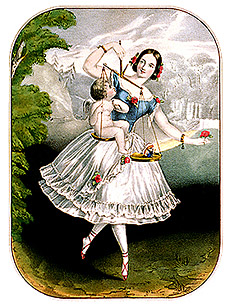
And now we will record some of our own customs peculiar to Saint Valentine. In many parts of England and
Scotland, an equal number of maidens and bachelors assemble together, and each write their name upon separate scraps of paper, which are all rolled up and put into bags; the papers are then drawn, and each young man lights upon a female who is to be his Valentine. The company being thus divided into so many happy, laughing couples, the gentlemen give balls and other amusements to their mistresses, and wear the paper with the lady’s name subscribed on it, upon their bosom or sleeve. The festival is kept up several days, and we need scarcely add that this little amusement generally ends in love!

In some parts of Kent they have a curious kind of sport on Valentine’s Day. The young girls of the diiferent villages construct a figure, which they call an ivy girl, while the young men make up another figure, which is denominated a holly boy, and after amusing themselves therewith, the girls steal the holly boy and burn him, and the men run away with the ivy girl, and serve her in a similar manner. The origin, or the meaning of this amusement, we confess ourselves at a loss to guess.

Who would not wish to receive a Valentine? Who is there so dead to all the fascinations of beauty, all the
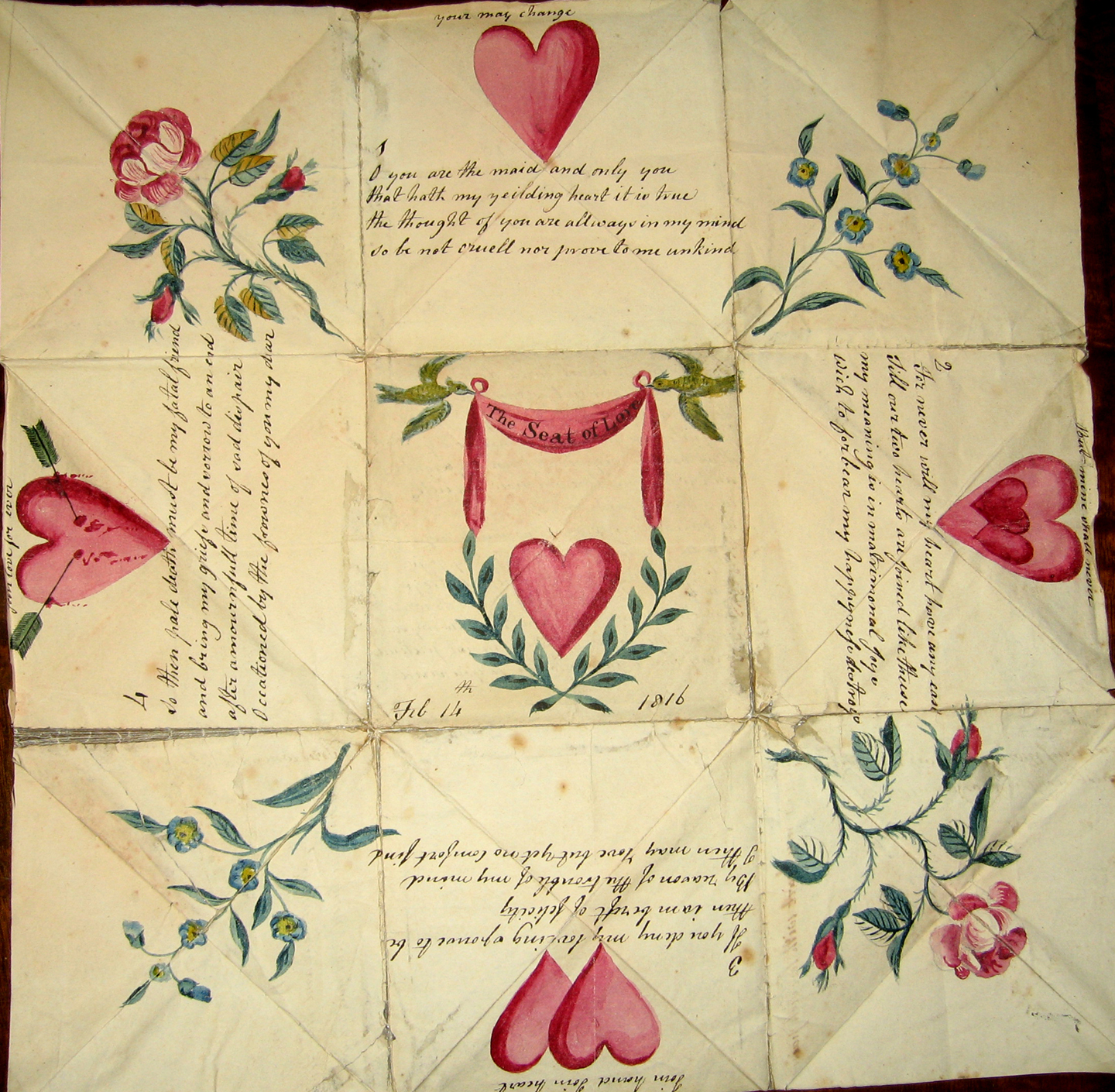
endearments and allurements of life, as to refuse paying two-pence or three-pence, or whatever it may be, for one of those neat folded, tale telling, blissful billets, even though it should contain nothing more than two hearts transfixed with a dart, or a true lover’s knot, and a poesy from the song, ” If you loves I as I loves you,
no knife shall cut our love in two.”

Who, I enquire, is there that would not feel delighted by any of these tender morceaux? Does it not plainly evidence that there are persons who feel a warm and ardent interest in your welfare, and, humble as the scrap may be, is it not a Valentine? and ought you not to be thankful?
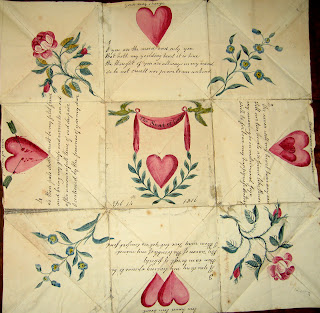
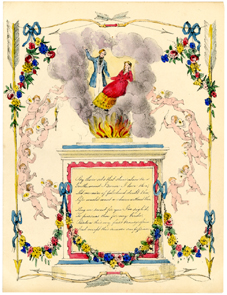
If such simple prettynesses then are to be esteemed, what are we to say of the bright and gorgeous emanations of the artist’s pencil, the glittering and highly wrought bijouterie which adorn the windows of our fancy stationers, and are more splendid than the beautiful annual pocket-books which we should never touch but with new gloves on our hands, for fear of sullying their brilliancy. Roses, which unfolding, discover gorgeous temples, sparkling in gold and glitter, surmounted with bands of little cherubs that seem starting into life, and quaint devices, which speak more forcibly to the heart than the finest poetry of Byron or of Moore. Wreaths and bouquets of flowers, with Cupids springing from the leaves, painted in the finest style of art,
the symbolical flowers arranged in an expressive manner; honeysuckle and jasmine twining fondly round the lilies, roses, and other beauty blossoms, with the little meek and blue-eyed ” Forget Me Not,” peering from between its more splendid compeers, but rivalling all in beautiful allusion. What a present for a lover ! how dearly does his lady esteem it! how fondly does she press the bright gem to her heart, and willingly believe its silent eloquence, the tender avowal of this pledge of love!

The practice of sending Valentines is not confined to one class or body of persons, for the same disposition is found in every rank of life; and every juvenile, as soon as he is old enough to fancy himself in love, thinks it very necessary to write Valentines. Nay, every village clodhopper must also have one for his charming Moggy Dumpling, or Betsy Blossom, and “comes up to town ‘ith’ waggon,” on purpose to buy the prettiest, and have a “real Lonnon one.” With what a happy face he enters the stationer’s shop, and enquires for a “nice looking Woluntine,” and after he has turned over some score or two of cupids, and hearts, and churches, and lovers knots, at length pounces upon one which tickles his
fancy, and chuckling to himself, with what a triumphant air he ulls out his leather pouch, and throws down the demanded sixpence; then borrowing a
pen and ink, he scribbles under the gaudy-coloured picture,

” I’ll be your’n if you’ll be mine,
So be my charming Woluntine.”

Afterwards, begging the shopkeeper to fold it up nicely for him, he sallies out of the shop with as much pride and consequence as if he had been made high constable of his parish . . . .

* Two hundred thousand letters, above and beyond the usual daily average, annually pass through the two-penny post-office in London alone, on St. Valentine’s day. What a tiribe of lovers!

Please Help to Save the Cleveland Street Workhouse

There’s a petition over at the London Historians’ Blog, which can also be found in our right sidebar under “Amusing Blogs.” They are feverishly trying to save the Cleveland Street Workhouse, which is thought to be Dickens’ inspiration for the workhouse in Oliver Twist, from demolition. Please take a moment to log onto their site and sign this document in the hopes of saving an important part of London’s disappearing history. Thank you!