The Darker Side of London History – Captain Coram and the Foundling Hospital


copyright The Foundling Museum

Recently, Janet Mullany at Risky Regencies did a post on websites of interest, one of them being a link to the Threads of Feeling online exhibition mounted by the Foundling Museum in London, which allows you to view fabrics that illustrate the moment of parting as mothers left their babies at the original Foundling Hospital, which continues today as the children’s charity Coram.
From the Museum’s website – “In the cases of more than 4,000 babies left between 1741 and 1760, a small object or token, usually a piece of fabric, was kept as an identifying record. The fabric was either provided by the mother or cut from the child’s clothing by the hospital’s nurses. Attached to registration forms and bound up into ledgers, these pieces of fabric form the largest collection of everyday textiles surviving in Britain from the 18th Century.
“John Styles Research Professor in History at the University of Hertfordshire received funding from the Arts and Humanities Research Council to curate the exhibition. John comments: “The process of giving over a baby to the hospital was anonymous. It was a form of adoption, whereby the hospital became the infant’s parent and its previous identity was effaced. The mother’s name was not recorded, but many left personal notes or letters exhorting the hospital to care for their child. Occasionally children were reclaimed. The pieces of fabric in the ledgers were kept, with the expectation that they could be used to identify the child if it was returned to its mother.
The textiles are both beautiful and poignant, embedded in a rich social history. Each swatch reflects the life of a single infant child. But the textiles also tell us about the clothes their mothers wore, because baby clothes were usually made up from worn-out adult clothing. The fabrics reveal how working women struggled to be fashionable in the 18th Century.”


Captain Thomas Coram painted by William Hogarth 1740

The Foundling Hospital in London began as the mission of retired sea captain Thomas Coram, who was appalled at the number of abandoned babies in the City. It took Captain Coram 17 years to raise the necessary money to build The Foundling Hospital as “an hospital for exposed and deserted children” to which destitute mothers brought their babies. AThe artist William Hogarth joined the cause and attracted benefactors by hanging many of his valuable paintings in the building and thereby founding the first London Art Gallery; and Handel gave fundraising concerts in the Hospital Chapel, which included a special Foundling Anthem and the music of Messiah. Coram’s efforts were finally recognized by King George II who, in 1739, gave Coram a Royal Charter to create the Foundling Hospital.
No man could have undertaken a cause with a greater need, nor with such good intentions. Unfortunately, the sheer numbers of abandoned and unwanted children led to pitfalls the kind hearted Coram could not have forseen.
From Memoranda; or, Chronicles of the Foundling Hospital by John Brownlow (1847)
“When a Foundling Hospital was established in Paris, in the year 1640, its objects were limited to the children found exposed in that city, and its suburbs; and it was understood by those who furthered a similar design in this country, that its operation would, in the same manner, be confined to London and its environs. But benefits so tempting being irresistable to persons in country towns, they were determined to share with the good people of London, a privilege which they considered common to all. “There is set up in our Corporation ” (writes a correspondent from a town three hundred miles distant, in one of the chronicles of the day), ” a new and uncommon trade, namely, the conveying children to the Foundling Hospital. The person employed in this trade is a woman of notoriously bad character. She undertakes the carrying of these children at so much per head. She has, I am told, made one trip already; and is now set upon her journey with two of her daughters, each with a child on her back.” The writer then very properly suggests, that it ought to be ascertained “whether or not these poor infants do really arrive at their destination, or what becomes of them.” That such an inquiry was necessary, there is no doubt;—the sequel will prove it.
“At Monmouth, a person was tried for the murder of his child, which was found drowned with a stone about its neck! when the prisoner proved that he delivered it to a travelling tinker, who received a guinea from him to carry it to the Hospital. Nay, it was publicly asserted in the House of Commons, that one man who had the charge of five infants in baskets, happened in his journey to get intoxicated, and lay all night asleep on a common; and in the morning he found three of the five children he had in charge actually dead! Also, that of eight infants brought out of the country at one time in a waggon, seven died before it reached London: the surviving child owing its life to the solicitude of its mother; who rather than commit it alone to the carrier, followed the waggon on foot, occasionally affording her infant the nourishment it required.
“It was further stated, that a man on horseback, going to London with luggage in two panniers, was overtaken at Highgate, and being asked what he had in his panniers, answered, “I have two children in each: I brought them from Yorkshire for the Foundling Hospital, and used to have eight guineas a trip; but lately another man has set up against me, which has lowered my price.”


copyright This Butterfly Mind
In his Knight’s Cyclopædia of London (1851) Charles Knight explains more about this dark trade in children and how children were received at the Hospital:
“During the period from the establishment of the Hospital to about five years after the death of Coram the applications for admission were so constantly beyond the number that the funds would admit, that the Governors ultimately determined to petition Parliament for assistance. It received the application favourably, and on the 6th of April, 1756, granted the sum of .£10,000, on the condition that all children under a certain age (first two months, then six, and lastly, as at present, twelve) should be received. And now commenced a state of things that had well-nigh utterly destroyed the institution, and which for a time caused it to be looked on, and at unjustly, as the greatest curse in the shape of a blessing that well-meant charity had ever inflicted. To make the act of application as agreeable as possible, a basket was hung at the gate, and all the trouble imposed on parents was the ringing of a bell, as they deposited their little burdens, to inform the officers of the act. Prostitution was never before, in England at least, made so easy. The new system began on the 2nd of June, 1756, on which day 117 children were received, and before the close of the year the vast number of 1,783 were adopted by the institution. Far from being frightened at this army of infants so suddenly put under their care, the Govenors appear to have been apprehensive of being neglectful of the uses and capacites of the institution; for in the following June appeared advertisements in the chief public papers, and notices at the end of every street, informing all who were concerned how very widely open were the Hospital gates. Such attention was not ill bestowed; 3727 children were admitted that year, and in all, during the three years and ten months this precious system lusted, nearly 15,000 infants were received into The Foundling Hospital! And now for some of the consequences. “There is set up in our corporation (writes a correspondent from a town three hundred miles distant in one of the chronicles of the day) a new and uncommon trade, namely, the conveying children to the Foundling Hospital. The person employed in this trade is a woman of a notoriously bad character. She undertakes the carrying of these children at so much per head. She has, I am told, made one trip already, and is now set upon her journey with two of her daughters, each with a child on her back.” From another quarter we learn that the charge for bringing up children from Yorkshire, four in two panniers slung across a horse’s back, was for some time eight guineas a trip, but competition had in that, as in other pursuits, lowered the price. It was perhaps to make up for the reduction in the profits that certain carriers, before leaving the children, actually stripped the little creatures naked for the sake of the value of their clothing, and thus left them in the basket! The same authority also states that out of eight babes brought up from the country for the Foundling Hospital at one time in a waggon, seven died before it reached London.”
Here we return to Memoranda; or, Chronicles of the Foundling Hospital
“This practice of transporting children from remote towns was condemned by a distinct resolution of the House of Commons, and a Bill was ordered to be brought in to prevent it; but this Bill was never presented, so that parish officers and others still continued to carry on their illicit trade, by delivering children to vagrants, who, for a small sum of money, undertook the task of conveying them to the Hospital, although they were in no condition to take care of them, whereby numbers perished for want, or were otherwise destroyed; and even in cases where children were really left at the Hospital, the barbarous wretches who had the conveying of them, not content with the gratuity they received, stript the poor infants of their clothing into the bargain, leaving them naked in the basket at the Hospital gate.*
“A system so void of all order and discretion, must necessarily have occasioned many difficulties: for instance, it frequently happened, that persons who sent their children to the Hospital, having nothing to prove their reception, were suspected, or, if not suspected, were charged by their malevolent neighbours with destroying them, and were consequently cited before a magistrate of the district to shew to the contrary. This they could only do by procuring an examination of the Hospital registers; and the Governors were frequently called upon for certificates of the fact, before the party could be released. This inconvenience was, however, afterwards obviated, by the practice of giving a billet to each person who brought a child, acknowledging its reception.

“* The following is a strong instance of the vicissitudes of life :—A few years since, an aged Banker in the north of England, received into the Hospital at the above period, was desirous of becoming acquainted with his origin, when, all the information afforded by the books of the establishment was, that he was put into the basket at the gate naked.”

Part Two Tomorrow!
Tea With The Harringtons

From The Letter Bag of Lady Stanhope
. . . . . It was in the Harrington branch that the foibles of the beau monde were cultivated with intention.


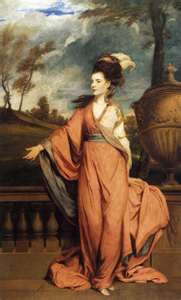
Jane Fleming, later Countess of Harrington
by Sir Joshua Reynolds


Charles, 3rd Earl of Harrington, born the same year as Charles, 3rd Earl Stanhope, had married Jane, daughter and heiress of Sir John Fleming, Bt., who proved no unworthy successor to her celebrated predecessor immortalised by George Selwyn for vivacity and abnormal conversational powers. The drawingroom of this later Lady Harrington was recognised as a great social centre where her friends could meet, if not actually without invitation, at least at a shortness of notice which marked the informality of the entertainment and lent to it a subtle charm. The hostess, whose energy was unbounded, would go out in the morning and pay about thirty calls, leaving at each house an invitation bidding her friends to assemble at Harrington House that same evening.
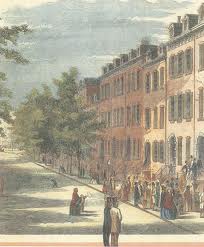
Bond Street

She would then walk up Bond Street at the hour at which the fashionable young men of the day were likely to be abroad, and would dart from one side of the road to the other as she spied a suitable object for her purpose. A circle of friends assembled thus three or four times a week, resulted in the formation of a recognised clique, the delightful informality of which was much appreciated by her young relations from Grosvenor Square, and the entrte into which was much envied by those who were admitted only to the larger and more stately parties reserved for the less favoured.


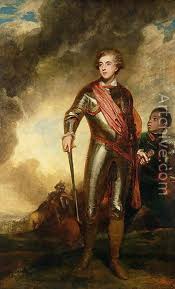
Charles Stanhope, Earl of Harrington
copyright 1st Art Gallery

Nor were Lady Harrington’s impromptu evening assemblies less celebrated than her perpetual teadrinkings at Harrington House. The superior quality of this expensive beverage in which the family of Stanhope indulged there, and the frequency with which Lady Harrington presented it to her visitors at all hours of the day, gave rise to the saying that where you saw a Stanhope, there you saw a tea-pot. A story current in town was that when her son, General Lincoln Stanhope, returned home after a prolonged absence in India, he found the family party precisely as he had left them many years before, seated in the long gallery sipping their favourite refreshment. On his entry, his father looked up from this absorbing occupation, and, with a restraint indicative of the highest breeding, gave voice to the characteristic greeting—” Hullo! Linky, my dear boy, you are just in time for a cup of tea!”


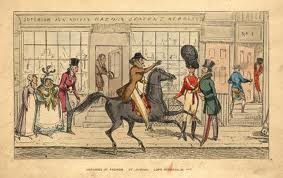
Votaries of Fashion. St. James’s
Lord Petersham, etc. (Charles Stanhope, 4th Earl of Harrington)
copyright National Portrait Gallery


Such a home was the very atmosphere in which to develop a fashionable man of the period; and the eldest son of the House, Charles, Lord Petersham, did not discredit his surroundings. Tall, handsome, and faultlessly clad, he was one of the most celebrated dandies of his day. Decidedly affected in his manners, he spoke with a slight lisp; and since he was said to recall the pictures of Henri IV., he endeavoured to accentuate this likeness by cultivating a pointed beard. He never went out till six in the evening, and one of his hobbies indoors was the strenuous manufacture of a particular sort of blacking which, he always maintained, once perfected, would surpass every other. His sitting-room emphasized his eccentricity. One side of it represented the family penchant, being covered with shelves upon which were placed canisters containing the most expensive and perfect kinds of tea. On the other, in beautiful jars, reposed an equally choice and varied assortment of snuffs. Lord Petersham’s snuff-boxes and his canes were alike celebrated; indeed, his collection of the former was said to be the finest in England, and he was reported to have a fresh box for every day in the year. Thus Gronow relates that once when a light Sevres box which he was using, was admired, Lord Petersham responded with a gentle lisp—” Yes, it is a nice summer box—but would certainly be inappropriate for winter wear!”


Interior of Harrington House
copyright 1st Art Gallery
Caricatures of the period represent the heir to the Earldom of Harrington clad in light trousers and a brown coat, seated upon a brown prancing horse. One of his whims, indeed, was to affect everything brown in hue—brown steeds, brown liveries, brown carriages, brown harness and brown attire. This was attributed to the fact of his having been in love with a fair widow of the name of Brown, whose charms he thus endeavoured to immortalise; but whatever the truth of this rumour, it is evident from the letter of Marianne Stanhope, that at the age of twenty-five he honoured with his devoted attention a lady whose personal attractions and unamiable disposition afforded a fund of entertainment to his relations living next door to her in Grosvenor Square. And this sidelight on the character of the dandy gives pause to criticism. How much, perhaps, of the eccentricity for which Lord Petersham was remarkable, like that of the celebrated Lady Hester Stanhope, may be attributed to the buffetings of a secret fate? Yet, this man who, with exceptional abilities and exceptional opportunity for exercising those abilities, could contentedly fill his empty days with the manufacture of blacking, or pass an entire night, as Gronow relates him to have done, playing battledore and shuttlecock for a wager with Ball Hughes, was, in much, a typical product of his generation. His mannerisms were accepted by his contemporaries with a forbearance which bordered on admiration, and, however childish his peculiarities, he remained unalterably popular.

The Hyde Park Pet Cemetery

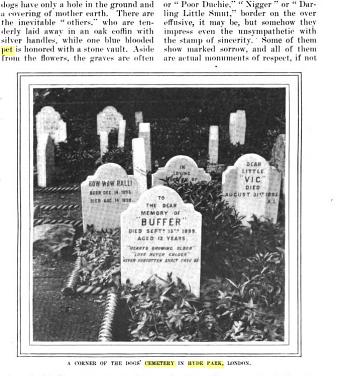
Founded in 1880 and now largely hidden behind thick undergrowth, Hyde Park’s pet cemetery is home to over 300 deceased pets, including dogs, cats, birds and even a monkey. Curious visitors can book an appointment to view it through the Hyde Park police. However, for a 19th century description of the cemetery we turn to The Puritan, Volume 9, (1901) which can be found at Google Books and which we quote below:

A CEMETERY FOR DOGS.
BY BERTHA DAMARIS KNOBE.
A CURIOUS LITTLE GRAVEYARD IN THE HEART OF LONDON, OFFERING QUAINT TESTIMONY OF MAN’S AFFECTION FOR HIS DOG.

This burial ground for dogs, oddly enough, is conspicuously placed in Hyde Park. One day, the keeper of the lodge at Victoria Gate—that is, the man who was keeper nineteen years ago—was tearfully importuned to dig a grave in his flower garden for a fox terrier belonging to an aristocratic resident. Thereupon it became the custom for dogs of high degree in that locality to have a first class funeral and interment. That the London officials have allowed it, centrally located as it is, to remain undisturbed is due, there is no doubt, to the fact that Queen Victoria has the dogs who serve as her faithful companions carefully buried in a sequestered spot at Windsor Castle.

This city of the canine dead is an attractive spot. It is the conventional cemetery in miniature, with more foliage, perhaps, which makes a pleasing setting to the glistening white tombstones. It is entirely inclosed with well trimmed bushes and young trees, so that the passer by in the street is prevented from peering through the park fence into the sacred precinct. Even the would be visitor must secure a permit from the brass buttoned keeper of the lodge.

Once inside, one sees narrow walks laid out with regularity, and on either side rows upon rows of little graves, each small lot being marked off with bars of brown earthernware. The graves are covered with sod or ivy, while on some flowers have been planted. In one corner is a tiny greenhouse, where the mourning master may purchase a floral emblem.

For a dog to repose peacefully in this resting place does not cost an excessive sum. There is a tinge of charity about it all. for if a poor washerwoman conies along, as one did not long ago, with a common cur rolled up in her apron and a big lump in her throat, the kind hearted keeper of the lodge buries her dog for nothing. If the owner is well to do, and the pampered pet has been fed on pate de foies gras all his life, a corresponding charge is made.

In this cemetery some of the deceased adorned with the most curious tokens. There are shells bleached to whiteness, glass cases in which are wreaths—these cheap gewgaws are so common in all European cemeteries—and on one is a string of New Zealand shells, which a man placed over the mortal remains of his dog to signify that as long as they last love shall endure. After the owner has decorated the grave, it is not uncommon for him to order a photograph of it.

As to the epitaphs, they are undoubtedly the oddest contributions to graveyard literature.  There are inscriptions in Egyptian and Italian, in poetry and prose, or. oftener still, some endearing term which was evidently in use before his dogship left for the happy hunting ground. One of the first epitaphs to attract the eye has a Biblical peroration. It reads: In loving memory of M. C. Trotter’s Jessie. Born 1893, died 1900. “Not one of them is forgotten before God.”- Luke xii, 6. Another reads: In fond memory of Gyp —” my Gippie “—who died February 1, 1899, aged seven years. He was a true little friend and companion, and will never be forgotten by his sorrowing mistress, M. B.

The owner of ” Hetty ” adds this to the usual dates of birth and death: And when at length my own life’s work is o’er I hope to find her watching as of yore. Eager, expectant, glad to meet me at the door.
One of the most popular inscriptions —it is found on at least three tombstones—is the quotation:
There are men both good and wise who say that dumb creatures we have cherished here below shall give us kindly greeting when we pass the Golden Gate. Is it folly if we hope it may be so?


Close by is “‘ Poor little Prince,” who was the pet of the Duchess of Cambridge, while “Pitkin” not only has an ” Au Revoir,” but the crest of the grand duke to whom he belonged. One woman went so far as to engrave on her dog’s stone: She brought the sunshine into our lives, but she took it away with her.


Aside from the inscriptions, which are nothing if not unique, are interesting little tales connected with some of these dogs. The most pretentious stone in the cemetery—the majority are simple —was erected by a rich voting woman who was devoted to her “Lily.” When this pet passed on, she purchased a good sized monument, the shaft of which is entwined with lilies. Around this grave are a stone coping and an iron railing, while a profusion of fresh flowers adorns the mound, the doting mistress being addicted to periodically slipping away from pink teas to leave a tear and a token over the remains of ” Lily.”

One mourning mistress adds “Faithful unto death” to “Spot Almond” and in a glass case which reposes on the grave are not only the conventional wax flowers, hut this message, written: In ever loving memory of our loving, faithful dog, Spot, for five years a faithful friend and companion of her devoted mistress, who will ever mourn her loss. Gone, but will never be forgotten.

Not one of the canary birds has a stone, but a parrot, known as the best talker in England and the winner of many pounds in prizes, has a small head piece. This post mortem care of pets, which is so oddly illustrated in the London cemetery, is a counterpart of the spirit that has ever induced fine companionship between man and the dog. When it comes to fidelity, the animal is so superior that a poet has put it: Oh, much enduring dogs to live With men! To you our praise we give.

Queen Victoria is not the only crowned head who has enjoyed these four footed friends “with soft brown eyes more eloquent than speech,” and after their demise ordered a respectable interment. ‘There are numerous other personages, crowned and uncrowned, who have recorded their comradeship in stone. History records that Frederick the Gre
at, King of Prussia, erected near his castle, “Sans Souci” at Potsdam, a monument to his favorite greyhound, Biche.

This care of the canine dead in London may seem overdone. But the sojourner in that metropolis is impressed with the consideration shown all living animals, from the horses hitched to the great lumbering `buses to the cats of the street. Humane societies for animals abound, and one finds everything from a horse hospital to a home for stray cats. The workingman who walked many mile at night, carrying his dog, to beseech the keeper of the dog cemetery to give it a ” Christian burial,” serves as a sample of the animal loving type in England. It is doubtless owing to this universal spirit of kindness for dumb creatures that the burial ground for dogs has flourished in the center of one of London’s most fashionable thoroughfares.

Do You Know About All Creatures Great and Small?

I’ve been spending time lately watching the All Creatures Great and Small Complete Series Collection that I recently purchased (28 disks worth) and am enjoying them all immensely. Again. The characters, from Seigfried and James to Tristan, Helen and Mrs Pumphrey and her Pekinese, Tricki Woo,  are all a delight to revisit and to pass time with. The Yorkshire farmers the vets encounter during the course of their practice are real characters, at times funny, at others infuriating, but always entertaining.

James Herriot

The television series was based on the books by British veterinarian Alf Wight, who wrote under the pseudonym of James Herriot and is set in the fictional Yorkshire town of Darrowby, where the vets practice at Skeldale House surgery.

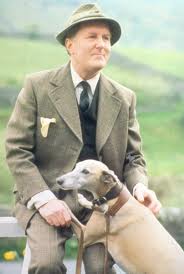
At the head of the practice is Siegfried Farnon, played by Robert Hardy (Sense and Sensibility) whose contrary nature and huge heart both often cause consternation for all concerned. Working alongside him is the younger James Herriot, who moves from Scotland to Yorkshire in order to join the practice.
Siegfried’s younger brotherTristan muddles his way through veterinary school and eventually graduates, working sometimes at the practice, at other times for the Department of Agriculture. What Tristan is always most serious about are girls and beer. He is generally acknowledged as being the best customer at the local pub, the Drover’s Inn. “I wouldn’t treat a mad dog the way he treats his liver,” mutters Siegfried. Never taking life too seriously, Tristan also has the habit of answering the practice telephone in a Chinese accent. Occasionally, those phone calls will necessitate his actually having to trudge out, often at night, in order to do vet-like things, which always elicits a grumble – i.e. “I know all about that ruddy pig; it’s a killer! It’s also pitch dark. What am I supposed to do, hold a torch in one hand and a lancet in the other while it disembowels me?”
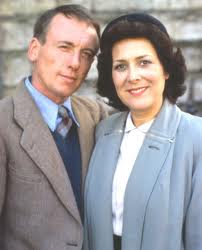
James is the steady partner, the one who takes on morning surgeries in place of a hungover Tristan, the man who can be relied upon for good judgment and a mature attitude. Unless, he’s anywhere near Granville Bennett, a nearby veterinary surgeon with whom they occasionally work. Granville has a wooden leg when it comes to liquor and, more disastrously, the power to persuade James into drinking more than his fill, despite James’s good intentions. Helen, James’s patient and long suffering wife, is always on hand to offer sustenance, as well as a few well deserved barbed comments.
All Creatures Great and Small is filled with gentle humour, appealing characters, the Yorkshire dales and some of the best photography of it’s time – people were astounded at how realistic the scenes involving veterinary treatments and live animal births were made to seem.

This past December, BBC announced that it will begin production on Young James, a  prequel drama inspired by the true story of how the world’s most famous vet, “James Herriot” came to learn his trade in Scotland. Drawing on an amazing archive and exclusive access to the diaries and case notes Herriot kept during his student days in Glasgow, as well as the biography written by his son.
Cast of the original, television series

James Herriot — Christopher Timothy

Siegfried Farnon — Robert Hardy

Tristan Farnon — Peter Davison (series 1-5, 7)

Helen Herriot — Carol Drinkwater (series 1-3 and specials)

and Lynda Bellingham (series 4-7)

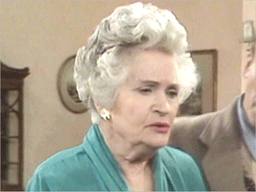
Mrs Pumphrey — Margaretta Scott (recurring)

Visit The World of James Herriot Museum website here.

In The Garden at Eyford House

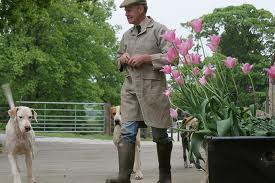
On Sunday, May 22nd, Eyford House in Upper Slaughter, Glouscestershire will play host to a giant plant sale featuring 25,000 plants on sale, local produce, a country-shopping village, sculpture garden, Light Cavalry Military Band and three garden experts – Val Bourne, Mary Keane and Roddy Llewellyn – will be on hand to answer gardening questions and offer advice. The event will benefit the ABF The Soldiers’ Charity and the Countryside Alliance at Eyford.
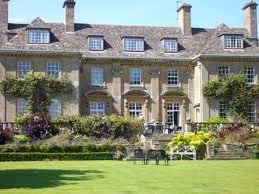
The property, a classical Cotswolds home in idyllic grounds is where legend has it, poet John Milton was inspired to write Paradise Lost and takes the crown as England’s Favourite House, according to Country Life magazine.
Charlotte Heber Percy, whose family lives at Eyford House, commented: “We are so lucky to live in this heavenly setting and love to share it with the public. The plant sale is something we are all passionate about: everyone on the committee supports country sports and the rural way of life, and we also support our brave armed forces, so this plant sale is the ideal way for us to boost both causes while providing a fun day out.”

Novelist Jilly Cooper will officially open the plant sale with a ribbon cutting and eight local hunts ( the Cotswold, North Cotswold, Heythrop, Old Berks, Beaufort, Warwickshire, Berkeley and VWH hunts) have joined together to tend 25,000 plants to sell on the day. The event will make the most of what Country Life magazine has called the “pastoral idyll” of Eyford’s parklands. The plant sale will include a shopping village with a range of gardeners’ accessories as well as outdoor clothing and gifts for the countryside enthusiast and there will be live chickens and ducks.
 
Jilly Cooper, who lives locally, will be signing the paperback edition of her latest blockbuster, Jump! Another local author, Duff Hart-Davis, the distinguished biographer, naturalist and journalist, will be signing copies of his latest two books, Among the Deer: In the Woods and On the Hill: A Stalker Looks Back and The War That Never Was: The True Story of the Men who Fought Britain’s Most Secret Battle.
Mrs Prest (Mrs. Heber Percy’s daughter), who lives at Eyford with husband Rupert and three children, said: “I am absolutely thrilled. “I always adored the house and I loved to come and stay here with my grandmother when I was a child. Each day, I pinch myself at how lucky I am to live in such a beautiful, peaceful house.”

THE PLANT SALE WILL BE HELD BETWEEN 10AM AND 4PM. TICKETS £5, YOUNG CHILDREN WILL BE ADMITTED FREE OF CHARGE.