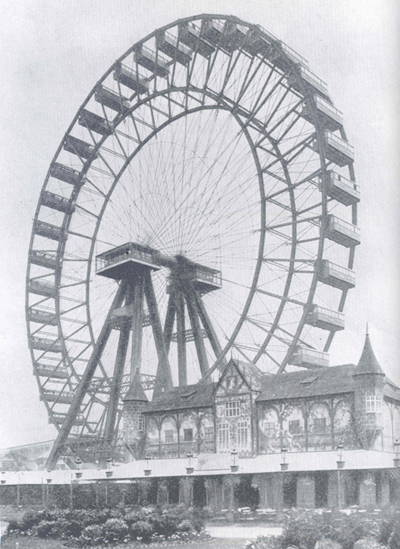
The Earl's Court Wheel

From Discoveries and Inventions of the 19th Century (1898) by Robert Routledge

” . . . . . . amid the attractions of an International Exhibition, it was not lost upon the enterprising people of the States when the ” World’s Fair” at Chicago was in preparation in 1893. It was then that Mr. G. W. G. Ferris, the head of a firm of bridge constructors at Pittsburg, conceived the idea of applying his engineering skill to the erection of a huge wheel, revolving in a vertical plane, with cars for persons to sit in, constituting, in fact, an enormous “merry-go-round,” as the machine once so common at country fairs was called. The novelty of the Chicago erection was, therefore, not the general idea, but the magnitude of the scale, which, for that reason, involved the application of the highest engineering skill, and the solution of hitherto unattempted practical problems. Several thousand pounds were, in fact, expended on merely preliminary plans and designs. The great wheel at Chicago was 350 feet in diameter, and to its periphery were hung thirty-six carriages, each seating forty persons. At each revolution, therefore, 1,440 people would be raised in the air to the height of 250 feet, and from that elevation afforded a splendid prospect, besides an experience of the peculiar sensation like that of being in a balloon, when the spectator has no perception of his own motion, but the objects beneath appear to have the contrary movement, that is to say, they seem to be sinking when he is rising, and viceversd.

“This curious structure was not begun until March, 1893, yet it was set in motion three months afterwards, having cost about £62,500. The Company had to hand over to the Exhibition one half of the receipts after the big wheel had paid for its construction, but even then they realised a handsome profit, and at the close of the World’s Fair, they sold the machine for four-thirds of its cost, in order that it might be re-erected at Coney Island.

“No sooner had the great Ferris wheel at Chicago proved a financial success than an American gentleman, Lieutenant Graydon, secured a patent for a like machine in the Un1ted Kingdom; and as it has now become almost a matter of course that some iron or steel structure, surpassing everything before attempted, should form a part of each great exhibition, a Company was at once formed in London, under the title of “The Gigantic Wheel and Recreation Towers Co., Limited,” to construct and work at the Earl’s Court Oriental Exhibition of 1895, a great wheel, similar in general form to that of Chicago. But the design of the London wheel had some new features . . . and, moreover, having been planned of larger dimensions than its American prototype, presented additional engineering problems of no small complexity. After due deliberation the scheme of the work was entrusted to Mr. Walter B. Bassett, a talented young engineer, connected with the firm of Messrs. Maudslay, Sons, & Field, and already experienced in designing iron structures. Under this gentleman, with the assistance of Mr. J. J. Webster in carrying out some of the details, the work has been so successfully accomplished that the ” Great Wheel”- of 1895 may be cited as one of the crowning mechanical triumphs of the nineteenth century. . . .
“The wheel at Earl’s Court exceeds the Ferris wheel in diameter by 50 feet, being 300 feet across. It is supported on two towers, 175 feet high, each formed by four columns 4 feet square, built of steel plates with internal diaphragms, and surmounted by balconies that may be ascended in elevators raised by a weight of water, which, after having been discharged into a reservoir under the ground level, is again pumped up to the top of the towers. Between the balconies on each tower there is also a communication through the axle of the wheel, which, instead of being solid as at Chicago, is a tube of 7 feet diameter, and 35 feet long, made in sections, riveted together, of steel 1 inch thick, and weighing no less than 58 tons.”
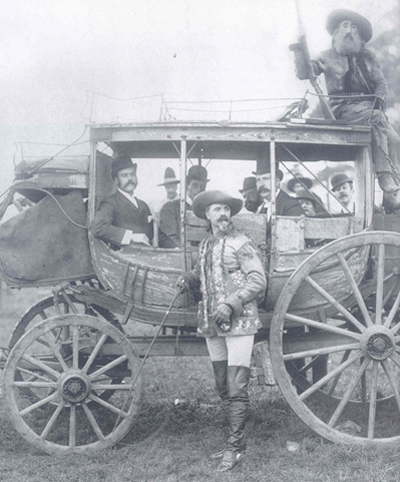
You can read much more about the history of Earl’s Court as an entertainment venue here. Other rides included a Water Chute and showman who appeared at the grounds included none other than Buffalo Bill, show below at Earl’s Court.
Sedan Chairs

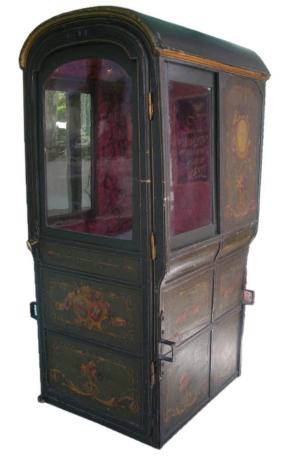
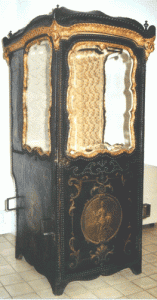
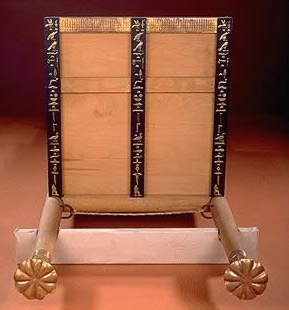
Sedan chairs, also called litters, are enclosed seats carried on poles that have been used for centuries, or at least as early as the Eyptian Empire. Sedan chairs were introduced to Britain from Spain – before leaving Madrid in 1623 to return to England, the Prince of Wales, later Charles I, was given a gift by the Prime Minister that included “three sedan chairs of curious workmanship.” He later gave two of these chairs to the Duke of Buckingham, who used them in the streets of London and prompted outrage for “reducing free born Englishmen to the condition of beasts of burden.”

Benjamin Franklin in his sedan chair
Sedan chair made for Queen Maria Luisa of Parma circa 1795

A late 18th century French sedan chair – click here to see the inside

By 1726 there were 400 sedan chairs registered in London. They were used in Edinburgh until the 1860’s.

Above is a modern day Chinese sedan chair, traditionally used to carry a bride to her wedding. There is also a foundation in Hong Kong that raises money through their Sedan Chair Charities Fund and annual sedan chair races. Come to that, there are even sedan chair races still going on in England.

You can see examples of sedan chairs in museums throughout Great Britain:


From the Ulster Folk and Transport Museum

From the Museum of Leathercraft

From the Victoria and Albert Museum

And coming full circle, the sedan chair of Queen Hetepheres from the Egyptian Museum, Cairo 

Best Exotic Marigold Hotel

Best Exotic Marigold Hotel, the movie, opens in the UK and Ireland 24 February. Those in the States will have to wait until summer to see the film, although the novel will be available in stores in March.

The movie, directed by John Madden, sees a group of retirement age Brits move to India to see out their elderly years in colorful Jaipur and take up residence in what they believe is a newly restored hotel. Less luxurious than its advertisements, the Marigold Hotel nevertheless slowly begins to charm in unexpected ways. Dev Patel, of “Slumdog Millionaire” fame, plays the guy who entices them to take the adventure and the film also features Dame Judi Dench, Dame Maggie Smith, Penelope Wilton and Bill Nighy.

Deborah Moggach is the author of sixteen successful novels, including the bestselling Tulip Fever, and two collections of stories. The book on which this film is based was originally titled These Foolish Things. Her screenplays include Pride and Prejudice, which was nominated for a BAFTA. She lives in North London.

You can watch the movie trailer here.

New London Hotels

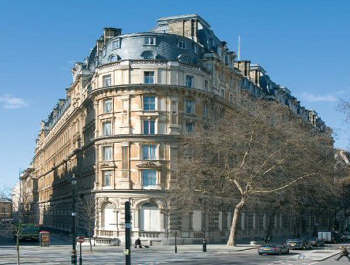
It’s always fun to hear about new hotels in our favourite city and today we bring you word of three new properties. The Corinthia London (above) recently opened its doors in Whithall Place within the former home of the Hotel Metropole, which itself opened for the first time in 1885. Currently, the hotel assures guests that it will offer “uncompromising standards of luxury within a 21st century grand hotel.” The hotel will have 294 lavishly decorated rooms, a restored Victorian ballroom,  two restaurants, and the Bassoon Bar. There is also an expansive ESPA Life spa on property. Rooms average about $500.00 a night, but a drink in the bar and a fabulous massage will be much less expensive.

Located in Mayfair, The Dorchester Collection’s ninth hotel, 45 Park Lane, boasts interiors by New York designer Thierry Despont, as well as Wolfgang Puck’s American style steak restaurant, CUT. The hotel strives to cater to the well being of their guests and offers bicycles, yoga mats, a fitness center and a Bath Menu, where guests can select from a range of aromatherapy oils, candles and herbal teas. 45 Park Lane will also house a collection of constantly evolving contemporary art and an in-house cinema. 

Looking forward to Fall of 2012, The Wellesley townhouse hotel in Knightsbridge (above) is laying claim to being London’s first ‘6-star’ property. Located just off Hyde Park next to the Lanesborough,  the 36-bedroom townhouse hotel is currently undergoing a £36 million pound renovation. The six-floor hotel will include London’s largest hotel suite with four bedrooms, a private lift, views over Hyde Park and The Cigar Terraces, which will boast the UK’s largest bespoke humidor. The MD of developer Arab Investments, Khalid Affara says: “This will be to a better standard than all the 5 star hotels in London. It will be like the first-class compartment of a plane.”

The Wellington Connection: The Koh-i-noor Diamond

The Koh-I-Noor diamond on view at the Great Exhibition

From Harper’s Magazine, Volume 32

The great diamonds of the world are as famous as the great mountains or rivers. Who has not read of the Koh-i-noor, the “Mountain of Light,” which has been stolen from sovereign by sovereign for near a thousand years, its last proprietor—by title, at least, semi-felonious—being her Gracious Majesty Queen Victoria? Every body knows that the Koh-inoor first belonged to the god Krischnu. From him—poor, helpless god!—it was stolen by a wild Delhi chief, who wore it in his hat; from him by Ala-ed-Din ; from him, in 1526,-by Baber of the Moguls. To Aurnnzebe it occurred that the Koh-i-noor, like other diamonds, would be the better for some polishing and cutting. Unhappily, the diamond-cutter who received it in charge was unskillful. From 793 carats the blockhead cut it down to 186. Aurunzebe was for cutting him down on the same scale, beginning with his head; and really, in the interest of art, one can not but deplore the fellow’s escape. It should have weighed at least 400 carats, and been worth  $500,000,000. As it is, it would not fetch more than the value of a couple of stout cities. A mere pebble. Nadir Shah stole it when his turn came; from his descendants it was wrenched by Achmet Shah; from his son it was extorted by Runjeet Singh ; and from his people it was ” conveyed” by British troops, who loyally presented it to their Queen, who showed it to her people at the Great Exhibition of 1851. Her Majesty was not satisfied with its brilliancy, and had it cut again, this time by the great diamond-cutter, Costar, of Amsterdam, who reduced it to 106 carats.
The cutting marked an epoch. Costar and his men came over from Amsterdam for the purpose, and were installed at the Queen’s jeweler’s work-shop. A steam-engine was erected to do the work, and it was the Duke of Wellington himself who set the machinery in motion, and made the first cut. All England, through representatives in the press, was a breathless spectator of the thrilling scene. A single slip of the cutter’s hand might have done a mischief not to be measured save by hundreds of thousands of pounds. A moment’s inattention might have cost a million. Happily the operators’ nerves were steady, and their thoughts concentrated on their work, so that no accident occurred. Long and loud were the controversies, to which the cutting gave rise—one party claiming that these Dutch Jews were ruining the finest jewel in England, others maintaining that without a new cutting the Koh-i-noor was comparatively valueless.
Whichever was right, Costar carried his point, and connoisseurs and the trade are now generally agreed that the cutting was beneficial. It is now a perfect brilliant, with duly proportioned table, facets, and culet. Its previous shape . . . was irregular—neither rose nor brilliant.

The stone was soon after mounted in a brooch which Queen Victoria often wore and, after her death, it was set in Queen Alexandra’s crown. It was afterwards used in the crown of Queen Mary and, today, appears in the crown of Queen Elizabeth II, as seen above.